
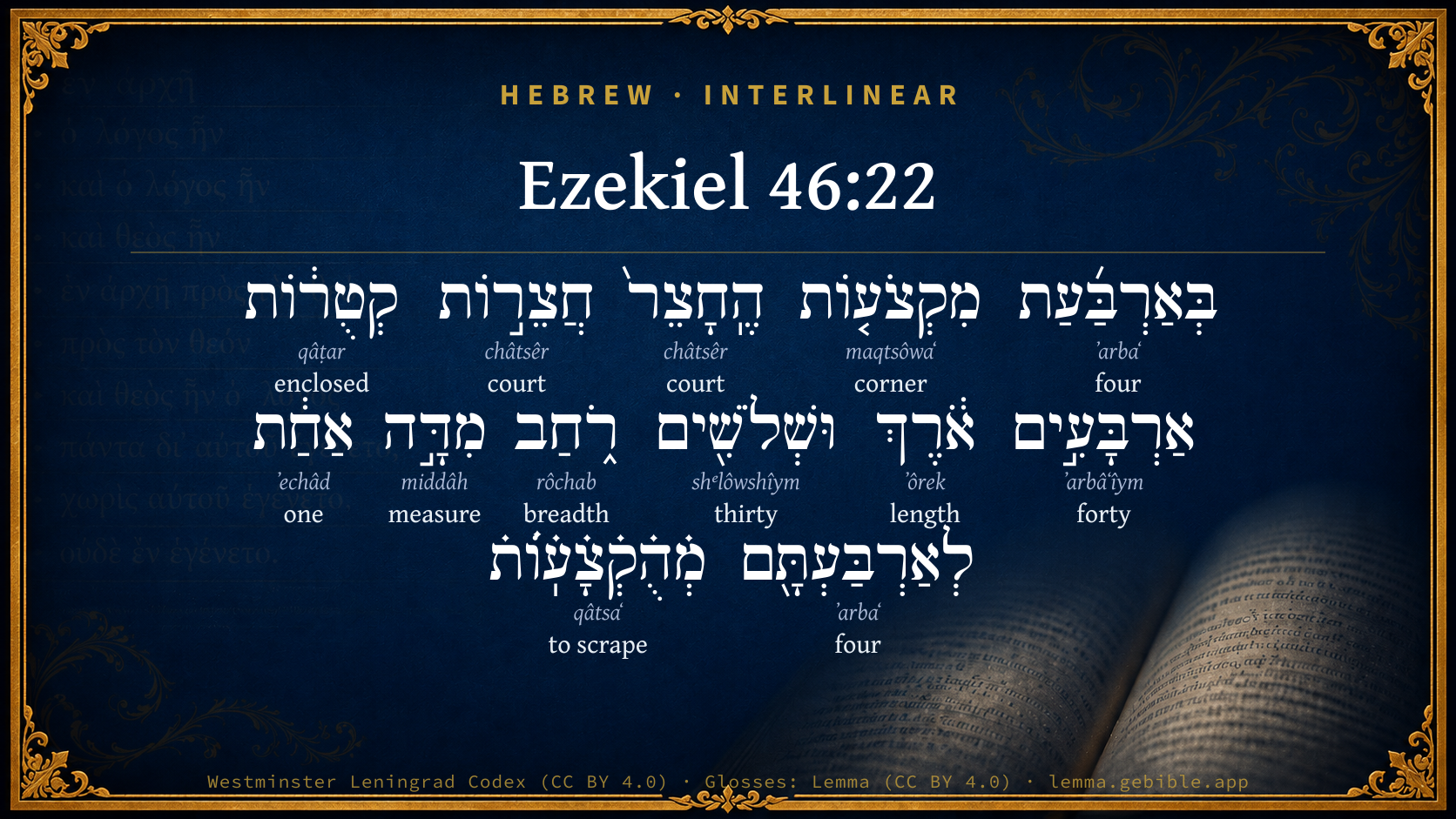
Ezekiel 46:22

Hebrew (Westminster Leningrad Codex) Ezekiel 46:22 appears in the Hebrew Old Testament. The text above is from the Westminster Leningrad Codex. Each word links to its Strong’s number, a concise gloss, and parsing drawn from the Open Scriptures Hebrew Bible morphology. Click any word for its full Brown-Driver-Briggs (BDB) entry.
Download image
Cite this verse

Ezekiel 46:22 (World English Bible). Public Domain. Lemma interlinear Bible study tool, https://lemma.gebible.app/v/ezekiel/46/22.

Show BibTeX & RIS
BibTeX
RIS
English Translation
In the four corners of the court there were courts enclosed, forty [cubits] long and thirty broad: these four in the corners were of one measure.
World English Bible · Public Domain
Highlights Full analysis ↓
Download a study sheet

One document with this verse’s original text, its word-by-word gloss line, the meaning frame, cross-references with their text, attributed commentary, and full source and license credits — printable, and it pastes into notes with its structure intact.

This verse Autodidact and up

Study sheet (.html) Plain text (.txt)

A passage Seminary Student

Up to 50 verses in one chapter. A passage sheet keeps up to 6 commentary sources and 12 cross-references per verse, in the order this page ranks them, and says so on the sheet whenever that leaves anything out. Ask for a single verse and you get the Autodidact verse sheet above.

Everything on this page stays free to read, with no account — the sheet is a download of what is already on screen, not access to it.

Want to remove ads? Support Godless Engineer
Compare translations 3

The same verse in 3 English versions, stacked beneath the original-language interlinear above. Click any original word for its lexicon entry.

Each is an independent rendering of the whole verse — the interlinear is not word-aligned to these translations.

Highlighted words mark where these versions differ — a whole-verse word diff, not a word-by-word alignment.

  • World English Bible Public Domain
    In the four corners of the court there were courts enclosed, forty [cubits] long and thirty broad: these four in the corners were of one measure.
  • King James Version Public Domain
    In the four corners of the court there were courts joined of forty cubits long and thirty broad: these four corners were of one measure.
  • unfoldingWord Literal Text CC BY-SA 4.0
    In the four corners of the outer courtyard there were four small courtyards, forty cubits in length and thirty in width. There were the same dimensions for all four of the courtyards.

unfoldingWord Literal Text — © unfoldingWord, licensed CC BY-SA 4.0. Word-aligned USFM3 via Door43 (git.door43.org/unfoldingWord/en_ult).

Versions to compare (up to 4)

3 of 4 selected

Show all 18 translations

Every available English version of this verse, each an independent rendering of the whole verse.

  • World English Bible Public Domain
    In the four corners of the court there were courts enclosed, forty [cubits] long and thirty broad: these four in the corners were of one measure.
  • Berean Standard Bible Public Domain
    In the four corners of the outer court there were enclosed courts, each forty cubits long and thirty cubits wide. Each of the four corner areas had the same dimensions.
  • Majority Standard Bible Public Domain
    In the four corners of the outer court there were enclosed courts, each forty cubits long and thirty cubits wide. Each of the four corner areas had the same dimensions.
  • King James Version Public Domain
    In the four corners of the court there were courts joined of forty cubits long and thirty broad: these four corners were of one measure.
  • American Standard Version (1901) Public Domain
    In the four corners of the court there were courts inclosed, forty `cubits' long and thirty broad: these four in the corners were of one measure.
  • Revised Version (1885) Public Domain
    In the four corners of the court there were courts enclosed, forty cubits long and thirty broad: these four in the corners were of one measure.
  • Geneva Bible (1599) Public Domain
    In the foure corners of the court there were courts ioyned of fourty cubits long, and thirty broad: these foure corners were of one measure.
  • Douay-Rheims (1899) Public Domain
    In the four corners of the court were little courts disposed, forty cubits long, and thirty broad, all the four were of one measure.
  • Young's Literal Translation Public Domain
    In the four corners of the court `are' perfume courts, forty long, and thirty broad, one measure `is' to the four corners.
  • Literal Standard Version CC BY-SA 4.0
    In the four corners of the court [are] enclosed courts, forty long and thirty broad, [with] one measure for the four corners.
  • Unlocked Literal Bible CC BY-SA 4.0
    In the four corners of the outer courtyard there were four small courtyards, forty cubits in length and thirty in width. There the same dimensions for all four of the courtyards.
  • unfoldingWord Literal Text CC BY-SA 4.0
    In the four corners of the outer courtyard there were four small courtyards, forty cubits in length and thirty in width. There were the same dimensions for all four of the courtyards.
  • Darby Bible Public Domain
    In the four corners of the court there were enclosed courts, forty [cubits] long and thirty broad: these four corner courts were of one measure.
  • World Messianic Bible Public Domain
    In the four corners of the court there were courts enclosed, forty cubits long and thirty wide. These four in the corners were the same size.
  • Webster's Bible Public Domain
    In the four corners of the court there were courts joined of forty cubits long and thirty broad: these four corners were of one measure.
  • Free Bible Version CC BY-SA 4.0
    There were separate walled courtyards in the four corners of the outer courtyard. They each measured forty cubits by thirty cubits—they were all the same size.
  • Bible in Basic English Public Domain
    In the four angles there were spaces walled in, forty cubits long and thirty wide; the four were of the same size.
  • JPS Tanakh (1917) Public Domain
    In the four corners of the court there were courts inclosed, forty cubits long and thirty broad; these four in the corners were of one measure.

Literal Standard Version (2020), Covenant Press — licensed CC BY-SA 4.0. Text via the HelloAO Bible API (eBible.org). Unlocked Literal Bible (unfoldingWord) — licensed CC BY-SA 4.0. Text via the HelloAO Bible API (eBible.org). unfoldingWord Literal Text — © unfoldingWord, licensed CC BY-SA 4.0. Word-aligned USFM3 via Door43 (git.door43.org/unfoldingWord/en_ult). Free Bible Version, Dr. Jonathan Gallagher — licensed CC BY-SA 4.0. Text via the HelloAO Bible API (eBible.org).

Word by word

More ways to search: Search by grammar → Find every occurrence → Compare this word →

Practice this passage: Drill this verse → Learn its vocabulary →

קְטֻר֔וֹת
qâṭar
H7000
“enclosed”
Noun, Common, Feminine, Plural, Absolute
Part of Speech
Noun
Type
Common
Gender
Feminine
Number
Plural
State
Absolute
Full BDB Definition

Origin: a primitive root

TWOT: 2012

(Qal) to shut in, enclose, join - meaning dubious
  1. בְּאַרְבַּ֜עַת ʼarbaʻ H702 “in/at · four” Preposition + Adjective, Cardinal number, Masculine, Singular, Construct
  2. מִקְצֹע֤וֹת maqtsôwaʻ H4740 “corners of” Noun, Common, Masculine, Plural, Construct
  3. הֶֽחָצֵר֙ châtsêr H2691 “the · court” Particle, Definite Article + Noun, Common, Both, Singular, Absolute
  4. חֲצֵר֣וֹת châtsêr H2691 “courts” Noun, Common, Both, Plural, Absolute
  5. אַרְבָּעִ֣ים ʼarbâʻîym H705 “forty” Adjective, Cardinal number, Both, Plural, Absolute
  6. אֹ֔רֶךְ ʼôrek H753 “length” Noun, Common, Masculine, Singular, Absolute
  7. וּשְׁלֹשִׁ֖ים shᵉlôwshîym H7970 “and · thirty” Conjunction + Adjective, Cardinal number, Both, Plural, Absolute
  8. רֹ֑חַב rôchab H7341 “breadth” Noun, Common, Masculine, Singular, Absolute
  9. מִדָּ֣ה middâh H4060 “measure” Noun, Common, Feminine, Singular, Absolute
  10. אַחַ֔ת ʼechâd H259 “one” Adjective, Cardinal number, Feminine, Singular, Absolute
  11. לְאַרְבַּעְתָּ֖ם ʼarbaʻ H702 “to/for · four · their” Preposition + Adjective, Cardinal number, Masculine, Singular, Construct + Suffix, Personal, 3rd Person, Masculine, Plural
  12. מְׄהֻׄקְׄצָׄעֽׄוֹׄתׄ qâtsaʻ H7106 “scraped” Verb, Hophal, Participle Passive, Feminine, Plural, Absolute

About this verse

These counts appear in no published source. They are computed here, from the morphology-tagged text and Lemma’s own curated glosses. What Lemma adds →

13
words
11
distinct lemmas
Prophets
section

Notable vocabulary

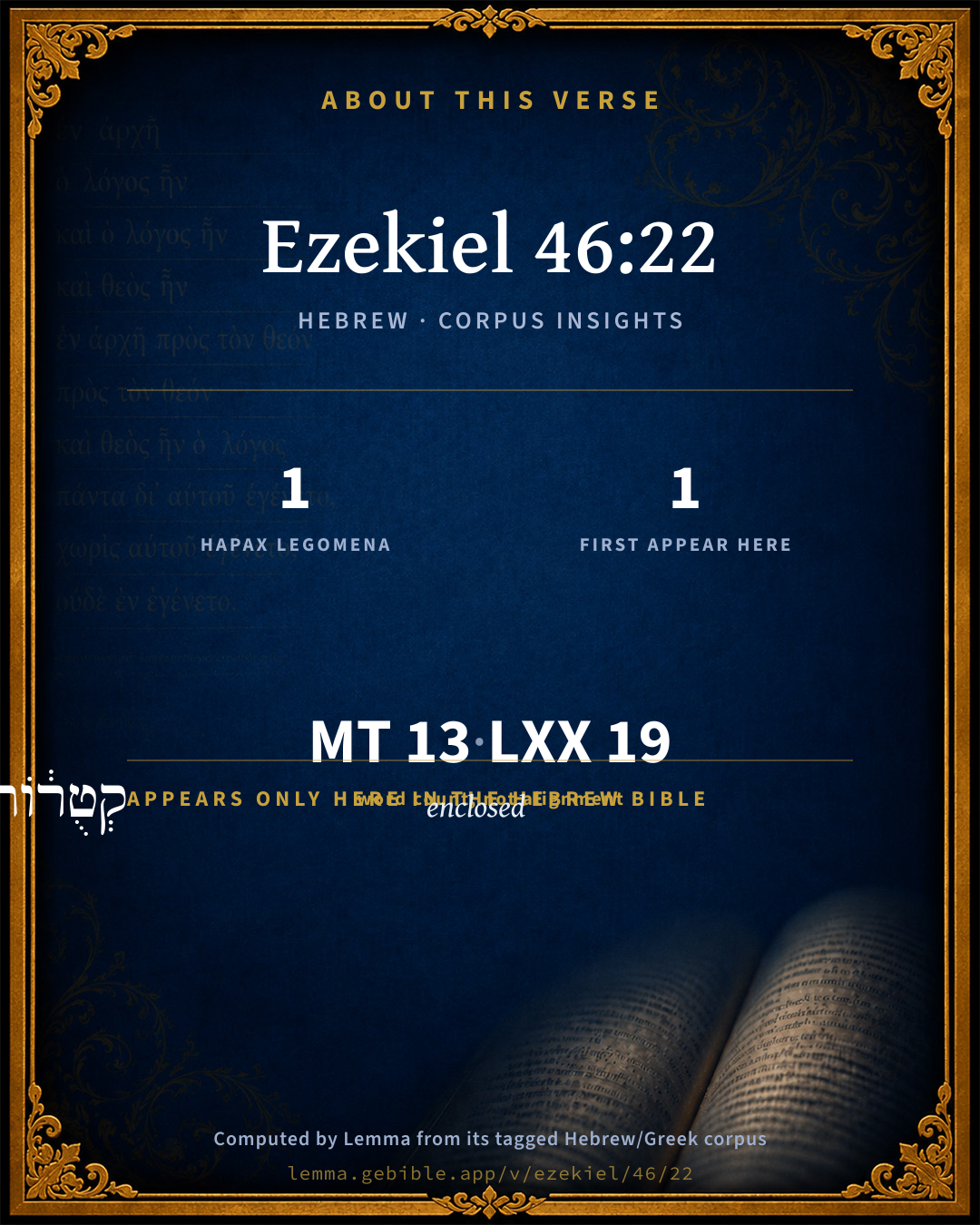
1 hapax legomenon — a word that appears only here in the entire Hebrew Bible:

  • קְטֻר֔וֹת enclosed H7000

First appearance in Scripture

This word makes its first canonical appearance in the Hebrew Bible here:

  • קְטֻר֔וֹת enclosed H7000

Shared distinctive vocabulary

מְׄהֻׄקְׄצָׄעֽׄוֹׄתׄ to scrape H7106 occurs in 2 verses of the Hebrew Bible. Also found in:

Grammatical profile

  • 1 verb
  • 7 nouns
  • 5 adjectives

Verb forms

  • מְׄהֻׄקְׄצָׄעֽׄוֹׄתׄ Hophal · Participle Passive

Repetition

Words recur within this verse — often emphatic in Hebrew:

  • בְּאַרְבַּ֜עַת four H702 ×2
  • הֶֽחָצֵר֙ court H2691 ×2

Hebrew & Septuagint length

In English translation the verse runs 26 words from the Hebrew and 38 from the Septuagint (LXX English) — the Septuagint runs noticeably longer here. See the side-by-side →

A rough comparison of the two English renderings, which tokenize alike — not a word-level alignment.

Word counts can differ between the Hebrew and the Greek without any difference in meaning — e.g. the Hebrew direct-object marker אֵת has no separate Greek word, and Greek often adds the article ὁ.

In the original languages it is 13 Hebrew tokens and 19 Greek tokens — but the two are counted differently (Hebrew bundles its prefixes and suffixes into one token; the Greek is in lemma form), so that isn’t a like-for-like length.

Hebrew and Greek witnesses Masoretic Hebrew ↔ Greek Septuagint

The same verse in the two great witnesses to the Old Testament, shown verse-for-verse.

Here the Septuagint runs noticeably longer than the Hebrew — LXX2012 (modern English Septuagint) 38 words vs World English Bible 26. A rough length comparison of the two English translations, not a word-level alignment — read both below.

These are two independent witnesses, not word-aligned to each other, and the Septuagint is shown in lemma (dictionary) form.

Hebrew Ezekiel 46:22 Masoretic · Westminster Leningrad Codex

בְּאַרְבַּ֜עַת מִקְצֹע֤וֹת הֶֽחָצֵר֙ חֲצֵר֣וֹת קְטֻר֔וֹת אַרְבָּעִ֣ים אֹ֔רֶךְ וּשְׁלֹשִׁ֖ים רֹ֑חַב מִדָּ֣ה אַחַ֔ת לְאַרְבַּעְתָּ֖ם מְׄהֻׄקְׄצָׄעֽׄוֹׄתׄ

In the four corners of the court there were courts enclosed, forty [cubits] long and thirty broad: these four in the corners were of one measure.

World English Bible · Public Domain

Greek LXX Ezekiel 46:22 Septuagint · lemma form

ἐπί ὁ τέσσαρες κλίτος ὁ αὐλή αὐλή μικρός μῆκος πηχύς τεσσαράκοντα καί εὖρος πηχύς τριάκοντα μέτρον εἷς ὁ τέσσαρες

on every side a court, even a court for all the four sides, and each little court belonging to the court was in length forty cubits, and in breadth thirty cubits, there was one measure to the four.

LXX2012 (modern English Septuagint) · Public Domain

On this verse, The Cambridge Bible for Schools and Colleges discusses the Septuagint’s reading. Read the note in Commentary ↓

Hebrew: Westminster Leningrad Codex (CC BY 4.0). Greek: Septuagint (public domain); English from LXX2012 (modern English Septuagint) (Public Domain). How the Septuagint differs from the Hebrew →

Targum (Aramaic paraphrase)

1

The Targum is the ancient Jewish Aramaic paraphrase of the Hebrew Scriptures — an interpretive translation, not the Hebrew text itself. Onkelos (literal) and Pseudo-Jonathan (expansive) render the Torah, and Jonathan the Prophets. Coverage is partial: where no permissively-licensed English translation exists for a verse, only the Aramaic is shown. This is verse-level text, not a word-by-word alignment to the Hebrew.

  1. Targum Jonathan Prophets (Joshua–Malachi)
    בְּאַרְבְּעָא זִוְיַת דַרְתָּא דָרָתָא מְקַטְרָן אַרְבְּעִין אוּרְכָּא וּתְלָתִין פּוּתְיָא מְשַׁחְתָּא חֲדָא לְאַרְבַּעְתְּהוֹן דְדַרְתָּא:

    (no public-domain English translation for this verse)

    Targum Jonathan — Aramaic: “Mikraot Gedolot” (public domain). English: “Sefaria Community Translation” (CC0 1.0 (public-domain dedication)); “London "Chaldee Paraphrase," 1871” (public domain). Text via Sefaria.

Commentary

Notes on Ezekiel 46:22 from classic Christian and Jewish commentators (each source and its license shown beneath its notes). The classic Christian expositions comment on the surrounding passage and are grouped to its opening verse, so a note may address several verses; the Jewish commentaries on the Tanakh (Rashi and others) are per-verse, so they appear only where the commentator wrote on this verse.

Lemma curates 59 commentaries, every one of them public domain or Creative Commons licensed, each selected and text-cleaned for this edition rather than reprinted as found. About our sources →

Trapp's Complete Commentary

John Trapp

Eze 46:22 In the four corners of the court [there were] courts joined of forty [cubits] long and thirty broad: these four corners [were] of one measure.

Ver. 22. Courts joined.] Or made with chimneys. Caminata, vaporaria. See on Eze 46:21.

John Trapp, A Commentary or Exposition upon All the Books of the Old and New Testament (1647–1656) — public domain. Text from a community e-Sword module.

Jamieson, Fausset & Brown

Robert Jamieson, A. R. Fausset & David Brown

courts joined--FAIRBAIRN translates, "roofed" or "vaulted." But these cooking apartments seem to have been uncovered, to let the smoke and smell of the meat the more easily pass away. They were "joined" or "attached" to the walls of the courts at the corners of the latter [MENOCHIUS].

Jamieson, Fausset & Brown — Commentary Critical and Explanatory on the Whole Bible (1871) — public domain (CC PDM 1.0). Text via the HelloAO Bible API.

The Cambridge Bible for Schools and Colleges

gen. ed. J. J. S. Perowne

22. courts joined] The term “joined” is obscure, not occurring elsewhere. Possibly: enclosed courts. LXX. appears to have read: small (the words differ in one letter).

these four corners] lit. the four of them had one measure, they being in the corners. The word in the corners, or, cornered, is deleted in the Heb. tradition by points over it, and not rendered in LXX. and Vulg.

The Cambridge Bible for Schools and Colleges (gen. ed. J. J. S. Perowne; Cambridge University Press, 1878–1918) — public domain. Text from a community e-Sword module.

John Gill's Exposition

And there was a row of building round about in them,.... Within the courts, not on the outside of them: these were either chambers to eat the sacrifices in when boiled; or they were sheds which covered the cooks, and the meat they were boiling, from the rain, &c.: the Targum renders it,

"and walls were made to them round about;''

to the court: and so Jarchi and Kimchi interpret this row of building of a stone wall:

round about them four; the four courts at the four corners:

and it was made with boiling places under the rows round about; under these rows of building, chambers or sheds; or under these stone walls were furnaces, and coppers, and caldrons, set on them, for the boiling of the sacrifices.

John Gill's Exposition of the Whole Bible (1746–1763) — public domain (CC PDM 1.0). Text via the HelloAO Bible API.

Haydock's Catholic Bible Commentary

Little. Hebrew, "courts joined;" (Protestants) or marginal note, "made with chimneys," (Haydock) or "smoked," as no chimneys were used. Septuagint, "little courts," as they have read differently. (Calmet) --- Vulgate unites both meanings. (Haydock)

George Leo Haydock (1774–1849), Haydock's Catholic Family Bible and Commentary, 1859 edition — public domain. Excludes Psalms (Douay-Rheims chapter numbering differs from Protestant) and Deuterocanonical books (Catholic canon only).

Matthew Poole's English Annotations

They were then an oblong quadrangle, and all of equal capacity for length and breadth.

Matthew Poole's English Annotations on the Holy Bible (1683–1685) — public domain. Text from a community e-Sword/MySword module.

Rashi

Rabbi Shlomo Yitzchaki (Rashi)

open enclosures We learned in Tractate Middoth (2:5): קְטֻרוֹת means that they had no roofs, and there it is explained what they were used for.

in the corners in the corners of the Court.

Rashi on the Tanakh — English translations: “The Judaica Press complete Tanach with Rashi, translated by A. J. Rosenberg” (CC BY 4.0); “Pentateuch with Rashi's commentary by M. Rosenbaum and A.M. Silbermann, 1929-1934” (public domain); “The Metsudah Tanach series, Lakewood, N.J” (CC BY 4.0); and “The Book of Joshua, Metsudah Publications, 1997” (CC BY 4.0). Text via Sefaria.

Lesson kit

Teaching starters — assembled from the data on this page, not authored interpretation. Every prompt links to the verse data it draws on. Edit before teaching.

Ezekiel, in the Prophets, opens this verse with 13 words (11 distinct Hebrew lemmas). Its most distinctive word is qâṭar (“enclosed”). The Greek Septuagint runs longer here. A historical commentator’s framing appears above. Read the whole chapter for the surrounding context.

Discussion questions

  1. The word qâṭar carries the sense “enclosed.” How does it shape the verse?
  2. 1 word here appears nowhere else in the Hebrew Bible. Why might the author reach for such rare wording?
  3. This is the first place “enclosed” appears in Scripture (first appears here). What does its debut here establish?
  4. How does Leviticus 14:41, which shares the word «to scrape», read alongside this verse?
  5. What does the repetition of “four” (2× in this one verse) do in this verse?
  6. The Septuagint runs longer here than the Hebrew. What might account for the difference?
  7. The translations on this page render this verse differently — a whole-verse word diff, not a word-by-word alignment. What might account for the different wordings?
  8. «מְׄהֻׄקְׄצָׄעֽׄוֹׄתׄ» is a Hophal Participle Passive verb. How does that grammatical form shape the action described?

Things to notice

  • 1 word in this verse appears nowhere else in the Hebrew Bible.
  • 1 word makes its first canonical appearance in Scripture here.
  • This verse counts 13 Hebrew ↔ 19 Greek words.
  • These translations choose different wording for 17 words in this verse.
  • “four” occurs 2× in this single verse.

Reading settings

Reading text

Shown beneath each verse's original-language words.

Old Testament
Old Testament edition

Read the OT as the Masoretic Hebrew (MT) or the Greek Septuagint (LXX).

English shown for the Greek Septuagint (in the Hebrew ↔ Greek comparison).

Comparing translations? Open the Compare panel on any verse page to stack up to four side by side.