
2 Chronicles 26:18

Hebrew (Westminster Leningrad Codex) 2 Chronicles 26:18 appears in the Hebrew Old Testament. The text above is from the Westminster Leningrad Codex. Each word links to its Strong’s number, a concise gloss, and parsing drawn from the Open Scriptures Hebrew Bible morphology. Click any word for its full Brown-Driver-Briggs (BDB) entry.
Download image
Cite this verse

2 Chronicles 26:18 (World English Bible). Public Domain. Lemma interlinear Bible study tool, https://lemma.gebible.app/v/2-chronicles/26/18.

Show BibTeX & RIS
BibTeX
RIS
English Translation
and they withstood Uzziah the king, and said to him, It pertains not to you, Uzziah, to burn incense to Yahweh, but to the priests the sons of Aaron, who are consecrated to burn incense: go out of the sanctuary; for you have trespassed; neither shall it be for your honor from Yahweh God.
World English Bible · Public Domain
Download a study sheet

One document with this verse’s original text, its word-by-word gloss line, the meaning frame, cross-references with their text, attributed commentary, and full source and license credits — printable, and it pastes into notes with its structure intact.

This verse Autodidact and up

Study sheet (.html) Plain text (.txt)

A passage Seminary Student

Up to 50 verses in one chapter. A passage sheet keeps up to 6 commentary sources and 12 cross-references per verse, in the order this page ranks them, and says so on the sheet whenever that leaves anything out. Ask for a single verse and you get the Autodidact verse sheet above.

Everything on this page stays free to read, with no account — the sheet is a download of what is already on screen, not access to it.

Want to remove ads? Support Godless Engineer
Compare translations 3

The same verse in 3 English versions, stacked beneath the original-language interlinear above. Click any original word for its lexicon entry.

Each is an independent rendering of the whole verse — the interlinear is not word-aligned to these translations.

Highlighted words mark where these versions differ — a whole-verse word diff, not a word-by-word alignment.

  • World English Bible Public Domain
    and they withstood Uzziah the king, and said to him, It pertains not to you, Uzziah, to burn incense to Yahweh, but to the priests the sons of Aaron, who are consecrated to burn incense: go out of the sanctuary; for you have trespassed; neither shall it be for your honor from Yahweh God.
  • King James Version Public Domain
    And they withstood Uzziah the king, and said unto him, It appertaineth not unto thee, Uzziah, to burn incense unto the LORD, but to the priests the sons of Aaron, that are consecrated to burn incense: go out of the sanctuary; for thou hast trespassed; neither shall it be for thine honor from the LORD God.
  • unfoldingWord Literal Text CC BY-SA 4.0
    And they stood against Uzziah the king, and they said to him, “Not for you, Uzziah, to sacrifice to Yahweh, but for the priests, the sons of Aaron, the ones consecrated to sacrifice. Go out from the sanctuary, for you acted unfaithfully, and not for you for honor from Yahweh God.”

unfoldingWord Literal Text — © unfoldingWord, licensed CC BY-SA 4.0. Word-aligned USFM3 via Door43 (git.door43.org/unfoldingWord/en_ult).

Versions to compare (up to 4)

3 of 4 selected

Show all 18 translations

Every available English version of this verse, each an independent rendering of the whole verse.

  • World English Bible Public Domain
    and they withstood Uzziah the king, and said to him, It pertains not to you, Uzziah, to burn incense to Yahweh, but to the priests the sons of Aaron, who are consecrated to burn incense: go out of the sanctuary; for you have trespassed; neither shall it be for your honor from Yahweh God.
  • Berean Standard Bible Public Domain
    They took their stand against King Uzziah and said, “Uzziah, you have no right to offer incense to the LORD. Only the priests, the descendants of Aaron, are consecrated to burn incense. Leave the sanctuary, for you have acted unfaithfully; you will not receive honor from the LORD God.”
  • Majority Standard Bible Public Domain
    They took their stand against King Uzziah and said, “Uzziah, you have no right to offer incense to the LORD. Only the priests, the descendants of Aaron, are consecrated to burn incense. Leave the sanctuary, for you have acted unfaithfully; you will not receive honor from the LORD God.”
  • King James Version Public Domain
    And they withstood Uzziah the king, and said unto him, It appertaineth not unto thee, Uzziah, to burn incense unto the LORD, but to the priests the sons of Aaron, that are consecrated to burn incense: go out of the sanctuary; for thou hast trespassed; neither shall it be for thine honor from the LORD God.
  • American Standard Version (1901) Public Domain
    and they withstood Uzziah the king, and said unto him, It pertaineth not unto thee, Uzziah, to burn incense unto Jehovah, but to the priests the sons of Aaron, that are consecrated to burn incense: go out of the sanctuary; for thou hast trespassed; neither shall it be for thine honor from Jehovah God.
  • Revised Version (1885) Public Domain
    and they withstood Uzziah the king, and said unto him, It pertaineth not unto thee, Uzziah, to burn incense unto the LORD, but to the priests the sons of Aaron, that are consecrated to burn incense: go out of the sanctuary; for thou hast trespassed; neither shall it be for thine honour from the LORD God.
  • Geneva Bible (1599) Public Domain
    And they withstoode Vzziah the King, and said vnto him, It perteineth not to thee, Vzziah, to burne incense vnto the Lord, but to the Priests the sonnes of Aaron, that are consecrated for to offer incense: goe forth of the Sanctuarie: for thou hast transgressed, and thou shalt haue none honour of the Lord God.
  • Douay-Rheims (1899) Public Domain
    Withstood the king and said: It doth not belong to thee, Ozias, to burn incense to the Lord, but to the priests, that is, to the sons of Aaron, who are consecrated for this ministry: go out of the sanctuary, do not despise: for this thing shall not be accounted to thy glory by the Lord God.
  • Young's Literal Translation Public Domain
    and they stand up against Uzziah the king, and say to him, `Not for thee, O Uzziah, to make perfume to Jehovah, but for priests, sons of Aaron, who are sanctified to make perfume; go forth from the sanctuary, for thou hast trespassed, and `it is' not to thee for honour from Jehovah God.'
  • Literal Standard Version CC BY-SA 4.0
    and they stand up against Uzziah the king, and say to him, “[It is] not for you, O Uzziah, to make incense to YHWH, but for priests, sons of Aaron, who are sanctified to make incense; go forth from the sanctuary, for you have trespassed, indeed, for you [will] not [have] honor from YHWH God.”
  • Unlocked Literal Bible CC BY-SA 4.0
    They resisted Uzziah, the king, and said to him, “It is not for you, Uzziah, to burn incense to Yahweh, but for the priests, the sons of Aaron, who are consecrated to burn incense. Go out of the holy place, for you have been unfaithful and you will not be honored by Yahweh God.”
  • unfoldingWord Literal Text CC BY-SA 4.0
    And they stood against Uzziah the king, and they said to him, “Not for you, Uzziah, to sacrifice to Yahweh, but for the priests, the sons of Aaron, the ones consecrated to sacrifice. Go out from the sanctuary, for you acted unfaithfully, and not for you for honor from Yahweh God.”
  • Darby Bible Public Domain
    and they withstood Uzziah the king, and said to him, It is not for thee, Uzziah, to burn incense to Jehovah, but for the priests the sons of Aaron, that are consecrated to burn incense. Go out of the sanctuary; for thou hast transgressed; neither shall it be for thine honour from Jehovah Elohim.
  • World Messianic Bible Public Domain
    They resisted Uzziah the king, and said to him, “It isn’t for you, Uzziah, to burn incense to the LORD, but for the priests the sons of Aaron, who are consecrated to burn incense. Go out of the sanctuary, for you have trespassed. It will not be for your honor from the LORD God.”
  • Webster's Bible Public Domain
    And they withstood Uzziah the king, and said to him, It appertaineth not to thee, Uzziah, to burn incense to the LORD, but to the priests the sons of Aaron, that are consecrated to burn incense: go out of the sanctuary; for thou hast trespassed; neither will it be for thy honor from the LORD God.
  • Free Bible Version CC BY-SA 4.0
    They stood up to him, and told him, “It's not your place to burn incense to the Lord. Only the priests, the descendants of Aaron, who have been set apart as holy may burn incense. Get out of the sanctuary, for you have sinned, and the Lord God will not bless you.”
  • Bible in Basic English Public Domain
    And they made protests to Uzziah the king, and said to him, The burning of perfumes, Uzziah, is not your business but that of the priests, the sons of Aaron, who have been made holy for this work: go out of the holy place, for you have done wrong, and it will not be to your honour before God.
  • JPS Tanakh (1917) Public Domain
    and they withstood Uzziah the king, and said unto him: 'It pertaineth not unto thee, Uzziah, to burn incense unto the LORD, but to the priests the sons of Aaron that are consecrated it pertaineth to burn incense; go out of the sanctuary; for thou hast trespassed; neither shall it be for thy honour from the LORD God.'

Literal Standard Version (2020), Covenant Press — licensed CC BY-SA 4.0. Text via the HelloAO Bible API (eBible.org). Unlocked Literal Bible (unfoldingWord) — licensed CC BY-SA 4.0. Text via the HelloAO Bible API (eBible.org). unfoldingWord Literal Text — © unfoldingWord, licensed CC BY-SA 4.0. Word-aligned USFM3 via Door43 (git.door43.org/unfoldingWord/en_ult). Free Bible Version, Dr. Jonathan Gallagher — licensed CC BY-SA 4.0. Text via the HelloAO Bible API (eBible.org).

Word by word

More ways to search: Search by grammar → Find every occurrence → Compare this word →

Practice this passage: Drill this verse → Learn its vocabulary →

עֻזִּיָּ֣הוּ
ʻUzzîyâh
H5818
“Uzziah”
Noun, Proper
Part of Speech
Noun
Type
Proper
Full BDB Definition

Origin: from H5797 and H3050

TWOT: None

Uzziah = "my strength is Jehovah" - son of king Amaziah of Judah and king of Judah himself for 52 years; also 'Azariah' - a Kohathite Levite and ancestor of Samuel - a priest of the sons of Harim who took a foreign wife in the time of Ezra - a Judaite, father of Athaiah or Uthai - father of Jehonathan, one of David's overseers
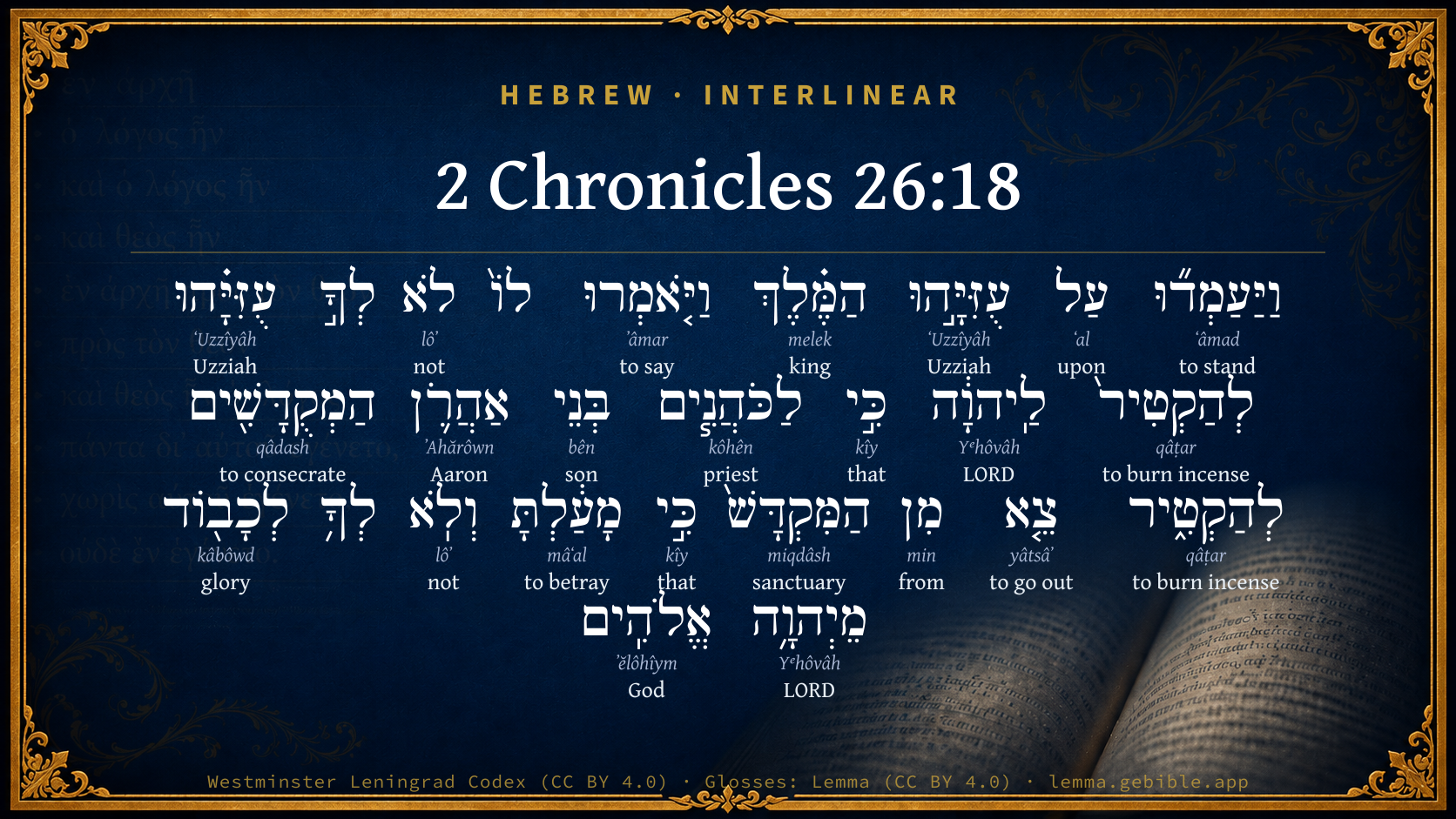
  1. וַיַּעַמְד֞וּ ʻâmad H5975 “and · to stand” Conjunction + Verb, Qal, Sequential Imperfect, 3rd Person, Masculine, Plural
  2. עַל ʻal H5921 “upon” Preposition
  3. הַמֶּ֗לֶךְ melek H4428 “the · king” Particle, Definite Article + Noun, Common, Masculine, Singular, Absolute
  4. וַיֹּ֤אמְרוּ ʼâmar H559 “and · to say” Conjunction + Verb, Qal, Sequential Imperfect, 3rd Person, Masculine, Plural
  5. לֹא lôʼ H3808 “not” Particle, Negative
  6. עֻזִּיָּ֗הוּ ʻUzzîyâh H5818 “Uzziah” Noun, Proper
  7. לְהַקְטִיר֙ qâṭar H6999 “to burn incense” Preposition + Verb, Hiphil, Infinitive Construct
  8. לַֽיהוָ֔ה Yᵉhôvâh H3068 “to/for · LORD” Preposition + Noun, Proper
  9. כִּ֣י kîy H3588 “that” Conjunction
  10. לַכֹּהֲנִ֧ים kôhên H3548 “to/for the · priests” Preposition, Determined + Noun, Common, Masculine, Plural, Absolute
  11. בְּנֵי bên H1121 “sons of” Noun, Common, Masculine, Plural, Construct
  12. אַהֲרֹ֛ן ʼAhărôwn H175 “Aaron” Noun, Proper
  13. הַמְקֻדָּשִׁ֖ים qâdash H6942 “the · consecrated” Particle, Definite Article + Verb, Pual, Participle Passive, Masculine, Plural, Absolute
  14. לְהַקְטִ֑יר qâṭar H6999 “to burn incense” Preposition + Verb, Hiphil, Infinitive Construct
  15. צֵ֤א yâtsâʼ H3318 “go out” Verb, Qal, Imperative, 2nd Person, Masculine, Singular
  16. מִן min H4480 “from” Preposition
  17. הַמִּקְדָּשׁ֙ miqdâsh H4720 “the · sanctuary” Particle, Definite Article + Noun, Common, Masculine, Singular, Absolute
  18. כִּ֣י kîy H3588 “that” Conjunction
  19. מָעַ֔לְתָּ mâʻal H4603 “to betray” Verb, Qal, Perfect, 2nd Person, Masculine, Singular
  20. וְלֹֽא lôʼ H3808 “and · not” Conjunction + Particle, Negative
  21. לְכָב֖וֹד kâbôwd H3519 “to/for · glory” Preposition + Noun, Common, Both, Singular, Absolute
  22. מֵיְהוָ֥ה Yᵉhôvâh H3068 “from · LORD” Preposition + Noun, Proper
  23. אֱלֹהִֽים ʼĕlôhîym H430 “God(s)” Noun, Common, Masculine, Plural, Absolute

About this verse

These counts appear in no published source. They are computed here, from the morphology-tagged text and Lemma’s own curated glosses. What Lemma adds →

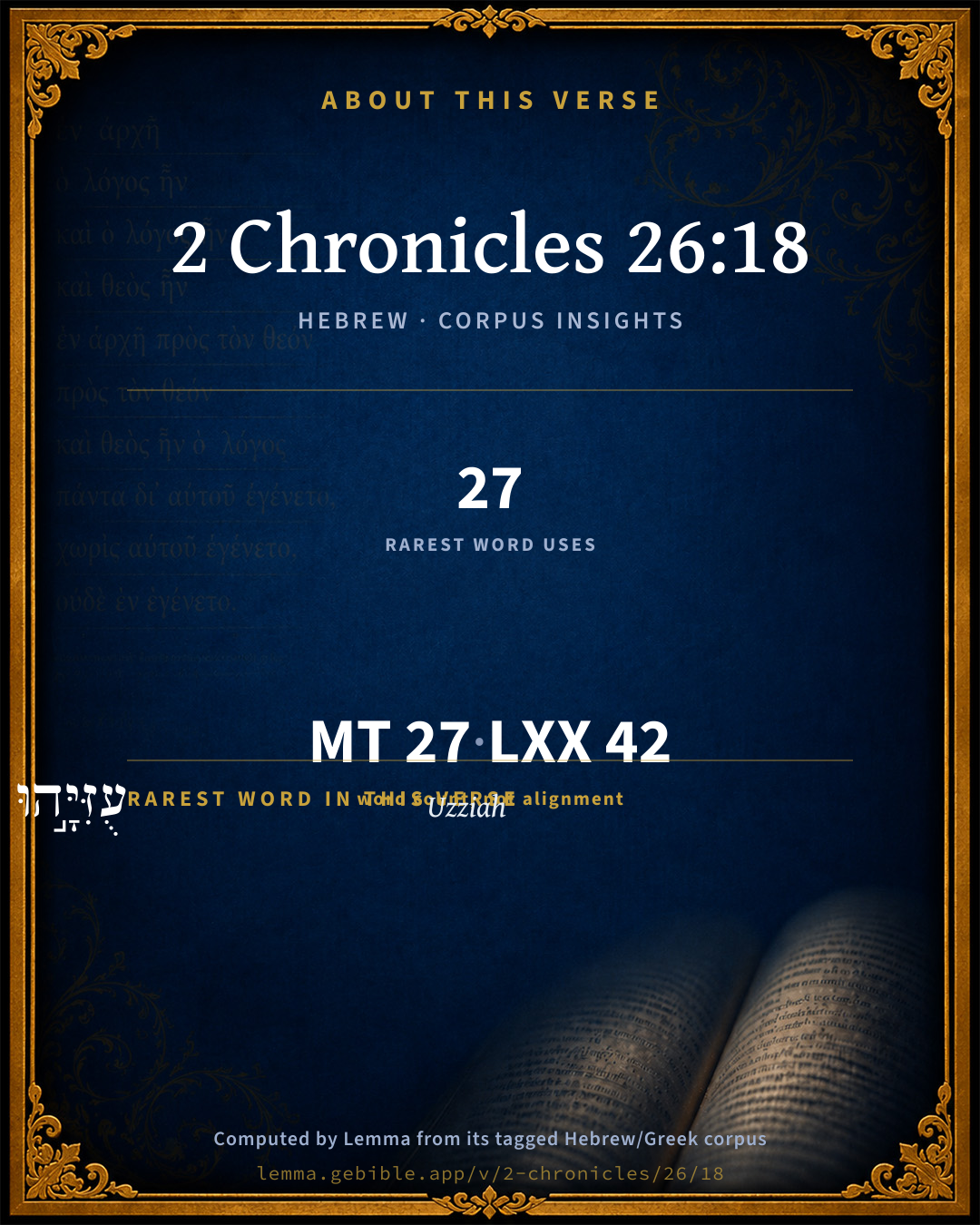
27
words
19
distinct lemmas
Historical
section

Shared distinctive vocabulary

עֻזִּיָּ֣הוּ Uzziah H5818 occurs in 26 verses of the Hebrew Bible. Also found in:

Grammatical profile

  • 7 verbs
  • 11 nouns
  • 5 prepositions
  • 2 conjunctions
  • 2 particles

Verb forms

  • וַיַּעַמְד֞וּ Qal · Sequential Imperfect
  • וַיֹּ֤אמְרוּ Qal · Sequential Imperfect
  • לְהַקְטִיר֙ Hiphil · Infinitive Construct
  • הַמְקֻדָּשִׁ֖ים Pual · Participle Passive
  • לְהַקְטִ֑יר Hiphil · Infinitive Construct
  • צֵ֤א Qal · Imperative
  • מָעַ֔לְתָּ Qal · Perfect

Repetition

Words recur within this verse — often emphatic in Hebrew:

  • עֻזִּיָּ֣הוּ Uzziah H5818 ×2
  • לְהַקְטִיר֙ to burn incense H6999 ×2
  • לַֽיהוָ֔ה LORD H3068 ×2
  • לֹא not H3808 ×2
  • כִּ֣י that H3588 ×2

Hebrew & Septuagint length

In English translation the verse runs 54 words from the Hebrew and 61 from the Septuagint (LXX English) — closely comparable.

A rough comparison of the two English renderings, which tokenize alike — not a word-level alignment.

Word counts can differ between the Hebrew and the Greek without any difference in meaning — e.g. the Hebrew direct-object marker אֵת has no separate Greek word, and Greek often adds the article ὁ.

In the original languages it is 27 Hebrew tokens and 42 Greek tokens — but the two are counted differently (Hebrew bundles its prefixes and suffixes into one token; the Greek is in lemma form), so that isn’t a like-for-like length.

Cross-references

18

Topical passages linked to 2 Chronicles 26:18 in the Treasury of Scripture Knowledge — connected by theme and wording, ordered by reader-vote popularity; previews shown in the World English Bible.

  • Exodus 30:7–8 Aaron shall burn incense of sweet spices on it every morning. When he tends the lamps, he shall burn it.
  • Numbers 18:7 You and your sons with you shall keep your priesthood for everything of the altar, and for that within the veil; and you shall serve: I give you the priesthood as a service of gift: and the stranger who comes near shall be put to death.
  • 2 Chronicles 19:2 Jehu the son of Hanani the seer went out to meet him, and said to king Jehoshaphat, Should you help the wicked, and love those who hate Yahweh? for this thing wrath is on you from before Yahweh.
  • Jeremiah 13:18 Say you to the king and to the queen-mother, Humble yourselves, sit down; for your headdresses are come down, even the crown of your glory.
  • Hebrews 5:4 Nobody takes this honor on himself, but he is called by God, just like Aaron was.
  • Numbers 16:39–40 Eleazar the priest took the brazen censers, which those who were burnt had offered; and they beat them out for a covering of the altar,
  • Numbers 16:46–48 Moses said to Aaron, Take your censer, and put fire therein from off the altar, and lay incense thereon, and carry it quickly to the congregation, and make atonement for them: for there is wrath gone out from Yahweh; the plague is begun.
  • 1 Samuel 2:30 Therefore Yahweh, the God of Israel, says, I said indeed that your house, and the house of your father, should walk before me forever: but now Yahweh says, Be it far from me; for those who honor me I will honor, and those who despise me shall be lightly esteemed.
  • 2 Chronicles 16:7–9 At that time Hanani the seer came to Asa king of Judah, and said to him, Because you have relied on the king of Syria, and have not relied on Yahweh your God, therefore is the host of the king of Syria escaped out of your hand.
  • Daniel 4:37 Now I, Nebuchadnezzar, praise and extol and honor the King of heaven; for all his works are truth, and his ways justice; and those who walk in pride he is able to abase.
  • Matthew 10:18 Yes, and you will be brought before governors and kings for my sake, for a testimony to them and to the Gentiles.
  • Matthew 10:28 Don't be afraid of those who kill the body, but are not able to kill the soul. Rather, fear him who is able to destroy both soul and body in Gehenna.
  • Matthew 14:4 For John said to him, "It is not lawful for you to have her."
  • John 5:44 How can you believe, who receive glory from one another, and you don't seek the glory that comes from the only God?
  • 1 Corinthians 5:5 are to deliver such a one to Satan for the destruction of the flesh, that the spirit may be saved in the day of the Lord Jesus.
  • 2 Corinthians 5:16 Therefore we know no one after the flesh from now on. Even though we have known Christ after the flesh, yet now we know him so no more.
  • Galatians 2:11 But when Peter came to Antioch, I resisted him to the face, because he stood condemned.
  • James 2:1 My brothers, don't hold the faith of our Lord Jesus Christ of glory with partiality.

Cross-references courtesy of OpenBible.info (CC BY 4.0).

Hebrew and Greek witnesses Masoretic Hebrew ↔ Greek Septuagint

The same verse in the two great witnesses to the Old Testament, shown verse-for-verse.

These are two independent witnesses, not word-aligned to each other, and the Septuagint is shown in lemma (dictionary) form.

Hebrew 2 Chronicles 26:18 Masoretic · Westminster Leningrad Codex

וַיַּעַמְד֞וּ עַל עֻזִּיָּ֣הוּ הַמֶּ֗לֶךְ וַיֹּ֤אמְרוּ לוֹ֙ לֹא לְךָ֣ עֻזִּיָּ֗הוּ לְהַקְטִיר֙ לַֽיהוָ֔ה כִּ֣י לַכֹּהֲנִ֧ים בְּנֵי אַהֲרֹ֛ן הַמְקֻדָּשִׁ֖ים לְהַקְטִ֑יר צֵ֤א מִן הַמִּקְדָּשׁ֙ כִּ֣י מָעַ֔לְתָּ וְלֹֽא לְךָ֥ לְכָב֖וֹד מֵיְהוָ֥ה אֱלֹהִֽים

and they withstood Uzziah the king, and said to him, It pertains not to you, Uzziah, to burn incense to Yahweh, but to the priests the sons of Aaron, who are consecrated to burn incense: go out of the sanctuary; for you have trespassed; neither shall it be for your honor from Yahweh God.

World English Bible · Public Domain

Greek LXX 2 Chronicles 26:18 Septuagint · lemma form

καί ἵστημι ἐπί οζιας ὁ βασιλεύς καί εἶπον αὐτός οὐ σύ οζιας θυμιάω ὁ κύριος ἀλλά ἤ ὁ ἱερεύς υἱός ἀαρών ὁ ἁγιάζω θυμιάω ἐκἔρχομαι ἐκ ὁ ἁγίασμα ὅτι ἀποἵστημι ἀπό κύριος καί οὐ εἰμί σύ οὗτος εἰς δόξα παρά κύριος θεός

And they withstood Ozias the king, and said to him, It is not for you, Ozias, to burn incense to the Lord, but only for the priests the sons of Aaron, who are consecrated to sacrifice: go forth of the sanctuary, for you have departed from the Lord; and this shall not be for glory to you from the Lord god.

LXX2012 (modern English Septuagint) · Public Domain

Hebrew: Westminster Leningrad Codex (CC BY 4.0). Greek: Septuagint (public domain); English from LXX2012 (modern English Septuagint) (Public Domain). How the Septuagint differs from the Hebrew →

Commentary

Notes on 2 Chronicles 26:18 from classic Christian and Jewish commentators (each source and its license shown beneath its notes). The classic Christian expositions comment on the surrounding passage and are grouped to its opening verse, so a note may address several verses; the Jewish commentaries on the Tanakh (Rashi and others) are per-verse, so they appear only where the commentator wrote on this verse.

Lemma curates 59 commentaries, every one of them public domain or Creative Commons licensed, each selected and text-cleaned for this edition rather than reprinted as found. About our sources →

Trapp's Complete Commentary

John Trapp

2Ch 26:18 And they withstood Uzziah the king, and said unto him, [It appertaineth] not unto thee, Uzziah, to burn incense unto the LORD, but to the priests the sons of Aaron, that are consecrated to burn incense: go out of the sanctuary; for thou hast trespassed; neither [shall it be] for thine honour from the LORD God.

Ver. 18. And they withstood Uzziah the king.] Wherein they became an example of courage and piety, to ministers especially, who must withstand the torrent of vices, and not spare to reprove the greatest, if need be; as Nathan did David, as John Baptist did Herod, as Ambrose did Theodosius. This emperor, when he was at Thessalonica, in revenge of certain of his judges slain there in an uproar and tumult of the people, made a great slaughter among them by his soldiers, who destroyed seven thousand of the citizens. Ambrose, bishop of Milan, heard hereof to his great grief; and when the emperor, afterwards returning to Milan, would have come, as his manner had been, to the holy assembly, he stoutly withstood him, saying, Quibus oculis intuebere templum illius qui est omnium Dominus, &c.? With what face canst thou look him in the face who is Lord of all? With what feet canst thou enter his house, whom thou hast so deeply displeased? How canst thou receive his body with those hands of thine so drenched in Christian blood? Or drink his blood with that mouth that commanded such an inhuman slaughter? Recede igitur, et ne conare novo scelere scelus ante editum augers, &c. Depart, therefore, and go not about to add one wickedness to another; but stand thou excommunicated, till by repentance thou hast obtained pardon of God, and given satisfaction to his offended people. The good emperor - who having been religiously bred, knew well what was fit for a king to do, and what for a bishop - returned hereupon to his palace, after that he had acknowledged the greatness of his sin, where also he spent eight months in weeping and lamentation; and then coming to Ambrose, he begged pardon and absolution; which after many rebukes, at length he obtained. {a}

It appertaineth not unto thee, Uzziah.] Chrysostom {b} much admiring this speech, Vide, saith he, libertatem: Vide mentem servire nesciam: Vide linguam caelos attingentem: Vide libertatera incoercibilem: Vide hominis corpus et angel; mentem, &c. See what a gallant spirit this man was of, and of what a bold speech; he had the body of a man, but the mind of an angel, &c.

{a} Theodoret.

{b} Hom. iv., De Verb. Isaiae.

John Trapp, A Commentary or Exposition upon All the Books of the Old and New Testament (1647–1656) — public domain. Text from a community e-Sword module.

Joseph Benson's Commentary

2Ch 26:18. And they withstood Uzziah — Hebrew, stood up against Uzziah, not by force, or laying hands upon him to restrain him, for in the next verse we still find the censer in his hand; but only by admonition and reproof, which follows. Neither shall it be for thine honour, &c. — Expect that God will punish thee, or put some brand of infamy upon thee for this presumption. But this they express modestly, because they considered that he to whom they spake, though an offender, was their sovereign.

Joseph Benson's Commentary on the Old and New Testaments (1811–1818) — public domain. Text from a community e-Sword module.

Geneva Bible (1599)

Geneva Bible translators

Though his zeal seemed to be good and also his intention, yet because they were not governed by the word of God, he did wickedly, and was therefore both justly resisted and also punished.

Geneva Bible (1599) marginal notes — public domain. Text via Bolls.life.

Ellicott's Commentary for English Readers

(18) They withstood.—‘Amad ‘al, a late usage. (Comp. 1Ch_21:1.)

It appertaineth not unto thee, Uzziah, to burn incense.—Comp. the construction (1Ch_15:2).

Trespassed.—Done faithlessly (ma’al), 2Ch_26:16.

Neither shall it be . . . Lord God.—Literally, and not to thee (is it) for honour from Jehovah; i.e., thine act will not issue in honour, as thou thinkest, but in shame. Or, perhaps, And burning incense belongs not to thee as a prerogative from Jehovah (‘ên, not lô,’ would be more natural).

A Bible Commentary for English Readers, edited by Charles John Ellicott (1878–1897) — public domain. Text from a community e-Sword module.

The Cambridge Bible for Schools and Colleges

gen. ed. J. J. S. Perowne

18. the priests the sons of Aaron] Cp. 2Ch_13:10-11 and Num_16:40. neither shall it be for thine honour] A euphemism, a threat of danger and disgrace.

The Cambridge Bible for Schools and Colleges (gen. ed. J. J. S. Perowne; Cambridge University Press, 1878–1918) — public domain. Text from a community e-Sword module.

John Gill's Exposition

And Azariah the chief priest, and all the priests, looked upon him, and, behold, he was leprous in his forehead,.... He was leprous all over his body, no doubt, but it appeared in his forehead very remarkably, and was seen by them all, who, without doubt, informed him of his case, and of which he soon became sensible:

and they thrust him out from thence; the holy place, he being now unfit to be in a common dwelling house, or his own palace, and much less to be in the house of God:

yea, himself also hasted to go out, because the Lord had smitten him; fearing, should he continue there, that something worse would befall him; the Targum is, the Word of the Lord. The leprosy was a disease sent immediately from God, as the case of Miriam, and this of Uzziah, show; and so the Persians (d) had a notion, that those had it who sinned against the sun, and for that reason, and which they accounted and worshipped as God.

(d) Herodot. Clio, sive, l. 1. c. 138.

John Gill's Exposition of the Whole Bible (1746–1763) — public domain (CC PDM 1.0). Text via the HelloAO Bible API.

Haydock's Catholic Bible Commentary

To thee. For usurping spiritual authority, the king was opposed by the high priest; and God confirmed the sentence of the latter, by striking Ozias with the leprosy; on which account, the was not only cast out of the temple, but also lost his kingdom, being obliged to live apart; (Lev. xiii. 46,) and after death, he could not be buried with his ancestors. W.

George Leo Haydock (1774–1849), Haydock's Catholic Family Bible and Commentary, 1859 edition — public domain. Excludes Psalms (Douay-Rheims chapter numbering differs from Protestant) and Deuterocanonical books (Catholic canon only).

Matthew Poole's English Annotations

They withstood Uzziah; Heb. stood up against Uzziah; not by force, or laying hands upon him to restrain him, for in the next verse you still find the censer in his hand; but only by admonition and reproof, which here follows.

Neither shall it be for thine honour from the Lord God; expect that God will punish thee, or put some brand of infamy upon thee, for this presumption. But this they express modestly, and by a figure called meiosis, where more is meant than is expressed, because they considered that he to whom they spake, though an offender, was their lord and sovereign.

Matthew Poole's English Annotations on the Holy Bible (1683–1685) — public domain. Text from a community e-Sword/MySword module.

Whedon's Commentary on the Bible

Daniel D. Whedon

18. They withstood Uzziah — Azariah and his assistants were too frail of zeal and respect for the law and service of Jehovah not to resist such high-handed offence.

Daniel D. Whedon (gen. ed.), Commentary on the Old and New Testaments (1874–1909) — public domain. Text from a community e-Sword module.

The Pulpit Commentary

They withstood. A somewhat more forcible rendering would be justified by the Hebrew text, such e.g. as, "They confronted Uzziah to his face," or "They stood in the way of Uzziah," since our "withstood" almost always conveys the idea of argumentative confronting only. There was expostulation here, as we are immediately told, but there was something else also, as ver. 20 makes very plain, "They thrust him out."

The Pulpit Commentary (1880–1919), ed. H.D.M. Spence-Jones & Joseph S. Exell — public domain. Text from a community e-Sword module.

John Wesley's Explanatory Notes

Withstood - Hebrew. stood up against Uzziah, not by force, or laying hands upon him to restrain him, for in the next verse you still find the censer in his hand; but only by admonition and reproof, which follows. Neither, &c. - Expect that God will punish thee, or put some brand of infamy upon thee for this presumption. But this they express modestly, because they considered that he to whom they spake, though an offender, was their sovereign.

John Wesley, Explanatory Notes Upon the Whole Bible (1754–1765) — public domain. Text via the GEBible commentary corpus.

Lesson kit

Teaching starters — assembled from the data on this page, not authored interpretation. Every prompt links to the verse data it draws on. Edit before teaching.

2 Chronicles, in the Historical, opens this verse with 27 words (19 distinct Hebrew lemmas). Its most distinctive word is ʻUzzîyâh (“Uzziah”). A historical commentator’s framing appears above. Read the whole chapter for the surrounding context.

Discussion questions

  1. What does “Uzziah” (ʻUzzîyâh) contribute to the verse as a whole?
  2. How does 2 Kings 15:13, which shares the word «Uzziah», read alongside this verse?
  3. What does the repetition of “Uzziah” (2× in this one verse) do in this verse?
  4. These translations render this verse differently. What is at stake in choosing one wording over another?
  5. «וַיַּעַמְד֞וּ» is a Qal Sequential Imperfect verb. How does that grammatical form shape the action described?
  6. Compare how Trapp's Complete Commentary and Joseph Benson's Commentary read this verse. Where do they agree or differ?

Things to notice

Reading settings

Reading text

Shown beneath each verse's original-language words.

Old Testament
Old Testament edition

Read the OT as the Masoretic Hebrew (MT) or the Greek Septuagint (LXX).

English shown for the Greek Septuagint (in the Hebrew ↔ Greek comparison).

Comparing translations? Open the Compare panel on any verse page to stack up to four side by side.