
Jeremiah 44:3

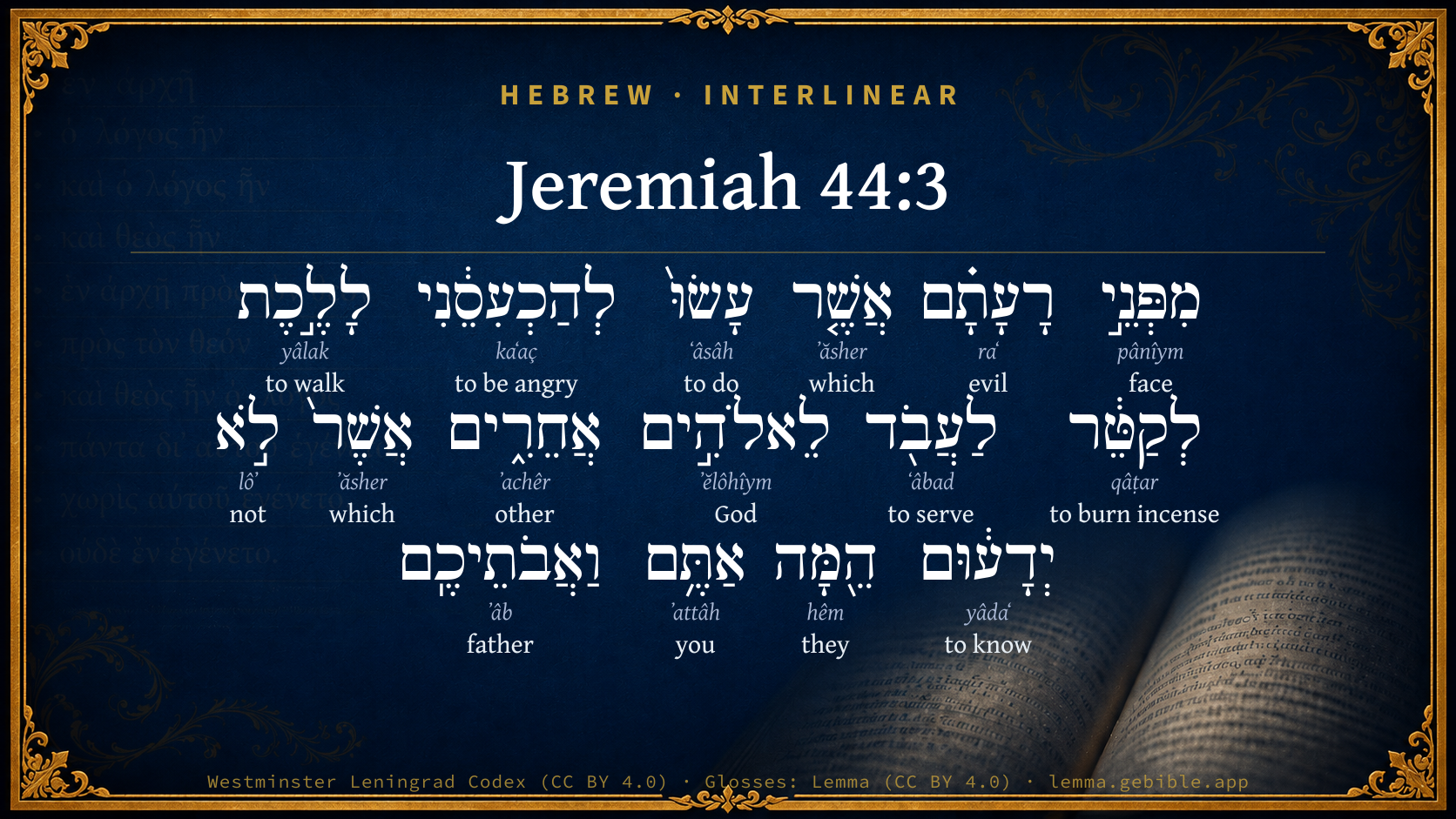
Hebrew (Westminster Leningrad Codex) Jeremiah 44:3 appears in the Hebrew Old Testament. The text above is from the Westminster Leningrad Codex. Each word links to its Strong’s number, a concise gloss, and parsing drawn from the Open Scriptures Hebrew Bible morphology. Click any word for its full Brown-Driver-Briggs (BDB) entry.
Download image
Cite this verse

Jeremiah 44:3 (World English Bible). Public Domain. Lemma interlinear Bible study tool, https://lemma.gebible.app/v/jeremiah/44/3.

Show BibTeX & RIS
BibTeX
RIS
English Translation
because of their wickedness which they have committed to provoke me to anger, in that they went to burn incense, [and] to serve other gods, that they didn't know, neither they, nor you, nor your fathers.
World English Bible · Public Domain
Download a study sheet

One document with this verse’s original text, its word-by-word gloss line, the meaning frame, cross-references with their text, attributed commentary, and full source and license credits — printable, and it pastes into notes with its structure intact.

This verse Autodidact and up

Study sheet (.html) Plain text (.txt)

A passage Seminary Student

Up to 50 verses in one chapter. A passage sheet keeps up to 6 commentary sources and 12 cross-references per verse, in the order this page ranks them, and says so on the sheet whenever that leaves anything out. Ask for a single verse and you get the Autodidact verse sheet above.

Everything on this page stays free to read, with no account — the sheet is a download of what is already on screen, not access to it.

Want to remove ads? Support Godless Engineer
Compare translations 3

The same verse in 3 English versions, stacked beneath the original-language interlinear above. Click any original word for its lexicon entry.

Each is an independent rendering of the whole verse — the interlinear is not word-aligned to these translations.

Highlighted words mark where these versions differ — a whole-verse word diff, not a word-by-word alignment.

  • World English Bible Public Domain
    because of their wickedness which they have committed to provoke me to anger, in that they went to burn incense, [and] to serve other gods, that they didn't know, neither they, nor you, nor your fathers.
  • King James Version Public Domain
    Because of their wickedness which they have committed to provoke me to anger, in that they went to burn incense, and to serve other gods, whom they knew not, neither they, ye, nor your fathers.
  • unfoldingWord Literal Text CC BY-SA 4.0
    This is because of the wicked things they did to offend me by going to burn incense and to worship other gods. These were gods that neither they themselves, nor you, nor your ancestors knew.’

unfoldingWord Literal Text — © unfoldingWord, licensed CC BY-SA 4.0. Word-aligned USFM3 via Door43 (git.door43.org/unfoldingWord/en_ult).

Versions to compare (up to 4)

3 of 4 selected

Show all 18 translations

Every available English version of this verse, each an independent rendering of the whole verse.

  • World English Bible Public Domain
    because of their wickedness which they have committed to provoke me to anger, in that they went to burn incense, [and] to serve other gods, that they didn't know, neither they, nor you, nor your fathers.
  • Berean Standard Bible Public Domain
    because of the evil they have done. They provoked Me to anger by continuing to burn incense and to serve other gods that neither they nor you nor your fathers ever knew.
  • Majority Standard Bible Public Domain
    because of the evil they have done. They provoked Me to anger by continuing to burn incense and to serve other gods that neither they nor you nor your fathers ever knew.
  • King James Version Public Domain
    Because of their wickedness which they have committed to provoke me to anger, in that they went to burn incense, and to serve other gods, whom they knew not, neither they, ye, nor your fathers.
  • American Standard Version (1901) Public Domain
    because of their wickedness which they have committed to provoke me to anger, in that they went to burn incense, `and' to serve other gods, that they knew not, neither they, nor ye, nor your fathers.
  • Revised Version (1885) Public Domain
    because of their wickedness which they have committed to provoke me to anger, in that they went to burn incense, and to serve other gods, whom they knew not, neither they, nor ye, nor your fathers.
  • Geneva Bible (1599) Public Domain
    Because of their wickednes which they haue comitted, to prouoke me to anger in that they went to burne incense, and to serue other gods, who they knew not, neither they nor you nor your fathers.
  • Douay-Rheims (1899) Public Domain
    Because of the wickedness which they have committed, to provoke me to wrath, and to go and offer sacrifice, and worship other gods, which neither they, nor you, nor your fathers knew.
  • Young's Literal Translation Public Domain
    because of their wickedness that they have done, by provoking Me to anger, by going to make perfume, by serving other gods, that they knew not, they, ye, and your fathers.
  • Literal Standard Version CC BY-SA 4.0
    because of their wickedness that they have done, by provoking Me to anger, by going to make incense, by serving other gods, that they did not know, they, you, and your fathers.
  • Unlocked Literal Bible CC BY-SA 4.0
    This is because of the wicked things they did to offend me by going to burn incense and to worship other gods. These were gods that neither they themselves, nor you, nor your ancestors knew.'
  • unfoldingWord Literal Text CC BY-SA 4.0
    This is because of the wicked things they did to offend me by going to burn incense and to worship other gods. These were gods that neither they themselves, nor you, nor your ancestors knew.’
  • Darby Bible Public Domain
    because of their wickedness which they have committed to provoke me to anger, in that they went to burn incense to serve other gods which they knew not, they, [nor] ye, nor your fathers.
  • World Messianic Bible Public Domain
    because of their wickedness which they have committed to provoke me to anger, in that they went to burn incense, to serve other gods that they didn’t know, neither they, nor you, nor your fathers.
  • Webster's Bible Public Domain
    Because of their wickedness which they have committed to provoke me to anger, in that they went to burn incense, and to serve other gods, whom they knew not, neither they, ye, nor your fathers.
  • Free Bible Version CC BY-SA 4.0
    because of the evil they did. They made me angry by burning incense and serving other gods that they hadn't ever known, and you and your forefathers hadn't known either.
  • Bible in Basic English Public Domain
    Because of the evil which they have done, moving me to wrath by burning perfumes in worship to other gods, who were not their gods or yours or the gods of their fathers.
  • JPS Tanakh (1917) Public Domain
    because of their wickedness which they have committed to provoke Me, in that they went to offer, and to serve other gods, whom they knew not, neither they, nor ye, nor your fathers.

Literal Standard Version (2020), Covenant Press — licensed CC BY-SA 4.0. Text via the HelloAO Bible API (eBible.org). Unlocked Literal Bible (unfoldingWord) — licensed CC BY-SA 4.0. Text via the HelloAO Bible API (eBible.org). unfoldingWord Literal Text — © unfoldingWord, licensed CC BY-SA 4.0. Word-aligned USFM3 via Door43 (git.door43.org/unfoldingWord/en_ult). Free Bible Version, Dr. Jonathan Gallagher — licensed CC BY-SA 4.0. Text via the HelloAO Bible API (eBible.org).

Word by word

More ways to search: Search by grammar → Find every occurrence → Compare this word →

Practice this passage: Drill this verse → Learn its vocabulary →

לְהַכְעִסֵ֔נִי
kaʻaç
H3707
“to be angry · me”
Preposition + Verb, Hiphil, Infinitive Construct + Suffix, Personal, 1st Person, Common, Singular
Part of Speech
Preposition + Verb
Stem
Hiphil
Form
Infinitive Construct
Full BDB Definition

Origin: a primitive root

TWOT: 1016

to be angry, be vexed, be indignant, be wroth, be grieved, provoke to anger and wrath - (Qal) - to be vexed, be indignant - to be angry - (Piel) to provoke to anger - (Hiphil) - to vex - to vex, provoke to anger
  1. מִפְּנֵ֣י pânîym H6440 “from · face(s) of” Preposition + Noun, Common, Both, Plural, Construct
  2. רָעָתָ֗ם raʻ H7451 “evil · their” Noun, Common, Feminine, Singular, Construct + Suffix, Personal, 3rd Person, Masculine, Plural
  3. אֲשֶׁ֤ר ʼăsher H834 “which” Particle, Relative
  4. עָשׂוּ֙ ʻâsâh H6213 “to do” Verb, Qal, Perfect, 3rd Person, Common, Plural
  5. לָלֶ֣כֶת yâlak H3212 “to walk” Preposition + Verb, Qal, Infinitive Construct
  6. לְקַטֵּ֔ר qâṭar H6999 “to burn incense” Preposition + Verb, Piel, Infinitive Construct
  7. לַעֲבֹ֖ד ʻâbad H5647 “to serve” Preposition + Verb, Qal, Infinitive Construct
  8. לֵאלֹהִ֣ים ʼĕlôhîym H430 “to/for · God(s)” Preposition + Noun, Common, Masculine, Plural, Absolute
  9. אֲחֵרִ֑ים ʼachêr H312 “other” Adjective, Adjective, Masculine, Plural, Absolute
  10. אֲשֶׁר֙ ʼăsher H834 “which” Particle, Relative
  11. לֹ֣א lôʼ H3808 “not” Particle, Negative
  12. יְדָע֔וּם yâdaʻ H3045 “to know · them” Verb, Qal, Perfect, 3rd Person, Common, Plural + Suffix, Personal, 3rd Person, Masculine, Plural
  13. הֵ֖מָּה hêm H1992 “they” Pronoun, Personal, 3rd Person, Masculine, Plural
  14. אַתֶּ֥ם ʼattâh H859 “you” Pronoun, Personal, 2nd Person, Masculine, Plural
  15. וַאֲבֹתֵיכֶֽם ʼâb H1 “and · fathers · your” Conjunction + Noun, Common, Masculine, Plural, Construct + Suffix, Personal, 2nd Person, Masculine, Plural

About this verse

These counts appear in no published source. They are computed here, from the morphology-tagged text and Lemma’s own curated glosses. What Lemma adds →

16
words
15
distinct lemmas
Prophets
section

Shared distinctive vocabulary

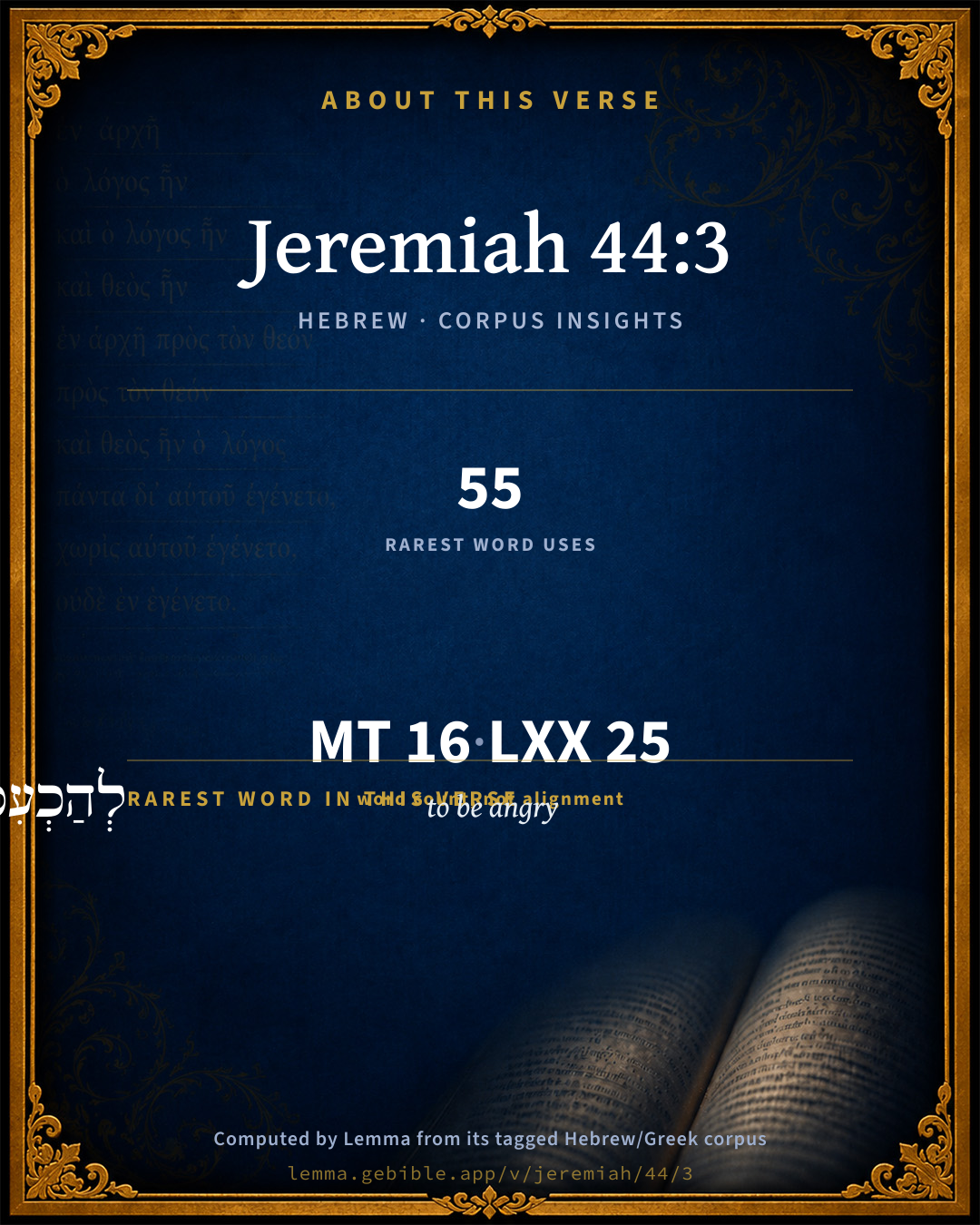
לְהַכְעִסֵ֔נִי to be angry H3707 occurs in 53 verses of the Hebrew Bible. Also found in:

Grammatical profile

  • 6 verbs
  • 4 nouns
  • 1 adjective
  • 2 pronouns
  • 3 particles

Verb forms

  • עָשׂוּ֙ Qal · Perfect
  • לְהַכְעִסֵ֔נִי Hiphil · Infinitive Construct
  • לָלֶ֣כֶת Qal · Infinitive Construct
  • לְקַטֵּ֔ר Piel · Infinitive Construct
  • לַעֲבֹ֖ד Qal · Infinitive Construct
  • יְדָע֔וּם Qal · Perfect

Repetition

A word recurs within this verse — often emphatic in Hebrew:

  • אֲשֶׁ֤ר which H834 ×2

Hebrew & Septuagint length

In the original languages it is 16 Hebrew tokens and 25 Greek tokens — but the two are counted differently (Hebrew bundles its prefixes and suffixes into one token; the Greek is in lemma form), so that isn’t a like-for-like length.

Cross-references

23

Topical passages linked to Jeremiah 44:3 in the Treasury of Scripture Knowledge — connected by theme and wording, ordered by reader-vote popularity; previews shown in the World English Bible.

  • Deuteronomy 29:26 and went and served other gods, and worshiped them, gods that they didn't know, and that he had not given to them:
  • Deuteronomy 13:6 If your brother, the son of your mother, or your son, or your daughter, or the wife of your bosom, or your friend, who is as your own soul, entice you secretly, saying, Let us go and serve other gods, which you have not known, you, nor your fathers;
  • Deuteronomy 32:17 They sacrificed to demons, [which were] no God, To gods that they didn't know, To new [gods] that came up of late, Which your fathers didn't dread.
  • Nehemiah 9:33 However you are just in all that is come on us; for you have dealt truly, but we have done wickedly;
  • Jeremiah 2:17–19 Haven't you procured this to yourself, in that you have forsaken Yahweh your God, when he led you by the way?
  • Jeremiah 44:8 in that you provoke me to anger with the works of your hands, burning incense to other gods in the land of Egypt, where you are gone to sojourn; that you may be cut off, and that you may be a curse and a reproach among all the nations of the earth?
  • Ezekiel 8:17–18 Then he said to me, Have you seen [this], son of man? Is it a light thing to the house of Judah that they commit the abominations which they commit here? for they have filled the land with violence, and have turned again to provoke me to anger: and, behold, they put the branch to their nose.
  • Daniel 9:5 we have sinned, and have dealt perversely, and have done wickedly, and have rebelled, even turning aside from your precepts and from your ordinances;
  • Ezra 9:6–11 and I said, my God, I am ashamed and blush to lift up my face to you, my God; for our iniquities are increased over our head, and our guiltiness is grown up to the heavens.
  • Jeremiah 4:17–18 As keepers of a field are they against her round about, because she has been rebellious against me, says Yahweh.
  • Jeremiah 5:19 It shall happen, when you shall say, Why has Yahweh our God done all these things to us? then shall you say to them, Like as you have forsaken me, and served foreign gods in your land, so shall you serve strangers in a land that is not yours.
  • Jeremiah 5:29 Shall I not visit for these things? says Yahweh; shall not my soul be avenged on such a nation as this?
  • Jeremiah 7:19 Do they provoke me to anger? says Yahweh; [do they] not [provoke] themselves, to the confusion of their own faces?
  • Jeremiah 9:12–14 Who is the wise man, that may understand this? and [who is] he to whom the mouth of Yahweh has spoken, that he may declare it? why is the land perished and burned up like a wilderness, so that none passes through?
  • Jeremiah 11:17 For Yahweh of Hosts, who planted you, has pronounced evil against you, because of the evil of the house of Israel and of the house of Judah, which they have worked for themselves in provoking me to anger by offering incense to Baal.
  • Jeremiah 16:11–12 Then shall you tell them, Because your fathers have forsaken me, says Yahweh, and have walked after other gods, and have served them, and have worshiped them, and have forsaken me, and have not kept my law;
  • Jeremiah 19:3–4 and say, Hear you the word of Yahweh, kings of Judah, and inhabitants of Jerusalem: thus says Yahweh of Hosts, the God of Israel, Behold, I will bring evil on this place, which whoever hears, his ears shall tingle.
  • Jeremiah 22:9 Then they shall answer, Because they forsook the covenant of Yahweh their God, and worshiped other gods, and served them.
  • Lamentations 1:8 Jerusalem has grievously sinned; therefore she is become as an unclean thing; All who honored her despise her, because they have seen her nakedness: Yes, she sighs, and turns backward.
  • Lamentations 4:13 [It is] because of the sins of her prophets, [and] the iniquities of her priests, That have shed the blood of the just in the midst of her.
  • Ezekiel 9:9 Then said he to me, The iniquity of the house of Israel and Judah is exceeding great, and the land is full of blood, and the city full of wrestling [of judgment]: for they say, Yahweh has forsaken the land, and Yahweh doesn't see.
  • Ezekiel 22:25–31 There is a conspiracy of her prophets in the midst of it, like a roaring lion ravening the prey: they have devoured souls; they take treasure and precious things; they have made her widows many in the midst of it.
  • Zechariah 7:12–13 Yes, they made their hearts as hard as flint, lest they might hear the law, and the words which Yahweh of Hosts had sent by his Spirit by the former prophets. Therefore great wrath came from Yahweh of Hosts.

Cross-references courtesy of OpenBible.info (CC BY 4.0).

Hebrew and Greek witnesses Masoretic Hebrew ↔ Greek Septuagint

The same verse in the two great witnesses to the Old Testament, shown verse-for-verse.

These are two independent witnesses, not word-aligned to each other, and the Septuagint is shown in lemma (dictionary) form.

Hebrew Jeremiah 44:3 Masoretic · Westminster Leningrad Codex

מִפְּנֵ֣י רָעָתָ֗ם אֲשֶׁ֤ר עָשׂוּ֙ לְהַכְעִסֵ֔נִי לָלֶ֣כֶת לְקַטֵּ֔ר לַעֲבֹ֖ד לֵאלֹהִ֣ים אֲחֵרִ֑ים אֲשֶׁר֙ לֹ֣א יְדָע֔וּם הֵ֖מָּה אַתֶּ֥ם וַאֲבֹתֵיכֶֽם

because of their wickedness which they have committed to provoke me to anger, in that they went to burn incense, [and] to serve other gods, that they didn't know, neither they, nor you, nor your fathers.

World English Bible · Public Domain

Greek LXX Structure differs

In the Septuagint, Jeremiah is about an eighth shorter than the Hebrew and arranges its material differently — the Oracles Against the Nations (Hebrew chapters 46–51) appear in the middle of the Greek book, after 25:13. Because the chapter and verse boundaries do not line up, a verse-for-verse comparison with the Hebrew is not shown.

A verse-for-verse comparison isn’t shown here because the chapters and verses don’t line up. Switch to the LXX edition with the MT / LXX toggle above to read the Greek directly.

Hebrew: Westminster Leningrad Codex (CC BY 4.0). Greek: Septuagint (public domain); English from a public-domain English Septuagint. How the Septuagint differs from the Hebrew →

Targum (Aramaic paraphrase)

1

The Targum is the ancient Jewish Aramaic paraphrase of the Hebrew Scriptures — an interpretive translation, not the Hebrew text itself. Onkelos (literal) and Pseudo-Jonathan (expansive) render the Torah, and Jonathan the Prophets. Coverage is partial: where no permissively-licensed English translation exists for a verse, only the Aramaic is shown. This is verse-level text, not a word-by-word alignment to the Hebrew.

  1. Targum Jonathan Prophets (Joshua–Malachi)
    מִן קֳדָם בִּישַׁתְהוֹן דַעֲבָדוּ לְאַרְגָזָא קֳדָמַי לִמְהַךְ לְאַסְקָא בּוּסְמִין לְמִפְלַח לְטַעֲוַת פַּלְחֵי כּוֹכְבַיָא דְלָא יֵדְעוּנוּן אַתּוּן וַאֲבָהָתְכוֹן:

    (no public-domain English translation for this verse)

    Targum Jonathan — Aramaic: “Mikraot Gedolot” (public domain). English: “Sefaria Community Translation” (CC0 1.0 (public-domain dedication)); “London "Chaldee Paraphrase," 1871” (public domain). Text via Sefaria.

Commentary

Notes on Jeremiah 44:3 from classic Christian and Jewish commentators (each source and its license shown beneath its notes). The classic Christian expositions comment on the surrounding passage and are grouped to its opening verse, so a note may address several verses; the Jewish commentaries on the Tanakh (Rashi and others) are per-verse, so they appear only where the commentator wrote on this verse.

Lemma curates 59 commentaries, every one of them public domain or Creative Commons licensed, each selected and text-cleaned for this edition rather than reprinted as found. About our sources →

Trapp's Complete Commentary

John Trapp

Jer 44:3 Because of their wickedness which they have committed to provoke me to anger, in that they went to burn incense, [and] to serve other gods, whom they knew not, [neither] they, ye, nor your fathers.

Ver. 3. Because of their wickedness.] That root of all their wretchedness.

John Trapp, A Commentary or Exposition upon All the Books of the Old and New Testament (1647–1656) — public domain. Text from a community e-Sword module.

Tyndale Open Study Notes

Tyndale Open Resources

44:3 Since the Exodus, worship of false gods had been forbidden in Israel.

Tyndale Open Study Notes — © Tyndale Open Resources, licensed CC BY-SA 4.0. Text via the HelloAO Bible API.

Jamieson, Fausset & Brown

Robert Jamieson, A. R. Fausset & David Brown

they went--implying perverse assiduity: they went out of their way to burn incense (one species of idolatry put for all kinds), &c.

Jamieson, Fausset & Brown — Commentary Critical and Explanatory on the Whole Bible (1871) — public domain (CC PDM 1.0). Text via the HelloAO Bible API.

John Calvin's Commentaries

He afterwards adds, For the evil which they did to provoke me. He refers to the sins by which the Jews had provoked the wrath of God; for the people whom Jeremiah addressed had relapsed into those superstitions which had been the cause of their ruin. Had the Prophet spoken generally and said, that it was strange that the Jews had forgotten the punishment which had been inflicted by God on the whole nation, his doctrine would not have been so impressive. But when he now points out as by the finger how they had procured for themselves such calamities, he presses and urges them more forcibly to acknowledge their madness, because they thus continually provoked God, and sinned not through ignorance, but offended him by the same sins for which yet they had suffered punishment so grievous and dreadful. This is the reason why the Prophet says, For the evil which they did to provoke me, even to go, he says, to offer incense and to serve alien gods. To go here intimates the care and diligence they exercised in false worship. God had shewn to the Jews a certain way in his Law which they ought to have followed: had they then continued in the doctrine of the Law, they would have kept in the right way, and gone forward to the right end. But they are said to go, because they disregarded the Law and went here and there, as those who wander at random, and know not where they are going. There is then to be understood a contrast between going and remaining under the teaching of the Law. To go, in short, is to weary one’s self by an erratic course, when the word of God is neglected, and the way which it points out is forsaken. This is one thing.

Then he adds, to offer incense and to serve alien gods. Incense here is mentioned as a particular thing, then that which is general is added; for incense, as it is well known, was an evidence of worship. Then the Prophet under one thing condemns the idolatry of his own nation. But at length he shews that they were given to other abominations, that they had devoted themselves to the false worship of alien gods.

This passage, and those which are like it, are entitled to particular notice; for we hence learn that men depart from God and alienate themselves from the true worship of him, whenever they mingle with it something of their own, and dream of this and that according to their own will, the very thing intended, as we have said, by going as used by the Prophet. As soon, then, as men devise for themselves some new modes of worship, it is the same thing as though they turned backward or willfully wandered, for they keep not in the right and legitimate way. We also learn from the second clause that idolaters in vain adduce pretences to excuse themselves. For if they transfer to another what peculiarly belongs to God, and what he claims for himself, it is more than a sufficient proof of idolatry; and incense, as I have said, was a symbol of divine worship. As then they offered incense to their idols, they robbed the true God of his own honor, and chose new gods, and adorned them with the rights of the only true God.

In vain, then, and foolishly do the Papists at this day seek evasions when we object to them and say, that gross idolatries prevail among them: “He! it is not our intention to transfer the worship which peculiarly belongs to the only true God to saints, to images; but we apply all this to God.” Since they burn incense to saints, images, and pictures, since they offer incense even to the dead, there is surely no further need of disputing the point; and when they try to evade whatever they can bring forward, it is confuted by this one expression of the Prophet, for when he speaks of incense, he condemns the Jews for their idolatry.

But as I have said, he speaks afterwards generally, and says, and to serve alien gods. Then it follows, whom they knew not, neither ye nor your fathers Here the Prophet amplifies the sin of his own nation, because they had devoted their attention to unknown gods. There is here again a contrast to be understood, that is, between God, who had revealed himself by his Law, by his Prophets, by so many miracles and blessings, and the fictitious gods, who had, without thought and without judgment, been invented and contrived by the Jews. Now, it was an evidence of a base and an intolerable ingratitude, that the Jews should have forsaken the true God after he had made himself known to them. For had the Law never been given, had God suffered them, as other nations, to be entangled in their own errors, their offense would have been lighter. But God had made himself to be so familiarly known to them, that he was pleased to give them his Law, to be a certain rule of religion; he had also exercised his miraculous powers among them. As, then, the knowledge of the true God had been made so remarkably clear to them, how great and how base was their ingratitude to reject him and to depart from him, in order to run after idols! when they contrived for themselves vain gods and nothing but fictions! Had any one inquired what sort of god was Baal, or what were their Baalim, they would have said, that they had Baalim as their patrons, who obtained favor for them with the supreme God. But whence had they derived their vain notion? It was nothing but superstition founded on no reason.

This ought to be carefully observed; for at this day were any one to ask the Papists by what right they have devised for themselves so various and so many modes of worship: devotion alone they say will suffice, or a good intention. Let us then know that religion, separated from knowledge, is nothing but the sport and delusion of Satan. It is hence necessary that men should with certainty know what god they worship. And Christ thus distinguishes the true worship of God from that of vain idols,

“We know,” he says, speaking of the Jews, “whom we worship.” (John 4:22)

He then says that the Jews knew, even those who worshipped God according to what the Law prescribes, — he says that they knew whom they worshipped. He then condemns all good intentions in which the superstitious delight themselves, for they know not whom they worship. And I have said that religion ought not to be separated from knowledge; but I call that knowledge, not what is innate in man, or what is by diligence acquired, but that which is delivered to us by the Law and the Prophets.

We now, then, understand why the Prophet says that the Jews devoted themselves to alien gods, whom they had not known, nor their fathers.

John Calvin's Commentaries (1540-1563) — public domain. Text from the Calvin Translation Society English edition (1840s-50s) via the Christian Classics Ethereal Library (ccel.org). Calvin's coverage is partial (roughly two-thirds of the Bible); uncommented books and verses are honest gaps, never fabricated. The 19th-century editor's footnotes and remarks are omitted so the notes are faithfully Calvin's own voice.

The Cambridge Bible for Schools and Colleges

gen. ed. J. J. S. Perowne

3. burn incense] For this expression (and so throughout the ch.) See on Jer_1:16.

The Cambridge Bible for Schools and Colleges (gen. ed. J. J. S. Perowne; Cambridge University Press, 1878–1918) — public domain. Text from a community e-Sword module.

John Gill's Exposition

Because of their wickedness which they have committed to provoke me to anger,.... The cause of this desolation was the wickedness they were guilty of; whereby they provoked the anger of God to bring this destruction on them. Sin is always provoking unto God; and though it may not be done on purpose to provoke him, which it sometimes seems to be; yet it eventually does, and is always the cause of punishment: God never punishes man without a cause, or for anything but sin:

in that they went to burn incense, and to serve other gods: the particular wickedness they were guilty of, and which was the cause of their ruin, was burning incense to idols, and worshipping them, than which nothing is more provoking to God: and it was an aggravation of their sin, that they were gods

whom they knew not, neither they, you, nor your fathers; what they were; from whence they were; their original, and perhaps not their names; however, did not know that they were gods; nor could they prove them to be such; nay, might know that they were not: and now, since this was the sin which brought on the destruction they were eyewitnesses of, it should have been a caution to them that they went not into the same idolatrous practices, which yet they did not avoid; taking no warning from such awful instances of the divine displeasure.

John Gill's Exposition of the Whole Bible (1746–1763) — public domain (CC PDM 1.0). Text via the HelloAO Bible API.

Albert Barnes' Notes on the Bible

In that they went to burn incense, and to serve - Or, by going to burn incense to serve thereby other gods.

Albert Barnes' Notes on the Bible (1834–1885) — public domain. Text from a community e-Sword/MySword module.

Matthew Poole's English Annotations

As they were eye-witnesses to the effect, so it was nothing but their unbelief made them strangers to the cause; for God by his prophets had told them that the great moving cause was their paying a Divine homage to idols; the sin of which is aggravated from this, that they were as much strangers to the idols, as to the people with whom they joined in the worship of them, neither they nor any of their fathers having had any experimental knowledge of what they had done or could do for such as adored them.

Matthew Poole's English Annotations on the Holy Bible (1683–1685) — public domain. Text from a community e-Sword/MySword module.

Whedon's Commentary on the Bible

Daniel D. Whedon

3. Went to burn — Literally, by going to burn. Perverse assiduity in idolatry is here implied.

Daniel D. Whedon (gen. ed.), Commentary on the Old and New Testaments (1874–1909) — public domain. Text from a community e-Sword module.

Lesson kit

Teaching starters — assembled from the data on this page, not authored interpretation. Every prompt links to the verse data it draws on. Edit before teaching.

Jeremiah, in the Prophets, opens this verse with 16 words (15 distinct Hebrew lemmas). Its most distinctive word is kaʻaç (“to be angry”). A historical commentator’s framing appears above. Read the whole chapter for the surrounding context.

Discussion questions

  1. What does “to be angry” (kaʻaç) contribute to the verse as a whole?
  2. Deuteronomy 4:25 shares the word «to be angry» with this verse. How do the two illuminate each other?
  3. “which” occurs 2× in this one verse. What is the effect of the repetition?
  4. The translations on this page render this verse differently — a whole-verse word diff, not a word-by-word alignment. What might account for the different wordings?
  5. The verb «עָשׂוּ֙» is Qal Perfect. How does its form color the action?
  6. Reading how Trapp's Complete Commentary and Tyndale Open Study Notes read this verse, where do the two commentators agree and where do they part?

Things to notice

Reading settings

Reading text

Shown beneath each verse's original-language words.

Old Testament
Old Testament edition

Read the OT as the Masoretic Hebrew (MT) or the Greek Septuagint (LXX).

English shown for the Greek Septuagint (in the Hebrew ↔ Greek comparison).

Comparing translations? Open the Compare panel on any verse page to stack up to four side by side.