
Psalms 80:9

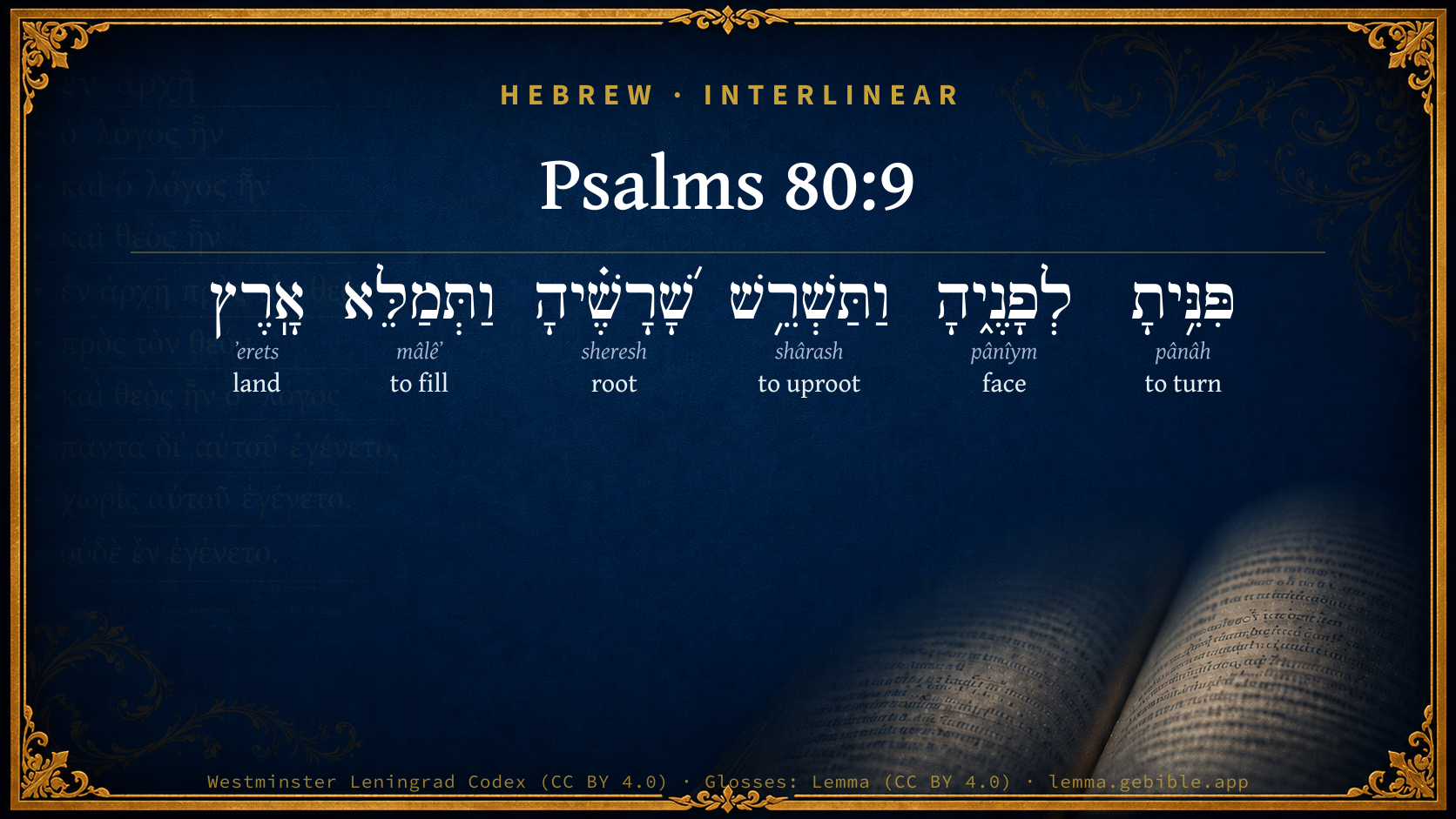
Hebrew (Westminster Leningrad Codex) Psalms 80:9 appears in the Hebrew Old Testament. The text above is from the Westminster Leningrad Codex. Each word links to its Strong’s number, a concise gloss, and parsing drawn from the Open Scriptures Hebrew Bible morphology. Click any word for its full Brown-Driver-Briggs (BDB) entry.
Download image
Cite this verse

Psalms 80:9 (World English Bible). Public Domain. Lemma interlinear Bible study tool, https://lemma.gebible.app/v/psalms/80/9.

Show BibTeX & RIS
BibTeX
RIS
English Translation
You cleared the ground for it. It took deep root, and filled the land.
World English Bible · Public Domain
Download a study sheet

One document with this verse’s original text, its word-by-word gloss line, the meaning frame, cross-references with their text, attributed commentary, and full source and license credits — printable, and it pastes into notes with its structure intact.

This verse Autodidact and up

Study sheet (.html) Plain text (.txt)

A passage Seminary Student

Up to 50 verses in one chapter. A passage sheet keeps up to 6 commentary sources and 12 cross-references per verse, in the order this page ranks them, and says so on the sheet whenever that leaves anything out. Ask for a single verse and you get the Autodidact verse sheet above.

Everything on this page stays free to read, with no account — the sheet is a download of what is already on screen, not access to it.

Want to remove ads? Support Godless Engineer
Compare translations 3

The same verse in 3 English versions, stacked beneath the original-language interlinear above. Click any original word for its lexicon entry.

Each is an independent rendering of the whole verse — the interlinear is not word-aligned to these translations.

Highlighted words mark where these versions differ — a whole-verse word diff, not a word-by-word alignment.

  • World English Bible Public Domain
    You cleared the ground for it. It took deep root, and filled the land.
  • King James Version Public Domain
    Thou preparedst room before it, and didst cause it to take deep root, and it filled the land.
  • unfoldingWord Literal Text CC BY-SA 4.0
    You cleared to the face of it, and it rooted its roots and filled the land.

unfoldingWord Literal Text — © unfoldingWord, licensed CC BY-SA 4.0. Word-aligned USFM3 via Door43 (git.door43.org/unfoldingWord/en_ult).

Versions to compare (up to 4)

3 of 4 selected

Show all 18 translations

Every available English version of this verse, each an independent rendering of the whole verse.

  • World English Bible Public Domain
    You cleared the ground for it. It took deep root, and filled the land.
  • Berean Standard Bible Public Domain
    You cleared the ground for it, and it took root and filled the land.
  • Majority Standard Bible Public Domain
    You cleared the ground for it, and it took root and filled the land.
  • King James Version Public Domain
    Thou preparedst room before it, and didst cause it to take deep root, and it filled the land.
  • American Standard Version (1901) Public Domain
    Thou preparedst `room' before it, And it took deep root, and filled the land.
  • Revised Version (1885) Public Domain
    Thou preparedst room before it, and it took deep root, and filled the land.
  • Geneva Bible (1599) Public Domain
    Thou madest roume for it, and didest cause it to take roote, and it filled the land.
  • Douay-Rheims (1899) Public Domain
    Thou hast brought a vineyard out of Egypt: thou hast cast cut the Gentiles and planted it.
  • Young's Literal Translation Public Domain
    Thou hast looked before it, and dost root it, And it filleth the land,
  • Literal Standard Version CC BY-SA 4.0
    You have looked before it, and root it, || And it fills the land,
  • Unlocked Literal Bible CC BY-SA 4.0
    You cleared the land for it; it took root and filled the land.
  • unfoldingWord Literal Text CC BY-SA 4.0
    You cleared to the face of it, and it rooted its roots and filled the land.
  • Darby Bible Public Domain
    Thou preparedst space before it, and it took deep root, and filled the land;
  • World Messianic Bible Public Domain
    You cleared the ground for it. It took deep root, and filled the land.
  • Webster's Bible Public Domain
    \\80:8\\Thou hast brought a vine out of Egypt: thou hast cast out the heathen, and planted it.
  • Free Bible Version CC BY-SA 4.0
    You prepared the ground for the vine. It took root and filled the land.
  • Bible in Basic English Public Domain
    You made ready a place for it, so that it might take deep root, and it sent out its branches over all the land.
  • JPS Tanakh (1917) Public Domain
    (80-10) Thou didst clear a place before it, and it took deep root, and filled the land.

Literal Standard Version (2020), Covenant Press — licensed CC BY-SA 4.0. Text via the HelloAO Bible API (eBible.org). Unlocked Literal Bible (unfoldingWord) — licensed CC BY-SA 4.0. Text via the HelloAO Bible API (eBible.org). unfoldingWord Literal Text — © unfoldingWord, licensed CC BY-SA 4.0. Word-aligned USFM3 via Door43 (git.door43.org/unfoldingWord/en_ult). Free Bible Version, Dr. Jonathan Gallagher — licensed CC BY-SA 4.0. Text via the HelloAO Bible API (eBible.org).

Word by word

More ways to search: Search by grammar → Find every occurrence → Compare this word →

Practice this passage: Drill this verse → Learn its vocabulary →

וַתַּשְׁרֵ֥שׁ
shârash
H8327
“and · to uproot”
Conjunction + Verb, Hiphil, Sequential Imperfect, 3rd Person, Feminine, Singular
Part of Speech
Conjunction + Verb
Stem
Hiphil
Form
Sequential Imperfect
Person
3rd Person
Gender
Feminine
Number
Singular
Full BDB Definition

Origin: a primitive root

TWOT: 2471

to uproot, take root, deal with the roots - (Piel) to root up, root out - (Pual) to be rooted up or out (of produce) - (Poel) to take root - (Poal) to take root - (Hiphil) to take root, cause to take root
  1. פִּנִּ֥יתָ pânâh H6437 “to turn” Verb, Piel, Perfect, 2nd Person, Masculine, Singular
  2. לְפָנֶ֑יהָ pânîym H6440 “to/for · face(s) · her” Preposition + Noun, Common, Both, Plural, Construct + Suffix, Personal, 3rd Person, Feminine, Singular
  3. שָׁ֝רָשֶׁ֗יהָ sheresh H8328 “roots · her” Noun, Common, Masculine, Plural, Construct + Suffix, Personal, 3rd Person, Feminine, Singular
  4. וַתְּמַלֵּא mâlêʼ H4390 “and · to fill” Conjunction + Verb, Piel, Sequential Imperfect, 3rd Person, Feminine, Singular
  5. אָֽרֶץ ʼerets H776 “land” Noun, Common, Both, Singular, Absolute

About this verse

These counts appear in no published source. They are computed here, from the morphology-tagged text and Lemma’s own curated glosses. What Lemma adds →

6
words
6
distinct lemmas
Wisdom
section

Notable vocabulary

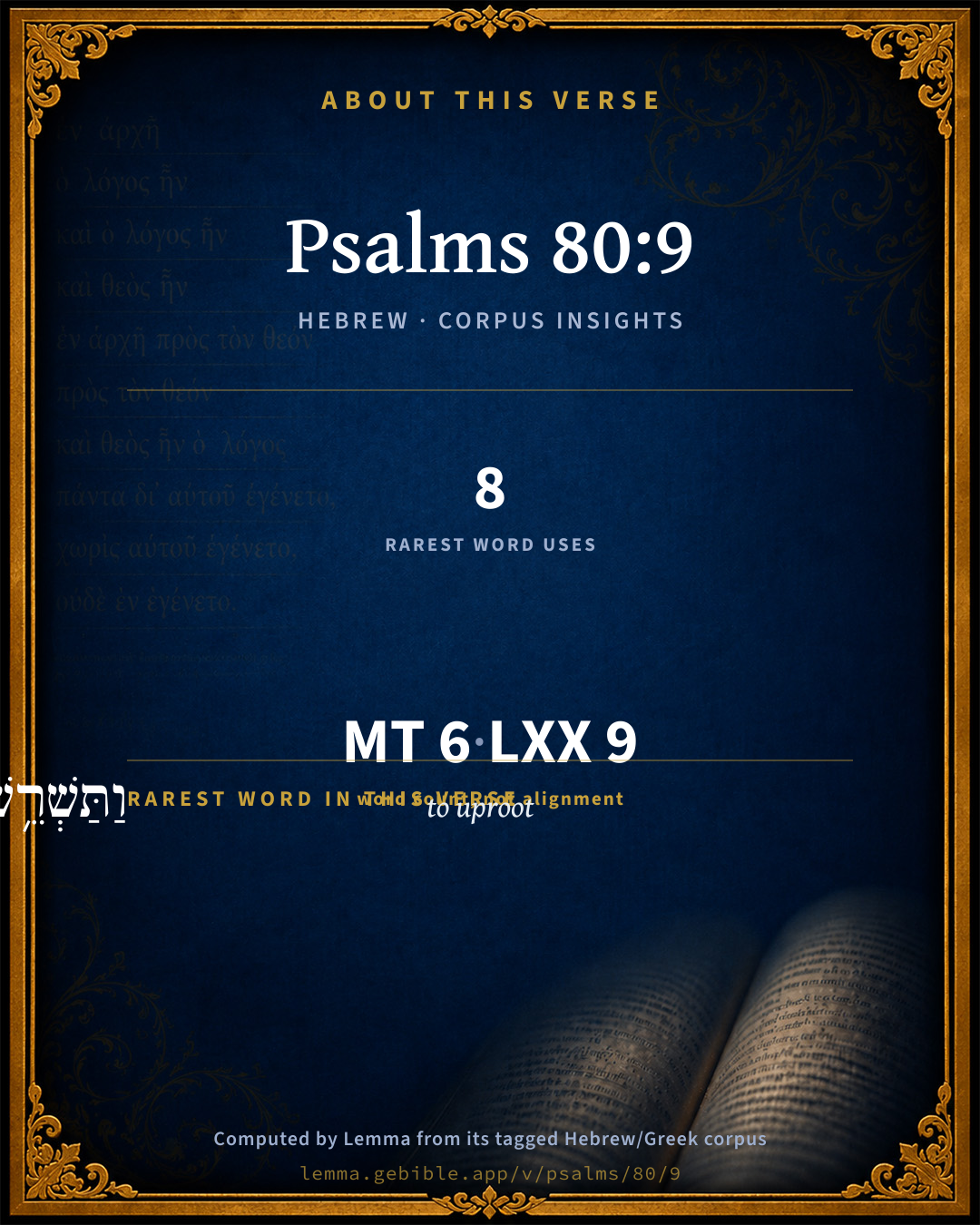
The rarest word here is וַתַּשְׁרֵ֥שׁ to uproot H8327 — appearing just 8 times in the whole Hebrew Bible.

Shared distinctive vocabulary

וַתַּשְׁרֵ֥שׁ to uproot H8327 occurs in 8 verses of the Hebrew Bible. Also found in:

Grammatical profile

  • 3 verbs
  • 3 nouns

Verb forms

  • פִּנִּ֥יתָ Piel · Perfect
  • וַתַּשְׁרֵ֥שׁ Hiphil · Sequential Imperfect
  • וַתְּמַלֵּא Piel · Sequential Imperfect

Hebrew & Septuagint length

In English translation the verse runs 14 words from the Hebrew and 20 from the Septuagint (LXX English) — closely comparable.

A rough comparison of the two English renderings, which tokenize alike — not a word-level alignment.

Word counts can differ between the Hebrew and the Greek without any difference in meaning — e.g. the Hebrew direct-object marker אֵת has no separate Greek word, and Greek often adds the article ὁ.

In the original languages it is 6 Hebrew tokens and 9 Greek tokens — but the two are counted differently (Hebrew bundles its prefixes and suffixes into one token; the Greek is in lemma form), so that isn’t a like-for-like length.

Cross-references

12

Topical passages linked to Psalms 80:9 in the Treasury of Scripture Knowledge — connected by theme and wording, ordered by reader-vote popularity; previews shown in the World English Bible.

  • Joshua 24:12 I sent the hornet before you, which drove them out from before you, even the two kings of the Amorites; not with your sword, nor with your bow.
  • Exodus 23:28–30 I will send the hornet before you, which will drive out the Hivite, the Canaanite, and the Hittite, from before you.
  • Isaiah 27:6 In days to come shall Jacob take root; Israel shall blossom and bud; and they shall fill the surface of the world with fruit.
  • Joshua 23:13–15 know for a certainty that Yahweh your God will no more drive these nations from out of your sight; but they shall be a snare and a trap to you, and a scourge in your sides, and thorns in your eyes, until you perish from off this good land which Yahweh your God has given you.
  • 1 Kings 4:20 Judah and Israel were many as the sand which is by the sea in multitude, eating and drinking and making merry.
  • 1 Kings 4:25 Judah and Israel lived safely, every man under his vine and under his fig tree, from Dan even to Beersheba, all the days of Solomon.
  • 1 Chronicles 21:5 Joab gave up the sum of the numbering of the people to David. All those of Israel were one million one hundred thousand men who drew sword: and in Judah were four hundred seventy thousand men who drew sword.
  • 1 Chronicles 27:23–24 But David didn't take the number of them from twenty years old and under, because Yahweh had said he would increase Israel like the stars of the sky.
  • Nehemiah 9:22–25 Moreover you gave them kingdoms and peoples, which you did allot after their portions: so they possessed the land of Sihon, even the land of the king of Heshbon, and the land of Og king of Bashan.
  • Psalms 105:44 He gave them the lands of the nations. They took the labor of the peoples in possession,
  • Isaiah 37:31 The remnant that is escaped of the house of Judah shall again take root downward, and bear fruit upward.
  • Jeremiah 12:2 You have planted them, yes, they have taken root; they grow, yes, they bring forth fruit: you are near in their mouth, and far from their heart.

Cross-references courtesy of OpenBible.info (CC BY 4.0).

Hebrew and Greek witnesses Masoretic Hebrew ↔ Greek Septuagint

The same verse in the two great witnesses to the Old Testament, shown verse-for-verse.

You’re reading Greek Psalm 79 (Hebrew Psalm 80). The Septuagint counts the superscription, so verse numbers can differ from the Hebrew — chapter-level alignment, not verse-by-verse. Numbering follows Rahlfs.

These are two independent witnesses, not word-aligned to each other, and the Septuagint is shown in lemma (dictionary) form.

Hebrew Psalms 80:9 Masoretic · Westminster Leningrad Codex

פִּנִּ֥יתָ לְפָנֶ֑יהָ וַתַּשְׁרֵ֥שׁ שָׁ֝רָשֶׁ֗יהָ וַתְּמַלֵּא אָֽרֶץ

You cleared the ground for it. It took deep root, and filled the land.

World English Bible · Public Domain

Greek LXX Greek Psalm 79:9 Septuagint · lemma form

ἄμπελος ἐκ αἴγυπτος μετααἴρω ἐκβάλλω ἔθνος καί καταφυτεύω αὐτός

You made a way before it, and did cause its roots to strike, and the land was filled with it.

LXX2012 (modern English Septuagint) · Public Domain

Hebrew: Westminster Leningrad Codex (CC BY 4.0). Greek: Septuagint (public domain); English from LXX2012 (modern English Septuagint) (Public Domain). How the Septuagint differs from the Hebrew →

Commentary

Notes on Psalms 80:9 from classic Christian and Jewish commentators (each source and its license shown beneath its notes). The classic Christian expositions comment on the surrounding passage and are grouped to its opening verse, so a note may address several verses; the Jewish commentaries on the Tanakh (Rashi and others) are per-verse, so they appear only where the commentator wrote on this verse.

Lemma curates 59 commentaries, every one of them public domain or Creative Commons licensed, each selected and text-cleaned for this edition rather than reprinted as found. About our sources →

Trapp's Complete Commentary

John Trapp

Psa 80:9 Thou preparedst [room] before it, and didst cause it to take deep root, and it filled the land.

Ver. 9. Thou preparedst room before it] Espying out a fit place to plant it in, Eze 20:6, and making clean work before it, as some render the words ( Expurgasti coram ea), by pulling up those bad and barren weeds, the Canaanites, that might have hindered its growth.

And didst cause it to take deep root] viz. By thy digging, dressing, watering, and mounding it; as of all possessions, none requireth greater care than that of vineyards, saith Care; and there is a peculiar affection in men toward the vine above all trees, as another observeth.

John Trapp, A Commentary or Exposition upon All the Books of the Old and New Testament (1647–1656) — public domain. Text from a community e-Sword module.

J. A. Alexander on Psalms

Joseph Addison Alexander

10. (Psa 80:9) Thou didst clear (the way) before it, and it took root and filled the land. The first word means to clear by the removal of obstructions. See Gen 24:31, Lev 14:36, and compare my notes on Isa 40:3; Isa 57:14; Isa 62:10. The sense may here be, thou didst clear (the ground), i.e. from weeds and stones (compare Isa 5:2) before it, i.e. to make room for it or prepare a place for it. Took root, literally rooted its roots, the cognate verb and noun being combined by a common Hebrew idiom. See my note on Isa 27:6.

Joseph Addison Alexander, The Psalms Translated and Explained (1850) — public domain. Text from a community e-Sword module.

Adam Clarke's Commentary

Verse 9. Thou preparedst - before it] 3. When the ground is properly cleared, then it is well digged and manured, and the vines are placed in the ground at proper distances, c. So when God had cast out the heathen, he caused the land to be divided by lot to the different tribes, and then to the several families of which these tribes were composed.

And didst cause it to take deep root] 4. By sheltering, propping up, and loosening the ground about the tender plants, they are caused to take a deep and firm rooting in the ground. Thus did God, by especial manifestations of his kind providence, support and protect the Israelites in Canaan and by various religious ordinances, and civil institutions, he established them in the land; and, by the ministry of priests and prophets, did every thing necessary to make them morally fruitful.

It filled the land.] 5. To multiply vines, the gardener cuts off a shoot from the old tree, leaving a joint or knob both at top and bottom; then plants it in proper soil; the lower knob furnishes the roots, and the upper the shoot, which should be carefully trained as it grows, in order to form another vine. By these means one tree will soon form a complete vineyard, and multiply itself to any given quantity. Thus God so carefully, tenderly, and abundantly blessed the Israelites, that they increased and multiplied; and, in process of time, filled the whole land of Canaan. Vines are propagated, not only by cuttings, but by layers, seed, grafting, and inoculation.

Adam Clarke's Commentary on the Bible (1810–1826) — public domain. Text from a community e-Sword/MySword module.

Ellicott's Commentary for English Readers

(9) Thou preparedst room.—The reference is, of course, to the casting out of the heathen in Psa_80:8.

Didst cause . . .—Rather, it struck its roots deep; literally, rooted its roots.

A Bible Commentary for English Readers, edited by Charles John Ellicott (1878–1897) — public domain. Text from a community e-Sword module.

The Cambridge Bible for Schools and Colleges

gen. ed. J. J. S. Perowne

9. Thou preparedst room before it] As the vinedresser prepares the ground for his vine by clearing away the stones and thorns and all that would hinder its free growth (Isa_5:2), so God prepared Canaan for Israel by the expulsion of its old inhabitants.

and didst cause it &c.] Rather, and it struck deep its roots, and filled the land.

The Cambridge Bible for Schools and Colleges (gen. ed. J. J. S. Perowne; Cambridge University Press, 1878–1918) — public domain. Text from a community e-Sword module.

John Gill's Exposition

The hills were covered with the shadow of it,.... Alluding to the land of Canaan, which was a mountainous and hilly country, at least some part of it; hence we read of the hill country of Judea, Luk 1:39 and to the nature of vines, which delight to grow on hills and mountains (p): in a figurative sense this may denote the subjection of kings and kingdoms, comparable to hills, to the Israelites in the times of David and Solomon, Sa2 8:1 and the exaltation of the church of Christ, in the latter day, over the hills and mountains, Isa 2:2. The Targum is,

"the mountains of Jerusalem were covered with the shadow of the house of the sanctuary, and of the houses of the schools:''

and the boughs thereof were like the goodly cedars; to these the righteous are compared, Psa 92:13, the Targum is,

"the doctors, the mighty preachers, who are like to the strong cedars:''

the words may be rendered, "the boughs thereof cover the goodly cedars", or "cedars of God" (q); that is, overrun and overtop the goodly cedars; alluding to vines running and growing upon high and goodly trees; and so may denote, as before, the power of Israel over the princes and potentates of the earth, comparable to cedars, the most excellent; as things most excellent have often the name of God added to them; see Psa 104:16.

(p) "Bacchus amat colles----" Virgil Georgic. l. 2. v. 113. (q) "rami ejus cedros Dei", Tigurine version; so Sept. "et ramia ejus cedri Dei", Musculus, Cocceius; "palmitibus ejus cedri altissimae operiebantur", Piscator, De Dieu; "ramis ejus opertae sunt cedri Dei", Michaelis.

John Gill's Exposition of the Whole Bible (1746–1763) — public domain (CC PDM 1.0). Text via the HelloAO Bible API.

Albert Barnes' Notes on the Bible

Thou preparedst room before it - The Hebrew word used here means properly to turn; to turn the back; then, to turn in order to look at anything; to look upon; to see; then, in Piel, to cause to turn away; to remove. Then it comes to mean to remove, or to clear from impediments so as to prepare a way Isa 40:3; Isa 57:14; Isa 62:10; Mal 3:1, and hence, to remove the impediments to planting a vine, etc.; to wit, by clearing away the trees, brush, stones, etc. Compare Isa 5:2. Here it means that the hindrances in planting the vine were taken out of the way; that is, God removed the pagan so that there was room then to establish his own people.

And didst cause it to take deep root - Hebrew, “And didst cause it to root roots;” that is, Its roots struck deep into the soil, and the plant became firm.

And it filled the land - Its branches ran everywhere, so as to fill the whole land. See the notes at Isa 16:8.

Albert Barnes' Notes on the Bible (1834–1885) — public domain. Text from a community e-Sword/MySword module.

Matthew Poole's English Annotations

Thou preparedst room; or, didst purge or cleanse the soil; taking out stones or sticks, or other roots or plants, which might hinder its growth or fruitfulness. Thou didst root out those idolatrous and wicked nations which might either corrupt or destroy them.

Didst cause it to take deep root; thou gavest them a firm settlement in that land.

Matthew Poole's English Annotations on the Holy Bible (1683–1685) — public domain. Text from a community e-Sword/MySword module.

The Treasury of David

Charles H. Spurgeon

Ver. 9. "Thou preparedst room before it." The weeds, brambles, and huge stones were cleared; the Amorites, and their brethren in iniquity, were made to quit the scene, their forces were routed, their kings slain, their cities captures, and Canaan became like a plot of land, made ready for a vineyard.

"And didst cause it to take deep root, and it filled the land." Israel became settled and established as a vine well rooted, and then it began to flourish and to spread to every side. This analogy might be applied to the experience of every believer in Jesus. The Lord has planted us, we are growing downward, "rooting roots, "and by his grace we are also advancing in manifest enlargement. The same is true of the church in a yet closer degree, for at this moment through the goodwill of the dresser of the vineyard her branches spread far and wide.

Charles H. Spurgeon's The Treasury of David (1869–1885) — public domain. Psalms only. Text from a community e-Sword/MySword module.

Whedon's Commentary on the Bible

Daniel D. Whedon

9. Thou preparedst room before it—This Hebrew vine came not to an unprepared place. The miracles of Egypt and the wilderness had caused the terror of God to fall upon the corrupt nations, and multitudes had fled from their country. The rest were cast out for their abominations. The Israelites entered the land in the opportune month, the forepart of April, just before harvest, (Jos_3:15; Jos_5:10; Jos_5:12,) and the land was full of supplies. For the force of the word prepare, see Gen_24:31; Isa_40:3; Mal_3:1

Daniel D. Whedon (gen. ed.), Commentary on the Old and New Testaments (1874–1909) — public domain. Text from a community e-Sword module.

The Pulpit Commentary

Thou preparest room before it. The "room" was made by the removal of the heathen inhabitants, who were first greatly weakened by Rameses III, and then driven out by Joshua. And didst cause it to take deep root; rather, and it took deep root, as in the Revised Version. And it filled the land. (comp. Deu_11:24 Jos_1:3) Possession was taken of the whole land, not at once, (Jud 1:27-36) but slowly and surely; the furthest limits being reached in David"s time. (1Ki_4:21, 1Ki_4:24)

The Pulpit Commentary (1880–1919), ed. H.D.M. Spence-Jones & Joseph S. Exell — public domain. Text from a community e-Sword module.

John Wesley's Explanatory Notes

Preparedst - Thou didst root out the idolatrous nations. Deep root - Thou gavest them a firm settlement.

John Wesley, Explanatory Notes Upon the Whole Bible (1754–1765) — public domain. Text via the GEBible commentary corpus.

unfoldingWord translationNotes

Door43 World Missions Community

General Information:

Asaph continues speaking of Israel in their land as if Israel were a grapevine in a vineyard. (See: Metaphor)

You cleared the land for it

"You cleared the land for the vine"

it took root

"the vine took root" or "the vine began to grow"

filled the land

"its branches covered the land"

The mountains were covered with its shade, the cedars of God by its branches

This can be stated in active form. AT: "Its shade covered the mountains, its branches the cedars of God" (See: Active or Passive)

the cedars of God by its branches

"and the cedars of God were covered by its branches," which copies the verb from the previous sentence. This can be stated in active form. AT: "and its branches covered the cedars of God" (See: Ellipsis and Active or Passive)

cedars of God

Possible meanings are 1) "the highest cedar trees," the cedar trees that grew on the "mountains" in the land of Lebanon north of Israel, or 2) "God's own cedar trees."

the sea

the Mediterranean Sea to the west of Israel

shoots

the parts of new plants that are just starting to grow above the ground

translationWords

cedar

send

Euphrates River

unfoldingWord translationNotes — © Distant Shores Media and the Door43 World Missions Community, licensed CC BY-SA 4.0. Source: git.door43.org/Door43/en_tn.

Rashi

Rabbi Shlomo Yitzchaki (Rashi)

You uprooted a vine from Egypt He went back and alluded to the exile of the Romans. The vine of Israel, which You uprooted from Egypt. You uprooted them from there, as (Job 19:10): “He has uprooted (ויסע) my hope like a tree.” Afterwards, You drove out the seven nations and planted Israel in their land.

Rashi on the Tanakh — English translations: “The Judaica Press complete Tanach with Rashi, translated by A. J. Rosenberg” (CC BY 4.0); “Pentateuch with Rashi's commentary by M. Rosenbaum and A.M. Silbermann, 1929-1934” (public domain); “The Metsudah Tanach series, Lakewood, N.J” (CC BY 4.0); and “The Book of Joshua, Metsudah Publications, 1997” (CC BY 4.0). Text via Sefaria.

Lesson kit

Teaching starters — assembled from the data on this page, not authored interpretation. Every prompt links to the verse data it draws on. Edit before teaching.

Psalms, in the Wisdom, opens this verse with 6 words (6 distinct Hebrew lemmas). Its most distinctive word is shârash (“to uproot”). A historical commentator’s framing appears above. Read the whole chapter for the surrounding context.

Discussion questions

  1. What does “to uproot” (shârash) contribute to the verse as a whole?
  2. How does Job 5:3, which shares the word «to uproot», read alongside this verse?
  3. The translations on this page render this verse differently — a whole-verse word diff, not a word-by-word alignment. What might account for the different wordings?
  4. «פִּנִּ֥יתָ» is a Piel Perfect verb. How does that grammatical form shape the action described?
  5. Compare how Trapp's Complete Commentary and J. A. Alexander on Psalms read this verse. Where do they agree or differ?

Things to notice

Reading settings

Reading text

Shown beneath each verse's original-language words.

Old Testament
Old Testament edition

Read the OT as the Masoretic Hebrew (MT) or the Greek Septuagint (LXX).

English shown for the Greek Septuagint (in the Hebrew ↔ Greek comparison).

Comparing translations? Open the Compare panel on any verse page to stack up to four side by side.