Jeremiah 49:8

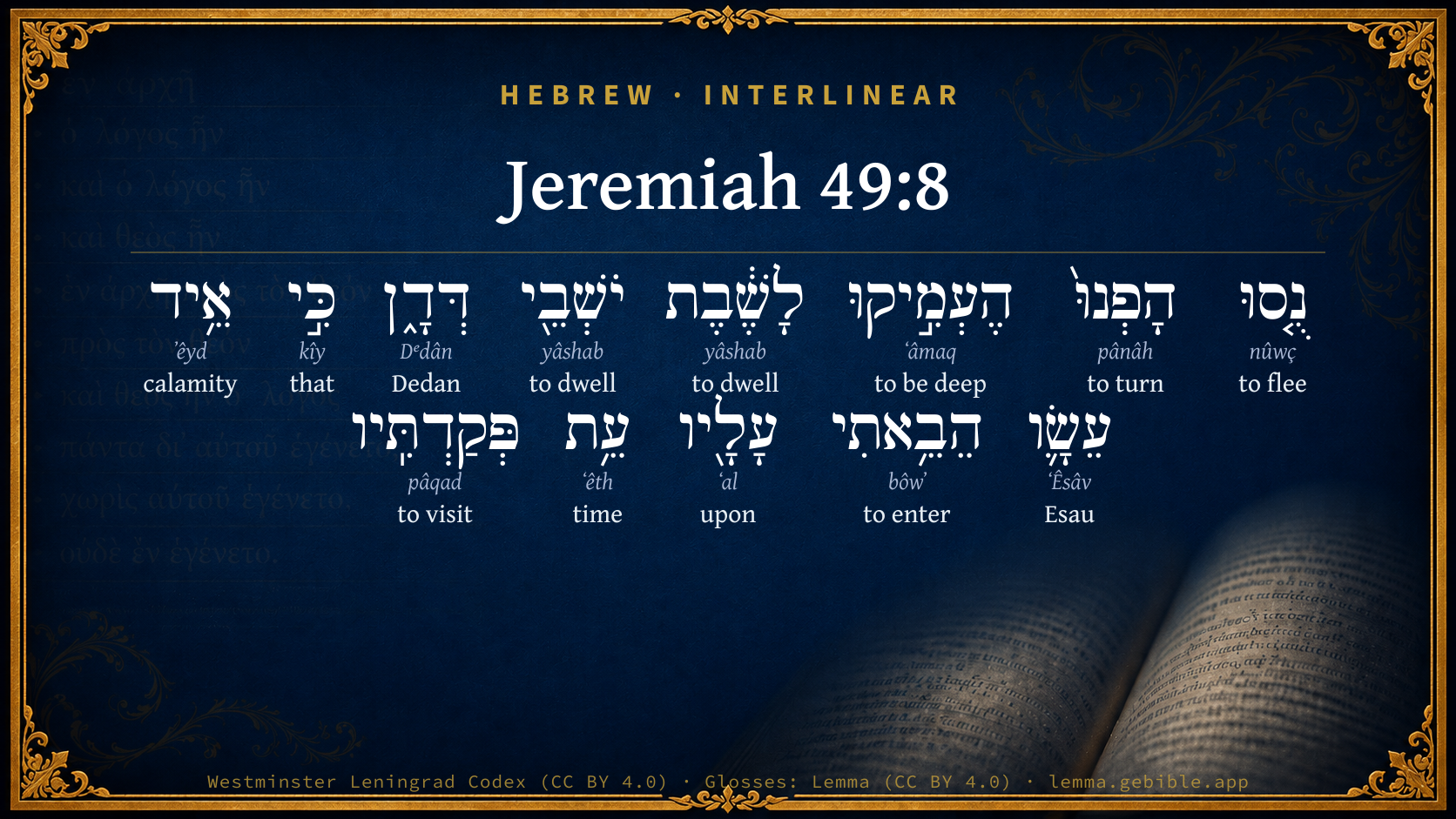
Hebrew (Westminster Leningrad Codex) Jeremiah 49:8 appears in the Hebrew Old Testament. The text above is from the Westminster Leningrad Codex. Each word links to its Strong’s number, a concise gloss, and parsing drawn from the Open Scriptures Hebrew Bible morphology. Click any word for its full Brown-Driver-Briggs (BDB) entry.
Download image
Cite this verse

Jeremiah 49:8 (World English Bible). Public Domain. Lemma interlinear Bible study tool, https://lemma.gebible.app/v/jeremiah/49/8.

Show BibTeX & RIS
BibTeX
RIS
English Translation
Flee you, turn back, dwell in the depths, inhabitants of Dedan; for I will bring the calamity of Esau on him, the time that I shall visit him.
World English Bible · Public Domain
Download a study sheet

One document with this verse’s original text, its word-by-word gloss line, the meaning frame, cross-references with their text, attributed commentary, and full source and license credits — printable, and it pastes into notes with its structure intact.

This verse Autodidact and up

Study sheet (.html) Plain text (.txt)

A passage Seminary Student

Up to 50 verses in one chapter. A passage sheet keeps up to 6 commentary sources and 12 cross-references per verse, in the order this page ranks them, and says so on the sheet whenever that leaves anything out. Ask for a single verse and you get the Autodidact verse sheet above.

Everything on this page stays free to read, with no account — the sheet is a download of what is already on screen, not access to it.

Want to remove ads? Support Godless Engineer
Compare translations 3

The same verse in 3 English versions, stacked beneath the original-language interlinear above. Click any original word for its lexicon entry.

Each is an independent rendering of the whole verse — the interlinear is not word-aligned to these translations.

Highlighted words mark where these versions differ — a whole-verse word diff, not a word-by-word alignment.

  • World English Bible Public Domain
    Flee you, turn back, dwell in the depths, inhabitants of Dedan; for I will bring the calamity of Esau on him, the time that I shall visit him.
  • King James Version Public Domain
    Flee ye, turn back, dwell deep, O inhabitants of Dedan; for I will bring the calamity of Esau upon him, the time that I will visit him.
  • unfoldingWord Literal Text CC BY-SA 4.0
    Flee! Turn back! Stay in holes in the ground, inhabitants of Dedan. For I am bringing the disaster of Esau on him at the time that I punish him.

unfoldingWord Literal Text — © unfoldingWord, licensed CC BY-SA 4.0. Word-aligned USFM3 via Door43 (git.door43.org/unfoldingWord/en_ult).

Versions to compare (up to 4)

3 of 4 selected

Show all 18 translations

Every available English version of this verse, each an independent rendering of the whole verse.

  • World English Bible Public Domain
    Flee you, turn back, dwell in the depths, inhabitants of Dedan; for I will bring the calamity of Esau on him, the time that I shall visit him.
  • Berean Standard Bible Public Domain
    Turn and run! Lie low, O dwellers of Dedan, for I will bring disaster on Esau at the time I punish him.
  • Majority Standard Bible Public Domain
    Turn and run! Lie low, O dwellers of Dedan, for I will bring disaster on Esau at the time I punish him.
  • King James Version Public Domain
    Flee ye, turn back, dwell deep, O inhabitants of Dedan; for I will bring the calamity of Esau upon him, the time that I will visit him.
  • American Standard Version (1901) Public Domain
    Flee ye, turn back, dwell in the depths, O inhabitants of Dedan; for I will bring the calamity of Esau upon him, the time that I shall visit him.
  • Revised Version (1885) Public Domain
    Flee ye, turn back, dwell deep, O inhabitants of Dedan; for I will bring the calamity of Esau upon him, the time that I shall visit him.
  • Geneva Bible (1599) Public Domain
    Flee, ye inhabitants of Dedan ( they are turned backe, and haue consulted to dwell) for I haue brought the destruction of Esau vpon him, and the time of his visitation.
  • Douay-Rheims (1899) Public Domain
    Flee and turn your backs, go down into the deep hole, ye inhabitants of Dedan: for I have brought the destruction of Esau upon him, the time of his visitation.
  • Young's Literal Translation Public Domain
    Flee, turn, go deep to dwell, ye inhabitants of Dedan, For the calamity of Esau I brought in upon him, The time I inspected him.
  • Literal Standard Version CC BY-SA 4.0
    Flee, turn, go deep to dwell, you inhabitants of Dedan, || For I brought the calamity of Esau on him, || The time I inspected him.
  • Unlocked Literal Bible CC BY-SA 4.0
    Flee! Turn back! Stay in holes in the ground, inhabitants of Dedan. For I am bringing the disaster of Esau on him at the time that I punish him.
  • unfoldingWord Literal Text CC BY-SA 4.0
    Flee! Turn back! Stay in holes in the ground, inhabitants of Dedan. For I am bringing the disaster of Esau on him at the time that I punish him.
  • Darby Bible Public Domain
    Flee, turn back, dwell deep down, ye inhabitants of Dedan! For I will bring the calamity of Esau upon him, the time that I visit him.
  • World Messianic Bible Public Domain
    Flee! Turn back! Dwell in the depths, inhabitants of Dedan; for I will bring the calamity of Esau on him when I visit him.
  • Webster's Bible Public Domain
    Flee ye, turn back, dwell deep, O inhabitants of Dedan; for I will bring the calamity of Esau upon him, the time that I will visit him.
  • Free Bible Version CC BY-SA 4.0
    Turn and run away! Find somewhere to hide, people of Dedan, because I'm bringing disaster down on you descendants of Esau when I punish you.
  • Bible in Basic English Public Domain
    Go in flight, go back, take cover in deep places, you who are living in Dedan; for I will send the fate of Edom on him, even the time of his punishment.
  • JPS Tanakh (1917) Public Domain
    Flee ye, turn back, dwell deep, O inhabitants of Dedan; For I do bring the calamity of Esau upon him, the time that I shall punish him.

Literal Standard Version (2020), Covenant Press — licensed CC BY-SA 4.0. Text via the HelloAO Bible API (eBible.org). Unlocked Literal Bible (unfoldingWord) — licensed CC BY-SA 4.0. Text via the HelloAO Bible API (eBible.org). unfoldingWord Literal Text — © unfoldingWord, licensed CC BY-SA 4.0. Word-aligned USFM3 via Door43 (git.door43.org/unfoldingWord/en_ult). Free Bible Version, Dr. Jonathan Gallagher — licensed CC BY-SA 4.0. Text via the HelloAO Bible API (eBible.org).

Word by word

More ways to search: Search by grammar → Find every occurrence → Compare this word →

Practice this passage: Drill this verse → Learn its vocabulary →

הֶעְמִ֣יקוּ
ʻâmaq
H6009
“be deep”
Verb, Hiphil, Imperative, 2nd Person, Masculine, Plural
Part of Speech
Verb
Stem
Hiphil
Form
Imperative
Person
2nd Person
Gender
Masculine
Number
Plural
Full BDB Definition

Origin: a primitive root

TWOT: 1644

to be deep, be profound, make deep - (Qal) to be deep - (Hiphil) to make deep, make profound
  1. נֻ֤סוּ nûwç H5127 “flee” Verb, Qal, Imperative, 2nd Person, Masculine, Plural
  2. הָפְנוּ֙ pânâh H6437 “turn” Verb, Hophal, Imperative, 2nd Person, Masculine, Plural
  3. לָשֶׁ֔בֶת yâshab H3427 “to dwell” Preposition + Verb, Qal, Infinitive Construct
  4. יֹשְׁבֵ֖י yâshab H3427 “dwelling” Verb, Qal, Participle Active, Masculine, Plural, Construct
  5. דְּדָ֑ן Dᵉdân H1719 “Dedan” Noun, Proper
  6. כִּ֣י kîy H3588 “that” Conjunction
  7. אֵ֥יד ʼêyd H343 “calamity of” Noun, Common, Masculine, Singular, Construct
  8. עֵשָׂ֛ו ʻÊsâv H6215 “Esau” Noun, Proper
  9. הֵבֵ֥אתִי bôwʼ H935 “to enter” Verb, Hiphil, Perfect, 1st Person, Common, Singular
  10. עָלָ֖יו ʻal H5921 “upon · him” Preposition + Suffix, Personal, 3rd Person, Masculine, Singular
  11. עֵ֥ת ʻêth H6256 “time” Noun, Common, Both, Singular, Absolute
  12. פְּקַדְתִּֽיו pâqad H6485 “to visit · him” Verb, Qal, Perfect, 1st Person, Common, Singular + Suffix, Personal, 3rd Person, Masculine, Singular

About this verse

These counts appear in no published source. They are computed here, from the morphology-tagged text and Lemma’s own curated glosses. What Lemma adds →

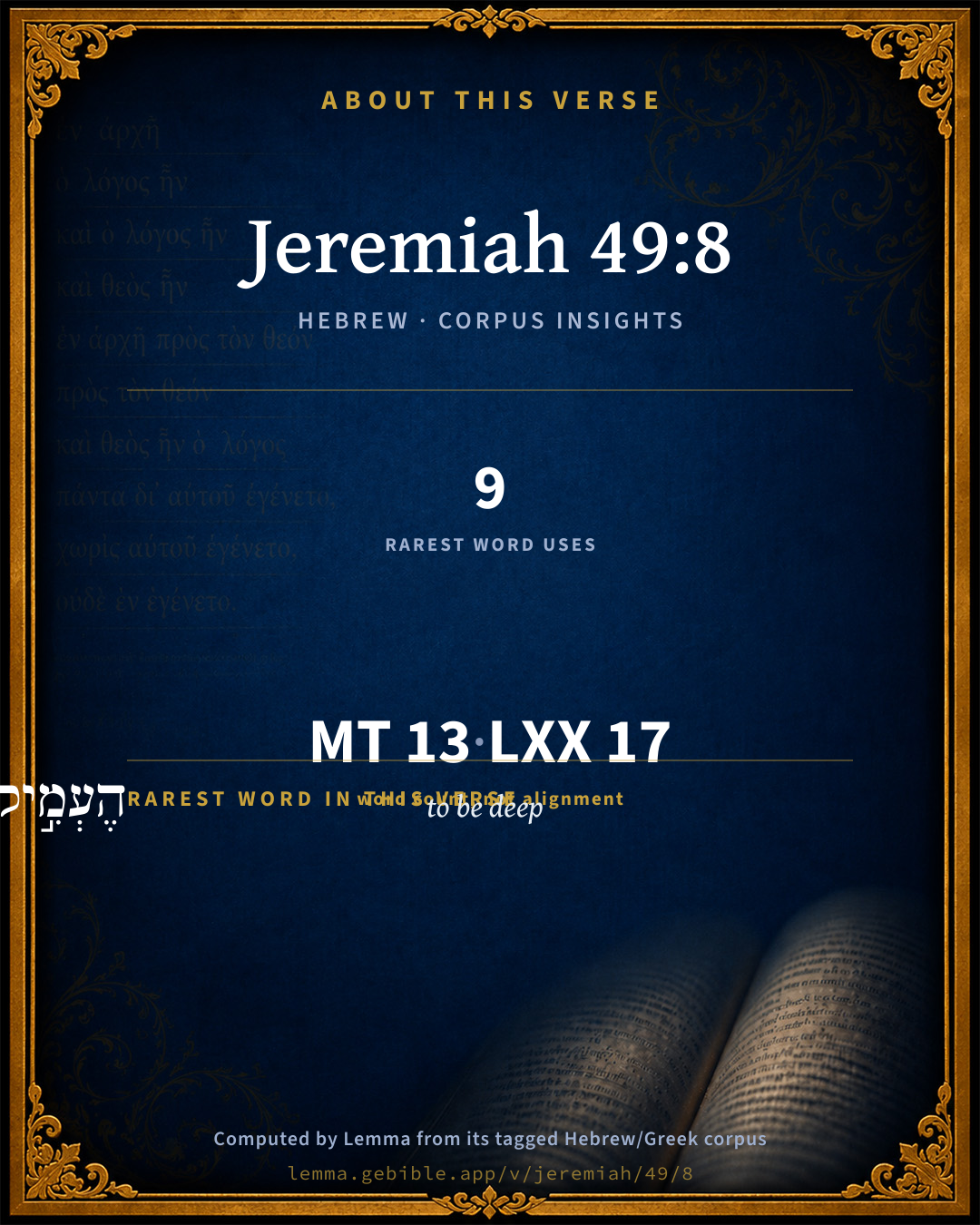
13
words
12
distinct lemmas
Prophets
section

Notable vocabulary

The rarest word here is הֶעְמִ֣יקוּ to be deep H6009 — appearing just 9 times in the whole Hebrew Bible.

Shared distinctive vocabulary

הֶעְמִ֣יקוּ to be deep H6009 occurs in 9 verses of the Hebrew Bible. Also found in:

Grammatical profile

  • 7 verbs
  • 4 nouns
  • 1 preposition
  • 1 conjunction

Verb forms

  • נֻ֤סוּ Qal · Imperative
  • הָפְנוּ֙ Hophal · Imperative
  • הֶעְמִ֣יקוּ Hiphil · Imperative
  • לָשֶׁ֔בֶת Qal · Infinitive Construct
  • יֹשְׁבֵ֖י Qal · Participle Active
  • הֵבֵ֥אתִי Hiphil · Perfect
  • פְּקַדְתִּֽיו Qal · Perfect

Repetition

A word recurs within this verse — often emphatic in Hebrew:

  • לָשֶׁ֔בֶת to dwell H3427 ×2

Hebrew & Septuagint length

In the original languages it is 13 Hebrew tokens and 17 Greek tokens — but the two are counted differently (Hebrew bundles its prefixes and suffixes into one token; the Greek is in lemma form), so that isn’t a like-for-like length.

Cross-references

18

Topical passages linked to Jeremiah 49:8 in the Treasury of Scripture Knowledge — connected by theme and wording, ordered by reader-vote popularity; previews shown in the World English Bible.

  • Jeremiah 25:23 Dedan, and Tema, and Buz, and all who have the corners [of their hair] cut off;
  • Jeremiah 46:21 Also her hired men in the midst of her are like calves of the stall; for they also are turned back, they are fled away together, they didn't stand: for the day of their calamity is come on them, the time of their visitation.
  • Isaiah 21:13 The burden on Arabia. In the forest in Arabia shall you lodge, you caravans of Dedanites.
  • Jeremiah 49:30 Flee you, wander far off, dwell in the depths, you inhabitants of Hazor, says Yahweh; for Nebuchadrezzar king of Babylon has taken counsel against you, and has conceived a purpose against you.
  • Judges 6:2 The hand of Midian prevailed against Israel; and because of Midian the children of Israel made them the dens which are in the mountains, and the caves, and the strongholds.
  • 1 Samuel 13:6 When the men of Israel saw that they were in a strait (for the people were distressed), then the people did hide themselves in caves, and in thickets, and in rocks, and in coverts, and in pits.
  • Isaiah 2:21 To go into the caverns of the rocks, And into the clefts of the ragged rocks, From before the terror of Yahweh, And from the glory of his majesty, When he arises to shake the earth mightily.
  • Jeremiah 6:1 Flee for safety, you children of Benjamin, out of the midst of Jerusalem, and blow the trumpet in Tekoa, and raise up a signal on Beth Haccherem; for evil looks forth from the north, and a great destruction.
  • Jeremiah 48:6 Flee, save your lives, and be like the heath in the wilderness.
  • Jeremiah 48:28 You inhabitants of Moab, leave the cities, and dwell in the rock; and be like the dove that makes her nest over the mouth of the abyss.
  • Jeremiah 48:44 He who flees from the fear shall fall into the pit; and he who gets up out of the pit shall be taken in the snare: for I will bring on him, even on Moab, the year of their visitation, says Yahweh.
  • Jeremiah 49:32 Their camels shall be a booty, and the multitude of their cattle a spoil: and I will scatter to all winds those who have the corners [of their hair] cut off; and I will bring their calamity from every side of them, says Yahweh.
  • Jeremiah 50:27 Kill all her bulls; let them go down to the slaughter: woe to them! for their day is come, the time of their visitation.
  • Lamentations 4:21–22 Rejoice and be glad, daughter of Edom, that dwell in the land of Uz: The cup shall pass through to you also; you shall be drunken, and shall make yourself naked.
  • Amos 9:1–3 I saw the Lord standing beside the altar, and he said, "Strike the tops of the pillars, that the thresholds may shake; and break them in pieces on the head of all of them; and I will kill the last of them with the sword: there shall not one of them flee away, and there shall not one of them escape.
  • Obadiah 1:3–4 The pride of your heart has deceived you, you who dwell in the clefts of the rock, whose habitation is high, who says in his heart, 'Who will bring me down to the ground?'
  • Matthew 24:15–18 "When, therefore, you see the abomination of desolation, which was spoken of through Daniel the prophet, standing in the holy place (let the reader understand),
  • Revelation 6:15 The kings of the earth, the princes, the commanding officers, the rich, the strong, and every slave and free person, hid themselves in the caves and in the rocks of the mountains.

Cross-references courtesy of OpenBible.info (CC BY 4.0).

Hebrew and Greek witnesses Masoretic Hebrew ↔ Greek Septuagint

The same verse in the two great witnesses to the Old Testament, shown verse-for-verse.

These are two independent witnesses, not word-aligned to each other, and the Septuagint is shown in lemma (dictionary) form.

Hebrew Jeremiah 49:8 Masoretic · Westminster Leningrad Codex

נֻ֤סוּ הָפְנוּ֙ הֶעְמִ֣יקוּ לָשֶׁ֔בֶת יֹשְׁבֵ֖י דְּדָ֑ן כִּ֣י אֵ֥יד עֵשָׂ֛ו הֵבֵ֥אתִי עָלָ֖יו עֵ֥ת פְּקַדְתִּֽיו

Flee you, turn back, dwell in the depths, inhabitants of Dedan; for I will bring the calamity of Esau on him, the time that I shall visit him.

World English Bible · Public Domain

Greek LXX Structure differs

In the Septuagint, Jeremiah is about an eighth shorter than the Hebrew and arranges its material differently — the Oracles Against the Nations (Hebrew chapters 46–51) appear in the middle of the Greek book, after 25:13. Because the chapter and verse boundaries do not line up, a verse-for-verse comparison with the Hebrew is not shown.

A verse-for-verse comparison isn’t shown here because the chapters and verses don’t line up. Switch to the LXX edition with the MT / LXX toggle above to read the Greek directly.

Hebrew: Westminster Leningrad Codex (CC BY 4.0). Greek: Septuagint (public domain); English from a public-domain English Septuagint. How the Septuagint differs from the Hebrew →

Targum (Aramaic paraphrase)

1

The Targum is the ancient Jewish Aramaic paraphrase of the Hebrew Scriptures — an interpretive translation, not the Hebrew text itself. Onkelos (literal) and Pseudo-Jonathan (expansive) render the Torah, and Jonathan the Prophets. Coverage is partial: where no permissively-licensed English translation exists for a verse, only the Aramaic is shown. This is verse-level text, not a word-by-word alignment to the Hebrew.

  1. Targum Jonathan Prophets (Joshua–Malachi)
    עֱרוֹקוּ גְלוּ אַרְחִיקוּ לְמִתַּב יַתְבֵי דְדָן אֲרֵי תְבִיר עֵשָׂו אַיְתֵיתִי עֲלוֹהִי עִדָן סְעוּדַת חוֹבוֹהִי:

    (no public-domain English translation for this verse)

    Targum Jonathan — Aramaic: “Mikraot Gedolot” (public domain). English: “Sefaria Community Translation” (CC0 1.0 (public-domain dedication)); “London "Chaldee Paraphrase," 1871” (public domain). Text via Sefaria.

Commentary

Notes on Jeremiah 49:8 from classic Christian and Jewish commentators (each source and its license shown beneath its notes). The classic Christian expositions comment on the surrounding passage and are grouped to its opening verse, so a note may address several verses; the Jewish commentaries on the Tanakh (Rashi and others) are per-verse, so they appear only where the commentator wrote on this verse.

Lemma curates 59 commentaries, every one of them public domain or Creative Commons licensed, each selected and text-cleaned for this edition rather than reprinted as found. About our sources →

Trapp's Complete Commentary

John Trapp

Jer 49:8 Flee ye, turn back, dwell deep, O inhabitants of Dedan; for I will bring the calamity of Esau upon him, the time [that] I will visit him.

Ver. 8. Dwell deep.] Hide yourselves in holes of the earth, grots in the ground, clefts of the rocks, where you may best secure yourselves from the pursuing enemy.

John Trapp, A Commentary or Exposition upon All the Books of the Old and New Testament (1647–1656) — public domain. Text from a community e-Sword module.

The Biblical Illustrator

Joseph S. Exell

Jer_49:8

Dwell deep, O inhabitants of Dedan.

Dwell deep, O Dedan

We do not quite know who these inhabitants of Dedan were, but in all probability they were some Arabian tribe or tribes. The text intends one of two things--either to inform these inhabitants of Dedan, that however deep in the cavernous rocks they should hide themselves, they would certainly be destroyed; or else it was a gracious warning to remove from Edom, strike their tents, and retreat into the depths of the wilderness, and so escape from the invaders.

I. Let us take it sarcastically. It is as though the prophet said to these Edomites, and those that dwelt with them, You think you never can be destroyed, for your city is situated in a rocky defile, where a handful of men can hold the pass. You suppose that the mightiest armies will fail to conquer you, and therefore you are very proud; but your pride is vain. Thy terribleness hath deceived thee, and the pride of thine heart, O thou that dwellest in the clefts of the rock, that holdest the height of the hill: though thou shouldest, make thy nest as high as the eagle, I will bring thee down from thence, saith the Lord. That word has been terribly fulfilled, for the ancient rock-city stands as a wonder to all travellers, and when they ride through it, which is not often, for it is with great difficulty that you reach the place at all, they find the city standing, but the houses desolate, and without inhabitants. Edom is a perpetual desolation, because of her sins:

1. From the text I hear a cry, like the stern voice of Elias, to every profane stoner who thinks that he will ultimately escape the wrath of God. Thou mayest dwell deep, O transgressor, but God shall find thee out. Thou sayest, How shall He reach me? The hand of death has only to be stretched out, and thou art HIS captive at once: and a little thing will do it--the wind has but to pass over thee, and thou art gone. A drop of blood may go the wrong way, a valve may refuse to open, a vessel may burst, a band may snap, and there thou liest, beneath Gods avenging hand, like a stag smitten by the hunter. Thou art dust, and a breath wilt scatter thee to the four winds. Thy spirit will be equally unable to escape from God. When it leaves this body, whither will it fly?

2. The same solemn warning may be applied to those who are self-righteous, and who think that they are forming a hiding-place for themselves You think that you will save yourselves by your works Ah! labour mightily; for hard must be your toil if you think to finish a righteousness of your own. In the very fire must you labour. You would make a dwelling for yourself as secure as the Rock of Ages? You had need build anxiously. I do not wonder that you are ill at ease. I wonder you have any peace, for the labours which you propose are more stupendous than those of Hercules! You would work miracles without the God of miracles! Vanity of vanities, all is vanity!

3. The same text, in the same way, might be applied to those who are hypocrites, and are practising secret sins while they yet wear the name of Christ, and are numbered amongst His people. Where are the deep places which can afford refuge to religious pretenders? Where shall liars conceal themselves? O hypocrite! it may be you have planned your sin so cleverly that the wife of your bosom does not know it: your scheme is so admirably cunning that you carry two faces, and yet no Christian sees other than that Christian mask of yours. Ah, sir! but you are a greater fool than I take you for, if you think you can deceive your God. Cast off your double-mindedness. Cease to do evil, learn to do well, for it is time to seek the Lord, and may God grant you His effectual grace that you may do so at once, ere He condemn you to the lowest hell.

II. But now we will use the text instructively, in which view, the first and natural sense would be, that the prophet warns the tribe of Dedan, who had come to live among the Edomites, to go away from them, and dwell in the depths of the wilderness; so that when the destroyer came, they might not participate in Edoms doom. It was the warning voice of mercy, separating its chosen from among the multitude of the condemned.

1. The people of God, like the tribes of Dedan, to some extent, dwell in Edom. Your business, your duty, is to come out from among them. Be ye separate, and touch not the unclean thing. Better go to heaven alone, than to hell in company. Better be true to God, with Abdiel, faithful among the faithless found, than win the applause of the crowd by great liberality and equal inconsistency. More important still, however, is the separation of every Christian from worldly habits, customs, and ways. Wherever you are, dear friend, though you must be in the world, take care that you be not of it. Dwelt deep in the solitudes where Jesus dwelt--in the lonely holiness which was fostered on the cold mountains side, and then shone resplendent amid temptation and persecution! Commit yourself unto no man; call no man master; lean on no arm of flesh; walk before the Lord in the land of the living, and so dwell deep, as did your Lord.

2. My earnest desire is that every saved soul among you may dwell deep, that is to say, that none of you may be superficial Christians, but that; you may be deep believers, well rooted plants of grace, thorough, downright, out-and-out Christians--that you may not only dwell in the Rock of Ages, but dwell deep in it. To this let me call your attention.

(1) It is highly important, beloved, that every one of us should have a deep sense of sin, and a profound horror of it. Oh, to loathe iniquity and see with self-abhorrence its heinous character; for so shall we prize the salvation of the Lord Jesus Christ, the love which thought it, the blood which bought it, and the grace which wrought it out!

(2) Should your convictions of sin be already deep, then seek to dwell deep as to your faith in Jesus Christ. The nearer to Jesus the more perfect our peace. The innermost place of the sanctuary is the most Divine.

(3) So would I have you dwell deep an the matter of Christian study. An instructed Christian is a more useful vessel of honour for the Master, than an ignorant believer.

(4) Above all things, and beyond all things, would I earnestly impress upon my beloved friends the need of deep living unto God. There is such a thing as flimsy living, in which you pray, and pray,--yes, but it is a superficial, routine exercise. Those who live only upon outward ordinances, and do not practise private devotion, and are not abundantly with God in secret communion--these do not dwell deep. Get to the roots of things. The gold mines of Scripture are not in the top soil, you must open a shaft; the precious diamonds of experience are not picked up in the roadway, their secret places are far down. Get down into the vitality, the solidity, the veracity, the divinity of the Word of God, and seek to possess with it all the inward work of the blessed Spirit.

3. If any inquire what are our reasons for bringing forward at this time such an exhortation as this, I will briefly answer them.

(1) It is well for us to dwell deep, because trials will surely come.

(2) Again, there is a necessity that you should dwell deep, for in these days many errors have gone abroad in the world, and many teachers of heresy and infidelity; and if you do not dwell deep, they will shake you terribly.

(3) Dwell deep, for there are seasons coming when all your grace will be wanted. I have never heard of a man coming to mischief through having too much grace. Presumption brings a thousand evils, but holy carefulness brings very few, if any.

(4) Dwell deep, because those who live near to God, and are substantial in godliness, are the happiest of people. The top of the cup of religion may be bitter, but it grows sweeter the deeper down you drink.

(5) While this deep living gives a man more happiness, it also endows him with more strength.

(6) Dwell deep, for you will glorify God most. The nearer you get to the sun, the brighter you will be. The nearer you live to Christ, the more like Him you will be. (C. H. Spurgeon.)

Dwell deep

I. Dwell deep in the peace of god. Gods peace is so deep and blessed that it cannot be fathomed or explained; the fugitive into its sacred secrets cannot be followed or dragged forth to perish by the merciless pack of the wolves of care. Men of the world cannot understand that mystery of peace; but the believer knows the way into it, and makes it his hiding-place and pavilion.

II. Dwell deep in communion with God. Get away from the rush and strife around, and go alone into the clear, still depths of His nature. The Rhone loses all its silt in the deep, clear waters of Genevas lake. A few hasty words of prayer will not avail for this. A days climb is often necessary before one can reach the heart of the mountains.

III. Dwell deep in stillness of soul. Get within. God awaits thee there. Centre thyself. When the world is full of alarm and harassments, study to be quiet. The souls health cannot be maintained apart from the observance of times of waiting on God in solitude. The great importance of perseverance in the exercise of prayer and inward retirement may be sufficiently learnt, says one, next to the experience of it, merely from the tempters artifices and endeavours to allure us from it, and make us neglect it. (F. B. Meyer, B. A.)

Deep dwellers

The plants which grow in the Alps are, as a rule, firmly and largely rooted. An authority on this topic says: The roots of some plants enter so far into the gritty soil as to defy the tourist to bring them out, while others simply search farther into the heart of the flaky rock, so that they are safer from any want of moisture than if in the best and richest soil. So in many lives, the very strength and beauty of Christian character are a proof that the roots of the soul have struck deep into the everlasting truth and love, the granite truths of the Divine Being and attributes. Dwell deep! O Dedan! (H. O. Mackey.)

The Biblical Illustrator, edited by Joseph S. Exell (c. 1880s–1900s) — public domain. Text from a community e-Sword module.

Joseph Benson's Commentary

Jer 49:8. Flee ye, turn back, dwell deep — “When the Arabs,” says Harmer, “have drawn upon themselves such a general resentment of the more fixed inhabitants of those countries that they think themselves unable to stand against them, they withdraw into the depths of the great wilderness, where none can follow them with hopes of success.” D’Arvieux tells us, “they will be quite ready to decamp upon less than two hours’ warning, and, retiring immediately into the deserts, render it impossible for other nations, even the most powerful, to conquer them, they not daring to venture far into the deserts, where the Arabs alone know how to steer their course, so as to hit upon places of water and forage. Is it not then most probable that the dwelling deep, which Jeremiah here recommends to the Arab tribes, means this plunging far into the deserts, rather than going into deep caves and dens, as Grotius and other commentators suppose?” O inhabitants of Dedan — The Dedanites were Arabians of the posterity of Dedan, a grandson of Abraham, Gen 25:3. They seem by this place to have been, in latter times, subdued by the Idumeans, and incorporated with them.

Joseph Benson's Commentary on the Old and New Testaments (1811–1818) — public domain. Text from a community e-Sword module.

Geneva Bible (1599)

Geneva Bible translators

The enemies that shall dissemble as though they fled away, shall turn back and invade your land, and possess it.

Geneva Bible (1599) marginal notes — public domain. Text via Bolls.life.

Jamieson, Fausset & Brown

Robert Jamieson, A. R. Fausset & David Brown

turn--namely, your backs in flight.

dwell deep--in deep defiles and caves [GROTIUS], which abound in Idumea. Others refer it to the Arab custom of retiring into the depth of the desert when avoiding an offended foe (Jer 49:30).

Dedan--a tribe bordering on and made subject by Idumea; descended from Jokshan, son of Abraham and Keturah (Gen 25:1-3).

Esau--The naming of Edom's progenitor, reprobated by God, recalls the remembrance of the old curse on him for his profanity, both his sin and its punishment being perpetuated in his descendants (Heb 12:16-17).

Jamieson, Fausset & Brown — Commentary Critical and Explanatory on the Whole Bible (1871) — public domain (CC PDM 1.0). Text via the HelloAO Bible API.

Adam Clarke's Commentary

Verse 8. Dwell deep] An allusion to the custom of the Arabs, who, when about to be attacked by a powerful foe, strike their tents, pack up their utensils, lade their camels, which they can do in a couple of hours, and set off to the great desert, and so bury themselves in it that no enemy either will or can pursue, as it is the Arabs alone that know the deserts, and can find water and provender for their support.

Dedan] Was a city of Idumea, not far from Teman.

Adam Clarke's Commentary on the Bible (1810–1826) — public domain. Text from a community e-Sword/MySword module.

John Calvin's Commentaries

The Prophet shews here how great was the pride of that nation, and sets it as it were before their eyes. Flee, he says; the language is abrupt, yet the meaning is not ambiguous. The meaning is, that when any one warned the Idumeans to flee, none of them would move; nay, they would remain fixed in their own country, for they thought that they would have there a perpetual quietness. The citizens of Dedan have made deep their habitation He names another city not far from Teman. He then adds, in God’s name, But I will bring destruction on Esau in the time of his visitation

We now understand the design of the Prophet, — that he wished to set before our eyes how proudly the Idumeans trusted in their defences, as they never could be persuaded to flee. The Prophet then, as God’s herald, declares that they would have to flee. But what did they do? They made deep their habitation, that is, they would remain quiet in their own country, as though they were fixed in the center of the earth, and therefore unassailable. By saying then that they made deep, he sets forth their obstinacy, so that no one could terrify them, though he announced extreme dangers. But it was his purpose thus to strengthen confidence in his prophecy, because the greatest part of the faithful could form no judgment but according to the present aspect of things; and the Idumeans proudly laughed at all threatenings. That the faithful then might not think that the Idumeans would be safe, he afterwards adds, in God’s name, “Behold, I will bring ruin on Esau.” He mentions their father, and the Idumeans, we know, descended from Esau the first-born of Isaac; and hence they were of the same blood with the Israelites. But the Prophet, by bringing forward the name of a reprobate man, intended, no doubt, to renew the memory of a curse, for Esau had been rejected, and his younger brother Jacob succeeded in his place. Hence the Prophet, that he might gain more credit to his words, brought before the people what was well known to them, that Esau had been rejected by God; for on the rejection of Esau depended their gratuitous election and adoption.

And he says that God would be the avenger of that nation at the time of visitation; for as I have before reminded you, what we have read was not immediately fulfilled. When, therefore, the Israelites suffered extreme calamities, their hope might a hundred times have failed them, on seeing the Idumeans remaining still as it were asleep in their pleasures, and these judgments of God as it were buried; for it might have come to their minds that all which Jeremiah had declared had passed away like smoke. Hence, to sustain their hope and patience, he sets before them here the time of visitation; as though he had said, that the Idumeans also would have their turn, after God had patiently borne with their impiety and spared them for a long time. But of this we shall hereafter see. Now, as I have shown elsewhere, the words which remind us of the time of God’s visitations, ought to be noticed, that we may not by hastening fall headlong, as it is usually the case; for they who are in a hurry, fall at the first step. That we may then learn to wait for the ripened time, let this remain fixed in our minds, that God has his settled seasons of visitations. It now follows —

John Calvin's Commentaries (1540-1563) — public domain. Text from the Calvin Translation Society English edition (1840s-50s) via the Christian Classics Ethereal Library (ccel.org). Calvin's coverage is partial (roughly two-thirds of the Bible); uncommented books and verses are honest gaps, never fabricated. The 19th-century editor's footnotes and remarks are omitted so the notes are faithfully Calvin's own voice.

Ellicott's Commentary for English Readers

(8) O inhabitants of Dedan.—See Note on Jer_25:23. In Eze_25:13 Dedan appears, as here, in company with Edom and Teman. In Isa_21:13 the “travelling companies of Dedanim” appear as carrying on the traffic of Edom with other countries. The words “dwell deep” are as a warning, bidding them retire as far as possible, so as to escape from the Chaldæan invaders.

A Bible Commentary for English Readers, edited by Charles John Ellicott (1878–1897) — public domain. Text from a community e-Sword module.

The Cambridge Bible for Schools and Colleges

gen. ed. J. J. S. Perowne

8. dwell deep, O inhabitants of Dedan] See on ch. Jer_25:23. They are bidden to seek an inaccessible hiding-place.

The Cambridge Bible for Schools and Colleges (gen. ed. J. J. S. Perowne; Cambridge University Press, 1878–1918) — public domain. Text from a community e-Sword module.

John Gill's Exposition

Flee ye, turn back, dwell deep, O inhabitants of Dedan,.... Another city in Idumea; though some take it to be a country in Arabia, bordering on Edom, and subdued by the Edomites: the inhabitants of this place are advised to "flee" for their lives, since the enemy was just upon them; and "turn back", lest they should fall into his hands; and hide themselves in some deep caverns of the earth, in holes, and dens of rocks, and such like places. It is a prophecy that they should flee from and turn their backs on their enemies, and betake themselves to some very secret places for safety;

for I will bring the calamity of Esau upon him; which was determined concerning him, threatened to him, and was his just desert; even the utter destruction of the whole land:

the time of his visitation; the time fixed to visit him in a way of wrath and punishment being come,

John Gill's Exposition of the Whole Bible (1746–1763) — public domain (CC PDM 1.0). Text via the HelloAO Bible API.

Haydock's Catholic Bible Commentary

Hole. The territory of Edom, from Eleutheropolis to Elath, is full of such. (St. Jerome, in Abdias) --- Dedan lies south of the Dead Sea. (Calmet)

George Leo Haydock (1774–1849), Haydock's Catholic Family Bible and Commentary, 1859 edition — public domain. Excludes Psalms (Douay-Rheims chapter numbering differs from Protestant) and Deuterocanonical books (Catholic canon only).

Matthew Poole's English Annotations

Dedan was the son of Jokshan, 1Ch 1:32, from which it is probable that the city

Dedan had its name; it is reckoned, Jer 25:23, with Tema and Buz, and is mentioned Eze 27:15,20; 38:13. It was a city of Arabia joining on Idumea, Isa 21:13. They being neighbours to the Edomites, are called to flee, and to get into caves and holes of the earth, where they might dwell deep in the earth, and be in some security, which they would not be in their own city, so near to the Edomites’ country, for God was resolved to bring misery upon the Edomites, a time of calamity in which he would visit them with his judgments. There are other critical readings of these words, but this seemeth to be the plain sense of them.

Matthew Poole's English Annotations on the Holy Bible (1683–1685) — public domain. Text from a community e-Sword/MySword module.

Whedon's Commentary on the Bible

Daniel D. Whedon

8. Dwell deep — Retire into the depth of the desert — the hidden and inaccessible places, where the enemy may not find and destroy you. Esau was the ancestor of the Edomites.

Daniel D. Whedon (gen. ed.), Commentary on the Old and New Testaments (1874–1909) — public domain. Text from a community e-Sword module.

The Pulpit Commentary

Turn back. The grammatical form is peculiar (literally, be made to turn back). If the punctuation is not an oversight the object is to suggest the compulsiveness of the change of route of the Dedanites. Dwell deep; i.e. tarry in the deepest recesses ye can find, so as to avoid the calamities of the Edomites. The Dedanites, it will be remembered, were a tribe devoted to commerce. (see on Jer_25:23) Isaiah had already, on an earlier occasion, given the same advice as Jeremiah, viz. to leave the beaten track and take refuge in a less exposed part of the desert, where shrubs and thorn bushes ("the forest," or rather, "the thickets") would secure them to some extent from observation. (Isa_21:13) See, however, ver. 10.

Desirable habitations: a new year"s sermon.

"Dwell deep, O inhabitants of Dedan." The prophet is foretelling the calamities that are to come on the different heathen nations who dwelt around the land of God"s people, and from whom they, at various times, had received sore wrong and harm. The Edomites the descendants of Esau were the traditional foes of Israel, and it is they who in all probability are referred to. The country they inhabited was full of rocks, cliffs, deep gorges in the sides of which were many all but inaccessible caves. The rocky dwellings of Edom have been often told of how they served as an almost impenetrable fortress for the robber bands which mostly inhabited them. But now vengeance was to come on these people, and the prophet is bidding them betake themselves in flight to the far off desert, or to hide themselves in the deep recesses of their rocky caves, and there, if possible, safely dwell. "Dwell deep... Dedan" (cf. also ver. 30). For disaster was threatening Hazer also. The ruthless King of Babylon would fall on them in his march westwards to Egypt, and well would it be for them if the forests and caverns, the lofty rocks and the deep valleys of their rugged land should provide them with secure retreat. It was in such hidden caves that David, during much of his fugitive life when hunted by Saul "like a partridge upon the mountains," so often found refuge. And this fact he is forever commemorating in his psalms by calling God his Rock, his Refuge, his Hiding place, his Fortress, his Secret Place. And the history of these lands tells once and again of the devices of military commanders to dislodge the inhabitants of these almost inaccessible retreats. Herod, so Josephus tells, caused a number of huge timber boxes to be made, in which stood armed soldiers, and these were lowered down the precipitous sides of the cliffs in which the robber caverns were until they reached the cavern mouths. Then, rushing in, they would massacre the inhabitants, or else by huge hooks drag them forth and then hurl them down to the dread depths beneath. But generally these hidden habitations proved secure refuges for those who dwelt in them, and it is to this fact that the prophet refers. He is bidding them betake themselves thither, for danger was at hand a relentless foe was threatening them. Now, the like exhortation may be addressed to us; for for us there are provided strong habitations unto which we may continually resort, sure refuges in which we may safely hide, Divine retreats in the deep recesses of which we may securely dwell. Therefore we would say

I DWELL DEEP IN THE LOVE OF GOD. For the firm faith of the love that God hath toward us will be found to be a shelter, a solace, and a strength, such as nought else can render. St. John says concerning that love, "We know and have believed the love that God hath towards us." Yes; sometimes we can clearly see it, we know and feel it. God"s providence, God"s grace, God"s Word, are all filled and flooded with it. But there are other times when we cannot say we know, but only that we believe the love that, etc. when providence seems adverse, when our path is rough and beset with thorns, when those you trusted prove treacherous and your own friends turn against you, when your home is left desolate and dark clouds of anxiety gather heavy and thick over you. But those times are made far less fearful for us if we will but dwell, dwell deep, in the love of God. It was through this ever cherished home of his soul that our Lord was able to endure so calmly and to meet with such meek majesty and Divine dignity the unspeakable sorrow of his earthly lot. Often did the tempter seek to drag him forth from that secure retreat by his mocking suggestion, "If thou be the Son of God," etc. But he tried in vain. Dwelling deep in the love of God, that inaccessible refuge, that sure retreat, he looked forth upon the path he had to tread and the cross he had to bear, and he could endure the one and despise the other in the might of that love in which he ever abode. And it is well that we should dwell where he dwelt, and so be blest as he was blest. And not a few of his people have done so Abraham, David, Daniel, Paul, and myriads more, as God grant we may likewise.

II DWELL DEEP IN THE KNOWLEDGE OF HOLY SCRIPTURE. For no surer aid to our obeying the former exhortation can be given than our obedience to this. And yet there are few books of importance that are neglected as the Scriptures are, notwithstanding the invaluable help which such knowledge has imparted and must ever impart. What is the hundred and nineteenth psalm but one long panegyric on the blessedness of this knowledge of the Word of God? And he who knows what the Word of God can do for his soul will deem no praise too extravagant, no admiration and love too enthusiastic. Oh to be mighty in the Scriptures! for that is to be mighty through them, capable and ready for all God"s will. The dark problems of life cease to dismay; the mysteries which meet us on every side cannot shake our faith; we become open eyed to signs and tokens of God"s love which otherwise we should not see. Integrity and uprightness preserve us, and we run the way of God"s commandments, because God, by means of them, hath enlarged our heart. It is this prayerful habitual study of God"s Word which is dwelling deep therein, and which is so fruitful of good to all that will,so dwell.

III DWELL DEEP IN THE FELLOWSHIP OF CHRIST. Cherish and guard with a holy care that communion with him which is the joy and strength of our souls. A sure test of the value of any spiritual aid is given us in the intensity of the opposition which Satan offers to our use of such aid. Now, measured by this standard it is difficult to over-estimate the value of this communion with Christ in which we say, "Dwell deep." This is not easy to do. For persistent indeed are the endeavours which Satan makes to destroy this communion. Who that kneels in prayer is ignorant of these endeavours? thoughts wandering; desires earth bound; faith feeble; love cold. Hence many neglect prayer, or they become formal in it. But there can be no real communion with Christ without this. Therefore we must rouse ourselves to earnestness. Pray that we may pray. Kneel down again and pray once more our as yet unprayed prayer. Let us resolve we will not be conquered. Encourage Ourselves by remembering that the very difficulties we meet are evidences of the truth of true prayer. And that such difficulties can be overcome; for they have been. And not only by prayer, but by walking with Christ in obedience and sympathy and love. C.

The Pulpit Commentary (1880–1919), ed. H.D.M. Spence-Jones & Joseph S. Exell — public domain. Text from a community e-Sword module.

John Wesley's Explanatory Notes

Dedan - Was a city of Arabia joining to Idumea, Isaiah xxi, 13, they being neighbours to the Edomites are called to flee, and to get into caves, where they might dwell deep in the earth and be in some security.

John Wesley, Explanatory Notes Upon the Whole Bible (1754–1765) — public domain. Text via the GEBible commentary corpus.

Rashi

Rabbi Shlomo Yitzchaki (Rashi)

Clear out! Heb. הפנו. Vacate this place. This is an expression of “And they shall clear out (וּפְּנוּ) the house” (Lev. 14:36).

Dwell deep to hide in the secret valleys. נֻסוּ הָפְנוּ הֶעְמִקוּ are all in the imperative form.

Rashi on the Tanakh — English translations: “The Judaica Press complete Tanach with Rashi, translated by A. J. Rosenberg” (CC BY 4.0); “Pentateuch with Rashi's commentary by M. Rosenbaum and A.M. Silbermann, 1929-1934” (public domain); “The Metsudah Tanach series, Lakewood, N.J” (CC BY 4.0); and “The Book of Joshua, Metsudah Publications, 1997” (CC BY 4.0). Text via Sefaria.

Lesson kit

Teaching starters — assembled from the data on this page, not authored interpretation. Every prompt links to the verse data it draws on. Edit before teaching.

Jeremiah, in the Prophets, opens this verse with 13 words (12 distinct Hebrew lemmas). Its most distinctive word is ʻâmaq (“to be deep”). A historical commentator’s framing appears above. Read the whole chapter for the surrounding context.

Discussion questions

  1. The word ʻâmaq carries the sense “to be deep.” How does it shape the verse?
  2. Psalms 92:5 shares the word «to be deep» with this verse. How do the two illuminate each other?
  3. “to dwell” occurs 2× in this one verse. What is the effect of the repetition?
  4. These translations render this verse differently; the difference is in the English rendering, not the original. What questions does that raise?
  5. The verb «נֻ֤סוּ» is Qal Imperative. How does its form color the action?
  6. Reading how Trapp's Complete Commentary and The Biblical Illustrator read this verse, where do the two commentators agree and where do they part?

Things to notice

Reading settings

Reading text

Shown beneath each verse's original-language words.

Old Testament
Old Testament edition

Read the OT as the Masoretic Hebrew (MT) or the Greek Septuagint (LXX).

English shown for the Greek Septuagint (in the Hebrew ↔ Greek comparison).

Comparing translations? Open the Compare panel on any verse page to stack up to four side by side.