
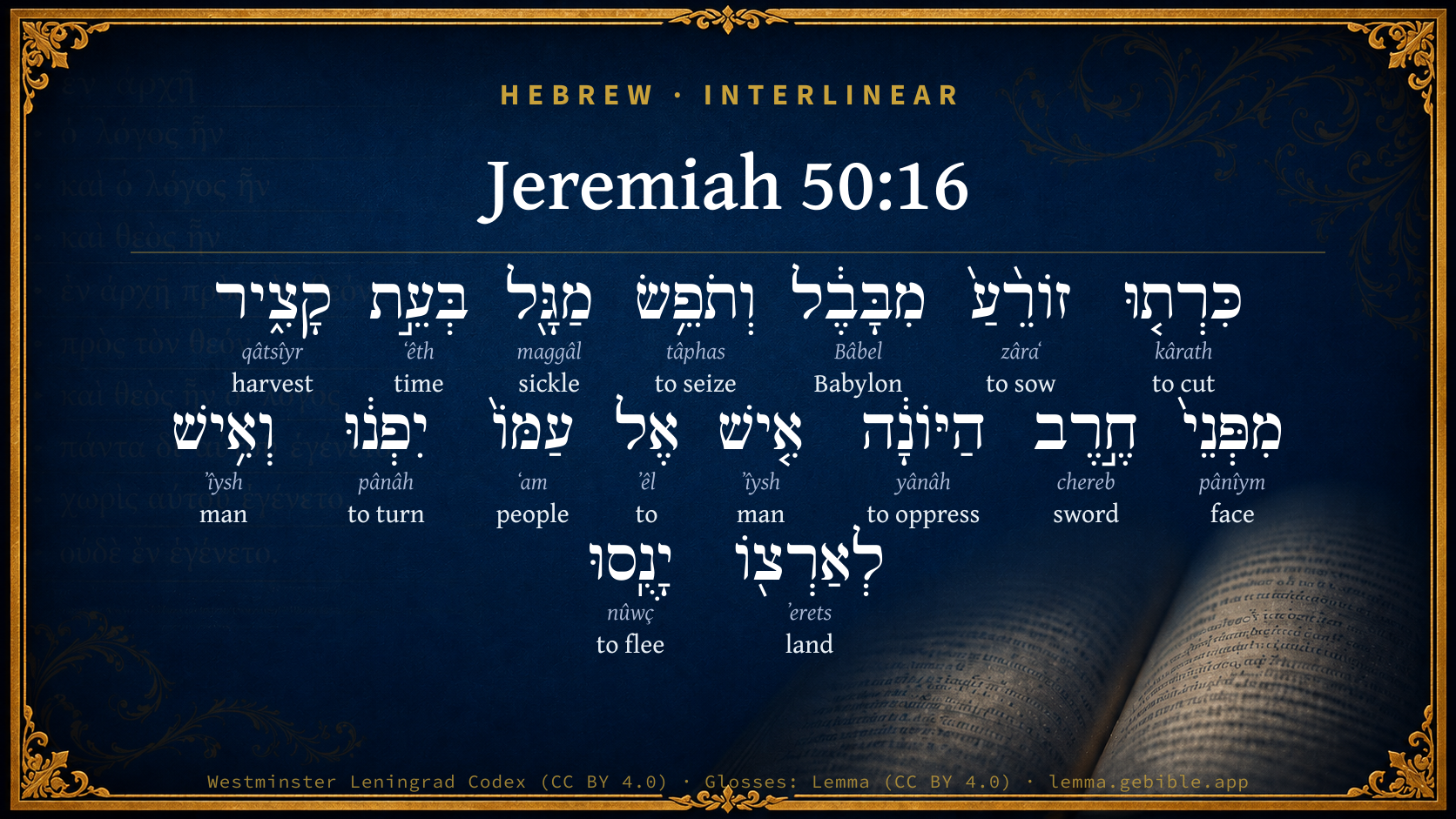
Jeremiah 50:16

Hebrew (Westminster Leningrad Codex) Jeremiah 50:16 appears in the Hebrew Old Testament. The text above is from the Westminster Leningrad Codex. Each word links to its Strong’s number, a concise gloss, and parsing drawn from the Open Scriptures Hebrew Bible morphology. Click any word for its full Brown-Driver-Briggs (BDB) entry.
Download image
Cite this verse

Jeremiah 50:16 (World English Bible). Public Domain. Lemma interlinear Bible study tool, https://lemma.gebible.app/v/jeremiah/50/16.

Show BibTeX & RIS
BibTeX
RIS
English Translation
Cut off the sower from Babylon, and him who handles the sickle in the time of harvest: for fear of the oppressing sword they shall turn everyone to his people, and they shall flee everyone to his own land.
World English Bible · Public Domain
Highlights
  • 1 first appearance in the Hebrew Bible
Full analysis ↓
Download a study sheet

One document with this verse’s original text, its word-by-word gloss line, the meaning frame, cross-references with their text, attributed commentary, and full source and license credits — printable, and it pastes into notes with its structure intact.

This verse Autodidact and up

Study sheet (.html) Plain text (.txt)

A passage Seminary Student

Up to 50 verses in one chapter. A passage sheet keeps up to 6 commentary sources and 12 cross-references per verse, in the order this page ranks them, and says so on the sheet whenever that leaves anything out. Ask for a single verse and you get the Autodidact verse sheet above.

Everything on this page stays free to read, with no account — the sheet is a download of what is already on screen, not access to it.

Want to remove ads? Support Godless Engineer
Compare translations 3

The same verse in 3 English versions, stacked beneath the original-language interlinear above. Click any original word for its lexicon entry.

Each is an independent rendering of the whole verse — the interlinear is not word-aligned to these translations.

Highlighted words mark where these versions differ — a whole-verse word diff, not a word-by-word alignment.

  • World English Bible Public Domain
    Cut off the sower from Babylon, and him who handles the sickle in the time of harvest: for fear of the oppressing sword they shall turn everyone to his people, and they shall flee everyone to his own land.
  • King James Version Public Domain
    Cut off the sower from Babylon, and him that handleth the sickle in the time of harvest: for fear of the oppressing sword they shall turn every one to his people, and they shall flee every one to his own land.
  • unfoldingWord Literal Text CC BY-SA 4.0
    Destroy both the farmer who sows seed and the one who uses a sickle at the time of harvest in Babylon. Let each person turn back to his own people from the oppressor’s sword; let them flee to their own land.

unfoldingWord Literal Text — © unfoldingWord, licensed CC BY-SA 4.0. Word-aligned USFM3 via Door43 (git.door43.org/unfoldingWord/en_ult).

Versions to compare (up to 4)

3 of 4 selected

Show all 18 translations

Every available English version of this verse, each an independent rendering of the whole verse.

  • World English Bible Public Domain
    Cut off the sower from Babylon, and him who handles the sickle in the time of harvest: for fear of the oppressing sword they shall turn everyone to his people, and they shall flee everyone to his own land.
  • Berean Standard Bible Public Domain
    Cut off the sower from Babylon, and the one who wields the sickle at harvest time. In the face of the oppressor’s sword, each will turn to his own people, each will flee to his own land.
  • Majority Standard Bible Public Domain
    Cut off the sower from Babylon, and the one who wields the sickle at harvest time. In the face of the oppressor’s sword, each will turn to his own people, each will flee to his own land.
  • King James Version Public Domain
    Cut off the sower from Babylon, and him that handleth the sickle in the time of harvest: for fear of the oppressing sword they shall turn every one to his people, and they shall flee every one to his own land.
  • American Standard Version (1901) Public Domain
    Cut off the sower from Babylon, and him that handleth the sickle in the time of harvest: for fear of the oppressing sword they shall turn every one to his people, and they shall flee every one to his own land.
  • Revised Version (1885) Public Domain
    Cut off the sower from Babylon, and him that handleth the sickle in the time of harvest: for fear of the oppressing sword they shall turn every one to his people, and they shall flee every one to his own land.
  • Geneva Bible (1599) Public Domain
    Destroy the sower from Babel, and him that handleth the sieth in the time of haruest: because of the sworde of the oppressor they shall turne euery one to his people, and they shall flee euery one to his owne land.
  • Douay-Rheims (1899) Public Domain
    Destroy the sower out of Babylon, and him that holdeth the sickle in the time of harvest: for fear of the sword of the dove every man shall return to his people, and every one shall flee to his own land.
  • Young's Literal Translation Public Domain
    Cut off the sower from Babylon, And him handling the sickle in the time of harvest, Because of the oppressing sword, Each unto his people -- they turn, And each to his land -- they flee.
  • Literal Standard Version CC BY-SA 4.0
    Cut off the sower from Babylon, || And him handling the sickle in the time of harvest, || Because of the oppressing sword, || Each to his people—they turn, || And each to his land—they flee.
  • Unlocked Literal Bible CC BY-SA 4.0
    Destroy both the farmer who sows seed and the one who uses a sickle at the time of harvest in Babylon. Let each person turn back to his own people from the oppressor's sword; let them flee to their own land.
  • unfoldingWord Literal Text CC BY-SA 4.0
    Destroy both the farmer who sows seed and the one who uses a sickle at the time of harvest in Babylon. Let each person turn back to his own people from the oppressor’s sword; let them flee to their own land.
  • Darby Bible Public Domain
    Cut off the sower from Babylon, and him that handleth the sickle in the time of harvest. For fear of the oppressing sword let them turn every one to his people, and let them flee every one to his own land.
  • World Messianic Bible Public Domain
    Cut off the sower from Babylon, and him who handles the sickle in the time of harvest. For fear of the oppressing sword, they will each return to their own people, and they will each flee to their own land.
  • Webster's Bible Public Domain
    Cut off the sower from Babylon, and him that handleth the sickle in the time of harvest: for fear of the oppressing sword they shall turn every one to his people, and they shall flee every one to his own land.
  • Free Bible Version CC BY-SA 4.0
    Stop the sower from sowing in the country of Babylon, and stop the harvester swinging the sickle to reap the grain. Under the threat of the enemies' swords, everyone runs home to their own people, they go back to where they came from.
  • Bible in Basic English Public Domain
    Let the planter of seed be cut off from Babylon, and everyone using the curved blade at the time of the grain-cutting: for fear of the cruel sword, everyone will be turned to his people, everyone will go in flight to his land.
  • JPS Tanakh (1917) Public Domain
    Cut off the sower from Babylon, and him that handleth the sickle in the time of harvest; For fear of the oppressing sword they shall turn every one to his people, and they shall flee every one to his own land.

Literal Standard Version (2020), Covenant Press — licensed CC BY-SA 4.0. Text via the HelloAO Bible API (eBible.org). Unlocked Literal Bible (unfoldingWord) — licensed CC BY-SA 4.0. Text via the HelloAO Bible API (eBible.org). unfoldingWord Literal Text — © unfoldingWord, licensed CC BY-SA 4.0. Word-aligned USFM3 via Door43 (git.door43.org/unfoldingWord/en_ult). Free Bible Version, Dr. Jonathan Gallagher — licensed CC BY-SA 4.0. Text via the HelloAO Bible API (eBible.org).

Word by word

More ways to search: Search by grammar → Find every occurrence → Compare this word →

Practice this passage: Drill this verse → Learn its vocabulary →

מַגָּ֖ל
maggâl
H4038
“sickle”
Noun, Common, Masculine, Singular, Absolute
Part of Speech
Noun
Type
Common
Gender
Masculine
Number
Singular
State
Absolute
Full BDB Definition

Origin: from an unused root meaning to reap

TWOT: 1292a

sickle
  1. כִּרְת֤וּ kârath H3772 “cut” Verb, Qal, Imperative, 2nd Person, Masculine, Plural
  2. זוֹרֵ֨עַ֙ zâraʻ H2232 “sowing” Verb, Qal, Participle Active, Masculine, Singular, Absolute
  3. מִבָּבֶ֔ל Bâbel H894 “from · Babylon” Preposition + Noun, Proper
  4. וְתֹפֵ֥שׂ tâphas H8610 “and · seizing” Conjunction + Verb, Qal, Participle Active, Masculine, Singular, Construct
  5. בְּעֵ֣ת ʻêth H6256 “in/at · time of” Preposition + Noun, Common, Both, Singular, Construct
  6. קָצִ֑יר qâtsîyr H7105 “harvest” Noun, Common, Masculine, Singular, Absolute
  7. מִפְּנֵי֙ pânîym H6440 “from · face(s) of” Preposition + Noun, Common, Both, Plural, Construct
  8. חֶ֣רֶב chereb H2719 “sword of” Noun, Common, Feminine, Singular, Construct
  9. הַיּוֹנָ֔ה yânâh H3238 “the · oppressing” Particle, Definite Article + Verb, Qal, Participle Active, Feminine, Singular, Absolute
  10. אִ֤ישׁ ʼîysh H376 “man” Noun, Common, Masculine, Singular, Absolute
  11. אֶל ʼêl H413 “to” Preposition
  12. עַמּוֹ֙ ʻam H5971 “people · his” Noun, Common, Masculine, Singular, Construct + Suffix, Personal, 3rd Person, Masculine, Singular
  13. יִפְנ֔וּ pânâh H6437 “to turn” Verb, Qal, Imperfect, 3rd Person, Masculine, Plural
  14. וְאִ֥ישׁ ʼîysh H376 “and · man” Conjunction + Noun, Common, Masculine, Singular, Absolute
  15. לְאַרְצ֖וֹ ʼerets H776 “to/for · land · his” Preposition + Noun, Common, Both, Singular, Construct + Suffix, Personal, 3rd Person, Masculine, Singular
  16. יָנֻֽסוּ nûwç H5127 “to flee” Verb, Qal, Imperfect, 3rd Person, Masculine, Plural

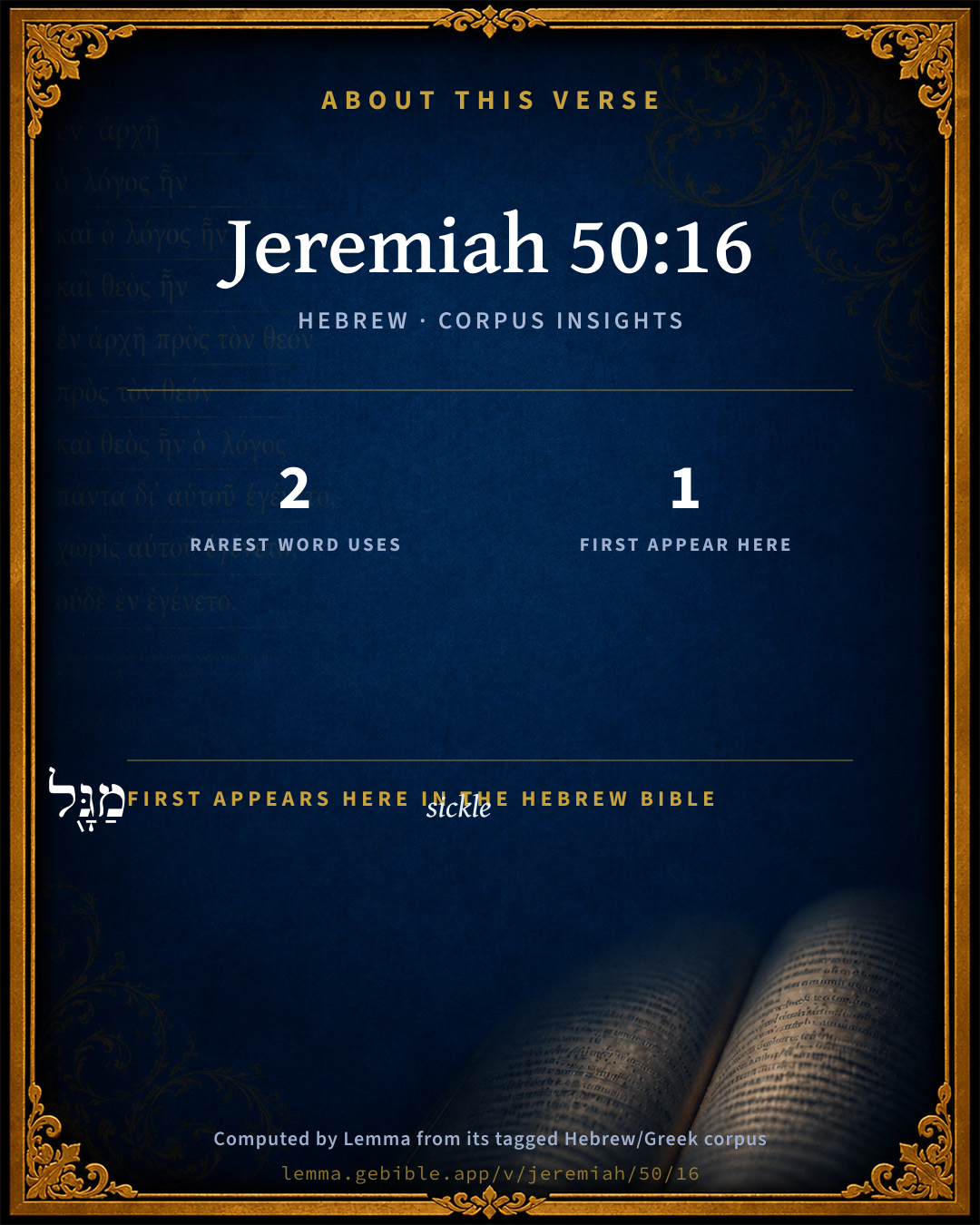
About this verse

These counts appear in no published source. They are computed here, from the morphology-tagged text and Lemma’s own curated glosses. What Lemma adds →

17
words
16
distinct lemmas
Prophets
section

Notable vocabulary

The rarest word here is מַגָּ֖ל sickle H4038 — appearing just 2 times in the whole Hebrew Bible.

First appearance in Scripture

This word makes its first canonical appearance in the Hebrew Bible here:

  • מַגָּ֖ל sickle H4038

Shared distinctive vocabulary

מַגָּ֖ל sickle H4038 occurs in 2 verses of the Hebrew Bible. Also found in:

Grammatical profile

  • 6 verbs
  • 10 nouns
  • 1 preposition

Verb forms

  • כִּרְת֤וּ Qal · Imperative
  • זוֹרֵ֨עַ֙ Qal · Participle Active
  • וְתֹפֵ֥שׂ Qal · Participle Active
  • הַיּוֹנָ֔ה Qal · Participle Active
  • יִפְנ֔וּ Qal · Imperfect
  • יָנֻֽסוּ Qal · Imperfect

Repetition

A word recurs within this verse — often emphatic in Hebrew:

  • אִ֤ישׁ man H376 ×2

Cross-references

7

Topical passages linked to Jeremiah 50:16 in the Treasury of Scripture Knowledge — connected by theme and wording, ordered by reader-vote popularity; previews shown in the World English Bible.

  • Jeremiah 46:16 He made many to stumble, yes, they fell one on another: and they said, Arise, and let us go again to our own people, and to the land of our birth, from the oppressing sword.
  • Jeremiah 51:9 We would have healed Babylon, but she is not healed: forsake her, and let us go everyone into his own country; for her judgment reaches to heaven, and is lifted up even to the skies.
  • Isaiah 13:14 It shall happen, that as the chased roe, and as sheep that no man gathers, they shall turn every man to his own people, and shall flee every man to his own land.
  • Joel 1:11 Be confounded, you farmers! Wail, you vineyard keepers; For the wheat and for the barley; For the harvest of the field has perished.
  • Jeremiah 25:38 He has left his covert, as the lion; for their land is become an astonishment because of the fierceness of the oppressing [sword], and because of his fierce anger.
  • Jeremiah 51:23 and with you will I break in pieces the shepherd and his flock; and with you will I break in pieces the farmer and his yoke [of oxen]; and with you will I break in pieces governors and deputies.
  • Amos 5:16 Therefore thus says Yahweh, the God of hosts, the Lord: "Wailing will be in all the broad ways; And they will say in all the streets, 'Alas! Alas!' And they will call the farmer to mourning, And those who are skillful in lamentation to wailing.

Cross-references courtesy of OpenBible.info (CC BY 4.0).

Hebrew and Greek witnesses Masoretic Hebrew ↔ Greek Septuagint

The same verse in the two great witnesses to the Old Testament, shown verse-for-verse.

These are two independent witnesses, not word-aligned to each other, and the Septuagint is shown in lemma (dictionary) form.

Hebrew Jeremiah 50:16 Masoretic · Westminster Leningrad Codex

כִּרְת֤וּ זוֹרֵ֨עַ֙ מִבָּבֶ֔ל וְתֹפֵ֥שׂ מַגָּ֖ל בְּעֵ֣ת קָצִ֑יר מִפְּנֵי֙ חֶ֣רֶב הַיּוֹנָ֔ה אִ֤ישׁ אֶל עַמּוֹ֙ יִפְנ֔וּ וְאִ֥ישׁ לְאַרְצ֖וֹ יָנֻֽסוּ

Cut off the sower from Babylon, and him who handles the sickle in the time of harvest: for fear of the oppressing sword they shall turn everyone to his people, and they shall flee everyone to his own land.

World English Bible · Public Domain

Greek LXX Structure differs

In the Septuagint, Jeremiah is about an eighth shorter than the Hebrew and arranges its material differently — the Oracles Against the Nations (Hebrew chapters 46–51) appear in the middle of the Greek book, after 25:13. Because the chapter and verse boundaries do not line up, a verse-for-verse comparison with the Hebrew is not shown.

A verse-for-verse comparison isn’t shown here because the chapters and verses don’t line up. Switch to the LXX edition with the MT / LXX toggle above to read the Greek directly.

On this verse, Ellicott's Commentary for English Readers discusses the Septuagint’s reading. Read the note in Commentary ↓

Hebrew: Westminster Leningrad Codex (CC BY 4.0). Greek: Septuagint (public domain); English from a public-domain English Septuagint. How the Septuagint differs from the Hebrew →

Targum (Aramaic paraphrase)

1

The Targum is the ancient Jewish Aramaic paraphrase of the Hebrew Scriptures — an interpretive translation, not the Hebrew text itself. Onkelos (literal) and Pseudo-Jonathan (expansive) render the Torah, and Jonathan the Prophets. Coverage is partial: where no permissively-licensed English translation exists for a verse, only the Aramaic is shown. This is verse-level text, not a word-by-word alignment to the Hebrew.

  1. Targum Jonathan Prophets (Joshua–Malachi)
    שֵׁיצוּ מַלְכָּא מִבָּבֶל וַאֲחִדוּ חַרְבָּא בְּעִדַן קְטוֹל מִן קֳדָם חֶרֶב סַנְאָה דְהִיא כַּחֲמַר מְרַוְיָא גְבַר לְעַמֵיהּ יִתְפְּנוּן וּגְבַר לְאַרְעֵיהּ יֶעְרְקוּן:

    (no public-domain English translation for this verse)

    Targum Jonathan — Aramaic: “Mikraot Gedolot” (public domain). English: “Sefaria Community Translation” (CC0 1.0 (public-domain dedication)); “London "Chaldee Paraphrase," 1871” (public domain). Text via Sefaria.

Commentary

Notes on Jeremiah 50:16 from classic Christian and Jewish commentators (each source and its license shown beneath its notes). The classic Christian expositions comment on the surrounding passage and are grouped to its opening verse, so a note may address several verses; the Jewish commentaries on the Tanakh (Rashi and others) are per-verse, so they appear only where the commentator wrote on this verse.

Lemma curates 59 commentaries, every one of them public domain or Creative Commons licensed, each selected and text-cleaned for this edition rather than reprinted as found. About our sources →

Trapp's Complete Commentary

John Trapp

Jer 50:16 Cut off the sower from Babylon, and him that handleth the sickle in the time of harvest: for fear of the oppressing sword they shall turn every one to his people, and they shall flee every one to his own land.

Ver. 16. Cut off the sower.] Leave not so much as a husbandman alive, who yet are generally spared, as harmless and useful; they were left and let alone by the Chaldeans when they carried away the Jews. {2Ki 25:12} But here is enjoined a more severe execution.

John Trapp, A Commentary or Exposition upon All the Books of the Old and New Testament (1647–1656) — public domain. Text from a community e-Sword module.

Tyndale Open Study Notes

Tyndale Open Resources

50:16 As Babylon fell, farmers fled and left their crops behind. The slaughter on the battlefield caused the people to run away.

Tyndale Open Study Notes — © Tyndale Open Resources, licensed CC BY-SA 4.0. Text via the HelloAO Bible API.

Geneva Bible (1599)

Geneva Bible translators

Destroy her so that none be left to labor the ground, or to take the fruit thereof.

Geneva Bible (1599) marginal notes — public domain. Text via Bolls.life.

Jamieson, Fausset & Brown

Robert Jamieson, A. R. Fausset & David Brown

Babylon had the extent rather of a nation than of a city. Therefore grain was grown within the city wall sufficient to last for a long siege [ARISTOTLE, Politics, 3.2; PLINY, 18.17]. Conquerors usually spare agriculturists, but in this case all alike were to be "cut off."

for fear of . . . oppressing sword--because of the sword of the oppressor.

every one to his people--from which they had been removed to Babylon from all quarters by the Chaldean conquerors (Jer 51:9; Isa 13:14).

Jamieson, Fausset & Brown — Commentary Critical and Explanatory on the Whole Bible (1871) — public domain (CC PDM 1.0). Text via the HelloAO Bible API.

Adam Clarke's Commentary

Verse 16. Cut off the sower] Destroy the gardens and the fields, that there may be neither fruits nor tillage.

Adam Clarke's Commentary on the Bible (1810–1826) — public domain. Text from a community e-Sword/MySword module.

John Calvin's Commentaries

He still addresses the Medes and the Persians, and bids them cut off from Babylon both the sowers and the reapers; but by stating a part for the whole he includes also all others. Husbandmen in a manner preserve the life of men, as other arts and occupations are not capable of doing so. Were there no sowing and reaping, all would of necessity perish. When, therefore, the Prophet bids them take away those who sowed and reaped, it was the same as though he had said, “Strike with the sword and kill all the inhabitants, so that nothing may remain but the land reduced to solitude.” He then commands the Chaldeans to be slain, so that no husbandmen should remain to sow and reap.

This, indeed, was not fulfilled by Cyrus, as we have elsewhere seen. But what I then reminded you of ought to be borne in mind, that the Prophet extends his threatenings much further, for Babylon was often smitten by God’s hand, and at length wholly destroyed. The assault of Cyrus was a prelude, but other calamities followed, when it was more severely oppressed.

He adds, From the face of the oppressing or wasting sword every one shall flee to his people and to his own land As that country was wealthy, many strangers had come there, and they had also drawn together captives from all parts. Thus many foreigners no doubt dwelt in Chaldea when the empire flourished. There were there many husbandmen and many artificers. The Chaldeans ruled, and yet many were content with small means, and even paltry; or it may be that the Chaldeans compelled conquered nations to do servile work in agriculture and in works of art. The Prophet now says, that in the revolution which was to happen, each would look to his own land and flee there, as there could be no delight in a country deserted and desolate. Then from the face of the oppressing sword shall every one look to his own people and to his own land; and those who before pretended to be wholly devoted to the Chaldeans, would forsake them in their necessity, because nothing would be better for them than to consult their own safety. It follows, —

John Calvin's Commentaries (1540-1563) — public domain. Text from the Calvin Translation Society English edition (1840s-50s) via the Christian Classics Ethereal Library (ccel.org). Calvin's coverage is partial (roughly two-thirds of the Bible); uncommented books and verses are honest gaps, never fabricated. The 19th-century editor's footnotes and remarks are omitted so the notes are faithfully Calvin's own voice.

Ellicott's Commentary for English Readers

(16) Cut off the sower . . .—The rich alluvial plains of Babylon, so plentiful that they yielded an increase of two hundred-fold (Herod. iii. 8), were to be laid waste. There may, possibly, be a special reference to the fields within the walls of the city, upon which the population largely depended, and which were now to be devastated. (Diod. Sic. ii. 9; Pliny, Hist. Nat. xi. 111.)

For fear of the oppressing sword.—The versions present the same noticeable variations, as in Jer_46:16, the LXX. giving “from the Greek sword,” possibly with reference to the belief that Cyrus had subdued the Æolians and Ionians before the conquest of Babylon, and that they were fighting in his army, or to Alexander’s capture of the city, and the Vulg. “from the sword of the dove,” the latter rendering being supposed to refer to the dove on the Babylonian standard, as the emblem of Semiramis. Here, however, as Babylon is the object of attack, the latter allusion is scarcely applicable, and there is no sufficient reason for altering the English version. (See Note on Jer_25:38; Jer_46:16.)

They shall flee every one to his own land.—The words are significant as showing that the Jews were not the only people for whom the fall of Babylon was the signal of a return from exile. The policy of Nebuchadnezzar, like that of Assyria, had been to people his own territory with the captive populations of other countries, and Israel (as in Jer_50:8) was to lead the way in the return.

A Bible Commentary for English Readers, edited by Charles John Ellicott (1878–1897) — public domain. Text from a community e-Sword module.

The Cambridge Bible for Schools and Colleges

gen. ed. J. J. S. Perowne

16. Cut off the sower from Babylon] Agricultural labour ceases, and foreign residents flee to their homes. Cp. Jer_51:9; Isa_13:14. But it is perhaps better to make the reference to be to slaves or hired foreign labourers.

The Cambridge Bible for Schools and Colleges (gen. ed. J. J. S. Perowne; Cambridge University Press, 1878–1918) — public domain. Text from a community e-Sword module.

John Gill's Exposition

Cut off the sower from in Babylon, and him that handleth the sickle in the time of harvest,.... Both sower and reaper: the walls of Babylon took in a large compass of land, where there were corn fields; and which, as Curtius (s) observes, would yield a sufficiency to hold out a siege against an enemy; but being taken, the husbandman would not be spared, as used to be, but should be cut off, and so none to till the ground, or to reap what was upon it; and thus, in course, would be, desolate, as before threatened. The Targum understands this in a figurative sense,

"destroy the king out of Babylon, and take hold of the sword in the time of slaughter;''

and Cocceius interprets the sower of any doctor or bishop in mystical Babylon, and the reaper of such that gather the fruits, and exact obedience; see Rev 18:14;

for fear of the oppressing sword; of the Medes and Persians:

they shall turn everyone to his people, and they shall flee everyone to his own land; not those of other nations, as the Jews, who were detained captives there, as Kimchi thinks; for these were not in such fear of the Persians, nor did they flee because of them; but were let go by them, and sent into their own land honourably: but either such who, of other nations, were come to traffic at Babylon; or rather the auxiliaries of other nations, who were either hired or forced into the service of Babylon; these, finding the city taken, would make the best of their way into their own country.

(s) Hist. l. 5. c. 1.

John Gill's Exposition of the Whole Bible (1746–1763) — public domain (CC PDM 1.0). Text via the HelloAO Bible API.

Albert Barnes' Notes on the Bible

The population is to be destroyed so utterly that the rich fields of Babylonia are to remain untilled.

They shall turn - The full force of the words will be seen if it be remembered that it had been the policy of Nebuchadnezzar to compel citizens selected from the vanquished nations to settle in Babylonia.

Albert Barnes' Notes on the Bible (1834–1885) — public domain. Text from a community e-Sword/MySword module.

Haydock's Catholic Bible Commentary

Harvest. Such were usually unmolested. (Calmet) --- Babylon was so large, that people sowed corn within the walls. (Curtius v.) --- The environs were well cultivated. (Pliny, [Natural History?] xviii. 17.) --- Dove, or the destroyer; for the Hebrew word signifies either the one or the other. (Challoner) (Chap. xxv. 38., and xlvi. 16.) --- Literally, "from before the sword of the dove." The power of Babylon is no more. (Haydock) --- The king is compared to a dove, for his swiftness; or God is meek, though terrible. (Worthington) --- Land. The other nations were set free as well as the Jews. (Calmet)

George Leo Haydock (1774–1849), Haydock's Catholic Family Bible and Commentary, 1859 edition — public domain. Excludes Psalms (Douay-Rheims chapter numbering differs from Protestant) and Deuterocanonical books (Catholic canon only).

Matthew Poole's English Annotations

We are told that Babylon was so large a city, that with the walls of it there was much ploughed ground: or else the threatening imports that God would deal more severely with Babylon, than conquerors use to do with places which they conquer, who use to spare and leave behind then ploughmen, and such as use to till the ground, but in the destruction of Babylon it should not be so.

They shall flee every one to his own land: he speaks either of such stranger as for commerce had their abodes in Babylon, or such assistants as the Babylonians had gotten against their ene rates, who upon the coming in of the enemies should make as much haste home as they could.

Matthew Poole's English Annotations on the Holy Bible (1683–1685) — public domain. Text from a community e-Sword/MySword module.

The Pulpit Commentary

Cut off the sower, etc. "Babylon" here probably means Babylonia, for it is clear from ver. 12 that the curse belongs to the country as well as the city of Babylon; indeed, "Babylon" in ver. 13 seems to be used in the wider sense. Others think of the open spaces within the walls of Babylon, in which it is said that crops were raised to provision the city in case of a siege (see Rawlinson, "Ancient Monarchies," 2:518); but this is less natural. They shall turn, etc. The subject is, not the husbandmen, but the strangers in Babylonia; comp. the parallel passage, Isa_13:14, on which this passage is based. Aesehylus ("Pers.," 53) speaks of the Pammiktov oclov in Babylon. Whether brought by force from their homes, like the Jews, or voluntary residents for the sake of commerce, all should hurry from the doomed city.

The Pulpit Commentary (1880–1919), ed. H.D.M. Spence-Jones & Joseph S. Exell — public domain. Text from a community e-Sword module.

John Wesley's Explanatory Notes

Everyone - Either such strangers as for commerce had their abodes in Babylon, or such assistance as the Babylonians had gotten against their enemies.

John Wesley, Explanatory Notes Upon the Whole Bible (1754–1765) — public domain. Text via the GEBible commentary corpus.

unfoldingWord translationNotes

Door43 World Missions Community

General Information:

Yahweh continues to tell the other nations to attack Babylon.

the farmer who sows seed and the one who uses a sickle

These people collectively represent all the farmers and harvesters of Babylon.

the one who uses a sickle at the time of harvest

A "sickle" is a farm tool that people use to harvest grain. Together with the previous phrase, Yahweh is saying that all planting and harvesting will stop in Babylon.

Let each person turn back to his own people ... let them flee to their own land

These two phrases mean basically the same thing. Together they strengthen the command for foreigners to flee from Babylon back to their own countries. (See: Doublet)

from the oppressor's sword

Here the word "sword" refers to the armies that will attack Babylon. (See: Metonymy)

translationWords

plant

harvest

turn

oppress

sword

unfoldingWord translationNotes — © Distant Shores Media and the Door43 World Missions Community, licensed CC BY-SA 4.0. Source: git.door43.org/Door43/en_tn.

Rashi

Rabbi Shlomo Yitzchaki (Rashi)

Cut off a sower Destroy a king from Babylon and one who grasps a sword in time of slaughter.

Rashi on the Tanakh — English translations: “The Judaica Press complete Tanach with Rashi, translated by A. J. Rosenberg” (CC BY 4.0); “Pentateuch with Rashi's commentary by M. Rosenbaum and A.M. Silbermann, 1929-1934” (public domain); “The Metsudah Tanach series, Lakewood, N.J” (CC BY 4.0); and “The Book of Joshua, Metsudah Publications, 1997” (CC BY 4.0). Text via Sefaria.

Lesson kit

Teaching starters — assembled from the data on this page, not authored interpretation. Every prompt links to the verse data it draws on. Edit before teaching.

Jeremiah, in the Prophets, opens this verse with 17 words (16 distinct Hebrew lemmas). Its most distinctive word is maggâl (“sickle”). A historical commentator’s framing appears above. Read the whole chapter for the surrounding context.

Discussion questions

  1. What does “sickle” (maggâl) contribute to the verse as a whole?
  2. This is the first place “sickle” appears in Scripture (first appears here). What does its debut here establish?
  3. How does Joel 3:13, which shares the word «sickle», read alongside this verse?
  4. What does the repetition of “man” (2× in this one verse) do in this verse?
  5. These translations render this verse differently. What is at stake in choosing one wording over another?
  6. «כִּרְת֤וּ» is a Qal Imperative verb. How does that grammatical form shape the action described?
  7. Compare how Trapp's Complete Commentary and Tyndale Open Study Notes read this verse. Where do they agree or differ?

Things to notice

  • 1 word makes its first canonical appearance in Scripture here.
  • These translations choose different wording for 24 words in this verse.
  • “man” occurs 2× in this single verse.
  • 16 distinct Hebrew lemmas span 17 words in this verse.

Reading settings

Reading text

Shown beneath each verse's original-language words.

Old Testament
Old Testament edition

Read the OT as the Masoretic Hebrew (MT) or the Greek Septuagint (LXX).

English shown for the Greek Septuagint (in the Hebrew ↔ Greek comparison).

Comparing translations? Open the Compare panel on any verse page to stack up to four side by side.