
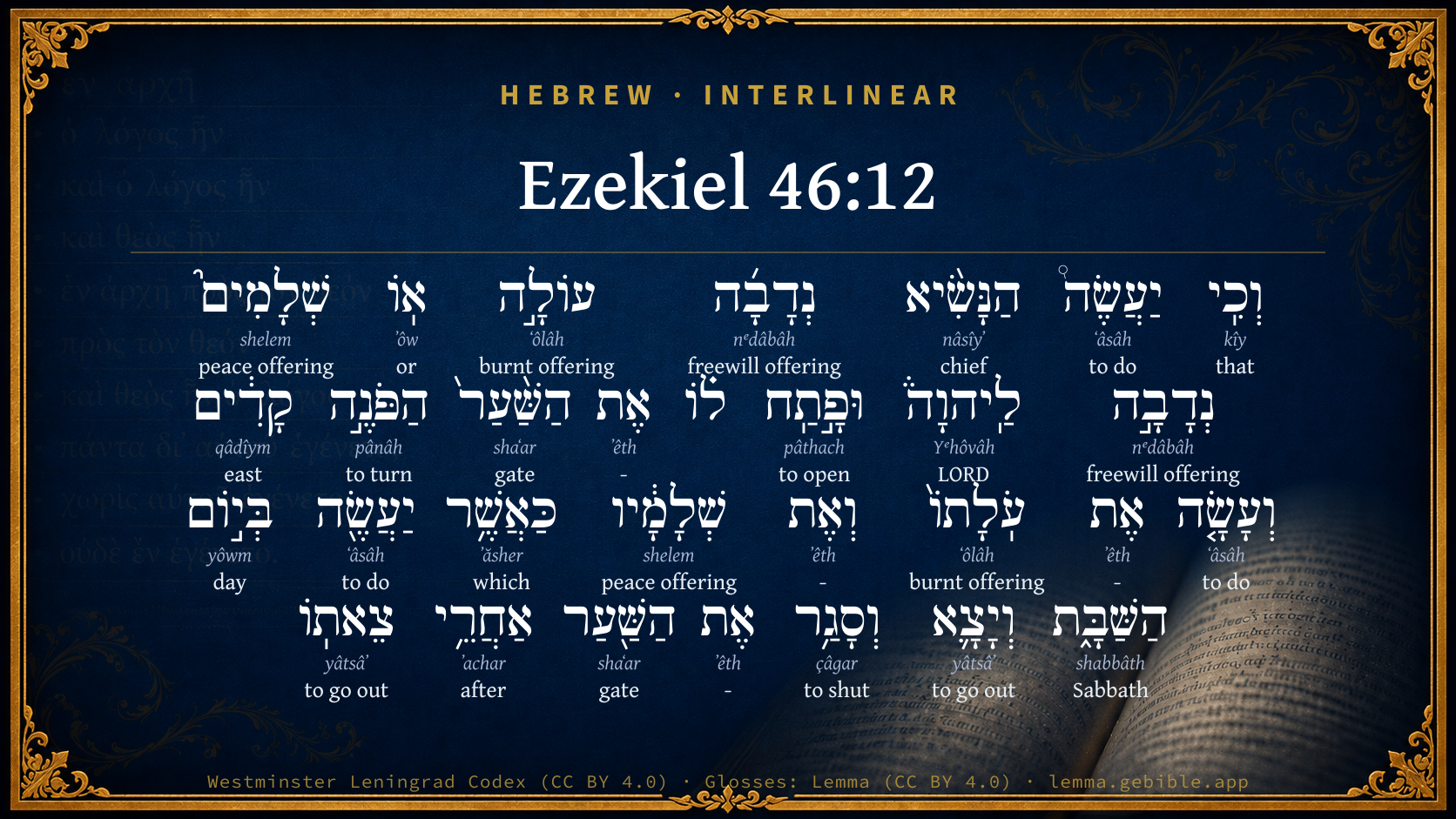
Ezekiel 46:12

Hebrew (Westminster Leningrad Codex) Ezekiel 46:12 appears in the Hebrew Old Testament. The text above is from the Westminster Leningrad Codex. Each word links to its Strong’s number, a concise gloss, and parsing drawn from the Open Scriptures Hebrew Bible morphology. Click any word for its full Brown-Driver-Briggs (BDB) entry.
Download image
Cite this verse

Ezekiel 46:12 (World English Bible). Public Domain. Lemma interlinear Bible study tool, https://lemma.gebible.app/v/ezekiel/46/12.

Show BibTeX & RIS
BibTeX
RIS
English Translation
When the prince shall prepare a freewill-offering, a burnt offering or peace-offerings as a freewill-offering to Yahweh, one shall open for him the gate that looks toward the east; and he shall prepare his burnt offering and his peace-offerings, as he does on the Sabbath day: then he shall go forth; and after his going forth one shall shut the gate.
World English Bible · Public Domain
Download a study sheet

One document with this verse’s original text, its word-by-word gloss line, the meaning frame, cross-references with their text, attributed commentary, and full source and license credits — printable, and it pastes into notes with its structure intact.

This verse Autodidact and up

Study sheet (.html) Plain text (.txt)

A passage Seminary Student

Up to 50 verses in one chapter. A passage sheet keeps up to 6 commentary sources and 12 cross-references per verse, in the order this page ranks them, and says so on the sheet whenever that leaves anything out. Ask for a single verse and you get the Autodidact verse sheet above.

Everything on this page stays free to read, with no account — the sheet is a download of what is already on screen, not access to it.

Want to remove ads? Support Godless Engineer
Compare translations 3

The same verse in 3 English versions, stacked beneath the original-language interlinear above. Click any original word for its lexicon entry.

Each is an independent rendering of the whole verse — the interlinear is not word-aligned to these translations.

Highlighted words mark where these versions differ — a whole-verse word diff, not a word-by-word alignment.

  • World English Bible Public Domain
    When the prince shall prepare a freewill-offering, a burnt offering or peace-offerings as a freewill-offering to Yahweh, one shall open for him the gate that looks toward the east; and he shall prepare his burnt offering and his peace-offerings, as he does on the Sabbath day: then he shall go forth; and after his going forth one shall shut the gate.
  • King James Version Public Domain
    Now when the prince shall prepare a voluntary burnt offering or peace offerings voluntarily unto the LORD, one shall then open him the gate that looketh toward the east, and he shall prepare his burnt offering and his peace offerings, as he did on the sabbath day: then he shall go forth; and after his going forth one shall shut the gate.
  • unfoldingWord Literal Text CC BY-SA 4.0
    When the prince gives a freewill offering, either a burnt offering or a peace offering to Yahweh, the gate facing east will be opened for him. He will offer his burnt offering or his peace offering as he does it on the Sabbath day. Then he must go out, and after he has gone out the gate will be shut.

unfoldingWord Literal Text — © unfoldingWord, licensed CC BY-SA 4.0. Word-aligned USFM3 via Door43 (git.door43.org/unfoldingWord/en_ult).

Versions to compare (up to 4)

3 of 4 selected

Show all 18 translations

Every available English version of this verse, each an independent rendering of the whole verse.

  • World English Bible Public Domain
    When the prince shall prepare a freewill-offering, a burnt offering or peace-offerings as a freewill-offering to Yahweh, one shall open for him the gate that looks toward the east; and he shall prepare his burnt offering and his peace-offerings, as he does on the Sabbath day: then he shall go forth; and after his going forth one shall shut the gate.
  • Berean Standard Bible Public Domain
    When the prince makes a freewill offering to the LORD, whether a burnt offering or a peace offering, the gate facing east must be opened for him. He is to offer his burnt offering or peace offering just as he does on the Sabbath day. Then he shall go out, and the gate must be closed after he goes out.
  • Majority Standard Bible Public Domain
    When the prince makes a freewill offering to the LORD, whether a burnt offering or a peace offering, the gate facing east must be opened for him. He is to offer his burnt offering or peace offering just as he does on the Sabbath day. Then he shall go out, and the gate must be closed after he goes out.
  • King James Version Public Domain
    Now when the prince shall prepare a voluntary burnt offering or peace offerings voluntarily unto the LORD, one shall then open him the gate that looketh toward the east, and he shall prepare his burnt offering and his peace offerings, as he did on the sabbath day: then he shall go forth; and after his going forth one shall shut the gate.
  • American Standard Version (1901) Public Domain
    And when the prince shall prepare a freewill-offering, a burnt-offering or peace-offerings as a freewill-offering unto Jehovah, one shall open for him the gate that looketh toward the east; and he shall prepare his burnt-offering and his peace-offerings, as he doth on the sabbath day: then he shall go forth; and after his going forth one shall shut the gate.
  • Revised Version (1885) Public Domain
    And when the prince shall prepare a freewill offering, a burnt offering or peace offerings as a freewill offering unto the LORD, one shall open for him the gate that looketh toward the east, and he shall prepare his burnt offering and his peace offerings, as he doth on the sabbath day: then he shall go forth; and after his going forth one shall shut the gate.
  • Geneva Bible (1599) Public Domain
    Nowe when the prince shall make a free burnt offring or peace offrings freely vnto the Lord, one shall then open him the gate, that turneth towarde the East, and hee shall make his burnt offring and his peace offrings, as he did on the Sabbath day: after, hee shall goe foorth, and when he is gone forth, one shall shut the gate.
  • Douay-Rheims (1899) Public Domain
    But when the prince shall offer a voluntary holocaust, or voluntary peace offerings to the Lord: the gate that looketh towards the east shall be opened to him, and he shall offer his holocaust, and his peace offerings, as it is wont to be done on the sabbath day: and he shall go out, and the gate shall be shut after he is gone forth.
  • Young's Literal Translation Public Domain
    And when the prince maketh a free-will burnt-offering, or free-will peace-offerings, to Jehovah, then he hath opened for himself the gate that is looking eastward, and he hath made his burnt-offering and his peace-offerings as he doth in the day of rest, and he hath gone out, and he hath shut the gate after his going out.
  • Literal Standard Version CC BY-SA 4.0
    And when the prince makes a free-will burnt-offering, or free-will peace-offerings, to YHWH, then he has opened the gate that is looking eastward for himself, and has made his burnt-offering and his peace-offerings as he does in the day of rest, and he has gone out, and has shut the gate after his going out.
  • Unlocked Literal Bible CC BY-SA 4.0
    When the prince gives a freewill offering, either a burnt offering or a peace offering to Yahweh, the gate facing east will be opened for him. He will offer his burnt offering offering or his peace offering as he does it on the Sabbath day. Then he must go out, and after he has gone out the gate will be shut.
  • unfoldingWord Literal Text CC BY-SA 4.0
    When the prince gives a freewill offering, either a burnt offering or a peace offering to Yahweh, the gate facing east will be opened for him. He will offer his burnt offering or his peace offering as he does it on the Sabbath day. Then he must go out, and after he has gone out the gate will be shut.
  • Darby Bible Public Domain
    And when the prince shall offer a voluntary burnt-offering or voluntary peace-offerings unto Jehovah, the gate that looketh toward the east shall be opened for him and he shall offer his burnt-offering and his peace-offerings as he did on the sabbath-day, and he shall go out again, and the gate shall be shut after he hath gone out.
  • World Messianic Bible Public Domain
    When the prince prepares a free will offering, a burnt offering or peace offerings as a free will offering to the LORD, one shall open for him the gate that looks toward the east; and he shall prepare his burnt offering and his peace offerings, as he does on the Sabbath day. Then he shall go out; and after his going out one shall shut the gate.
  • Webster's Bible Public Domain
    Now when the prince shall prepare a voluntary burnt-offering or peace-offerings voluntarily to the LORD, one shall then open to him the gate that looketh towards the east, and he shall prepare his burnt-offering and his peace-offerings, as he did on the sabbath-day: then he shall go forth; and after his going forth one shall shut the gate.
  • Free Bible Version CC BY-SA 4.0
    When the prince decides to make a freewill offering to the Lord, whether it's a burnt offering or a peace offering, the east gate is to be opened for him. He shall offer his burnt offering or peace offering in the same way he does on the Sabbath. When he leaves, the gate must be closed after him.
  • Bible in Basic English Public Domain
    And when the ruler makes a free offering, a burned offering or a peace-offering freely given to the Lord, the doorway looking to the east is to be made open for him, and he is to make his burned offering and his peace-offerings as he does on the Sabbath day: and he will go out; and the door will be shut after he has gone out.
  • JPS Tanakh (1917) Public Domain
    And when the prince shall prepare a freewill-offering, a burnt-offering or peace-offerings as a freewill-offering unto the LORD, one shall open for him the gate that looketh toward the east, and he shall prepare his burnt-offering and his peace-offerings, as he doth on the sabbath day; then he shall go forth; and after his going forth one shall shut the gate.

Literal Standard Version (2020), Covenant Press — licensed CC BY-SA 4.0. Text via the HelloAO Bible API (eBible.org). Unlocked Literal Bible (unfoldingWord) — licensed CC BY-SA 4.0. Text via the HelloAO Bible API (eBible.org). unfoldingWord Literal Text — © unfoldingWord, licensed CC BY-SA 4.0. Word-aligned USFM3 via Door43 (git.door43.org/unfoldingWord/en_ult). Free Bible Version, Dr. Jonathan Gallagher — licensed CC BY-SA 4.0. Text via the HelloAO Bible API (eBible.org).

Word by word

More ways to search: Search by grammar → Find every occurrence → Compare this word →

Practice this passage: Drill this verse → Learn its vocabulary →

נְדָבָ֜ה
nᵉdâbâh
H5071
“freewill offering”
Noun, Common, Feminine, Singular, Absolute
Part of Speech
Noun
Type
Common
Gender
Feminine
Number
Singular
State
Absolute
Full BDB Definition

Origin: from H5068

TWOT: 1299a

voluntariness, free-will offering - voluntariness - freewill, voluntary, offering
  1. וְכִֽי kîy H3588 “and · that” Conjunction + Conjunction
  2. יַעֲשֶׂה֩ ʻâsâh H6213 “to do” Verb, Qal, Imperfect, 3rd Person, Masculine, Singular
  3. הַנָּשִׂ֨יא nâsîyʼ H5387 “the · chief” Particle, Definite Article + Noun, Common, Masculine, Singular, Absolute
  4. עוֹלָ֣ה ʻôlâh H5930 “burnt offering” Noun, Common, Feminine, Singular, Absolute
  5. אֽוֹ ʼôw H176 “or” Conjunction
  6. שְׁלָמִים֮ shelem H8002 “peace offerings” Noun, Common, Masculine, Plural, Absolute
  7. נְדָבָ֣ה nᵉdâbâh H5071 “freewill offering” Noun, Common, Feminine, Singular, Absolute
  8. לַֽיהוָה֒ Yᵉhôvâh H3068 “to/for · LORD” Preposition + Noun, Proper
  9. וּפָ֣תַֽח pâthach H6605 “and · to open” Conjunction + Verb, Qal, Sequential Perfect, 3rd Person, Masculine, Singular
  10. אֶת ʼêth H853 “-” Particle, Direct Object
  11. הַשַּׁ֨עַר֙ shaʻar H8179 “the · gate” Particle, Definite Article + Noun, Common, Masculine, Singular, Absolute
  12. הַפֹּנֶ֣ה pânâh H6437 “the · turning” Particle, Definite Article + Verb, Qal, Participle Active, Masculine, Singular, Absolute
  13. קָדִ֔ים qâdîym H6921 “east” Noun, Common, Masculine, Singular, Absolute
  14. וְעָשָׂ֤ה ʻâsâh H6213 “and · to do” Conjunction + Verb, Qal, Sequential Perfect, 3rd Person, Masculine, Singular
  15. אֶת ʼêth H853 “-” Particle, Direct Object
  16. עֹֽלָתוֹ֙ ʻôlâh H5930 “burnt offering · his” Noun, Common, Feminine, Singular, Construct + Suffix, Personal, 3rd Person, Masculine, Singular
  17. וְאֶת ʼêth H853 “and · -” Conjunction + Particle, Direct Object
  18. שְׁלָמָ֔יו shelem H8002 “peace offerings · his” Noun, Common, Masculine, Plural, Construct + Suffix, Personal, 3rd Person, Masculine, Singular
  19. כַּאֲשֶׁ֥ר ʼăsher H834 “like/as · which” Preposition + Particle, Relative
  20. יַעֲשֶׂ֖ה ʻâsâh H6213 “to do” Verb, Qal, Imperfect, 3rd Person, Masculine, Singular
  21. בְּי֣וֹם yôwm H3117 “in/at · day of” Preposition + Noun, Common, Masculine, Singular, Construct
  22. הַשַּׁבָּ֑ת shabbâth H7676 “the · Sabbath” Particle, Definite Article + Noun, Common, Both, Singular, Absolute
  23. וְיָצָ֛א yâtsâʼ H3318 “and · to go out” Conjunction + Verb, Qal, Sequential Perfect, 3rd Person, Masculine, Singular
  24. וְסָגַ֥ר çâgar H5462 “and · to shut” Conjunction + Verb, Qal, Sequential Perfect, 3rd Person, Masculine, Singular
  25. אֶת ʼêth H853 “-” Particle, Direct Object
  26. הַשַּׁ֖עַר shaʻar H8179 “the · gate” Particle, Definite Article + Noun, Common, Masculine, Singular, Absolute
  27. אַחֲרֵ֥י ʼachar H310 “after” Preposition
  28. צֵאתֽוֹ yâtsâʼ H3318 “to go out · him” Verb, Qal, Infinitive Construct + Suffix, Personal, 3rd Person, Masculine, Singular

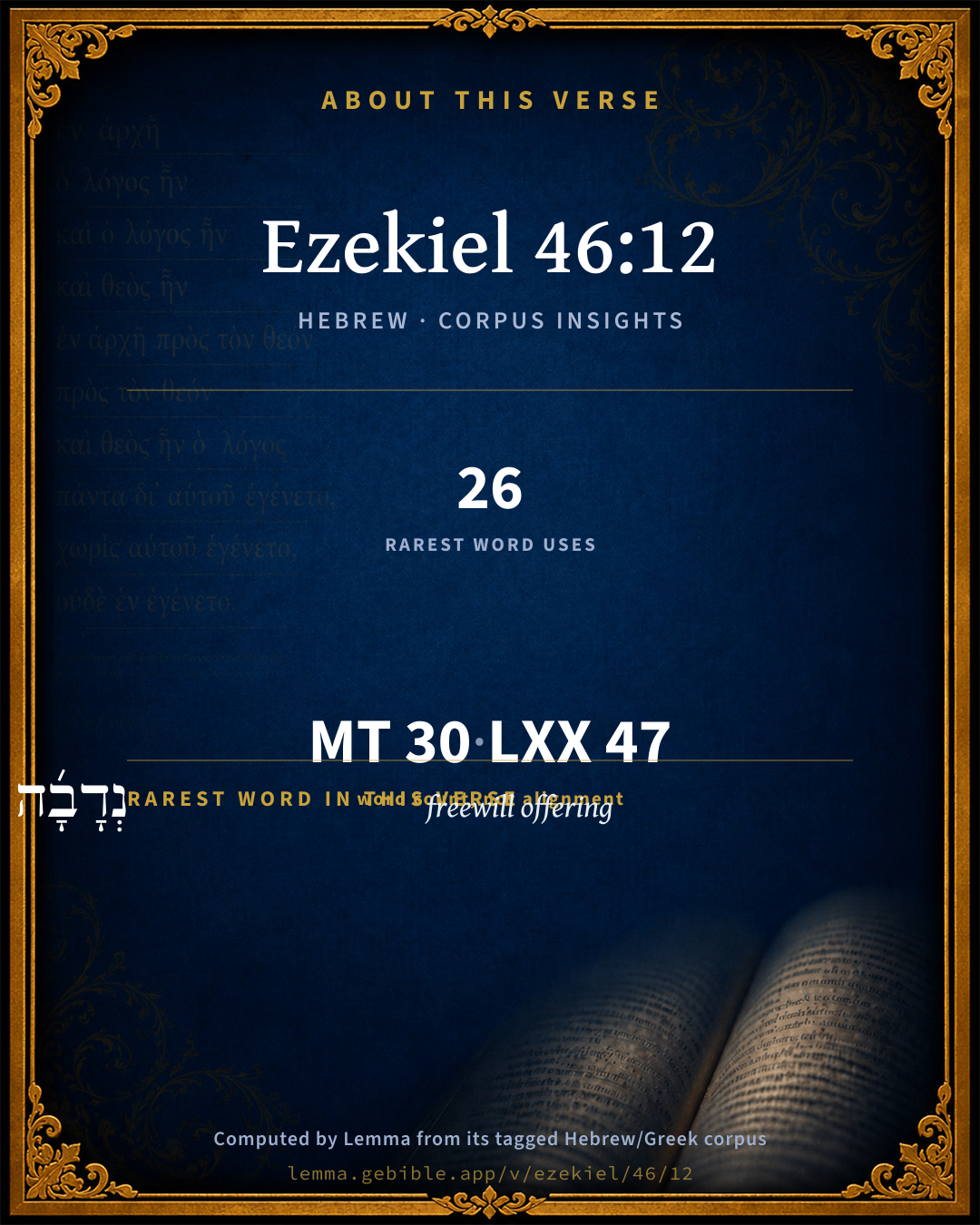
About this verse

These counts appear in no published source. They are computed here, from the morphology-tagged text and Lemma’s own curated glosses. What Lemma adds →

30
words
19
distinct lemmas
Prophets
section

Shared distinctive vocabulary

נְדָבָ֜ה freewill offering H5071 occurs in 25 verses of the Hebrew Bible. Also found in:

Grammatical profile

  • 8 verbs
  • 13 nouns
  • 2 prepositions
  • 2 conjunctions
  • 5 particles

Verb forms

  • יַעֲשֶׂה֩ Qal · Imperfect
  • וּפָ֣תַֽח Qal · Sequential Perfect
  • הַפֹּנֶ֣ה Qal · Participle Active
  • וְעָשָׂ֤ה Qal · Sequential Perfect
  • יַעֲשֶׂ֖ה Qal · Imperfect
  • וְיָצָ֛א Qal · Sequential Perfect
  • וְסָגַ֥ר Qal · Sequential Perfect
  • צֵאתֽוֹ Qal · Infinitive Construct

Repetition

Words recur within this verse — often emphatic in Hebrew:

  • יַעֲשֶׂה֩ to do H6213 ×3
  • נְדָבָ֜ה freewill offering H5071 ×2
  • עוֹלָ֣ה burnt offering H5930 ×2
  • שְׁלָמִים֮ peace offering H8002 ×2
  • הַשַּׁ֨עַר֙ gate H8179 ×2
  • וְיָצָ֛א to go out H3318 ×2

Hebrew & Septuagint length

In English translation the verse runs 61 words from the Hebrew and 54 from the Septuagint (LXX English) — closely comparable.

A rough comparison of the two English renderings, which tokenize alike — not a word-level alignment.

Word counts can differ between the Hebrew and the Greek without any difference in meaning — e.g. the Hebrew direct-object marker אֵת has no separate Greek word, and Greek often adds the article ὁ.

In the original languages it is 30 Hebrew tokens and 47 Greek tokens — but the two are counted differently (Hebrew bundles its prefixes and suffixes into one token; the Greek is in lemma form), so that isn’t a like-for-like length.

Cross-references

18

Topical passages linked to Ezekiel 46:12 in the Treasury of Scripture Knowledge — connected by theme and wording, ordered by reader-vote popularity; previews shown in the World English Bible.

  • Ezekiel 45:17 It shall be the prince's part to give the burnt offerings, and the meal-offerings, and the drink-offerings, in the feasts, and on the new moons, and on the Sabbaths, in all the appointed feasts of the house of Israel: he shall prepare the sin-offering, and the meal-offering, and the burnt offering, and the peace-offerings, to make atonement for the house of Israel.
  • Ezekiel 46:1–2 Thus says the Lord Yahweh: The gate of the inner court that looks toward the east shall be shut the six working days; but on the Sabbath day it shall be opened, and on the day of the new moon it shall be opened.
  • Leviticus 23:38 besides the Sabbaths of Yahweh, and besides your gifts, and besides all your vows, and besides all your freewill offerings, which you give to Yahweh.
  • 2 Chronicles 29:31 Then Hezekiah answered, Now you have consecrated yourselves to Yahweh; come near and bring sacrifices and thank-offerings into the house of Yahweh. The assembly brought in sacrifices and thank-offerings; and as many as were of a willing heart [brought] burnt offerings.
  • Ezekiel 44:3 As for the prince, he shall sit therein as prince to eat bread before Yahweh; he shall enter by the way of the porch of the gate, and shall go out by the way of the same.
  • Ezekiel 46:8 When the prince shall enter, he shall go in by the way of the porch of the gate, and he shall go forth by the way of it.
  • Leviticus 1:3 "'If his offering is a burnt offering from the herd, he shall offer a male without blemish. He shall offer it at the door of the Tent of Meeting, that he may be accepted before Yahweh.
  • Leviticus 7:16 "'But if the sacrifice of his offering is a vow, or a freewill offering, it shall be eaten on the day that he offers his sacrifice; and on the next day what remains of it shall be eaten:
  • Numbers 29:39 These you shall offer to Yahweh in your set feasts, besides your vows, and your freewill-offerings, for your burnt offerings, and for your meal-offerings, and for your drink-offerings, and for your peace-offerings.
  • 1 Kings 3:4 The king went to Gibeon to sacrifice there; for that was the great high place: a thousand burnt offerings did Solomon offer on that altar.
  • 1 Chronicles 29:21 They sacrificed sacrifices to Yahweh, and offered burnt offerings to Yahweh, on the next day after that day, even one thousand bulls, one thousand rams, and one thousand lambs, with their drink-offerings, and sacrifices in abundance for all Israel,
  • 2 Chronicles 5:6 King Solomon and all the congregation of Israel, that were assembled to him, were before the ark, sacrificing sheep and oxen, that could not be counted nor numbered for multitude.
  • 2 Chronicles 7:5–7 King Solomon offered a sacrifice of twenty-two thousand oxen, and a hundred and twenty thousand sheep. So the king and all the people dedicated the house of God.
  • Ezra 1:4 Whoever is left, in any place where he sojourns, let the men of his place help him with silver, and with gold, and with goods, and with animals, besides the freewill-offering for the house of God which is in Jerusalem.
  • Ezra 3:5 and afterward the continual burnt-offering, and [the offerings] of the new moons, and of all the set feasts of Yahweh that were consecrated, and of everyone who willingly offered a freewill-offering to Yahweh.
  • Ezra 6:17 They offered at the dedication of this house of God one hundred bulls, two hundred rams, four hundred lambs; and for a sin-offering for all Israel, twelve male goats, according to the number of the tribes of Israel.
  • Romans 12:1 Therefore I urge you, brothers, by the mercies of God, to present your bodies a living sacrifice, holy, acceptable to God, which is your spiritual service.
  • Ephesians 5:2 Walk in love, even as Christ also loved you, and gave himself up for us, an offering and a sacrifice to God for a sweet-smelling fragrance.

Cross-references courtesy of OpenBible.info (CC BY 4.0).

Hebrew and Greek witnesses Masoretic Hebrew ↔ Greek Septuagint

The same verse in the two great witnesses to the Old Testament, shown verse-for-verse.

These are two independent witnesses, not word-aligned to each other, and the Septuagint is shown in lemma (dictionary) form.

Hebrew Ezekiel 46:12 Masoretic · Westminster Leningrad Codex

וְכִֽי יַעֲשֶׂה֩ הַנָּשִׂ֨יא נְדָבָ֜ה עוֹלָ֣ה אֽוֹ שְׁלָמִים֮ נְדָבָ֣ה לַֽיהוָה֒ וּפָ֣תַֽח ל֗וֹ אֶת הַשַּׁ֨עַר֙ הַפֹּנֶ֣ה קָדִ֔ים וְעָשָׂ֤ה אֶת עֹֽלָתוֹ֙ וְאֶת שְׁלָמָ֔יו כַּאֲשֶׁ֥ר יַעֲשֶׂ֖ה בְּי֣וֹם הַשַּׁבָּ֑ת וְיָצָ֛א וְסָגַ֥ר אֶת הַשַּׁ֖עַר אַחֲרֵ֥י צֵאתֽוֹ

When the prince shall prepare a freewill-offering, a burnt offering or peace-offerings as a freewill-offering to Yahweh, one shall open for him the gate that looks toward the east; and he shall prepare his burnt offering and his peace-offerings, as he does on the Sabbath day: then he shall go forth; and after his going forth one shall shut the gate.

World English Bible · Public Domain

Greek LXX Ezekiel 46:12 Septuagint · lemma form

ἐάν δέ ποιέω ὁ ἀποἡγέομαι ὁμολογία ὁλοκαύτωμα σωτήριον ὁ κύριος καί ἀναοἴγω ἑαυτοῦ ὁ πύλη ὁ βλέπω κατά ἀνατολή καί ποιέω ὁ ὁλοκαύτωμα αὐτός καί ὁ ὁ σωτήριον αὐτός ὅς τρόπος ποιέω ἐν ὁ ἡμέρα ὁ σάββατον καί ἐκἔρχομαι καί κλείω ὁ θύρα μετά ὁ ἐκἔρχομαι αὐτός

And if the prince should prepare as a thanksgiving a whole burnt-peace-offering to the Lord, and should open for himself the gate looking eastward, and offer his whole burnt offering, and his peace-offerings, as he does on the sabbath-day; then shall he go out, and shall shut the doors after he has gone out.

LXX2012 (modern English Septuagint) · Public Domain

On this verse, Joseph Benson's Commentary discusses the Septuagint’s reading. Read the note in Commentary ↓

Hebrew: Westminster Leningrad Codex (CC BY 4.0). Greek: Septuagint (public domain); English from LXX2012 (modern English Septuagint) (Public Domain). How the Septuagint differs from the Hebrew →

Targum (Aramaic paraphrase)

1

The Targum is the ancient Jewish Aramaic paraphrase of the Hebrew Scriptures — an interpretive translation, not the Hebrew text itself. Onkelos (literal) and Pseudo-Jonathan (expansive) render the Torah, and Jonathan the Prophets. Coverage is partial: where no permissively-licensed English translation exists for a verse, only the Aramaic is shown. This is verse-level text, not a word-by-word alignment to the Hebrew.

  1. Targum Jonathan Prophets (Joshua–Malachi)
    וַאֲרֵי יַעְבֵּיד רַבָּא נִדְבָתָא עֲלָתָא אוֹ נִכְסַת קוּדְשַׁיָא נִדְבְתָא קֳדָם יְיָ וְיִפְתַּח לֵיהּ יַת תַּרְעָא דִפְתִיחַ לְמַדִינְחָא וְיַעְבֵּיד יַת עֲלָתֵיהּ וְיַת נְכָסַת קוּדְשׁוֹהִי כְּמָא דִי עֲבַד בְּיוֹמָא דְשַׁבְּתָּא וְיִפּוֹק וְיֵחוּד יַת תַּרְעָא בָּתַר מַפְקֵיהּ:

    (no public-domain English translation for this verse)

    Targum Jonathan — Aramaic: “Mikraot Gedolot” (public domain). English: “Sefaria Community Translation” (CC0 1.0 (public-domain dedication)); “London "Chaldee Paraphrase," 1871” (public domain). Text via Sefaria.

Commentary

Notes on Ezekiel 46:12 from classic Christian and Jewish commentators (each source and its license shown beneath its notes). The classic Christian expositions comment on the surrounding passage and are grouped to its opening verse, so a note may address several verses; the Jewish commentaries on the Tanakh (Rashi and others) are per-verse, so they appear only where the commentator wrote on this verse.

Lemma curates 59 commentaries, every one of them public domain or Creative Commons licensed, each selected and text-cleaned for this edition rather than reprinted as found. About our sources →

Trapp's Complete Commentary

John Trapp

Eze 46:12 Now when the prince shall prepare a voluntary burnt offering or peace offerings voluntarily unto the LORD, [one] shall then open him the gate that looketh toward the east, and he shall prepare his burnt offering and his peace offerings, as he did on the sabbath day: then he shall go forth; and after his going forth [one] shall shut the gate.

Ver. 12. A voluntary burnt offering … one shall then open him the gate, &c.] Here is warrant for our week day lectures, a voluntary service well accepted; provided that afterwards one shut the gate, and men return to their honest labours.

John Trapp, A Commentary or Exposition upon All the Books of the Old and New Testament (1647–1656) — public domain. Text from a community e-Sword module.

Joseph Benson's Commentary

Eze 46:12-14. Now when the prince shall prepare a voluntary offering — The foregoing verses gave directions about the sacrifices the prince was enjoined to offer upon solemn days; this gives directions concerning his free-will, or voluntary offerings, concerning which see Lev 22:18; Lev 22:21. Upon these occasions the eastern gate was to be opened for the prince; but then, as soon as the service was over, and he was gone out, the gate was to be shut, because that gate was not to stand open, but only on the sabbath and festival days. Thou shalt daily prepare — The LXX. read, He shall prepare, or make, a burnt-offering, &c., as also all the ancient versions, except the Chaldee. He shall prepare it every morning — The daily evening sacrifice is generally supposed to be here implied, according to the prescription of the law, Num 28:3. The sixth part of an ephah, &c. — In Num 28:5, the proportion required is the tenth part of an ephah, and the fourth part of a hin of oil. By a perpetual ordinance unto the Lord — The law of the passover is called a perpetual ordinance, Exo 12:17; and likewise the ordinances about the first- fruits. Lev 23:14. The Hebrew word, עולם, is used in each of these places; but it does not always denote perpetuity in a strict sense, but only a long period, or succession of time.

Joseph Benson's Commentary on the Old and New Testaments (1811–1818) — public domain. Text from a community e-Sword module.

Tyndale Open Study Notes

Tyndale Open Resources

46:12 The voluntary burnt offering or peace offering was in addition to the regular daily offerings of meat, grain, and oil that symbolized the regular table fellowship and communion that had now been restored between God and his people.

Tyndale Open Study Notes — © Tyndale Open Resources, licensed CC BY-SA 4.0. Text via the HelloAO Bible API.

Jamieson, Fausset & Brown

Robert Jamieson, A. R. Fausset & David Brown

Not only is he to perform official acts of worship on holy days and feasts, but in "voluntary" offerings daily he is to show his individual zeal, surpassing all his people in liberality, and so setting them a princely example.

Jamieson, Fausset & Brown — Commentary Critical and Explanatory on the Whole Bible (1871) — public domain (CC PDM 1.0). Text via the HelloAO Bible API.

Ellicott's Commentary for English Readers

(12) A voluntary burnt offering.—One case in which the prince might present a sacrifice is yet unprovided for. He might offer, like any of the people, a voluntary sacrifice at any time, either a burnt offering or a peace offering. In this case he is still to enter by the east gate; but the gate, instead of standing open until evening, as on the Sabbaths and new moons, is to be immediately shut as soon as he retires after the completion of the sacrifice.

A Bible Commentary for English Readers, edited by Charles John Ellicott (1878–1897) — public domain. Text from a community e-Sword module.

The Cambridge Bible for Schools and Colleges

gen. ed. J. J. S. Perowne

12. Regulation when the prince presents a free-will offering. The east (inner) gate shall be opened for him on such occasions as on the sabbaths and new moons. Cf. Lev_7:16, Eze_33:28; Num_15:3; Num_29:39; Deu_12:6; Amo_4:5.

The Cambridge Bible for Schools and Colleges (gen. ed. J. J. S. Perowne; Cambridge University Press, 1878–1918) — public domain. Text from a community e-Sword module.

John Gill's Exposition

Thou shalt daily prepare a burnt offering unto the Lord,.... Called the daily sacrifice, Dan 8:11 typical of Christ's sacrifice, which has a continual daily virtue in it, to take away the sins of his people; and which ought to be looked unto faith, and pleaded by them for that purpose every day Joh 1:29,

of a lamb of the first year without a blemish; a type of Christ the Lamb of God, without spot and blemish, strong and able, and so fit and proper to be a sacrifice for the sins of others:

thou shalt prepare it every morning; or, "morning by morning" (m); this seems to be said not to the prince, but rather to the prophet, and indeed to every believer; who should, every morning he rises, look to Christ as the atoning sacrifice for sin, whose blood continually cleanses from it, and who is always in the midst of the throne as a lamb that had been slain, and ever lives to make intercession; and as the mercies of the Lord's people are renewed every morning, they should renew their thankfulness to God as often, and bring this lamb with them, through whose sacrifice their sacrifices of praise become acceptable. No mention is made of the evening sacrifice; see Exo 29:38, which some think is included in the morning burnt offering. Kimchi thinks that in future time this was not to be offered, only the morning sacrifice; but the true reason is, Christ has appeared once in the evening of the world, and offered up himself; yea, it was literally in the evening, or decline of the day, when he suffered, or between the two evenings, whereby he answered the type of the passover lamb; hence no evening sacrifice is mentioned, Christ's being offered up.

(m) "in mane, in mane", Montanus, Vatablus.

John Gill's Exposition of the Whole Bible (1746–1763) — public domain (CC PDM 1.0). Text via the HelloAO Bible API.

Matthew Poole's English Annotations

In Eze 46:2,4-7, orders were given about those offerings which were required, which the prince must offer; in this, direction is given about those that are free-will offerings, which in all points must be prepared as the other were on the sabbath day, which see in the forementioned verses.

One shall shut the gate; one of the priests’ porters; as the gate was opened for this service only on such a day, so, the service performed, some priests’ porter shall shut it, for it must not stand open on ordinary days. days.

Matthew Poole's English Annotations on the Holy Bible (1683–1685) — public domain. Text from a community e-Sword/MySword module.

The Pulpit Commentary

Verse 12 determines the procedure in case of the prince resolving to offer privately, on his own account, a voluntary burnt offering or peace offering; better, a free-will offering (hbdn), a sacrifice prompted by the heart of the offerer, as opposed to one legally enjoined. (Exo_35:29; Lev_22:23) which might be either a burnt or a peace offering. In this case the east inner gate should be opened to him as on the sabbath days (see ver. 1), but, differently from what occurred on the sabbath, it should not remain open till the evening (ver. 2), but should be shut immediately the prince"s offering was done.

A free-will offering.

There were certain sacrifices and offerings which the pious Jew was bound to present. To omit compliance with certain regulations upon these observances would have been disloyalty. But there were other offerings which were optional, which were left to the feelings and to the circumstances of the worshipper. They were only brought when there was an especially lively sense of the Lord"s goodness, and an especial desire to express consecration and devotion. Gifts prompted by gratitude and love are the only gifts which are of value in the sight of him who searcheth and looketh upon the hearers.

I FREE-WILL OFFERINGS ARE BECOMING ON THE PART OF MAN. Man"s nature is distinguished by the glorious prerogative of liberty. There is for him no moral excellence or beauty in constraint. The heart is free, and it is the only gift which in God"s sight is precious; all other gifts have value so far only as they are the expression of the love and loyalty of the spiritual nature. Whatever is dedicated to God of the worshipper"s freewill is a human and a worthy offering, such as a being with man"s prerogative of liberty may justly offer.

II FREE-WILL OFFERINGS ARE ACCEPTABLE TO GOD. False religions sometimes extort from devotees, by the motive of terror, gifts and offerings services and sacrifices which would otherwise be withheld. They must be fictitious" deities that are represented as gratified with such offerings as these. But the character of God is such as assures us of his willingness to receive what is freely and cheerfully presented. Not that he can be enriched by anything that his creatures can present. "Of thine own," they acknowledge thine own have we given thee." But all is precious to him that reveals a loyal, loving, and grateful heart. T.

The Pulpit Commentary (1880–1919), ed. H.D.M. Spence-Jones & Joseph S. Exell — public domain. Text from a community e-Sword module.

Rashi

Rabbi Shlomo Yitzchaki (Rashi)

And when the prince brings a freewill offering on the six working days.

one shall then open for him the gate, etc. Not to enter the Heichal through it, but he shall stand there, and the priests shall make his burnt offering and his peace-offering, and he shall prostrate himself and leave, as it is said: “as he would do on the Sabbath day.” Now what is stated regarding the Sabbath day (here)? (Verse 2) “And he shall stand at the doorpost of the gate, and the priests shall offer his burnt offering, etc.”

after he has gone out He does not say here: “but the gate shall not be closed until the evening,” as he says regarding the Sabbath day. For regarding the Sabbath day it says (verse 3): “And the people of the land shall prostrate themselves at the entrance of that gate.” Therefore, it is left open. But on weekdays it is not customary for them to come to prostrate themselves, for everyone is occupied with work; therefore, “after he has gone out, one shall close the gate.”

Rashi on the Tanakh — English translations: “The Judaica Press complete Tanach with Rashi, translated by A. J. Rosenberg” (CC BY 4.0); “Pentateuch with Rashi's commentary by M. Rosenbaum and A.M. Silbermann, 1929-1934” (public domain); “The Metsudah Tanach series, Lakewood, N.J” (CC BY 4.0); and “The Book of Joshua, Metsudah Publications, 1997” (CC BY 4.0). Text via Sefaria.

Lesson kit

Teaching starters — assembled from the data on this page, not authored interpretation. Every prompt links to the verse data it draws on. Edit before teaching.

Ezekiel, in the Prophets, opens this verse with 30 words (19 distinct Hebrew lemmas). Its most distinctive word is nᵉdâbâh (“freewill offering”). A historical commentator’s framing appears above. Read the whole chapter for the surrounding context.

Discussion questions

  1. What does “freewill offering” (nᵉdâbâh) contribute to the verse as a whole?
  2. Exodus 35:29 shares the word «freewill offering» with this verse. How do the two illuminate each other?
  3. “to do” occurs 3× in this one verse. What is the effect of the repetition?
  4. The translations on this page render this verse differently — a whole-verse word diff, not a word-by-word alignment. What might account for the different wordings?
  5. The verb «יַעֲשֶׂה֩» is Qal Imperfect. How does its form color the action?
  6. Reading how Trapp's Complete Commentary and Joseph Benson's Commentary read this verse, where do the two commentators agree and where do they part?

Things to notice

Reading settings

Reading text

Shown beneath each verse's original-language words.

Old Testament
Old Testament edition

Read the OT as the Masoretic Hebrew (MT) or the Greek Septuagint (LXX).

English shown for the Greek Septuagint (in the Hebrew ↔ Greek comparison).

Comparing translations? Open the Compare panel on any verse page to stack up to four side by side.