
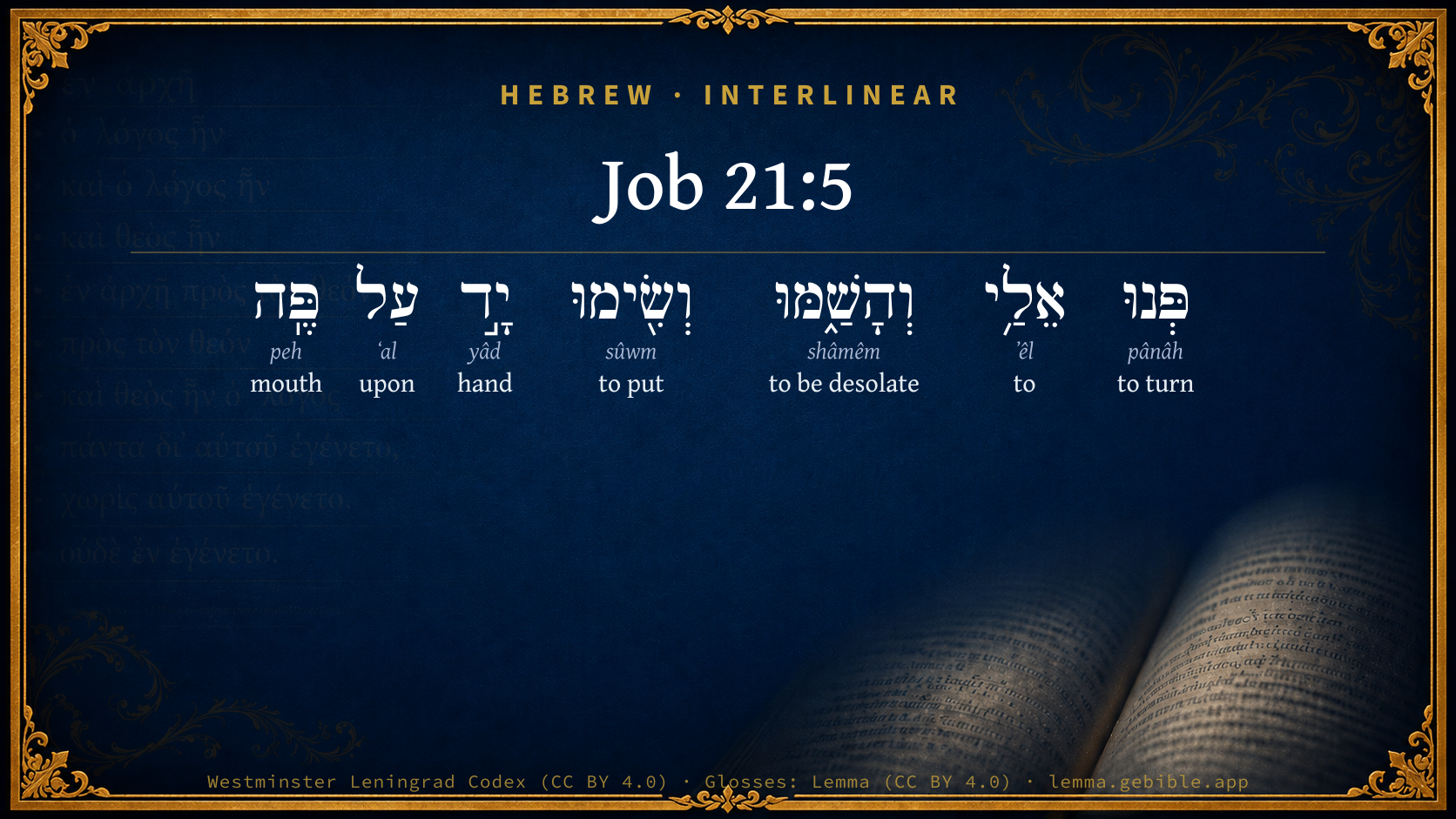
Job 21:5

Hebrew (Westminster Leningrad Codex) Job 21:5 appears in the Hebrew Old Testament. The text above is from the Westminster Leningrad Codex. Each word links to its Strong’s number, a concise gloss, and parsing drawn from the Open Scriptures Hebrew Bible morphology. Click any word for its full Brown-Driver-Briggs (BDB) entry.
Download image
Cite this verse

Job 21:5 (World English Bible). Public Domain. Lemma interlinear Bible study tool, https://lemma.gebible.app/v/job/21/5.

Show BibTeX & RIS
BibTeX
RIS
English Translation
Look at me, and be astonished. Lay your hand on your mouth.
World English Bible · Public Domain
Download a study sheet

One document with this verse’s original text, its word-by-word gloss line, the meaning frame, cross-references with their text, attributed commentary, and full source and license credits — printable, and it pastes into notes with its structure intact.

This verse Autodidact and up

Study sheet (.html) Plain text (.txt)

A passage Seminary Student

Up to 50 verses in one chapter. A passage sheet keeps up to 6 commentary sources and 12 cross-references per verse, in the order this page ranks them, and says so on the sheet whenever that leaves anything out. Ask for a single verse and you get the Autodidact verse sheet above.

Everything on this page stays free to read, with no account — the sheet is a download of what is already on screen, not access to it.

Want to remove ads? Support Godless Engineer
Compare translations 3

The same verse in 3 English versions, stacked beneath the original-language interlinear above. Click any original word for its lexicon entry.

Each is an independent rendering of the whole verse — the interlinear is not word-aligned to these translations.

Highlighted words mark where these versions differ — a whole-verse word diff, not a word-by-word alignment.

  • World English Bible Public Domain
    Look at me, and be astonished. Lay your hand on your mouth.
  • King James Version Public Domain
    Mark me, and be astonished, and lay your hand upon your mouth.
  • unfoldingWord Literal Text CC BY-SA 4.0
    Look at me and wonder, and lay the hand upon the mouth.

unfoldingWord Literal Text — © unfoldingWord, licensed CC BY-SA 4.0. Word-aligned USFM3 via Door43 (git.door43.org/unfoldingWord/en_ult).

Versions to compare (up to 4)

3 of 4 selected

Show all 18 translations

Every available English version of this verse, each an independent rendering of the whole verse.

  • World English Bible Public Domain
    Look at me, and be astonished. Lay your hand on your mouth.
  • Berean Standard Bible Public Domain
    Look at me and be appalled; put your hand over your mouth.
  • Majority Standard Bible Public Domain
    Look at me and be appalled; put your hand over your mouth.
  • King James Version Public Domain
    Mark me, and be astonished, and lay your hand upon your mouth.
  • American Standard Version (1901) Public Domain
    Mark me, and be astonished, And lay your hand upon your mouth.
  • Revised Version (1885) Public Domain
    Mark me, and be astonished, and lay your hand upon your mouth.
  • Geneva Bible (1599) Public Domain
    Marke mee, and be abashed, and lay your hand vpon your mouth.
  • Douay-Rheims (1899) Public Domain
    Hearken to me and be astonished, and lay your finger on your mouth.
  • Young's Literal Translation Public Domain
    Turn unto me, and be astonished, And put hand to mouth.
  • Literal Standard Version CC BY-SA 4.0
    Turn to me, and be astonished, || And put hand to mouth.
  • Unlocked Literal Bible CC BY-SA 4.0
    Look at me and be astonished, and lay your hand upon your mouth.
  • unfoldingWord Literal Text CC BY-SA 4.0
    Look at me and wonder, and lay the hand upon the mouth.
  • Darby Bible Public Domain
    Mark me, and be astonished, and lay the hand upon the mouth.
  • World Messianic Bible Public Domain
    Look at me, and be astonished. Lay your hand on your mouth.
  • Webster's Bible Public Domain
    Mark me, and be astonished, and lay your hand upon your mouth.
  • Free Bible Version CC BY-SA 4.0
    Just take a look at me. Aren't you appalled? Cover your mouth with your hand in shock!
  • Bible in Basic English Public Domain
    Take note of me and be full of wonder, put your hand on your mouth.
  • JPS Tanakh (1917) Public Domain
    Turn unto me, and be astonished, and lay your hand upon your mouth.

Literal Standard Version (2020), Covenant Press — licensed CC BY-SA 4.0. Text via the HelloAO Bible API (eBible.org). Unlocked Literal Bible (unfoldingWord) — licensed CC BY-SA 4.0. Text via the HelloAO Bible API (eBible.org). unfoldingWord Literal Text — © unfoldingWord, licensed CC BY-SA 4.0. Word-aligned USFM3 via Door43 (git.door43.org/unfoldingWord/en_ult). Free Bible Version, Dr. Jonathan Gallagher — licensed CC BY-SA 4.0. Text via the HelloAO Bible API (eBible.org).

Word by word

More ways to search: Search by grammar → Find every occurrence → Compare this word →

Practice this passage: Drill this verse → Learn its vocabulary →

וְהָשַׁ֑מּוּ
shâmêm
H8074
“and · be desolate”
Conjunction + Verb, Hiphil, Imperative, 2nd Person, Masculine, Plural
Part of Speech
Conjunction + Verb
Stem
Hiphil
Form
Imperative
Person
2nd Person
Gender
Masculine
Number
Plural
Full BDB Definition

Origin: a primitive root

TWOT: 2409

to be desolate, be appalled, stun, stupefy - (Qal) - to be desolated, be deflowered, be deserted, be appalled - to be appalled, be awestruck - (Niphal) - to be desolated, be made desolate - to be appalled - (Polel) - to be stunned - appalling, causing horror (participle) - horror-causer, appaller (substantive) - (Hiphil) - to devastate, ravage, make desolated - to appal, show horror - (Hophal) to lay desolate, be desolated - (Hithpolel) - to cause to be desolate - to be appalled, be astounded - to cause oneself desolation, cause oneself ruin
  1. פְּנוּ pânâh H6437 “turn” Verb, Qal, Imperative, 2nd Person, Masculine, Plural
  2. אֵלַ֥י ʼêl H413 “to · me” Preposition + Suffix, Personal, 1st Person, Common, Singular
  3. וְשִׂ֖ימוּ sûwm H7760 “and · put” Conjunction + Verb, Qal, Imperative, 2nd Person, Masculine, Plural
  4. יָ֣ד yâd H3027 “hand” Noun, Common, Both, Singular, Absolute
  5. עַל ʻal H5921 “upon” Preposition
  6. פֶּֽה peh H6310 “mouth” Noun, Common, Masculine, Singular, Absolute

About this verse

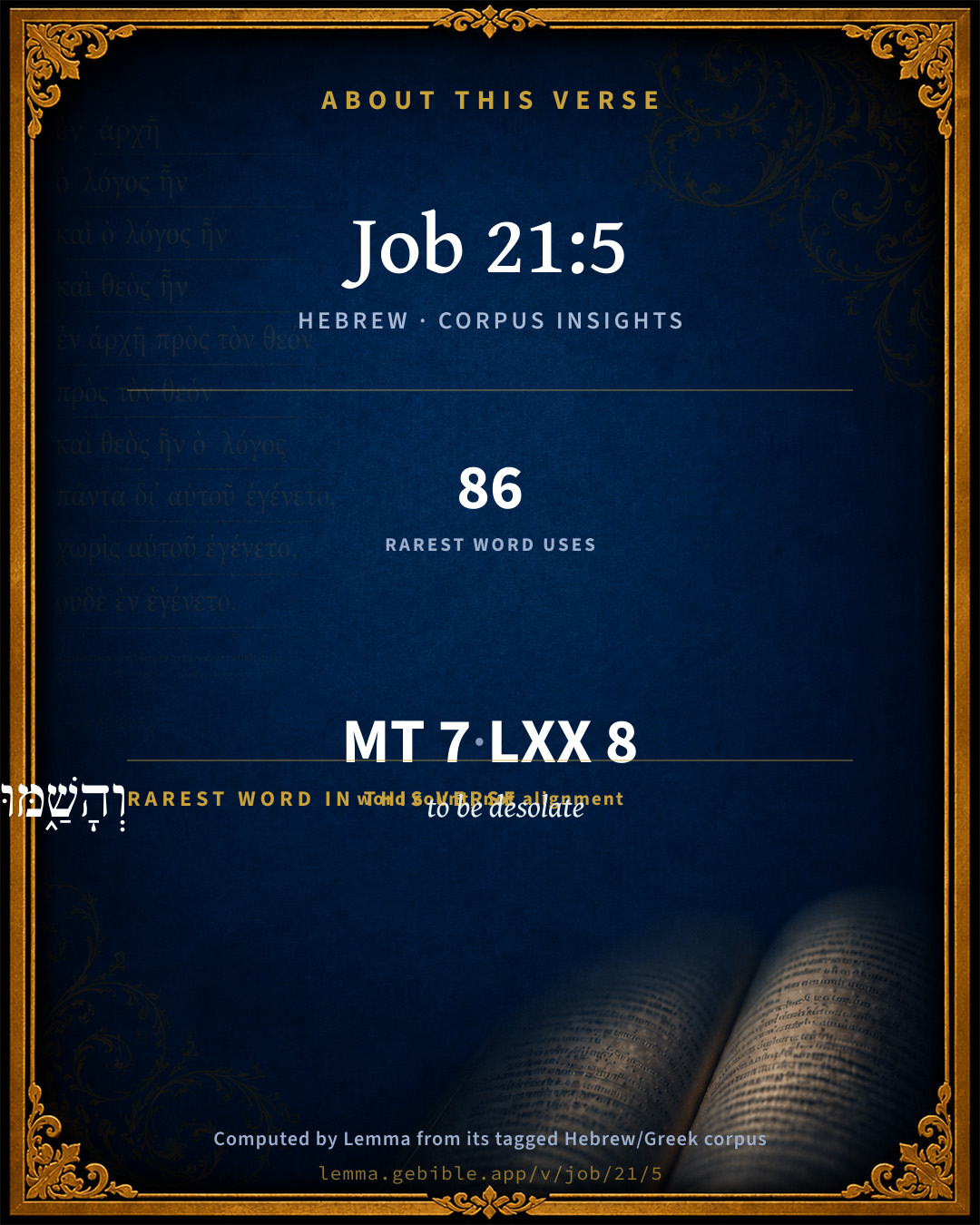
These counts appear in no published source. They are computed here, from the morphology-tagged text and Lemma’s own curated glosses. What Lemma adds →

7
words
7
distinct lemmas
Wisdom
section

Grammatical profile

  • 3 verbs
  • 2 nouns
  • 2 prepositions

Verb forms

  • פְּנוּ Qal · Imperative
  • וְהָשַׁ֑מּוּ Hiphil · Imperative
  • וְשִׂ֖ימוּ Qal · Imperative

Hebrew & Septuagint length

In English translation the verse runs 12 words from the Hebrew and 11 from the Septuagint (LXX English) — closely comparable.

A rough comparison of the two English renderings, which tokenize alike — not a word-level alignment.

Word counts can differ between the Hebrew and the Greek without any difference in meaning — e.g. the Hebrew direct-object marker אֵת has no separate Greek word, and Greek often adds the article ὁ.

In the original languages it is 7 Hebrew tokens and 8 Greek tokens — but the two are counted differently (Hebrew bundles its prefixes and suffixes into one token; the Greek is in lemma form), so that isn’t a like-for-like length.

Cross-references

11

Topical passages linked to Job 21:5 in the Treasury of Scripture Knowledge — connected by theme and wording, ordered by reader-vote popularity; previews shown in the World English Bible.

  • Judges 18:19 They said to him, Hold your peace, lay your hand on your mouth, and go with us, and be to us a father and a priest: is it better for you to be priest to the house of one man, or to be priest to a tribe and a family in Israel?
  • Job 29:9 The princes refrained from talking, And laid their hand on their mouth;
  • Job 40:4 "Behold, I am of small account. What shall I answer you? I lay my hand on my mouth.
  • Proverbs 30:32 "If you have done foolishly in lifting up yourself, Or if you have thought evil, Put your hand over your mouth.
  • Job 2:12 When they lifted up their eyes from a distance, and didn't recognize him, they raised their voices, and wept; and they each tore his robe, and sprinkled dust on their heads toward the sky.
  • Job 17:8 Upright men shall be astonished at this. The innocent shall stir up himself against the godless.
  • Job 19:20–21 My bones stick to my skin and to my flesh. I have escaped by the skin of my teeth.
  • Psalms 39:9 I was mute. I didn't open my mouth, Because you did it.
  • Amos 5:13 Therefore he who is prudent shall keep silence in such a time; For it is an evil time.
  • Micah 7:16 The nations will see and be ashamed of all their might. They will lay their hand on their mouth. Their ears will be deaf.
  • Romans 11:33 Oh the depth of the riches both of the wisdom and the knowledge of God! How unsearchable are his judgments, and his ways past tracing out!

Cross-references courtesy of OpenBible.info (CC BY 4.0).

Hebrew and Greek witnesses Masoretic Hebrew ↔ Greek Septuagint

The same verse in the two great witnesses to the Old Testament, shown verse-for-verse.

These are two independent witnesses, not word-aligned to each other, and the Septuagint is shown in lemma (dictionary) form.

Hebrew Job 21:5 Masoretic · Westminster Leningrad Codex

פְּנוּ אֵלַ֥י וְהָשַׁ֑מּוּ וְשִׂ֖ימוּ יָ֣ד עַל פֶּֽה

Look at me, and be astonished. Lay your hand on your mouth.

World English Bible · Public Domain

Greek LXX Job 21:5 Septuagint · lemma form

εἰςβλέπω εἰς ἐγώ θαυμάζω χείρ τίθημι ἐπί σιαγών

Look upon me, and wonder, laying your hand upon your cheek.

LXX2012 (modern English Septuagint) · Public Domain

On this verse, Haydock's Catholic Bible Commentary discusses the Septuagint’s reading. Read the note in Commentary ↓

Hebrew: Westminster Leningrad Codex (CC BY 4.0). Greek: Septuagint (public domain); English from LXX2012 (modern English Septuagint) (Public Domain). How the Septuagint differs from the Hebrew →

Commentary

Notes on Job 21:5 from classic Christian and Jewish commentators (each source and its license shown beneath its notes). The classic Christian expositions comment on the surrounding passage and are grouped to its opening verse, so a note may address several verses; the Jewish commentaries on the Tanakh (Rashi and others) are per-verse, so they appear only where the commentator wrote on this verse.

Lemma curates 59 commentaries, every one of them public domain or Creative Commons licensed, each selected and text-cleaned for this edition rather than reprinted as found. About our sources →

Trapp's Complete Commentary

John Trapp

Job 21:5 Mark me, and be astonished, and lay [your] hand upon [your] mouth.

Ver. 5. Mark me, and be astonied] Heb. Look upon me. He had said before, Hear and hear, now, Behold and see if there be any sorrow like unto my sorrow. Mark it, I say, and stand amazed at it. Did you ever find any on this side hell so sore afflicted as I am? Is it not because you are not duly affected with my miseries, that ye are so regardless of my discourse? Strange that my sorrows should be great enough to work astonishment, and yet not great enough to deserve attention. O mark first what I suffer, and then what I speak.

And (this once done) lay your hand upon your mouth] Be swift to hear, but slow to speak; yea, spare to speak at all in this case. The Greek proverb admonisheth men either to be silent or to speak something that is better than silence. Harpocrates, the heathenish god of silence, was pictured with his finger laid upon his lips.

John Trapp, A Commentary or Exposition upon All the Books of the Old and New Testament (1647–1656) — public domain. Text from a community e-Sword module.

Joseph Benson's Commentary

Job 21:5. Mark me, and be astonished — Consider what I am about to say, concerning the wonderful prosperity of the worst of men, and the pressures of some good men; and it will fill you with astonishment at the mysterious conduct of Divine Providence herein. And lay your hand upon your mouth — Be silent: quietly wait the issue; and judge nothing before the time. God’s way is in the sea, and his path in the great waters. When we cannot account for what he doth, in suffering the wicked to prosper, and the godly to be afflicted, nor fathom the depth of those proceedings, it becomes us to sit down and admire them. Upright men shall be astonished at this, chap. Job 17:8. Be you so.

Joseph Benson's Commentary on the Old and New Testaments (1811–1818) — public domain. Text from a community e-Sword module.

Geneva Bible (1599)

Geneva Bible translators

He chargeth them as though they were not able to comprehend this his feeling of God’s judgment, and exhorteth them therefore to silence.

Geneva Bible (1599) marginal notes — public domain. Text via Bolls.life.

Jamieson, Fausset & Brown

Robert Jamieson, A. R. Fausset & David Brown

lay . . . hand upon . . . mouth-- (Pro 30:32; Jdg 18:19). So the heathen god of silence was pictured with his hand on his mouth. There was enough in Job's case to awe them into silence (Job 17:8).

Jamieson, Fausset & Brown — Commentary Critical and Explanatory on the Whole Bible (1871) — public domain (CC PDM 1.0). Text via the HelloAO Bible API.

Adam Clarke's Commentary

Verse 5. Mark me, and be astonished] Consider and compare the state in which I was once, with that in which I am now; and be astonished at the judgments and dispensations of God. You will then be confounded; you will put your hands upon your mouths, and keep silent.

Putting the hand on the mouth, or the finger on the lips, was the token of silence. The Egyptian god Harpocrates, who was the god of silence, is represented with his finger compressing his upper lip.

Adam Clarke's Commentary on the Bible (1810–1826) — public domain. Text from a community e-Sword/MySword module.

The Cambridge Bible for Schools and Colleges

gen. ed. J. J. S. Perowne

5. The mystery which he will lay before them if they will mark it will strike them dumb. To “lay the hand upon the mouth” is a gesture of awe-struck silence, cf. ch. Job_40:4.

The Cambridge Bible for Schools and Colleges (gen. ed. J. J. S. Perowne; Cambridge University Press, 1878–1918) — public domain. Text from a community e-Sword module.

John Gill's Exposition

Even when I remember,.... Either the iniquities of his youth he was made to possess; or his former state of outward happiness and prosperity he had enjoyed, and reviewed his present miserable case and condition, and called to mind the evil tidings brought him thick and fast of the loss of his substance, servants, and children, which were so terrible and shocking; or when he reflected on the instances of Providence he was about to relate in the following verses:

I am afraid, and trembling taketh hold on my flesh; which is sometimes the case of good men, both with respect to the judgments of God upon the wicked, and with respect to what befalls, or is coming upon, the people of God, Psa 119:120; and even the different treatment of good and bad men in this life, as that the one should be severely afflicted and distressed, and the other be in such prosperous and happy circumstances, is not only a sore temptation to them, but shocks their minds, and makes them shudder and stagger at it, and gives them great pain and uneasiness, Psa 73:2.

John Gill's Exposition of the Whole Bible (1746–1763) — public domain (CC PDM 1.0). Text via the HelloAO Bible API.

Albert Barnes' Notes on the Bible

Mark me - Margin, “look unto.” Literally, “Look upon me. That is, attentively look on me, on my sufferings, on my disease, and my losses. See if I am a proper object of repreach and mockery - see if I have not abundant reason to be in deep distress when God has afflicted me in a manner so unusual and mysterious.

And be astonished - Silent astonishment should be evinced instead of censure. You should wonder that a man whose life has been a life of piety, should exhibit the spectacle which you now behold, while so many proud contemners of God are permitted to live in affluence and ease.

And lay your hand upon your mouth - As a token of silence and wonder. So Plutarch, de Iside et Osiride, “Wherefore, he had laid his finger on his mouth as a symbol of silence and admiration - ἐχεμυθίας καὶ σιωπῆς σύμβολον echemuthias kai siōpēs sumbolon.”

Albert Barnes' Notes on the Bible (1834–1885) — public domain. Text from a community e-Sword/MySword module.

Haydock's Catholic Bible Commentary

Hearken to. Literally, "look steadfastly on me." (Haydock) --- Compare my present with my former condition, and do not pretend to fathom God’s judgments; which fall me also with astonishment, when I consider why the virtuous are distressed, and the wicked prosper, ver. 7. --- Mouth be silent. Harpocrates, the god of silence, was represented in this posture; and Virgil says, Intentique ora tenebant. (Æneid ii.) --- Septuagint, "upon the cheek," like men in deep consideration. (Calmet)

George Leo Haydock (1774–1849), Haydock's Catholic Family Bible and Commentary, 1859 edition — public domain. Excludes Psalms (Douay-Rheims chapter numbering differs from Protestant) and Deuterocanonical books (Catholic canon only).

Matthew Poole's English Annotations

Consider what I am about to say concerning the wonderful prosperity of the worst of men, and the intolerable pressures of some good men, such as I have manifested and shall prove that I am, and it is able to fill you that are but spectators with astonishment and horror at the strange and mysterious course of Divine Providence herein; and therefore it is no wonder if I, who suffer such things from that God whom I have so faithfully served, am overwhelmed with the sense of it.

Lay your hand upon your mouth, i.e. be silent, as this phrase is oft used, as Job 40:4; Pro 10:32; Mic 7:16; for shame forbear to vex me with your words: or, you will lay, &c.; the imperative being put for the future, as is usual. I am persuaded you will be silenced and convinced by what I shall say.

Matthew Poole's English Annotations on the Holy Bible (1683–1685) — public domain. Text from a community e-Sword/MySword module.

Whedon's Commentary on the Bible

Daniel D. Whedon

5. Hand upon your mouth — (Compare Job_40:4; Pro_30:32; Mic_7:16.) The Egyptian mode of indicating silence was by placing the hand on the mouth. One of their deities, Horus, is represented as a child seated on a lotus leaf with his finger on his lips. This attitude however, Wilkinson thinks, was only illustrative of his extreme youth.

Daniel D. Whedon (gen. ed.), Commentary on the Old and New Testaments (1874–1909) — public domain. Text from a community e-Sword module.

The Pulpit Commentary

Vers. 5, 6. Here we have an abrupt transition. Job is about to controvert Zophar"s theory of the certain retribution that overtakes the wicked man in this life, and to maintain that, on the contrary, he usually prospers (vers. 7-18). Knowing that, in thus running counter to the general religious teaching, he will arouse much horror and indignation on the part of those who hear him, he prefaces his remarks with a notice that they will cause astonishment, and an acknowledgment that he himself cannot reflect upon the subject without a feeling of alarm and dismay. He thus hopes partially to disarm his opponents. Mark me; literally, look to me; i.e. "attend to me," for I am about to say something well worth attention. And be astonished. Prepare yourselves, i.e. , for something that will astonish you. And lay your hand upon your mouth. Harpocrates, the Egyptian god of silence, was often represented with his finger on his lips (see the author"s "History of Ancient Egypt," vol. 1. p. 362). The symbolism is almost universal. Job begs his auditors to "refrain their lips," and, however much astonished, to keep silence until he has concluded.

The Pulpit Commentary (1880–1919), ed. H.D.M. Spence-Jones & Joseph S. Exell — public domain. Text from a community e-Sword module.

John Wesley's Explanatory Notes

Mark - Consider what I am about to say concerning the prosperity of the worst of men, and the pressures of some good men, and it is able to fill you with astonishment. Lay, &c. - Be silent.

John Wesley, Explanatory Notes Upon the Whole Bible (1754–1765) — public domain. Text via the GEBible commentary corpus.

Rashi

Rabbi Shlomo Yitzchaki (Rashi)

Turn to me to listen.

and be silent Be astonished at my words.

and place your hand upon your mouth because you will not know what to answer.

Rashi on the Tanakh — English translations: “The Judaica Press complete Tanach with Rashi, translated by A. J. Rosenberg” (CC BY 4.0); “Pentateuch with Rashi's commentary by M. Rosenbaum and A.M. Silbermann, 1929-1934” (public domain); “The Metsudah Tanach series, Lakewood, N.J” (CC BY 4.0); and “The Book of Joshua, Metsudah Publications, 1997” (CC BY 4.0). Text via Sefaria.

Lesson kit

Teaching starters — assembled from the data on this page, not authored interpretation. Every prompt links to the verse data it draws on. Edit before teaching.

Job, in the Wisdom, opens this verse with 7 words (7 distinct Hebrew lemmas). Its most distinctive word is shâmêm (“to be desolate”). A historical commentator’s framing appears above. Read the whole chapter for the surrounding context.

Discussion questions

  1. The word shâmêm carries the sense “to be desolate.” How does it shape the verse?
  2. How does Judges 18:19, which shares this passage’s theme, read alongside this verse?
  3. These translations render this verse differently; the difference is in the English rendering, not the original. What questions does that raise?
  4. «פְּנוּ» is a Qal Imperative verb. How does that grammatical form shape the action described?
  5. Compare how Trapp's Complete Commentary and Joseph Benson's Commentary read this verse. Where do they agree or differ?

Things to notice

Reading settings

Reading text

Shown beneath each verse's original-language words.

Old Testament
Old Testament edition

Read the OT as the Masoretic Hebrew (MT) or the Greek Septuagint (LXX).

English shown for the Greek Septuagint (in the Hebrew ↔ Greek comparison).

Comparing translations? Open the Compare panel on any verse page to stack up to four side by side.