1 Samuel 13:17

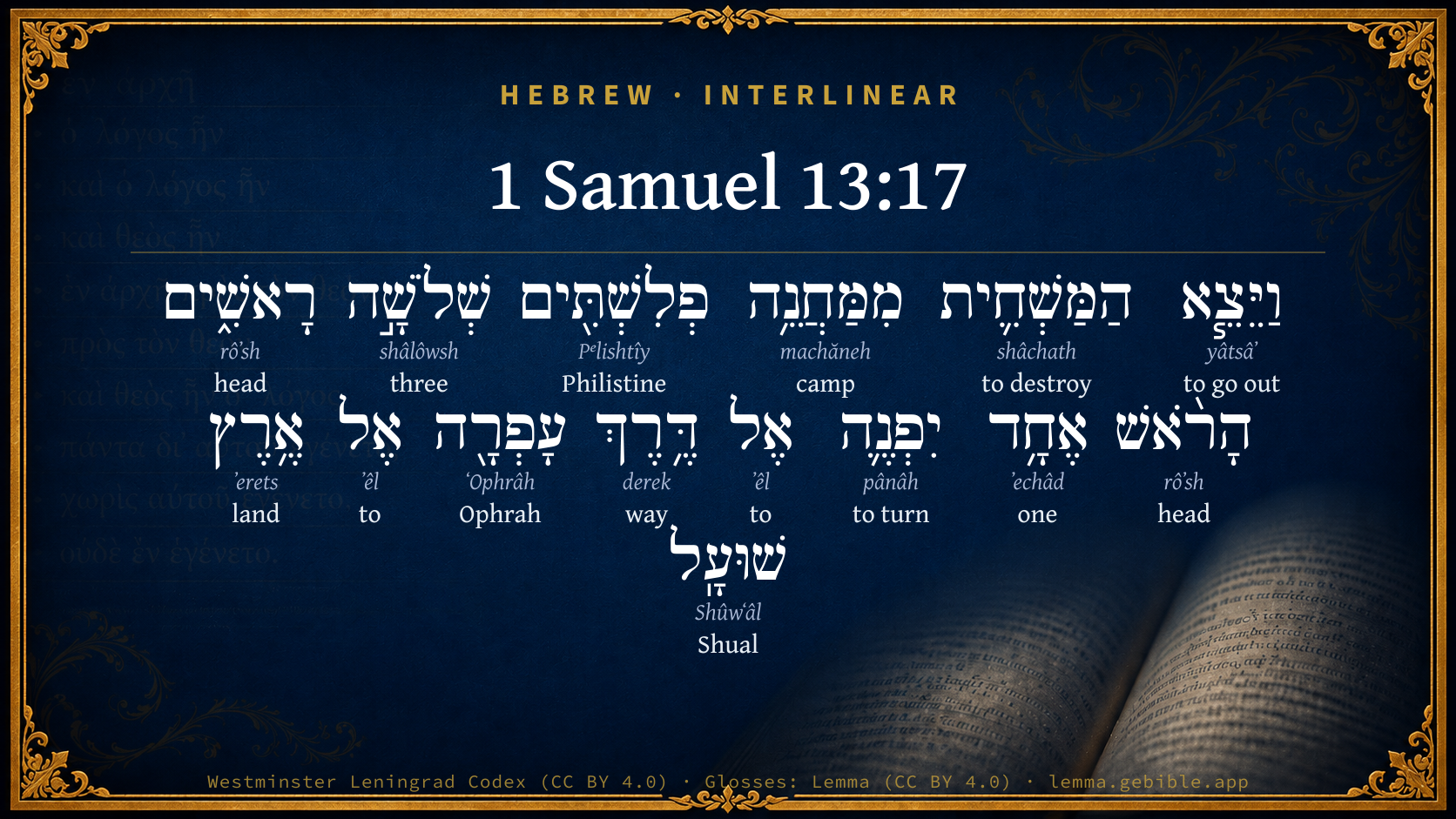
Hebrew (Westminster Leningrad Codex) 1 Samuel 13:17 appears in the Hebrew Old Testament. The text above is from the Westminster Leningrad Codex. Each word links to its Strong’s number, a concise gloss, and parsing drawn from the Open Scriptures Hebrew Bible morphology. Click any word for its full Brown-Driver-Briggs (BDB) entry.
Download image
Cite this verse

1 Samuel 13:17 (World English Bible). Public Domain. Lemma interlinear Bible study tool, https://lemma.gebible.app/v/1-samuel/13/17.

Show BibTeX & RIS
BibTeX
RIS
English Translation
The spoilers came out of the camp of the Philistines in three companies: one company turned to the way that leads to Ophrah, to the land of Shual;
World English Bible · Public Domain
Highlights
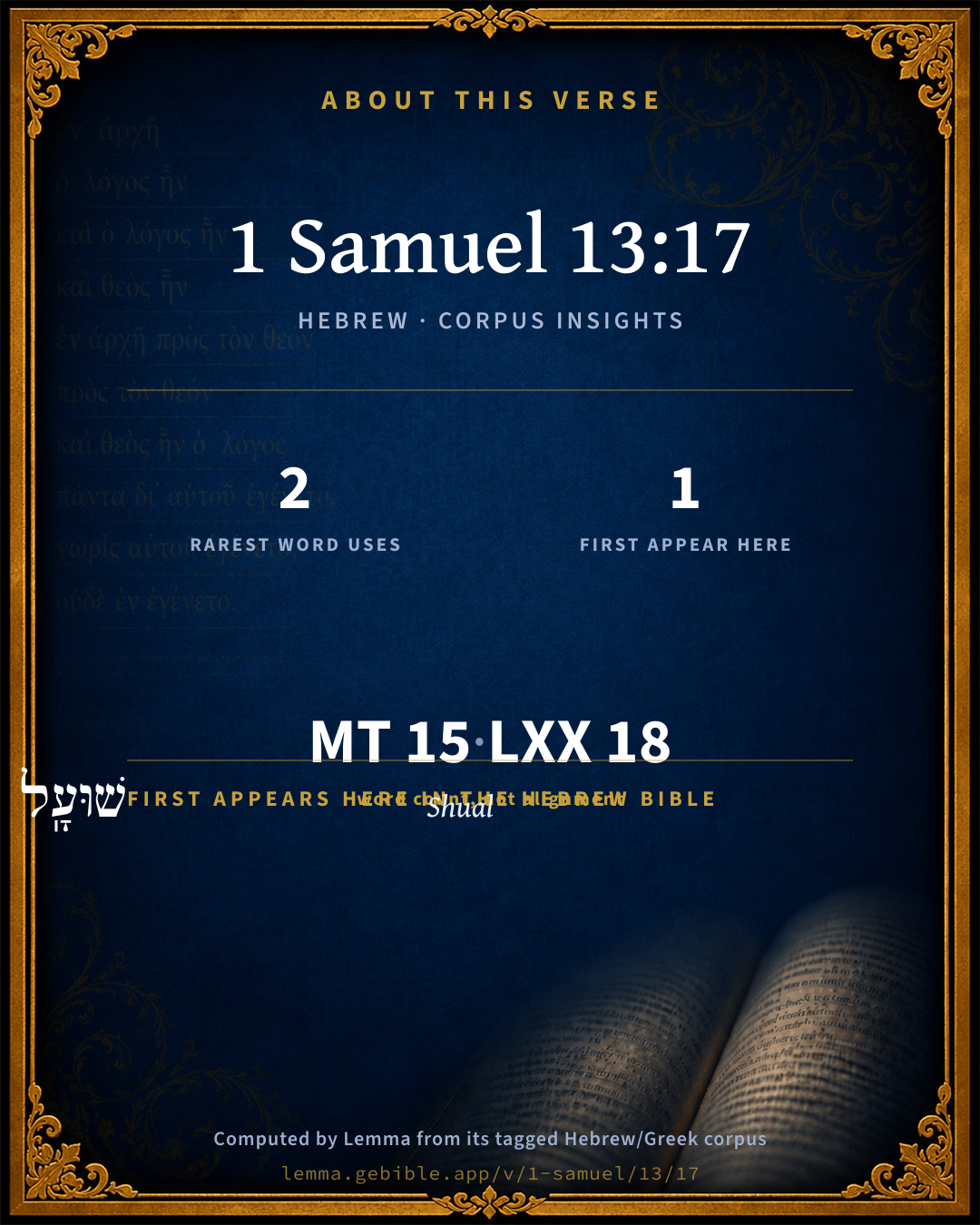
  • 1 first appearance in the Hebrew Bible
Full analysis ↓
Download a study sheet

One document with this verse’s original text, its word-by-word gloss line, the meaning frame, cross-references with their text, attributed commentary, and full source and license credits — printable, and it pastes into notes with its structure intact.

This verse Autodidact and up

Study sheet (.html) Plain text (.txt)

A passage Seminary Student

Up to 50 verses in one chapter. A passage sheet keeps up to 6 commentary sources and 12 cross-references per verse, in the order this page ranks them, and says so on the sheet whenever that leaves anything out. Ask for a single verse and you get the Autodidact verse sheet above.

Everything on this page stays free to read, with no account — the sheet is a download of what is already on screen, not access to it.

Want to remove ads? Support Godless Engineer
Compare translations 3

The same verse in 3 English versions, stacked beneath the original-language interlinear above. Click any original word for its lexicon entry.

Each is an independent rendering of the whole verse — the interlinear is not word-aligned to these translations.

Highlighted words mark where these versions differ — a whole-verse word diff, not a word-by-word alignment.

  • World English Bible Public Domain
    The spoilers came out of the camp of the Philistines in three companies: one company turned to the way that leads to Ophrah, to the land of Shual;
  • King James Version Public Domain
    And the spoilers came out of the camp of the Philistines in three companies: one company turned unto the way that leadeth to Ophrah, unto the land of Shual:
  • unfoldingWord Literal Text CC BY-SA 4.0
    And the destroyer went out from the camp of the Philistines, three companies. One company turned to the way of Ophrah, to the land of Shual,

unfoldingWord Literal Text — © unfoldingWord, licensed CC BY-SA 4.0. Word-aligned USFM3 via Door43 (git.door43.org/unfoldingWord/en_ult).

Versions to compare (up to 4)

3 of 4 selected

Show all 18 translations

Every available English version of this verse, each an independent rendering of the whole verse.

  • World English Bible Public Domain
    The spoilers came out of the camp of the Philistines in three companies: one company turned to the way that leads to Ophrah, to the land of Shual;
  • Berean Standard Bible Public Domain
    And raiders went out of the Philistine camp in three divisions. One headed toward Ophrah in the land of Shual,
  • Majority Standard Bible Public Domain
    And raiders went out of the Philistine camp in three divisions. One headed toward Ophrah in the land of Shual,
  • King James Version Public Domain
    And the spoilers came out of the camp of the Philistines in three companies: one company turned unto the way that leadeth to Ophrah, unto the land of Shual:
  • American Standard Version (1901) Public Domain
    And the spoilers came out of the camp of the Philistines in three companies: one company turned unto the way that leadeth to Ophrah, unto the land of Shual;
  • Revised Version (1885) Public Domain
    And the spoilers came out of the camp of the Philistines in three companies: one company turned unto the way that leadeth to Ophrah, unto the land of Shual:
  • Geneva Bible (1599) Public Domain
    And there came out of the hoste of the Philistims three bandes to destroie, one bande turned vnto the way of Ophrah vnto the lande of Shual,
  • Douay-Rheims (1899) Public Domain
    And there went out of the camp of the Philistines three companies to plunder. One company went towards the way of Ephra to the land of Sual;
  • Young's Literal Translation Public Domain
    And the destroyer goeth out from the camp of the Philistines -- three detachments; the one detachment turneth unto the way of Ophrah, unto the land of Shual;
  • Literal Standard Version CC BY-SA 4.0
    And the destroyer goes out from the camp of the Philistines—three detachments: one detachment turns to the way of Ophrah, to the land of Shual,
  • Unlocked Literal Bible CC BY-SA 4.0
    Raiders came from the camp of the Philistines in three groups. One group turned toward Ophrah, to the land of Shual.
  • unfoldingWord Literal Text CC BY-SA 4.0
    And the destroyer went out from the camp of the Philistines, three companies. One company turned to the way of Ophrah, to the land of Shual,
  • Darby Bible Public Domain
    And the ravagers came out of the camp of the Philistines in three companies: one company turned the way of Ophrah, into the land of Shual;
  • World Messianic Bible Public Domain
    The raiders came out of the camp of the Philistines in three companies: one company turned to the way that leads to Ophrah, to the land of Shual;
  • Webster's Bible Public Domain
    And the spoilers came out of the camp of the Philistines in three companies: one company turned to the way that leadeth to Ophrah, to the land of Shual:
  • Free Bible Version CC BY-SA 4.0
    Three groups of raiders left the Philistine camp to go and attack. One group went towards Ophrah in the land of Shual,
  • Bible in Basic English Public Domain
    And three bands of men came out from the Philistines to make an attack; one band went by the road which goes to Ophrah, into the land of Shual:
  • JPS Tanakh (1917) Public Domain
    And the spoilers came out of the camp of the Philistines in three companies: one company turned unto the way that leadeth to Ophrah, unto the land of Shual;

Literal Standard Version (2020), Covenant Press — licensed CC BY-SA 4.0. Text via the HelloAO Bible API (eBible.org). Unlocked Literal Bible (unfoldingWord) — licensed CC BY-SA 4.0. Text via the HelloAO Bible API (eBible.org). unfoldingWord Literal Text — © unfoldingWord, licensed CC BY-SA 4.0. Word-aligned USFM3 via Door43 (git.door43.org/unfoldingWord/en_ult). Free Bible Version, Dr. Jonathan Gallagher — licensed CC BY-SA 4.0. Text via the HelloAO Bible API (eBible.org).

Word by word

More ways to search: Search by grammar → Find every occurrence → Compare this word →

Practice this passage: Drill this verse → Learn its vocabulary →

שׁוּעָֽל
Shûwʻâl
H7777
“Shual”
Noun, Proper
Part of Speech
Noun
Type
Proper
Full BDB Definition

Origin: the same as H7776

TWOT: None

Shual = "jackal" - as Asherite, son of Zophah (noun proper masculine) - a district in Benjamin probably north of Michmash (noun proper locative)
  1. וַיֵּצֵ֧א yâtsâʼ H3318 “and · to go out” Conjunction + Verb, Qal, Sequential Imperfect, 3rd Person, Masculine, Singular
  2. הַמַּשְׁחִ֛ית shâchath H7843 “the · destroyer” Particle, Definite Article + Noun, Common, Masculine, Singular, Absolute
  3. מִמַּחֲנֵ֥ה machăneh H4264 “from · camp of” Preposition + Noun, Common, Both, Singular, Construct
  4. פְלִשְׁתִּ֖ים Pᵉlishtîy H6430 “Philistines” Noun, Gentilic, Masculine, Plural, Absolute
  5. שְׁלֹשָׁ֣ה shâlôwsh H7969 “three” Adjective, Cardinal number, Masculine, Singular, Absolute
  6. רָאשִׁ֑ים rôʼsh H7218 “heads” Noun, Common, Masculine, Plural, Absolute
  7. הָרֹ֨אשׁ rôʼsh H7218 “the · head” Particle, Definite Article + Noun, Common, Masculine, Singular, Absolute
  8. אֶחָ֥ד ʼechâd H259 “one” Adjective, Cardinal number, Masculine, Singular, Absolute
  9. יִפְנֶ֛ה pânâh H6437 “to turn” Verb, Qal, Imperfect, 3rd Person, Masculine, Singular
  10. אֶל ʼêl H413 “to” Preposition
  11. דֶּ֥רֶךְ derek H1870 “way of” Noun, Common, Both, Singular, Construct
  12. עָפְרָ֖ה ʻOphrâh H6084 “Ophrah” Noun, Proper
  13. אֶל ʼêl H413 “to” Preposition
  14. אֶ֥רֶץ ʼerets H776 “land of” Noun, Common, Both, Singular, Construct

About this verse

These counts appear in no published source. They are computed here, from the morphology-tagged text and Lemma’s own curated glosses. What Lemma adds →

15
words
13
distinct lemmas
Historical
section

Notable vocabulary

The rarest word here is שׁוּעָֽל Shual H7777 — appearing just 2 times in the whole Hebrew Bible.

First appearance in Scripture

This word makes its first canonical appearance in the Hebrew Bible here:

  • שׁוּעָֽל Shual H7777

Shared distinctive vocabulary

שׁוּעָֽל Shual H7777 occurs in 2 verses of the Hebrew Bible. Also found in:

Grammatical profile

  • 2 verbs
  • 9 nouns
  • 2 adjectives
  • 2 prepositions

Verb forms

  • וַיֵּצֵ֧א Qal · Sequential Imperfect
  • יִפְנֶ֛ה Qal · Imperfect

Repetition

Words recur within this verse — often emphatic in Hebrew:

  • רָאשִׁ֑ים head H7218 ×2
  • אֶל to H413 ×2

Hebrew & Septuagint length

In English translation the verse runs 28 words from the Hebrew and 29 from the Septuagint (LXX English) — closely comparable.

A rough comparison of the two English renderings, which tokenize alike — not a word-level alignment.

Word counts can differ between the Hebrew and the Greek without any difference in meaning — e.g. the Hebrew direct-object marker אֵת has no separate Greek word, and Greek often adds the article ὁ.

In the original languages it is 15 Hebrew tokens and 18 Greek tokens — but the two are counted differently (Hebrew bundles its prefixes and suffixes into one token; the Greek is in lemma form), so that isn’t a like-for-like length.

Cross-references

4

Topical passages linked to 1 Samuel 13:17 in the Treasury of Scripture Knowledge — connected by theme and wording, ordered by reader-vote popularity; previews shown in the World English Bible.

  • Joshua 18:23 and Avvim, and Parah, and Ophrah,
  • 1 Samuel 14:15 There was a trembling in the camp, in the field, and among all the people; the garrison, and the spoilers, they also trembled; and the earth quaked: so there was an exceeding great trembling.
  • Joshua 19:3 and Hazar Shual, and Balah, and Ezem,
  • 1 Samuel 11:11 It was so on the next day, that Saul put the people in three companies; and they came into the midst of the camp in the morning watch, and struck the Ammonites until the heat of the day: and it happened, that those who remained were scattered, so that no two of them were left together.

Cross-references courtesy of OpenBible.info (CC BY 4.0).

Hebrew and Greek witnesses Masoretic Hebrew ↔ Greek Septuagint

The same verse in the two great witnesses to the Old Testament, shown verse-for-verse.

These are two independent witnesses, not word-aligned to each other, and the Septuagint is shown in lemma (dictionary) form.

Hebrew 1 Samuel 13:17 Masoretic · Westminster Leningrad Codex

וַיֵּצֵ֧א הַמַּשְׁחִ֛ית מִמַּחֲנֵ֥ה פְלִשְׁתִּ֖ים שְׁלֹשָׁ֣ה רָאשִׁ֑ים הָרֹ֨אשׁ אֶחָ֥ד יִפְנֶ֛ה אֶל דֶּ֥רֶךְ עָפְרָ֖ה אֶל אֶ֥רֶץ שׁוּעָֽל

The spoilers came out of the camp of the Philistines in three companies: one company turned to the way that leads to Ophrah, to the land of Shual;

World English Bible · Public Domain

Greek LXX 1 Samuel 13:17 Septuagint · lemma form

καί ἐκἔρχομαι διαφθείρω ἐκ ἀγρός ἀλλόφυλος τρεῖς ἀρχή ὁ ἀρχή ὁ εἷς ἐπιβλέπω ὁδός γοφερα ἐπί γῆ σωγαλ

And men came forth to destroy out of the land of the Philistines in three companies; one company turning by the way of Gophera toward the land of Sogal,

LXX2012 (modern English Septuagint) · Public Domain

Hebrew: Westminster Leningrad Codex (CC BY 4.0). Greek: Septuagint (public domain); English from LXX2012 (modern English Septuagint) (Public Domain). How the Septuagint differs from the Hebrew →

Targum (Aramaic paraphrase)

1

The Targum is the ancient Jewish Aramaic paraphrase of the Hebrew Scriptures — an interpretive translation, not the Hebrew text itself. Onkelos (literal) and Pseudo-Jonathan (expansive) render the Torah, and Jonathan the Prophets. Coverage is partial: where no permissively-licensed English translation exists for a verse, only the Aramaic is shown. This is verse-level text, not a word-by-word alignment to the Hebrew.

  1. Targum Jonathan Prophets (Joshua–Malachi)
    וּנְפַק מְחַבְּלָא מִמַשְׁרִיתָא פְלִישְׁתָּאֵי תְּלָתָא מַשִׁירְיָן מַשְׁרִיתָא חֲדָא מִתְפַּנְיָא לְאוֹרַח עָפְרָה לְאַרְעָא דָרוֹמָא:

    (no public-domain English translation for this verse)

    Targum Jonathan — Aramaic: “Mikraot Gedolot” (public domain). English: “Sefaria Community Translation” (CC0 1.0 (public-domain dedication)); “London "Chaldee Paraphrase," 1871” (public domain). Text via Sefaria.

Commentary

Notes on 1 Samuel 13:17 from classic Christian and Jewish commentators (each source and its license shown beneath its notes). The classic Christian expositions comment on the surrounding passage and are grouped to its opening verse, so a note may address several verses; the Jewish commentaries on the Tanakh (Rashi and others) are per-verse, so they appear only where the commentator wrote on this verse.

Lemma curates 59 commentaries, every one of them public domain or Creative Commons licensed, each selected and text-cleaned for this edition rather than reprinted as found. About our sources →

Trapp's Complete Commentary

John Trapp

1Sa 13:17 And the spoilers came out of the camp of the Philistines in three companies: one company turned unto the way [that leadeth to] Ophrah, unto the land of Shual:

Ver. 17. And the spoilers came out of the camp.] This is one of the woes of war, that hell of this world, - as one calleth it, wherein there is no measure or satiety of blood and spoil; witness our late stripping and bleeding times.

John Trapp, A Commentary or Exposition upon All the Books of the Old and New Testament (1647–1656) — public domain. Text from a community e-Sword module.

The Biblical Illustrator

Joseph S. Exell

1Sa_13:17

The spoilers came out of the camp of the Philistines in three companies.

The spoilers

Saul is reproved for his haste, his presumption, and his disobedience. Samuel then departs to Gibeah, and the nation are for a time, notwithstanding Sauls valour, reduced to great straits under the rule of the Philistines. The spoilers, too, came out of the camp of the Philistines in three companies, spreading desolation over the whole country. At last, by the brilliant valour of Jonathan and his armour bearer, a portion of the Philistine host was slain, and a sudden panic spreading throughout their camp, their entire forces were routed. Thus the children of Israel regained once more their freedom.

I. That it is when men are unprepared that temptations come. When there was neither sword nor spear found in the hand of any of the people, that was the time that the spoilers came out. Temptations assail us on our weakest side, and at the most unexpected moment. The sin that most easily besets us is the sin that comes upon us when we are in idleness and ease, in no way prepared for a spiritual conflict.

II. That temptations, though very distinct, are often difficult to separate from each other, and to individualise. These spoilers came out of the camp in three companies, and they are not named nor individualised. Sins glide so into each other that it is frequently difficult to analyse any particular offence amidst so confused a mass. Lavish benefactions, for instance, may be given from thoughtless generosity, from true charity, or from ostentation. Who can tell which of these is the actuating motive in any particular case? Not even, often, the doer himself. It is the same with our sins and vices. It is difficult to assign the true place, and therefore the real guilt, of any particular one amongst them.

III. That temptations come from three main causes, the world, the flesh, and the devil. The spoilers came out of the camp of the Philistines in three companies. The world is too much with us; its pleasures and its pains continually affect us. The lusts of the flesh unceasingly tend to drag us down. The temptations of Satan, too, are craftily devised to overwhelm us.

IV. That these temptations often arise from our superabundance of worldly riches. These spoilers came out of the camp of the Philistines, and this camp was situated at Michmash, which name means treasure. Money is useful if it be usefully employed. Wealth is a great trust, which, if a man employs rightly, he may be a benefactor to his fellow men, and may receive a blessing from God. But it is a great snare, more especially if it has been acquired without much personal merit or much personal exertion on the part of its possessor

V. That these temptations have their starting point frequently from wilful and conceited ignorance. The spoilers came out of the camp of the Philistines. A modern author, Matt, hew Arnold, has taken the term Philistine as descriptive of self-satisfied and offensive want of culture. From the fields of ignorance and of thoughtlessness no harvest but a crop of tares can be expected. Evil is wrought from want of thought, as well as want of heart.

VI. That obedience is the garrison that keeps these companies of evil passions in check. The spoilers did not come out of the camp of the Philistines to spread like devouring grasshoppers over the land of the children of Israel until Saul had disobeyed the Divine command given to him through Samuel. So, as long as we follow the plain line of duty, and act in obedience to the strict letter as well as to the real spirit of the law of God, we shall be little liable to the assaults of sin. It is when we palter with truth, equivocate with conscience, enter into dalliance with some evil passion, that we are ensnared by temptation. In the Pilgrims Progress, as long as Christian kept on the highway, he was safe; it was only when he strayed into the byways of error that he fell into the power of Giant Despair, and was immured in the dungeons of Doubting Castle. (R. Young, M. A.)

The Biblical Illustrator, edited by Joseph S. Exell (c. 1880s–1900s) — public domain. Text from a community e-Sword module.

Tyndale Open Study Notes

Tyndale Open Resources

13:17-18 Armies would send out raiding parties to plunder and sow panic among the enemy. These raiders embarked north (Ophrah), west (Beth-horon), and east (Zeboim), but not south, where Israelite strength was consolidated and where the terrain did not allow easy movement of forces (see study note on 13:23).

Tyndale Open Study Notes — © Tyndale Open Resources, licensed CC BY-SA 4.0. Text via the HelloAO Bible API.

Geneva Bible (1599)

Geneva Bible translators

Or, the destroyer: to wit, the captains came out with three bands.

Geneva Bible (1599) marginal notes — public domain. Text via Bolls.life.

Jamieson, Fausset & Brown

Robert Jamieson, A. R. Fausset & David Brown

the spoilers came out of the camp of the Philistines in three companies--ravaging through the three valleys which radiate from the uplands of Michmash to Ophrah on the north, through the pass of Beth-horon on the west, and down the ravines of Zeboim ("the hyænas"), towards the Ghor or Jordan valley on the east.

Jamieson, Fausset & Brown — Commentary Critical and Explanatory on the Whole Bible (1871) — public domain (CC PDM 1.0). Text via the HelloAO Bible API.

Adam Clarke's Commentary

Verse 17. The spoilers came out] The Philistines, finding that the Israelites durst not hazard a battle, divided their army into three bands, and sent them in three different directions to pillage and destroy the country. Jonathan profited by this circumstance, and attacked the remains of the army at Michmash, as we shall see in the succeeding chapter.

Adam Clarke's Commentary on the Bible (1810–1826) — public domain. Text from a community e-Sword/MySword module.

Ellicott's Commentary for English Readers

(17) And the spoilers came out.—The compiler of these Books of Samuel does not profess to give a detailed account of this or any of the wars of Saul It would seem that the Philistines, with their great armed demonstration (1Sa_13:5), had completely cowed the Israelites, certainly in the southern part of Canaan. Probably the allied forces were now suffered to leave the Philistine host, and we next hear of the old raids re-commencing. The three companies spoken of in this and the next verse were directed to ravage districts in the tribe of Benjamin, for in that locality are situated all the places mentioned. Unchecked, they seem to have carried out their plans. These armed companies swept away all the smithies in the south part of the land. The fortunes of Saul now reached their lowest ebb. “The heights of his own tribe . . . and the passes of his own tribe were occupied by hostile garrisons. We see him leaning on his gigantic spear, whether it be on the summit of the Rock Rimmon . . . or under the tamarisk of Ramah . . . or on the heights of Gibeah. There he stood with his small band, the faithful six hundred, and as he wept aloud over the misfortunes of his country . . . another voice swelled the wild, indignant lament—the voice of Jonathan, his son.”—Dean Stanley: Lectures on the Jewish Church.

A Bible Commentary for English Readers, edited by Charles John Ellicott (1878–1897) — public domain. Text from a community e-Sword module.

The Cambridge Bible for Schools and Colleges

gen. ed. J. J. S. Perowne

17. the spoilers came out] Lit. the destroyer, the part of the army sent out to harry the country. (a) One band of marauders turned northwards to Ophrah, a city of Benjamin (Jos_18:23), conjecturally placed by Robinson at et Taiyibeh, 4 miles N. E. of Bethel, in the land of Shual (= jackal) possibly the same as Shalim (1Sa_9:4). (b) Another band took a westerly direction to Beth-horon (= house of caverns) on the main pass from the hill country of Judaea into the plain of Philistia. (c) A third band went eastwards to “the way of the border,” probably that between Judah and Benjamin, by “the valley of Zeboim” (Neh_11:34) = “the ravine of hyenas,” “towards the wilderness” or uncultivated district between the central district of Benjamin and the Jordan valley. Mr Grove went from Jericho to Michmash up a wild gorge bearing the name Shuk-ed-Dubba, or “ravine of the hyena,” the exact Arabic equivalent of “the valley of Zeboim,” and possibly the same. Dict. of Bible, iii. 1819.

Southwards, Saul’s camp in Geba protected the country. The tense of the verbs “turned” expresses repeated action, indicating that these ravages were continued for some time. The Philistines hoped to draw Saul out from his strong position, and force him to an engagement.

The Cambridge Bible for Schools and Colleges (gen. ed. J. J. S. Perowne; Cambridge University Press, 1878–1918) — public domain. Text from a community e-Sword module.

John Gill's Exposition

And the spoilers came out of the camp of the Philistines in three companies,.... Saul not daring to come out to fight them, and there being none throughout the land to oppose them, they sent out three companies of soldiers to ravage and spoil the country; of so little use and service was a king to Israel, they were so extremely desirous of; and this was suffered, to convince them of their vain confidence in him, and that their trust ought to be in the Lord their God; never was their country more exposed to rapine and violence than now:

one company turned unto the way that leadeth to Ophrah; a city in the land of Benjamin, of which see Jos 18:23 and lay southwest from Michmash, where the army of the Philistines were:

unto the land of Shual: which the Targum paraphrases,"the land of the south;''it seems to have had its name from the multitude of foxes in it, Shual signifying a fox.

John Gill's Exposition of the Whole Bible (1746–1763) — public domain (CC PDM 1.0). Text via the HelloAO Bible API.

Albert Barnes' Notes on the Bible

The spoilers - “The devastator:” the same word is used of the destroying Angel Exo 12:23. The verse describes the system adopted by the Philistines by which for a time they subjugated the Israelites. From their central camp at Michmash they sent out three bands to kill and lay waste and destroy. One took a northerly direction toward Ophrah - five miles east of Bethel, identified with “Ephrain” 2Ch 13:19 and the modern “Taiyibeh,” - and toward the land of Shual, possibly the same as Shalim 1Sa 9:4; the second westward to Beth-horon; and the third eastward, by the unknown valley of Zeboim, toward the wilderness, i. e., the Jordan valley, toward Jericho.

Albert Barnes' Notes on the Bible (1834–1885) — public domain. Text from a community e-Sword/MySword module.

Haydock's Catholic Bible Commentary

Plunder, seeing that the Israelites durst not come to an engagement. Jonathan took advantage of their absence, chap. xiv. --- Land of Sual, "foxes," not far from the birth-place of Gedeon, Judges vi. 11.

George Leo Haydock (1774–1849), Haydock's Catholic Family Bible and Commentary, 1859 edition — public domain. Excludes Psalms (Douay-Rheims chapter numbering differs from Protestant) and Deuterocanonical books (Catholic canon only).

Matthew Poole's English Annotations

In three companies; that they might march several ways, and so waste several parts of the country.

Ophrah; a city of Benjamin, Jos 18:23, south-west from Michmash.

Matthew Poole's English Annotations on the Holy Bible (1683–1685) — public domain. Text from a community e-Sword/MySword module.

Whedon's Commentary on the Bible

Daniel D. Whedon

17. The spoilers — Marauding parties, whose object was to spy out the land and condition of the enemy, and do him all the injury possible.

Ophrah — Located at the modern Taiyibeh, five or six miles north of Michmash. This also was a city of Benjamin. Jos_18:23.

The land of Shual — This must have been the territory around, and more probably somewhat to the north of, Ophrah, though its exact position is unknown. If, as some suppose, it be the same as the land of Sha-lim, (1Sa_9:4,) it confirms our conjecture as to the route of Saul when in search of the asses.

Daniel D. Whedon (gen. ed.), Commentary on the Old and New Testaments (1874–1909) — public domain. Text from a community e-Sword module.

The Pulpit Commentary

Vers. 17, 18The spoilers. The conduct of the Philistines is that of men over confident in their strength. They ought to have pounced at once upon Saul in the plain of Jordan, where their cavalry would have secured for them the victory, and then, following Samuel"s and Saul"s route, have seized the other end of the defile, and overpowered Jonathan. But they despised them both, and regarding the country as conquered, proceed to punish it, as probably they had cone on previous occasions, when no one had dared to make resistance. Leaving then the main army to guard the camp at Michmash, they sent out light armed troops to plunder the whole land. One company turned unto the way to Ophrah, unto the land of Shual. This company went northward, towards Ophrah, a place five miles east of Bethel. The land of Shual, i.e. fox land, was probably the same as the land of Shalim in 1Sa_9:4. Another company, etc. This went eastward, towards Beth-heron, for which see Jos_10:11. The third went to the south east, towards the wilderness of Judaea. Zeboim, and all the places mentioned, are in the tribe of Benjamin, which had committed the offence of making for itself a king. To the south Saul held the mountain fastnesses towards Jerusalem.

Vers. 17-23.

The ramifications of evil.

The facts are

1. In the absence of Divine interposition, and consequent on Saul"s inabilityto resist advance, the Philistines develop their forces and plunder certain districts of country.

2. As a matter of policy on their part, and as one result of Saul"stransgression, the Philistines deprive the people of the ordinary means of conducting warfare.

3. This state of things necessitates Saul"s protracted inactivity, and inflictsconsiderable inconvenience on the people with respect to their daily pursuits in agriculture. Although we cannot say precisely what course events would have taken had Saul, in loyalty to God, awaited the arrival of Samuel (vers. 8-10), yet the whole history of Israel and the recent promises made through Samuel (1Sa_12:20-25) lead to the belief that, as when Jabesh-Gilead was in danger help came from God, (1Sa_11:6) so now the Philistines would have been scattered by a Power more than human. The facts given in this paragraph appear to be designed to prepare the way for the narrative of Jonathan"s heroism in the following chapter; at the same time they illustrate, in themselves, some truths of wider range than Israel"s political and social condition. We have here an instance of

I THE DEPRESSING INFLUENCE OF A SENSE OF GUILT ON THE CONDUCT OF AFFAIRS. The military inactivity and general helplessness of Saul after Samuel"s interview with him (vers. 11-14) are in striking contrast with his energy at other times, and are not altogether to be ascribed to the absence of special Divine interposition. The explanation is to be sought in his personal conviction of sin. There was no joy, no hope, no spring in his soul, no eagerness for a close conflict with the foe; and that, too, because a sense of sin brought moral paralysis upon his entire nature. The sense of guilt is not always present in men, but when it is brought home to a man it exercises a depressing influence on his entire life, and seriously affects the transaction of affairs. Conscience, when guilty, not only "makes cowards of us all," but it robs life of brightness, drains the springs of hope, fetters the operation of the faculties, and impairs the sum total of energy. No man"s life is made the most of as long as some unrepented and unforgiven sin haunts his spirit. This is the reverse side of another fact, namely, that the soul possessed of the peace and joy of the reconciled is in a condition to render its best service to the world, and to attain to the most perfect development of its powers. The wisdom of every one oppressed with a sense of guilt is to humble himself before God, and seek in Christ forgiveness and power for a truer life in future.

II THE MANIFOLD RAMIFICATIONS OF EVIL. The sin of Saul did not begin and end with himself. His failure in duty affected the general interests of his kingdom. Even the brief narrative before us enables us to see how directly and indirectly the following circumstances were connected with his disobedience namely, the inability of Israel to assail the threatening host; the depredations of the three divisions of the Philistine army; the private and social misery over a considerable area inseparable from the raids of the invader; the cutting off of the ordinary means for waging successful war; the impediments to the pursuits of trade and agriculture; the general humiliation and dread brought on the noncombatants of the land; and the withdrawal for a while of the counsels and encouragements of the prophet of God. The truth thus exemplified in the instance of a monarch"s sin finds expression also in every sin, and especially in sins of persons in responsible positions. No sin can end in the act or in the person of the sinner. It impairs the tone and force of the entire man; it adds another item to the germs of future sorrow and shame; it further disqualifies for conferring on the world spiritual good; it gives a stronger taint of evil to the current of thought and feeling which flows out from the inner man to the world. Sin in us is as a wave of influence that spreads out, by laws of association and impulse, over the whole area of the spirit, and modifies all conduct for the worse. Especially is this true of persons in office and of parents. A monarch"s official acts reach all classes. A parent"s sin ramifies through the home inducing, it may be, loss of peace, certainly loss of hallowed influence over children, and possibly ruin to health in offspring.

III UNFAITHFULNESS IN THE SERVICE OF GOD DEPRIVES US OF A MOST IMPORTANT MEANS OF ACCOMPLISHING OUR MISSION AS CHRISTIANS IN THE WORLD. The scarcity of smiths and weapons of war is evidently associated by the historian with the disobedience of Saul. It is possible for Christian men engaged in the endeavour to maintain and extend the kingdom of Christ to be brought into an analogous condition as a consequence of their manifest unfaithfulness. In our conflict with the world it is of supreme importance that we make use of the ever available and potent instrumentinfluence of character. With this as a weapon we can accomplish much, by the blessing of God. If this be lost, if by our manifest inconsistencies before the world we virtually place this instrument of war at the feet of the men whom we seek to bring to Christ, then we shall be as powerless with them as was Saul and his people when the Philistines had control of their smiths and weapons of war.

General lessons:

1. The general spiritual power of our life will be in proportion as we keep pure, or, in case of falling into sin, at once humble ourselves before God and seek for pardon and a right spirit. (Psa_51:6-13)

2. It is an encouragement to holiness and obedience to know that theramifications of righteousness may become as wide as are those of sin.

3. It is a mercy to know that, though the enemy may sometimes triumphover the servants of Christ because of their weakness of character, yet the eternal Source of strength is in reserve, and will manifest himself.

HOMILIES BY B. DALE.

Vers. 1-7. (MICHMASH, GIBEAH, GEBA, GILGAL.)

The trumpet sounded.

Saul blew the trumpet throughout all the land, saying, Let the Hebrews hear.

1. The great conflict between good and evil which has been waged fromthe first (Gen_3:15) has been concentrated in every age on some particular issue. At this time it was whether Israel and the worship of the true God or the Philistines and the worship of idols should prevail. It was thus of the highest importance in relation to the kingdom of God upon earth.

2. The Philistines were old enemies and powerful oppressors (Jud_1:3:3 10:7 13:1; 1Sa_7:2) During the administration of Samuel they were held in check, (1Sa_7:13) although they appear to have had military posts or garrisons in the land (1Sa_10:5; ver. 3), and the overthrow of one of these by Jonathan (at Geba, four miles north of Gibeah, and opposite Michmash) gave the signal for renewed conflict. Having evacuated Michmash, where he had stationed himself with an army of 2000, Saul summoned all the men of Israel to gather to him at Gilgal; but the advancing hosts of the enemy filled the country with terror, so that he was left with only 600 followers, and found it necessary, after his interview with Samuel, to join his son Jonathan at Gibeah (Geba) (vers. 2, 16; ch. 14:2). Meanwhile the enemy occupied Michmash, whence three companies of spoilers issued, plundering the plains and valleys. A second and greater exploit of Jonathan, however, drove them out of Michmash, and it was followed by a general engagement, in which large numbers of them were slain, and the rest "went to their own place". (1Sa_14:23, 1Sa_14:31, 1Sa_14:46)

3. The conflict to which Israel was summoned represents that to whichChristians are called. It is a conflict with physical and moral evil, with the world, the flesh, and the devil (Joh_15:19; 2Co_10:4; Eph_6:12; 1Pe_2:11 1Pe_5:8; 1Jn_2:16) and with men only in so far as they are ruled by sin, and in order to their salvation; a conflict which is good ("the good fight of faith (1Ti_6:12) and necessary, and affords full scope for whatever warlike instincts and energies are possessed. What does the sound of the trumpet signify?. (1Co_14:8)

I A BLOW HAS BEEN STRUCK AGAINST THE FOE. The greatest blow that was ever inflicted upon the "power of darkness" was struck by "the Captain of our salvation" in his life and death and glorious resurrection (Joh_12:31 Joh_16:33; 1Jn_3:8) and in the spirit and power of his victory his followers carry on the conflict. (Mat_10:34) At times there seems to be something like a truce, but it never lasts long; and when a fresh blow is struck by "a good soldier of Jesus Christ" it

1. Reveals the essential difference between the spirit that is in "the Israel of God" and "the spirit that is in the world.

2. Intensifies their antagonism (ver. 4).

3. Commits them to more definite and decisive action. And to this end the fact should be proclaimed. "When Saul the king of the Hebrews was informed of this (ver. 3), he went down to the city of Gilgal, and made proclamation of it over all the country, summoning them to freedom" (Josephus).

II THE ENEMY IS MUSTERING HIS FORCES (ver. 5), which are

1. Exceedingly numerous, "as the sand which is on the sea shore.

2. Skilful, crafty, and deceitful. (2Co_11:14)

3. Very powerful. There is at the present day an extraordinary combination of anti-christian agencies (2Ti_3:1-9; Rev_13:11-18) threatening Christian faith and practice, which might well fill us with fear, did we not believe that "they that be with us are more than they that be with them". (2Ki_6:16) "The spirits of the unseen world seem to be approaching us. Times of trouble there have been before; but such a time, in which everything, everywhere, tends in one direction to one mighty struggle of one sort of faith with infidelity, lawlessness with rule, Christ with antichrist there seems never to have been till now" (Pusey).

III THE FAITHFUL MUST RALLY AROUND THEIR LEADER. The gathering forces of the enemy should constrain us to closer union, and the proper centre of union is he of whom the greatest kings and heroes were feeble types and shadows.

1. He has been Divinely appointed, and claims our obedience and cooperation.

2. He is fully qualified as "a Leader and Commander of the people.

3. He is the only hope of safety and success. "God is with him". (1Sa_10:7)

With force of arms we nothing can, Full soon were we down ridden, But for us fights the proper man, Whom God himself hath bidden.

Ask ye, Who is this same? Christ Jesus is his name; The Lord Sabaoth"s Son; He, and no other one, Shall conquer in the battle" (Luther).

IV THE SUCCESS ALREADY ACHIEVED GIVES ASSURANCE OF VICTORY (1Sa_11:11; ver. 3).

1. What triumphs has he gained in former days I

2. They are an earnest of "still greater things than these.

3. And they should inspire us with the confidence and courage which areneedful to participation in his victory and glory. (Rev_17:14 Rev_19:11) "This is the victory that overcometh the world, even our faith. D.

The Pulpit Commentary (1880–1919), ed. H.D.M. Spence-Jones & Joseph S. Exell — public domain. Text from a community e-Sword module.

Kretzmann's Popular Commentary

Paul E. Kretzmann

The Oppression of the Philistines

v. 17. And the spoilers, soldiers to whom was assigned the task of plundering and devastating the land of Israel, came out of the camp of the Philistines in three companies. One company turned unto the way that leadeth to Ophrah, unto the land of Shual, toward the northeast, through the territory of Benjamin and Ephraim;

v. 18. and another company turned the way to Beth-horon, toward the west; and another company turned to the way of the border that looketh to the Valley of Zeboim toward the wilderness, in a southeasterly direction.

v. 19. Now, there was no smith found throughout all the land of Israel; for the Philistines said, Lest the Hebrews make them swords or spears; so the Philistines had removed all smiths out of the whole country;

v. 20. but all the Israelites went down to the Philistines to sharpen every man his share, and his coulter, and his ax, and his mattock. So all the agricultural implements which the Israelites used, plowshares, hoes, axes, were sharpened by Philistine smiths, upon whom the subject people were altogether dependent.

v. 21. Yet they had a file for the mattocks, and for the coulters, and for the forks, and for the axes, and to sharpen the goads. The verses have lately been rendered: "But all the Israelites went down to the Philistines to sharpen every man his plowshare, and his ax, and his adze, and his hoe, and the price was a pim for the plowshares, and for the axes, and for the three-tined forks, and for the adzes, and for the setting of the goads. " Whenever the implements became dull and needed sharpening, and whenever the ox-goads needed new setting, it was necessary to make the trip to the lowlands occupied by the Philistines, who permitted the Hebrews to carry on the tillage only of the highlands and of the valley of the Jordan, and incidentally charged the Israelites a high price for all the work done by them. 3)

v. 22. So it came to pass in the day of battle, which is described in the next chapter, that there was neither sword nor spear found in the hand of any of the people that were with Saul and Jonathan, they were unprovided with real weapons of war, being dependent upon their farm implements for arms against the enemy; but with Saul and with Jonathan, his son, was there found, they were the only ones that had real weapons.

v. 23. And the garrison of the Philistines, a post or vanguard from the main army, went out to the passage, or pass, of Michmash, as a protection against the Israelites, who might otherwise have slipped up through some of the valleys converging at this point and surprised the Philistine camp. The invariable result of forsaking the Lord is distress and tribulation, the object of such visitations being to cause the backsliders to repent of their sins and to place their full reliance upon the Lord.

Paul E. Kretzmann, Popular Commentary of the Bible (1921–1924) — public domain. Text from a community e-Sword module.

unfoldingWord translationNotes

Door43 World Missions Community

Raiders came

Raiders are normally military people who attack enemy villages for their food and other supplies.

Ophrah, to the land of Shual ... Beth Horon ... Valley of Zeboyim

These are the names of places. (See: How to Translate Names)

translationWords

Philistines

desert

unfoldingWord translationNotes — © Distant Shores Media and the Door43 World Missions Community, licensed CC BY-SA 4.0. Source: git.door43.org/Door43/en_tn.

Lesson kit

Teaching starters — assembled from the data on this page, not authored interpretation. Every prompt links to the verse data it draws on. Edit before teaching.

1 Samuel, in the Historical, opens this verse with 15 words (13 distinct Hebrew lemmas). Its most distinctive word is Shûwʻâl (“Shual”). A historical commentator’s framing appears above. Read the whole chapter for the surrounding context.

Discussion questions

  1. What does “Shual” (Shûwʻâl) contribute to the verse as a whole?
  2. The word “Shual” first appears here in Scripture. What is being introduced at this debut?
  3. 1 Chronicles 7:36 shares the word «Shual» with this verse. How do the two illuminate each other?
  4. “head” occurs 2× in this one verse. What is the effect of the repetition?
  5. The translations on this page render this verse differently — a whole-verse word diff, not a word-by-word alignment. What might account for the different wordings?
  6. The verb «וַיֵּצֵ֧א» is Qal Sequential Imperfect. How does its form color the action?
  7. Reading how Trapp's Complete Commentary and The Biblical Illustrator read this verse, where do the two commentators agree and where do they part?

Things to notice

Reading settings

Reading text

Shown beneath each verse's original-language words.

Old Testament
Old Testament edition

Read the OT as the Masoretic Hebrew (MT) or the Greek Septuagint (LXX).

English shown for the Greek Septuagint (in the Hebrew ↔ Greek comparison).

Comparing translations? Open the Compare panel on any verse page to stack up to four side by side.