Job 24:18

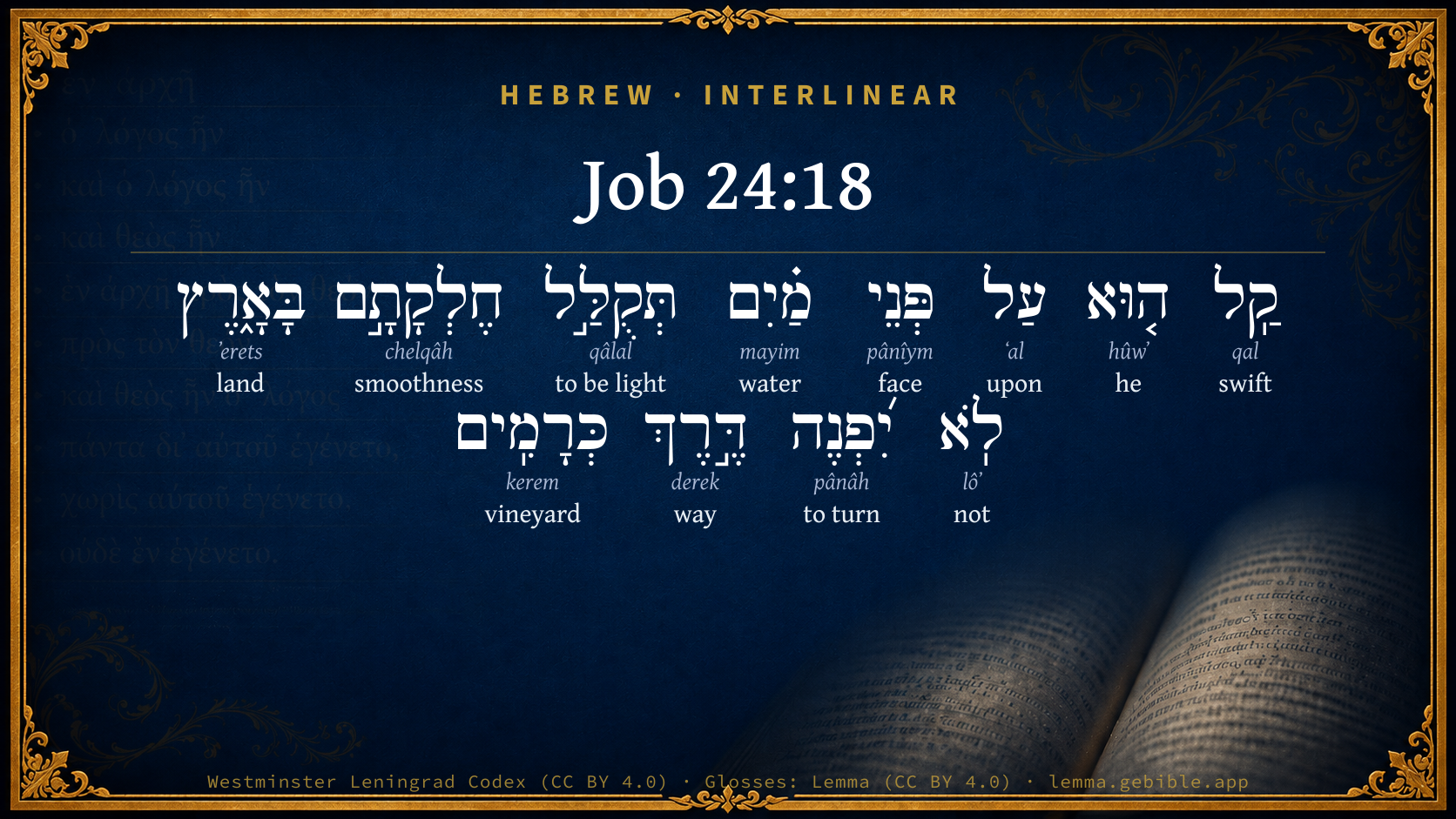
Hebrew (Westminster Leningrad Codex) Job 24:18 appears in the Hebrew Old Testament. The text above is from the Westminster Leningrad Codex. Each word links to its Strong’s number, a concise gloss, and parsing drawn from the Open Scriptures Hebrew Bible morphology. Click any word for its full Brown-Driver-Briggs (BDB) entry.
Download image
Cite this verse

Job 24:18 (World English Bible). Public Domain. Lemma interlinear Bible study tool, https://lemma.gebible.app/v/job/24/18.

Show BibTeX & RIS
BibTeX
RIS
English Translation
"They are foam on the surface of the waters. Their portion is cursed in the earth: They don't turn into the way of the vineyards.
World English Bible · Public Domain
Download a study sheet

One document with this verse’s original text, its word-by-word gloss line, the meaning frame, cross-references with their text, attributed commentary, and full source and license credits — printable, and it pastes into notes with its structure intact.

This verse Autodidact and up

Study sheet (.html) Plain text (.txt)

A passage Seminary Student

Up to 50 verses in one chapter. A passage sheet keeps up to 6 commentary sources and 12 cross-references per verse, in the order this page ranks them, and says so on the sheet whenever that leaves anything out. Ask for a single verse and you get the Autodidact verse sheet above.

Everything on this page stays free to read, with no account — the sheet is a download of what is already on screen, not access to it.

Want to remove ads? Support Godless Engineer
Compare translations 3

The same verse in 3 English versions, stacked beneath the original-language interlinear above. Click any original word for its lexicon entry.

Each is an independent rendering of the whole verse — the interlinear is not word-aligned to these translations.

Highlighted words mark where these versions differ — a whole-verse word diff, not a word-by-word alignment.

  • World English Bible Public Domain
    "They are foam on the surface of the waters. Their portion is cursed in the earth: They don't turn into the way of the vineyards.
  • King James Version Public Domain
    He is swift as the waters; their portion is cursed in the earth: he beholdeth not the way of the vineyards.
  • unfoldingWord Literal Text CC BY-SA 4.0
    He swift on the face of the waters; their portion of the land is cursed; one does not turn the way of their vineyards.

unfoldingWord Literal Text — © unfoldingWord, licensed CC BY-SA 4.0. Word-aligned USFM3 via Door43 (git.door43.org/unfoldingWord/en_ult).

Versions to compare (up to 4)

3 of 4 selected

Show all 18 translations

Every available English version of this verse, each an independent rendering of the whole verse.

  • World English Bible Public Domain
    "They are foam on the surface of the waters. Their portion is cursed in the earth: They don't turn into the way of the vineyards.
  • Berean Standard Bible Public Domain
    They are but foam on the surface of the water; their portion of the land is cursed, so that no one turns toward their vineyards.
  • Majority Standard Bible Public Domain
    They are but foam on the surface of the water; their portion of the land is cursed, so that no one turns toward their vineyards.
  • King James Version Public Domain
    He is swift as the waters; their portion is cursed in the earth: he beholdeth not the way of the vineyards.
  • American Standard Version (1901) Public Domain
    Swiftly they `pass away' upon the face of the waters; Their portion is cursed in the earth: They turn not into the way of the vineyards.
  • Revised Version (1885) Public Domain
    He is swift upon the face of the waters; their portion is cursed in the earth: he turneth not by the way of the vineyards.
  • Geneva Bible (1599) Public Domain
    He is swift vpon the waters: their portion shalbe cursed in the earth: he will not behold the way of the vineyardes.
  • Douay-Rheims (1899) Public Domain
    He is light upon the face of the water: cursed be his portion on the earth, let him not walk by the way of the vineyards.
  • Young's Literal Translation Public Domain
    Light he `is' on the face of the waters, Vilified is their portion in the earth, He turneth not the way of vineyards.
  • Literal Standard Version CC BY-SA 4.0
    He [is] light on the face of the waters, || Their portion is vilified in the earth, || He does not turn the way of vineyards.
  • Unlocked Literal Bible CC BY-SA 4.0
    Swiftly they pass away, however, like foam on the surface of the waters; their portion of the land is cursed; no one goes to work in their vineyards.
  • unfoldingWord Literal Text CC BY-SA 4.0
    He swift on the face of the waters; their portion of the land is cursed; one does not turn the way of their vineyards.
  • Darby Bible Public Domain
    He is swift on the face of the waters; their portion is cursed on the earth: he turneth not unto the way of the vineyards.
  • World Messianic Bible Public Domain
    “They are foam on the surface of the waters. Their portion is cursed in the earth. They don’t turn into the way of the vineyards.
  • Webster's Bible Public Domain
    He is swift as the waters; their portion is cursed in the earth: he beholdeth not the way of the vineyards.
  • Free Bible Version CC BY-SA 4.0
    Like bubbles on the surface of a river they are quickly carried away. The land they own is cursed by God. They don't enter their own vineyards.
  • Bible in Basic English Public Domain
    They go quickly on the face of the waters; their heritage is cursed in the earth; the steps of the crusher of grapes are not turned to their vine-garden.
  • JPS Tanakh (1917) Public Domain
    He is swift upon the face of the waters; their portion is cursed in the earth; he turneth not by the way of the vineyards.

Literal Standard Version (2020), Covenant Press — licensed CC BY-SA 4.0. Text via the HelloAO Bible API (eBible.org). Unlocked Literal Bible (unfoldingWord) — licensed CC BY-SA 4.0. Text via the HelloAO Bible API (eBible.org). unfoldingWord Literal Text — © unfoldingWord, licensed CC BY-SA 4.0. Word-aligned USFM3 via Door43 (git.door43.org/unfoldingWord/en_ult). Free Bible Version, Dr. Jonathan Gallagher — licensed CC BY-SA 4.0. Text via the HelloAO Bible API (eBible.org).

Word by word

More ways to search: Search by grammar → Find every occurrence → Compare this word →

Practice this passage: Drill this verse → Learn its vocabulary →

קַֽל
qal
H7031
“swift”
Adjective, Adjective, Masculine, Singular, Absolute
Part of Speech
Adjective
Type
Adjective
Gender
Masculine
Number
Singular
State
Absolute
Full BDB Definition

Origin: contracted from H7043

TWOT: 2028a

swift, light, fleet - swift - one who is swift
  1. ה֤וּא hûwʼ H1931 “he” Pronoun, Personal, 3rd Person, Masculine, Singular
  2. עַל ʻal H5921 “upon” Preposition
  3. פְּנֵי pânîym H6440 “face(s) of” Noun, Common, Both, Plural, Construct
  4. מַ֗יִם mayim H4325 “water(s)” Noun, Common, Masculine, Plural, Absolute
  5. תְּקֻלַּ֣ל qâlal H7043 “to be light” Verb, Pual, Imperfect, 3rd Person, Feminine, Singular
  6. חֶלְקָתָ֣ם chelqâh H2513 “smoothness · their” Noun, Common, Feminine, Singular, Construct + Suffix, Personal, 3rd Person, Masculine, Plural
  7. בָּאָ֑רֶץ ʼerets H776 “in/at the · land” Preposition, Determined + Noun, Common, Both, Singular, Absolute
  8. לֹֽא lôʼ H3808 “not” Particle, Negative
  9. יִ֝פְנֶה pânâh H6437 “to turn” Verb, Qal, Imperfect, 3rd Person, Masculine, Singular
  10. דֶּ֣רֶךְ derek H1870 “way of” Noun, Common, Both, Singular, Construct
  11. כְּרָמִֽים kerem H3754 “vineyards” Noun, Common, Both, Plural, Absolute

About this verse

These counts appear in no published source. They are computed here, from the morphology-tagged text and Lemma’s own curated glosses. What Lemma adds →

12
words
12
distinct lemmas
Wisdom
section

Notable vocabulary

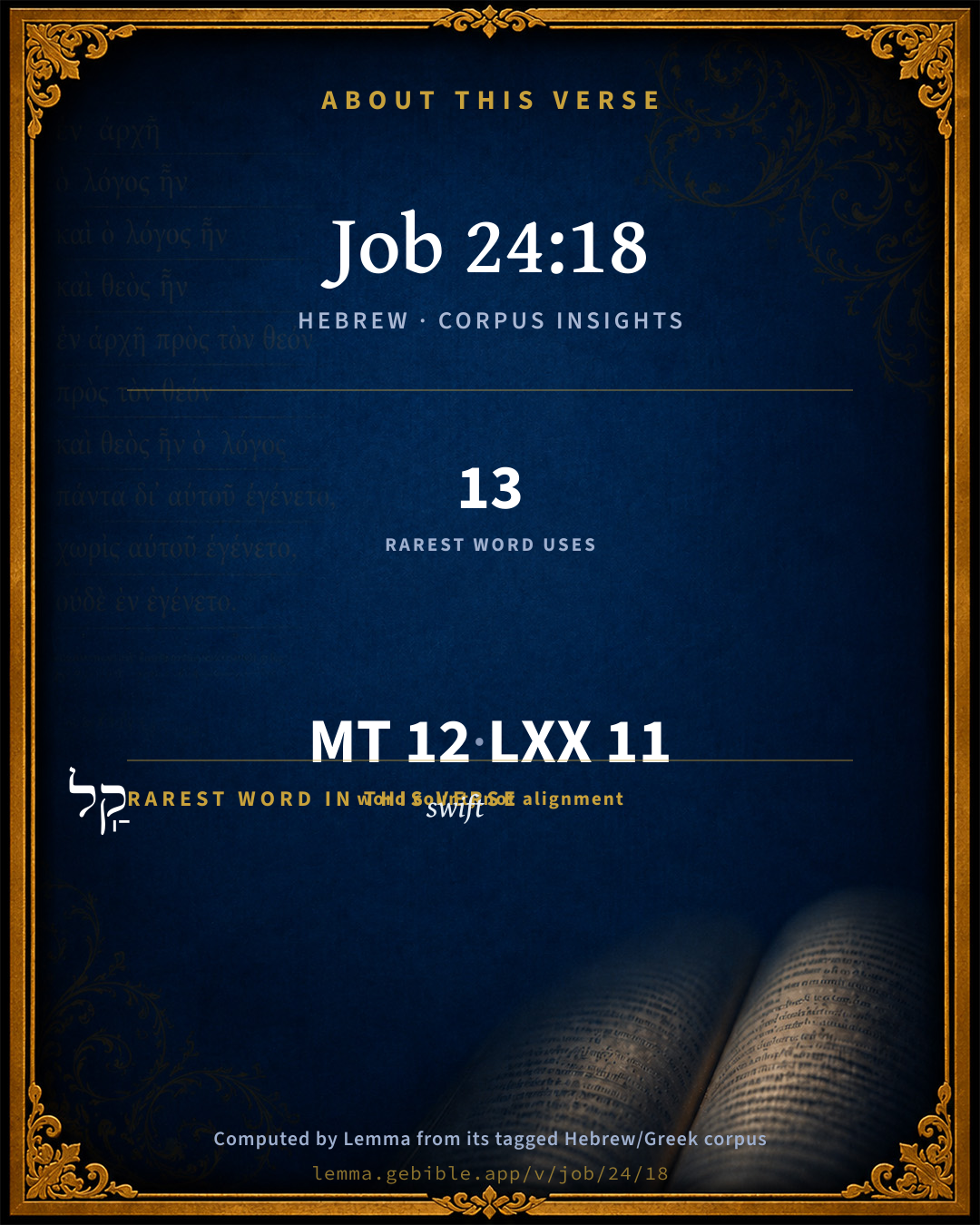
The rarest word here is קַֽל swift H7031 — appearing just 13 times in the whole Hebrew Bible.

Shared distinctive vocabulary

קַֽל swift H7031 occurs in 13 verses of the Hebrew Bible. Also found in:

Grammatical profile

  • 2 verbs
  • 6 nouns
  • 1 adjective
  • 1 pronoun
  • 1 preposition
  • 1 particle

Verb forms

  • תְּקֻלַּ֣ל Pual · Imperfect
  • יִ֝פְנֶה Qal · Imperfect

Hebrew & Septuagint length

In English translation the verse runs 25 words from the Hebrew and 24 from the Septuagint (LXX English) — closely comparable.

A rough comparison of the two English renderings, which tokenize alike — not a word-level alignment.

Word counts can differ between the Hebrew and the Greek without any difference in meaning — e.g. the Hebrew direct-object marker אֵת has no separate Greek word, and Greek often adds the article ὁ.

In the original languages it is 12 Hebrew tokens and 11 Greek tokens — but the two are counted differently (Hebrew bundles its prefixes and suffixes into one token; the Greek is in lemma form), so that isn’t a like-for-like length.

Cross-references

9

Topical passages linked to Job 24:18 in the Treasury of Scripture Knowledge — connected by theme and wording, ordered by reader-vote popularity; previews shown in the World English Bible.

  • Deuteronomy 28:16–20 Cursed shall you be in the city, and cursed shall you be in the field.
  • Job 9:26 They have passed away as the swift ships, As the eagle that swoops on the prey.
  • Job 22:16 Who were snatched away before their time, Whose foundation was poured out as a stream,
  • Psalms 58:7 Let them vanish as water that flows away. When they draw the bow, let their arrows be made blunt.
  • Psalms 69:22 Let their table before them become a snare. May it become a retribution and a trap.
  • Psalms 73:18–20 Surely you set them in slippery places. You throw them down to destruction.
  • Proverbs 3:33 Yahweh's curse is in the house of the wicked, But he blesses the habitation of the righteous.
  • Isaiah 23:10 Pass through your land as the Nile, daughter of Tarshish; there is no restraint any more.
  • Malachi 2:2 If you will not listen, and if you will not lay it to heart, to give glory to my name," says Yahweh of Hosts, "then will I send the curse on you, and I will curse your blessings. Indeed, I have cursed them already, because you do not lay it to heart.

Cross-references courtesy of OpenBible.info (CC BY 4.0).

Hebrew and Greek witnesses Masoretic Hebrew ↔ Greek Septuagint

The same verse in the two great witnesses to the Old Testament, shown verse-for-verse.

These are two independent witnesses, not word-aligned to each other, and the Septuagint is shown in lemma (dictionary) form.

Hebrew Job 24:18 Masoretic · Westminster Leningrad Codex

קַֽל ה֤וּא עַל פְּנֵי מַ֗יִם תְּקֻלַּ֣ל חֶלְקָתָ֣ם בָּאָ֑רֶץ לֹֽא יִ֝פְנֶה דֶּ֣רֶךְ כְּרָמִֽים

"They are foam on the surface of the waters. Their portion is cursed in the earth: They don't turn into the way of the vineyards.

World English Bible · Public Domain

Greek LXX Job 24:18 Septuagint · lemma form

ἐλαφρός εἰμί ἐπί πρόσωπον ὕδωρ καταἀράομαι ὁ μερίς αὐτός ἐπί γῆ

He is swift on the face of the water: let his portion be cursed on the earth; and let their plants be laid bare.

LXX2012 (modern English Septuagint) · Public Domain

On this verse, Whedon's Commentary on the Bible discusses the Septuagint’s reading. Read the note in Commentary ↓

Hebrew: Westminster Leningrad Codex (CC BY 4.0). Greek: Septuagint (public domain); English from LXX2012 (modern English Septuagint) (Public Domain). How the Septuagint differs from the Hebrew →

Commentary

Notes on Job 24:18 from classic Christian and Jewish commentators (each source and its license shown beneath its notes). The classic Christian expositions comment on the surrounding passage and are grouped to its opening verse, so a note may address several verses; the Jewish commentaries on the Tanakh (Rashi and others) are per-verse, so they appear only where the commentator wrote on this verse.

Lemma curates 59 commentaries, every one of them public domain or Creative Commons licensed, each selected and text-cleaned for this edition rather than reprinted as found. About our sources →

Matthew Henry's Commentary

Job here, in the conclusion of his discourse,

I. Gives some further instances of the wickedness of these cruel bloody men. 1. Some are pirates and robbers at sea. To this many learned interpreters apply those difficult expressions (Job 24:18), He is swift upon the waters. Privateers choose those ships that are the best sailors. In these swift ships they cruise from one channel to another, to pick up prizes; and this brings them in so much wealth that their portion is cursed in the earth, and they behold not the way of the vineyards, that is (as bishop Patrick explains it), they despise the employment of those who till the ground and plant vineyards as poor and unprofitable. But others make this a further description of the conduct of those sinners that are afraid of the light: if they be discovered, they get away as fast as they can, and choose to lurk, not in the vineyards, for fear of being discovered, but in some cursed portion, a lonely and desolate place, which nobody looks after. 2. Some are abusive to those that are in trouble, and add affliction to the afflicted. Barrenness was looked upon as a great reproach, and those that fall under that affliction they upbraid with it, as Peninnah did Hannah, on purpose to vex them and make them to fret, which is a barbarous thing. This is evil entreating the barren that beareth not (Job 24:21), or those that are childless, and so want the arrows others have in their quiver, which enable them to deal with their enemy in the gate, Psa 127:5. They take that advantage against and are oppressive to them. As the fatherless, so the childless, are in some degree helpless. For the same reason it is a cruel thing to hurt the widow, to whom we ought to do good; and not doing good, when it is in our power, is doing hurt. 3. There are those who, by inuring themselves to cruelty, come at last to be so exceedingly boisterous that they are the terror of the mighty in the land of the living (Job 24:22): "He draws the mighty into a snare with his power; even the greatest are not able to stand before him when he is in his mad fits: he rises up in his passion, and lays about him with so much fury that no man is sure of his life; nor can he at the same time be sure of his own, for his hand is against every man and every man's hand against him," Gen 16:12. One would wonder how any man can take pleasure in making all about him afraid of him, yet there are those that do.

II. He shows that these daring sinners prosper, and are at ease for a while, nay, and often end their days in peace, as Ishmael, who, though he was a man of such a character as is here given, yet both lived and died in the presence of all his brethren, as we are told, Gen 16:12; Gen 25:18 : Of these sinners here it is said, 1. That it is given them to be in safety, Job 24:23. They seem to be under the special protection of the divine Providence; and one would wonder how they escape with life through so many dangers as they run themselves into. 2. That they rest upon this, that is, they rely upon this as sufficient to warrant all their violences. Because sentence against their evil works is not executed speedily they think that there is no great evil in them, and that God is not displeased with them, nor will ever call them to an account. Their prosperity is their security. 3. That they are exalted for a while. They seem to be the favourites of heaven, and value themselves as making the best figure on earth. They are set up in honour, set up (as they think) out of the reach of danger, and lifted up in the pride of their own spirits. 4. That, at length, they are carried out of the world very silently and gently, and without any remarkable disgrace or terror. "They go down to the grave as easily as snow-water sinks into the dry ground when it is melted by the sun;" so bishop Patrick explains Job 24:19. To the same purport he paraphrases Job 24:20, The womb shall forget him, etc. "God sets no such mark of his displeasure upon him but that his mother may soon forget him. The hand of justice does not hang him on a gibbet for the birds to feed on; but he is carried to his grave like other men, to be the sweet food of worms. There he lies quietly, and neither he nor his wickedness is any more remembered than a tree which is broken to shivers." And Job 24:24, They are taken out of the way as all others, that is, "they are shut up in their graves like all other men; nay, they die as easily (without those tedious pains which some endure) as an ear of corn is cropped with your hand." Compare this with Solomon's observation (Ecc 8:10), I saw the wicked buried, who had come and gone from the place of the holy, and they were forgotten.

III. He foresees their fall however, and that their death, though they die in ease and honour, will be their ruin. God's eyes are upon their ways, Job 24:23. Though he keep silence, and seem to connive at them, yet he takes notice, and keeps account of all their wickedness, and will make it to appear shortly that their most secret sins, which they thought no eye should see (Job 24:15), were under his eye and will be called over again. Here is no mention of the punishment of these sinners in the other world, but it is intimated in the particular notice taken of the consequences of their death. 1. The consumption of the body in the grave, though common to all, yet to them is in the nature of a punishment for their sin. The grave shall consume those that have sinned; that land of darkness will be the lot of those that love darkness rather than light. The bodies they pampered shall be a feast for worms, which shall feed as sweetly on them as ever they fed on the pleasures and gains of their sins. 2. Though they thought to make themselves a great name by their wealth, and power, and mighty achievements, yet their memorial perished with them, Psa 9:6. He that made himself so much talked of shall, when he is dead, be no more remembered with honour; his name shall rot, Pro 10:7. Those that durst not give him his due character while he lived shall not spare him when he is dead; so that the womb that bore him, his own mother, shall forget him, that is, shall avoid making mention of him, and shall think that the greatest kindness she can do him, since no good can be said of him. That honour which is got by sin will soon turn into shame. 3. The wickedness they thought to establish in their families shall be broken as a tree; all their wicked projects shall be blasted, and all their wicked hopes dashed and buried with them. 4. Their pride shall be brought down and laid in the dust (Job 24:24); and, in mercy to the world, they shall be taken out of the way, and all their power and prosperity shall be cut off. You may seek them, and they shall not be found. Job owns that wicked people will be miserable at last, miserable on the other side death, but utterly denies what his friends asserted, that ordinarily they are miserable in this life.

IV. He concludes with a bold challenge to all that were present to disprove what he had said if they could (Job 24:25): "If it be not so now, as I have declared, and if it do not thence follow that I am unjustly condemned and censured, let those that can undertake to prove that my discourse is either, 1. False in itself, and then they prove me a liar; or, 2. Foreign, and nothing to the purpose, and then they prove my speech frivolous and nothing worth." That indeed which is false is nothing worth; where there is not truth, how can there be goodness? But those that speak the words of truth and soberness need not fear having what they say brought to the test, but can cheerfully submit it to a fair examination, as Job does here.

Matthew Henry's Commentary on the Whole Bible (1708–1710) — public domain (CC PDM 1.0). Text via the HelloAO Bible API.

The Cambridge Bible for Schools and Colleges

gen. ed. J. J. S. Perowne

18. He is swift as the waters] Rather, he is swift upon the face of the waters. The person spoken of is the wicked man, especially such a tyrannical, proud oppressor as is alluded to in Job_24:2-4; and what is said of him is, that he is like a waif or spray on the surface of the water, swept rapidly away, and disappearing in a moment from the eyes of men in destruction; comp. ch. Job_20:28, Hos_10:7, “As for Samaria, her king is cut off like foam (or, a twig) upon the face of the waters.”

their portion] i. e. their fields and possessions. A curse is pronounced over the estates of such men by those who behold their downfall; comp. ch. Job_5:3.

he beholdeth not] Or, he turneth not unto the way of the vineyards—he shall no more return unto the smiling vineyards in which he delighted. The joys of his luxurious life shall no more be his, misery and destruction have overtaken him. The general meaning of the phrase is the converse of that expressed by “sitting under his vine and figtree,” 1Ki_4:25; Mic_4:4.

18–21. The popular creed regarding the fate of the wicked in God’s government of the world.

18–24. This detailed and graphic picture of the enormities of wicked men (Job_24:2-17) suggests the question, What then is the fate of such men? Are they seized by the sudden judgments of God and delivered into the hand of their own transgression (ch. Job_8:4)? or, are they prolonged in the possession of their power, protected in their wickedness, and brought to a natural and peaceful end at last like men in general? The following passage gives both answers, one in Job_24:18-21, and the other in Job_24:22-24. The former answer is that of Job’s friends, and perhaps of the common mind, a passage or fragments from a poetical expression of whose creed Job seems to cite. This answer is only introduced ironically and in order to supply the background to the true picture which Job himself draws of the history of these violent and wicked men. And this picture is a very different one.

The Cambridge Bible for Schools and Colleges (gen. ed. J. J. S. Perowne; Cambridge University Press, 1878–1918) — public domain. Text from a community e-Sword module.

Trapp's Complete Commentary

John Trapp

Job 24:18 He [is] swift as the waters; their portion is cursed in the earth: he beholdeth not the way of the vineyards.

Ver. 18. He is swift as the waters] He stays not long in a place, but flees away swiftly (like the river Tigris, swift as an arrow out of a bow), to avoid punishment. Heb. He is light upon the face of the waters. The meaning is, saith one, they are as a light thing upon the streams of water running swiftly, and carrying it away with speed. Some, that it is spoken in respect to their swift passing on from one wickedness to another, or their never being settled after such wickedness committed, but always ready to be overturned, as a ship that is unballasted, and so to be drowned in the sea.

Their portion is cursed in the earth] Cain like, they wander up and down, a corde suo facti fugitivi, but their sin will surely find them out; neither can they run out of the reach of God’s rod, &c. This Job saith, lest any should gather, from what he had said before, that it should be always well with the wicked and ill with the godly. Some take it as a curse, Let their portion on earth be accursed, neither let them turn themselves to the vineyards; sc. either to dress them or to taste of the fruits of them.

He beholdeth not the way of the vineyards] That is, say some, to run away by them, which were common ways to cities, but by some other obscure byway, that he may not be found. In vineyards something is to be done at all times, that way therefore they take not, lest they should be discovered and punished. Beza rendereth it, He turneth not into the way (that is, the nature) of the vines, which, by cutting and pruning, sprouteth out, and becometh more profitable. Others sense it far otherwise. The concise brevity and ambiguity of the words, together with the change of number, hath caused a cloud upon them.

John Trapp, A Commentary or Exposition upon All the Books of the Old and New Testament (1647–1656) — public domain. Text from a community e-Sword module.

Joseph Benson's Commentary

Job 24:18. He is swift as the waters — That is, the wicked man quickly passeth away, with all his glory, as the waters, which never stay in one place, but are always hasting away. Their portion — Or, his portion (for he still speaks of the same person, though with a change of the number) is cursed in the earth — His habitation and estate, which he leaves behind him, is accursed of God; and, by all men who live near it, or observe it, is pronounced accursed, because of the remarkable judgments of God upon it, and upon his posterity or family, to which he left it, and from whom it is strangely and unexpectedly alienated. He beholdeth not the way of the vineyards — He shall never more see or enjoy his vineyards, or other pleasant places and things, which seem to be comprehended under this particular. Thus, though Job constantly maintains against his friends, that many ungodly men do prosper, and escape punishment, in this life, yet, withal, he asserts that God will certainly, sooner or later, punish them; and that he sometimes doth it here, cutting them off by cruel and untimely deaths, or otherwise inflicting some notable judgment upon them, of which he also speaks Job 21:17.

Joseph Benson's Commentary on the Old and New Testaments (1811–1818) — public domain. Text from a community e-Sword module.

Whedon's Commentary on the Bible

Daniel D. Whedon

18-21. Clericus regards this passage as one of the most difficult in Holy Scripture. Job seems to argue against himself, (Job_21:7,) and to have surrendered the citadel to his foes. Some moderns (Dathe, Umbreit, etc.) follow the Septuagint and Vulgate in regarding these verses as an imprecation, thus: “May he be light (swift) on the face of the waters,” and thus swiftly hasten to his doom. Others (Ewald, Hirtzel, and Dillmann) suppose that Job is ironical, and that he parodies the sentiments of his friends; others still (Stickel, Welte, and Hahn) that he repeats their views only the more emphatically to controvert and refute them. But none of these opinions meet the demands of the passage. Rosenmuller, Delitzsch, and Canon Cook are right in looking upon it in general as simply a description of the unperturbed fate of such sinners as those he has just described. Like the Psalmist (Psa_73:3-5) under dark temptation, he sees in their death no marks of divine displeasure. Like a bubble on the flood, (Job_24:18,) or an evanishing stream of the desert, (Job_24:19,) the grave (sheol) silently swallows them up.

Second strophe — Wealthy and respectable evildoers, (18-21,) widely differing from the miscreants he has just described, (13-17,) sink into sheol like a bubble on the stream, or snow waters in the desert sands, and escape long-protracted suffering and slow-footed justice, Job_24:18-21.

18. He is swift as the waters — Better, Light is he on the face of the waters. A figure similar to that of the text appears in Hos_10:7, “He is like foam (a twig, Sept.) on the face of the water.” Borne onward by the current, he is swift to disappear; while justice, with limping foot, (pede poena claudo. — HORACE, Carm., Job_3:2,) is too slow-paced to overtake him. Men may curse his “portion” when he is gone, but what cares he in the grave for public opinion? An exquisite stroke is that of the poet, He beholdeth not the way of the vineyards: scene of delights to him — of many a cool and shady walk — though of stern oppression for the poor, (Job_24:6-11.) The picture may remind the reader of a similar, but no more touching, one in “The Elegy,” that of the warm precincts of a cheerful day, on which the soul, departing, casts “one longing, lingering look behind.” The view of Carey and Hengstenberg, that Job speaks of pirates in this verse, is untenable.

Daniel D. Whedon (gen. ed.), Commentary on the Old and New Testaments (1874–1909) — public domain. Text from a community e-Sword module.

Keil & Delitzsch

C. F. Keil & F. Delitzsch

18 For he is light upon the surface of the water;

Their heritage is cursed upon the earth;

He turneth no more in the way of the vineyard.

19 Drought, also heat, snatch away snow water -

So doth Shel those who have sinned.

20 The womb forgetteth him, worms shall feast on him,

He is no more remembered;

So the desire of the wicked is broken as a tree -

21 He who hath plundered the barren that bare not,

And did no good to the widow.

The point of comparison in Job 24:18 is the swiftness of the disappearing: he is carried swiftly past, as any light substance on the surface of the water is hurried along by the swiftness of the current, and can scarcely be seen; comp. Job 9:26 : "My days shoot by as ships of reeds, as an eagle which dasheth upon its prey," and Hos 10:7, "Samaria's king is destroyed like a bundle of brushwood (lxx, Theod., φρύγανον) on the face of the water," which is quickly drawn into the whirlpool, or buried by the approaching wave.

(Note: The translation: like foam (spuma or bulla), is also very suitable here. Thus Targ., Symm., Jerome, and others; but the signification to foam cannot be etymologically proved, whereas קצף in the signification confringere is established by קצפה, breaking, Joe 1:7, and Arab. qṣf; so that consequently קצף, as synon. of אף, signifies properly the breaking forth, and is then allied to אברה.)

But here the idea is not that of being swallowed up by the waters, as in the passage in Hosea, but, on the contrary, of vanishing from sight, by being carried rapidly past by the rush of the waters. If, then, the evil-doer dies a quick, easy death, his heritage (חלקה, from חלק, to divide) is cursed by men, since no one will dwell in it or use it, because it is appointed by God to desolation on account of the sin which is connected with it (vid., on Job 15:28); even he, the evil-doer, no more turns the way of the vineyard (פּנה, with דּרך, not an acc. of the obj., but as indicating the direction = אל־דּרך; comp. Sa1 13:18 with Sa1 13:17 of the same chapter), proudly to inspect his wide extended domain, and overlook the labourers. The curse therefore does not come upon him, nor can one any longer lie in wait for him to take vengeance on him; it is useless to think of venting upon him the rage which his conduct during life provoked; he is long since out of reach in Shel.

That which Job says figuratively in Job 24:18, and in Job 21:13 without a figure: "in a moment they go down to Shel," he expresses in Job 24:19 under a new figure, and, moreover, in the form of an emblematic proverb (vid., Herzog's Real-Encyklopdie, xiv. 696), according to the peculiarity of which, not כּן, but either only the copulative Waw (Pro 25:25) or nothing whatever (Pro 11:22), is to be supplied before שׁאול חטאו. חטאוּ is virtually an object: eos qui peccarunt. Job 24:19 is a model-example of extreme brevity of expression, Ges. 155, 4, b. Sandy ground (ציּה, arid land, without natural moisture), added to it (גּם, not: likewise) the heat of the sun - these two, working simultaneously from beneath and above, snatch away (גּזלוּ, cogn. גּזר, root גז, to cut, cut away, tear away; Arab. jzr, fut. i, used of sinking, decreasing water) מימי שׁלג, water of (melted) snow (which is fed from no fountain, and therefore is quickly absorbed), and Shel snatches away those who have sinned (= גּזלה את־אשׁר חטאוּ). The two incidents are alike: the death of those whose life has been a life of sin, follows as a consequence easily and unobserved, without any painful and protracted struggle. The sinner disappears suddenly; the womb, i.e., the mother that bare him, forgets him (רחם, matrix = mater; according to Ralbag: friendship, from רחם, to love tenderly; others: relationship, in which sense Arab. raḥimun = רחם is used), worms suck at him (מתקו for מתקתּוּ, according to Ges. 147, a, sugit eum, from which primary notion of sucking comes the signification to be sweet, Job 21:33 : Syriac, metkat ennun remto; Ar. imtasahum, from the synonymous Arab. maṣṣa = מצץ, מצה, מזה), he is no more thought of, and thus then is mischief (abstr. pro concr. as Job 5:16) broken like a tree (not: a staff, which עץ never, not even in Hos 4:12, directly, like the Arabic ‛asa, ‛asât, signifies). Since עולה is used personally, רעה וגו, Job 24:21, can be connected with it as an appositional permutative. His want of compassion (as is still too often seen in the present day in connection with the tyrannical conduct of the executive in Syria and Palestine, especially on the part of those who collected the taxes) goes the length of eating up, i.e., entirely plundering, the barren, childless (Gen 11:30; Isa 54:1), and therefore helpless woman, who has no sons to protect and defend her, and never showing favour to the widow, but, on the contrary, thrusting her away from him. There is as little need for regarding the verb רעה here, with Rosenm. after the Targ., in the signification confringere, as cognate with רעע, רצץ, as conversely to change תּרעם, Psa 2:9, into תּרעם; it signifies depascere, as in Job 20:26, here in the sense of depopulari. On the form ייטיב for יימיב, vid., Ges. 70, 2, rem.; and on the transition from the part. to the v. fin., vid., Ges. 134, rem. 2. Certainly the memory of such an one is not affectionately cherished; this is equally true with what Job maintains in Job 21:32, that the memory of the evil-doer is immortalized by monuments. Here the allusion is to the remembrance of a mother's love and sympathetic feeling. The fundamental thought of the strophe is this, that neither in life nor in death had he suffered the punishment of his evil-doing. The figure of the broken tree (broken in its full vigour) also corresponds to this thought; comp. on the other hand what Bildad says, Job 18:16 : "his roots dry up beneath, and above his branch is lopped off" (or: withered). The severity of his oppression is not manifest till after his death.

In the next strophe Job goes somewhat further. But after having, in Job 24:22, Job 24:23, said that the life of the ungodly passes away as if they were the favoured of God, he returns to their death, which the friends, contrary to experience, have so fearfully described, whilst it is only now and then distinguished from the death of other men by coming on late and painlessly.

Keil & Delitzsch — Biblical Commentary on the Old Testament (1861–1891) — public domain (CC PDM 1.0). Text via the HelloAO Bible API. (Old Testament only.)

Tyndale Open Study Notes

Tyndale Open Resources

24:18-24 These sentiments appear to oppose Job’s observations, so some scholars suggest that they were the words of Bildad or Zophar. However, Job might have been pronouncing curses on the wicked, sarcastically quoting his friends’ views, or saying that the fate of the wicked presented by Eliphaz (5:2-7; 15:17-25), Bildad (8:8-19; 18:5-21), and Zophar (20:4-29) also overtakes the righteous (21:23-26).

Tyndale Open Study Notes — © Tyndale Open Resources, licensed CC BY-SA 4.0. Text via the HelloAO Bible API.

Geneva Bible (1599)

Geneva Bible translators

He fleeth to the waters for his succor.

They think that all the world is bent against them, and dare not go by the high way.

Geneva Bible (1599) marginal notes — public domain. Text via Bolls.life.

Jamieson, Fausset & Brown

Robert Jamieson, A. R. Fausset & David Brown

In these verses Job quotes the opinions of his adversaries ironically; he quoted them so before (Job 21:7-21). In Job 24:22-24, he states his own observation as the opposite. You say, "The sinner is swift, that is, swiftly passes away (as a thing floating) on the surface of the waters" (Ecc 11:1; Hos 10:7).

is cursed--by those who witness their "swift" destruction.

beholdeth not--"turneth not to"; figuratively, for He cannot enjoy his pleasant possessions (Job 20:17; Job 15:33).

the way of the vineyards--including his fields, fertile as vineyards; opposite to "the way of the desert."

Jamieson, Fausset & Brown — Commentary Critical and Explanatory on the Whole Bible (1871) — public domain (CC PDM 1.0). Text via the HelloAO Bible API.

Adam Clarke's Commentary

Verse 18. He is swift as the waters] Literally, Light is he on the face of the waters: and cursed shall be their portion on the earth, which Mr. Good translates: -

Miserable is this man on the waters:

Deeply miserable the lot of those on dry land.

He beholdeth not the way of the vineyards.] These no longer flourish or bring forth fruit. The labour of the vintage fails.

Adam Clarke's Commentary on the Bible (1810–1826) — public domain. Text from a community e-Sword/MySword module.

Ellicott's Commentary for English Readers

(18) He is swift.—That is—each of these rebels against the light is swift to make his escape over the face of the waters. So we ought to read it, and not, with Authorised Version, as a comparison.

Their portion is cursed in the earth.—That is, men so regard it; it has an evil name, and is of bad repute.

He beholdeth not.—Rather, he—that is, each of them—turneth not the way of the vineyards, which is frequented and cultivated, but chooseth rather lone, desolate, solitary, and rugged paths.

A Bible Commentary for English Readers, edited by Charles John Ellicott (1878–1897) — public domain. Text from a community e-Sword module.

John Gill's Exposition

He is swift as the waters,.... Or "upon the face of the waters" (y); which some interpret of another set and sort of wicked men, guilty of like crimes, not on land, but upon the mighty waters; pirates, such that commit robberies upon the high seas; who generally choose the swiftest vessels to run from place to place for their prey, and to carry off their booty when pursued; whose manner of life is detestable to other persons; and especially they are cursed by those on land, who suffer by robbing the ships of their goods they send abroad; but these men best like such a manner of life, and prefer it to any thing by land, to agriculture or cultivation of vineyards, which they have no regard unto, as is supposed to be intimated by the following clauses; but it is greatly to be questioned whether there were any such persons, or that such practices obtained so early as the time of Job. Schultens thinks Sodomites are meant, who are most profuse to lust, and flow in it like water, plough the accursed field, by going after strange flesh, and have no regard to lawful marriage, or honest wives, comparable to vines and vineyards; but I should rather think those guilty of the sin of Onan are meant, who have no regard to the propagation of posterity. Others, as Ben Gersom are of opinion that this refers to the above persons, murderers, adulterers, and thieves, Job 24:14; who, being conscious of their crimes and due deserts, and in danger of being taken up, and brought to just punishment, flee to the sea with all the haste they can, take shipping, and go abroad into foreign parts; where they dwell in desolate and uncultivated places of the earth, which are cursed, or nigh unto cursing, and never more see pleasant fields, gardens, orchards, and vineyards: though others suppose that these words describe the temper and disposition of such wicked persons, who are unstable as water, carried about as any light thing upon the water with every wind of temptation, run swiftly into evil, and make haste to commit sin; though it seems best of all to interpret the words as respecting the state of wicked men at death, who then pass away swiftly and suddenly as gliding waters, and are "lighter" or swifter "than the waters", as Mr. Broughton renders the words:

their portion is cursed in the earth; that part and portion of the good things of this world they have is with a curse; their very blessings are cursed, and what they leave behind has a curse entailed on it, and in process of time is blasted, and comes to nothing; for, the curse of the Lord is in the house of the wicked, Pro 3:33;

he beholdeth not the way of the vineyards; as in their lifetime they had no regard to the way of good and righteous men, of whom Jarchi in a mystical sense, interprets the vineyards; so at death they are taken away from all their worldly enjoyments they set their hearts upon; their places know them no more, and they no more see their fields, and vineyards, and oliveyards, and take no more walks unto them nor in them.

(y) "super faciem aquarum", Mercerus, Bolducius, Beza, Drusius, Schultens.

John Gill's Exposition of the Whole Bible (1746–1763) — public domain (CC PDM 1.0). Text via the HelloAO Bible API.

Albert Barnes' Notes on the Bible

He is swift as the waters - Noyes renders this, “They are as swift as the skiff upon the waters.” Dr. Good, “Miserable is this man upon the waters.” Wemyss, “Such should be as foam upon the waters.” Le Clerc says that there is scarcely any passage of the Scriptures more obscure than this, and the variety of rendering adopted will show at once the perplexity of expositors. Rosenmuller supposes that the particle of comparison (כ k) is to be understood, and that the meaning is, “he is as a light thing upon the waters;” and this probably expresses the true sense. It is a comparison of the thief with a light boat, or any other light thing that moves gently on the face of the water, and that glides along without noise. So gently and noiselessly does the thief glide along in the dark. He is rapid in his motion, but he is still. It is not uncommon to describe one who is about to commit crime in the night as moving noiselessly along, and as taking every precaution that the utmost silence should be preserved. So Macbeth, when about to commit murder, soliloquizes:

Now o’er the one half world

Nature seems dead -

And withered murder,

Alarm’d by his sentinel, the wolf,

Who’s howl’d his watch, thus with his stealthy pace,

With Tarquin’s ravishing strides, towards his design

Moves like a ghost.

Thou sure and firm-set earth,

Hear not my steps, which way they walk, for fear

The very stones prate of my whereabout.

I do not know, however, that this comparison of a thief, with a light object on the waters, is to be found any where else, but it is one of great beauty. The word rendered “swift” (קל qal) may denote either that which is swift, or that which is light. In Isa 30:16, it is applied to a fleet horse. Here it may be rendered, “He is as a light thing upon the face of the waters.”

Their portion is cursed in the earth - That is, their manner of life, their way of obtaining a livelihood, is deserving of execration. The result of humble toil and honest labor may be said to be blessed; but not the property which they acquire. Rosenmuller and Noyes, however, suppose that the word “portion” here refers to their habitation, and that the idea is, they have their dwelling in wild and uncultivated places; they live in places that are cursed by sterility and barrenness. The Hebrew will bear either construction. The word lot, as it is commonly understood by us, may perhaps embrace both ideas. “Theirs is a cursed lot on earth.”

He beholdeth not the way of the vineyards - That is, they do not spend their lives in cultivating them, nor do they derive a subsistence from them. They live by plunder, and their abodes are in wild retreats, far away from quiet and civilised society. The object seems to be to describe marauders, who make a sudden descent at night on the possessions of others, and who have their dwellings far away from fields that are covered with the fruits of cultivation.

Albert Barnes' Notes on the Bible (1834–1885) — public domain. Text from a community e-Sword/MySword module.

Haydock's Catholic Bible Commentary

He is light, &c. That is, the adulterer, that he may not be perceived and discovered, steps as nimbly and as light as if her were walking upon the waters. Or the sense is: he is as light, that is, as swift and nimble as the running waters. --- By the way of the vineyards. That is, by the way where he may meet with fruit and blessings. (Challoner) --- The wicked are always inconstant. (Calmet) (Isaias lvii. 29.) --- He deserves no temporal nor eternal happiness. If he were deprived of the former, he might perhaps endeavour to escape the torments of hell. (Haydock)

George Leo Haydock (1774–1849), Haydock's Catholic Family Bible and Commentary, 1859 edition — public domain. Excludes Psalms (Douay-Rheims chapter numbering differs from Protestant) and Deuterocanonical books (Catholic canon only).

Matthew Poole's English Annotations

In these words he describes either,

1. The wicked man’s disposition and deportment, that such persons are light and frothy in their spirits, or swift or hasty to do evil, or unstable in their ways as the waters, or upon the face of the waters, i.e. like the foam, or froth, or any other light thing which swims upon the top of the waters. Or rather,

2. His miserable condition, of which he manifestly speaks in the next words, and in the two next verses. For though Job constantly affirms and maintains it against his friends, that many ungodly men do prosper and escape punishment in this life; yet withal he observes and asserts that God will certainly sooner or later punish them, and that he sometimes doth it here, cutting them off by cruel and untimely deaths, or otherwise inflicting some notable judgment upon them; of which he also speaks Job 21:17, &c. So the sense is,

He is swift, i.e. he quickly putteth away with all his glory,

as the waters, which never stay in one place, but are always hasting and running away; or like a ship, or any other thing which swimmeth upon the face of the waters: though he seems to stand as firm and unmovable as a rock, and to have taken deep rooting in the earth, yet he is suddenly and unexpectedly removed and pulled up by the roots. Their; or, his; for he still speaks of the same person, though with a change of the number, which is most familiar in this book, and elsewhere in Scripture.

Portion, or part, i.e. his habitation and estate which he left behind him.

Is cursed in the earth; is really accursed by God, and is by all men who live near it, or observe it, pronounced accursed, because of the remarkable judgments of God upon it, and upon his posterity or family to which he left it, and from whom it is strangely and suddenly alienated.

He beholdeth not the way of the vineyard, i.e. he shall never more see or enjoy his vineyards, or other pleasant places and things, which seem to be comprehended under this particular.

Matthew Poole's English Annotations on the Holy Bible (1683–1685) — public domain. Text from a community e-Sword/MySword module.

The Pulpit Commentary

He is swift as the waters. "Locus obscurissimus" (Schulteus). Scarcely any two commentators agree even as to the subject on which Job proceeds to speak. Some regard him as giving his own judgment on the ultimate fate of the wicked; others, as anticipating what his opponents will say on the point. One recent expositor takes the passage as referring to the efforts made by the malefactors of vers. 14-16 to escape from justice, and to the discredit and difficulty in which they involve themselves. Another suggests that Job here calls attention to a fresh class of oppressors, viz. water-thieves (see Strabo, 16:18), who, starting in light boats from some island in a lake or river, plundered the neighbouring lands, making the portions of the landholders worthless, and causing them to neglect the cultivation, even of their vineyards. If we accept this view, the proper translation of the present verse will be, Swift is he (i.e. the water-thief) upon the face of the waters: then is the portion of them who dwell in the land worthless; no one turneth his face toward his vine. yards (see Professor Lee"s "Book of Job," pp. 153, 378, 379).

The Pulpit Commentary (1880–1919), ed. H.D.M. Spence-Jones & Joseph S. Exell — public domain. Text from a community e-Sword module.

John Wesley's Explanatory Notes

Swift - That is, he quickly passeth away with all his glory, as the waters which never stay in one place, but are always hasting away. Portion - His habitation and estate which he left behind him. He - He shall never more see or enjoy his vineyards, or other pleasant places and things, which seem to be comprehended under this particular.

John Wesley, Explanatory Notes Upon the Whole Bible (1754–1765) — public domain. Text via the GEBible commentary corpus.

Kretzmann's Popular Commentary

Paul E. Kretzmann

Other Cases seem to Support Job’s Idea

v. 18. He is swift as the waters, he is swept away irresistibly, as by a flood; their portion is cursed in the earth, whatever they have called their own; he beholdeth not the way of the vineyards, that is, he does not enter there any more, the wealthy evil-doer is kept from enjoying his ill-gotten possessions.

v. 19. Drought and heat consume the snow waters, bearing them away, lapping them up, consuming them quickly; so doth the grave those which have sinned, they are swallowed, consumed, by the realm of the dead.

v. 20. The womb, the mother who bore him, shall forget him; the worm shall feed sweetly on him, enjoying the pleasant meal which his dead body offers; he shall be no more remembered; and wickedness shall be broken as a tree, iniquity is like a felled tree, suddenly chopped down.

v. 21. He evil entreateth the barren that beareth not, plundering her who has no children to protect her, and doeth not good to the widow, showing himself unmerciful to all the defenseless.

v. 22. He draweth also the mighty with His power, God preserves the men of might by His strength, prolonging the life of such mighty evil-doers. He riseth up, and no man is sure of life, literally, "such a one rises up again although not sure of his life," even when he has despaired of his life.

v. 23. Though it be given him to be in safety whereon he resteth, that is, God grants him a quiet existence so that he is sustained in life, yet His eyes are upon their ways, God watches over the paths of the prosperous wicked, blesses and protects them.

v. 24. They are exalted for a little while, but are gone and brought low; they are taken out of the way as all other, they perish like the rest, and cut off as the tops of the ears of corn, the spikes of the wheatstalks, the harvesting at that time being largely done by the process of heading.

v. 25. And if it be not so now, who will make me a liar, convicting him of falsehood, and make my speech nothing worth? Job very emphatically expresses his conviction that he now had the advantage of his opponents, by virtue of the arguments which he last advanced. He felt that they could offer no solution to the riddle which confronted them in the fact of his affliction.

Paul E. Kretzmann, Popular Commentary of the Bible (1921–1924) — public domain. Text from a community e-Sword module.

unfoldingWord translationNotes

Door43 World Missions Community

Connecting Statement:

Job continues speaking.

like foam on the surface of the waters

Foam lasts only a short time. This emphasizes how quickly God will cause the wicked to disappear. (See: Simile)

their portion of the land is cursed

This can be stated in active form. AT: "God curses the part of the land that they own" (See: Active or Passive)

As drought and heat melt away ... those who have sinned

Job says that sinners will disappear in Sheol in the same way as snow melts and disappears when it becomes warm. (See: Simile)

drought and heat

These two words describe essentially the same weather and are used together to describe it fully. (See: Hendiadys)

translationWords

water

curse

vineyard

consume

snow

Hades

sin

unfoldingWord translationNotes — © Distant Shores Media and the Door43 World Missions Community, licensed CC BY-SA 4.0. Source: git.door43.org/Door43/en_tn.

Rashi

Rabbi Shlomo Yitzchaki (Rashi)

He is light upon the face of the water When the righteous men, Noah and Methuselah, would rebuke them, they would say, “we are light [enough] to swim on the water, and we have papyrus and light materials from which to make boats and to float.”

their portion in the earth is cursed; he does not turn by the way of the vineyards They would curse their portion in the earth, saying that they would not turn by the way of the good, in the way of the righteous, who are lofty and dwell in the height or the world. Vineyards represent the righteous men and the leaders of the generation, as in (Hosea 2:17), “And I will give her vineyards from there,” which Jonathan renders: her leaders. They would curse their portion in the earth, saying that they would not turn in the way of the good; they would swear that they would not turn their way. Another explanation: תקלל חלקתם בארץ Their portion in the earth was spoiled, for they would destroy their seed in vain, as in (Gen. 6:12), “for all flesh had corrupted its way.” תקלל is an expression of spoiling (קלקול), as in (I Sam. 3:13), “for the iniquity [of the matter] that he knew that his sons were bringing disgrace (מקללים) upon them.” Another explanation: Their portion shall be cursed—the following generations will curse by them: He who requited the generation of the Flood. So I heard. (Gen. Rabbah 30:2). Another explanation: their portion is cursed; he does not turn by the way of the vineyards They would not accept reproof from the good men. Another explanation: They were swift to sail in ships to kill and to plunder property, but in the way of the land that was inhabited by humans and planted with vineyards they did not care to go.

Rashi on the Tanakh — English translations: “The Judaica Press complete Tanach with Rashi, translated by A. J. Rosenberg” (CC BY 4.0); “Pentateuch with Rashi's commentary by M. Rosenbaum and A.M. Silbermann, 1929-1934” (public domain); “The Metsudah Tanach series, Lakewood, N.J” (CC BY 4.0); and “The Book of Joshua, Metsudah Publications, 1997” (CC BY 4.0). Text via Sefaria.

Lesson kit

Teaching starters — assembled from the data on this page, not authored interpretation. Every prompt links to the verse data it draws on. Edit before teaching.

Job, in the Wisdom, opens this verse with 12 words (12 distinct Hebrew lemmas). Its most distinctive word is qal (“swift”). A historical commentator’s framing appears above. Read the whole chapter for the surrounding context.

Discussion questions

  1. The word qal carries the sense “swift.” How does it shape the verse?
  2. 2 Samuel 2:18 shares the word «swift» with this verse. How do the two illuminate each other?
  3. These translations render this verse differently; the difference is in the English rendering, not the original. What questions does that raise?
  4. The verb «תְּקֻלַּ֣ל» is Pual Imperfect. How does its form color the action?
  5. Reading how Matthew Henry's Commentary and The Cambridge Bible for Schools and Colleges read this verse, where do the two commentators agree and where do they part?

Things to notice

Reading settings

Reading text

Shown beneath each verse's original-language words.

Old Testament
Old Testament edition

Read the OT as the Masoretic Hebrew (MT) or the Greek Septuagint (LXX).

English shown for the Greek Septuagint (in the Hebrew ↔ Greek comparison).

Comparing translations? Open the Compare panel on any verse page to stack up to four side by side.