
Job 6:28

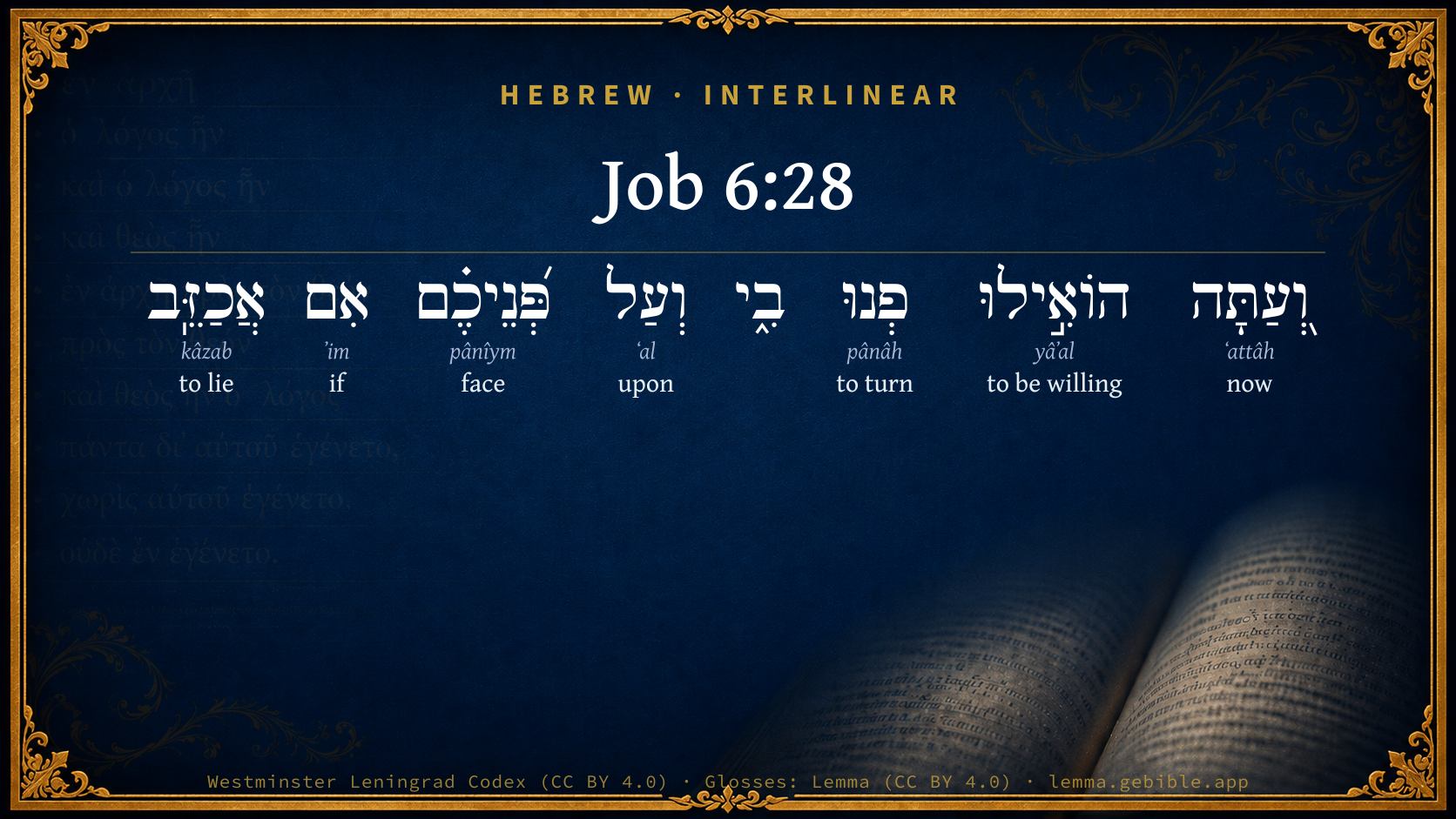
Hebrew (Westminster Leningrad Codex) Job 6:28 appears in the Hebrew Old Testament. The text above is from the Westminster Leningrad Codex. Each word links to its Strong’s number, a concise gloss, and parsing drawn from the Open Scriptures Hebrew Bible morphology. Click any word for its full Brown-Driver-Briggs (BDB) entry.
Download image
Cite this verse

Job 6:28 (World English Bible). Public Domain. Lemma interlinear Bible study tool, https://lemma.gebible.app/v/job/6/28.

Show BibTeX & RIS
BibTeX
RIS
English Translation
Now therefore be pleased to look at me, For surely I shall not lie to your face.
World English Bible · Public Domain
Download a study sheet

One document with this verse’s original text, its word-by-word gloss line, the meaning frame, cross-references with their text, attributed commentary, and full source and license credits — printable, and it pastes into notes with its structure intact.

This verse Autodidact and up

Study sheet (.html) Plain text (.txt)

A passage Seminary Student

Up to 50 verses in one chapter. A passage sheet keeps up to 6 commentary sources and 12 cross-references per verse, in the order this page ranks them, and says so on the sheet whenever that leaves anything out. Ask for a single verse and you get the Autodidact verse sheet above.

Everything on this page stays free to read, with no account — the sheet is a download of what is already on screen, not access to it.

Want to remove ads? Support Godless Engineer
Compare translations 3

The same verse in 3 English versions, stacked beneath the original-language interlinear above. Click any original word for its lexicon entry.

Each is an independent rendering of the whole verse — the interlinear is not word-aligned to these translations.

Highlighted words mark where these versions differ — a whole-verse word diff, not a word-by-word alignment.

  • World English Bible Public Domain
    Now therefore be pleased to look at me, For surely I shall not lie to your face.
  • King James Version Public Domain
    Now therefore be content, look upon me; for it is evident unto you if I lie.
  • unfoldingWord Literal Text CC BY-SA 4.0
    But now, be willing, look at me, and if I would lie to your faces!

unfoldingWord Literal Text — © unfoldingWord, licensed CC BY-SA 4.0. Word-aligned USFM3 via Door43 (git.door43.org/unfoldingWord/en_ult).

Versions to compare (up to 4)

3 of 4 selected

Show all 18 translations

Every available English version of this verse, each an independent rendering of the whole verse.

  • World English Bible Public Domain
    Now therefore be pleased to look at me, For surely I shall not lie to your face.
  • Berean Standard Bible Public Domain
    But now, please look at me. Would I lie to your face?
  • Majority Standard Bible Public Domain
    But now, please look at me. Would I lie to your face?
  • King James Version Public Domain
    Now therefore be content, look upon me; for it is evident unto you if I lie.
  • American Standard Version (1901) Public Domain
    Now therefore be pleased to look upon me; For surely I shall not lie to your face.
  • Revised Version (1885) Public Domain
    Now therefore be pleased to look upon me; for surely I shall not lie to your face.
  • Geneva Bible (1599) Public Domain
    Nowe therefore be content to looke vpon me: for I will not lie before your face.
  • Douay-Rheims (1899) Public Domain
    However finish what you have begun, give ear, and see whether I lie.
  • Young's Literal Translation Public Domain
    And, now, please, look upon me, Even to your face do I lie?
  • Literal Standard Version CC BY-SA 4.0
    And now, please, look on me, || Even to your face do I lie?
  • Unlocked Literal Bible CC BY-SA 4.0
    Now, therefore, please look at me, for surely I would not lie to your face.
  • unfoldingWord Literal Text CC BY-SA 4.0
    But now, be willing, look at me, and if I would lie to your faces!
  • Darby Bible Public Domain
    Now therefore if ye will, look upon me; and it shall be to your face if I lie.
  • World Messianic Bible Public Domain
    Now therefore be pleased to look at me, for surely I will not lie to your face.
  • Webster's Bible Public Domain
    Now therefore be content, look upon me; for it is evident to you if I lie.
  • Free Bible Version CC BY-SA 4.0
    Look me in the eye and see if I'm lying to your face!
  • Bible in Basic English Public Domain
    Now then, let your eyes be turned to me, for truly I will not say what is false to your face.
  • JPS Tanakh (1917) Public Domain
    Now therefore be pleased to look upon me; for surely I shall not lie to your face.

Literal Standard Version (2020), Covenant Press — licensed CC BY-SA 4.0. Text via the HelloAO Bible API (eBible.org). Unlocked Literal Bible (unfoldingWord) — licensed CC BY-SA 4.0. Text via the HelloAO Bible API (eBible.org). unfoldingWord Literal Text — © unfoldingWord, licensed CC BY-SA 4.0. Word-aligned USFM3 via Door43 (git.door43.org/unfoldingWord/en_ult). Free Bible Version, Dr. Jonathan Gallagher — licensed CC BY-SA 4.0. Text via the HelloAO Bible API (eBible.org).

Word by word

More ways to search: Search by grammar → Find every occurrence → Compare this word →

Practice this passage: Drill this verse → Learn its vocabulary →

אֲכַזֵּֽב
kâzab
H3576
“to lie”
Verb, Piel, Imperfect, 1st Person, Common, Singular
Part of Speech
Verb
Stem
Piel
Form
Imperfect
Person
1st Person
Gender
Common
Number
Singular
Full BDB Definition

Origin: a primitive root

TWOT: 970

to lie, tell a lie, be a liar, be found a liar, be in vain, fail - (Qal) liar (participle) - (Niphal) to be proven to be lying - (Piel) - to lie, tell a lie, tell a lie with, deceive - to disappoint, fail - (Hiphil) to make a liar, prove to be a liar
  1. וְ֭עַתָּה ʻattâh H6258 “and · now” Conjunction + Adverb
  2. הוֹאִ֣ילוּ yâʼal H2974 “be willing” Verb, Hiphil, Imperative, 2nd Person, Masculine, Plural
  3. פְנוּ pânâh H6437 “turn” Verb, Qal, Imperative, 2nd Person, Masculine, Plural
  4. וְעַל ʻal H5921 “and · upon” Conjunction + Preposition
  5. פְּ֝נֵיכֶ֗ם pânîym H6440 “face(s) · your” Noun, Common, Both, Plural, Construct + Suffix, Personal, 2nd Person, Masculine, Plural
  6. אִם ʼim H518 “if” Conjunction

About this verse

These counts appear in no published source. They are computed here, from the morphology-tagged text and Lemma’s own curated glosses. What Lemma adds →

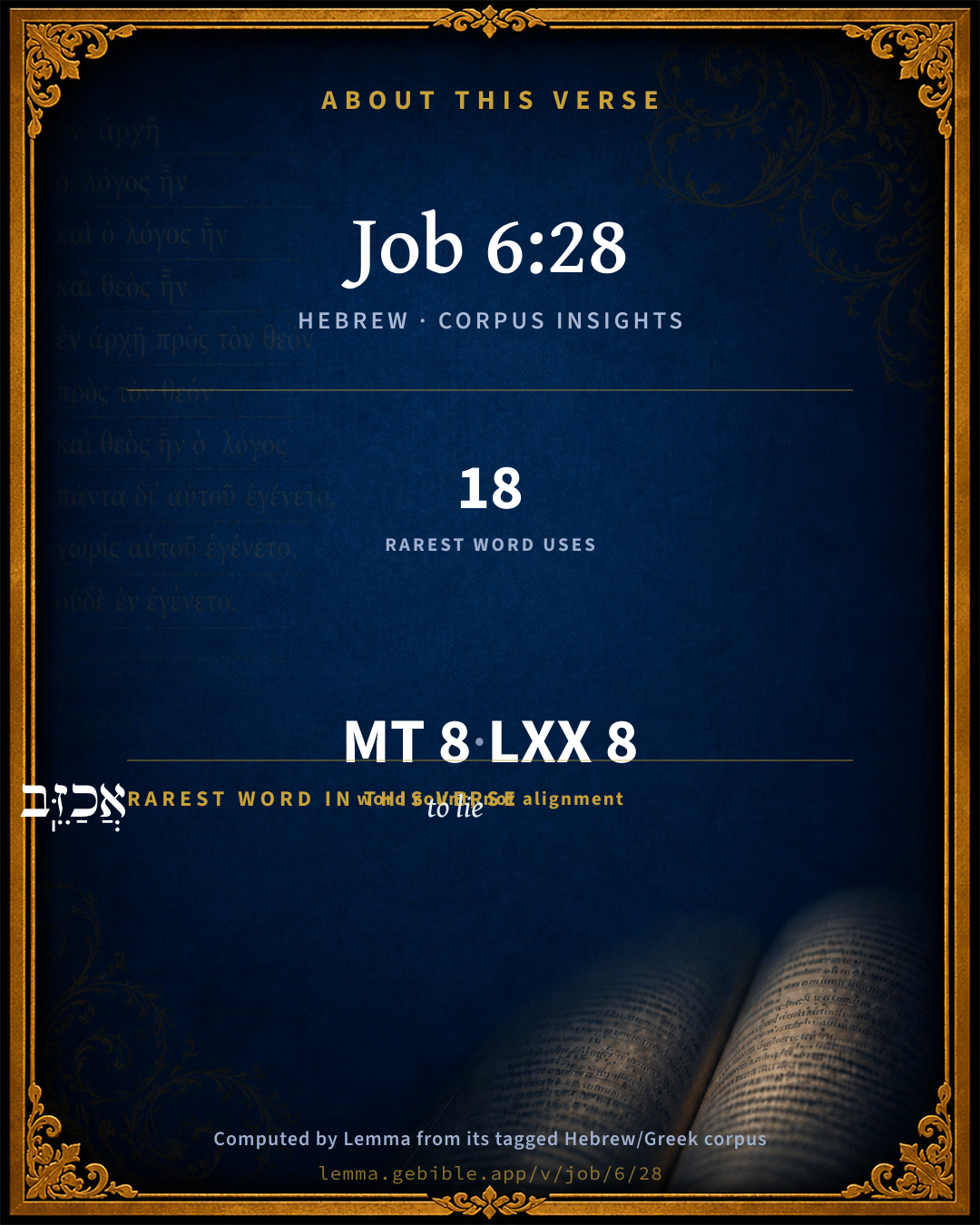
8
words
7
distinct lemmas
Wisdom
section

Notable vocabulary

The rarest word here is אֲכַזֵּֽב to lie H3576 — appearing just 18 times in the whole Hebrew Bible.

Shared distinctive vocabulary

אֲכַזֵּֽב to lie H3576 occurs in 18 verses of the Hebrew Bible. Also found in:

Grammatical profile

  • 3 verbs
  • 1 noun
  • 2 prepositions
  • 1 conjunction
  • 1 adverb

Verb forms

  • הוֹאִ֣ילוּ Hiphil · Imperative
  • פְנוּ Qal · Imperative
  • אֲכַזֵּֽב Piel · Imperfect

Hebrew & Septuagint length

In English translation the verse runs 17 words from the Hebrew and 11 from the Septuagint (LXX English) — the Septuagint runs noticeably shorter here. See the side-by-side →

A rough comparison of the two English renderings, which tokenize alike — not a word-level alignment.

Word counts can differ between the Hebrew and the Greek without any difference in meaning — e.g. the Hebrew direct-object marker אֵת has no separate Greek word, and Greek often adds the article ὁ.

In the original languages it is 8 Hebrew tokens and 8 Greek tokens — but the two are counted differently (Hebrew bundles its prefixes and suffixes into one token; the Greek is in lemma form), so that isn’t a like-for-like length.

Cross-references

5

Topical passages linked to Job 6:28 in the Treasury of Scripture Knowledge — connected by theme and wording, ordered by reader-vote popularity; previews shown in the World English Bible.

  • Job 13:4 But you are forgers of lies. You are all physicians of no value.
  • Job 27:4 Surely my lips shall not speak unrighteousness, Neither shall my tongue utter deceit.
  • Job 33:3 My words shall utter the uprightness of my heart; That which my lips know they shall speak sincerely.
  • Job 11:3 Should your boastings make men hold their peace? When you mock, shall no man make you ashamed?
  • Job 36:4 For truly my words are not false. One who is perfect in knowledge is with you.

Cross-references courtesy of OpenBible.info (CC BY 4.0).

Hebrew and Greek witnesses Masoretic Hebrew ↔ Greek Septuagint

The same verse in the two great witnesses to the Old Testament, shown verse-for-verse.

Here the Septuagint runs noticeably shorter than the Hebrew — LXX2012 (modern English Septuagint) 11 words vs World English Bible 17. A rough length comparison of the two English translations, not a word-level alignment — read both below.

These are two independent witnesses, not word-aligned to each other, and the Septuagint is shown in lemma (dictionary) form.

Hebrew Job 6:28 Masoretic · Westminster Leningrad Codex

וְ֭עַתָּה הוֹאִ֣ילוּ פְנוּ בִ֑י וְעַל פְּ֝נֵיכֶ֗ם אִם אֲכַזֵּֽב

Now therefore be pleased to look at me, For surely I shall not lie to your face.

World English Bible · Public Domain

Greek LXX Job 6:28 Septuagint · lemma form

νυνί δέ εἰςβλέπω εἰς πρόσωπον σύ οὐ ψεύδω

But now, having looked upon your countenances, I will not lie.

LXX2012 (modern English Septuagint) · Public Domain

Hebrew: Westminster Leningrad Codex (CC BY 4.0). Greek: Septuagint (public domain); English from LXX2012 (modern English Septuagint) (Public Domain). How the Septuagint differs from the Hebrew →

Commentary

Notes on Job 6:28 from classic Christian and Jewish commentators (each source and its license shown beneath its notes). The classic Christian expositions comment on the surrounding passage and are grouped to its opening verse, so a note may address several verses; the Jewish commentaries on the Tanakh (Rashi and others) are per-verse, so they appear only where the commentator wrote on this verse.

Lemma curates 59 commentaries, every one of them public domain or Creative Commons licensed, each selected and text-cleaned for this edition rather than reprinted as found. About our sources →

Trapp's Complete Commentary

John Trapp

Job 6:28 Now therefore be content, look upon me; for [it is] evident unto you if I lie.

Ver. 28. Now therefore be content, look upon me] Let it suffice you to have thus hardly handled me; cast now a more benign aspect upon me, and be not henceforth so hot and so harsh. Now therefore be content, regard me, so Mr Broughton translateth it, or look upon me, sc. with a critical eye: what guiltiness can you find in my face? do I look like a hypocrite, and can you read my conscience in my countenance?

It is evident to you if I lie] You may soon see mine integrity if you please, for my heart sitteth and showeth itself in my forehead, neither can I collude. I am one of those children that will not lie: so be God my Saviour, Isa 63:8.

John Trapp, A Commentary or Exposition upon All the Books of the Old and New Testament (1647–1656) — public domain. Text from a community e-Sword module.

Joseph Benson's Commentary

Job 6:28. Now therefore be content, look upon me — Hebrew, Be willing; look upon me, or, to look upon me, the second imperative being put for the infinitive. Be pleased to consider me and my cause further and better than you have done, that you may give a more true and righteous judgment concerning it; for it is — Or rather, will be; evident — You will plainly discover it; if I lie — A little farther consideration and discourse will make it manifest if I have uttered any thing untrue or without foundation, and I shall readily acknowledge it.

Joseph Benson's Commentary on the Old and New Testaments (1811–1818) — public domain. Text from a community e-Sword module.

Whedon's Commentary on the Bible

Daniel D. Whedon

Third strophe — He makes an appeal for justice, and justice only, Job_6:28-30.

28. Now therefore — And now be pleased to look upon me. He deems that they will see, notwithstanding his disfigurement, integrity in his look and bearing. Evident unto you, etc. — I will not speak falsely to your face, is the reading of most modern critics. Hengstenberg prefers to read, “let it be before your face,” that is, be determined by you, “whether I lie.”

Daniel D. Whedon (gen. ed.), Commentary on the Old and New Testaments (1874–1909) — public domain. Text from a community e-Sword module.

Geneva Bible (1599)

Geneva Bible translators

Consider whether I speak as one that is driven to this impatience through very sorrow, or as an hypocrite as you condemn me.

Geneva Bible (1599) marginal notes — public domain. Text via Bolls.life.

Jamieson, Fausset & Brown

Robert Jamieson, A. R. Fausset & David Brown

be content--rather, "be pleased to"--look. Since you have so falsely judged my words, look upon me, that is, upon my countenance: for (it is evident before your faces) if I lie; my countenance will betray me, if I be the hypocrite that you suppose.

Jamieson, Fausset & Brown — Commentary Critical and Explanatory on the Whole Bible (1871) — public domain (CC PDM 1.0). Text via the HelloAO Bible API.

Adam Clarke's Commentary

Verse 28. Look upon me] View me; consider my circumstances; compare my words; and you must be convinced that I have spoken nothing but truth.

Adam Clarke's Commentary on the Bible (1810–1826) — public domain. Text from a community e-Sword/MySword module.

Ellicott's Commentary for English Readers

(28) Now therefore be content to look upon me; for it will be evident unto you if I lie; or, for surely I shall not lie to your face.

A Bible Commentary for English Readers, edited by Charles John Ellicott (1878–1897) — public domain. Text from a community e-Sword module.

The Cambridge Bible for Schools and Colleges

gen. ed. J. J. S. Perowne

28. The verse means as a whole,

Now, therefore, be pleased to look upon me,

I will not surely lie to your face!

“Be pleased,” or, as we say, be good enough. “To your face,” as in ch. Job_1:11. Job desires that instead of speaking at him with averted faces they would look him in the face, and judge from his countenance whether he would lie directly in asserting his innocence—a test that only conscious honesty would propose.

The Cambridge Bible for Schools and Colleges (gen. ed. J. J. S. Perowne; Cambridge University Press, 1878–1918) — public domain. Text from a community e-Sword module.

John Gill's Exposition

Return, I pray you,.... From the ill opinion you have of me, and from your hard censures, and entertain other sentiments concerning me: or it may be, upon these words of Job his friends might be rising up as usual to take their leave of him, and break off conversation with him; and therefore he entreats they would return to their seats, and resume the debate, and give a friendly hearing of his case:

let it not be iniquity; either let it not be reckoned an iniquity to return and go on hearing his case; or he entreats that they would take care not to sin in their anger and resentment against him, nor go on to charge him with iniquity: or it may be rendered, "there is no iniquity" (h); that is, it should be found that there was no such iniquity in him as he was charged with; not that he was free from all sin, which no man is, but from that which his friends judged he was guilty of, hypocrisy:

yea, return again; he most earnestly importunes them to return and patiently hear him out:

my righteousness is in it; in the whole of this affair before them, and which was the matter of controversy between them; meaning, not his justifying righteousness before God, but the righteousness of his cause before men; he doubted not but, when things were thoroughly searched into, that his righteousness would be as clear as the light, and his judgment as the noonday; that he should appear to be a righteous man, and his cause a just one; and should stand acquitted and free from all charges and imputations.

(h) "non erit iniquitas", Beza, Mercerus; "nulla", Schultens.

John Gill's Exposition of the Whole Bible (1746–1763) — public domain (CC PDM 1.0). Text via the HelloAO Bible API.

Albert Barnes' Notes on the Bible

Now, therefore, be content - Rosenmuller has better rendered this, “if it please you.” The sense is, “if you are willing, look upon me.” That is, “if you are disposed, you may take a careful view of me. Look me in the countenance. You can see for yourselves whether I am sincere or false. I am willing that my whole demeanor should be subjected to the utmost scrutiny.”

For it is evident unto you if I lie - Margin, as in Hebrew before your face. That is, “you yourselves can see by my whole demeanor, by my sufferings, my patience, my manifest sincerity, that I am not playing the hypocrite.” Conscious of sincerity, he believed that if they would look upon him, they would be convinced that he was a sincere and an upright man.

Albert Barnes' Notes on the Bible (1834–1885) — public domain. Text from a community e-Sword/MySword module.

Matthew Poole's English Annotations

Look upon me; be pleased either,

1. To look upon my countenance, if it betrays any fear or guilt, as if I spoke contrary to my own conscience. Or rather,

2. To consider me and my cause further and better than you have done, that you may give a more true and righteous judgment concerning it.

Is evident unto you; you will plainly discover it. A little further consideration and discourse will make it manifest, and I shall readily acknowledge it.

Matthew Poole's English Annotations on the Holy Bible (1683–1685) — public domain. Text from a community e-Sword/MySword module.

The Pulpit Commentary

Now therefore be content, look upon me; rather, be pleased to look upon me. Professor Lee translates, "Look favorably upon me." But this addition is unnecessary. What Job desires is that his friends would look him straight in the face. Then they would not be able to doubt him. They would see that he was telling the truth. For it is evident unto you if I lie; rather, it will be evident unto you, etc. Others render the passage, "For surely I shall not lie to your face" (Schultens, Canon Cook, Revised Version).

The Pulpit Commentary (1880–1919), ed. H.D.M. Spence-Jones & Joseph S. Exell — public domain. Text from a community e-Sword module.

John Wesley's Explanatory Notes

Look - Consider my cause better than you have done, that you may give a more righteous judgment. Evident - You will plainly discover it.

John Wesley, Explanatory Notes Upon the Whole Bible (1754–1765) — public domain. Text via the GEBible commentary corpus.

Keil & Delitzsch

C. F. Keil & F. Delitzsch

28 And now be pleased to observe me keenly,

I will not indeed deceive you to your face.

29 Try it again, then: let there be no injustice;

Try it again, my righteousness still stands.

30 Is there wrong on my tongue?

Or shall not my palate discern iniquity?

He begs them to observe him more closely; בּ פּנה, as Ecc 2:11, to observe scrutinizingly. אם is the sign of negative asseveration (Ges. 155, 2, f). He will not indeed shamelessly give them the lie, viz., in respect to the greatness and inexplicableness of his suffering. The challenging שׁוּבוּ we do not translate: retrace your steps, but: begin afresh, to which both the following clauses are better suited. So Schlottm. and von Gerlach. Hahn retains the Chethib שׁובי, in the signification: my answer; but that is impossible: to answer is השׁיב, not שׁוּב. The עוד drawn to שׁובו by Rebia mugrasch is more suitably joined with צדקי־בה, in which בּהּ refers neutrally to the matter of which it treats. They are to try from the beginning to find that comfort which will meet the case. Their accusations are עולה; his complaints, on the contrary, are fully justified. He does not grant that the outburst of his feeling of pain (Job 3) is עולה: he has not so completely lost his power against temptation, that he would not restrain himself, if he should fall into הוּות. Thus wickedness, which completely contaminates feeling and utterance, is called (Psa 52:4).

Keil & Delitzsch — Biblical Commentary on the Old Testament (1861–1891) — public domain (CC PDM 1.0). Text via the HelloAO Bible API. (Old Testament only.)

unfoldingWord translationNotes

Door43 World Missions Community

Now

This word is used by Job to introduce new information.

please look

The verb "to look" is in second person plural form. (See: Forms of You)

I would not lie to your face

The word "your" refers to Job's friends. Here his friends are represented by their faces to emphasize that they are looking at him. AT: "I would not lie to you while I am looking at you" (See: Synecdoche)

Relent, I beg you

"Please be merciful to me" or "Stop speaking like this, I beg you"

let there be no injustice with you

This can be stated in positive form. AT: "treat me fairly" (See: Double Negatives)

Indeed, relent

"Please relent."

Is there evil on my tongue?

"Do I say wicked things?" Job uses this question to rebuke his friends and to emphasize that he is not wicked. This question can be written as a statement. AT: "I do not say wicked things." (See: Rhetorical Question)

on my tongue

Here Job's speech is represented by his "tongue." AT: "in my speech" (See: Metonymy)

Cannot my mouth detect malicious things?

Job uses this question to rebuke his friends and to emphasize that he can tell the difference between right and wrong. Here Job refers to himself by his "mouth" to emphasize his speech. This question can be written as a statement. AT: "I know what is right to say and what is wrong to say." (See: Rhetorical Question and Synecdoche)

translationWords

face

beg

evil

unfoldingWord translationNotes — © Distant Shores Media and the Door43 World Missions Community, licensed CC BY-SA 4.0. Source: git.door43.org/Door43/en_tn.

Rashi

Rabbi Shlomo Yitzchaki (Rashi)

agree Be willing to turn to me and to hear my words. Then you will see whether I lie to your face.

Rashi on the Tanakh — English translations: “The Judaica Press complete Tanach with Rashi, translated by A. J. Rosenberg” (CC BY 4.0); “Pentateuch with Rashi's commentary by M. Rosenbaum and A.M. Silbermann, 1929-1934” (public domain); “The Metsudah Tanach series, Lakewood, N.J” (CC BY 4.0); and “The Book of Joshua, Metsudah Publications, 1997” (CC BY 4.0). Text via Sefaria.

Lesson kit

Teaching starters — assembled from the data on this page, not authored interpretation. Every prompt links to the verse data it draws on. Edit before teaching.

Job, in the Wisdom, opens this verse with 8 words (7 distinct Hebrew lemmas). Its most distinctive word is kâzab (“to lie”). The Greek Septuagint runs shorter here. A historical commentator’s framing appears above. Read the whole chapter for the surrounding context.

Discussion questions

  1. The word kâzab carries the sense “to lie.” How does it shape the verse?
  2. How does Numbers 23:19, which shares the word «to lie», read alongside this verse?
  3. The Septuagint runs shorter here than the Hebrew. What might account for the difference?
  4. These translations render this verse differently; the difference is in the English rendering, not the original. What questions does that raise?
  5. «הוֹאִ֣ילוּ» is a Hiphil Imperative verb. How does that grammatical form shape the action described?
  6. Compare how Trapp's Complete Commentary and Joseph Benson's Commentary read this verse. Where do they agree or differ?

Things to notice

Reading settings

Reading text

Shown beneath each verse's original-language words.

Old Testament
Old Testament edition

Read the OT as the Masoretic Hebrew (MT) or the Greek Septuagint (LXX).

English shown for the Greek Septuagint (in the Hebrew ↔ Greek comparison).

Comparing translations? Open the Compare panel on any verse page to stack up to four side by side.