
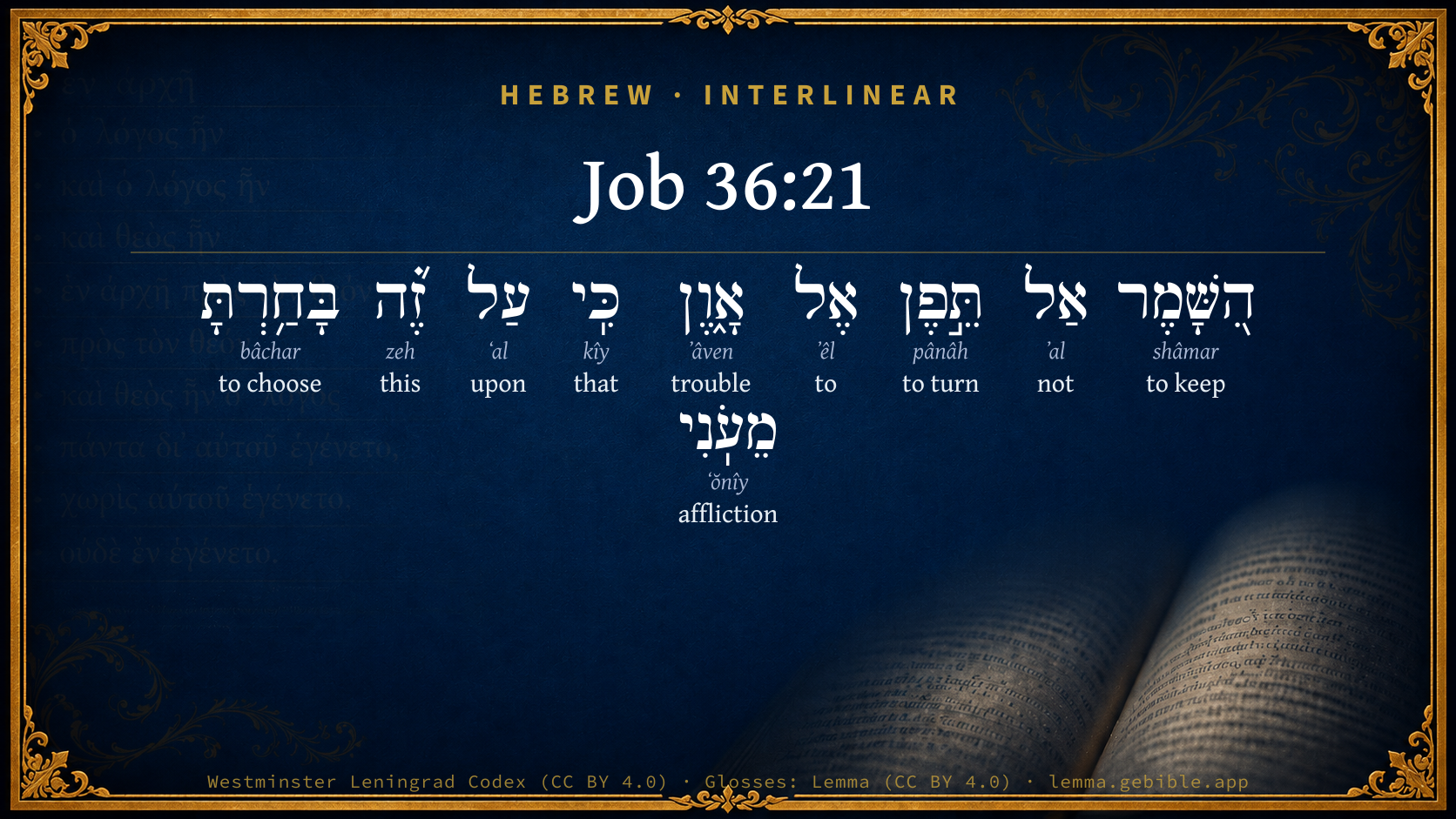
Job 36:21

Hebrew (Westminster Leningrad Codex) Job 36:21 appears in the Hebrew Old Testament. The text above is from the Westminster Leningrad Codex. Each word links to its Strong’s number, a concise gloss, and parsing drawn from the Open Scriptures Hebrew Bible morphology. Click any word for its full Brown-Driver-Briggs (BDB) entry.
Download image
Cite this verse

Job 36:21 (World English Bible). Public Domain. Lemma interlinear Bible study tool, https://lemma.gebible.app/v/job/36/21.

Show BibTeX & RIS
BibTeX
RIS
English Translation
Take heed, don't regard iniquity; For this you have chosen rather than affliction.
World English Bible · Public Domain
Download a study sheet

One document with this verse’s original text, its word-by-word gloss line, the meaning frame, cross-references with their text, attributed commentary, and full source and license credits — printable, and it pastes into notes with its structure intact.

This verse Autodidact and up

Study sheet (.html) Plain text (.txt)

A passage Seminary Student

Up to 50 verses in one chapter. A passage sheet keeps up to 6 commentary sources and 12 cross-references per verse, in the order this page ranks them, and says so on the sheet whenever that leaves anything out. Ask for a single verse and you get the Autodidact verse sheet above.

Everything on this page stays free to read, with no account — the sheet is a download of what is already on screen, not access to it.

Want to remove ads? Support Godless Engineer
Compare translations 3

The same verse in 3 English versions, stacked beneath the original-language interlinear above. Click any original word for its lexicon entry.

Each is an independent rendering of the whole verse — the interlinear is not word-aligned to these translations.

Highlighted words mark where these versions differ — a whole-verse word diff, not a word-by-word alignment.

  • World English Bible Public Domain
    Take heed, don't regard iniquity; For this you have chosen rather than affliction.
  • King James Version Public Domain
    Take heed, regard not iniquity: for this hast thou chosen rather than affliction.
  • unfoldingWord Literal Text CC BY-SA 4.0
    Watch yourself, do not turn to sin, for you have chosen upon that rather than affliction.

unfoldingWord Literal Text — © unfoldingWord, licensed CC BY-SA 4.0. Word-aligned USFM3 via Door43 (git.door43.org/unfoldingWord/en_ult).

Versions to compare (up to 4)

3 of 4 selected

Show all 18 translations

Every available English version of this verse, each an independent rendering of the whole verse.

  • World English Bible Public Domain
    Take heed, don't regard iniquity; For this you have chosen rather than affliction.
  • Berean Standard Bible Public Domain
    Be careful not to turn to iniquity, for this you have preferred to affliction.
  • Majority Standard Bible Public Domain
    Be careful not to turn to iniquity, for this you have preferred to affliction.
  • King James Version Public Domain
    Take heed, regard not iniquity: for this hast thou chosen rather than affliction.
  • American Standard Version (1901) Public Domain
    Take heed, regard not iniquity: For this hast thou chosen rather than affliction.
  • Revised Version (1885) Public Domain
    Take heed, regard not iniquity: for this hast thou chosen rather than affliction.
  • Geneva Bible (1599) Public Domain
    Take thou heede: looke not to iniquitie: for thou hast chosen it rather then affliction.
  • Douay-Rheims (1899) Public Domain
    Beware thou turn not aside to iniquity: for this thou hast begun to follow after misery.
  • Young's Literal Translation Public Domain
    Take heed -- do not turn unto iniquity, For on this thou hast fixed Rather than `on' affliction.
  • Literal Standard Version CC BY-SA 4.0
    Take heed—do not turn to iniquity, || For you have fixed on this || Rather than [on] affliction.
  • Unlocked Literal Bible CC BY-SA 4.0
    Be careful that you do not turn to sin because you are being tested by suffering so that you will stay away from sinning.
  • unfoldingWord Literal Text CC BY-SA 4.0
    Watch yourself, do not turn to sin, for you have chosen upon that rather than affliction.
  • Darby Bible Public Domain
    Take heed, turn not to iniquity; for this hast thou chosen rather than affliction.
  • World Messianic Bible Public Domain
    Take heed, don’t regard iniquity; for you have chosen this rather than affliction.
  • Webster's Bible Public Domain
    Take heed, regard not iniquity: for this hast thou chosen rather than affliction.
  • Free Bible Version CC BY-SA 4.0
    Watch out that you don't turn to evil! For it's because of this that you are being tested through suffering.
  • Bible in Basic English Public Domain
    Take care not to be turned to sin, for you have taken evil for your part in place of sorrow.
  • JPS Tanakh (1917) Public Domain
    Take heed, regard not iniquity; for this hast thou chosen rather than affliction.

Literal Standard Version (2020), Covenant Press — licensed CC BY-SA 4.0. Text via the HelloAO Bible API (eBible.org). Unlocked Literal Bible (unfoldingWord) — licensed CC BY-SA 4.0. Text via the HelloAO Bible API (eBible.org). unfoldingWord Literal Text — © unfoldingWord, licensed CC BY-SA 4.0. Word-aligned USFM3 via Door43 (git.door43.org/unfoldingWord/en_ult). Free Bible Version, Dr. Jonathan Gallagher — licensed CC BY-SA 4.0. Text via the HelloAO Bible API (eBible.org).

Word by word

More ways to search: Search by grammar → Find every occurrence → Compare this word →

Practice this passage: Drill this verse → Learn its vocabulary →

About this verse

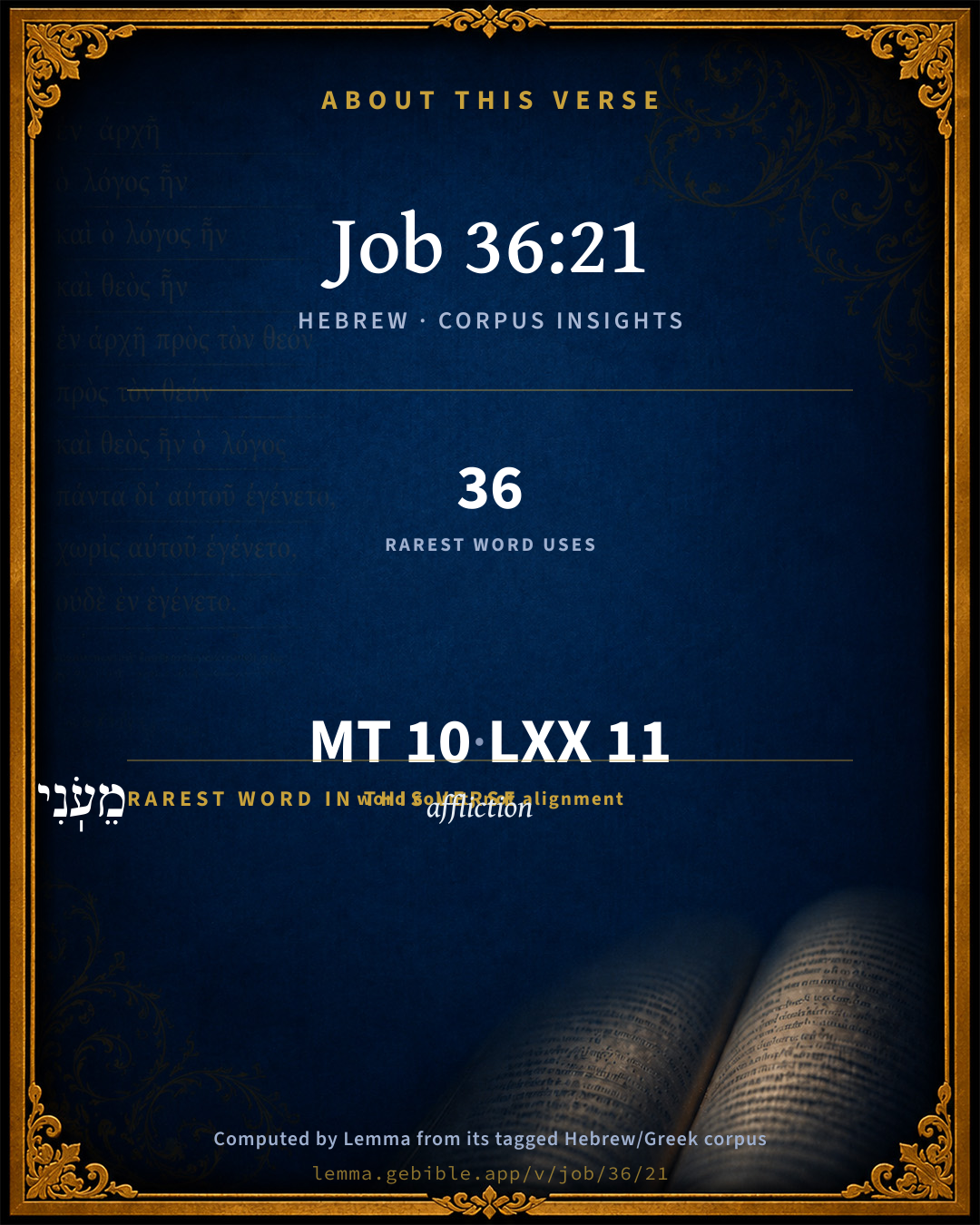
These counts appear in no published source. They are computed here, from the morphology-tagged text and Lemma’s own curated glosses. What Lemma adds →

10
words
10
distinct lemmas
Wisdom
section

Shared distinctive vocabulary

מֵעֹֽנִי affliction H6040 occurs in 36 verses of the Hebrew Bible. Also found in:

Grammatical profile

  • 3 verbs
  • 2 nouns
  • 1 pronoun
  • 2 prepositions
  • 1 conjunction
  • 1 particle

Verb forms

  • הִ֭שָּׁמֶר Niphal · Imperative
  • תֵּ֣פֶן Qal · Jussive
  • בָּחַ֥רְתָּ Qal · Perfect

Hebrew & Septuagint length

In English translation the verse runs 13 words from the Hebrew and 20 from the Septuagint (LXX English) — the Septuagint runs noticeably longer here. See the side-by-side →

A rough comparison of the two English renderings, which tokenize alike — not a word-level alignment.

Word counts can differ between the Hebrew and the Greek without any difference in meaning — e.g. the Hebrew direct-object marker אֵת has no separate Greek word, and Greek often adds the article ὁ.

In the original languages it is 10 Hebrew tokens and 11 Greek tokens — but the two are counted differently (Hebrew bundles its prefixes and suffixes into one token; the Greek is in lemma form), so that isn’t a like-for-like length.

Cross-references

13

Topical passages linked to Job 36:21 in the Treasury of Scripture Knowledge — connected by theme and wording, ordered by reader-vote popularity; previews shown in the World English Bible.

  • Psalms 66:18 If I cherished sin in my heart, The Lord wouldn't have listened.
  • Hebrews 11:25 choosing rather to share ill treatment with God's people, than to enjoy the pleasures of sin for a time;
  • 1 Peter 3:17 For it is better, if the will of God should so will, that you suffer for doing well than for doing evil.
  • Matthew 16:24 Then Jesus said to his disciples, "If anyone desires to come after me, let him deny himself, and take up his cross, and follow me.
  • Job 35:3 That you ask, 'What advantage will it be to you? What profit shall I have, more than if I had sinned?'
  • Ezekiel 14:4 Therefore speak to them, and tell them, Thus says the Lord Yahweh: Every man of the house of Israel who takes his idols into his heart, and puts the stumbling block of his iniquity before his face, and comes to the prophet; I Yahweh will answer him therein according to the multitude of his idols;
  • Daniel 3:16–18 Shadrach, Meshach, and Abednego answered the king, Nebuchadnezzar, we have no need to answer you in this matter.
  • Daniel 6:10 When Daniel knew that the writing was signed, he went into his house (now his windows were open in his chamber toward Jerusalem) and he kneeled on his knees three times a day, and prayed, and gave thanks before his God, as he did before.
  • Matthew 5:29–30 If your right eye causes you to stumble, pluck it out and throw it away from you. For it is more profitable for you that one of your members should perish, than for your whole body to be cast into Gehenna.
  • Matthew 13:21 yet he has no root in himself, but endures for a while. When oppression or persecution arises because of the word, immediately he stumbles.
  • Acts 5:40–41 They agreed with him. Summoning the apostles, they beat them and charged them not to speak in the name of Jesus, and let them go.
  • Job 34:7–9 What man is like Job, Who drinks scorn like water,
  • 1 Peter 4:15–16 For let none of you suffer as a murderer, or a thief, or an evil doer, or as a meddler in other men's matters.

Cross-references courtesy of OpenBible.info (CC BY 4.0).

Hebrew and Greek witnesses Masoretic Hebrew ↔ Greek Septuagint

The same verse in the two great witnesses to the Old Testament, shown verse-for-verse.

Here the Septuagint runs noticeably longer than the Hebrew — LXX2012 (modern English Septuagint) 20 words vs World English Bible 13. A rough length comparison of the two English translations, not a word-level alignment — read both below.

These are two independent witnesses, not word-aligned to each other, and the Septuagint is shown in lemma (dictionary) form.

Hebrew Job 36:21 Masoretic · Westminster Leningrad Codex

הִ֭שָּׁמֶר אַל תֵּ֣פֶן אֶל אָ֑וֶן כִּֽי עַל זֶ֝֗ה בָּחַ֥רְתָּ מֵעֹֽנִי

Take heed, don't regard iniquity; For this you have chosen rather than affliction.

World English Bible · Public Domain

Greek LXX Job 36:21 Septuagint · lemma form

ἀλλά φυλάσσω μή πράσσω ἄτοπος ἐπί οὗτος γάρ ἐκεἰλέω ἀπό πτωχεία

But take heed lest you do that which is wrong: for of this you have made choice because of poverty.

LXX2012 (modern English Septuagint) · Public Domain

Hebrew: Westminster Leningrad Codex (CC BY 4.0). Greek: Septuagint (public domain); English from LXX2012 (modern English Septuagint) (Public Domain). How the Septuagint differs from the Hebrew →

Commentary

Notes on Job 36:21 from classic Christian and Jewish commentators (each source and its license shown beneath its notes). The classic Christian expositions comment on the surrounding passage and are grouped to its opening verse, so a note may address several verses; the Jewish commentaries on the Tanakh (Rashi and others) are per-verse, so they appear only where the commentator wrote on this verse.

Lemma curates 59 commentaries, every one of them public domain or Creative Commons licensed, each selected and text-cleaned for this edition rather than reprinted as found. About our sources →

Trapp's Complete Commentary

John Trapp

Job 36:21 Take heed, regard not iniquity: for this hast thou chosen rather than affliction.

Ver. 21. Take heed, regard not iniquity] This especially of blaming God’s judgments, as if they were unequal. No more of that, saith Elihu. Cave tibi, ne coniecias oculos ad vanitatem, Beware thou cast not an eye towards such a vanity or iniquity as that is. This was very good counsel; and it is very well observed that this whole following treatise to the end of the thirty-seventh chapter is, as it were, a gentle lenitive of that foregoing sharp rebuke which otherwise was likely to drive Job beside all patience.

For this thou hast chosen rather than affliction] That is, this forementioned iniquity of speaking rashly and wickedly against God’s proceedings with thee; this thou hast chosen rather than to bear thine affliction, or thy poverty, patiently. Now this was an ill choice; for, quas non oportet mortes praeeligere, saith Zuinglius (Epist. 3), What deaths ought not a man rather to make choice of, what torments not rather undergo, yea, into what deepest gulf of hell itself not rather enter, than wittingly and willingly to sin against God! The ancient martyrs would not be delivered upon base terms, Heb 11:35. Daniel chose rather to be thrown to the lions than to violate his conscience, and so to have a lion roaring in his own bosom. The primitive Christians cried out, Ad leonem magis quam lenonem (Tertul.). I would rather enter into hell, being clear from sin and innocent, quam peccati sorde pollutus, coelorum regna tenere, than go to heaven, if I might, besmeared with the filth of sin, saith Anselm. I would rather leap into a bonfire and be burnt, said another of the ancients, than commit any sin against God (Pintus in Daniel). Some write, that there is a certain little beast, called the mouse of Armenia, which will rather die than be defiled with any filth; insomuch that if her hole be besmeared with dirt she will rather choose to be taken than polluted. Such ought the servants of God to be.

John Trapp, A Commentary or Exposition upon All the Books of the Old and New Testament (1647–1656) — public domain. Text from a community e-Sword module.

The Biblical Illustrator

Joseph S. Exell

Job_36:21

Take heed; regard not iniquity; for this hast thou chosen rather than affliction.

Affliction better than sin

Elihu rebukes Job with a becoming dignity, for some rash and unadvised speeches which the severity of his other friends, and the sharpness of his own anguish, had drawn from him, and particularly cautions him in the passage before us. Illustrate and prove the general proposition, that there can be no greater folly than to seek to escape from affliction by complying with the temptations of sin. That the greater part of mankind are under the influence of a contrary opinion, may be too justly referred from their practice. How many have recourse to sinful pleasures to relieve their inward distress. In order to evade sufferings for righteousness sake, thousands make shipwreck of faith and a good conscience, through sinful compliances with the manners of the world.

1. Sin separates us from God, the only source of real felicity. That man is not sufficient to his own happiness is a truth confirmed by the experience of all who have candidly attended to their own feelings. This makes men seek resources from abroad, and fly to pleasures and amusements of various kinds, to fill up the blanks of time, and divert their uneasy reflections. God alone can be the source of real happiness to an immortal soul. Sin bereaves the soul of man of this its only portion. Afflictions are often the means of bringing the soul nearer to Him.

2. Affliction may not only consist with the love of a father, but may even be the fruit of it. Whom the Lord loveth He chasteneth. A good man may even glory in tribulation. But sin is always both evil in its nature, and pernicious in its effects.

3. Sin is evil whether we feel it or not, and worst when we are most insensible of it. To be past feeling, in this respect, is the worst woe we can possibly bring upon ourselves. Affliction, though a bitter, is a salutary medicine. It is the discipline by which we are trained to glory, honour, and virtue. The greatest error we can fall into, is that of taking this world for the place of our rest. To cure this fatal mistake, God visits us with affliction.

4. In afflictions we are commonly passive, but always active in sin. The one is left to our choice, the other is not. When we suffer in the cause of virtue, we are in the hand of our most faithful and everlasting friend; but when we sin, in order to avoid suffering, we commit ourselves into the hands of that malicious and cunning enemy, who goeth about seeking whom he may devour.

5. The evil of affliction is of short duration, but that of sin perpetual. (R. Walker.)

Caution against losing the crown through fear of the cross

Three things to be observed in Jobs case.

1. Job, before his afflictions, is called a man perfect and upright, one that feared God, and eschewed evil: that is, both a moral man and a pious man. Before anyone may suppose that the lamentations of Job suit his case, he must be clear that he has lived like Job.

2. A great part of Jobs complaints are made in answer to the three friends. Whatever Jobs sin was, it was not hypocrisy. No wonder that when accused, Job should break out in strong cries of grief, defend his innocence, and hold fast his integrity.

3. Some of Jobs complaints are absolutely sinful; they are murmurings of self-righteousness and rebellion. Job would not submit to the chastisement of God. The other three had accused Job falsely, but Elihu accused him justly. If any take comfort from reading these sinful complaints of Job, and think that, because Job complained in the way he did, they may do the like, they are greatly mistaken. And if any go further and think that because, like Job, they utter sinful complaints, like him too they shall be pardoned and accepted in the end, they are yet more mistaken. Unless they are brought, like the penitent patriarch, to see and confess with self-abhorrence the sinfulness of their murmurs, those complaints will be the ruin of their souls, even though they may be expressed in simple language. It is owned that it is hard to bear affliction. A wounded spirit is tempted to breathe hard sayings against God. But a child of God will not indulge such a temper. He will know the wickedness of it. There are many, however, who do not murmur against Gods dealings with them, who may still be accused of choosing iniquity rather than affliction. In truth, it may be charged against all unconverted men. There is an affliction which all who live in a careless, unconverted state must suffer before they can have any hope of salvation. To everyone whose conscience tells him that he has not yet been brought to a sense of the exceeding sinfulness of sin, the word of the Lord is, Take heed. It would be a false and unscriptural representation of Christ and religion, to make it appear a light or an easy thing to be His disciple. And he who does not find it a life of constant struggle and watchfulness, of difficulty and self-denial, may be certain that he is altogether mistaken if he thinks he is a believer. Let no man flatter himself that the way to glory is a path strewed with flowers, one in which he may take his fill of pleasure and indulge his indolence. The true profession of Christianity is inseparable from suffering. It would be well for all those who are living in security, who have no fear for the safety of their souls, if they would examine the grounds of their confidence, and ask themselves in what way they bear their cross daily? What afflictions of the righteous fall to their lot? If they find that they really are not bearing the cross; that they are suffering none of the afflictions of the righteous, they may be sure that their confidence is not the assurance of faith, but the presumption of ignorance . . . It generally happens that a believers comforts and spiritual consolations rise higher in proportion to his trials and conflicts. (R. W. Dibdin, M. A.)

The Biblical Illustrator, edited by Joseph S. Exell (c. 1880s–1900s) — public domain. Text from a community e-Sword module.

Geneva Bible (1599)

Geneva Bible translators

And so murmur against God through impatience.

Geneva Bible (1599) marginal notes — public domain. Text via Bolls.life.

Jamieson, Fausset & Brown

Robert Jamieson, A. R. Fausset & David Brown

regard--literally, "turn thyself to."

iniquity--namely, presumptuous speaking against God (Job 34:5, and above, see on Job 36:17-18).

rather than--to bear "affliction" with pious patience. Men think it an alleviation to complain against God, but this is adding sin to sorrow; it is sin, not sorrow, which can really hurt us (contrast Heb 11:25).

Jamieson, Fausset & Brown — Commentary Critical and Explanatory on the Whole Bible (1871) — public domain (CC PDM 1.0). Text via the HelloAO Bible API.

Adam Clarke's Commentary

Verse 21. Regard not iniquity] It is sinful to entertain such wishes; it is an insult to the providence of God. He sends affliction; he knows this to be best for thee: but thou hast preferred death to affliction, thereby setting thy wisdom against the wisdom of God. Many in affliction, long for death; and yet they are not prepared to appear before God! What madness is this! If he takes them at their wish, they are ruined for ever. Affliction may be the means of their salvation; the wished-for death, of their eternal destruction.

Adam Clarke's Commentary on the Bible (1810–1826) — public domain. Text from a community e-Sword/MySword module.

Ellicott's Commentary for English Readers

(21) Regard not iniquity.—Or, perhaps, the special sin of longing for death, for thou hast desired to die rather than bear thine affliction. Alas! Job’s case is not a solitary one, for who that has been tried as he was has not longed for the end?

A Bible Commentary for English Readers, edited by Charles John Ellicott (1878–1897) — public domain. Text from a community e-Sword module.

The Cambridge Bible for Schools and Colleges

gen. ed. J. J. S. Perowne

21. The verse continues the warning against a rebellious mind under affliction, called here “turning unto iniquity”; for Job shews himself more inclined to this than to submission to God’s chastening hand.

The Cambridge Bible for Schools and Colleges (gen. ed. J. J. S. Perowne; Cambridge University Press, 1878–1918) — public domain. Text from a community e-Sword module.

John Gill's Exposition

Take heed, regard not iniquity,.... Not any iniquity, as to show any approbation of it, love for it, and desire after it. All appearance of sin, of every sin, is to be abstained from; but particularly by the iniquity here meant may be the sin of impatience under his affliction; murmuring at the dealings of God with him; arraigning his justice, and saying very indecent things of him, as in Job 34:5. Or it may mean the evil he had been guilty of in so earnestly desiring the night of death:

for this thou hast chosen rather than affliction; chose rather to die than to be afflicted as he was; or chose rather to complain of God, as if he dealt hardly with him, and did not do justly by him, than to submit patiently to the will of God, as he, ought to have done: or this he chose "through affliction" (d); through the force of it, because of it, and by means thereof; and so is a sort of excuse that Elihu makes for him; though at the same time he would have him by no means to regard such iniquity, and indulge to it.

(d) "prae afflictione", Junius & Tremellius, Piscator; "prae miseria ex adflictione", Michaelis.

John Gill's Exposition of the Whole Bible (1746–1763) — public domain (CC PDM 1.0). Text via the HelloAO Bible API.

Albert Barnes' Notes on the Bible

Take heed, regard not iniquity - That is, be cautious that in the view which you take of the divine government, and the sentiments which you express, you do not become the advocate of iniquity. Elihu apprehended this from the remarks in which he had indulged, and regarded him as having become the advocate of the same sentiments which the wicked held, and as in fact manifesting the same spirit. It is well to put a man who is afflicted on his guard against this, when he attempts to reason about the divine administration.

For this hast thou chosen rather than affliction - That is, you have chosen rather to give vent to the language of complaint, than to bear your trials with resignation. “You have chosen rather to accuse divine Providence than to submit patiently to his chastisements.” “Patrick.” There was too much truth in this remark about Job; and it is still not an uncommon thing in times of trial, and indeed in human life in general. People often prefer iniquity to affliction. They will commit crime rather than suffer the evils of poverty; they will be guilty of fraud and forgery to avoid apprehended want. They will be dishonest to their creditors rather than submit to the disgrace of bankruptcy. They will take advantage of the widow and the fatherless rather than suffer themselves. “Sin is often preferred to affliction;” and many are the people who, to avoid calamity, would not shrink from the commission of wrong. Especially in times of trial, when the hand of God is laid upon people, they “prefer” a spirit of complaining and murmuring to patient and calm resignation to the will of God. They seek relief even in complaining; and think it “some” alleviation of their sufferings that they can “find fault with God.” “They who choose iniquity rather than affliction, make a very foolish choice; they that ease their cares by sinful pleasures, escape their troubles by sinful projects, and evade sufferings for righteousness’ sake by sinful compliances against their consciences; these make a choice they will repent of, for there is more evil in the least sin than in the greatest affliction.” Henry.

Albert Barnes' Notes on the Bible (1834–1885) — public domain. Text from a community e-Sword/MySword module.

Haydock's Catholic Bible Commentary

Iniquity, or blaspheming, (chap. xxxiv. 37.; Menochius) and murmurs, to which alone thou hast given way since thy fall. (Calmet)

George Leo Haydock (1774–1849), Haydock's Catholic Family Bible and Commentary, 1859 edition — public domain. Excludes Psalms (Douay-Rheims chapter numbering differs from Protestant) and Deuterocanonical books (Catholic canon only).

Matthew Poole's English Annotations

Regard not iniquity, or, look not to it, to wit, with an approving or coveting eye, as this word is used, Pro 23:31. Thou hast chosen rather to quarrel with God, and censure his judgments, than humbly and quietly to submit to them, and to wait upon God by faith and prayer for deliverance in his time and way.

Matthew Poole's English Annotations on the Holy Bible (1683–1685) — public domain. Text from a community e-Sword/MySword module.

Whedon's Commentary on the Bible

Daniel D. Whedon

21. This hast thou chosen — Poor, weak human nature shrinks from chastisement, though it knows such to be divine and for its real good. But to choose iniquity rather than affliction is to act over again the folly of the Jews, who chose Barabbas rather than Christ. “There is more evil in the least sin than in the greatest affliction.” — Henry. “In particular the closing verses of this division (16-21) contain statements… such as occur in the like combination nowhere in the Old Testament, and such as belong in truth to the profoundest utterances which the literature of the Old Testament has produced in the attempt to solve the mystery of affliction before the coming of Christ.” — Zockler.

Daniel D. Whedon (gen. ed.), Commentary on the Old and New Testaments (1874–1909) — public domain. Text from a community e-Sword module.

The Pulpit Commentary

Take heed, regard not iniquity; i.e. be on thy guard. Whilst thou art careful to preserve thy integrity and faith in God, do not fall into sin in other respects as by impatient desires, or proud thoughts, or rash accusations of God. For this hast thou chosen rather than affliction. Rather than acquiesce in thy afflictions and bear them patiently, thou hast elected to murmur, to complain, to question the justice of God, and speak overboldly concerning him. There is some ground for Elihu"s condemnation; but it is excessive; it fails to make allowance for the extremity of Job"s sufferings, and the disturbing influence of extreme suffering on the mind and judgment. It is, at any rate, more severe than God"s judgment upon his servant. (Job_38:2 Job_42:7)

The Pulpit Commentary (1880–1919), ed. H.D.M. Spence-Jones & Joseph S. Exell — public domain. Text from a community e-Sword module.

John Wesley's Explanatory Notes

Chosen - Thou hast chosen rather to quarrel with God, and censure his judgments, than quietly to submit to them.

John Wesley, Explanatory Notes Upon the Whole Bible (1754–1765) — public domain. Text via the GEBible commentary corpus.

Rashi

Rabbi Shlomo Yitzchaki (Rashi)

Beware, do not turn to iniquity to contend and to say, “He should have judged me with the sufferings of poverty.”

for...this These sufferings are to be chosen above poverty. A man to whom people behaved with respect and who has been accustomed to wealth all his life, will now stand and bargain, and having no money [to pay with], will be embarrassed and return home in disappointment. Now if you say that Job was a poor man in addition to his sufferings, we do not find that he lost anything except his livestock, but not silver or gold. And even if he lost his cattle with silver and gold, it is better for him to be a poor sick man than to be healthy and go in the marketplaces empty-handed [and be embarrassed as well]. In this manner, it is explained in the midrash of Rabbi Tanchuma (Mishpatim 11) from this verse, that Job’s sufferings are preferable to the sufferings of poverty, and so in the Aggadoth of the Talmud (Baba Bathra 116a).

Rashi on the Tanakh — English translations: “The Judaica Press complete Tanach with Rashi, translated by A. J. Rosenberg” (CC BY 4.0); “Pentateuch with Rashi's commentary by M. Rosenbaum and A.M. Silbermann, 1929-1934” (public domain); “The Metsudah Tanach series, Lakewood, N.J” (CC BY 4.0); and “The Book of Joshua, Metsudah Publications, 1997” (CC BY 4.0). Text via Sefaria.

Lesson kit

Teaching starters — assembled from the data on this page, not authored interpretation. Every prompt links to the verse data it draws on. Edit before teaching.

Job, in the Wisdom, opens this verse with 10 words (10 distinct Hebrew lemmas). Its most distinctive word is ʻŏnîy (“affliction”). The Greek Septuagint runs longer here. A historical commentator’s framing appears above. Read the whole chapter for the surrounding context.

Discussion questions

  1. What does “affliction” (ʻŏnîy) contribute to the verse as a whole?
  2. How does Genesis 16:11, which shares the word «affliction», read alongside this verse?
  3. The Septuagint runs longer here than the Hebrew. What might account for the difference?
  4. The translations on this page render this verse differently — a whole-verse word diff, not a word-by-word alignment. What might account for the different wordings?
  5. «הִ֭שָּׁמֶר» is a Niphal Imperative verb. How does that grammatical form shape the action described?
  6. Compare how Trapp's Complete Commentary and The Biblical Illustrator read this verse. Where do they agree or differ?

Things to notice

Reading settings

Reading text

Shown beneath each verse's original-language words.

Old Testament
Old Testament edition

Read the OT as the Masoretic Hebrew (MT) or the Greek Septuagint (LXX).

English shown for the Greek Septuagint (in the Hebrew ↔ Greek comparison).

Comparing translations? Open the Compare panel on any verse page to stack up to four side by side.