
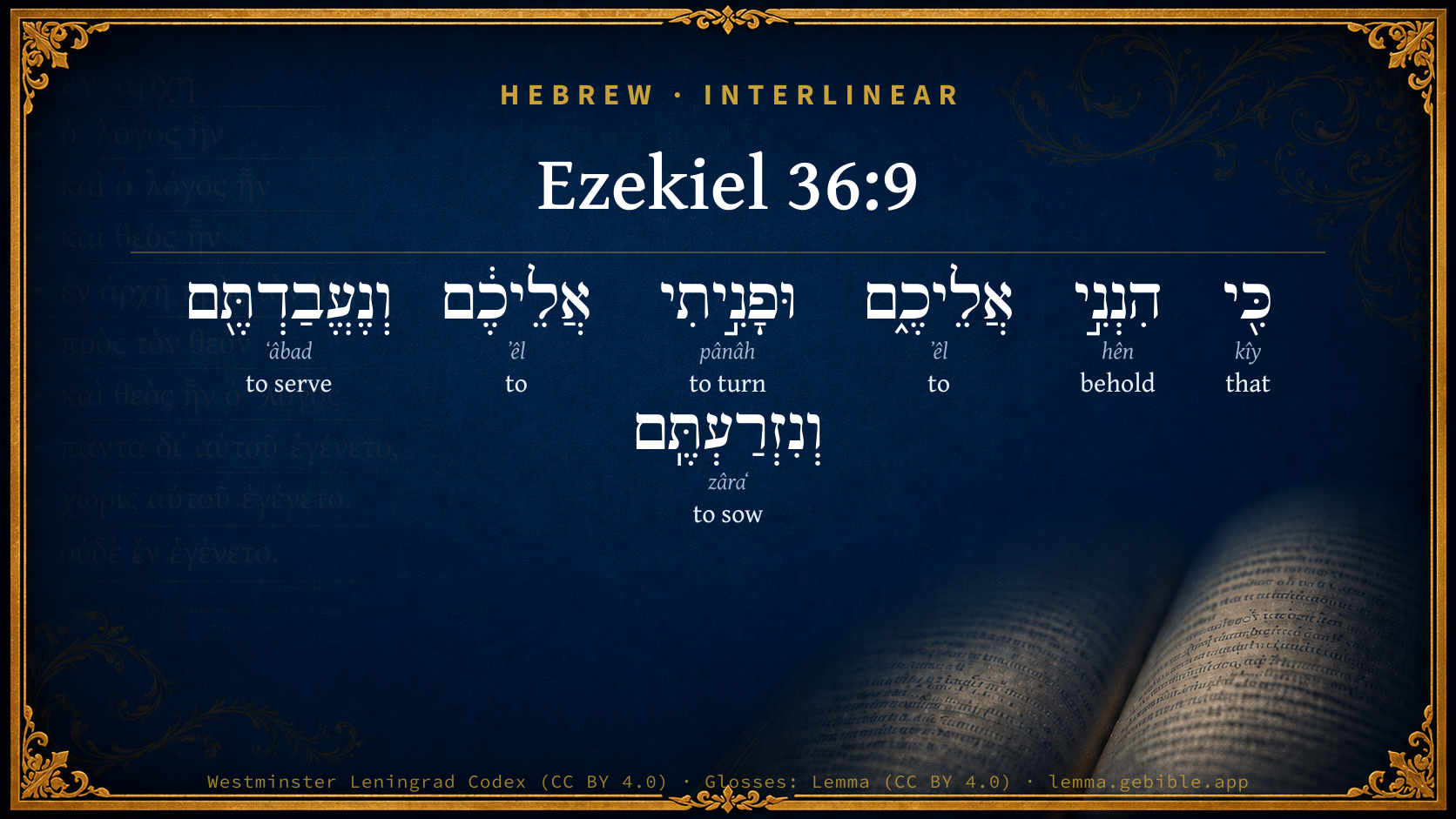
Ezekiel 36:9

Hebrew (Westminster Leningrad Codex) Ezekiel 36:9 appears in the Hebrew Old Testament. The text above is from the Westminster Leningrad Codex. Each word links to its Strong’s number, a concise gloss, and parsing drawn from the Open Scriptures Hebrew Bible morphology. Click any word for its full Brown-Driver-Briggs (BDB) entry.
Download image
Cite this verse

Ezekiel 36:9 (World English Bible). Public Domain. Lemma interlinear Bible study tool, https://lemma.gebible.app/v/ezekiel/36/9.

Show BibTeX & RIS
BibTeX
RIS
English Translation
For, behold, I am for you, and I will turn into you, and you shall be tilled and sown;
World English Bible · Public Domain
Download a study sheet

One document with this verse’s original text, its word-by-word gloss line, the meaning frame, cross-references with their text, attributed commentary, and full source and license credits — printable, and it pastes into notes with its structure intact.

This verse Autodidact and up

Study sheet (.html) Plain text (.txt)

A passage Seminary Student

Up to 50 verses in one chapter. A passage sheet keeps up to 6 commentary sources and 12 cross-references per verse, in the order this page ranks them, and says so on the sheet whenever that leaves anything out. Ask for a single verse and you get the Autodidact verse sheet above.

Everything on this page stays free to read, with no account — the sheet is a download of what is already on screen, not access to it.

Want to remove ads? Support Godless Engineer
Compare translations 3

The same verse in 3 English versions, stacked beneath the original-language interlinear above. Click any original word for its lexicon entry.

Each is an independent rendering of the whole verse — the interlinear is not word-aligned to these translations.

Highlighted words mark where these versions differ — a whole-verse word diff, not a word-by-word alignment.

  • World English Bible Public Domain
    For, behold, I am for you, and I will turn into you, and you shall be tilled and sown;
  • King James Version Public Domain
    For, behold, I am for you, and I will turn unto you, and ye shall be tilled and sown:
  • unfoldingWord Literal Text CC BY-SA 4.0
    For behold, I am for you, and I treat you with favor; you will be plowed and sown with seed.

unfoldingWord Literal Text — © unfoldingWord, licensed CC BY-SA 4.0. Word-aligned USFM3 via Door43 (git.door43.org/unfoldingWord/en_ult).

Versions to compare (up to 4)

3 of 4 selected

Show all 18 translations

Every available English version of this verse, each an independent rendering of the whole verse.

  • World English Bible Public Domain
    For, behold, I am for you, and I will turn into you, and you shall be tilled and sown;
  • Berean Standard Bible Public Domain
    For behold, I am on your side; I will turn toward you, and you will be tilled and sown.
  • Majority Standard Bible Public Domain
    For behold, I am on your side; I will turn toward you, and you will be tilled and sown.
  • King James Version Public Domain
    For, behold, I am for you, and I will turn unto you, and ye shall be tilled and sown:
  • American Standard Version (1901) Public Domain
    For, behold, I am for you, and I will turn into you, and ye shall be tilled and sown;
  • Revised Version (1885) Public Domain
    For, behold, I am for you, and I will turn unto you, and ye shall be tilled and sown:
  • Geneva Bible (1599) Public Domain
    For behold, I come vnto you, and I wil turne vnto you, and ye shalbe tilled and sowen.
  • Douay-Rheims (1899) Public Domain
    For lo I am for you, and I will turn to you, and you shall be ploughed and sown.
  • Young's Literal Translation Public Domain
    For, lo, I `am' for you, and have turned to you, And ye have been tilled and sown.
  • Literal Standard Version CC BY-SA 4.0
    For behold, I [am] for you, and have turned to you, || And you have been tilled and sown.
  • Unlocked Literal Bible CC BY-SA 4.0
    For behold, I am for you, and I treat you with favor; you will be plowed and sown with seed.
  • unfoldingWord Literal Text CC BY-SA 4.0
    For behold, I am for you, and I treat you with favor; you will be plowed and sown with seed.
  • Darby Bible Public Domain
    For behold, I am for you, and I will turn unto you, and ye shall be tilled and sown.
  • World Messianic Bible Public Domain
    For, behold, I am for you, and I will come to you, and you will be tilled and sown.
  • Webster's Bible Public Domain
    For behold, I am for you, and I will turn to you, and ye shall be tilled and sown:
  • Free Bible Version CC BY-SA 4.0
    Look, I am for you and I will help you. Your land will be plowed, and crops will be sown.
  • Bible in Basic English Public Domain
    For truly I am for you, and I will be turned to you, and you will be ploughed and planted:
  • JPS Tanakh (1917) Public Domain
    For, behold, I am for you, and I will turn unto you, and ye shall be tilled and sown;

Literal Standard Version (2020), Covenant Press — licensed CC BY-SA 4.0. Text via the HelloAO Bible API (eBible.org). Unlocked Literal Bible (unfoldingWord) — licensed CC BY-SA 4.0. Text via the HelloAO Bible API (eBible.org). unfoldingWord Literal Text — © unfoldingWord, licensed CC BY-SA 4.0. Word-aligned USFM3 via Door43 (git.door43.org/unfoldingWord/en_ult). Free Bible Version, Dr. Jonathan Gallagher — licensed CC BY-SA 4.0. Text via the HelloAO Bible API (eBible.org).

Word by word

More ways to search: Search by grammar → Find every occurrence → Compare this word →

Practice this passage: Drill this verse → Learn its vocabulary →

וְנִזְרַעְתֶּֽם
zâraʻ
H2232
“and · to sow”
Conjunction + Verb, Niphal, Sequential Perfect, 2nd Person, Masculine, Plural
Part of Speech
Conjunction + Verb
Stem
Niphal
Form
Sequential Perfect
Person
2nd Person
Gender
Masculine
Number
Plural
Full BDB Definition

Origin: a primitive root

TWOT: 582

to sow, scatter seed - (Qal) - to sow - producing, yielding seed - (Niphal) - to be sown - to become pregnant, be made pregnant - (Pual) to be sown - (Hiphil) to produce seed, yield seed
  1. כִּ֖י kîy H3588 “that” Conjunction
  2. הִנְנִ֣י hên H2005 “behold · me” Particle, Demonstrative + Suffix, Personal, 1st Person, Common, Singular
  3. אֲלֵיכֶ֑ם ʼêl H413 “to · you” Preposition + Suffix, Personal, 2nd Person, Masculine, Plural
  4. וּפָנִ֣יתִי pânâh H6437 “and · to turn” Conjunction + Verb, Qal, Sequential Perfect, 1st Person, Common, Singular
  5. אֲלֵיכֶ֔ם ʼêl H413 “to · you” Preposition + Suffix, Personal, 2nd Person, Masculine, Plural
  6. וְנֶעֱבַדְתֶּ֖ם ʻâbad H5647 “and · to serve” Conjunction + Verb, Niphal, Sequential Perfect, 2nd Person, Masculine, Plural

About this verse

These counts appear in no published source. They are computed here, from the morphology-tagged text and Lemma’s own curated glosses. What Lemma adds →

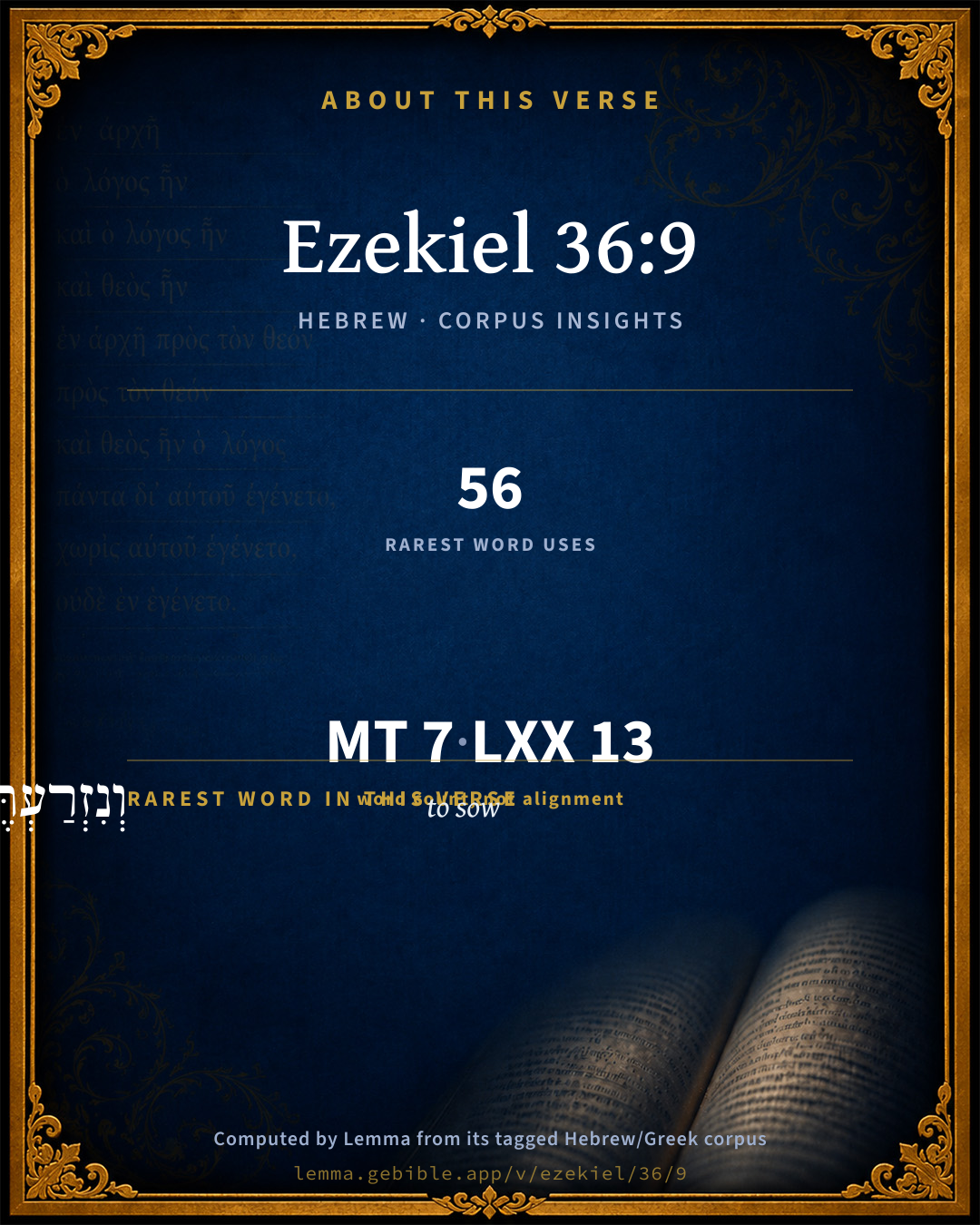
7
words
6
distinct lemmas
Prophets
section

Shared distinctive vocabulary

וְנִזְרַעְתֶּֽם to sow H2232 occurs in 54 verses of the Hebrew Bible. Also found in:

Grammatical profile

  • 3 verbs
  • 2 prepositions
  • 1 conjunction
  • 1 particle

Verb forms

  • וּפָנִ֣יתִי Qal · Sequential Perfect
  • וְנֶעֱבַדְתֶּ֖ם Niphal · Sequential Perfect
  • וְנִזְרַעְתֶּֽם Niphal · Sequential Perfect

Repetition

A word recurs within this verse — often emphatic in Hebrew:

  • אֲלֵיכֶ֑ם to H413 ×2

Hebrew & Septuagint length

In English translation the verse runs 19 words from the Hebrew and 20 from the Septuagint (LXX English) — closely comparable.

A rough comparison of the two English renderings, which tokenize alike — not a word-level alignment.

Word counts can differ between the Hebrew and the Greek without any difference in meaning — e.g. the Hebrew direct-object marker אֵת has no separate Greek word, and Greek often adds the article ὁ.

In the original languages it is 7 Hebrew tokens and 13 Greek tokens — but the two are counted differently (Hebrew bundles its prefixes and suffixes into one token; the Greek is in lemma form), so that isn’t a like-for-like length.

Cross-references

9

Topical passages linked to Ezekiel 36:9 in the Treasury of Scripture Knowledge — connected by theme and wording, ordered by reader-vote popularity; previews shown in the World English Bible.

  • Psalms 46:11 Yahweh of Hosts is with us. The God of Jacob is our refuge. Selah.
  • Ezekiel 36:34 The land that was desolate shall be tilled, whereas it was a desolation in the sight of all who passed by.
  • Hosea 2:21–23 It will happen in that day, I will respond," says Yahweh, I will respond to the heavens, And they will respond to the earth;
  • Zechariah 8:12 "For the seed of peace and the vine will yield its fruit, and the ground will give its increase, and the heavens will give their dew; and I will cause the remnant of this people to inherit all these things.
  • Romans 8:31 What then shall we say about these things? If God is for us, who can be against us?
  • Psalms 99:8 You answered them, Yahweh our God. You are a God who forgave them, Although you took vengeance for their doings.
  • Joel 3:18 It will happen in that day, That the mountains will drop down sweet wine, The hills will flow with milk, All the brooks of Judah will flow with waters; And a fountain will come forth from the house of Yahweh, And will water the valley of Shittim.
  • Haggai 2:19 Is the seed yet in the barn? Yes, the vine, the fig tree, the pomegranate, and the olive tree haven't brought forth. From this day will I bless you.'"
  • Malachi 3:10–11 Bring the whole tithe into the store-house, that there may be food in my house, and test me now in this," says Yahweh of hosts, "if I will not open you the windows of heaven, and pour you out a blessing, that there shall not be room enough for.

Cross-references courtesy of OpenBible.info (CC BY 4.0).

Hebrew and Greek witnesses Masoretic Hebrew ↔ Greek Septuagint

The same verse in the two great witnesses to the Old Testament, shown verse-for-verse.

These are two independent witnesses, not word-aligned to each other, and the Septuagint is shown in lemma (dictionary) form.

Hebrew Ezekiel 36:9 Masoretic · Westminster Leningrad Codex

כִּ֖י הִנְנִ֣י אֲלֵיכֶ֑ם וּפָנִ֣יתִי אֲלֵיכֶ֔ם וְנֶעֱבַדְתֶּ֖ם וְנִזְרַעְתֶּֽם

For, behold, I am for you, and I will turn into you, and you shall be tilled and sown;

World English Bible · Public Domain

Greek LXX Ezekiel 36:9 Septuagint · lemma form

ὅτι ἰδού ἐγώ ἐπί σύ καί ἐπιβλέπω ἐπί σύ καί καταἐργάζομαι καί σπείρω

For, behold, I am toward you, and I will have respect to you, and you⌃ shall be tilled and sown:

LXX2012 (modern English Septuagint) · Public Domain

Hebrew: Westminster Leningrad Codex (CC BY 4.0). Greek: Septuagint (public domain); English from LXX2012 (modern English Septuagint) (Public Domain). How the Septuagint differs from the Hebrew →

Targum (Aramaic paraphrase)

1

The Targum is the ancient Jewish Aramaic paraphrase of the Hebrew Scriptures — an interpretive translation, not the Hebrew text itself. Onkelos (literal) and Pseudo-Jonathan (expansive) render the Torah, and Jonathan the Prophets. Coverage is partial: where no permissively-licensed English translation exists for a verse, only the Aramaic is shown. This is verse-level text, not a word-by-word alignment to the Hebrew.

  1. Targum Jonathan Prophets (Joshua–Malachi)
    אֲרֵי הָא אֲנָא מִתְגְלֵי עֲלֵיכוֹן וְאִתְפְּנִי בְמֵימְרִי לְאֵיטָבָא לְכוֹן וְתִתְפַּלְחוּן וְתִזְדָרְעוּן:

    (no public-domain English translation for this verse)

    Targum Jonathan — Aramaic: “Mikraot Gedolot” (public domain). English: “Sefaria Community Translation” (CC0 1.0 (public-domain dedication)); “London "Chaldee Paraphrase," 1871” (public domain). Text via Sefaria.

Commentary

Notes on Ezekiel 36:9 from classic Christian and Jewish commentators (each source and its license shown beneath its notes). The classic Christian expositions comment on the surrounding passage and are grouped to its opening verse, so a note may address several verses; the Jewish commentaries on the Tanakh (Rashi and others) are per-verse, so they appear only where the commentator wrote on this verse.

Lemma curates 59 commentaries, every one of them public domain or Creative Commons licensed, each selected and text-cleaned for this edition rather than reprinted as found. About our sources →

Trapp's Complete Commentary

John Trapp

Eze 36:9 For, behold, I [am] for you, and I will turn unto you, and ye shall be tilled and sown:

Ver. 9. For, behold, I am for you.] Or, I come to you, and I come with a cornucopia in mine hand.

John Trapp, A Commentary or Exposition upon All the Books of the Old and New Testament (1647–1656) — public domain. Text from a community e-Sword module.

The Biblical Illustrator

Joseph S. Exell

Eze_36:9

And ye shall be tilled and sown.

A vision of the field

I. Mans heart by nature is like a waste field.

1. He brings forth no fruit unto God. Leave him alone and he will live unto himself. He will live and he will die a strange monstrosity in the world--a creature that has lived without his Creator. Methinks I see the great God coming to look at the man, even as a farmer might come to look upon his fallow field. He looks the whole field through. There is no thought for God, no consecration of time to God, no desire to honour God, no longing to produce in the world fresh glory to God, no effort to raise up to Him fresh voices that shall praise His name. He lives unto himself or to his fellow men, and having so lived, he so dies.

2. Worse than this; the field that has never been ploughed or sown does produce something. There is an activity about human nature that will not let us live without doing. No man liveth to himself. Is there no wheat growing on that soil? no barley? no rye? Very well, then, there will be darnel, and cockle, and twitch, and all sorts of weed. So it is with the unrenewed heart. It is prolific of evil imaginations, wrong desires, and bitter envyings. As these ripen they bring forth ill words--idle, or, it may be, lascivious words, and perhaps atheistic, blasphemous words; and as these ripen they come to actions, had the man becomes an offender in his deeds, perhaps against man, certainly against God. The apples of Gomorrah hang plentifully upon him.

II. There is no hope for this field, unless God turn to it in mercy. I am for you, and I will turn unto you. Man never does of himself turn unto God, and that for obvious reasons. We are sure he never can, for he is dead in trespasses and sins. We are certain he never will, for by nature he hates anything like a new birth; and if he could make himself a new creature he would not, for Christ has expressly said, Ye will not come unto Me that ye might have life. If you have turned, you know that the Lord has done it. Give unto Him the glory. If you have not been converted, God help you to cry unto Him instantly and earnestly, Turn us, and we shall be turned. Look unto Him who is exalted on high to give repentance and remission of sins. Seek ye unto Him, and ye shall live.

III. When the field is to be put under cultivation it must be tilled. So when God turns to any man in His mercy there has to be an operation, a tillage, performed upon his heart. Common calling is addressed to every man, but effectual calling comes only to prepared men, to those whom God makes willing in the day of His power. Now, what is the plough wanted for? Why, it is wanted, first of all, to break up the soil and make it crumble. The more thoroughly pulverised the heart becomes, the better. The seed will never get into an unbroken heart. The plough is also wanted to destroy the weeds, for they must be killed. If the Lord save you, He must kill your drunkenness, He must kill your swearing, He must kill your whoredom, He must kill your lying, He must kill your dishonesty. These must all go; every single weed must be torn up; there is no hope for you while there is a weed living. The Lord make a clean sweep of the weeds, and burn them all! Well, now, mark you, in this tilling there are different soils. There is the light soil and the heavy soil; and so there are different sorts of constitutions. There are some men who are naturally tender and sensitive. Many, too, of our sisters are like Lydia: they soon receive the Word. There are others that are like the heavy clay soil; and you know the farmer does not plough both soils alike, or else he would make a sad mess of it. And so God does not deal with all men alike. Some have, as it were, first a little ploughing, and then the seed is put in, and all is done; but some have to be ploughed and cross ploughed; and then there is the scarifier and the clod crusher, and I know not what, which have to be rolled over them before they are good for anything; and perhaps, after all, they produce very little fruit. And, you know, the farmer has his time for ploughing. Some soils break up best after a shower of rain, and some do best when they are driest. So there are some hearts--ay, and I think almost all hearts--that are best ploughed after a shower of heavenly love has fallen upon them. They are in a grateful frame of mind for mercies received, and then the story of a dying Saviour comes to them as just that which will touch the springs of their hearts.

IV. Unless God has tilled the heart, it cannot be sown with any hope of success. After ploughing there comes the sowing. When the heart is ready God sows it--sows it with the best of wheat. The wise farmer does not sow tail corn, but, as Isaiah says, he casts in the principal wheat. The seed which God sows is living seed. It shall grow, for God has prepared the soil for it. (C. H. Spurgeon.)

The Biblical Illustrator, edited by Joseph S. Exell (c. 1880s–1900s) — public domain. Text from a community e-Sword module.

Adam Clarke's Commentary

Verse 9. Ye shall be tilled and sown] The land shall be cultivated as it formerly was, when best peopled and at peace.

Adam Clarke's Commentary on the Bible (1810–1826) — public domain. Text from a community e-Sword/MySword module.

John Gill's Exposition

For, behold, I am for you,.... For the mountains, that they might be cultivated and become fruitful, and be of advantage to their proprietors, and appear beautiful and lovely to behold, as well as to be useful:

and I will turn unto you; the Lord had turned from them, and left them a prey to the enemy, whereby they were become desolate; but now he would turn unto them, and bless them, and make them fruitful, and return the right owners of them to them, who should greatly improve them:

and ye shall be tilled and sown; manured and cultivated, and sown with wheat and barley, as in former times.

John Gill's Exposition of the Whole Bible (1746–1763) — public domain (CC PDM 1.0). Text via the HelloAO Bible API.

Matthew Poole's English Annotations

I am for you; favour you, and am pacified towards you, or I come towards you with redemption, that your old inhabitants may return to you with singing.

Turn unto you; look towards you, with regard to what hath been and is your estate, your sufferings, which were less than you deserved, yet were the greater because ye are mine. Your inhabitants gave me the back and sinned against me, and I turned the back on you and regarded you not; then all darkness covered you. now my face shall be towards you, and you shall prosper and be fruitful, to the comfort of those that shall dwell in you and plough and sow you.

Matthew Poole's English Annotations on the Holy Bible (1683–1685) — public domain. Text from a community e-Sword/MySword module.

The Pulpit Commentary

I am for you. He had previously been against, (Eze_5:8 Eze_13:8) but was now for Israel and against Seir. (Eze_35:3) This change of dispensation implied no mutation in God, but merely that, as God had previously visited Israel with judgment on account of sin, so henceforth would he visit her with grace on condition of repentance. I will turn unto you. Always it is presupposed that Israel turns unto Jehovah.

The Pulpit Commentary (1880–1919), ed. H.D.M. Spence-Jones & Joseph S. Exell — public domain. Text from a community e-Sword module.

Lesson kit

Teaching starters — assembled from the data on this page, not authored interpretation. Every prompt links to the verse data it draws on. Edit before teaching.

Ezekiel, in the Prophets, opens this verse with 7 words (6 distinct Hebrew lemmas). Its most distinctive word is zâraʻ (“to sow”). A historical commentator’s framing appears above. Read the whole chapter for the surrounding context.

Discussion questions

  1. What does “to sow” (zâraʻ) contribute to the verse as a whole?
  2. How does Genesis 1:11, which shares the word «to sow», read alongside this verse?
  3. What does the repetition of “to” (2× in this one verse) do in this verse?
  4. These translations render this verse differently. What is at stake in choosing one wording over another?
  5. «וּפָנִ֣יתִי» is a Qal Sequential Perfect verb. How does that grammatical form shape the action described?
  6. Compare how Trapp's Complete Commentary and The Biblical Illustrator read this verse. Where do they agree or differ?

Things to notice

Reading settings

Reading text

Shown beneath each verse's original-language words.

Old Testament
Old Testament edition

Read the OT as the Masoretic Hebrew (MT) or the Greek Septuagint (LXX).

English shown for the Greek Septuagint (in the Hebrew ↔ Greek comparison).

Comparing translations? Open the Compare panel on any verse page to stack up to four side by side.