
Proverbs 17:8

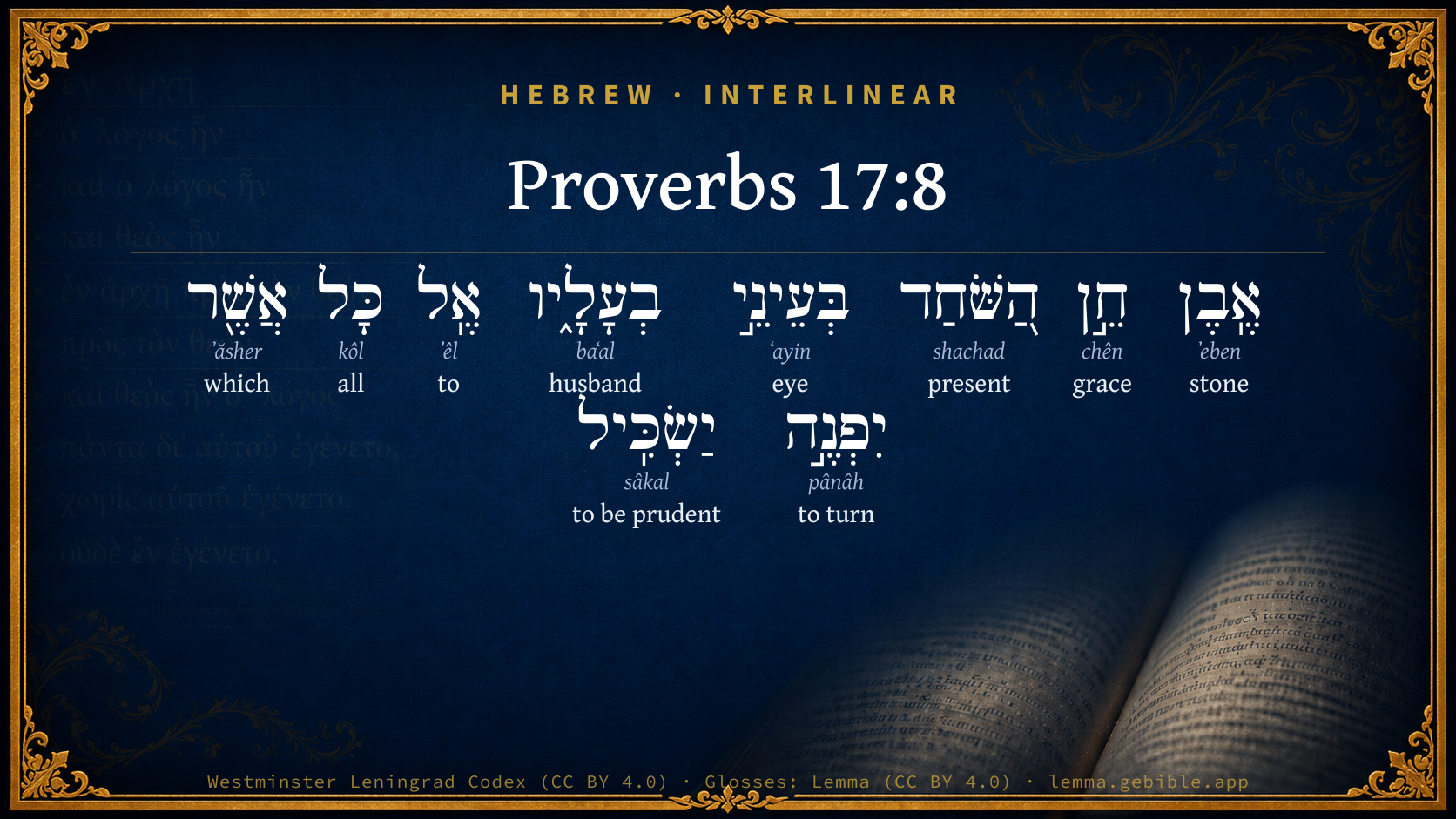
Hebrew (Westminster Leningrad Codex) Proverbs 17:8 appears in the Hebrew Old Testament. The text above is from the Westminster Leningrad Codex. Each word links to its Strong’s number, a concise gloss, and parsing drawn from the Open Scriptures Hebrew Bible morphology. Click any word for its full Brown-Driver-Briggs (BDB) entry.
Download image
Cite this verse

Proverbs 17:8 (World English Bible). Public Domain. Lemma interlinear Bible study tool, https://lemma.gebible.app/v/proverbs/17/8.

Show BibTeX & RIS
BibTeX
RIS
English Translation
A bribe is a precious stone in the eyes of him who gives it; Wherever he turns, he prospers.
World English Bible · Public Domain
Download a study sheet

One document with this verse’s original text, its word-by-word gloss line, the meaning frame, cross-references with their text, attributed commentary, and full source and license credits — printable, and it pastes into notes with its structure intact.

This verse Autodidact and up

Study sheet (.html) Plain text (.txt)

A passage Seminary Student

Up to 50 verses in one chapter. A passage sheet keeps up to 6 commentary sources and 12 cross-references per verse, in the order this page ranks them, and says so on the sheet whenever that leaves anything out. Ask for a single verse and you get the Autodidact verse sheet above.

Everything on this page stays free to read, with no account — the sheet is a download of what is already on screen, not access to it.

Want to remove ads? Support Godless Engineer
Compare translations 3

The same verse in 3 English versions, stacked beneath the original-language interlinear above. Click any original word for its lexicon entry.

Each is an independent rendering of the whole verse — the interlinear is not word-aligned to these translations.

Highlighted words mark where these versions differ — a whole-verse word diff, not a word-by-word alignment.

  • World English Bible Public Domain
    A bribe is a precious stone in the eyes of him who gives it; Wherever he turns, he prospers.
  • King James Version Public Domain
    A gift is as a precious stone in the eyes of him that hath it: whithersoever it turneth, it prospereth.
  • unfoldingWord Literal Text CC BY-SA 4.0
    A stone of favor a bribe in the eyes of its owner; he succeeds to all that he turns.

unfoldingWord Literal Text — © unfoldingWord, licensed CC BY-SA 4.0. Word-aligned USFM3 via Door43 (git.door43.org/unfoldingWord/en_ult).

Versions to compare (up to 4)

3 of 4 selected

Show all 18 translations

Every available English version of this verse, each an independent rendering of the whole verse.

  • World English Bible Public Domain
    A bribe is a precious stone in the eyes of him who gives it; Wherever he turns, he prospers.
  • Berean Standard Bible Public Domain
    A bribe is a charm to its giver; wherever he turns, he succeeds.
  • Majority Standard Bible Public Domain
    A bribe is a charm to its giver; wherever he turns, he succeeds.
  • King James Version Public Domain
    A gift is as a precious stone in the eyes of him that hath it: whithersoever it turneth, it prospereth.
  • American Standard Version (1901) Public Domain
    A bribe is `as' a precious stone in the eyes of him that hath it; Whithersoever it turneth, it prospereth.
  • Revised Version (1885) Public Domain
    A gift is as a precious stone in the eyes of him that hath it: whithersoever it turneth, it prospereth.
  • Geneva Bible (1599) Public Domain
    A rewarde is as a stone pleasant in the eyes of them that haue it: it prospereth, whithersoeuer it turneth.
  • Douay-Rheims (1899) Public Domain
    The expectation of him that expecteth, is a most acceptable jewel: whithersoever he turneth himself, he understandeth wisely.
  • Young's Literal Translation Public Domain
    A stone of grace `is' the bribe in the eyes of its possessors, Whithersoever it turneth, it prospereth.
  • Literal Standard Version CC BY-SA 4.0
    A stone of grace [is] the bribe in the eyes of its possessors, || Wherever it turns, it prospers.
  • Unlocked Literal Bible CC BY-SA 4.0
    A bribe is like a magic stone to the one who gives it; wherever he turns, he succeeds.
  • unfoldingWord Literal Text CC BY-SA 4.0
    A stone of favor a bribe in the eyes of its owner; he succeeds to all that he turns.
  • Darby Bible Public Domain
    A gift is a precious stone in the eyes of the possessor: whithersoever it turneth it prospereth.
  • World Messianic Bible Public Domain
    A bribe is a precious stone in the eyes of him who gives it; wherever he turns, he prospers.
  • Webster's Bible Public Domain
    A gift is as a precious stone in the eyes of him that hath it: whithersoever it turneth, it prospereth.
  • Free Bible Version CC BY-SA 4.0
    Whoever gives a bribe thinks it's a magical stone—that wherever they turn they'll have success!
  • Bible in Basic English Public Domain
    An offering of money is like a stone of great price in the eyes of him who has it: wherever he goes, he does well.
  • JPS Tanakh (1917) Public Domain
    A gift is as a precious stone in the eyes of him that hath it; whithersoever he turneth, he prospereth.

Literal Standard Version (2020), Covenant Press — licensed CC BY-SA 4.0. Text via the HelloAO Bible API (eBible.org). Unlocked Literal Bible (unfoldingWord) — licensed CC BY-SA 4.0. Text via the HelloAO Bible API (eBible.org). unfoldingWord Literal Text — © unfoldingWord, licensed CC BY-SA 4.0. Word-aligned USFM3 via Door43 (git.door43.org/unfoldingWord/en_ult). Free Bible Version, Dr. Jonathan Gallagher — licensed CC BY-SA 4.0. Text via the HelloAO Bible API (eBible.org).

Word by word

More ways to search: Search by grammar → Find every occurrence → Compare this word →

Practice this passage: Drill this verse → Learn its vocabulary →

About this verse

These counts appear in no published source. They are computed here, from the morphology-tagged text and Lemma’s own curated glosses. What Lemma adds →

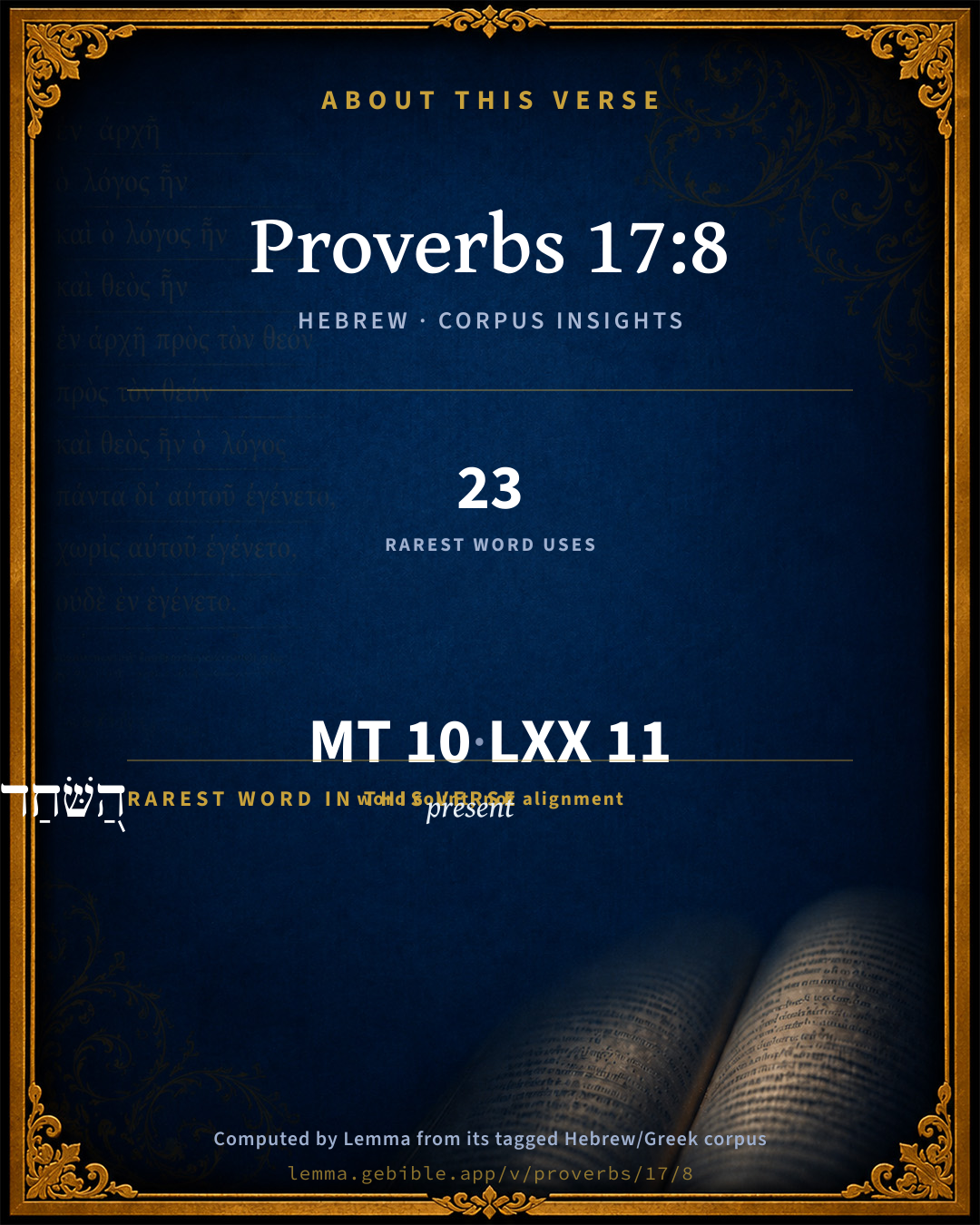
10
words
10
distinct lemmas
Wisdom
section

Notable vocabulary

The rarest word here is הַ֭שֹּׁחַד present H7810 — appearing just 23 times in the whole Hebrew Bible.

Shared distinctive vocabulary

הַ֭שֹּׁחַד present H7810 occurs in 21 verses of the Hebrew Bible. Also found in:

Grammatical profile

  • 2 verbs
  • 6 nouns
  • 1 preposition
  • 1 particle

Verb forms

  • יִפְנֶ֣ה Qal · Imperfect
  • יַשְׂכִּֽיל Hiphil · Imperfect

Hebrew & Septuagint length

In English translation the verse runs 19 words from the Hebrew and 18 from the Septuagint (LXX English) — closely comparable.

A rough comparison of the two English renderings, which tokenize alike — not a word-level alignment.

Word counts can differ between the Hebrew and the Greek without any difference in meaning — e.g. the Hebrew direct-object marker אֵת has no separate Greek word, and Greek often adds the article ὁ.

In the original languages it is 10 Hebrew tokens and 11 Greek tokens — but the two are counted differently (Hebrew bundles its prefixes and suffixes into one token; the Greek is in lemma form), so that isn’t a like-for-like length.

Cross-references

15

Topical passages linked to Proverbs 17:8 in the Treasury of Scripture Knowledge — connected by theme and wording, ordered by reader-vote popularity; previews shown in the World English Bible.

  • Exodus 23:8 You shall take no bribe, for a bribe blinds those who have sight and perverts the words of the righteous.
  • Micah 7:3 Their hands are on that which is evil to do it diligently. The ruler and judge ask for a bribe; And the powerful man dictates the evil desire of his soul. Thus they conspire together.
  • Deuteronomy 16:19 You shall not wrest justice: you shall not respect persons; neither shall you take a bribe; for a bribe does blind the eyes of the wise, and pervert the words of the righteous.
  • 1 Samuel 25:35 So David received of her hand that which she had brought him: and he said to her, Go up in peace to your house; behold, I have listened to your voice, and have accepted your person.
  • Proverbs 17:23 A wicked man receives a bribe in secret, To pervert the ways of justice.
  • Proverbs 21:14 A gift in secret pacifies anger; And a bribe in the cloak, strong wrath.
  • Isaiah 1:23 Your princes are rebellious, and companions of thieves. Everyone loves bribes, and follows after rewards. They don't judge the fatherless, Neither does the cause of the widow come to them.
  • Amos 5:12 For I know how many your offenses, And how great are your sins-- You who afflict the just, Who take a bribe, And who turn aside the needy in the courts.
  • Genesis 33:9–11 Esau said, "I have enough, my brother; let that which you have be yours."
  • Genesis 43:11 Their father, Israel, said to them, "If it be so now, do this. Take from the choice fruits of the land in your bags, and carry down a present for the man, a little balm, a little honey, spices and myrrh, nuts, and almonds;
  • 2 Samuel 16:1–4 When David was a little past the top [of the ascent], behold, Ziba the servant of Mephibosheth met him, with a couple of donkeys saddled, and on them two hundred loaves of bread, and one hundred clusters of raisins, and one hundred summer fruits, and a bottle of wine.
  • Psalms 18:16 He sent from on high. He took me. He drew me out of many waters.
  • Psalms 19:6 His going forth is from the end of the heavens, His circuit to its ends; There is nothing hidden from its heat.
  • Psalms 21:13 Be exalted, Yahweh, in your strength, So we will sing and praise your power.
  • Psalms 29:4 Yahweh's voice is powerful. Yahweh's voice is full of majesty.

Cross-references courtesy of OpenBible.info (CC BY 4.0).

Hebrew and Greek witnesses Masoretic Hebrew ↔ Greek Septuagint

The same verse in the two great witnesses to the Old Testament, shown verse-for-verse.

These are two independent witnesses, not word-aligned to each other, and the Septuagint is shown in lemma (dictionary) form.

Hebrew Proverbs 17:8 Masoretic · Westminster Leningrad Codex

אֶֽבֶן חֵ֣ן הַ֭שֹּׁחַד בְּעֵינֵ֣י בְעָלָ֑יו אֶֽל כָּל אֲשֶׁ֖ר יִפְנֶ֣ה יַשְׂכִּֽיל

A bribe is a precious stone in the eyes of him who gives it; Wherever he turns, he prospers.

World English Bible · Public Domain

Greek LXX Proverbs 17:8 Septuagint · lemma form

μισθός χάρις ὁ παιδεία ὁ χράομαι ὅς δέ ἄν ἐπιστρέφω εὐοδόω

Instruction is to them that use it a gracious reward; and wherever it may turn, it shall prosper.

LXX2012 (modern English Septuagint) · Public Domain

On this verse, Haydock's Catholic Bible Commentary discusses the Septuagint’s reading. Read the note in Commentary ↓

Hebrew: Westminster Leningrad Codex (CC BY 4.0). Greek: Septuagint (public domain); English from LXX2012 (modern English Septuagint) (Public Domain). How the Septuagint differs from the Hebrew →

Commentary

Notes on Proverbs 17:8 from classic Christian and Jewish commentators (each source and its license shown beneath its notes). The classic Christian expositions comment on the surrounding passage and are grouped to its opening verse, so a note may address several verses; the Jewish commentaries on the Tanakh (Rashi and others) are per-verse, so they appear only where the commentator wrote on this verse.

Lemma curates 59 commentaries, every one of them public domain or Creative Commons licensed, each selected and text-cleaned for this edition rather than reprinted as found. About our sources →

Trapp's Complete Commentary

John Trapp

Pro 17:8 A gift [is as] a precious stone in the eyes of him that hath it: whithersoever it turneth, it prospereth.

Ver. 8. A gift is as a precious stone, &c.] Heb., As a stone of grace. Like that precious stone tantarbe, spoken of in Philostratus, {a} that hath a marvellous conciliating property; or the wonderworking lodestone, that among other strange effects reckoned up by Marbodeus and Pictorius, doth possessores suos disertos et principibus gratos reddere, make those that have it well-spoken men, and well accepted by princes.

Whithersoever it turneth, it prospereth.] Most men are δωροφαγοι, and "love with shame, Give ye." Yet some Persian-like spirits there are - as hath been made good before by the examples of Luther, Galeabrius, and some others - that regard not silver; and as for gold, in such a way, they have no delight in it. {Isa 13:17} But these are black swans indeed. The most sing, Quis nisi mentis inops oblatum respuat aurum? Who but a fool would refuse offered gold?

{a} In Vita Apollon, lib. iii. cap. 14.

John Trapp, A Commentary or Exposition upon All the Books of the Old and New Testament (1647–1656) — public domain. Text from a community e-Sword module.

Joseph Benson's Commentary

Pro 17:8. A gift is as a precious stone, &c. — “A gift is so tempting that it can no more be refused than a lovely jewel can, by him to whom it is presented; and such is its power, that it commonly prevails over all men, despatches all business, carries all causes; and, in a word, effects whatsoever a man desires.” — Bishop Patrick.

Joseph Benson's Commentary on the Old and New Testaments (1811–1818) — public domain. Text from a community e-Sword module.

The Preacher's Complete Homiletical Commentary

Joseph S. Exell (gen. ed.)

CRITICAL NOTES.—

Pro_17:8. A gift. Some expositors understand this in the sense of a bribe. Delitzsch translates the whole verse—“The gift of bribery appears a jewel to its receiver, whithersoever he turneth himself he acteth prudently,” i.e., “it determines and impels him to apply all his understanding, in order that he may reach the goal for which it shall be his reward.” Zöckler understands it to refer to the gift of seasonable liberality which secures for its giver supporters and friends.

MAIN HOMILETICS OF Pro_17:8

THE POWER OF GIFTS

I. All men value gifts. Whether they be gifts which are of intrinsic value from their beauty or their rarity or whether they are of little worth in themselves, but are the expressions of the love and gratitude of those who offer them, there is a certain pleasure in receiving them. A free-will offering is more acceptable to a right-minded man than that which is bestowed upon him as a matter of necessity. The fact that it is a gift invests it with a value beyond that which would otherwise be attached to it—makes it as a “precious stone” to the receiver. The good-will that prompts the gift turns a pebble into a diamond.

II. All the blessing of a gift does not rest with the receiver.—As a precious stone reflects rays of light in whichever way it is held, so generous-hearted liberality blesses him who gives as well as him who takes. The giver has the gratitude and love of the recipient and experiences the truth of the words of the Lord Jesus: “It is more blessed to give than to receive” (Act_20:35). (For the opposite meanings which different commentators attach to the word gift, see Critical Notes.)

OUTLINES AND SUGGESTIVE COMMENTS

1. Those that have money in their hand think they can do anything with it. Rich men, whithersoever they turn this sparkling diamond, expect it should dazzle the eyes of all, and make them do just what they would have them do in hopes of it.

2. Those who have money in their eye will do anything for it. It has great influence upon them, and they will be sure to go the way it leads them.—Henry.

Viewed as referring to the person who confers the gift, or has it to bestow,—we may notice first, that the reference may be to the man who is known to have something to bestow which all covet. In this case, every one desires his favour, strives to oblige him, tries every means of insinuation into his good graces. A man who has any skill in manœuvering may, in this way, render what he has to confer a capital instrument for pushing forward his own prosperity; Keeping all in expectation,—cherishing hope,—making his desired and coveted gift look first one way, then another, then a third; perhaps partially bestowing, and still reserving enough to hold expectants hanging on, so as to have them available for his own ends. Secondly:—On the part of those who have gifts to bestow, uses may be made of them that are honourable and prudent,—quite consistent, not with mere self-interest, but with right principle. They may be employed to avert threatened evil, and for the more sure attainment of desired good. Such was Jacob’s gift to his brother Esau; when, in setting it apart, he said, “I will appease him with the present that goeth before me, and afterward will I see his face.” Such was the gift of the same patriarch, at a later period, to “the man the lord of the country,” when he sent his sons the second time to Joseph in Egypt.—Wardlaw.

The Preacher's Complete Homiletical Commentary (gen. ed. Joseph S. Exell; Funk & Wagnalls, c. 1892) — public domain (pre-1929). A full-Bible homiletical/sermon-outline anthology covering 65 of 66 books (2 John is absent from the source module). Text from a community e-Sword module.

Geneva Bible (1599)

Geneva Bible translators

The reward hath great force to gain the hearts of men.

Geneva Bible (1599) marginal notes — public domain. Text via Bolls.life.

Matthew Henry's Commentary

The design of this observation is to show, 1. That those who have money in their hand think they can do any thing with it. Rich men value a little money as if it were a precious stone, and value themselves on it as if it gave them not only ornament, but power, and every one were bound to be at their beck, even justice itself. Whithersoever they turn this sparkling diamond they expect it should dazzle the eyes of all, and make them do just what they would have them do in hopes of it. The deepest bag will carry the cause. Fee high, and you may have what you will. 2. That those who have money in their eye, and set their hearts upon it, will do any thing for it: A bribe is as a precious stone in the eyes of him that takes it; it has a great influence upon him, and he will be sure to go the way that it leads him, hither and thither, though contrary to justice and not consistent with himself.

Matthew Henry's Commentary on the Whole Bible (1708–1710) — public domain (CC PDM 1.0). Text via the HelloAO Bible API.

Jamieson, Fausset & Brown

Robert Jamieson, A. R. Fausset & David Brown

One so corrupt as to take a bribe evinces his high estimate of it by subjection to its influence (Pro 18:16; Pro 19:6).

Jamieson, Fausset & Brown — Commentary Critical and Explanatory on the Whole Bible (1871) — public domain (CC PDM 1.0). Text via the HelloAO Bible API.

Adam Clarke's Commentary

Verse 8. A gift is as a precious stone] It both enriches and ornaments. In the latter clause there is an evident allusion to cut stones. Whithersoever you turn them, they reflect the light, are brilliant and beautiful.

Adam Clarke's Commentary on the Bible (1810–1826) — public domain. Text from a community e-Sword/MySword module.

Ellicott's Commentary for English Readers

(8) A gift is as a precious stone . . .—A description of the influence of bribery:—A bribe is as a jewel in the eyes of him that receives it; whithersoever he turns he prospers: all his energies are called out by the prospect of gain, so that he carries out successfully all that he sets his hand to. The constant warnings against this form of corruption, from the time of Moses (Exo_23:8) to that of the prophets (Amo_5:12; Isa_1:23, &c), show the prevalence of the evil in Israel.

A Bible Commentary for English Readers, edited by Charles John Ellicott (1878–1897) — public domain. Text from a community e-Sword module.

The Cambridge Bible for Schools and Colleges

gen. ed. J. J. S. Perowne

8. him that hath it] Lit. its lord or possessor. This may mean either the giver, or the receiver of it. The former sense seems preferable. He who has a gift to bestow counts himself the possessor of that with which he can secure success in any direction he pleases, as though he turned in this direction or in that a precious gem or talisman to attract and conciliate the beholder. Maurer quotes the familiar lines of Ovid (de art. am. 3. 653),

“Munera, crede mihi, capiunt hominesque deosque;

Placatur donis Jupiter ipse datis.”

Comp. Pro_18:16.

The Cambridge Bible for Schools and Colleges (gen. ed. J. J. S. Perowne; Cambridge University Press, 1878–1918) — public domain. Text from a community e-Sword module.

John Gill's Exposition

A gift is as a precious stone in the eyes of him that hath it,.... Or "is a stone of grace" (h), the note of similitude being wanting. It is an ornament of grace, adorns the person that wears it, makes him look lovely and amiable; is very grateful and desirable in itself, attracts and dazzles the eyes, and fills the mind with pleasure; so is a gift in the eyes of him that has it, that is the owner of it; either that has it in his possession to give, is the giver of it, as Aben Ezra; which, as it is valuable in his own eyes, he judges it to be so with others, and thinks he can do what be pleases with it, and engage persons by it to do as he would have them: or that is the receiver of it, as the Targum; who, having it given him, is master of it, and is so acceptable to him, and has such an influence upon him, as to do anything for it the giver of it directs him to, as follows:

whithersoever it turneth it prospereth: to whatsoever cause, or to whatsoever persons, judge or jury, it is given and received; it succeeds far better than the most eloquent orations, or learned pleadings in law, or appeals to statutes, and the production of them. Money answers all things; a gift blinds the eyes; it is like a diamond, so sparkling and dazzling, so charming and attracting, that the person to whom it is offered cannot resist it; and it draws him to do whatever is desired of him; it carries the cause, it succeeds according to the wish of the giver: or, as the Arabic version renders it,

"he shall find his business plain;''

done as he would have it. Jarchi applies the proverb thus;

"when a man comes before the Lord, and bribes him with words, and returns unto him, it is a precious stone in his eyes; and in all that he asks of him he prospers.''

(h) "lapsis gratiae", Montanus, Baynus, Michaelis.

John Gill's Exposition of the Whole Bible (1746–1763) — public domain (CC PDM 1.0). Text via the HelloAO Bible API.

Albert Barnes' Notes on the Bible

A half-satirical description of the power of bribery in palaces and among judges. The precious stone (literally as in the margin) is probably a gem, thought of as a talisman, which, “wherever it turns,” will ensure “prosperity” to him who, being the possessor, has the power to give it.

Albert Barnes' Notes on the Bible (1834–1885) — public domain. Text from a community e-Sword/MySword module.

Haydock's Catholic Bible Commentary

Expecteth heavenly things. Septuagint, "instruction is the reward of good deeds to those who use it."

George Leo Haydock (1774–1849), Haydock's Catholic Family Bible and Commentary, 1859 edition — public domain. Excludes Psalms (Douay-Rheims chapter numbering differs from Protestant) and Deuterocanonical books (Catholic canon only).

Matthew Poole's English Annotations

As a precious stone; pleasant and acceptable, and withal dazzleth his eyes.

Of him that hath it, Heb. of the lord or owner of it; either,

1. Of the giver; or rather,

2. Of the receiver of it, who by the giver is made lord of it; for to his eyes it was exposed, that he might discern the beauty and worth of it, and thereby be allured to do what was desired, which accordingly he did, as it here follows.

Whithersoever it turneth; to whomsoever it is presented. But this, as also many other proverbs, are to be understood of the common course or effect with most men, but not universally of all men.

Matthew Poole's English Annotations on the Holy Bible (1683–1685) — public domain. Text from a community e-Sword/MySword module.

Whedon's Commentary on the Bible

Daniel D. Whedon

8. A gift — This is supposed to mean that kind of gift which is given to a judge or rider to secure favour, or escape punishment — a bribe. Zockler thinks it is not a bribe, but a lawful present, as Pro_18:16. Precious stone — Hebrews, a stone of grace (Pro_1:9) or beauty; a precious stone.

Him that hath it — Literally, its possessor, the person to whom it is given.

Whithersoever it turneth it prospereth — Or, it looks well, appears beautiful; that is, in the eyes of him that sees it. The verb, as is common, has a variety of significations, and possibly more than one of them may be intended here. One of them is, to succeed in the design for which it was given. This it does by appearing desirable in the eyes of its receiver. Some suggest this thought: A diamond reflects a great deal of light when viewed on this side and on that. Turn it as you will, it never fails to reflect lustre. So a bribe, or even a lawful present, will influence in many ways, perhaps without a consciousness of its power on the part of the receiver. Turn which way he will, its influence will follow him. Conant renders the last clause, “To whomsoever it turns.” Comp. Pro_18:16.

Daniel D. Whedon (gen. ed.), Commentary on the Old and New Testaments (1874–1909) — public domain. Text from a community e-Sword module.

The Pulpit Commentary

There is a breath of satire in this verse. A gift is as a precious stone in the eyes of him that hath it. "A precious stone" is literally "a stone of grace". (Pro_1:9) The gnome expresses the idea that a bribe is like a bright jewel that dazzles the sight and affects the mind of him who receives it. (see on Pro_15:27; comp. Deu_16:19 1Sa_12:3) Ovid, "Art. Amat.," 3:653"Munera, crede mihi, capiunt hominesque deosque; Placatur donis Jupiter ipse datis.

It is possible that the gnome may have a more general application, and apply to gifts given to appease anger or to prove friendship. (Pro_19:6 Pro_21:14) Septuagint, "A reward of graces is discipline to those who use it;" i.e. moral discipline brings an ample reward of graces to those who practise it. Whithersoever it turneth, it prospereth. The Authorized Version refers these words to the gift. Delitzsch points out that the words are more properly taken of the person who receives the gift, so that they should be rendered, "Wheresoever he turneth himself he dealeth wisely." Inflamed by sordid hopes and the love of gain, he acts with all possible skill and prudence in order to work out his wages and show that he was rightly selected to receive the present. The verse merely states a common trait among unscrupulous men, and pronounces no judgment upon it.

The Pulpit Commentary (1880–1919), ed. H.D.M. Spence-Jones & Joseph S. Exell — public domain. Text from a community e-Sword module.

John Wesley's Explanatory Notes

A precious stone - Pleasant and acceptable; and withal dazzles his eyes. Whithersoever - To whomsoever it is presented. But this, as also many of her Proverbs, are to be understood of most men, not of all.

John Wesley, Explanatory Notes Upon the Whole Bible (1754–1765) — public domain. Text via the GEBible commentary corpus.

Bridges on Proverbs

Charles Bridges

A gift is so tempting, that it can no more be refused than a lovely jewel, by him to whom it is presented; and such is its power, it commonly prevails over all men, dispatches all business, carries all causes, and — in a word — effects whatever a man desires.’†1 Such is the sympathy between a lusting eye and a glittering gift. The covetous prophet†2 — nay even an apostle†3 — was willfully beguiled by its fascination. The Heathen soldiers sold themselves to its slavery.†4 A King’s Minister was won over by its allurement. (Act 12:20 .) Even a King — and such as the man after God’s own heart — was sinfully perverted in the snare. (2Sa 16:1-4 .) Seldom does it fail to prosper whithersoever it turneth. But who would envy a prosperity for evil? All ministers of law were wisely directed (like fabled justice) to give their decisions blindfolded! not looking at this precious stone, lest they should be dazzled by its sparkling attraction.†5 Unfaithfulness was always visited with the heavy displeasure of the Great Judge.†6

And is not the child of God often pressed with this temptation? Does the influence of a gift, the sense of obligation, never repress the bold consistency of godliness? Does no bias of friendship, no plausible advantage, entice into a crooked path? Oh! be resolute in a better strength than thine own in the resistance of the sin. The conflict is not with the violent temptation, or with open sin, but with subtle and apparently harmless deviations from the strait path. Exercise thy "integrity and uprightness" in the spirit of faith; and doubt not that they will "preserve thee." (Psa 25:21 .) The man of God, who "dwells on high" with his God, "shaketh his hands from holding of bribes;" as the Apostle shook off "the viper that had fastened on his hand."†7 From this height he looks down upon this corruption with indignant abhorrence — "Let thy gifts be to thyself — Thy money perish with thee."†8

Footnotes:

†1 Bishop Patrick — ’What a description’ adds Mr. Scott — ’of the mercenary selfishness of mankind!’ Compare also Pro 17:23 ; Pro 18:16 . Even the Heathen conscience seems to have had a just perception of this evil. The saying of Philip of Macedon is well known, that ’there was no fortress so strong, but it might be taken, if an ass laden with gold was brought to the gate.’ The poet finely illustrates this remark, referring also to the current report, that — ’not Philip, but Philip’s gold, — conquered Greece.’ Hor. Od. lib. iii. 16. ’Auro loquente, inest omnis Oratio.’ Greg. Nazian. ’Gold and silver pervert many things, especially motives of right. Money hath a great power with those that are in power. A golden key will open any prison door, and cast the watchman into a deep sleep. Gold will break open gates of iron, as well as silence the orator’s voice, and blind the judge’s eyes. It will blind the strong man’s hands, and blunt the edge of the sword. It makes war, and it makes peace. What almost can it not do with corrupt minds?’ Caryl on Job 30:21 .

†2 Num 22:7-8, Num 22:21 . 2Pe 2:15 .

†3 Mat 26:14-16.

†4 Mat 28:12-15.

†5 Exo 23:8. Deu 16:19 .

†6 Deu 27:25. Isa 5:22-23 . Mic 7:3-4 .

†7 Isa 33:15, with Act 28:5 .

†8 Dan 5:17. Act 8:18-20 . Compare 1Sa 12:3 .

Charles Bridges, An Exposition of the Book of Proverbs (1846) — public domain. Text from a community e-Sword module.

Kretzmann's Popular Commentary

Paul E. Kretzmann

v. 8. A gift is as a precious stone, literally, "a stone of loveliness," of charming grace, in the eyes of him that hath it, the reference apparently being to the case of one who is stimulated by the prospect of a rich gift or bribe and therefore works with all the greater earnestness; whithersoever it turneth, that is, to whomsoever the gift comes, it prospereth, making prosperous, securing for its giver supporters and friends.

Paul E. Kretzmann, Popular Commentary of the Bible (1921–1924) — public domain. Text from a community e-Sword module.

Rashi

Rabbi Shlomo Yitzchaki (Rashi)

a precious stone When a person comes before the Holy One, blessed be He, and placates Him with words and returns to Him, it is as a precious stone and as pearls in His eyes.

wherever he turns, he prospers In whatever he asks of Him, He makes him prosper.

Rashi on the Tanakh — English translations: “The Judaica Press complete Tanach with Rashi, translated by A. J. Rosenberg” (CC BY 4.0); “Pentateuch with Rashi's commentary by M. Rosenbaum and A.M. Silbermann, 1929-1934” (public domain); “The Metsudah Tanach series, Lakewood, N.J” (CC BY 4.0); and “The Book of Joshua, Metsudah Publications, 1997” (CC BY 4.0). Text via Sefaria.

Lesson kit

Teaching starters — assembled from the data on this page, not authored interpretation. Every prompt links to the verse data it draws on. Edit before teaching.

Proverbs, in the Wisdom, opens this verse with 10 words (10 distinct Hebrew lemmas). Its most distinctive word is shachad (“present”). A historical commentator’s framing appears above. Read the whole chapter for the surrounding context.

Discussion questions

  1. The word shachad carries the sense “present.” How does it shape the verse?
  2. How does Exodus 23:8, which shares the word «present», read alongside this verse?
  3. These translations render this verse differently; the difference is in the English rendering, not the original. What questions does that raise?
  4. «יִפְנֶ֣ה» is a Qal Imperfect verb. How does that grammatical form shape the action described?
  5. Compare how Trapp's Complete Commentary and Joseph Benson's Commentary read this verse. Where do they agree or differ?

Things to notice

Reading settings

Reading text

Shown beneath each verse's original-language words.

Old Testament
Old Testament edition

Read the OT as the Masoretic Hebrew (MT) or the Greek Septuagint (LXX).

English shown for the Greek Septuagint (in the Hebrew ↔ Greek comparison).

Comparing translations? Open the Compare panel on any verse page to stack up to four side by side.