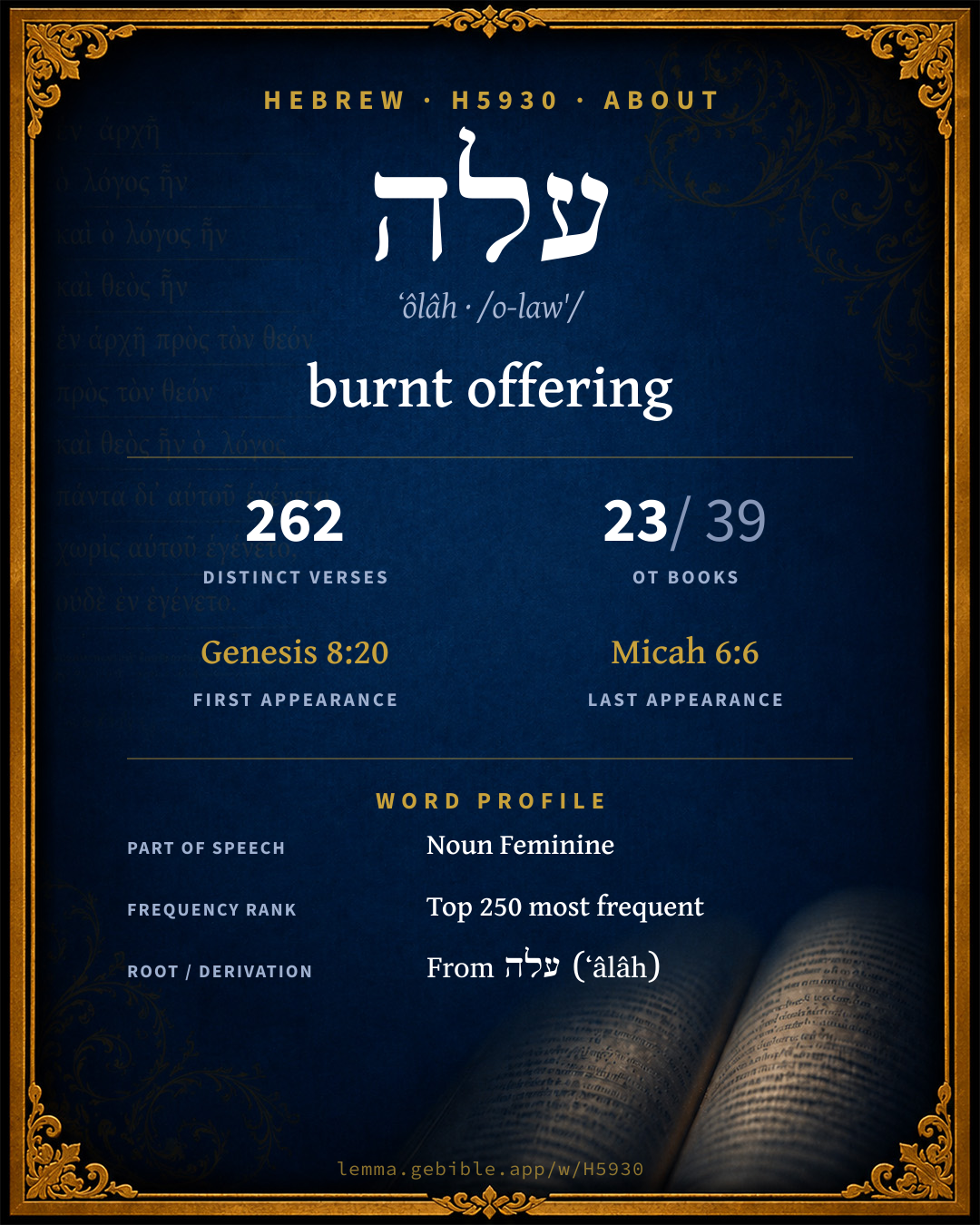
עֹלָה
burnt offering
‘burnt offering’ is one of 2 main senses fuller range ↓
Full lexicon entry — Brown-Driver-Briggs (BDB)
From Brown-Driver-Briggs (BDB)
Where this word appears
See every Absolute-state word in the Hebrew Bible →
Grammar key — what these labels mean
Part of speech
- Noun
- A naming word — a person, place, thing, or idea.
Noun type
- Common
- A common noun — a general class of person, place, or thing (“king,” “city,” “water”), not a specific name.
State
- Absolute
- The independent form of a noun, not bound to a following word.
- Construct
- A noun bound to a following noun in a possessive / “of” relationship (the construct chain).
Gender
- Feminine
- Grammatically feminine.
Number
- Singular
- One.
- Plural
- More than one (in Hebrew, generally three or more).
Grammatical forms
- Noun, Common, Feminine, Singular, Absolute 176 times (61%)
- Noun, Common, Feminine, Plural, Absolute 48 times (17%)
- Noun, Common, Feminine, Singular, Construct 45 times (16%)
- Noun, Common, Feminine, Plural, Construct 20 times (7%)
Parsed forms decoded from the imported morphology (morphhb / Westminster Leningrad Codex — WLC text public domain, morphhb tagging CC BY 4.0), counted across 289 parsed occurrences — not distinct verses.
Page 2 of 2 — showing verses 201–262 of 262 distinct verses where H5930 appears, across 23 books. Click any verse to open its interlinear word-by-word view. Verse text shown in the World English Bible for context — . Each verse’s Hebrew form is shown with its reference; the English is not keyword-highlighted, since the data carries no word-level English alignment. Use “Compare translations” on any verse to read it across multiple English versions. This concordance covers the Hebrew Bible; Septuagint (Greek Old Testament) occurrences are not indexed here.
2 Chronicles 24 verses
- 2 Chronicles 29:18 הָ/עוֹלָה֙ ptcl def.art + n c fs Then they went in to Hezekiah the king within [the palace], and said, We have cleansed all the house of Yahweh, and the altar of burnt offering, with all the vessels of it, and the table of show bread, with all the vessels of it.
- 2 Chronicles 29:24 הָ/עוֹלָ֖ה ptcl def.art + n c fs and the priests killed them, and they made a sin-offering with their blood on the altar, to make atonement for all Israel; for the king commanded [that] the burnt offering and the sin-offering [should be made] for all Israel.
- 2 Chronicles 29:27 הָ/עֹלָ֖ה הָֽ/עוֹלָ֗ה ptcl def.art + n c fs ptcl def.art + n c fs Hezekiah commanded to offer the burnt offering on the altar. When the burnt offering began, the song of Yahweh began also, and the trumpets, together with the instruments of David king of Israel.
- 2 Chronicles 29:28 הָ/עֹלָֽה ptcl def.art + n c fs All the assembly worshiped, and the singers sang, and the trumpeters sounded; all this [continued] until the burnt offering was finished.
- 2 Chronicles 29:31 עֹלֽוֹת n c fp Then Hezekiah answered, Now you have consecrated yourselves to Yahweh; come near and bring sacrifices and thank-offerings into the house of Yahweh. The assembly brought in sacrifices and thank-offerings; and as many as were of a willing heart [brought] burnt offerings.
- 2 Chronicles 29:32 הָ/עֹלָה֮ לְ/עֹלָ֥ה ptcl def.art + n c fs prep + n c fs The number of the burnt offerings which the assembly brought was seventy bulls, one hundred rams, and two hundred lambs: all these were for a burnt offering to Yahweh.
- 2 Chronicles 29:34 הָ/עֹל֑וֹת ptcl def.art + n c fp But the priests were too few, so that they could not flay all the burnt offerings: therefore their brothers the Levites helped them, until the work was ended, and until the priests had sanctified themselves; for the Levites were more upright in heart to sanctify themselves than the priests.
- 2 Chronicles 29:35 עֹלָ֨ה לָ/עֹלָ֑ה n c fs prep det + n c fs Also the burnt offerings were in abundance, with the fat of the peace-offerings, and with the drink-offerings for every burnt offering. So the service of the house of Yahweh was set in order.
- 2 Chronicles 30:15 עֹל֖וֹת n c fp Then they killed the Passover on the fourteenth [day] of the second month: and the priests and the Levites were ashamed, and sanctified themselves, and brought burnt offerings into the house of Yahweh.
- 2 Chronicles 31:2 לְ/עֹלָ֖ה prep + n c fs Hezekiah appointed the divisions of the priests and the Levites after their divisions, every man according to his service, both the priests and the Levites, for burnt offerings and for peace-offerings, to minister, and to give thanks, and to praise in the gates of the camp of Yahweh.
- 2 Chronicles 31:3 לָ/עֹל֗וֹת לְ/עֹלוֹת֙ וְ/הָ֣/עֹל֔וֹת prep det + n c fp prep + n c fp cs conj + ptcl def.art + n c fp [He appointed] also the king's portion of his substance for the burnt-offerings, [to wit], for the morning and evening burnt offerings, and the burnt offerings for the Sabbaths, and for the new moons, and for the set feasts, as it is written in the law of Yahweh.
- 2 Chronicles 35:12 הָ/עֹלָ֜ה ptcl def.art + n c fs They removed the burnt offerings, that they might give them according to the divisions of the fathers' houses of the children of the people, to offer to Yahweh, as it is written in the book of Moses. So did they with the oxen.
- 2 Chronicles 35:14 הָ/עוֹלָ֥ה ptcl def.art + n c fs Afterward they prepared for themselves, and for the priests, because the priests the sons of Aaron [were busied] in offering the burnt offerings and the fat until night: therefore the Levites prepared for themselves, and for the priests the sons of Aaron.
- 2 Chronicles 35:16 עֹל֔וֹת n c fp So all the service of Yahweh was prepared the same day, to keep the Passover, and to offer burnt-offerings on the altar of Yahweh, according to the commandment of king Josiah.
Ezra 6 verses
- Ezra 3:2 עֹל֔וֹת n c fp Then stood up Jeshua the son of Jozadak, and his brothers the priests, and Zerubbabel the son of Shealtiel, and his brothers, and built the altar of the God of Israel, to offer burnt offerings thereon, as it is written in the law of Moses the man of God.
- Ezra 3:3 עֹלוֹת֙ עֹל֖וֹת n c fp n c fp They set the altar on its base; for fear was on them because of the peoples of the countries: and they offered burnt offerings thereon to Yahweh, even burnt offerings morning and evening.
- Ezra 3:4 וְ/עֹלַ֨ת conj + n c fs cs They kept the feast of tents, as it is written, and [offered] the daily burnt offerings by number, according to the ordinance, as the duty of every day required;
- Ezra 3:5 עֹלַ֤ת n c fs cs and afterward the continual burnt-offering, and [the offerings] of the new moons, and of all the set feasts of Yahweh that were consecrated, and of everyone who willingly offered a freewill-offering to Yahweh.
- Ezra 3:6 עֹל֖וֹת n c fp From the first day of the seventh month began they to offer burnt offerings to Yahweh: but the foundation of the temple of Yahweh was not yet laid.
- Ezra 8:35 עֹל֣וֹת עוֹלָ֥ה n c fp n c fs The children of the captivity, who had come out of exile, offered burnt offerings to the God of Israel, twelve bulls for all Israel, ninety-six rams, seventy-seven lambs, and twelve male goats for a sin-offering: all this was a burnt offering to Yahweh.
Nehemiah 1 verse
Job 2 verses
- Job 1:5 עֹלוֹת֮ n c fp It was so, when the days of their feasting had run their course, that Job sent and sanctified them, and rose up early in the morning, and offered burnt offerings according to the number of them all. For Job said, "It may be that my sons have sinned, and renounced God in their hearts." Thus did Job continually.
- Job 42:8 עוֹלָה֙ n c fs Now therefore, take to yourselves seven bulls and seven rams, and go to my servant Job, and offer up for yourselves a burnt offering; and my servant Job shall pray for you, for I will accept him, that I not deal with you according to your folly. For you have not spoken of me the thing that is right, as my servant Job has."
Psalms 7 verses
- Psalms 20:3 וְ/עוֹלָתְ/ךָ֖ conj + n c fs cs + sfx pers 2ms Remember all your offerings, And accept your burnt sacrifice. Selah.
- Psalms 40:6 עוֹלָ֥ה n c fs Sacrifice and offering you didn't desire. You have opened my ears: Burnt offering and sin offering you have not required.
- Psalms 50:8 וְ/עוֹלֹתֶ֖י/ךָ conj + n c fp cs + sfx pers 2ms I don't rebuke you for your sacrifices. Your burnt offerings are continually before me.
- Psalms 51:16 ע֝וֹלָ֗ה n c fs For you don't delight in sacrifice, or else I would give it. You have no pleasure in burnt offering.
- Psalms 51:19 עוֹלָ֣ה n c fs Then you will delight in the sacrifices of righteousness, In burnt offerings and in whole burnt offerings. Then they will offer bulls on your altar.
- Psalms 66:13 בְ/עוֹל֑וֹת prep + n c fp I will come into your temple with burnt offerings. I will pay my vows to you,
- Psalms 66:15 עֹ֘ל֤וֹת n c fp cs I will offer to you burnt offerings of fat animals, With the offering of rams, I will offer bulls with goats. Selah.
Isaiah 5 verses
- Isaiah 1:11 עֹל֥וֹת n c fp cs "What are the multitude of your sacrifices to me?," says Yahweh. "I have had enough of the burnt offerings of rams, And the fat of fed animals. I don't delight in the blood of bulls, Or of lambs, Or of male goats.
- Isaiah 40:16 עוֹלָֽה n c fs Lebanon is not sufficient to burn, nor the animals of it sufficient for a burnt offering.
- Isaiah 43:23 עֹלֹתֶ֔י/ךָ n c fp cs + sfx pers 2ms You have not brought me of your sheep for burnt offerings; neither have you honored me with your sacrifices. I have not burdened you with offerings, nor wearied you with frankincense.
- Isaiah 56:7 עוֹלֹתֵי/הֶ֧ם n c fp cs + sfx pers 3mp even them will I bring to my holy mountain, and make them joyful in my house of prayer: their burnt offerings and their sacrifices shall be accepted on my altar; for my house shall be called a house of prayer for all peoples.
- Isaiah 61:8 בְּ/עוֹלָ֑ה prep + n c fs For I, Yahweh, love justice, I hate robbery with iniquity; and I will give them their recompense in truth, and I will make an everlasting covenant with them.
Jeremiah 7 verses
- Jeremiah 6:20 עֹלֽוֹתֵי/כֶם֙ n c fp cs + sfx pers 2mp To what purpose comes there to me frankincense from Sheba, and the sweet cane from a far country? your burnt offerings are not acceptable, nor your sacrifices pleasing to me.
- Jeremiah 7:21 עֹלוֹתֵי/כֶ֛ם n c fp cs + sfx pers 2mp Thus says Yahweh of Hosts, the God of Israel: Add your burnt offerings to your sacrifices, and eat you flesh.
- Jeremiah 7:22 עוֹלָ֖ה n c fs For I didn't speak to your fathers, nor command them in the day that I brought them out of the land of Egypt, concerning burnt offerings or sacrifices:
- Jeremiah 14:12 עֹלָ֥ה n c fs When they fast, I will not hear their cry; and when they offer burnt offering and meal-offering, I will not accept them; but I will consume them by the sword, and by the famine, and by the pestilence.
- Jeremiah 17:26 עוֹלָ֥ה n c fs They shall come from the cities of Judah, and from the places round about Jerusalem, and from the land of Benjamin, and from the lowland, and from the hill-country, and from the South, bringing burnt offerings, and sacrifices, and meal-offerings, and frankincense, and bringing [sacrifices of] thanksgiving, to the house of Yahweh.
- Jeremiah 19:5 עֹל֣וֹת n c fp and have built the high places of Baal, to burn their sons in the fire for burnt offerings to Baal; which I didn't command, nor spoke it, neither came it into my mind:
- Jeremiah 33:18 עוֹלָ֜ה n c fs neither shall the priests the Levites want a man before me to offer burnt offerings, and to burn meal-offerings, and to do sacrifice continually.
Ezekiel 17 verses
- Ezekiel 40:26 עלות/ו עֹֽלוֹתָ֔י/ו n c fs cs + sfx pers 3ms n c fp cs + sfx pers 3ms There were seven steps to go up to it, and the arches of it were before them; and it had palm trees, one on this side, and another on that side, on the posts of it.
- Ezekiel 40:38 הָ/עֹלָֽה ptcl def.art + n c fs A chamber with the door of it was by the posts at the gates; there they washed the burnt offering.
- Ezekiel 40:39 הָ/עוֹלָ֔ה ptcl def.art + n c fs In the porch of the gate were two tables on this side, and two tables on that side, to kill thereon the burnt offering and the sin-offering and the trespass-offering.
- Ezekiel 40:42 לָ/עוֹלָ֜ה הָ/עוֹלָ֛ה prep det + n c fs ptcl def.art + n c fs There were four tables for the burnt offering, of hewn stone, a cubit and a half long, and a cubit and a half broad, and one cubit high; whereupon they laid the instruments with which they killed the burnt offering and the sacrifice.
- Ezekiel 43:18 עוֹלָ֔ה n c fs He said to me, Son of man, thus says the Lord Yahweh: These are the ordinances of the altar in the day when they shall make it, to offer burnt offerings thereon, and to sprinkle blood thereon.
- Ezekiel 43:24 עֹלָ֖ה n c fs You shall bring them near before Yahweh, and the priests shall cast salt on them, and they shall offer them up for a burnt offering to Yahweh.
- Ezekiel 43:27 עוֹלֽוֹתֵי/כֶם֙ n c fp cs + sfx pers 2mp When they have accomplished the days, it shall be that on the eighth day, and forward, the priests shall make your burnt offerings on the altar, and your peace-offerings; and I will accept you, says the Lord Yahweh.
- Ezekiel 44:11 הָ/עֹלָ֤ה ptcl def.art + n c fs Yet they shall be ministers in my sanctuary, having oversight at the gates of the house, and ministering in the house: they shall kill the burnt offering and the sacrifice for the people, and they shall stand before them to minister to them.
- Ezekiel 45:15 וּ/לְ/עוֹלָ֣ה conj + prep + n c fs and one lamb of the flock, out of two hundred, from the well-watered pastures of Israel; -for a meal-offering, and for a burnt offering, and for peace-offerings, to make atonement for them, says the Lord Yahweh.
- Ezekiel 45:17 הָ/עוֹל֣וֹת הָֽ/עוֹלָה֙ ptcl def.art + n c fp ptcl def.art + n c fs It shall be the prince's part to give the burnt offerings, and the meal-offerings, and the drink-offerings, in the feasts, and on the new moons, and on the Sabbaths, in all the appointed feasts of the house of Israel: he shall prepare the sin-offering, and the meal-offering, and the burnt offering, and the peace-offerings, to make atonement for the house of Israel.
- Ezekiel 45:23 עוֹלָ֣ה n c fs The seven days of the feast he shall prepare a burnt offering to Yahweh, seven bulls and seven rams without blemish daily the seven days; and a male goat daily for a sin-offering.
- Ezekiel 45:25 כָּ/עֹלָ֔ה prep det + n c fs In the seventh [month], in the fifteenth day of the month, in the feast, shall he do the like the seven days; according to the sin-offering, according to the burnt offering, and according to the meal-offering, and according to the oil.
- Ezekiel 46:2 עֽוֹלָת/וֹ֙ n c fs cs + sfx pers 3ms The prince shall enter by the way of the porch of the gate outside, and shall stand by the post of the gate; and the priests shall prepare his burnt-offering and his peace-offerings, and he shall worship at the threshold of the gate: then he shall go forth; but the gate shall not be shut until the evening.
- Ezekiel 46:4 וְ/הָ֣/עֹלָ֔ה conj + ptcl def.art + n c fs The burnt offering that the prince shall offer to Yahweh shall be on the Sabbath day six lambs without blemish and a ram without blemish;
- Ezekiel 46:12 עוֹלָ֣ה עֹֽלָת/וֹ֙ n c fs n c fs cs + sfx pers 3ms When the prince shall prepare a freewill-offering, a burnt offering or peace-offerings as a freewill-offering to Yahweh, one shall open for him the gate that looks toward the east; and he shall prepare his burnt offering and his peace-offerings, as he does on the Sabbath day: then he shall go forth; and after his going forth one shall shut the gate.
- Ezekiel 46:13 עוֹלָ֛ה n c fs You shall prepare a lamb a year old without blemish for a burnt offering to Yahweh daily: morning by morning shall you prepare it.
- Ezekiel 46:15 עוֹלַ֖ת n c fs cs Thus shall they prepare the lamb, and the meal-offering, and the oil, morning by morning, for a continual burnt offering.
Hosea 1 verse
Amos 1 verse
Micah 1 verse
About this entry
At a glance — auto-summarized from this page’s data, not written by a person. Every figure links to its source below. This summary describes the numbers; it doesn’t interpret them.
“burnt offering” is the headline sense of the Hebrew noun עלה (ʻôlâh). First canonically at Genesis 8:20, it enters the text early. It turns up in 262 verses across 23 books, a common footprint. Catalogued under 2 senses, its meaning is not single-sense. From the same root come עלה, מעל and מעל. The sections below give every sense, occurrence, and version rendering.
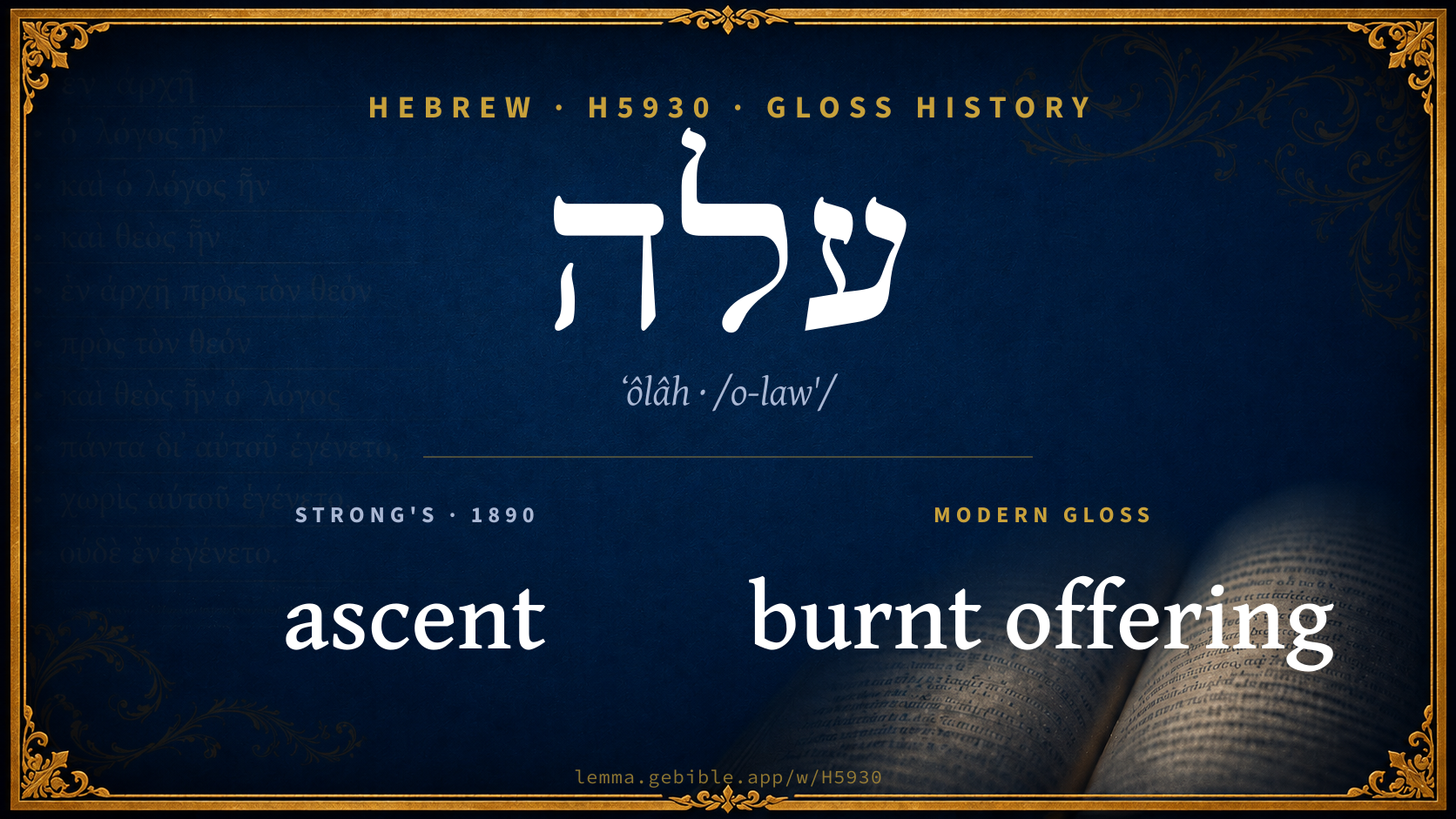
Gloss history
Strong's 1890 vs modern scholarship
About this word
Strong's H5930 catalogs a Hebrew word from the Hebrew Old Testament.
These counts are not copied from any lexicon or concordance. They are computed here, from the morphology-tagged Hebrew Old Testament. What Lemma adds →
- 262
- distinct verses
- The word appears in 262 distinct verses.
- 23 / 39
- OT books
- The word appears in 23 of 39 Old Testament books.
- #172
- by frequency
- Top 250 most frequent Hebrew words (rank 172 of 8,640 Hebrew words by occurrence).
View all 262 occurrences in the concordance →
Most concentrated in
- Leviticus 58 verses 22%
- Numbers 53 verses 20%
- 2 Chronicles 24 verses 9%
By section of the Old Testament
By traditional corpus
Conventional, traditional groupings — biblical authorship is debated, so this is a traditional corpus grouping, not an authorship claim. Each share is this word’s portion of its verses in that division of the Hebrew canon. Each figure is a share of the word’s 262 distinct verses.
- Torah (Pentateuch) 140 verses · 53%
- Prophets (Nevi'im) 71 verses · 27%
- Writings (Ketuvim) 51 verses · 19%
How translations render this word
Counts come from each version’s own published word-to-Strong’s tagging or interlinear alignment — an approximate guide to how each version renders this word, not a word-level alignment the data otherwise carries. Because each total is that version’s own tagged count, the per-version totals vary from one another and need not match the appearance or distinct-verse counts above. These counts may also differ from a printed concordance because Lemma counts each distinctly tagged rendering and does not collapse phrase taggings into a single head-word total. This is a fixed set of word-tagged versions (KJV, ASV, BSB, ULT) and does not change with the reading translation you choose elsewhere. Each version’s license is shown beside its name below (and on Sources).
BDB lists this Strong’s number as 2 distinct words (homographs). Each count above pools all of them and is not split by sense — see the Senses section below. A low-frequency rendering may belong to a different one of those words, not the primary meaning.
- King James Version†: Burnt offering 168×, Burnt offerings 74×, Burnt sacrifice 11×
- American Standard Version†: Burnt-offering 133×, Burnt-offerings 62×, Peace-offerings 14×
- Berean Standard Bible†: Burnt offering 159×, Burnt offerings 95×, Is a burnt offering 7×
- unfoldingWord Literal Text†: Burnt offering 162×, Burnt offerings 70×, Burnt offering of 23×
King James Version Public Domain
Renders H5930 across 289† tagged occurrences — most commonly:
Plus 25 renderings that appear only once — usually multi-word phrases or single function words the recovered tagging swept in, not distinct renderings.
American Standard Version Public Domain
Renders H5930 across 302† tagged occurrences — most commonly:
Plus other, less common renderings. Plus 43 renderings that appear only once — usually multi-word phrases or single function words the recovered tagging swept in, not distinct renderings.
Berean Standard Bible Public Domain
Renders H5930 across 279† tagged occurrences — most commonly:
Plus 16 renderings that appear only once — usually multi-word phrases or single function words the recovered tagging swept in, not distinct renderings. Not rendered by a distinct English word in 8 further occurrences.
unfoldingWord Literal Text CC BY-SA 4.0
Renders H5930 across 293† tagged occurrences — most commonly:
Plus 20 renderings that appear only once — usually multi-word phrases or single function words the recovered tagging swept in, not distinct renderings.
Senses in the full BDB
What do BDB’s symbols mean?
BDB uses these scholarly abbreviations:
| Symbol | Meaning |
|---|---|
| 𝔊 | the Septuagint (the ancient Greek translation, LXX) |
| 𝔙 | the Vulgate (the Latin translation) |
| 𝔖 | the Syriac version (the Peshitta) |
| 𝔗 | the Targum (the Aramaic translation) |
| ψ | the Psalms |
| √ | root (the underlying root or stem) |
| ‖ | parallel passage (a synonymous or contrasted parallel) |
| † | the dagger: every passage where the word occurs is cited |
The 0 senses and sub-senses the full Brown-Driver-Briggs lexicon distinguishes for this word, in lexicon order (not ranked by frequency), with BDB’s own verbatim wording and sub-sense lettering. Shown in Hebrew script with BDB’s own scholarly abbreviations. The condensed entry is in the Lexicon Entry tab. See also the Forms in the corpus table below.
עלה I whole burnt-offering (that which goes up (√ 6) to heaven (al. on altar))
עלה II ascent, stairway, עלותו Ez 40
Senses from the full Brown-Driver-Briggs lexicon (Brown, Driver, Briggs; Oxford 1906 — public domain), digitized via Sefaria, supplemented by the OpenScriptures HebrewLexicon (CC BY 4.0). Full attribution on Sources.
Word origin
I. n.f. whole burnt-offering (that which goes up (√ 6) to heaven (al. on altar));—ע׳ Gn 22:3 + 141 times; עוֹלָה Nu 28:37 + 33 times; cstr. עֹלַת Ex 29:42 + 27 times, עוֹלַת Nu 28:24 + 2 times; sf. עוֹלָֽתְךָ ψ 20:4, etc.; pl. עֹלוֹת Jos 8:31 + 42 times, עֹלֹת Gn 8:20 + 3 times; עוֹלֹת Dt 27:6, עוֹלוֹת Am 5:22 +; sf. עֹלוֹתֵיכֶם Je 6:20 +, etc.;—the whole burnt-offering (beast or fowl) is entirely consumed and goes up in the flame of the altar to God expressing the ascent of the soul in worship. All of the victim is laid on the altar except the hide and such parts as could not be washed clean. If beast the ע׳ must be a male without blemish Lv 1:3, 10; 22:18, 19, of herd or flock; if of flock, either sheep or goat; if fowl, either turtledove or young pigeon Lv 1:14, the latter usually offered by the poor †5:7; 12:8; 14:22; 15:14, 15, 29, 30; Nu 6:10, 11. A lamb was offered by individuals Lv 12:6; Nu 6:14, and by the nation at the עֹמֶר offering Lv 23:12, and daily at the עֹלַת הַבֹּקֶר 9:17; Nu 28:23; 2 K 16:15; Ez 46:13, and at morning and evening עלה תמיד Nu 28:3, †עֹלַת (הַ)תָּמִיד Ex 29:42; Nu 28:6, 10, 15, 23, 24, 31; 29:6, 11, 16, 19, 22, 25, 28, 31, 34, 38; Ezr 3:5; Ne 10:34; Ez 46:15. These were doubled at the עֹלַת שַׁבָּת Nu 28:10. A ram was offered by Aaron and his sons †Ex 29:18; Lv 8:18; 9:2; 16:3, 5; but a young bullock was of greater value Nu 15:8, 24; 2 S 24:22 1 Ch 21:23, at consecration of Levites Nu 8:12, so calves Mi 6:6; on great occasions bullocks + rams Nu 23:1–6, 14, 15, bullocks + rams + lambs Is 1:11; one of each kind offered by tribal chiefs Nu 7:15, 21, 27, 33, 39, 45, 51, 57, 63, 69, 76, 81, 87. In ritual of עֹלַת (ה)חֹדֶשׁ Nu 28:14; 29:6 and at מצּות and Pentecost 2 bullocks, 1 ram, and 7 lambs were added to daily offering Nu 28:11, 19, 27; at offering of new bread at Pentecost 1 bullock, 2 rams, and 7 lambs Lv 23:18; on the 1st and 10th of the 7th month and at עצרת 1 bullock, 1 ram, and 7 lambs, in addition to the offerings of new moon Nu 29:2, 8, 36; the system culminated in 70 bullocks, 14 rams, 98 lambs for the 7 days of Tabernacles 29:13 ff. According to Ezek. the prince was to offer on each of 7 days of מצות 7 bullocks and 7 rams Ez 45:23, and on Sabbath 6 lambs and 1 ram 46:4. At the reconsecration of temple 70 bullocks, 100 rams, and 200 lambs were offered 2 Ch 29:32, and at the return of exiles 12 bullocks, 96 rams, and 77 lambs Ezr 8:35. In early times whole burnt-offerings of children were sometimes made, e.g. Jephthah’s daughter Ju 11:31, Isaac proposed as, Gn 22:2 but ram substituted v 13; made to other gods 2 K 3:27; Je 19:5 +. The ע׳ was anciently made on any altar used for worship, but in P confined to †מִזְבַּח הָעֹלָה Ex 30:28; 31:9; 35:16; 38:1; 40:6, 10, 29; Lv 4:7, 10, 18, 25(×2), 30, 34; 1 Ch 6:34; 16:40; 21:26, 29; 2 Ch 29:18 (not in other lit.); מזבח לעלה Jos 22:29; 1 Ch 22:1. The offerer imposed his hands on head of animal, then slaughtered it Lv 1:4, 5; †שׁחט ע׳ 4:24, 33; 6:8; 7:2; 9:12; 14;14:13, 19, 31; Ez 40:39, 42; 44:11, and flayed it †הִפְשִׁיט ע׳ Lv 1:6 2 Ch 29:34. The priest washed the pieces Ez 40:38; arranged them on the altar above the wood Lv 6:5; the fire devoured them v 2–6; 9:24; 1 K 18:38; 2 Ch 7:1, they went up in the flame ריח ניחח ליהוה (ל) Lv 1:9, 13, 17; 8:21 Nu 28:13; לְרָצוֹן, according to character of offerer is Is 56:7; Je 6:20; see also ψ 20:4; 40:7; 51:18; 1 S 15:22. Phrases: †העלה ע׳ Gn 8:20 Ex 32:6 (J) 24:5 (E) 30:9; 40:29; Lv 14:20; 17:8 (P) Dt 12:13, 14; 27:6; Jos 8:31; 22:23; Ju 6:26; 20:26; 21:4; 1 S 6:14, 15; 7:9, 10; 10:8; 13:9, 10, 12; 2 S 6:17, 18; 24:24, 25; 1 K 3:4, 15; 9:25; 10:5; 2 K 3:27; 1 Ch 16:2, 40; 21:24, 26; 23:31; 29:21; 2 Ch 1:6; 8:12; 9:4; 23:18; 24:14; 29:7, 27; 35:14, 16; Ezr 3:2, 3, 6; Jb 1:5; 42:8 ψ 66:15 Je 14:12; 33:18; Ez 43:18, 24; Am 5:22 (cf. העלה 9); †זבח ע׳ Ex 20:24 (E); עשׂה לע׳ Lv 23:12; Nu 6:11; 15:24; 29:39; †עָשָׂה ע׳ Lv 5:10; 9:7, 22; 15:15, 30; 16:24(×2); Nu 6:16; 8:12; 15:3, 8; 29:2; Dt 12:27; Ju 13:16; 1 K 8:61; 2 K 5:17; 10:24, 25; 2 Ch 7:7; Ez 43:27; 45:17, 23; 46:2, 12(×2), 13; †הִקְרִיב ע׳ Lv 7:8; 9:16; 10:19; 23:37; Nu 28:3, 11, 19, 27; 29:8, 13, 36; 1 Ch 16:1; Ezr 8:35; Ez 46:4; הקריב לע׳ Lv 22:18; Nu 6:14; †הביא ע׳ Dt 12:6, 11; 2 Ch 29:31, 32; 30:15; Is 43:23; Je 17:26; †הקטיר ע׳ 2 K 16:13, 15; 2 Ch 13:11.—עֹלָתָה, עוֹלוֹת v. also עַוְלָה sub I. עוּל.
II. n.f. ascent, stairway, עלותו Ez 40:26 Kt, עֹלוֹתָיו Qr; read prob. מַעֲלָתוֹ (𝔊 Co SS לוֹ, Toy עֹלָתוֹ).
— Brown-Driver-Briggs (Oxford 1906, public domain), digitized via Sefaria, supplemented by the OpenScriptures HebrewLexicon (CC BY 4.0). See Sources.
Derived from עלה (ʻâlâh) (H5927) — to go up.
Jastrow Dictionary
A second Hebrew/Aramaic lexicon for comparison, covering Aramaic and post-biblical (Talmudic, Targumic, Midrashic) usage that the biblical-Hebrew BDB does not. Matched by lemma rather than by Strong’s number, so a lemma may carry more than one Jastrow headword (shown separately below), and the entries cover usage well beyond the Bible.
עָלֶה
- [cover,] foliage, leaf. Gen. R. s. 19 (play on עֲלֵי תאנה, Gen. III, 7) ע׳ שהביאו תואנה וכ׳ the leaves which brought grief into the world; Yalk. ib. 27 ע׳ שהביא וכ׳. Shebi. VII, 1 עֲלֵה הלוף השוטה, v. לוֹף; a. fr.—Pl. עָלִים, עָלִין; constr. עֲלֵי. Y. ib. V, 35ᵈ bot. מהוצאת ע׳ ועד וכ׳ from the sprouting of leaves to the coming forth of buds of fruits there is an interval of fifty days. Ib. עלי בצלים leaves of onions. Ḥull. 92ᵃ ע׳ שבה וכ׳ the leaves thereon (on the vine Israel) are the untutored, v. אֶשְׁכּוֹל; a. fr. e.g. Genesis 3:7
עִלָּה
- , v. עִילָה
עָלָה
- , v. עלי
עלי
- (b. h.) to go up, rise; to come up, arrive. Pes. VIII, 3 מי שיַּעֲלֶה מכם וכ׳ whichever of you shall first arrive at Jerusalem (for the Passover), v. infra. Snh. X, 3 אינה עתידה לַעֲלוֹת shall not rise (from the grave at the time of resurrection). Y. Peah V, end, 19ᵃ (ref. to גבול עולם, Prov. XXII, 28) זו עוֹלֵי מצרים this refers to those who came up from Egypt; Ḥag. 3ᵇ. Ib. עולי בבל those who came back from Babylonia. Ber. 20ᵃ, a. e. (ref. to Gen. XLIX, 22) א"ת עֲלֵי עין אלא עוֹלֵי עין read not ‘ăle ‘ayin, but ‘ole ‘ayin, those rising above the (evil) eye (whom the evil eye cannot affect). Snh. 111ᵃ כשע׳ משה למרום when Moses came up to heaven. Keth. 61ᵃ עוֹלָה עמו וכ׳ she rises with him, but does not go down with him, i.e. the wife rises to the husband’s social position and can claim its comforts, if it be a higher one than her own, &c.; a. v. fr.—Ḥull. 17ᵇ עוֹלֶה ויורד בסכין a going up and down in a slaughtering knife, i.e. a curved blade.—קרבן עולה ויורד, v. יָרַד.—עלה על דעת, v. דַּעַת.—Esp. to be put on the altar, be offered. Zeb. IX, 1 אם עָלְתָה לא תרד if it has been offered, it must not be taken down again. Ib. 2. Men. 22ᵇ מכאן לעוֹלִין שאינן מבטלין וכ׳ this proves that things which are offered up (e.g. blood of several sacrifices that has become mixed up) do not neutralize one another. Ib. 23ᵃ חיבורי עולין that which is attached to things which go on the altar; a. fr.—Idiomatic uses: a) (sub. לחשבון) to be counted in; to be accounted as. M. Kat. III, 5 שבת עולה ואינה וכ׳ the Sabbath counts as one of the seven days of mourning, and does not discontinue the mourning, i.e. the mourning continues after the Sabbath; רגלים מפסיקין ואינן עולין festivals discontinue (the mourning begun before), but do not count, i.e. if the burial took place on a festive day, the mourning days begin after the festival. Ab. IV, 13 עוֹלָה זדון, v. זָדוֹן. Zeb. I, 3 לא עָלוּ לבעלים משום חובה the owners of the sacrifices are not credited with them as a compliance with their obligation; a. fr.—b) to rise in value; to be esteemed. Ab. l. c. וכתר שם טוב עוֹלֶה על גביהן the crown of a good name is worth more than all of them; a. e.—c) [to rise on the scale, be outweighed,] to be void, be neutralized (cmp. בָּטֵל). Ter. IV, 7 תרומה עולה באחד ומאה T’rumah (mixed up in secular matter) is neutralized in one hundred and one (i.e. one against one hundred). Ib. 11 תַּעֲלֶה באחד ומאה is neutralized in &c.; לא תעלה is not neutralized. Ib. 13; a. fr.—d) ע׳ לרגל, or ע׳ to go up (to Jerusalem and the Temple) for the festival. Yoma 21 בשעה שישראל עולין לרגל when the Israelites were in the Temple on the festivals. Ḥag. I, 1. Ib. 4ᵃ שאינן ראויין לעלות who are not fit for the pilgrimage. Pes. 8ᵇ, a. e. עוֹלֵי רגלים pilgrims; a. fr.—e) ע׳ בידו to obtain, achieve. Ber. 35ᵇ עָלְתָה בידן they were successful. Naz. 23ᵃ מי שנתכוון לעלות בידו בשר חזיר וע׳ בידו בשר טלה he who intended to obtain flesh of the swine, and happened to obtain mutton; a. fr. e.g. Proverbs 22:28
- 1. to elevate, exalt, praise. Sabb. 33ᵇ יהודה שעי׳ יִתְעַלֶּה Judah who elevated (praised the Roman government), shall be elevated (to high office). Y. Snh. X, 29ᶜ top שעִילּוּ אותי וכ׳ who exalted me &c., v. זָבַח. Gen. R. s. 15 (ref. to וישם, Gen. II, 8) עי׳ אותו God raised him (made him a dignitary, by analogy to Deut. XVII, 15); a. fr. e.g. Genesis 2:8
- 2. to prize, to acquire at the highest price, bid for. Gen. R. s. 16 (ref. to ויקח, Gen. II, 15) עי׳ אותו he acquired him (by analogy to Is. XIV, 2; v. infra Hithpa.); Yalk. ib. 22. Gen. R. s. 40 (ref. to ויעלו, Jer. XXXVIII, 13) מְעַלִּין אותו (or מַעֲלִין, Hif.) they bade for him. e.g. Genesis 2:15
- 1. to raise, bring up. Makhsh. VI, 1 המַעֲלֶה פירותיו וכ׳ if one carries his fruits up to the roof, v. כְּנִימָה; Tosef. ib. III, 1. Pesik. R. s. 26 ובקושי הֶעֱלוּהוּ and with hard work they brought him up (out of the pit); a. v. fr.—Esp. to offer on the altar. Zeb. XIV, 3 המַעֲלֶה מבשר וכ׳ he who offers parts of the flesh of a sin offering &c. Ib. XIII, 1 שחט בפנים וה׳ בחוץ if he slaughtered a sacrifice within the Temple precincts, and offered it without; a. v. fr.
- 2. to raise, promote to a higher dignity. Yoma 20ᵇ, a. fr. מַעֲלִין בקדש ולא מורידין we may promote (a person or thing) to a higher grade of sanctity, but must not degrade. Tosef. Ned. VI, 5 שמעלה … מטומאתן which raises (relieves) the unclean from their uncleanness; Ned. 75ᵇ; Y. ib. X, 42ᵃ; a. fr.—לא מעלה ולא מוריד, v. יָרַד.—Idiomatic uses: a) to cause to go up from the reader’s place (which was low, v. תֵּיבה); to remove, discharge. Ber. 29ᵃ ולא הָעֱלוּהוּ and they did not remove him. Ib. טעה … מעלין אותו if a reader makes a mistake in the twelfth section of the T’fillah (v. מִין III), he must be removed; a. fr.—b) (v. Kal, c) to neutralize. Ter. IV, 8 תאנים שחורות מַעֲלוֹת וכ׳ black figs help to neutralize in conjunction with white ones, i.e. the black and the white secular figs are counted together against the admixture of figs of T’rumah whether black or white; a. fr.—c) (v. Kal, a) to account, credit or charge. B. Mets. 69ᵇ אני אעלה לך סלע וכ׳ I will give thee credit for one Sela each month (as a compensation for the use of the cow). Ab. II, 2 מעלה אני עליכם וכ׳ I (the Lord) shall credit you with a large reward, just as if you had accomplished (the good you had intended to do). Ib. III, 7, sq. מעלה עליו הכתוב כאילו וכ׳ the Bible text (the Lord) charges him as if he had endangered his life (v. חוּב). Yoma 81ᵇ מעלה עליו הכתוב כאילו וכ׳ it is accounted to his credit, as if he had fasted on the ninth and the tenth; a. fr.—d) (v. Kal, e) to succeed, profit. Snh. 90ᵇ הֶעֱלֵיתֶם בידכם, v. יָעַל.—f) ה׳ חן to effect grace; to find favor. Gen. R. s. 9 הלואי תהא מַעֲלַת חן לפני … כשם שהֶעֱלִית וכ׳ Oh, that thou wouldst find favor before me (please me) at all times, as thou dost now; a. e.—g) ה׳ חֵמָה [to let anger rise,] to become angry. Gen. R. s. 93 בשעה שהיה יהודה מעלה ח׳ וכ׳ whenever Judah got angry, the hair &c.; a. e.—h) (with or sub. ארוכה) to heal up. Ḥull. 77ᵃ, v. אֲרוּכָה II. Shebi. IV, 6 לא שיַעֲלֶה, v. פָּשַׁח; a. fr.
- to be removed, withdraw. Tosef. Yoma I, 12 בעון … שכינה נַעֲלַת through the sin of bloodshed has the Divine Presence withdrawn (Sifré Num. 161 מסתלקת).
- 1. to be raised, exalted. Sabb. 33ᵇ, v. supra; a. e.
- 2. to be raised in price, to be bargained for at auction. Gen. R. s. 40, end (ref. to וַתֻּקַּח, Gen. XII, 15) מִתְעַלָּה והולכת חד וכ׳ higher and higher prices were offered for her; one said, I give &c.; Esth. R. to II, 16 (ref. to ותלקח, ib.) מתעלה בליקוחין. e.g. Genesis 12:15
A Dictionary of the Targumim, the Talmud Babli and Yerushalmi, and the Midrashic Literature (Marcus Jastrow; London, Luzac, 1903) — Public Domain. Digitized via Sefaria. Digitized via Sefaria. Full attribution on Sources.
Forms in the corpus
The 135 distinct written forms H5930 takes in the Hebrew Bible, most frequent first — each parse links to that state’s occurrences in the concordance. Hebrew forms include their vowel points and cantillation, so a single lemma takes many written forms.
The 60 most common forms are shown; 75 rarer forms follow in the full concordance.
Same root — word family
Other BDB entries built from the same root as H5930, grouped by Strong’s listed origin. These share a root / origin per the lexicon — not necessarily a shared meaning. Each links to that word’s own entry.
Derives from
Shares the same root
- מעל maʻal H4605 above
- מעל môʻal H4607 lifting
- מעלה maʻăleh H4608 ascent
- על ʻal H5920 above
- עלה ʻâleh H5929 leaf
- עלה ʻillâh H5931 matter
- עלי ʻĕlîy H5940 pestle
- עלי ʻillîy H5942 upper
- עליה ʻălîyâh H5944 roof chamber
- עלית ʻallîyth H5952 roof chamber
- תעלה tᵉʻâlâh H8585 conduit
Derived from this word
Proper names from this root
People and places named from this root — a name, not an additional meaning of the word.
Compare all same-root words → Showing 4 of 18 — not the complete family. 4 of the same-root words are proper names (people or places). They share a root, not necessarily a meaning.
Septuagint verse parallels
This word appears in 254 verses that also exist in the Greek Old Testament (Septuagint), out of the 262 Hebrew verses it occurs in. You can read those verses in Greek by switching the Old Testament edition to the Septuagint.
Read these verses in the Septuagint
- Genesis 8:20
- Exodus 10:25
- Leviticus 1:3
- Numbers 6:11
- Deuteronomy 12:6
- Joshua 22:23
- Judges 6:26
- 1 Samuel 6:14
- 2 Samuel 6:17
- 1 Kings 3:4
- 2 Kings 3:27
- 1 Chronicles 6:49
This is a verse-level parallel only — the same verses exist in both the Hebrew and Greek Old Testaments. No word-level Hebrew↔Greek correspondence is claimed: the data carries no such alignment, so no Greek word is shown as this Hebrew word’s translation. Coverage is not total — the Septuagint omits the deuterocanon and renumbers the Psalms, so some Hebrew verses have no direct Greek parallel.