
Ezekiel 40:42

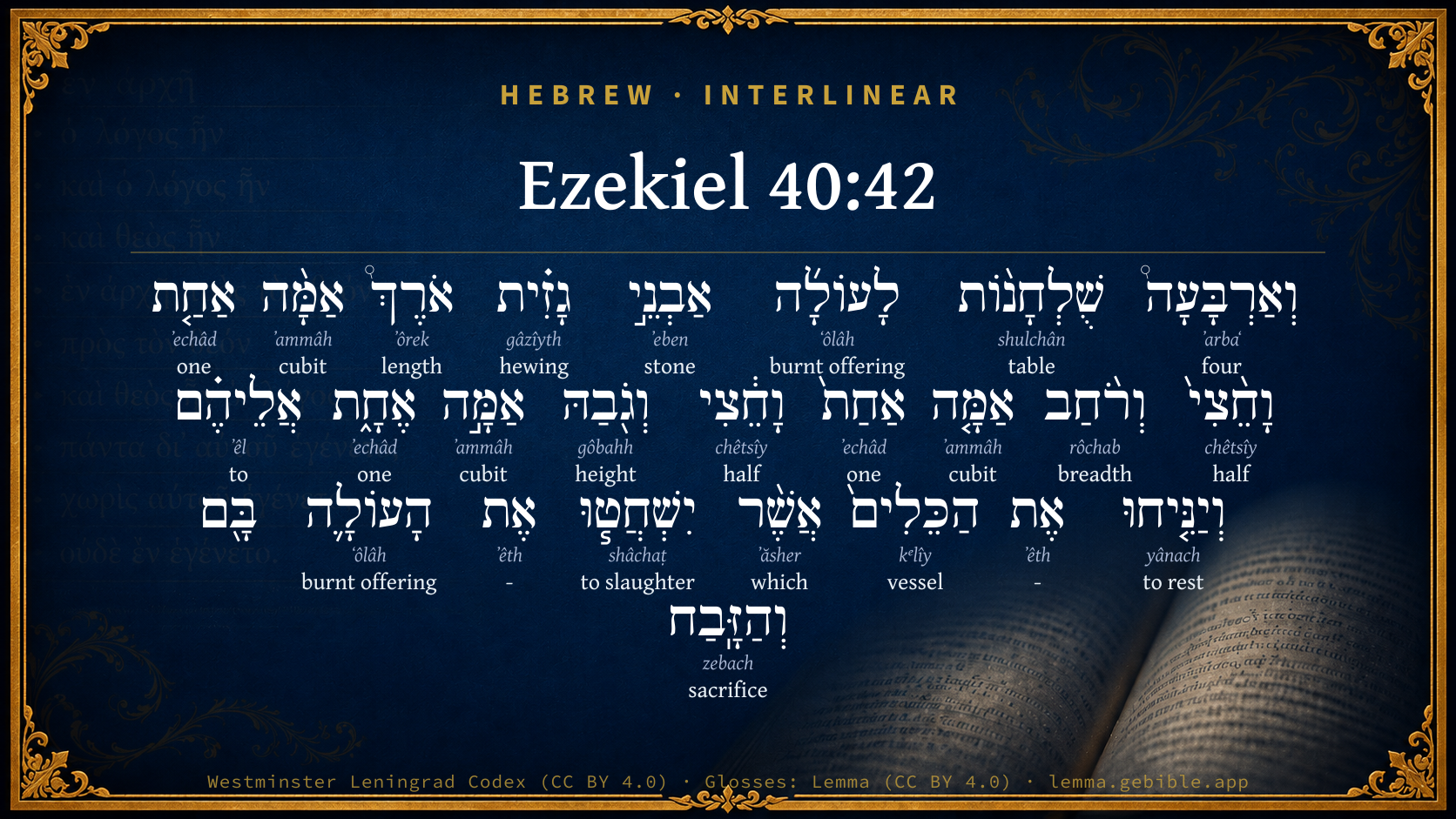
Hebrew (Westminster Leningrad Codex) Ezekiel 40:42 appears in the Hebrew Old Testament. The text above is from the Westminster Leningrad Codex. Each word links to its Strong’s number, a concise gloss, and parsing drawn from the Open Scriptures Hebrew Bible morphology. Click any word for its full Brown-Driver-Briggs (BDB) entry.
Download image
Cite this verse

Ezekiel 40:42 (World English Bible). Public Domain. Lemma interlinear Bible study tool, https://lemma.gebible.app/v/ezekiel/40/42.

Show BibTeX & RIS
BibTeX
RIS
English Translation
There were four tables for the burnt offering, of hewn stone, a cubit and a half long, and a cubit and a half broad, and one cubit high; whereupon they laid the instruments with which they killed the burnt offering and the sacrifice.
World English Bible · Public Domain
Download a study sheet

One document with this verse’s original text, its word-by-word gloss line, the meaning frame, cross-references with their text, attributed commentary, and full source and license credits — printable, and it pastes into notes with its structure intact.

This verse Autodidact and up

Study sheet (.html) Plain text (.txt)

A passage Seminary Student

Up to 50 verses in one chapter. A passage sheet keeps up to 6 commentary sources and 12 cross-references per verse, in the order this page ranks them, and says so on the sheet whenever that leaves anything out. Ask for a single verse and you get the Autodidact verse sheet above.

Everything on this page stays free to read, with no account — the sheet is a download of what is already on screen, not access to it.

Want to remove ads? Support Godless Engineer
Compare translations 3

The same verse in 3 English versions, stacked beneath the original-language interlinear above. Click any original word for its lexicon entry.

Each is an independent rendering of the whole verse — the interlinear is not word-aligned to these translations.

Highlighted words mark where these versions differ — a whole-verse word diff, not a word-by-word alignment.

  • World English Bible Public Domain
    There were four tables for the burnt offering, of hewn stone, a cubit and a half long, and a cubit and a half broad, and one cubit high; whereupon they laid the instruments with which they killed the burnt offering and the sacrifice.
  • King James Version Public Domain
    And the four tables were of hewn stone for the burnt offering, of a cubit and an half long, and a cubit and an half broad, and one cubit high: whereupon also they laid the instruments wherewith they slew the burnt offering and the sacrifice.
  • unfoldingWord Literal Text CC BY-SA 4.0
    There were four tables of cut stone for the burnt offerings, one and a half cubits in length, one and a half cubits in width, and one cubit tall. On them they laid the tools with which they slaughtered the burnt offerings for the sacrifices.

unfoldingWord Literal Text — © unfoldingWord, licensed CC BY-SA 4.0. Word-aligned USFM3 via Door43 (git.door43.org/unfoldingWord/en_ult).

Versions to compare (up to 4)

3 of 4 selected

Show all 18 translations

Every available English version of this verse, each an independent rendering of the whole verse.

  • World English Bible Public Domain
    There were four tables for the burnt offering, of hewn stone, a cubit and a half long, and a cubit and a half broad, and one cubit high; whereupon they laid the instruments with which they killed the burnt offering and the sacrifice.
  • Berean Standard Bible Public Domain
    There were also four tables of dressed stone for the burnt offering, each a cubit and a half long, a cubit and a half wide, and a cubit high. On these were placed the utensils used to slaughter the burnt offerings and the other sacrifices.
  • Majority Standard Bible Public Domain
    There were also four tables of dressed stone for the burnt offering, each a cubit and a half long, a cubit and a half wide, and a cubit high. On these were placed the utensils used to slaughter the burnt offerings and the other sacrifices.
  • King James Version Public Domain
    And the four tables were of hewn stone for the burnt offering, of a cubit and an half long, and a cubit and an half broad, and one cubit high: whereupon also they laid the instruments wherewith they slew the burnt offering and the sacrifice.
  • American Standard Version (1901) Public Domain
    And there were four tables for the burnt-offering, of hewn stone, a cubit and a half long, and a cubit and a half broad, and one cubit high; whereupon they laid the instruments wherewith they slew the burnt-offering and the sacrifice.
  • Revised Version (1885) Public Domain
    And there were four tables for the burnt offering, of hewn stone, a cubit and an half long, and a cubit and an half broad, and one cubit high: whereupon they laid the instruments wherewith they slew the burnt offering and the sacrifice.
  • Geneva Bible (1599) Public Domain
    And the foure tables were of hewen stone for the burnt offering, of a cubite and an halfe long, and a cubite and an halfe broade, and one cubite hie: whereupon also they layde the instruments wherewith they slew the burnt offring and the sacrifice.
  • Douay-Rheims (1899) Public Domain
    And the four tables for the holocausts were made of square stones: one cubit and a half long, and one cubit and a half broad, and one cubit high: to lay the vessels upon, in which the holocaust and the victim is slain.
  • Young's Literal Translation Public Domain
    And the four tables for burnt-offering `are' of hewn stone: the length one cubit and a half, and the breadth one cubit and a half, and the height one cubit: on them they place the instruments with which they slaughter the burnt-offering and the sacrifice.
  • Literal Standard Version CC BY-SA 4.0
    And the four tables for burnt-offering [are] of hewn stone: the length—one cubit and a half, and the breadth—one cubit and a half, and the height—one cubit; they place on them the instruments with which they slaughter the burnt-offering and the sacrifice.
  • Unlocked Literal Bible CC BY-SA 4.0
    There were four tables of cut stone for the burnt offerings, one and a half cubits in length, one and a half cubits in width, and one cubit tall. On them they laid the tools with which they slaughtered the burnt offerings for the sacrifices.
  • unfoldingWord Literal Text CC BY-SA 4.0
    There were four tables of cut stone for the burnt offerings, one and a half cubits in length, one and a half cubits in width, and one cubit tall. On them they laid the tools with which they slaughtered the burnt offerings for the sacrifices.
  • Darby Bible Public Domain
    -- and at the ascent, four tables of hewn stone, of a cubit and a half long, and a cubit and a half broad, and one cubit high; whereon also they laid the instruments with which they slew the burnt-offering and the sacrifice.
  • World Messianic Bible Public Domain
    There were four cut stone tables for the burnt offering, a cubit and a half long, a cubit and a half wide, and one cubit high. They laid the instruments with which they killed the burnt offering and the sacrifice on them.
  • Webster's Bible Public Domain
    And the four tables were of hewn stone for the burnt-offering, of a cubit and a half long, and a cubit and a half broad, and one cubit high: upon which also they laid the instruments with which they slew the burnt-offering and the sacrifice.
  • Free Bible Version CC BY-SA 4.0
    There were also four tables of cut stone for the burnt offering. They each measured one and a half cubits long, one and a half cubits wide, and a cubit high. The tools used to slaughter the burnt offerings and the other sacrifices were placed on these tables.
  • Bible in Basic English Public Domain
    And there were four tables for the burned offering, made of cut stone, one and a half cubits long, one and a half cubits wide and a cubit high, where the instruments were placed which were used for putting to death the burned offering and the beasts for the offerings.
  • JPS Tanakh (1917) Public Domain
    Moreover there were four tables for the burnt-offering, of hewn stone, a cubit and a half long, and a cubit and a half broad, and one cubit high, whereupon to lay the instruments wherewith the burnt-offering and the sacrifice are slain.

Literal Standard Version (2020), Covenant Press — licensed CC BY-SA 4.0. Text via the HelloAO Bible API (eBible.org). Unlocked Literal Bible (unfoldingWord) — licensed CC BY-SA 4.0. Text via the HelloAO Bible API (eBible.org). unfoldingWord Literal Text — © unfoldingWord, licensed CC BY-SA 4.0. Word-aligned USFM3 via Door43 (git.door43.org/unfoldingWord/en_ult). Free Bible Version, Dr. Jonathan Gallagher — licensed CC BY-SA 4.0. Text via the HelloAO Bible API (eBible.org).

Word by word

More ways to search: Search by grammar → Find every occurrence → Compare this word →

Practice this passage: Drill this verse → Learn its vocabulary →

גָזִ֗ית
gâzîyth
H1496
“hewing”
Noun, Common, Feminine, Singular, Absolute
Part of Speech
Noun
Type
Common
Gender
Feminine
Number
Singular
State
Absolute
Full BDB Definition

Origin: from H1491

TWOT: 335a

a cutting, hewing
  1. וְאַרְבָּעָה֩ ʼarbaʻ H702 “and · four” Conjunction + Adjective, Cardinal number, Masculine, Singular, Absolute
  2. שֻׁלְחָנ֨וֹת shulchân H7979 “tables” Noun, Common, Masculine, Plural, Absolute
  3. לָעוֹלָ֜ה ʻôlâh H5930 “to/for the · burnt offering” Preposition, Determined + Noun, Common, Feminine, Singular, Absolute
  4. אַבְנֵ֣י ʼeben H68 “stones of” Noun, Common, Feminine, Plural, Construct
  5. אֹרֶךְ֩ ʼôrek H753 “length” Noun, Common, Masculine, Singular, Absolute
  6. אַמָּ֨ה ʼammâh H520 “cubit” Noun, Common, Feminine, Singular, Absolute
  7. אַחַ֤ת ʼechâd H259 “one” Adjective, Cardinal number, Feminine, Singular, Absolute
  8. וָחֵ֨צִי֙ chêtsîy H2677 “and · half” Conjunction + Noun, Common, Masculine, Singular, Absolute
  9. וְרֹ֨חַב rôchab H7341 “and · breadth” Conjunction + Noun, Common, Masculine, Singular, Absolute
  10. אַמָּ֤ה ʼammâh H520 “cubit” Noun, Common, Feminine, Singular, Absolute
  11. אַחַת֙ ʼechâd H259 “one” Adjective, Cardinal number, Feminine, Singular, Absolute
  12. וָחֵ֔צִי chêtsîy H2677 “and · half” Conjunction + Noun, Common, Masculine, Singular, Absolute
  13. וְגֹ֖בַהּ gôbahh H1363 “and · height” Conjunction + Noun, Common, Masculine, Singular, Absolute
  14. אַמָּ֣ה ʼammâh H520 “cubit” Noun, Common, Feminine, Singular, Absolute
  15. אֶחָ֑ת ʼechâd H259 “one” Adjective, Cardinal number, Feminine, Singular, Absolute
  16. אֲלֵיהֶ֗ם ʼêl H413 “to · them” Preposition + Suffix, Personal, 3rd Person, Masculine, Plural
  17. וְיַנִּ֤יחוּ yânach H3240 “and · to rest” Conjunction + Verb, Hiphil, Imperfect, 3rd Person, Masculine, Plural
  18. אֶת ʼêth H853 “-” Particle, Direct Object
  19. הַכֵּלִים֙ kᵉlîy H3627 “the · vessels” Particle, Definite Article + Noun, Common, Masculine, Plural, Absolute
  20. אֲשֶׁ֨ר ʼăsher H834 “which” Particle, Relative
  21. יִשְׁחֲט֧וּ shâchaṭ H7819 “to slaughter” Verb, Qal, Imperfect, 3rd Person, Masculine, Plural
  22. אֶת ʼêth H853 “-” Particle, Direct Object
  23. הָעוֹלָ֛ה ʻôlâh H5930 “the · burnt offering” Particle, Definite Article + Noun, Common, Feminine, Singular, Absolute
  24. וְהַזָּֽבַח zebach H2077 “and · the · sacrifice” Conjunction + Particle, Definite Article + Noun, Common, Masculine, Singular, Absolute

About this verse

These counts appear in no published source. They are computed here, from the morphology-tagged text and Lemma’s own curated glosses. What Lemma adds →

26
words
18
distinct lemmas
Prophets
section

Notable vocabulary

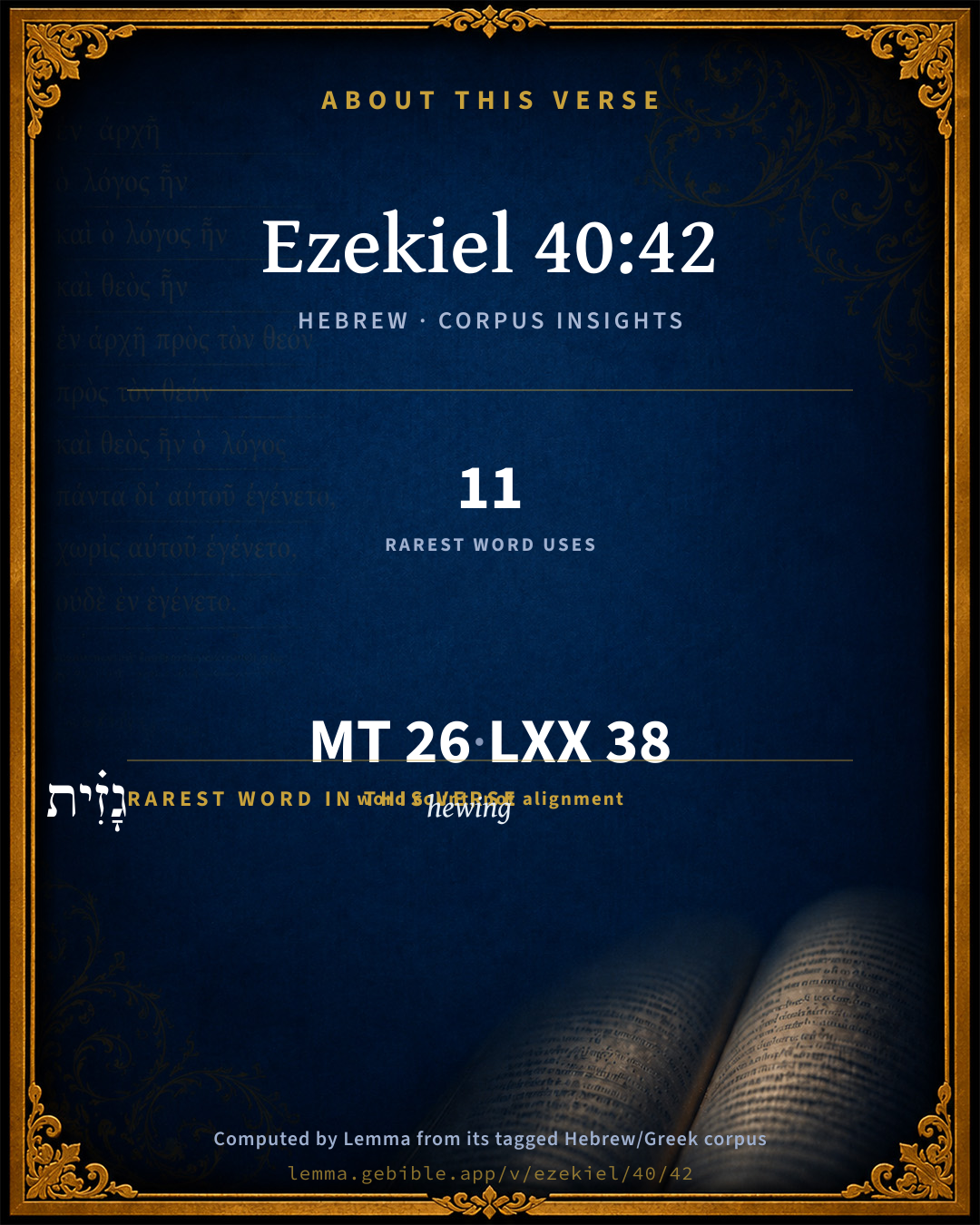
The rarest word here is גָזִ֗ית hewing H1496 — appearing just 11 times in the whole Hebrew Bible.

Shared distinctive vocabulary

גָזִ֗ית hewing H1496 occurs in 11 verses of the Hebrew Bible. Also found in:

Grammatical profile

  • 2 verbs
  • 15 nouns
  • 4 adjectives
  • 2 prepositions
  • 3 particles

Verb forms

  • וְיַנִּ֤יחוּ Hiphil · Imperfect
  • יִשְׁחֲט֧וּ Qal · Imperfect

Repetition

Words recur within this verse — often emphatic in Hebrew:

  • אַמָּ֨ה cubit H520 ×3
  • אַחַ֤ת one H259 ×3
  • לָעוֹלָ֜ה burnt offering H5930 ×2
  • וָחֵ֨צִי֙ half H2677 ×2

Hebrew & Septuagint length

In English translation the verse runs 43 words from the Hebrew and 57 from the Septuagint (LXX English) — closely comparable.

A rough comparison of the two English renderings, which tokenize alike — not a word-level alignment.

Word counts can differ between the Hebrew and the Greek without any difference in meaning — e.g. the Hebrew direct-object marker אֵת has no separate Greek word, and Greek often adds the article ὁ.

In the original languages it is 26 Hebrew tokens and 38 Greek tokens — but the two are counted differently (Hebrew bundles its prefixes and suffixes into one token; the Greek is in lemma form), so that isn’t a like-for-like length.

Cross-references

2

Topical passages linked to Ezekiel 40:42 in the Treasury of Scripture Knowledge — connected by theme and wording, ordered by reader-vote popularity; previews shown in the World English Bible.

  • Ezekiel 40:39 In the porch of the gate were two tables on this side, and two tables on that side, to kill thereon the burnt offering and the sin-offering and the trespass-offering.
  • Exodus 20:25 If you make me an altar of stone, you shall not build it of hewn stones; for if you lift up your tool on it, you have polluted it.

Cross-references courtesy of OpenBible.info (CC BY 4.0).

Hebrew and Greek witnesses Masoretic Hebrew ↔ Greek Septuagint

The same verse in the two great witnesses to the Old Testament, shown verse-for-verse.

These are two independent witnesses, not word-aligned to each other, and the Septuagint is shown in lemma (dictionary) form.

Hebrew Ezekiel 40:42 Masoretic · Westminster Leningrad Codex

וְאַרְבָּעָה֩ שֻׁלְחָנ֨וֹת לָעוֹלָ֜ה אַבְנֵ֣י גָזִ֗ית אֹרֶךְ֩ אַמָּ֨ה אַחַ֤ת וָחֵ֨צִי֙ וְרֹ֨חַב אַמָּ֤ה אַחַת֙ וָחֵ֔צִי וְגֹ֖בַהּ אַמָּ֣ה אֶחָ֑ת אֲלֵיהֶ֗ם וְיַנִּ֤יחוּ אֶת הַכֵּלִים֙ אֲשֶׁ֨ר יִשְׁחֲט֧וּ אֶת הָעוֹלָ֛ה בָּ֖ם וְהַזָּֽבַח

There were four tables for the burnt offering, of hewn stone, a cubit and a half long, and a cubit and a half broad, and one cubit high; whereupon they laid the instruments with which they killed the burnt offering and the sacrifice.

World English Bible · Public Domain

Greek LXX Ezekiel 40:42 Septuagint · lemma form

καί τέσσαρες τράπεζα ὁ ὁλοκαύτωμα λίθινος λαξεύω πῆχυς καί ἥμισυς ὁ πλάτος καί πῆχυς δύο καί ἥμισυς ὁ μῆκος καί ἐπί πῆχυς ὁ ὕψος ἐπί αὐτός ἐπιτίθημι ὁ σκεῦος ἐν ὅς σφάζω ἐκεῖ ὁ ὁλοκαύτωμα καί ὁ θῦμα

And there were four tables of hewn stone for whole burnt offerings, the breadth of them was a cubit and a half, and the length of them two cubits and a half, and their height was a cubit: on them they shall place the instruments with which they kill there the whole burnt offerings and the victims.

LXX2012 (modern English Septuagint) · Public Domain

Hebrew: Westminster Leningrad Codex (CC BY 4.0). Greek: Septuagint (public domain); English from LXX2012 (modern English Septuagint) (Public Domain). How the Septuagint differs from the Hebrew →

Targum (Aramaic paraphrase)

1

The Targum is the ancient Jewish Aramaic paraphrase of the Hebrew Scriptures — an interpretive translation, not the Hebrew text itself. Onkelos (literal) and Pseudo-Jonathan (expansive) render the Torah, and Jonathan the Prophets. Coverage is partial: where no permissively-licensed English translation exists for a verse, only the Aramaic is shown. This is verse-level text, not a word-by-word alignment to the Hebrew.

  1. Targum Jonathan Prophets (Joshua–Malachi)
    וְאַרְבְּעָא פָּתוֹרִין לַעֲלָתָא בְּאַבְנֵי גָזִית אוּרְכָּא אַמְתָא חֲדָא וּפַלְגָא וּפוּתְיָא אַמְתָא חֲדָא וּפַלְגָא וְרוּמֵיהּ אַמְתָא חֲדָא עֲלֵיהוֹן וְיַחֲתוּן יַת מָנַיָא דְיִכְסוּן יַת עֲלָתָה בְּהוֹן וְנִכְסַת קוּדְשַׁיָא:

    (no public-domain English translation for this verse)

    Targum Jonathan — Aramaic: “Mikraot Gedolot” (public domain). English: “Sefaria Community Translation” (CC0 1.0 (public-domain dedication)); “London "Chaldee Paraphrase," 1871” (public domain). Text via Sefaria.

Commentary

Notes on Ezekiel 40:42 from classic Christian and Jewish commentators (each source and its license shown beneath its notes). The classic Christian expositions comment on the surrounding passage and are grouped to its opening verse, so a note may address several verses; the Jewish commentaries on the Tanakh (Rashi and others) are per-verse, so they appear only where the commentator wrote on this verse.

Lemma curates 59 commentaries, every one of them public domain or Creative Commons licensed, each selected and text-cleaned for this edition rather than reprinted as found. About our sources →

Trapp's Complete Commentary

John Trapp

Eze 40:42 And the four tables [were] of hewn stone for the burnt offering, of a cubit and an half long, and a cubit and an half broad, and one cubit high: whereupon also they laid the instruments wherewith they slew the burnt offering and the sacrifice.

Ver. 42. Wherewith they slew the burnt offering.] The faithful ministers of the do daily execute their priestly offices, and have their instruments according. See Act 10:13 Rom 15:15-16 Php 2:17. The saints also, as spiritual priests, &c. {Rom 12:1 1Pe 2:9}

John Trapp, A Commentary or Exposition upon All the Books of the Old and New Testament (1647–1656) — public domain. Text from a community e-Sword module.

The Cambridge Bible for Schools and Colleges

gen. ed. J. J. S. Perowne

42. Read: and there were four tables for the burnt offering, of hewn stone. The phrase “for the burnt offering” is very indefinite. These stone tables seem too small to slay the offerings upon, and the end of the verse intimates that instruments for slaughtering were laid on the stone tables.

whereupon also they laid] whereupon they laid. The construction is peculiar.

The Cambridge Bible for Schools and Colleges (gen. ed. J. J. S. Perowne; Cambridge University Press, 1878–1918) — public domain. Text from a community e-Sword module.

John Gill's Exposition

And he said unto me,.... The illustrious Person that appeared in a human form, measuring the several parts of the temple, said to the prophet, as follows:

this chamber, whose prospect is toward the south; the row of chambers that were on the side of the north gate, facing the south:

is for the priests, the keepers of the charge of the house; that observe the keeping of it; observe all the laws and ordinances of God's house, and are careful that the worship of God may be maintained and preserved, to his glory, and their mutual edification: and which is, or should be, the concern, not of ministers only, but of all true believers, who are priests unto God; that present their bodies and souls before him, as a holy, living, and acceptable sacrifice, which is their reasonable service; and offer up the spiritual sacrifices of prayer and praise to him, through Christ, Rev 1:6.

John Gill's Exposition of the Whole Bible (1746–1763) — public domain (CC PDM 1.0). Text via the HelloAO Bible API.

Albert Barnes' Notes on the Bible

Omit “the” and “were.” These “four tables” are not the same as those mentioned before. The eight tables (T) were for slaying and preparing the victims, and were probably of wood, these (S) were of “hewn stone.” There may be in the number twelve a reference to the twelve tribes of Israel.

Albert Barnes' Notes on the Bible (1834–1885) — public domain. Text from a community e-Sword/MySword module.

Matthew Poole's English Annotations

The four tables; each four tables, for the prophet speaks of all eight, but names them four, because they were coupled so one four on the one side and the other four on the other side.

Hewn stone: it is not likely these were mean, worthless stones, but either best marble, or else some stone better than marble, and they are exactly square, a cubit and half every way.

One cubit high: here is nothing said of the thickness of these stone tables, it is probable they were of a good thickness, which, added to the cubit height, on which they were set, might raise them to convenient height for use.

They laid the instruments, when they were brought out for present use; at other times we know they were laid up in chambers and cupboards prepared for that end.

Matthew Poole's English Annotations on the Holy Bible (1683–1685) — public domain. Text from a community e-Sword/MySword module.

unfoldingWord translationNotes

Door43 World Missions Community

There were four tables of cut stone

These were apparently different tables than the eight tables on which the sacrifices were killed. This can be stated explicitly. AT: "There were also four tables of cut stone" or "There were four other tables made of cut stone" (See: Assumed Knowledge and Implicit Information)

of cut stone

"that were made out of stone that had been cut"

cubits

See how you translated these "long" cubits in Ezekiel 40:05.

one and a half cubits

about 0.8 meter (See: Biblical Distance)

one cubit

about one-half meter

Two-pronged hooks a handbreadth in length were fastened in the portico all around

"All around the portico, people had attached hooks that were a handbreadth long and had two prongs each"

Two-pronged hooks

something that has two long curved points, which people can hang things on

a handbreadth in length

about 8 centimeters (See: Biblical Distance)

the flesh of the offerings would be put on the tables

This can be stated in active form. AT: "they would put the flesh of the offerings on the tables" (See: Active or Passive)

translationWords

burnt offering

sacrifice

flesh

unfoldingWord translationNotes — © Distant Shores Media and the Door43 World Missions Community, licensed CC BY-SA 4.0. Source: git.door43.org/Door43/en_tn.

Rashi

Rabbi Shlomo Yitzchaki (Rashi)

upon them they would lay the implements Upon them they lay the knives and the basins in which the blood is received to be ready for [use by] those who slaughter the holiest sacrifices [Kodshei Kodoshim] in the north.

Rashi on the Tanakh — English translations: “The Judaica Press complete Tanach with Rashi, translated by A. J. Rosenberg” (CC BY 4.0); “Pentateuch with Rashi's commentary by M. Rosenbaum and A.M. Silbermann, 1929-1934” (public domain); “The Metsudah Tanach series, Lakewood, N.J” (CC BY 4.0); and “The Book of Joshua, Metsudah Publications, 1997” (CC BY 4.0). Text via Sefaria.

Lesson kit

Teaching starters — assembled from the data on this page, not authored interpretation. Every prompt links to the verse data it draws on. Edit before teaching.

Ezekiel, in the Prophets, opens this verse with 26 words (18 distinct Hebrew lemmas). Its most distinctive word is gâzîyth (“hewing”). A historical commentator’s framing appears above. Read the whole chapter for the surrounding context.

Discussion questions

  1. What does “hewing” (gâzîyth) contribute to the verse as a whole?
  2. How does Exodus 20:25, which shares the word «hewing», read alongside this verse?
  3. What does the repetition of “cubit” (3× in this one verse) do in this verse?
  4. These translations render this verse differently. What is at stake in choosing one wording over another?
  5. «וְיַנִּ֤יחוּ» is a Hiphil Imperfect verb. How does that grammatical form shape the action described?
  6. Compare how Trapp's Complete Commentary and The Cambridge Bible for Schools and Colleges read this verse. Where do they agree or differ?

Things to notice

Reading settings

Reading text

Shown beneath each verse's original-language words.

Old Testament
Old Testament edition

Read the OT as the Masoretic Hebrew (MT) or the Greek Septuagint (LXX).

English shown for the Greek Septuagint (in the Hebrew ↔ Greek comparison).

Comparing translations? Open the Compare panel on any verse page to stack up to four side by side.