Amos 5:22

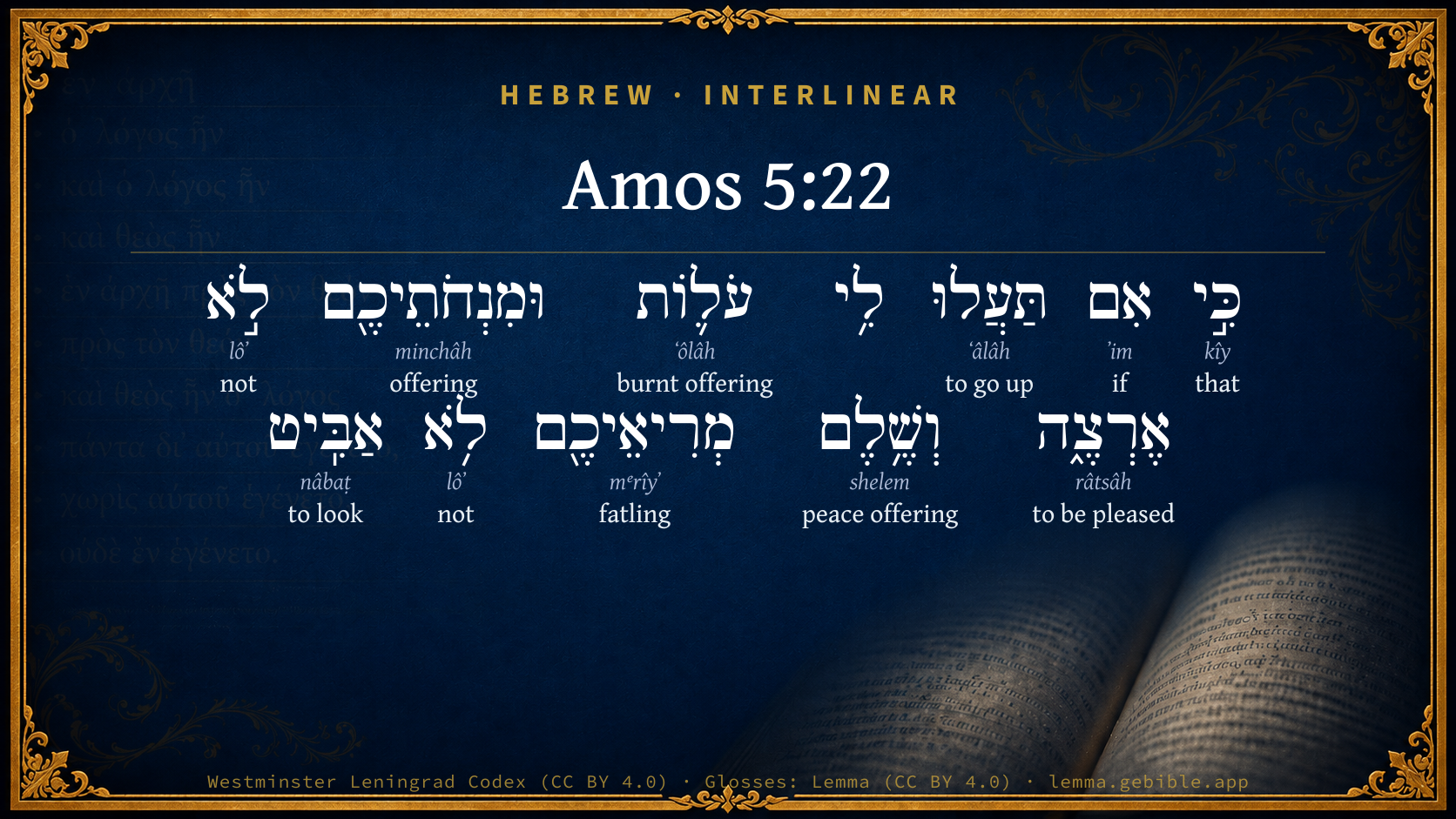
Hebrew (Westminster Leningrad Codex) Amos 5:22 appears in the Hebrew Old Testament. The text above is from the Westminster Leningrad Codex. Each word links to its Strong’s number, a concise gloss, and parsing drawn from the Open Scriptures Hebrew Bible morphology. Click any word for its full Brown-Driver-Briggs (BDB) entry.
Download image
Cite this verse

Amos 5:22 (World English Bible). Public Domain. Lemma interlinear Bible study tool, https://lemma.gebible.app/v/amos/5/22.

Show BibTeX & RIS
BibTeX
RIS
English Translation
Yes, though you offer me your burnt offerings and meal-offerings, I will not accept them; Neither will I regard the peace offerings of your fat animals.
World English Bible · Public Domain
Download a study sheet

One document with this verse’s original text, its word-by-word gloss line, the meaning frame, cross-references with their text, attributed commentary, and full source and license credits — printable, and it pastes into notes with its structure intact.

This verse Autodidact and up

Study sheet (.html) Plain text (.txt)

A passage Seminary Student

Up to 50 verses in one chapter. A passage sheet keeps up to 6 commentary sources and 12 cross-references per verse, in the order this page ranks them, and says so on the sheet whenever that leaves anything out. Ask for a single verse and you get the Autodidact verse sheet above.

Everything on this page stays free to read, with no account — the sheet is a download of what is already on screen, not access to it.

Want to remove ads? Support Godless Engineer
Compare translations 3

The same verse in 3 English versions, stacked beneath the original-language interlinear above. Click any original word for its lexicon entry.

Each is an independent rendering of the whole verse — the interlinear is not word-aligned to these translations.

Highlighted words mark where these versions differ — a whole-verse word diff, not a word-by-word alignment.

  • World English Bible Public Domain
    Yes, though you offer me your burnt offerings and meal-offerings, I will not accept them; Neither will I regard the peace offerings of your fat animals.
  • King James Version Public Domain
    Though ye offer me burnt offerings and your meat offerings, I will not accept them: neither will I regard the peace offerings of your fat beasts.
  • unfoldingWord Literal Text CC BY-SA 4.0
    Even though you offer me your burnt offerings and grain offerings, I will not accept them, neither will I look at the fellowship offerings of your fattened animals.

unfoldingWord Literal Text — © unfoldingWord, licensed CC BY-SA 4.0. Word-aligned USFM3 via Door43 (git.door43.org/unfoldingWord/en_ult).

Versions to compare (up to 4)

3 of 4 selected

Show all 18 translations

Every available English version of this verse, each an independent rendering of the whole verse.

  • World English Bible Public Domain
    Yes, though you offer me your burnt offerings and meal-offerings, I will not accept them; Neither will I regard the peace offerings of your fat animals.
  • Berean Standard Bible Public Domain
    Even though you offer Me burnt offerings and grain offerings, I will not accept them; for your peace offerings of fattened cattle I will have no regard.
  • Majority Standard Bible Public Domain
    Even though you offer Me burnt offerings and grain offerings, I will not accept them; for your peace offerings of fattened cattle I will have no regard.
  • King James Version Public Domain
    Though ye offer me burnt offerings and your meat offerings, I will not accept them: neither will I regard the peace offerings of your fat beasts.
  • American Standard Version (1901) Public Domain
    Yea, though ye offer me your burnt-offerings and meal-offerings, I will not accept them; neither will I regard the peace-offerings of your fat beasts.
  • Revised Version (1885) Public Domain
    Yea, though ye offer me your burnt offerings and meal offerings, I will not accept them: neither will I regard the peace offerings of your fat beasts.
  • Geneva Bible (1599) Public Domain
    Though ye offer me burnt offrings and meat offrings, I wil not accept them: neither will I regard the peace offrings of your fat beasts.
  • Douay-Rheims (1899) Public Domain
    And if you offer me holocausts, and your gifts, I will not receive them: neither will I regard the vows of your fat beasts.
  • Young's Literal Translation Public Domain
    For though ye cause burnt-offerings and your presents to ascend to Me, I am not pleased, And the peace-offering of your fatlings I behold not.
  • Literal Standard Version CC BY-SA 4.0
    For though you cause burnt-offerings and your presents to ascend to Me, || I am not pleased, || And I do not behold the peace-offering of your fatlings.
  • Unlocked Literal Bible CC BY-SA 4.0
    Even though you offer me your burnt offerings and grain offerings, I will not accept them, neither will I look at the fellowship offerings of your fattened animals.
  • unfoldingWord Literal Text CC BY-SA 4.0
    Even though you offer me your burnt offerings and grain offerings, I will not accept them, neither will I look at the fellowship offerings of your fattened animals.
  • Darby Bible Public Domain
    For if ye offer up unto me burnt-offerings and your oblations, I will not accept [them]; neither will I regard the peace-offerings of your fatted beasts.
  • World Messianic Bible Public Domain
    Yes, though you offer me your burnt offerings and meal offerings, I will not accept them; neither will I regard the peace offerings of your fat animals.
  • Webster's Bible Public Domain
    Though ye offer me burnt-offerings and your meat-offerings, I will not accept them; neither will I regard the peace-offerings of your fat beasts.
  • Free Bible Version CC BY-SA 4.0
    Even though you present me with burnt offerings and grain offerings, I will not accept them. As for your peace offerings of fattened cattle—I will not even look at them.
  • Bible in Basic English Public Domain
    Even if you give me your burned offerings and your meal offerings, I will not take pleasure in them: I will have nothing to do with the peace-offerings of your fat beasts.
  • JPS Tanakh (1917) Public Domain
    Yea, though ye offer me burnt-offerings and your meal-offerings, I will not accept them; neither will I regard the peace-offerings of your fat beasts.

Literal Standard Version (2020), Covenant Press — licensed CC BY-SA 4.0. Text via the HelloAO Bible API (eBible.org). Unlocked Literal Bible (unfoldingWord) — licensed CC BY-SA 4.0. Text via the HelloAO Bible API (eBible.org). unfoldingWord Literal Text — © unfoldingWord, licensed CC BY-SA 4.0. Word-aligned USFM3 via Door43 (git.door43.org/unfoldingWord/en_ult). Free Bible Version, Dr. Jonathan Gallagher — licensed CC BY-SA 4.0. Text via the HelloAO Bible API (eBible.org).

Word by word

More ways to search: Search by grammar → Find every occurrence → Compare this word →

Practice this passage: Drill this verse → Learn its vocabulary →

מְרִיאֵיכֶ֖ם
mᵉrîyʼ
H4806
“fatlings · your”
Noun, Common, Masculine, Plural, Construct + Suffix, Personal, 2nd Person, Masculine, Plural
Part of Speech
Noun
Type
Common
Gender
Masculine
Number
Plural
State
Construct
Full BDB Definition

Origin: from H4754 in the sense of grossness, through the idea of domineering (compare H4756 )

TWOT: 1239a

well-fed, fatling
  1. כִּ֣י kîy H3588 “that” Conjunction
  2. אִם ʼim H518 “if” Conjunction
  3. תַּעֲלוּ ʻâlâh H5927 “to go up” Verb, Hiphil, Imperfect, 2nd Person, Masculine, Plural
  4. עֹל֛וֹת ʻôlâh H5930 “burnt offerings” Noun, Common, Feminine, Plural, Absolute
  5. וּמִנְחֹתֵיכֶ֖ם minchâh H4503 “and · offerings · your” Conjunction + Noun, Common, Feminine, Plural, Construct + Suffix, Personal, 2nd Person, Masculine, Plural
  6. לֹ֣א lôʼ H3808 “not” Particle, Negative
  7. אֶרְצֶ֑ה râtsâh H7521 “to be pleased” Verb, Qal, Imperfect, 1st Person, Common, Singular
  8. וְשֶׁ֥לֶם shelem H8002 “and · peace offering of” Conjunction + Noun, Common, Masculine, Singular, Construct
  9. לֹ֥א lôʼ H3808 “not” Particle, Negative
  10. אַבִּֽיט nâbaṭ H5027 “to look” Verb, Hiphil, Imperfect, 1st Person, Common, Singular

About this verse

These counts appear in no published source. They are computed here, from the morphology-tagged text and Lemma’s own curated glosses. What Lemma adds →

12
words
10
distinct lemmas
Prophets
section

Notable vocabulary

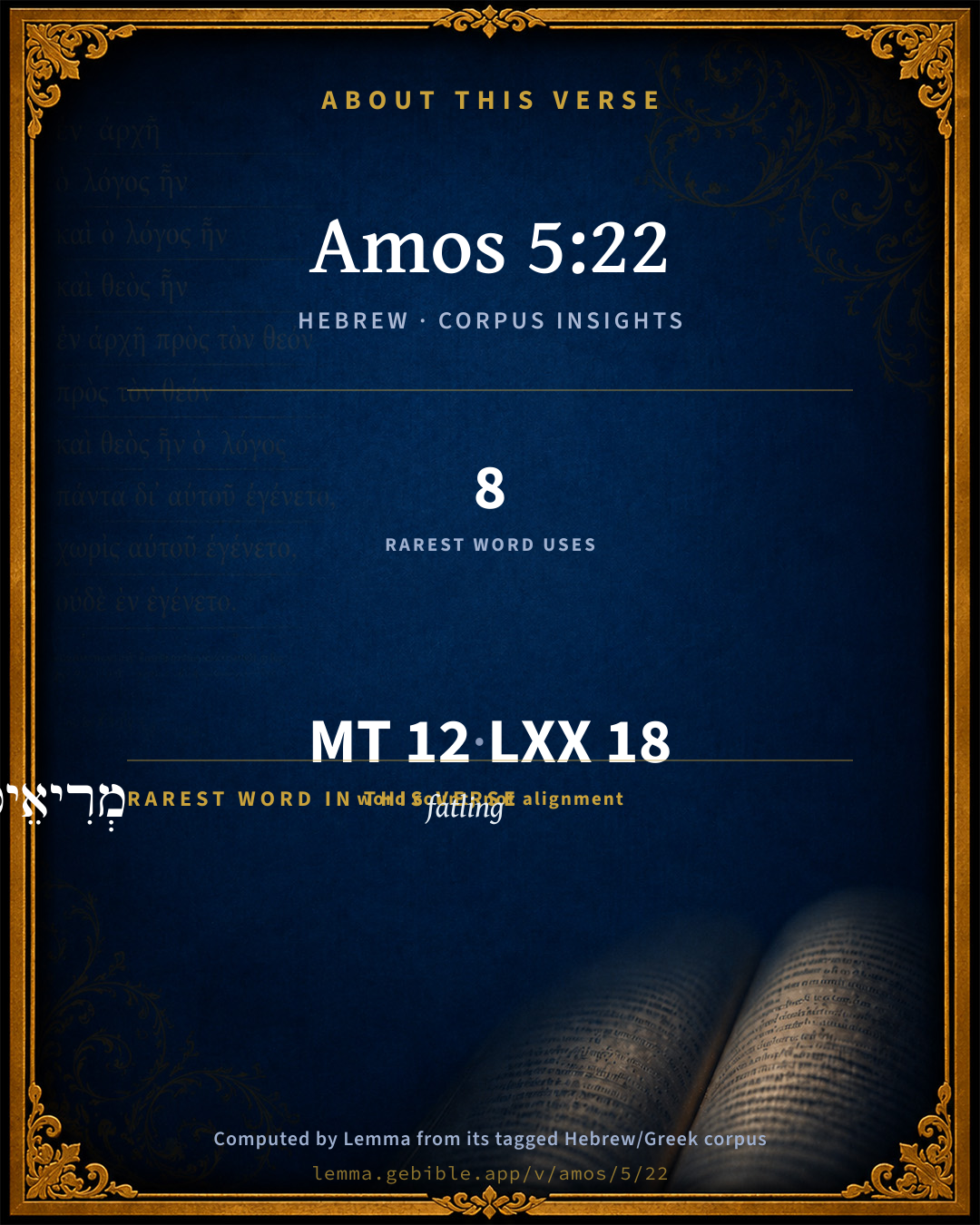
The rarest word here is מְרִיאֵיכֶ֖ם fatling H4806 — appearing just 8 times in the whole Hebrew Bible.

Shared distinctive vocabulary

מְרִיאֵיכֶ֖ם fatling H4806 occurs in 8 verses of the Hebrew Bible. Also found in:

Grammatical profile

  • 3 verbs
  • 4 nouns
  • 1 preposition
  • 2 conjunctions
  • 2 particles

Verb forms

  • תַּעֲלוּ Hiphil · Imperfect
  • אֶרְצֶ֑ה Qal · Imperfect
  • אַבִּֽיט Hiphil · Imperfect

Repetition

A word recurs within this verse — often emphatic in Hebrew:

Hebrew & Septuagint length

In English translation the verse runs 26 words from the Hebrew and 26 from the Septuagint (LXX English) — the same length.

A rough comparison of the two English renderings, which tokenize alike — not a word-level alignment.

Word counts can differ between the Hebrew and the Greek without any difference in meaning — e.g. the Hebrew direct-object marker אֵת has no separate Greek word, and Greek often adds the article ὁ.

In the original languages it is 12 Hebrew tokens and 18 Greek tokens — but the two are counted differently (Hebrew bundles its prefixes and suffixes into one token; the Greek is in lemma form), so that isn’t a like-for-like length.

Cross-references

8

Topical passages linked to Amos 5:22 in the Treasury of Scripture Knowledge — connected by theme and wording, ordered by reader-vote popularity; previews shown in the World English Bible.

  • Micah 6:6–7 How shall I come before Yahweh, And bow myself before the exalted God? Shall I come before him with burnt offerings, With calves a year old?
  • Amos 4:4–5 "Go to Bethel, and sin; To Gilgal, and sin more. Bring your sacrifices every morning, Your tithes every three days,
  • Isaiah 66:3 He who kills an ox is as he who kills a man; he who sacrifices a lamb, as he who breaks a dog's neck; he who offers an offering, [as he who offers] pig's blood; he who burns frankincense, as he who blesses an idol. Yes, they have chosen their own ways, and their soul delights in their abominations:
  • Leviticus 7:12–15 If he offers it for a thanksgiving, then he shall offer with the sacrifice of thanksgiving unleavened cakes mixed with oil, and unleavened wafers anointed with oil, and cakes mixed with oil.
  • Psalms 50:8–14 I don't rebuke you for your sacrifices. Your burnt offerings are continually before me.
  • Psalms 50:23 Whoever offers the sacrifice of thanksgiving glorifies me, And prepares his way so that I will show God's salvation to him."
  • Psalms 107:21–22 Let them praise Yahweh for his loving kindness, For his wonderful works to the children of men!
  • Psalms 116:17 I will offer to you the sacrifice of thanksgiving, And will call on the name of Yahweh.

Cross-references courtesy of OpenBible.info (CC BY 4.0).

Hebrew and Greek witnesses Masoretic Hebrew ↔ Greek Septuagint

The same verse in the two great witnesses to the Old Testament, shown verse-for-verse.

These are two independent witnesses, not word-aligned to each other, and the Septuagint is shown in lemma (dictionary) form.

Hebrew Amos 5:22 Masoretic · Westminster Leningrad Codex

כִּ֣י אִם תַּעֲלוּ לִ֥י עֹל֛וֹת וּמִנְחֹתֵיכֶ֖ם לֹ֣א אֶרְצֶ֑ה וְשֶׁ֥לֶם מְרִיאֵיכֶ֖ם לֹ֥א אַבִּֽיט

Yes, though you offer me your burnt offerings and meal-offerings, I will not accept them; Neither will I regard the peace offerings of your fat animals.

World English Bible · Public Domain

Greek LXX Amos 5:22 Septuagint · lemma form

διότι καί ἐάν φέρω ἐγώ ὁλοκαύτωμα καί θυσία σύ οὐ προςδέχομαι αὐτός καί σωτήριον ἐπιφανεία σύ οὐ ἐπιβλέπω

Therefore if you⌃ should bring me your whole burnt sacrifices and meat-offerings, I will not accept them: neither will I have respect to your grand peace-offerings.

LXX2012 (modern English Septuagint) · Public Domain

On this verse, John Gill's Exposition discusses the Septuagint’s reading. Read the note in Commentary ↓

Hebrew: Westminster Leningrad Codex (CC BY 4.0). Greek: Septuagint (public domain); English from LXX2012 (modern English Septuagint) (Public Domain). How the Septuagint differs from the Hebrew →

Targum (Aramaic paraphrase)

1

The Targum is the ancient Jewish Aramaic paraphrase of the Hebrew Scriptures — an interpretive translation, not the Hebrew text itself. Onkelos (literal) and Pseudo-Jonathan (expansive) render the Torah, and Jonathan the Prophets. Coverage is partial: where no permissively-licensed English translation exists for a verse, only the Aramaic is shown. This is verse-level text, not a word-by-word alignment to the Hebrew.

  1. Targum Jonathan Prophets (Joshua–Malachi)
    אֲרֵי אִם תִּסְקוּן קֳדָמַי עַלְוָן וְקוּרְבְּנֵיכוֹן לָא לְרַעֲוָא וְנִכְסַת קוּדְשֵׁיכוֹן לָא יִתְקַבְּלוּן קֳדָמַי:

    (no public-domain English translation for this verse)

    Targum Jonathan — Aramaic: “Mikraot Gedolot” (public domain). English: “Sefaria Community Translation” (CC0 1.0 (public-domain dedication)); “London "Chaldee Paraphrase," 1871” (public domain). Text via Sefaria.

Commentary

Notes on Amos 5:22 from classic Christian and Jewish commentators (each source and its license shown beneath its notes). The classic Christian expositions comment on the surrounding passage and are grouped to its opening verse, so a note may address several verses; the Jewish commentaries on the Tanakh (Rashi and others) are per-verse, so they appear only where the commentator wrote on this verse.

Lemma curates 59 commentaries, every one of them public domain or Creative Commons licensed, each selected and text-cleaned for this edition rather than reprinted as found. About our sources →

Trapp's Complete Commentary

John Trapp

Amo 5:22 Though ye offer me burnt offerings and your meat offerings, I will not accept [them]: neither will I regard the peace offerings of your fat beasts.

Ver. 22. Though ye offer me burnt offerings, &c.] So long as ye stick in the bark, please yourselves in the external performance, rest in the work done, think to expiate your sins by your duties, and to set off with God for your bad deeds by your good, and to get a licence thereby to live as you list: "though ye offer me burnt offerings," which were wholly burnt in sacrifice to God, and so were ordinarily most acceptable.

I will not accept them] Nor shall you be a button the better for them, but the worse. Isa 63:8, yea, though ye added wine, oil, and incense, that there might be a savour of rest in it. The very heathens could say, that God’s favour is not to be gained by multitude of sacrifices, but by the integrity of those that offer them.

Neither will I regard (or look at) the peace offerings of your fat beasts] Whether sheep or oxen, or another distinct creature bigger than an ox, called in the Arabic dialect gamus, as Aben Ezra affirmeth, the French call it buffie, and we the buffe, or wild ox: all would not do; God would neither see nor hear, as it followeth.

John Trapp, A Commentary or Exposition upon All the Books of the Old and New Testament (1647–1656) — public domain. Text from a community e-Sword module.

Tyndale Open Study Notes

Tyndale Open Resources

5:22 God would not accept the offerings (see Lev 1–6) of the Israelites because they were attempts to manipulate him magically rather than signs of true repentance and faith.

Tyndale Open Study Notes — © Tyndale Open Resources, licensed CC BY-SA 4.0. Text via the HelloAO Bible API.

Geneva Bible (1599)

Geneva Bible translators

Because ye have corrupted my true service, and remain obstinate in your vices, Isa. 1:11; Jer. 6:10.

Geneva Bible (1599) marginal notes — public domain. Text via Bolls.life.

Jamieson, Fausset & Brown

Robert Jamieson, A. R. Fausset & David Brown

meat offerings--flour, &c. Unbloody offerings.

peace offerings--offerings for obtaining from God peace and prosperity. Hebrew, "thank offerings."

Jamieson, Fausset & Brown — Commentary Critical and Explanatory on the Whole Bible (1871) — public domain (CC PDM 1.0). Text via the HelloAO Bible API.

Adam Clarke's Commentary

Verse 22. The peace-offerings of your fat beasts.] מריאיכם merieychem probably means buffaloes; and so Bochart.

Adam Clarke's Commentary on the Bible (1810–1826) — public domain. Text from a community e-Sword/MySword module.

John Calvin's Commentaries

When ye offer me sacrifices and your gift, etc. מנחה, meneche, properly means a gift of flour, which was an addition to the sacrifice; but it is often taken generally for any kind of offering. It is indeed certain that the Prophet meant, that however much the Israelites accumulated their ritual observances, they did nothing towards appeasing God, inasmuch as they observed not the law that was given them; and they turned also to a wrong purpose their sacrifices; for they did not exercise themselves in piety and in the spiritual worship of God, but, on the contrary, spread veils before God, that by presenting a fictitious form of worship, they might cover all their sins; for they thought themselves to be hidden from God.

This is the reason why the Prophet declares that these offerings would not be received by God, לא ארצה, la areste, I will not accept them. The Prophet no doubt alludes here to those promises, which are to be found everywhere in the law, as he did when he said in the last verse, לא אריח, la arich, I will not smell רוחה, ruch, means to smell; and Moses often uses the expression, that God is delighted with the odour of sacrifices, or with the smell of incense. But when the Lord declares that odour is pleasant to him, he means that it is so, provided the people sacrificed rightly, that is, when they brought not sacrifices as false veils to cover their sins, but as true and real evidences of their faith and repentance; God promised in that case that sacrifices would be a sweet odour to him. Now, on the contrary, he declares that the perfume would not be acceptable to him, nor sacrifices appeasing. But sacrifices not only were acceptable to God, but also pacified him. Since then the Lord had so often said, that he would be propitious to his people, when sacrifices were offered, it was necessary expressly to cut off this confidence from the Israelites, when they dealt not faithfully with God. God never disappointed his true worshipers, but ever received them into favor, provided they approached him in sincerity. But as these hypocrites dealt falsely with him, they were necessarily disappointed of their hope, as the Prophet here declares.

The peace-offerings of your fat things, he says, I will not regard God indeed promised in the law that he would regard their sacrifices provided they were lawful; but as the Israelites had in two ways departed from pure worship, God now justly says, I will not look on your sacrifices, nor on the peace-offerings of your fat things He calls them the peace-offerings of fat things, intimating, that though the beasts were the choicest, they would not yet be acceptable to him; for the Lord regards not fatness, as he needs neither meat nor drink. Then, in a word, the Prophet here sets this fatness in opposition to true godliness and obedience too. In both respects there was, as we have seen, a defect among the Israelites; for they obeyed not the law as to its outward requirements, and their hearts were impure and perverse: hence all their sacrifices were necessarily polluted and corrupt.

John Calvin's Commentaries (1540-1563) — public domain. Text from the Calvin Translation Society English edition (1840s-50s) via the Christian Classics Ethereal Library (ccel.org). Calvin's coverage is partial (roughly two-thirds of the Bible); uncommented books and verses are honest gaps, never fabricated. The 19th-century editor's footnotes and remarks are omitted so the notes are faithfully Calvin's own voice.

The Cambridge Bible for Schools and Colleges

gen. ed. J. J. S. Perowne

22. The commonest and most popular kinds of sacrifice are particularized as rejected by Jehovah. The burnt- and peace-offerings are often mentioned in the historical books, and were frequently sacrificed together (Exo_20:24; Exo_32:6; Jdg_20:26; Jdg_21:4; 1Sa_10:8; 1Sa_13:9; 2Sa_6:17; 2Sa_24:25; 1Ki_3:15; cf. Isa_1:11, where ‘the fat of fed beasts’ is an allusion to the peace-offering). The peace-offering, being the sacrifice most commonly offered, is also often called ‘sacrifice’ (lit. slaughtering) simply: Exo_18:12; Deu_12:6; 1Sa_6:15 al.).

meat offerings] meal-offerings, or cereal offerings. The word ‘meat’ has altered its meaning since the time when the A.V. was made, and is now restricted to flesh: so that the rendering ‘meat offering’ for offerings consisting exclusively of either parched corn or various preparations of flour (see Leviticus 2) has become altogether misleading. The Heb. word minḥah means properly a present or gift, especially one offered to a king or noble, to do him homage or secure his favour (Gen_32:13; Gen_43:11; 1Sa_10:27), and euphemistically for tribute, 2Sa_8:2; 2Sa_8:6 &c.: hence it is used sometimes in a general sense of gifts offered in sacrifice to God (Gen_4:3-5; Num_16:15; 1Sa_2:17; 1Sa_2:29; 1Sa_26:19); in the priestly sections of the Pent., on the other hand, it is used exclusively in the narrower and technical sense of a ‘meal-offering.’ It seems therefore that the custom must have gradually grown up of designating animal sacrifices by their special names (burnt-offering, peace-offering &c.), while minḥah was more and more restricted to vegetable offerings alone. This double application of the term sometimes makes it uncertain whether ‘offering’ in general, or ‘meal-offering’ in particular, is denoted by it. Where, however, as here, it stands beside the names of two other species of sacrifice, it has the presumption of being used to denote a special kind likewise (cf. Jos_22:23; Jdg_13:23; 1Ki_8:64).

fat beasts] or fatlings, 2Sa_6:13, 1Ki_1:9; 1Ki_1:19; 1Ki_1:25, and (in the same connexion) Isa_1:11 (where, on account of the word fat, with which it is joined, it is in the English version rendered fed beasts). In the ‘peace-offering’ the fat parts were those which were specially set apart to be “burnt” (הקטיר), i.e. consumed in sweet smoke (cf. on Amo_4:5), upon the altar (Lev_3:3-5; Lev_3:9-11; Lev_3:14-16).

The Cambridge Bible for Schools and Colleges (gen. ed. J. J. S. Perowne; Cambridge University Press, 1878–1918) — public domain. Text from a community e-Sword module.

John Gill's Exposition

Though ye offer me burnt offerings, and your meat offerings, I will not accept them,.... The daily burnt offerings, morning and night, and others which were wholly the Lord's; and the "minchah", or bread offering, which went along with them; in which they thought to do God service, and to merit his favour; but instead of that they were unacceptable to him, being neither offered up in a proper place, if in a right manner according to the law of Moses; however, not in the faith of the great sacrifice, Christ; nor attended with repentance towards God:

neither will I regard the peace offerings of your fat beasts; even though their peace offerings were of the best of the herd. Aben Ezra says the creature here meant is the same which in the Ishmaelitish or Arabic language is called "giamus", a creature bigger than an ox, and like one, which is called a buffle or buffalo. And so Ben Melech says it means one of the kinds of the larger cattle; for not a lamb, a ram, or a sheep, is meant, as the word is sometimes rendered by the Septuagint, but a creature like an ox; not larger, or the wild ox, as the above Hebrew writers, but smaller; with which agrees the description Bellonius (n) gives of the Syrian "bubalus" or "buffalo", which he calls a small ox, full bodied, little, smooth, sleek, fat, and well made; and is no doubt the same the Arabs call "almari", from its smoothness.

(n) Apud Bochart. Hierozoic. p. 1. l. 2. c. 28. col. 283.

John Gill's Exposition of the Whole Bible (1746–1763) — public domain (CC PDM 1.0). Text via the HelloAO Bible API.

Haydock's Catholic Bible Commentary

Vows. Hebrew, "peace-offerings of your mercies;" a sort of oxen, 2 Kings vi. 13., and 3 Kings i. 9. Septuagint, "the salvation of your appearance," or what you offer for your welfare.

George Leo Haydock (1774–1849), Haydock's Catholic Family Bible and Commentary, 1859 edition — public domain. Excludes Psalms (Douay-Rheims chapter numbering differs from Protestant) and Deuterocanonical books (Catholic canon only).

Matthew Poole's English Annotations

Though ye, that have departed from my temple, law, and institutions, you of the ten tribes, offer me burnt-offerings; which was wholly burnt on the altar; no part due to any but God; of this these hypocrites had a high esteem, Mic 6:6, because they accounted it an entire gift to God.

And your meat-offerings; to your burnt-offering add the other, your meat-offering also, as Lev 2:1,2; Num 6:17. See Joe 1:13; 2:14.

I will not accept them; it may be a meiosis, I will hate them, as Amo 5:21.

Neither will I regard the peace-offerings; your thank-offerings too, of which Lev 6:12; 7:15, your praises for your prosperity, are no better pleasing neither.

Of your fat beasts: in these peace-offerings, though you bring the best, the fattest, yet you bring nothing but a beast, for you leave your hearts with your sins; and you have no warrant from God to do this, nay, you are prohibited, for you are to offer only at Jerusalem, and at the temple.

Matthew Poole's English Annotations on the Holy Bible (1683–1685) — public domain. Text from a community e-Sword/MySword module.

The Pulpit Commentary

They maintained the formal ritual of the Mosaic worship in their idolatry. The various offerings are here enumerated. Burnt offerings; oJlokautwmata (Exo_29:38, Exo_29:42; Num_28:9-11) Meat offerings; qusiav (Septuagint); munera (Vulgate); Exo_29:40, Exo_29:41; ouv Lev_2:1. Peace offerings of your fat beasts; swthri ejpifaneiav, "your grand peace offerings" (Septuagint); vota pinguium vestrorum (Vulgate); Lev_3:1, etc.

The Pulpit Commentary (1880–1919), ed. H.D.M. Spence-Jones & Joseph S. Exell — public domain. Text from a community e-Sword module.

Rashi

Rabbi Shlomo Yitzchaki (Rashi)

and the peace offerings of your fattened cattle Heb. שֶׁלֶם מְרִיאֵיכֶם, the peace offerings of your fatlings, i.e, fattened cattle.

Rashi on the Tanakh — English translations: “The Judaica Press complete Tanach with Rashi, translated by A. J. Rosenberg” (CC BY 4.0); “Pentateuch with Rashi's commentary by M. Rosenbaum and A.M. Silbermann, 1929-1934” (public domain); “The Metsudah Tanach series, Lakewood, N.J” (CC BY 4.0); and “The Book of Joshua, Metsudah Publications, 1997” (CC BY 4.0). Text via Sefaria.

Lesson kit

Teaching starters — assembled from the data on this page, not authored interpretation. Every prompt links to the verse data it draws on. Edit before teaching.

Amos, in the Prophets, opens this verse with 12 words (10 distinct Hebrew lemmas). Its most distinctive word is mᵉrîyʼ (“fatling”). A historical commentator’s framing appears above. Read the whole chapter for the surrounding context.

Discussion questions

  1. What does “fatling” (mᵉrîyʼ) contribute to the verse as a whole?
  2. How does 2 Samuel 6:13, which shares the word «fatling», read alongside this verse?
  3. What does the repetition of “not” (2× in this one verse) do in this verse?
  4. These translations render this verse differently. What is at stake in choosing one wording over another?
  5. «תַּעֲלוּ» is a Hiphil Imperfect verb. How does that grammatical form shape the action described?
  6. Compare how Trapp's Complete Commentary and Tyndale Open Study Notes read this verse. Where do they agree or differ?

Things to notice

Reading settings

Reading text

Shown beneath each verse's original-language words.

Old Testament
Old Testament edition

Read the OT as the Masoretic Hebrew (MT) or the Greek Septuagint (LXX).

English shown for the Greek Septuagint (in the Hebrew ↔ Greek comparison).

Comparing translations? Open the Compare panel on any verse page to stack up to four side by side.