
Ezekiel 45:15

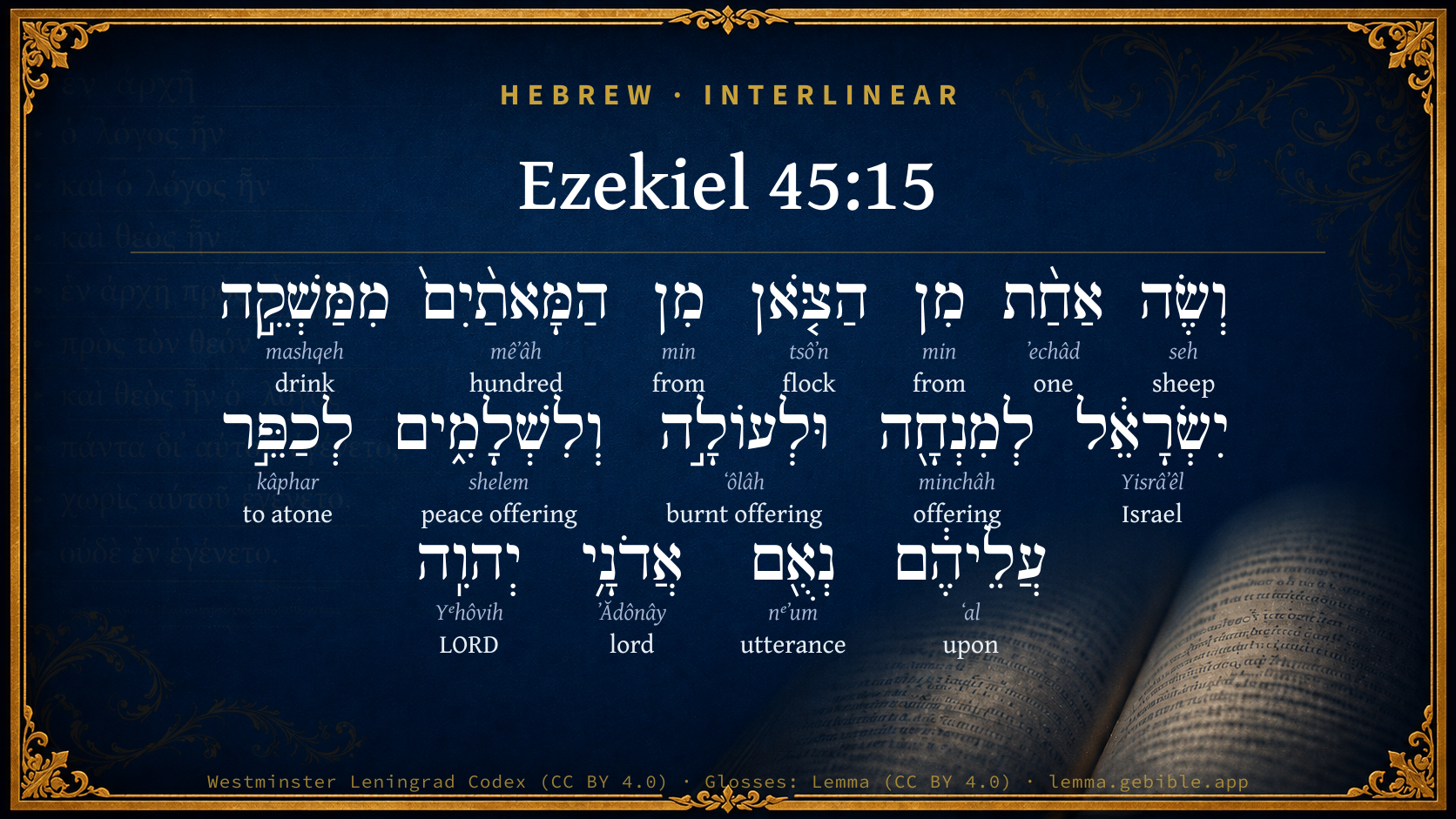
Hebrew (Westminster Leningrad Codex) Ezekiel 45:15 appears in the Hebrew Old Testament. The text above is from the Westminster Leningrad Codex. Each word links to its Strong’s number, a concise gloss, and parsing drawn from the Open Scriptures Hebrew Bible morphology. Click any word for its full Brown-Driver-Briggs (BDB) entry.
Download image
Cite this verse

Ezekiel 45:15 (World English Bible). Public Domain. Lemma interlinear Bible study tool, https://lemma.gebible.app/v/ezekiel/45/15.

Show BibTeX & RIS
BibTeX
RIS
English Translation
and one lamb of the flock, out of two hundred, from the well-watered pastures of Israel; -for a meal-offering, and for a burnt offering, and for peace-offerings, to make atonement for them, says the Lord Yahweh.
World English Bible · Public Domain
Download a study sheet

One document with this verse’s original text, its word-by-word gloss line, the meaning frame, cross-references with their text, attributed commentary, and full source and license credits — printable, and it pastes into notes with its structure intact.

This verse Autodidact and up

Study sheet (.html) Plain text (.txt)

A passage Seminary Student

Up to 50 verses in one chapter. A passage sheet keeps up to 6 commentary sources and 12 cross-references per verse, in the order this page ranks them, and says so on the sheet whenever that leaves anything out. Ask for a single verse and you get the Autodidact verse sheet above.

Everything on this page stays free to read, with no account — the sheet is a download of what is already on screen, not access to it.

Want to remove ads? Support Godless Engineer
Compare translations 3

The same verse in 3 English versions, stacked beneath the original-language interlinear above. Click any original word for its lexicon entry.

Each is an independent rendering of the whole verse — the interlinear is not word-aligned to these translations.

Highlighted words mark where these versions differ — a whole-verse word diff, not a word-by-word alignment.

  • World English Bible Public Domain
    and one lamb of the flock, out of two hundred, from the well-watered pastures of Israel; -for a meal-offering, and for a burnt offering, and for peace-offerings, to make atonement for them, says the Lord Yahweh.
  • King James Version Public Domain
    And one lamb out of the flock, out of two hundred, out of the fat pastures of Israel; for a meat offering, and for a burnt offering, and for peace offerings, to make reconciliation for them, saith the Lord GOD.
  • unfoldingWord Literal Text CC BY-SA 4.0
    One sheep or goat from the flock for every two hundred animals from the watered regions of Israel will be used for any burnt offering or peace offering to make atonement for the people—this is the Lord Yahweh’s declaration.

unfoldingWord Literal Text — © unfoldingWord, licensed CC BY-SA 4.0. Word-aligned USFM3 via Door43 (git.door43.org/unfoldingWord/en_ult).

Versions to compare (up to 4)

3 of 4 selected

Show all 18 translations

Every available English version of this verse, each an independent rendering of the whole verse.

  • World English Bible Public Domain
    and one lamb of the flock, out of two hundred, from the well-watered pastures of Israel; -for a meal-offering, and for a burnt offering, and for peace-offerings, to make atonement for them, says the Lord Yahweh.
  • Berean Standard Bible Public Domain
    And one sheep shall be given from each flock of two hundred from the well-watered pastures of Israel. These are for the grain offerings, burnt offerings, and peace offerings, to make atonement for the people, declares the Lord GOD.
  • Majority Standard Bible Public Domain
    And one sheep shall be given from each flock of two hundred from the well-watered pastures of Israel. These are for the grain offerings, burnt offerings, and peace offerings, to make atonement for the people, declares the Lord GOD.
  • King James Version Public Domain
    And one lamb out of the flock, out of two hundred, out of the fat pastures of Israel; for a meat offering, and for a burnt offering, and for peace offerings, to make reconciliation for them, saith the Lord GOD.
  • American Standard Version (1901) Public Domain
    and one lamb of the flock, out of two hundred, from the well-watered pastures of Israel; -for a meal-offering, and for a burnt-offering, and for peace-offerings, to make atonement for them, saith the Lord Jehovah.
  • Revised Version (1885) Public Domain
    and one lamb of the flock, out of two hundred, from the fat pastures of Israel; for a meal offering, and for a burnt offering, and for peace offerings, to make atonement for them, saith the Lord GOD.
  • Geneva Bible (1599) Public Domain
    And one lambe of two hundreth sheepe out of ye fat pastures of Israel for a meat offring, and for a burnt offring and for peace offrings, to make reconciliation for them, sayth the Lord God.
  • Douay-Rheims (1899) Public Domain
    And one ram out of a flock of two hundred, of those that Israel feedeth for sacrifice, and for holocausts, and for peace offerings, to make atonement for them, saith the Lord God.
  • Young's Literal Translation Public Domain
    and one lamb out of the flock, out of two hundred, out of the watered country of Israel, for a present, and for a burnt-offering, and for peace-offerings, to make atonement by them -- an affirmation of the Lord Jehovah.
  • Literal Standard Version CC BY-SA 4.0
    and one lamb out of the flock, out of two hundred, out of the watered country of Israel, for a present, and for a burnt-offering, and for peace-offerings, to make atonement by them—a declaration of Lord YHWH.
  • Unlocked Literal Bible CC BY-SA 4.0
    One sheep or goat from the flock for every two hundred animals from the watered regions of Israel will be used for any burnt offering or peace offering to make atonement for the people—this is the Lord Yahweh's declaration.
  • unfoldingWord Literal Text CC BY-SA 4.0
    One sheep or goat from the flock for every two hundred animals from the watered regions of Israel will be used for any burnt offering or peace offering to make atonement for the people—this is the Lord Yahweh’s declaration.
  • Darby Bible Public Domain
    and one lamb out of the flock, out of two hundred, from the well-watered pastures of Israel; -- for an oblation, and for a burnt-offering, and for peace-offerings, to make atonement for them, saith the Lord Jehovah.
  • World Messianic Bible Public Domain
    and one lamb of the flock out of two hundred, from the well-watered pastures of Israel—for a meal offering, for a burnt offering, and for peace offerings, to make atonement for them,” says the Lord GOD.
  • Webster's Bible Public Domain
    And one lamb out of the flock, out of two hundred, out of the fat pastures of Israel; for a meat-offering, and for a burnt-offering, and for peace-offerings, to make reconciliation for them, saith the Lord GOD.
  • Free Bible Version CC BY-SA 4.0
    In addition one sheep is to be supplied from every flock of two hundred from the green pastures of Israel. These are to provide for the grain offerings, burnt offerings, and peace offerings, to set the people right, declares the Lord God.
  • Bible in Basic English Public Domain
    And one lamb from the flock out of every two hundred, from all the families of Israel, for a meal offering and for a burned offering and for peace-offerings, to take away their sin, says the Lord.
  • JPS Tanakh (1917) Public Domain
    and one lamb of the flock, out of two hundred, from the well-watered pastures of Israel; for a meal-offering, and for a burnt-offering, and for peace-offerings, to make atonement for them, saith the Lord GOD.

Literal Standard Version (2020), Covenant Press — licensed CC BY-SA 4.0. Text via the HelloAO Bible API (eBible.org). Unlocked Literal Bible (unfoldingWord) — licensed CC BY-SA 4.0. Text via the HelloAO Bible API (eBible.org). unfoldingWord Literal Text — © unfoldingWord, licensed CC BY-SA 4.0. Word-aligned USFM3 via Door43 (git.door43.org/unfoldingWord/en_ult). Free Bible Version, Dr. Jonathan Gallagher — licensed CC BY-SA 4.0. Text via the HelloAO Bible API (eBible.org).

Word by word

More ways to search: Search by grammar → Find every occurrence → Compare this word →

Practice this passage: Drill this verse → Learn its vocabulary →

מִמַּשְׁקֵ֣ה
mashqeh
H4945
“from · drink of”
Preposition + Noun, Common, Masculine, Singular, Construct
Part of Speech
Preposition + Noun
Type
Common
Gender
Masculine
Number
Singular
State
Construct
Full BDB Definition

Origin: from H8248

TWOT: 2452c

irrigation, drink - irrigation - drink, drinking vessels - butlership (office of butler) - butler, cup-bearer
  1. וְשֶׂה seh H7716 “and · sheep” Conjunction + Noun, Common, Both, Singular, Absolute
  2. אַחַ֨ת ʼechâd H259 “one” Adjective, Cardinal number, Feminine, Singular, Absolute
  3. מִן min H4480 “from” Preposition
  4. הַצֹּ֤אן tsôʼn H6629 “the · flock” Particle, Definite Article + Noun, Common, Both, Singular, Absolute
  5. מִן min H4480 “from” Preposition
  6. הַמָּאתַ֨יִם֙ mêʼâh H3967 “the · hundred” Particle, Definite Article + Adjective, Cardinal number, Both, Dual, Absolute
  7. יִשְׂרָאֵ֔ל Yisrâʼêl H3478 “Israel” Noun, Proper
  8. לְמִנְחָ֖ה minchâh H4503 “to/for · offering” Preposition + Noun, Common, Feminine, Singular, Absolute
  9. וּלְעוֹלָ֣ה ʻôlâh H5930 “and · to/for · burnt offering” Conjunction + Preposition + Noun, Common, Feminine, Singular, Absolute
  10. וְלִשְׁלָמִ֑ים shelem H8002 “and · to/for · peace offerings” Conjunction + Preposition + Noun, Common, Masculine, Plural, Absolute
  11. לְכַפֵּ֣ר kâphar H3722 “to atone” Preposition + Verb, Piel, Infinitive Construct
  12. עֲלֵיהֶ֔ם ʻal H5921 “upon · them” Preposition + Suffix, Personal, 3rd Person, Masculine, Plural
  13. נְאֻ֖ם nᵉʼum H5002 “utterance of” Noun, Common, Masculine, Singular, Construct
  14. אֲדֹנָ֥י ʼĂdônây H136 “Lord · my” Noun, Common, Masculine, Plural, Construct + Suffix, Personal, 1st Person, Common, Singular
  15. יְהוִֽה Yᵉhôvih H3069 “LORD” Noun, Proper

About this verse

These counts appear in no published source. They are computed here, from the morphology-tagged text and Lemma’s own curated glosses. What Lemma adds →

16
words
15
distinct lemmas
Prophets
section

Notable vocabulary

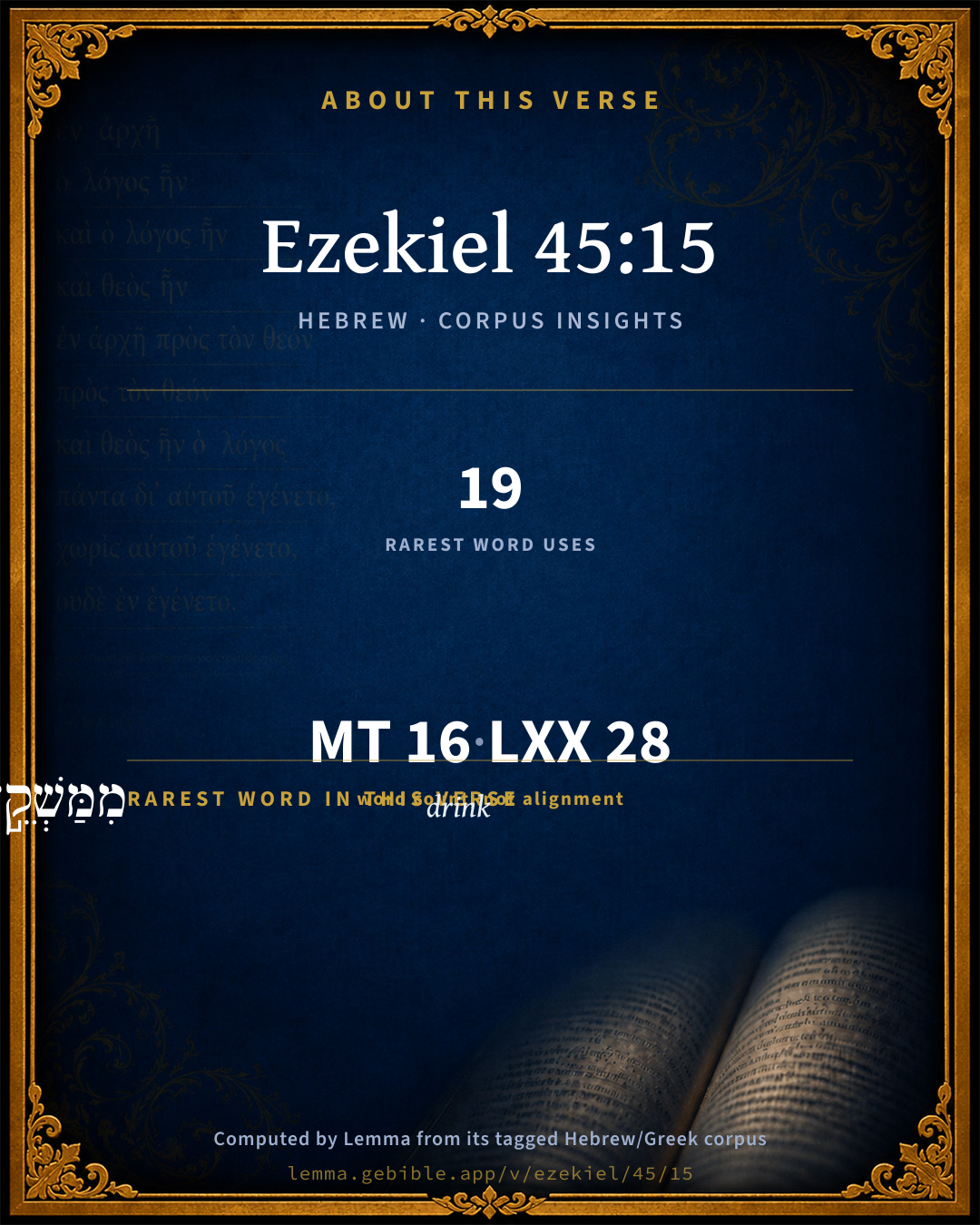
The rarest word here is מִמַּשְׁקֵ֣ה drink H4945 — appearing just 19 times in the whole Hebrew Bible.

Shared distinctive vocabulary

מִמַּשְׁקֵ֣ה drink H4945 occurs in 18 verses of the Hebrew Bible. Also found in:

Grammatical profile

  • 1 verb
  • 10 nouns
  • 2 adjectives
  • 3 prepositions

Verb forms

  • לְכַפֵּ֣ר Piel · Infinitive Construct

Repetition

A word recurs within this verse — often emphatic in Hebrew:

Hebrew & Septuagint length

In English translation the verse runs 36 words from the Hebrew and 37 from the Septuagint (LXX English) — closely comparable.

A rough comparison of the two English renderings, which tokenize alike — not a word-level alignment.

Word counts can differ between the Hebrew and the Greek without any difference in meaning — e.g. the Hebrew direct-object marker אֵת has no separate Greek word, and Greek often adds the article ὁ.

In the original languages it is 16 Hebrew tokens and 28 Greek tokens — but the two are counted differently (Hebrew bundles its prefixes and suffixes into one token; the Greek is in lemma form), so that isn’t a like-for-like length.

Cross-references

12

Topical passages linked to Ezekiel 45:15 in the Treasury of Scripture Knowledge — connected by theme and wording, ordered by reader-vote popularity; previews shown in the World English Bible.

  • Leviticus 1:4 He shall lay his hand on the head of the burnt offering, and it shall be accepted for him to make atonement for him.
  • Leviticus 6:30 No sin offering, of which any of the blood is brought into the Tent of Meeting to make atonement in the Holy Place, shall be eaten: it shall be burned with fire.
  • Proverbs 3:9–10 Honor Yahweh with your substance, With the first fruits of all your increase:
  • Daniel 9:24 Seventy weeks are decreed on your people and on your holy city, to finish disobedience, and to make an end of sins, and to make reconciliation for iniquity, and to bring in everlasting righteousness, and to seal up vision and prophecy, and to anoint the most holy.
  • Malachi 1:8 When you offer the blind for sacrifice, isn't that evil? And when you offer the lame and sick, isn't that evil? Present it now to your governor! Will he be pleased with you? Or will he accept your person?" says Yahweh of Hosts.
  • Malachi 1:14 "But the deceiver is cursed, who has in his flock a male, and vows, and sacrifices to the Lord a blemished thing; for I am a great King," says Yahweh of hosts, "and my name is awesome among the nations."
  • Romans 5:10 For if, while we were enemies, we were reconciled to God through the death of his Son, much more, being reconciled, we will be saved by his life.
  • 2 Corinthians 5:19–21 namely, that God was in Christ reconciling the world to himself, not reckoning to them their trespasses, and having committed to us the word of reconciliation.
  • Ephesians 2:16 and might reconcile them both in one body to God through the cross, having killed the hostility thereby.
  • Colossians 1:21 You, being in past times alienated and enemies in your mind in your evil works,
  • Hebrews 2:17 Therefore he was obligated in all things to be made like his brothers, that he might become a merciful and faithful high priest in things pertaining to God, to make atonement for the sins of the people.
  • Hebrews 9:22–23 According to the law, nearly everything is cleansed with blood, and apart from shedding of blood there is no remission.

Cross-references courtesy of OpenBible.info (CC BY 4.0).

Hebrew and Greek witnesses Masoretic Hebrew ↔ Greek Septuagint

The same verse in the two great witnesses to the Old Testament, shown verse-for-verse.

These are two independent witnesses, not word-aligned to each other, and the Septuagint is shown in lemma (dictionary) form.

Hebrew Ezekiel 45:15 Masoretic · Westminster Leningrad Codex

וְשֶׂה אַחַ֨ת מִן הַצֹּ֤אן מִן הַמָּאתַ֨יִם֙ מִמַּשְׁקֵ֣ה יִשְׂרָאֵ֔ל לְמִנְחָ֖ה וּלְעוֹלָ֣ה וְלִשְׁלָמִ֑ים לְכַפֵּ֣ר עֲלֵיהֶ֔ם נְאֻ֖ם אֲדֹנָ֥י יְהוִֽה

and one lamb of the flock, out of two hundred, from the well-watered pastures of Israel; -for a meal-offering, and for a burnt offering, and for peace-offerings, to make atonement for them, says the Lord Yahweh.

World English Bible · Public Domain

Greek LXX Ezekiel 45:15 Septuagint · lemma form

καί πρόβατον ἀπό ὁ δέκα πρόβατον ἀφαίρεμα ἐκ πᾶς ὁ πατριά ὁ ἰσραήλ εἰς θυσία καί εἰς ὁλοκαύτωμα καί εἰς σωτήριον ὁ ἐκἱλάσκομαι περί σύ λέγω κύριος θεός

And one sheep from the flock out of ten, as an oblation from all the tribes of Israel, for sacrifices, and for whole burnt offerings, and for peace-offerings, to make atonement for you, says the Lord God.

LXX2012 (modern English Septuagint) · Public Domain

On this verse, The Cambridge Bible for Schools and Colleges discusses the Septuagint’s reading. Read the note in Commentary ↓

Hebrew: Westminster Leningrad Codex (CC BY 4.0). Greek: Septuagint (public domain); English from LXX2012 (modern English Septuagint) (Public Domain). How the Septuagint differs from the Hebrew →

Targum (Aramaic paraphrase)

1

The Targum is the ancient Jewish Aramaic paraphrase of the Hebrew Scriptures — an interpretive translation, not the Hebrew text itself. Onkelos (literal) and Pseudo-Jonathan (expansive) render the Torah, and Jonathan the Prophets. Coverage is partial: where no permissively-licensed English translation exists for a verse, only the Aramaic is shown. This is verse-level text, not a word-by-word alignment to the Hebrew.

  1. Targum Jonathan Prophets (Joshua–Malachi)
    וְאִימַר חַד מִן עֲנָא מִן מָאתָן דַחֲזֵי לְמִסַת מִפַּטְמָא דְיִשְׂרָאֵל לְמִנְחֲתָא וְלַעֲלָתָא וּלְנִכְסַת קוּדְשַׁיָא לְכַפָּרָא עֲלֵיהוֹן אֲמַר יְיָ אֱלֹהִים:

    (no public-domain English translation for this verse)

    Targum Jonathan — Aramaic: “Mikraot Gedolot” (public domain). English: “Sefaria Community Translation” (CC0 1.0 (public-domain dedication)); “London "Chaldee Paraphrase," 1871” (public domain). Text via Sefaria.

Commentary

Notes on Ezekiel 45:15 from classic Christian and Jewish commentators (each source and its license shown beneath its notes). The classic Christian expositions comment on the surrounding passage and are grouped to its opening verse, so a note may address several verses; the Jewish commentaries on the Tanakh (Rashi and others) are per-verse, so they appear only where the commentator wrote on this verse.

Lemma curates 59 commentaries, every one of them public domain or Creative Commons licensed, each selected and text-cleaned for this edition rather than reprinted as found. About our sources →

Trapp's Complete Commentary

John Trapp

Eze 45:15 And one lamb out of the flock, out of two hundred, out of the fat pastures of Israel; for a meat offering, and for a burnt offering, and for peace offerings, to make reconciliation for them, saith the Lord GOD.

Ver. 15. Out of the fat pastures.] Those that are well watered and most fruitful. God must have the very best of the best, and that on pain of a heavy curse. {Mal 1:14}

John Trapp, A Commentary or Exposition upon All the Books of the Old and New Testament (1647–1656) — public domain. Text from a community e-Sword module.

The Cambridge Bible for Schools and Colleges

gen. ed. J. J. S. Perowne

15. The due out of the flock was one in two hundred.

the fat pastures] lit. the watered land of Israel (Gen_13:10). LXX. reads, out of all the families of Israel. These dues from the flock and from the soil were for purposes of sacrifice and offering (Eze_45:17).

The Cambridge Bible for Schools and Colleges (gen. ed. J. J. S. Perowne; Cambridge University Press, 1878–1918) — public domain. Text from a community e-Sword module.

John Gill's Exposition

And one lamb out of the flock, out of two hundred,.... As provision is before made for bread and oil, so here for meat for the servants of the Lord: if a man had two hundred lambs in his flock, one of them was to be given to them; it may be observed, that this plainly refers to times when the Mosaic dispensation should be abrogated; not tithes of all things are to be given to the priests, as heretofore; only the sixtieth part of wheat and barley, the hundredth part of oil, and but one lamb of two hundred; and which denotes the moderate maintenance of Gospel ministers, with which they should be contented, and the people should not grudge to give; nothing extraordinary or extravagant being required of them: this lamb was to be taken

out of the fat pastures of Israel; or, out of the watery places (c); out of those fields which were well watered, and produced good pasture, which fattened the sheep and lambs that were fed in them; and denotes that the best of the kind is to be given to the Lord, and to his servants, or for the support of his interest; not the lean and the lame, the halt and the blind, Mal 1:8,

for a meat offering, and for a burnt offering, and for peace offerings; not that the lamb was given for all these; but the wheat and the oil for the meat offering, and the lamb for the burnt offering and peace offerings. The sense may be, that this provision of wheat and barley, oil and lambs, or the sufficient maintenance signified by them, was in the room of the meat offering, burnt offerings, and peace offerings, which fell to the share of the priests under the legal dispensation:

to make reconciliation for them, saith the Lord God; either to this end, that the ministers of the Gospel, who have the word of reconciliation committed to them, might cheerfully and faithfully dispense it to the people; or that they, by these liberal and generous contributions of theirs to the maintenance of them, might testify that they have truly by faith received the atonement by the sacrifice of Christ.

(c) "de irriguo", Montanus, Vatablus; "ex irriguis pascuis", Junius & Tremellius, Piscator, Polanus.

John Gill's Exposition of the Whole Bible (1746–1763) — public domain (CC PDM 1.0). Text via the HelloAO Bible API.

Haydock's Catholic Bible Commentary

One ram. He shall receive the tithe of sheep, &c., and take one out of two hundred, on condition that he furnish victims, ver. 17. (Calmet) --- The obligation was mutual. St. Jerome explains it of the high priest and people. (Worthington)

George Leo Haydock (1774–1849), Haydock's Catholic Family Bible and Commentary, 1859 edition — public domain. Excludes Psalms (Douay-Rheims chapter numbering differs from Protestant) and Deuterocanonical books (Catholic canon only).

Matthew Poole's English Annotations

This verse prescribes the proportion that is to he observed in bringing the lambs for daily sacrifice. They were bound to choose out of the best pastures of Israel the best and fattest lambs, one out of two hundred; so favourable was God to them in these cattle, taking so few out of so many. And these lambs were designed for to be offered with the meat-offering, either in expiatory sacrifices, or in eucharistical sacrifices: thus daily sacrifices kept up their peace with God.

Matthew Poole's English Annotations on the Holy Bible (1683–1685) — public domain. Text from a community e-Sword/MySword module.

The Pulpit Commentary

Reconciliation.

The relations between Israel and Jehovah were symbolical of those existing between the race of man and the same righteous Ruler and Judge. The sacrifices and priesthoods, the services and festivals, of the Mosaic economy have all a spiritual significance, and are typical of spiritual and Christian realities. Turning from the local and temporary circumstances, and regarding only the abiding, permanent, and universal truths suggested by the term "reconciliation," we remark

I THERE IS REASON AND NEED FOR RECONCILIATION. This is to be found in the estrangement of the human race from God, in that rebellion which is both serious in itself and universal in extent, in the displeasure of him who is justly offended with the repudiation of his claims and the rejection of his authority.

II RECONCILIATION IS NEEDED FOR MAN WITH GOD. God"s favor is essential to man"s welfare. God stands in no need of aught upon man"s part. The requirements and necessity are on the human side; but the advances and the provision must be upon the Divine side. The question is Is God willing to be reconciled with sinful, rebellious, guilty man? Thereis no equality between the parties to the transaction. It is God"s part to bestow, and man"s to receive.

III RECONCILIATION IS EFFECTED BY A DIVINELY APPOINTED MEDIATOR. It is observable that, in the arrangement prescribed in the prophetic book, the prince and the Driest both took part in the work of reconciliation. The oblation of the people was handed to the prince, and he gave it to the priests, who duly presented it. The kingly and sacerdotal offices had accordingly each a part in the work of reconciliation. This typifies the union of the two offices in the Person of the great Reconciler, the Son of God. In him were combined the functions of the high priest with the functions of the king. The more the character and the offices of Christ are studied, the more is it apparent that he combined in himself all the qualifications needed for the fulfillment of the atoning work, for making reconciliation for the sins of the people.

IV THE MEANS BY WHICH RECONCILIATION IS EFFECTED ARE SACRIFICIAL. The sacrifices required under the old covenant were minutely prescribed; but their importance lay, not only in the moral truths which they symbolized, but in the great Sacrifice which was to be offered up for all mankind, and not for Israel alone, and by which not a ceremonial but a true and spiritual reconciliation was to be brought about. Christ offered himself for us.

V THE RESULT IS WORTHY OF THE MEANS EMPLOYED. Whether we consider the vast numbers of those whose acceptance and well-being is secured, the completeness of the harmony effected, or the everlasting duration of the peace secured, we cannot but admit that the sacrifice offered on Calvary and pleaded in heaven was not provided in vain. The nation of the saved is brought into harmonious relations with the Lord of all. Rebellion is at an end, and an affectionate loyalty reigns for ever in place of discord and disobedience. T.

The Pulpit Commentary (1880–1919), ed. H.D.M. Spence-Jones & Joseph S. Exell — public domain. Text from a community e-Sword module.

Scofield Reference Notes

C. I. Scofield

reconciliation

Heb. "kaphar," atone. (See Scofield "Dan 9:24").

The Scofield Reference Bible (1917 edition), notes by C. I. Scofield — public domain. Text from a community e-Sword module.

Rashi

Rabbi Shlomo Yitzchaki (Rashi)

And one lamb from the flocks A special one of his flocks, and so too said Moses (Deut. 12: 11): “and all the choice of your pledges, le meilleur in Fr., the best.

out of two hundred, from Israel’s banquet Our Rabbis expounded (Pes. 48a) this as regarding libations [coming] from a multiplicity of two hundred [times as much of the original wine] as remained in the pit after the wine of “orlah” or of “mingled species in the vineyard” fell into it. From here it is derived that “orlah” and “mingled species in the vineyard” are nullified in two hundred [times as much].

from Israel’s banquet from what is permissible for Israel. All your sacrifices shall be drink that is fit for Israel. The main part of the feast is called by the name of the drink; i.e., the food and also the drink shall be from that which is permitted for Israel.

Rashi on the Tanakh — English translations: “The Judaica Press complete Tanach with Rashi, translated by A. J. Rosenberg” (CC BY 4.0); “Pentateuch with Rashi's commentary by M. Rosenbaum and A.M. Silbermann, 1929-1934” (public domain); “The Metsudah Tanach series, Lakewood, N.J” (CC BY 4.0); and “The Book of Joshua, Metsudah Publications, 1997” (CC BY 4.0). Text via Sefaria.

Lesson kit

Teaching starters — assembled from the data on this page, not authored interpretation. Every prompt links to the verse data it draws on. Edit before teaching.

Ezekiel, in the Prophets, opens this verse with 16 words (15 distinct Hebrew lemmas). Its most distinctive word is mashqeh (“drink”). A historical commentator’s framing appears above. Read the whole chapter for the surrounding context.

Discussion questions

  1. How does “drink” (mashqeh) shape what this verse is saying?
  2. Genesis 13:10 shares the word «drink» with this verse. How do the two illuminate each other?
  3. “from” occurs 2× in this one verse. What is the effect of the repetition?
  4. The translations on this page render this verse differently — a whole-verse word diff, not a word-by-word alignment. What might account for the different wordings?
  5. The verb «לְכַפֵּ֣ר» is Piel Infinitive Construct. How does its form color the action?
  6. Reading how Trapp's Complete Commentary and The Cambridge Bible for Schools and Colleges read this verse, where do the two commentators agree and where do they part?

Things to notice

Reading settings

Reading text

Shown beneath each verse's original-language words.

Old Testament
Old Testament edition

Read the OT as the Masoretic Hebrew (MT) or the Greek Septuagint (LXX).

English shown for the Greek Septuagint (in the Hebrew ↔ Greek comparison).

Comparing translations? Open the Compare panel on any verse page to stack up to four side by side.