
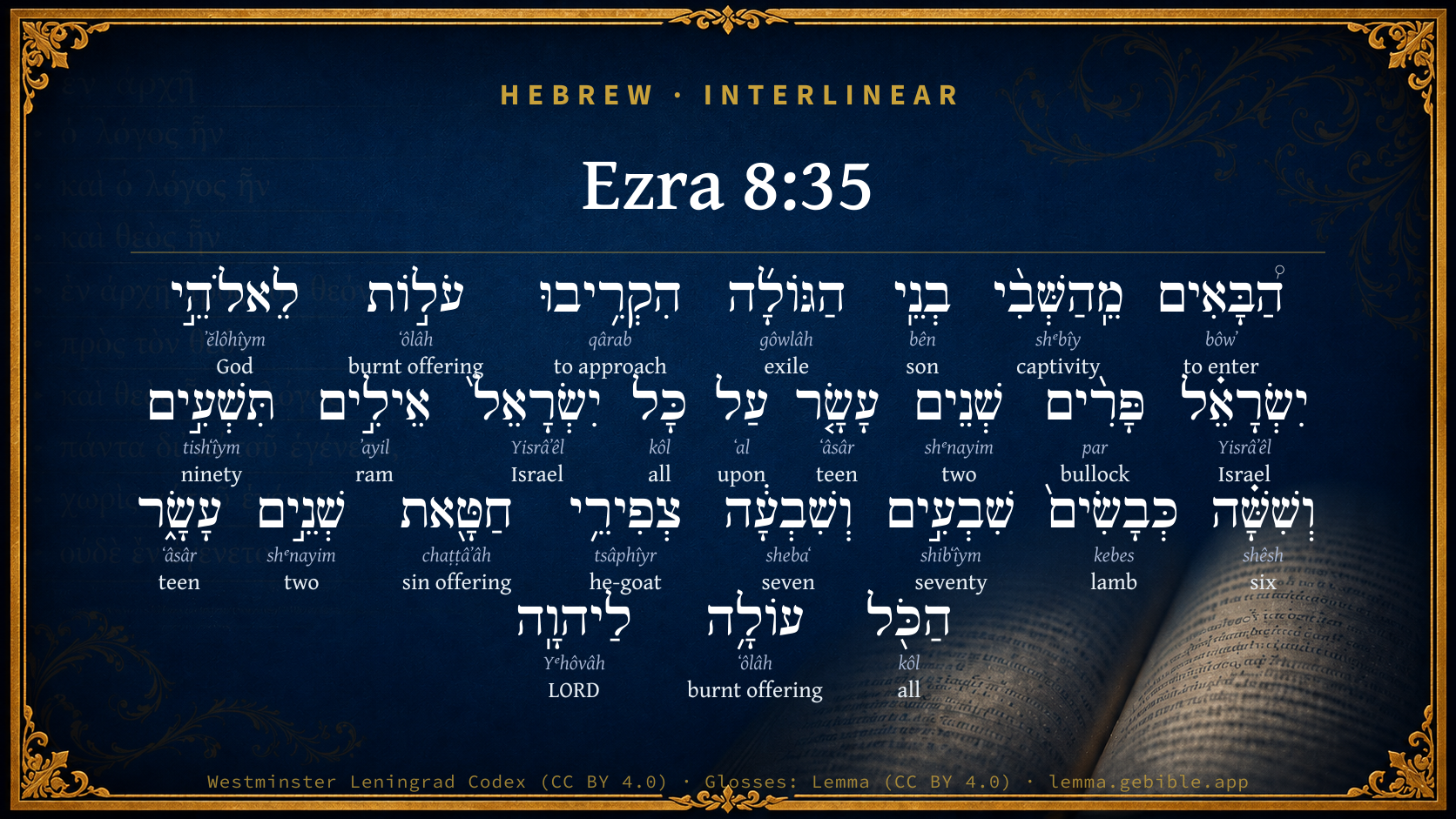
Ezra 8:35

Hebrew (Westminster Leningrad Codex) Ezra 8:35 appears in the Hebrew Old Testament. The text above is from the Westminster Leningrad Codex. Each word links to its Strong’s number, a concise gloss, and parsing drawn from the Open Scriptures Hebrew Bible morphology. Click any word for its full Brown-Driver-Briggs (BDB) entry.
Download image
Cite this verse

Ezra 8:35 (World English Bible). Public Domain. Lemma interlinear Bible study tool, https://lemma.gebible.app/v/ezra/8/35.

Show BibTeX & RIS
BibTeX
RIS
English Translation
The children of the captivity, who had come out of exile, offered burnt offerings to the God of Israel, twelve bulls for all Israel, ninety-six rams, seventy-seven lambs, and twelve male goats for a sin-offering: all this was a burnt offering to Yahweh.
World English Bible · Public Domain
Download a study sheet

One document with this verse’s original text, its word-by-word gloss line, the meaning frame, cross-references with their text, attributed commentary, and full source and license credits — printable, and it pastes into notes with its structure intact.

This verse Autodidact and up

Study sheet (.html) Plain text (.txt)

A passage Seminary Student

Up to 50 verses in one chapter. A passage sheet keeps up to 6 commentary sources and 12 cross-references per verse, in the order this page ranks them, and says so on the sheet whenever that leaves anything out. Ask for a single verse and you get the Autodidact verse sheet above.

Everything on this page stays free to read, with no account — the sheet is a download of what is already on screen, not access to it.

Want to remove ads? Support Godless Engineer
Compare translations 3

The same verse in 3 English versions, stacked beneath the original-language interlinear above. Click any original word for its lexicon entry.

Each is an independent rendering of the whole verse — the interlinear is not word-aligned to these translations.

Highlighted words mark where these versions differ — a whole-verse word diff, not a word-by-word alignment.

  • World English Bible Public Domain
    The children of the captivity, who had come out of exile, offered burnt offerings to the God of Israel, twelve bulls for all Israel, ninety-six rams, seventy-seven lambs, and twelve male goats for a sin-offering: all this was a burnt offering to Yahweh.
  • King James Version Public Domain
    Also the children of those that had been carried away, which were come out of the captivity, offered burnt offerings unto the God of Israel, twelve bullocks for all Israel, ninety and six rams, seventy and seven lambs, twelve he goats for a sin offering: all this was a burnt offering unto the LORD.
  • unfoldingWord Literal Text CC BY-SA 4.0
    The ones who had come from the captivity, the sons of the exile, offered burnt up offerings to the God of Israel: 12 bulls for all Israel, 96 rams, 77 lambs, 12 male goats of a sin offering. The whole was a burnt up offering to Yahweh.

unfoldingWord Literal Text — © unfoldingWord, licensed CC BY-SA 4.0. Word-aligned USFM3 via Door43 (git.door43.org/unfoldingWord/en_ult).

Versions to compare (up to 4)

3 of 4 selected

Show all 18 translations

Every available English version of this verse, each an independent rendering of the whole verse.

  • World English Bible Public Domain
    The children of the captivity, who had come out of exile, offered burnt offerings to the God of Israel, twelve bulls for all Israel, ninety-six rams, seventy-seven lambs, and twelve male goats for a sin-offering: all this was a burnt offering to Yahweh.
  • Berean Standard Bible Public Domain
    Then the exiles who had returned from captivity sacrificed burnt offerings to the God of Israel: 12 bulls for all Israel, 96 rams, 77 lambs, and a sin offering of 12 male goats. All this was a burnt offering to the LORD.
  • Majority Standard Bible Public Domain
    Then the exiles who had returned from captivity sacrificed burnt offerings to the God of Israel: 12 bulls for all Israel, 96 rams, 77 lambs, and a sin offering of 12 male goats. All this was a burnt offering to the LORD.
  • King James Version Public Domain
    Also the children of those that had been carried away, which were come out of the captivity, offered burnt offerings unto the God of Israel, twelve bullocks for all Israel, ninety and six rams, seventy and seven lambs, twelve he goats for a sin offering: all this was a burnt offering unto the LORD.
  • American Standard Version (1901) Public Domain
    The children of the captivity, that were come out of exile, offered burnt-offerings unto the God of Israel, twelve bullocks for all Israel, ninety and six rams, seventy and seven lambs, twelve he-goats for a sin-offering: all this was a burnt-offering unto Jehovah.
  • Revised Version (1885) Public Domain
    The children of the captivity, which were come out of exile, offered burnt offerings unto the God of Israel, twelve bullocks for all Israel, ninety and six rams, seventy and seven lambs, twelve he-goats for a sin offering: all this was a burnt offering unto the LORD.
  • Geneva Bible (1599) Public Domain
    Also the children of the captiuitie, which were come out of captiuitie, offred burnt offrings vnto the God of Israel, twelue bullockes for all Israel, ninetie and sixe rammes, seuentie and seuen lambes, and twelue hee goates for sinne: all was a burnt offring of the Lord.
  • Douay-Rheims (1899) Public Domain
    Moreover the children of them that had been carried away that were come out of the captivity, offered holocausts to the God of Israel, twelve calves for all the people of Israel, ninety-six rams, seventy- seven lambs, and twelve he goats for sin: all for a holocaust to the Lord.
  • Young's Literal Translation Public Domain
    Those coming in of the captives -- sons of the removal -- have brought near burnt-offerings to the God of Israel, bullocks twelve, for all Israel, rams ninety and six, lambs seventy and seven, young he-goats for a sin-offering twelve -- the whole a burnt-offering to Jehovah;
  • Literal Standard Version CC BY-SA 4.0
    Those coming in of the captives—sons of the expulsion—have brought burnt-offerings near to the God of Israel: twelve bullocks for all Israel, ninety-six rams, seventy-seven lambs, twelve young male goats for a sin-offering—the whole a burnt-offering to YHWH;
  • Unlocked Literal Bible CC BY-SA 4.0
    The ones who came back from the captivity, the people of exile, offered burnt offerings to the God of Israel: twelve bulls for all of Israel, ninety-six rams, seventy-seven lambs, and twelve male goats as a sin offering. All were a burnt offering for Yahweh.
  • unfoldingWord Literal Text CC BY-SA 4.0
    The ones who had come from the captivity, the sons of the exile, offered burnt up offerings to the God of Israel: 12 bulls for all Israel, 96 rams, 77 lambs, 12 male goats of a sin offering. The whole was a burnt up offering to Yahweh.
  • Darby Bible Public Domain
    The children of those that had been carried away, who had come out of the captivity, presented burnt-offerings to the God of Israel, twelve bullocks for all Israel, ninety-six rams, seventy-seven lambs, twelve he-goats for a sin-offering: all for a burnt-offering to Jehovah.
  • World Messianic Bible Public Domain
    The children of the captivity, who had come out of exile, offered burnt offerings to the God of Israel: twelve bulls for all Israel, ninety-six rams, seventy-seven lambs, and twelve male goats for a sin offering. All this was a burnt offering to the LORD.
  • Webster's Bible Public Domain
    Also the children of those that had been carried away, who had come out of the captivity, offered burnt-offerings to the God of Israel, twelve bullocks for all Israel, ninety and six rams, seventy and seven lambs, twelve he-goats for a sin-offering: all this was a burnt-offering to the LORD.
  • Free Bible Version CC BY-SA 4.0
    Then the exiles who had returned from captivity sacrificed burnt offerings to the God of Israel—twelve bulls for all of Israel, ninety-six rams, seventy-seven lambs, and a sin offering of twelve goats. All were sacrificed as a burnt offering to the Lord.
  • Bible in Basic English Public Domain
    And those who had been prisoners, who had come back from a strange land, made burned offerings to the God of Israel, twelve oxen for all Israel, ninety-six male sheep, seventy-seven lambs, twelve he-goats for a sin-offering: all this was a burned offering to the Lord.
  • JPS Tanakh (1917) Public Domain
    The children of the captivity, that were come out of exile, offered burnt-offerings unto the God of Israel, twelve bullocks for all Israel, ninety and six rams, seventy and seven lambs, twelve he-goats for a sin-offering; all this was a burnt-offering unto the LORD.

Literal Standard Version (2020), Covenant Press — licensed CC BY-SA 4.0. Text via the HelloAO Bible API (eBible.org). Unlocked Literal Bible (unfoldingWord) — licensed CC BY-SA 4.0. Text via the HelloAO Bible API (eBible.org). unfoldingWord Literal Text — © unfoldingWord, licensed CC BY-SA 4.0. Word-aligned USFM3 via Door43 (git.door43.org/unfoldingWord/en_ult). Free Bible Version, Dr. Jonathan Gallagher — licensed CC BY-SA 4.0. Text via the HelloAO Bible API (eBible.org).

Word by word

More ways to search: Search by grammar → Find every occurrence → Compare this word →

Practice this passage: Drill this verse → Learn its vocabulary →

צְפִירֵ֥י
tsâphîyr
H6842
“he-goats of”
Noun, Common, Masculine, Plural, Construct
Part of Speech
Noun
Type
Common
Gender
Masculine
Number
Plural
State
Construct
Full BDB Definition

Origin: from H6852

TWOT: 1962a

he-goat
  1. הַ֠בָּאִים bôwʼ H935 “the · entering” Particle, Definite Article + Verb, Qal, Participle Active, Masculine, Plural, Absolute
  2. מֵֽהַשְּׁבִ֨י shᵉbîy H7628 “from · the · captivity” Preposition + Particle, Definite Article + Noun, Common, Both, Singular, Absolute
  3. בְנֵֽי bên H1121 “sons of” Noun, Common, Masculine, Plural, Construct
  4. הַגּוֹלָ֜ה gôwlâh H1473 “the · exile” Particle, Definite Article + Noun, Common, Feminine, Singular, Absolute
  5. הִקְרִ֥יבוּ qârab H7126 “to approach” Verb, Hiphil, Perfect, 3rd Person, Common, Plural
  6. עֹל֣וֹת ʻôlâh H5930 “burnt offerings” Noun, Common, Feminine, Plural, Absolute
  7. לֵאלֹהֵ֣י ʼĕlôhîym H430 “to/for · God(s) of” Preposition + Noun, Common, Masculine, Plural, Construct
  8. יִשְׂרָאֵ֗ל Yisrâʼêl H3478 “Israel” Noun, Proper
  9. פָּרִ֨ים par H6499 “bullocks” Noun, Common, Masculine, Plural, Absolute
  10. שְׁנֵים shᵉnayim H8147 “two” Adjective, Cardinal number, Masculine, Dual, Absolute
  11. עָשָׂ֤ר ʻâsâr H6240 “teen” Adjective, Cardinal number, Masculine, Singular, Absolute
  12. עַל ʻal H5921 “upon” Preposition
  13. כָּל kôl H3605 “all of” Noun, Common, Masculine, Singular, Construct
  14. יִשְׂרָאֵל֙ Yisrâʼêl H3478 “Israel” Noun, Proper
  15. אֵילִ֣ים ʼayil H352 “rams” Noun, Common, Masculine, Plural, Absolute
  16. תִּשְׁעִ֣ים tishʻîym H8673 “ninety” Adjective, Cardinal number, Both, Plural, Absolute
  17. וְשִׁשָּׁ֗ה shêsh H8337 “and · six” Conjunction + Adjective, Cardinal number, Masculine, Singular, Absolute
  18. כְּבָשִׂים֙ kebes H3532 “lambs” Noun, Common, Masculine, Plural, Absolute
  19. שִׁבְעִ֣ים shibʻîym H7657 “seventy” Adjective, Cardinal number, Both, Plural, Absolute
  20. וְשִׁבְעָ֔ה shebaʻ H7651 “and · seven” Conjunction + Adjective, Cardinal number, Masculine, Singular, Absolute
  21. חַטָּ֖את chaṭṭâʼâh H2403 “sin offering” Noun, Common, Feminine, Singular, Absolute
  22. שְׁנֵ֣ים shᵉnayim H8147 “two” Adjective, Cardinal number, Masculine, Dual, Absolute
  23. עָשָׂ֑ר ʻâsâr H6240 “teen” Adjective, Cardinal number, Masculine, Singular, Absolute
  24. הַכֹּ֖ל kôl H3605 “the · all” Particle, Definite Article + Noun, Common, Masculine, Singular, Absolute
  25. עוֹלָ֥ה ʻôlâh H5930 “burnt offering” Noun, Common, Feminine, Singular, Absolute
  26. לַיהוָֽה Yᵉhôvâh H3068 “to/for · LORD” Preposition + Noun, Proper

About this verse

These counts appear in no published source. They are computed here, from the morphology-tagged text and Lemma’s own curated glosses. What Lemma adds →

27
words
22
distinct lemmas
Historical
section

Notable vocabulary

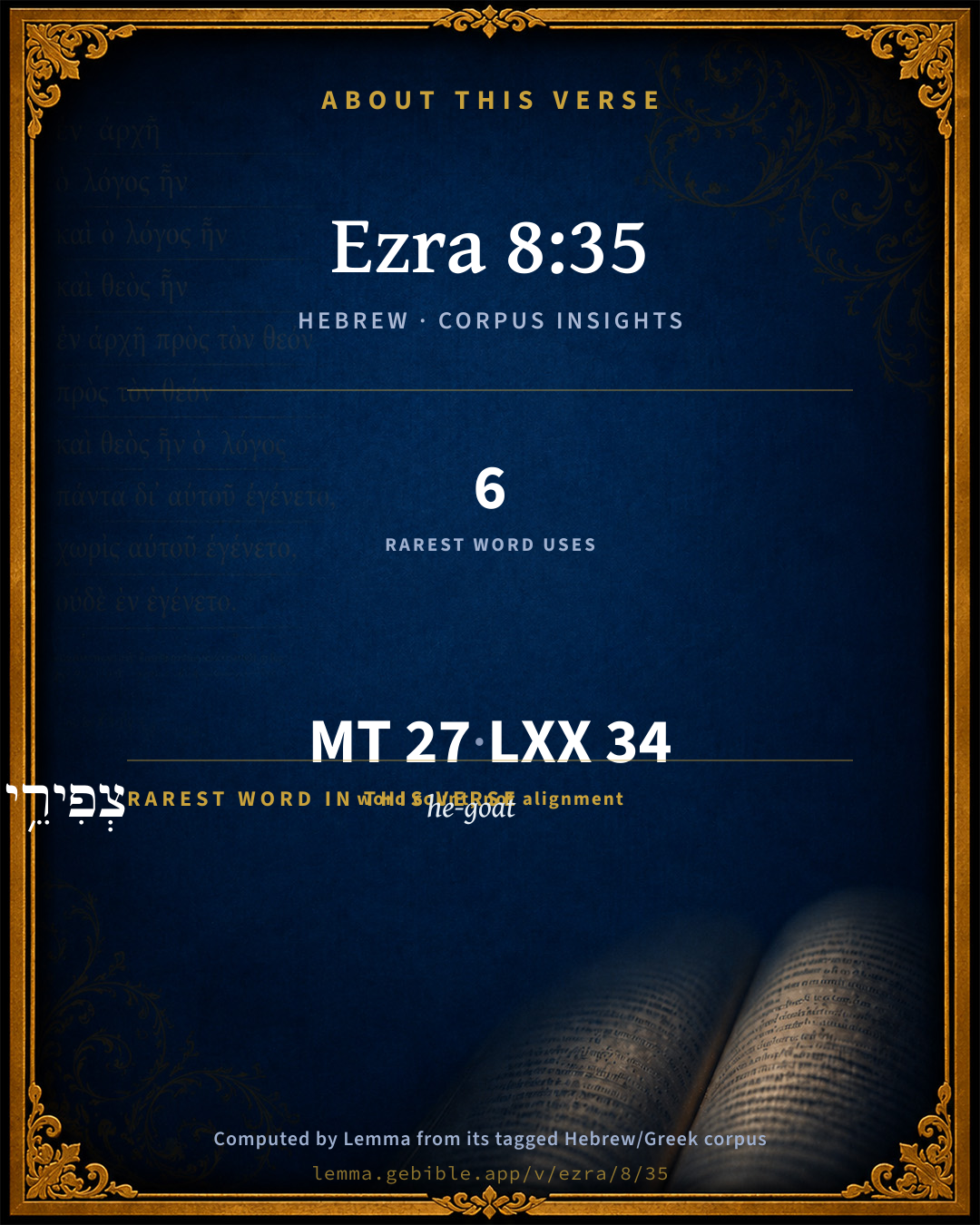
The rarest word here is צְפִירֵ֥י he-goat H6842 — appearing just 6 times in the whole Hebrew Bible.

Shared distinctive vocabulary

צְפִירֵ֥י he-goat H6842 occurs in 5 verses of the Hebrew Bible. Also found in:

Grammatical profile

  • 2 verbs
  • 16 nouns
  • 8 adjectives
  • 1 preposition

Verb forms

  • הַ֠בָּאִים Qal · Participle Active
  • הִקְרִ֥יבוּ Hiphil · Perfect

Repetition

Words recur within this verse — often emphatic in Hebrew:

  • עֹל֣וֹת burnt offering H5930 ×2
  • יִשְׂרָאֵ֗ל Israel H3478 ×2
  • שְׁנֵים two H8147 ×2
  • עָשָׂ֤ר teen H6240 ×2
  • כָּל all H3605 ×2

Hebrew & Septuagint length

In English translation the verse runs 43 words from the Hebrew and 43 from the Septuagint (LXX English) — the same length.

A rough comparison of the two English renderings, which tokenize alike — not a word-level alignment.

Word counts can differ between the Hebrew and the Greek without any difference in meaning — e.g. the Hebrew direct-object marker אֵת has no separate Greek word, and Greek often adds the article ὁ.

In the original languages it is 27 Hebrew tokens and 34 Greek tokens — but the two are counted differently (Hebrew bundles its prefixes and suffixes into one token; the Greek is in lemma form), so that isn’t a like-for-like length.

Cross-references

8

Topical passages linked to Ezra 8:35 in the Treasury of Scripture Knowledge — connected by theme and wording, ordered by reader-vote popularity; previews shown in the World English Bible.

  • Ezra 6:17 They offered at the dedication of this house of God one hundred bulls, two hundred rams, four hundred lambs; and for a sin-offering for all Israel, twelve male goats, according to the number of the tribes of Israel.
  • Leviticus 1:1–7 Yahweh called to Moses, and spoke to him out of the Tent of Meeting, saying,
  • Numbers 7:27 one young bull, one ram, one male lamb a year old, for a burnt offering;
  • 2 Chronicles 29:31–32 Then Hezekiah answered, Now you have consecrated yourselves to Yahweh; come near and bring sacrifices and thank-offerings into the house of Yahweh. The assembly brought in sacrifices and thank-offerings; and as many as were of a willing heart [brought] burnt offerings.
  • Ezra 2:1 Now these are the children of the province, who went up out of the captivity of those who had been carried away, whom Nebuchadnezzar the king of Babylon had carried away to Babylon, and who returned to Jerusalem and Judah, everyone to his city;
  • Psalms 66:10–15 For you, God, have tested us. You have refined us, as silver is refined.
  • Psalms 116:12–19 What will I give to Yahweh for all his benefits toward me?
  • Luke 1:74–75 To grant to us that we, being delivered out of the hand of our enemies, should serve him without fear,

Cross-references courtesy of OpenBible.info (CC BY 4.0).

Hebrew and Greek witnesses Masoretic Hebrew ↔ Greek Septuagint

The same verse in the two great witnesses to the Old Testament, shown verse-for-verse.

These are two independent witnesses, not word-aligned to each other, and the Septuagint is shown in lemma (dictionary) form.

Hebrew Ezra 8:35 Masoretic · Westminster Leningrad Codex

הַ֠בָּאִים מֵֽהַשְּׁבִ֨י בְנֵֽי הַגּוֹלָ֜ה הִקְרִ֥יבוּ עֹל֣וֹת לֵאלֹהֵ֣י יִשְׂרָאֵ֗ל פָּרִ֨ים שְׁנֵים עָשָׂ֤ר עַל כָּל יִשְׂרָאֵל֙ אֵילִ֣ים תִּשְׁעִ֣ים וְשִׁשָּׁ֗ה כְּבָשִׂים֙ שִׁבְעִ֣ים וְשִׁבְעָ֔ה צְפִירֵ֥י חַטָּ֖את שְׁנֵ֣ים עָשָׂ֑ר הַכֹּ֖ל עוֹלָ֥ה לַיהוָֽה

The children of the captivity, who had come out of exile, offered burnt offerings to the God of Israel, twelve bulls for all Israel, ninety-six rams, seventy-seven lambs, and twelve male goats for a sin-offering: all this was a burnt offering to Yahweh.

World English Bible · Public Domain

Greek LXX Ezra 8:35 Septuagint · lemma form

ὁ ἔρχομαι ἀπό ὁ αἰχμαλωσία υἱός ὁ παροικία προςφέρω ὁλοκαύτωσις ὁ θεός ἰσραήλ μόσχος δώδεκα περί πᾶς ἰσραήλ κριός ἐνενήκοντα ἕξ ἀμνός ἑβδομήκοντα καί ἑπτά χίμαρος περί ἁμαρτία δώδεκα ὁ πᾶς ὁλοκαύτωμα ὁ κύριος

At that time the children of the banishment that came from the captivity offered whole burnt offerings to the God of Israel, twelve calves for all Israel, ninety-six rams, seventy-seven lambs, twelve goats for a sin-offering; all whole burnt offerings to the Lord.

LXX2012 (modern English Septuagint) · Public Domain

In the Septuagint this is one book — Esdras B (2 Esdras): Ezra is chapters 1–10, Nehemiah 11–23.

Hebrew: Westminster Leningrad Codex (CC BY 4.0). Greek: Septuagint (public domain); English from LXX2012 (modern English Septuagint) (Public Domain). How the Septuagint differs from the Hebrew →

Commentary

Notes on Ezra 8:35 from classic Christian and Jewish commentators (each source and its license shown beneath its notes). The classic Christian expositions comment on the surrounding passage and are grouped to its opening verse, so a note may address several verses; the Jewish commentaries on the Tanakh (Rashi and others) are per-verse, so they appear only where the commentator wrote on this verse.

Lemma curates 59 commentaries, every one of them public domain or Creative Commons licensed, each selected and text-cleaned for this edition rather than reprinted as found. About our sources →

Trapp's Complete Commentary

John Trapp

Ezr 8:35 [Also] the children of those that had been carried away, which were come out of the captivity, offered burnt offerings unto the God of Israel, twelve bullocks for all Israel, ninety and six rams, seventy and seven lambs, twelve he goats [for] a sin offering: all [this was] a burnt offering unto the LORD.

Ver. 35. Also the children of those that had been] In token of presenting their bodies a living sacrifice, holy and acceptable to God their deliverer, Rom 12:1. Let us that are freed from sin’s slavery become the servants of righteousness, Rom 6:18; and being delivered from the hands of our enemies, serve God without fear in holiness and righteousness all the days of our lives, Luk 1:74-75.

John Trapp, A Commentary or Exposition upon All the Books of the Old and New Testament (1647–1656) — public domain. Text from a community e-Sword module.

Joseph Benson's Commentary

Ezr 8:35. Which were come out of the captivity — Namely, those new- comers whom God had safely conducted thither. Offered burnt-offerings unto the God of Israel — Whereby they acknowledged the Lord for their God, and expressed their gratitude for their restoration. Twelve he-goats for a sin-offering — For it is the atonement that secures every mercy to us, which will not be truly comfortable, unless iniquity be taken away, and our peace be made with God. They offer twelve bullocks, twelve he-goats, and ninety-six rams, (eight times twelve,) signifying the union of the two kingdoms. They did not any longer go two tribes one way, and ten tribes another; but all the twelve met by their representatives at the same altar.

Joseph Benson's Commentary on the Old and New Testaments (1811–1818) — public domain. Text from a community e-Sword module.

Tyndale Open Study Notes

Tyndale Open Resources

8:35 sacrificed burnt offerings: For many of the Jews who came to Jerusalem with Ezra, this was probably the first sacrifice they had ever offered. It would have been a moving spiritual experience for them to confess their sins and dedicate their lives to God in this way. For details on the burnt offering, see Lev 1.

Tyndale Open Study Notes — © Tyndale Open Resources, licensed CC BY-SA 4.0. Text via the HelloAO Bible API.

Adam Clarke's Commentary

Verse 35. Twelve bullocks for all Israel] Though of tribes there were only Judah and Benjamin, yet they offered a bullock for every tribe, as if present. There can be little doubt that there were individuals there from all the twelve tribes, possibly some families of each; but no complete tribe but those mentioned above.

Adam Clarke's Commentary on the Bible (1810–1826) — public domain. Text from a community e-Sword/MySword module.

The Cambridge Bible for Schools and Colleges

gen. ed. J. J. S. Perowne

35. Also the children of those that had been carried away, which were come out of the captivity] R.V. The children of the captivity which were come out of exile.

By this term is intended Ezra’s company which had just returned. The sacrifices offered by them resembled those offered by Zerubbabel and his companions at the dedication of the Temple (Ezr_6:17). (1) They consisted of the same animals, bullocks, rams and lambs; (2) they were offered in the name of the whole people.

For the expression ‘the children of the captivity’ compare Ezr_6:19, and see note on chap. Ezr_2:1. The ‘exile’ (sh‘bhi) refers to the condition of captivity, the ‘captivity’ (haggôlah) to the community of exiles.

twelve bullocks … twelve he goats] i.e. for the twelve tribes, cf. on Ezr_6:17, ‘for all Israel’.

ninety and six rams] i.e. eight for each tribe.

seventy and seven lambs] a magnification of the perfect number (cf. Gen_4:24; Mat_18:22).

for a sin offering] The twelve he goats as in Ezr_6:17.

all this was a burnt offering] i.e. it was completely consumed.

An offering, of thanksgiving for protection in the journey, and of consecration of the new life.

The Cambridge Bible for Schools and Colleges (gen. ed. J. J. S. Perowne; Cambridge University Press, 1878–1918) — public domain. Text from a community e-Sword module.

Albert Barnes' Notes on the Bible

Compare the marginal reference. The idea of offerings for all Israel pervades in this case the entire sacrifice, with the exception of the lambs, whose number (77) is unique, and has not been accounted for.

Albert Barnes' Notes on the Bible (1834–1885) — public domain. Text from a community e-Sword/MySword module.

Haydock's Catholic Bible Commentary

Israel. Some of the different tribes certainly returned, chap. vi. 17.

George Leo Haydock (1774–1849), Haydock's Catholic Family Bible and Commentary, 1859 edition — public domain. Excludes Psalms (Douay-Rheims chapter numbering differs from Protestant) and Deuterocanonical books (Catholic canon only).

Matthew Poole's English Annotations

Which were come out of the captivity, to wit, these new comers, whom God had safely conducted hither.

Matthew Poole's English Annotations on the Holy Bible (1683–1685) — public domain. Text from a community e-Sword/MySword module.

Whedon's Commentary on the Bible

Daniel D. Whedon

35. The children… which were come — That is, these who had just now coma up from Babylon with Ezra.

Twelve bullocks for all Israel — See note on Ezr_6:17. “The idea of offerings for all Israel pervades the entire sacrifice, with the exception of the lambs, whose number (77) is peculiar, and has not been accounted for.” — Rawlinson.

Daniel D. Whedon (gen. ed.), Commentary on the Old and New Testaments (1874–1909) — public domain. Text from a community e-Sword module.

The Pulpit Commentary

Also the children of those who had been carried away. i.e. the newly-returned exiles. Like their predecessors under Zernbbabel, who had made an offering for all Israel, (Ezr_6:17) so the present colonists under Ezra, assuming that they represented all Israel, offered for the whole nation. The classes of animals offered are the same on the two occasions, and the number of the he-goats is identical; but in every other case the victims are far less numerous now than on the former occasion. This is fully accounted for by the comparatively small number of those who returned under Ezra.

The Pulpit Commentary (1880–1919), ed. H.D.M. Spence-Jones & Joseph S. Exell — public domain. Text from a community e-Sword module.

John Wesley's Explanatory Notes

Sin offering - For it is the atonement that secures every mercy to us, which will not be truly comfortable, unless iniquity be taken away, and our peace made with God. They offer twelve bullocks, twelve he-goats, and ninety six rams, (eight times twelve) signifying the union of the two kingdoms. They did not any longer go two tribes one way, and ten tribes another; but all the twelve met by their representatives at the same altar.

John Wesley, Explanatory Notes Upon the Whole Bible (1754–1765) — public domain. Text via the GEBible commentary corpus.

unfoldingWord translationNotes

Door43 World Missions Community

The ones who came back from the captivity ... the people of exile

These two phrases refer to the Jewish people who were living as exiles in Babylon and who left Babylon and returned to Jerusalem in Judea. AT: "The ones who came back to Jerusalem from the captivity in Babylon, the people of exile"

twelve ... ninety-six ... seventy-seven ... twelve

"12 ... 96 ... 77 ... 12" (See: Numbers)

the governors in the Province Beyond the River

These were the Babylonian officials managing the people west of the Euphrates River, which included the people living in Judea.

the Province Beyond the River

This is the name of the province that was west of the Euphrates River. It was across the river from the city of Susa. It included Judea. See how you translated it in Esra 4:10. (See: How to Translate Names)

translationWords

captive

exile

burnt offering

God

Israel

lamb

goat

sin offering

king

decree

govern

house of God

unfoldingWord translationNotes — © Distant Shores Media and the Door43 World Missions Community, licensed CC BY-SA 4.0. Source: git.door43.org/Door43/en_tn.

Rashi

Rabbi Shlomo Yitzchaki (Rashi)

Those coming from captivity, the people of the exile those who came with Ezra.

offered up burnt offerings all were burnt offerings, and it was a temporary ruling.

Rashi on the Tanakh — English translations: “The Judaica Press complete Tanach with Rashi, translated by A. J. Rosenberg” (CC BY 4.0); “Pentateuch with Rashi's commentary by M. Rosenbaum and A.M. Silbermann, 1929-1934” (public domain); “The Metsudah Tanach series, Lakewood, N.J” (CC BY 4.0); and “The Book of Joshua, Metsudah Publications, 1997” (CC BY 4.0). Text via Sefaria.

Lesson kit

Teaching starters — assembled from the data on this page, not authored interpretation. Every prompt links to the verse data it draws on. Edit before teaching.

Ezra, in the Historical, opens this verse with 27 words (22 distinct Hebrew lemmas). Its most distinctive word is tsâphîyr (“he-goat”). A historical commentator’s framing appears above. Read the whole chapter for the surrounding context.

Discussion questions

  1. The word tsâphîyr carries the sense “he-goat.” How does it shape the verse?
  2. 2 Chronicles 29:21 shares the word «he-goat» with this verse. How do the two illuminate each other?
  3. “burnt offering” occurs 2× in this one verse. What is the effect of the repetition?
  4. These translations render this verse differently; the difference is in the English rendering, not the original. What questions does that raise?
  5. The verb «הַ֠בָּאִים» is Qal Participle Active. How does its form color the action?
  6. Reading how Trapp's Complete Commentary and Joseph Benson's Commentary read this verse, where do the two commentators agree and where do they part?

Things to notice

Reading settings

Reading text

Shown beneath each verse's original-language words.

Old Testament
Old Testament edition

Read the OT as the Masoretic Hebrew (MT) or the Greek Septuagint (LXX).

English shown for the Greek Septuagint (in the Hebrew ↔ Greek comparison).

Comparing translations? Open the Compare panel on any verse page to stack up to four side by side.