
Isaiah 43:23

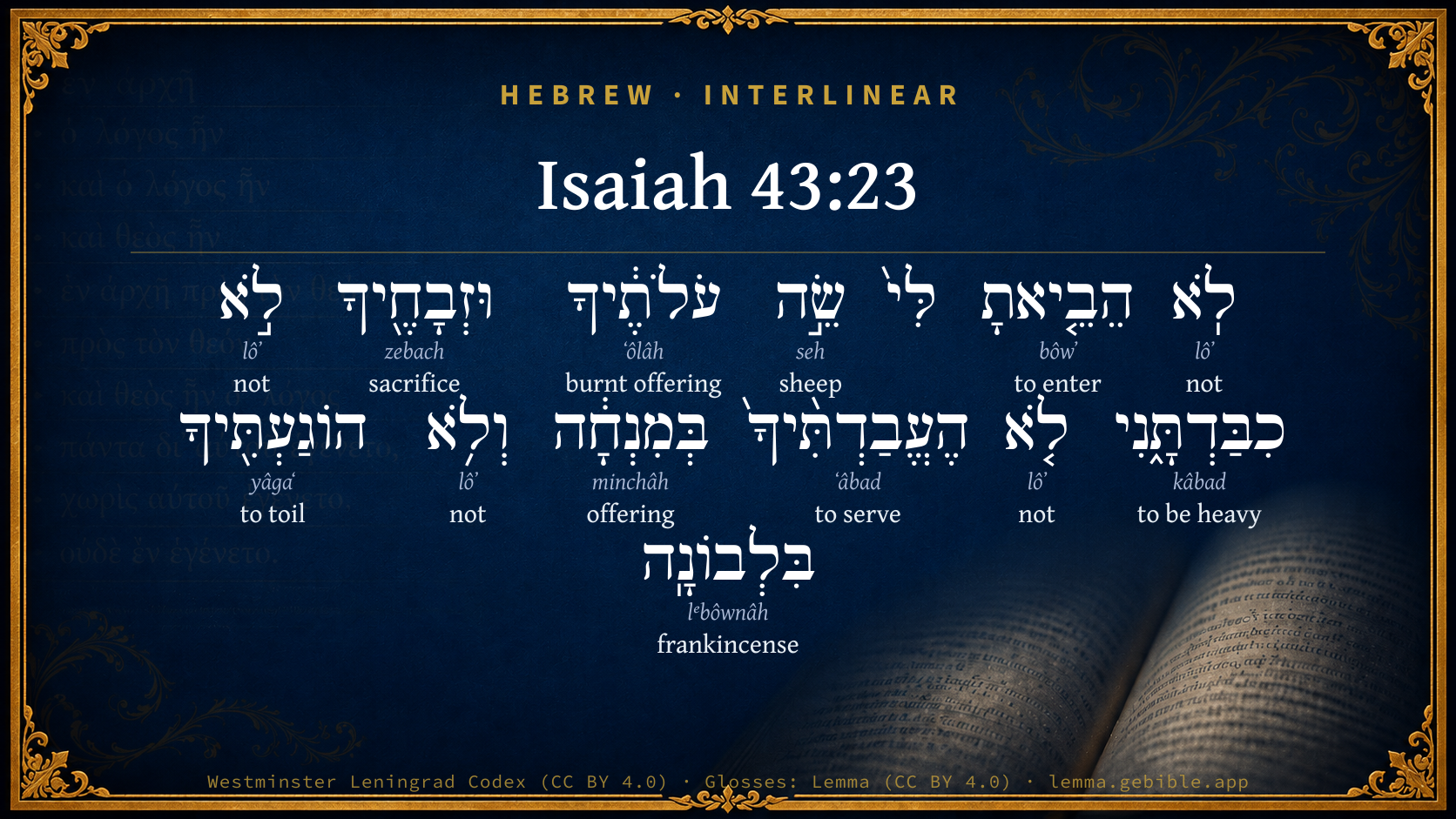
Hebrew (Westminster Leningrad Codex) Isaiah 43:23 appears in the Hebrew Old Testament. The text above is from the Westminster Leningrad Codex. Each word links to its Strong’s number, a concise gloss, and parsing drawn from the Open Scriptures Hebrew Bible morphology. Click any word for its full Brown-Driver-Briggs (BDB) entry.
Download image
Cite this verse

Isaiah 43:23 (World English Bible). Public Domain. Lemma interlinear Bible study tool, https://lemma.gebible.app/v/isaiah/43/23.

Show BibTeX & RIS
BibTeX
RIS
English Translation
You have not brought me of your sheep for burnt offerings; neither have you honored me with your sacrifices. I have not burdened you with offerings, nor wearied you with frankincense.
World English Bible · Public Domain
Download a study sheet

One document with this verse’s original text, its word-by-word gloss line, the meaning frame, cross-references with their text, attributed commentary, and full source and license credits — printable, and it pastes into notes with its structure intact.

This verse Autodidact and up

Study sheet (.html) Plain text (.txt)

A passage Seminary Student

Up to 50 verses in one chapter. A passage sheet keeps up to 6 commentary sources and 12 cross-references per verse, in the order this page ranks them, and says so on the sheet whenever that leaves anything out. Ask for a single verse and you get the Autodidact verse sheet above.

Everything on this page stays free to read, with no account — the sheet is a download of what is already on screen, not access to it.

Want to remove ads? Support Godless Engineer
Compare translations 3

The same verse in 3 English versions, stacked beneath the original-language interlinear above. Click any original word for its lexicon entry.

Each is an independent rendering of the whole verse — the interlinear is not word-aligned to these translations.

Highlighted words mark where these versions differ — a whole-verse word diff, not a word-by-word alignment.

  • World English Bible Public Domain
    You have not brought me of your sheep for burnt offerings; neither have you honored me with your sacrifices. I have not burdened you with offerings, nor wearied you with frankincense.
  • King James Version Public Domain
    Thou hast not brought me the small cattle of thy burnt offerings; neither hast thou honoured me with thy sacrifices. I have not caused thee to serve with an offering, nor wearied thee with incense.
  • unfoldingWord Literal Text CC BY-SA 4.0
    You have not brought the sheep of your burnt offerings to me, and you have not honored me your sacrifices. I have not made you serve with a grain offering, and I have not wearied you with frankincense.

unfoldingWord Literal Text — © unfoldingWord, licensed CC BY-SA 4.0. Word-aligned USFM3 via Door43 (git.door43.org/unfoldingWord/en_ult).

Versions to compare (up to 4)

3 of 4 selected

Show all 18 translations

Every available English version of this verse, each an independent rendering of the whole verse.

  • World English Bible Public Domain
    You have not brought me of your sheep for burnt offerings; neither have you honored me with your sacrifices. I have not burdened you with offerings, nor wearied you with frankincense.
  • Berean Standard Bible Public Domain
    You have not brought Me sheep for burnt offerings, nor honored Me with your sacrifices. I have not burdened you with offerings, nor wearied you with frankincense.
  • Majority Standard Bible Public Domain
    You have not brought Me sheep for burnt offerings, nor honored Me with your sacrifices. I have not burdened you with offerings, nor wearied you with frankincense.
  • King James Version Public Domain
    Thou hast not brought me the small cattle of thy burnt offerings; neither hast thou honoured me with thy sacrifices. I have not caused thee to serve with an offering, nor wearied thee with incense.
  • American Standard Version (1901) Public Domain
    Thou hast not brought me of thy sheep for burnt-offerings; neither hast thou honored me with thy sacrifices. I have not burdened thee with offerings, nor wearied thee with frankincense.
  • Revised Version (1885) Public Domain
    Thou hast not brought me the small cattle of thy burnt offerings; neither hast thou honoured me with thy sacrifices. I have not made thee to serve with offerings, nor wearied thee with frankincense.
  • Geneva Bible (1599) Public Domain
    Thou hast not brought me the sheepe of thy burnt offrings, neither hast thou honoured me with thy sacrifices. I haue not caused thee to serue with an offring, nor wearied thee with incense.
  • Douay-Rheims (1899) Public Domain
    Thou hast not offered me the ram of thy holocaust, nor hast thou glorified me with thy victims: I have not caused thee to serve with oblations, nor wearied thee with incense.
  • Young's Literal Translation Public Domain
    Thou hast not brought in to Me, The lamb of thy burnt-offerings, And `with' thy sacrifices thou hast not honoured Me, I have not caused thee to serve with a present, Nor wearied thee with frankincense.
  • Literal Standard Version CC BY-SA 4.0
    You have not brought to Me, || The lamb of your burnt-offerings, || And [with] your sacrifices you have not honored Me, || I have not caused you to serve with a present, || Nor wearied you with frankincense.
  • Unlocked Literal Bible CC BY-SA 4.0
    You have not brought me any of your sheep as burnt offerings, or honored me with your sacrifices. I have not burdened you with grain offerings, nor wearied you with demands for incense.
  • unfoldingWord Literal Text CC BY-SA 4.0
    You have not brought the sheep of your burnt offerings to me, and you have not honored me your sacrifices. I have not made you serve with a grain offering, and I have not wearied you with frankincense.
  • Darby Bible Public Domain
    thou hast not brought me the small cattle of thy burnt-offerings, neither hast thou glorified me with thy sacrifices. I have not caused thee to toil with an oblation, nor wearied thee with incense.
  • World Messianic Bible Public Domain
    You have not brought me any of your sheep for burnt offerings, neither have you honored me with your sacrifices. I have not burdened you with offerings, nor wearied you with frankincense.
  • Webster's Bible Public Domain
    Thou hast not brought me the small cattle of thy burnt-offerings; neither hast thou honored me with thy sacrifices. I have not caused thee to serve with an offering, nor wearied thee with incense.
  • Free Bible Version CC BY-SA 4.0
    You haven't brought me sheep for burnt offerings; you haven't honored me with your sacrifices. I haven't burdened you by asking for grain offerings; I haven't tired you out by demanding incense.
  • Bible in Basic English Public Domain
    You have not made me burned offerings of sheep, or given me honour with your offerings of beasts; I did not make you servants to give me an offering, and I did not make you tired with requests for perfumes.
  • JPS Tanakh (1917) Public Domain
    Thou hast not brought Me the small cattle of thy burnt-offerings; neither hast thou honoured Me with thy sacrifices. I have not burdened thee with a meal-offering, nor wearied thee with frankincense.

Literal Standard Version (2020), Covenant Press — licensed CC BY-SA 4.0. Text via the HelloAO Bible API (eBible.org). Unlocked Literal Bible (unfoldingWord) — licensed CC BY-SA 4.0. Text via the HelloAO Bible API (eBible.org). unfoldingWord Literal Text — © unfoldingWord, licensed CC BY-SA 4.0. Word-aligned USFM3 via Door43 (git.door43.org/unfoldingWord/en_ult). Free Bible Version, Dr. Jonathan Gallagher — licensed CC BY-SA 4.0. Text via the HelloAO Bible API (eBible.org).

Word by word

More ways to search: Search by grammar → Find every occurrence → Compare this word →

Practice this passage: Drill this verse → Learn its vocabulary →

בִּלְבוֹנָֽה
lᵉbôwnâh
H3828
“in/at · frankincense”
Preposition + Noun, Common, Feminine, Singular, Absolute
Part of Speech
Preposition + Noun
Type
Common
Gender
Feminine
Number
Singular
State
Absolute
Full BDB Definition

Origin: from H3836

TWOT: 1074d

frankincense - a white resin burned as fragrant incense - ceremonially - personally - used in compounding the holy incense
  1. לֹֽא lôʼ H3808 “not” Particle, Negative
  2. הֵבֵ֤יאתָ bôwʼ H935 “to enter” Verb, Hiphil, Perfect, 2nd Person, Masculine, Singular
  3. שֵׂ֣ה seh H7716 “sheep of” Noun, Common, Both, Singular, Construct
  4. עֹלֹתֶ֔יךָ ʻôlâh H5930 “burnt offerings · your” Noun, Common, Feminine, Plural, Construct + Suffix, Personal, 2nd Person, Masculine, Singular
  5. וּזְבָחֶ֖יךָ zebach H2077 “and · sacrifices · your” Conjunction + Noun, Common, Masculine, Plural, Construct + Suffix, Personal, 2nd Person, Masculine, Singular
  6. לֹ֣א lôʼ H3808 “not” Particle, Negative
  7. כִבַּדְתָּ֑נִי kâbad H3513 “to be heavy · me” Verb, Piel, Perfect, 2nd Person, Masculine, Singular + Suffix, Personal, 1st Person, Common, Singular
  8. לֹ֤א lôʼ H3808 “not” Particle, Negative
  9. הֶעֱבַדְתִּ֨יךָ֙ ʻâbad H5647 “to serve · you” Verb, Hiphil, Perfect, 1st Person, Common, Singular + Suffix, Personal, 2nd Person, Masculine, Singular
  10. בְּמִנְחָ֔ה minchâh H4503 “in/at · offering” Preposition + Noun, Common, Feminine, Singular, Absolute
  11. וְלֹ֥א lôʼ H3808 “and · not” Conjunction + Particle, Negative
  12. הוֹגַעְתִּ֖יךָ yâgaʻ H3021 “to toil · you” Verb, Hiphil, Perfect, 1st Person, Common, Singular + Suffix, Personal, 2nd Person, Masculine, Singular

About this verse

These counts appear in no published source. They are computed here, from the morphology-tagged text and Lemma’s own curated glosses. What Lemma adds →

14
words
10
distinct lemmas
Prophets
section

Notable vocabulary

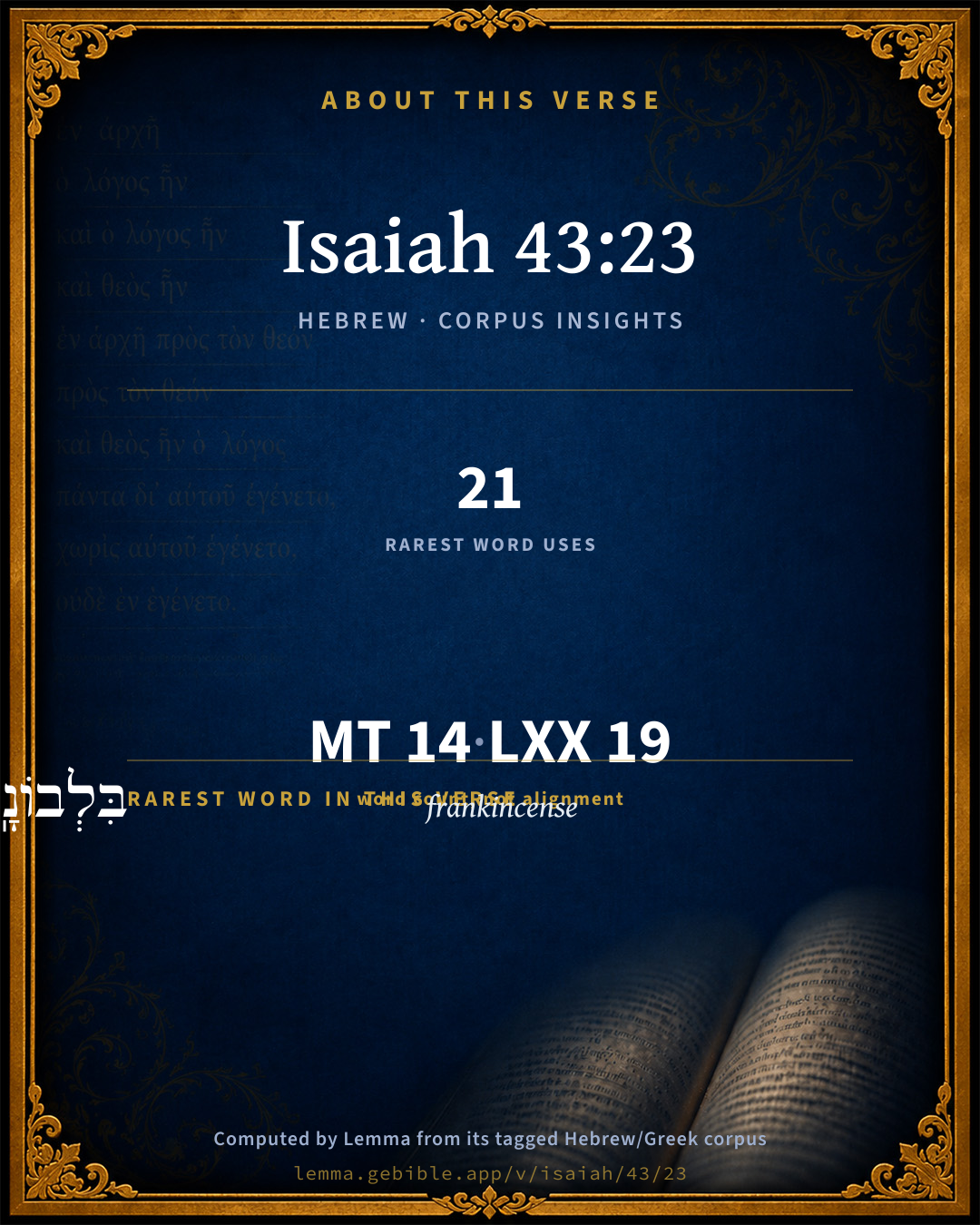
The rarest word here is בִּלְבוֹנָֽה frankincense H3828 — appearing just 21 times in the whole Hebrew Bible.

Shared distinctive vocabulary

בִּלְבוֹנָֽה frankincense H3828 occurs in 21 verses of the Hebrew Bible. Also found in:

Grammatical profile

  • 4 verbs
  • 5 nouns
  • 1 preposition
  • 4 particles

Verb forms

  • הֵבֵ֤יאתָ Hiphil · Perfect
  • כִבַּדְתָּ֑נִי Piel · Perfect
  • הֶעֱבַדְתִּ֨יךָ֙ Hiphil · Perfect
  • הוֹגַעְתִּ֖יךָ Hiphil · Perfect

Repetition

A word recurs within this verse — often emphatic in Hebrew:

Hebrew & Septuagint length

In English translation the verse runs 31 words from the Hebrew and 36 from the Septuagint (LXX English) — closely comparable.

A rough comparison of the two English renderings, which tokenize alike — not a word-level alignment.

Word counts can differ between the Hebrew and the Greek without any difference in meaning — e.g. the Hebrew direct-object marker אֵת has no separate Greek word, and Greek often adds the article ὁ.

In the original languages it is 14 Hebrew tokens and 19 Greek tokens — but the two are counted differently (Hebrew bundles its prefixes and suffixes into one token; the Greek is in lemma form), so that isn’t a like-for-like length.

Cross-references

13

Topical passages linked to Isaiah 43:23 in the Treasury of Scripture Knowledge — connected by theme and wording, ordered by reader-vote popularity; previews shown in the World English Bible.

  • Amos 5:25 "Did you bring to me sacrifices and offerings in the wilderness forty years, house of Israel?
  • Zechariah 7:5–6 "Speak to all the people of the land, and to the priests, saying, 'When you fasted and mourned in the fifth and in the seventh month for these seventy years, did you at all fast to me, really to me?
  • Leviticus 2:1 "'When anyone offers an offering of a meal offering to Yahweh, his offering shall be of fine flour; and he shall pour oil on it, and put frankincense on it.
  • Proverbs 15:8 The sacrifice made by the wicked is an abomination to Yahweh, But the prayer of the upright is his delight.
  • Proverbs 21:27 The sacrifice of the wicked is an abomination: How much more, when he brings it with a wicked mind!
  • Isaiah 66:3 He who kills an ox is as he who kills a man; he who sacrifices a lamb, as he who breaks a dog's neck; he who offers an offering, [as he who offers] pig's blood; he who burns frankincense, as he who blesses an idol. Yes, they have chosen their own ways, and their soul delights in their abominations:
  • Jeremiah 7:22 For I didn't speak to your fathers, nor command them in the day that I brought them out of the land of Egypt, concerning burnt offerings or sacrifices:
  • Amos 5:21–22 I hate, I despise your feasts, And I can't stand your solemn assemblies.
  • Malachi 1:6–8 "A son honors his father, and a servant his master. If I am a father, then where is my honor? And if I am a master, where is the respect due me? Says Yahweh of Hosts to you, priests, who despise my name. You say, 'How have we despised your name?'
  • Malachi 1:13–14 You say also, 'Behold, what a weariness it is!' and you have sniffed at it," says Yahweh of Hosts; "and you have brought that which was taken by violence, the lame, and the sick; thus you bring the offering. Should I accept this at your hand?" says Yahweh.
  • Malachi 3:8 Will a man rob God? Yet you rob me! But you say, 'How have we robbed you?' In tithes and offerings.
  • Matthew 11:30 For my yoke is easy, and my burden is light."
  • Isaiah 1:11–15 "What are the multitude of your sacrifices to me?," says Yahweh. "I have had enough of the burnt offerings of rams, And the fat of fed animals. I don't delight in the blood of bulls, Or of lambs, Or of male goats.

Cross-references courtesy of OpenBible.info (CC BY 4.0).

Hebrew and Greek witnesses Masoretic Hebrew ↔ Greek Septuagint

The same verse in the two great witnesses to the Old Testament, shown verse-for-verse.

These are two independent witnesses, not word-aligned to each other, and the Septuagint is shown in lemma (dictionary) form.

Hebrew Isaiah 43:23 Masoretic · Westminster Leningrad Codex

לֹֽא הֵבֵ֤יאתָ לִּי֙ שֵׂ֣ה עֹלֹתֶ֔יךָ וּזְבָחֶ֖יךָ לֹ֣א כִבַּדְתָּ֑נִי לֹ֤א הֶעֱבַדְתִּ֨יךָ֙ בְּמִנְחָ֔ה וְלֹ֥א הוֹגַעְתִּ֖יךָ בִּלְבוֹנָֽה

You have not brought me of your sheep for burnt offerings; neither have you honored me with your sacrifices. I have not burdened you with offerings, nor wearied you with frankincense.

World English Bible · Public Domain

Greek LXX Isaiah 43:23 Septuagint · lemma form

οὐ ἐγώ πρόβατον ὁ ὁλοκάρπωσις σύ οὐδέ ἐν ὁ θυσία σύ δοξάζω ἐγώ οὐδέ ἔγκοπος ποιέω σύ ἐν λίβανος

You have not brought me the sheep of your whole burnt offering; neither have you glorified me with your sacrifices. I have not caused you to serve with sacrifices, neither have I wearied you with frankincense.

LXX2012 (modern English Septuagint) · Public Domain

Hebrew: Westminster Leningrad Codex (CC BY 4.0). Greek: Septuagint (public domain); English from LXX2012 (modern English Septuagint) (Public Domain). How the Septuagint differs from the Hebrew →

Targum (Aramaic paraphrase)

1

The Targum is the ancient Jewish Aramaic paraphrase of the Hebrew Scriptures — an interpretive translation, not the Hebrew text itself. Onkelos (literal) and Pseudo-Jonathan (expansive) render the Torah, and Jonathan the Prophets. Coverage is partial: where no permissively-licensed English translation exists for a verse, only the Aramaic is shown. This is verse-level text, not a word-by-word alignment to the Hebrew.

  1. Targum Jonathan Prophets (Joshua–Malachi)
    לָא אַיְתֵיתָא קֳדָמַי אִמְרִין לְעָלְתָא וְנִכְסַת קוּדְשָׁךְ לָא יַקַרְתָּא קֳדָמַי לָא אַסְגֵיתִי עֲלָךְ בְּקוּרְבָּנִין וְלָא אַתְקְפֵית עֲלָךְ בִּלְבוֹנְתָּא:

    Thou hast not brought unto me the lambs of thy burnt offerings, and with thy holy sacrifices thou hast not honoured me. I have not caused thee to multiply offerings, neither did I burden thee with frankincense.

    Targum Jonathan — Aramaic: “Mikraot Gedolot” (public domain). English: “Sefaria Community Translation” (CC0 1.0 (public-domain dedication)); “London "Chaldee Paraphrase," 1871” (public domain). Text via Sefaria.

Commentary

Notes on Isaiah 43:23 from classic Christian and Jewish commentators (each source and its license shown beneath its notes). The classic Christian expositions comment on the surrounding passage and are grouped to its opening verse, so a note may address several verses; the Jewish commentaries on the Tanakh (Rashi and others) are per-verse, so they appear only where the commentator wrote on this verse.

Lemma curates 59 commentaries, every one of them public domain or Creative Commons licensed, each selected and text-cleaned for this edition rather than reprinted as found. About our sources →

Trapp's Complete Commentary

John Trapp

Isa 43:23 Thou hast not brought me the small cattle of thy burnt offerings; neither hast thou honoured me with thy sacrifices. I have not caused thee to serve with an offering, nor wearied thee with incense.

Ver. 23. Thou hast not brought me, &c.] Not me, but a god of thine own framing, {a} Such a one as would take up with external heartless services, formal courtings and compliments.

{a} Non Mihi sed deo fictitio.

John Trapp, A Commentary or Exposition upon All the Books of the Old and New Testament (1647–1656) — public domain. Text from a community e-Sword module.

The Biblical Illustrator

Joseph S. Exell

Isa_43:23-24

Thou hast not brought Me the small cattle

Failure in religious details

Failure in religious details may we not ask whether some emphasis may not be laid upon the designation the small cattle?

Do not many men fail in religious details? They are emphatic in their stupendous word-creed, but they do not bless some little child on the road to church, or bring some wandering soul to the Church home. We do certain great or conspicuous things, and we forget the small cattle, the little offerings and tributes. Every omission is noticed (Isa_43:24). Does God care for our sweet cane? Does He like to see us spending a trifle upon some cane stick that we may take it and offer it as if it were a flower? He hath no need of any service of the kind; yet it pleases Him that we should with some small piece of money buy sweet cane. Observe how He notes the omissions! This might be the very voice of Christ, who said to Simon the Pharisee, I entered into thine house, thou gavest Me no water for My feet; but she hath washed My feet with tears, and wiped them with the hairs of her head. Thou gavest Me no kiss: but this woman since the time I came in hath not ceased to kiss My feet. My head with oil thou didst not anoint: but this woman hath anointed My feet with ointment. What an eye is the eye of Omniscience! It notices every slip and flaw and omission. That would, indeed, be a miserable declaration to make if it stood alone; but it only leads to the fuller declaration that it notices every cup of cold water, every widows gift, every childs service. God is not unrighteous to forget your work of faith and labour of love. (J. Parker, D. D.)

God and His people a contrast

In one of those antithetical clauses, or balances of words, so frequent in Isaiah, He thus contrasts His own and His peoples doings (verse 23): I have not burdened thee in exacting oblations; I have not wearied thee in demanding incense.. . . But thou hast burdened Me with thy sins; thou hast wearied Me with thine iniquities (verse 24). (J. R. Macduff, D. D.)

The Biblical Illustrator, edited by Joseph S. Exell (c. 1880s–1900s) — public domain. Text from a community e-Sword module.

Geneva Bible (1599)

Geneva Bible translators

Meaning, in true faith and obedience.

Geneva Bible (1599) marginal notes — public domain. Text via Bolls.life.

Jamieson, Fausset & Brown

Robert Jamieson, A. R. Fausset & David Brown

small cattle--rather, the "lamb" or "kid," required by the law to be daily offered to God (Exo 29:38; Num 28:3).

sacrifices--offered any way; whereas the Hebrew for "holocaust," or "burnt offering," denotes that which ascends as an offering consumed by fire.

I have not caused thee to serve--that is, to render the the service of a slave (Mat 11:30; Rom 8:15; Jo1 4:18; Jo1 5:3).

offering--bloodless (Lev 2:1-2).

wearied--antithetical to Isa 43:22, "Thou hast been weary of Me." Though God in the law required such offerings, yet not so as to "weary" the worshipper, or to exact them in cases where, as in the Babylonish captivity, they were physically unable to render them; God did not require them, save in subordination to the higher moral duties (Psa 50:8-14; Psa 51:16-17; Mic 6:3, Mic 6:6-8).

Jamieson, Fausset & Brown — Commentary Critical and Explanatory on the Whole Bible (1871) — public domain (CC PDM 1.0). Text via the HelloAO Bible API.

Ellicott's Commentary for English Readers

(23) I have not caused thee to serve . . .—The words practically imply the suspension of sacrifices during the exile. Jehovah had not imposed that bond service on them—had not wearied them with demanding incense when they were far away from the Temple to whose ritual it belonged.

A Bible Commentary for English Readers, edited by Charles John Ellicott (1878–1897) — public domain. Text from a community e-Sword module.

The Cambridge Bible for Schools and Colleges

gen. ed. J. J. S. Perowne

23. The absence of sacrifice has not impaired the bond between Jehovah and His people. The thought presents a striking contrast to ch. Isa_1:10 ff., a passage which was probably in the writer’s mind.

the small cattle] The Heb. word serves as the noun of unity to the word for “flock” (i.e. sheep and goats). On burnt-offerings, sacrifices and offering, see on ch. Isa_1:11; Isa_1:13.

I have not caused thee to serve] “have not treated thee as a slave,” by exacting tribute. The statement might no doubt be understood absolutely, according to Jer_7:21 ff.; but it is perhaps sufficient to take it of the Exile, when the non-essential character of sacrifice was revealed by its enforced discontinuance (cf. Psa_51:16).

incense] See ch. Isa_60:6; Jer_6:20. In both these passages incense is described as coming from Arabia, which agrees with the statement of Pliny, that it was collected in the chief city of Hadramaut and thence conveyed to Syria. The Heb. word (lìbônâh), which is preserved in the Gr. λίβανος, λιβανωτός, is quite different from that found in ch. Isa_1:13.

The Cambridge Bible for Schools and Colleges (gen. ed. J. J. S. Perowne; Cambridge University Press, 1878–1918) — public domain. Text from a community e-Sword module.

John Gill's Exposition

Thou hast bought me no sweet cane with money,.... Or "calamus" (r), which was used in the anointing oil, and for the perfume or incense, Exo 30:7, this they thought too expensive, and so left it out of the composition, or neglected the whole this being put a part for the whole. Jarchi gives it as the sense, that they had no need to buy it, since it grew in great plenty in the land of Israel, which he took to be cinnamon; though this is distinguished from calamus, or the sweet cane, Sol 4:14, wherefore Kimchi much better observes, that it was not to be had in the land of Israel, but came from a land afar off; and therefore must be bought; see Jer 6:20, hence grudging to give the price for it, and to be at the expense of it, bought it not, and disused it:

neither hast thou filled me with the fat of thy sacrifices; they did not multiply their sacrifices, offered only just what the law required, if so many, and those of the leaner sort; and whereas the fat of the sacrifices was the Lord's, there was little of it for him in these:

but thou hast made me to serve with thy sins, thou hast wearied me with thine iniquities; they were so many, and so aggravated, that he could not bear with them any longer, his patience was worn out; they were an uneasiness to him, as it were a burden upon him, and therefore would ease himself, as he sometimes does, by avenging himself, Isa 1:24, but here by pardoning them, as in the following verse. Some think that these are the words of Christ, the surety of his people, who took upon him the form of a servant for the sake of them, and had all their sins laid upon him, and which he bore, and made satisfaction for; and were to the human nature a burden, and a weariness to it; see Psa 40:12. This must be understood of the remnant according to the election of grace, among these people so sadly corrupted, for whose sins of omission and commission Christ made atonement; and upon the foot of his satisfaction, remission of sins proceeds, as in the next verse: this they thought too chargeable, and so left it out of the composition, or neglected the whole this being put a part for the whole. Jarchi gives it as the sense, that they had no need to buy it, since it grew in great plenty in the land of Israel, which he took to be cinnamon; though this is distinguished from calamus, or the sweet cane, Sol 4:14, wherefore Kimchi much better observes, that it was not to be had in the land of Israel, but came from a land afar off; and therefore must be bought; see Jer 6:20, hence grudging to give the price for it, and to be at the expense of it, bought it not, and disused it:

neither hast thou filled me with the fat of thy sacrifices; they did not multiply their sacrifices, offered only just what the law required, if so many, and those of the leaner sort; and whereas the fat of the sacrifices was the Lord's, there was little of it for him in these:

but thou hast made me to serve with thy sins, thou hast wearied me with thine iniquities; they were so many, and so aggravated, that he could not bear with them any longer, his patience was worn out; they were an uneasiness to him, as it were a burden upon him, and therefore would ease himself, as he sometimes does, by avenging himself, Isa 1:24, but here by pardoning them, as in the following verse. Some think that these are the words of Christ, the surety of his people, who took upon him the form of a servant for the sake of them, and had all their sins laid upon him, and which he bore, and made satisfaction for; and were to the human nature a burden, and a weariness to it; see Psa 40:12. This must be understood of the remnant according to the election of grace, among these people so sadly corrupted, for whose sins of omission and commission Christ made atonement; and upon the foot of his satisfaction, remission of sins proceeds, as in the next verse.

(r) "calamum", V. L. Pagninus, Montanus; "calamum odoratum", Junius & Tremellius, Piscator, Cocceius, Vitringa.

John Gill's Exposition of the Whole Bible (1746–1763) — public domain (CC PDM 1.0). Text via the HelloAO Bible API.

Albert Barnes' Notes on the Bible

Thou hast not brought me - As a people you have witcheld from me the sacrifices which were commanded. They had not maintained and observed his worship as he had required.

The small cattle - Margin, ‘Lambs,’ or ‘kids.’ The Hebrew word (שׂה s'eh) denotes properly one of a flock - a sheep or a goat. It should have been so rendered here. These animals were used for burnt-offerings, and the Jews were required to offer them daily to God.

Of thy burnt-offerings - (Compare Exo 29:38; Num 28:3). The burnt-offering was wholly consumed on the altar.

With thy sacrifices - Bloody offerings. There is little difference between this word and that rendered ‘burnt-offerings.’ If there is any, it is that the word rendered ‘sacrifice’ (זבח zebach) is of wider signification, and expresses sacrifice in general; the word rendered ‘burnt-offering’ (עלה ‛olâh), denotes that which is consumed, or which ascends as an offering. The holocaust refers to its being burned; the sacrifice to the offering, however made.

I have not caused thee to serve with an offering - ‘I have not made a slave of thee; I have not exacted such a service as would be oppressive and intolerable - such as is imposed on a slave.’ The word used here (עבד ‛âbad), is often used in such a sense, and with such a reference Lev 25:39; ‘Thou shalt not compel him to serve the service of a bondman’ Exo 1:14; Jer 22:13; Jer 25:14; Jer 30:8. The sense is, that the laws of God on the subject, were not grievous and oppressive.

With an offering - The word used here (מנחה minchāh) denotes properly a bloodless oblation, and is thus distinguished from those mentioned before. It consisted of flour mingled with salt, oil, and incense; or of the fruits of the earth, etc. (see the notes at Isa 1:11; compare Lev 2:2; Num 28:5.

Nor wearied thee - By exacting incense. I have not so exacted it as to make it burdensome and wearisome to you.

With incense - (See the note at Isa 1:13). The word לבונה lebônâh (Greek λίβανος libanos) denotes properly frankincense, a substance so called from its white color, from לבן lāban, “to be white.” It is found in Arabia Isa 60:6; Jer 6:20, and in Palestine Son 4:6, Son 4:14, and was obtained by making incisions in the bark of trees. It was much used in worship among the Jews as well as by other nations. It was burned in order to produce an agreeable fragrance Exo 30:8; Exo 37:29; Lev 16:13.

Albert Barnes' Notes on the Bible (1834–1885) — public domain. Text from a community e-Sword/MySword module.

Haydock's Catholic Bible Commentary

Incense. My kindness is gratuitous. In a strange land, thou couldst not offer sacrifice. See chap. xlviii. 9., and xlix. 1. (Calmet)

George Leo Haydock (1774–1849), Haydock's Catholic Family Bible and Commentary, 1859 edition — public domain. Excludes Psalms (Douay-Rheims chapter numbering differs from Protestant) and Deuterocanonical books (Catholic canon only).

Matthew Poole's English Annotations

Thou hast not brought me the small cattle of thy burnt offerings; either,

1. Because thou didst not offer thy sacrifices to me, but to idols. Or rather,

2. Because what thou didst offer was not done to me, not for my sake, not from a principle of love and obedience to me, not to please and honour me with it; but merely for thine own ends: which interpretation seems to be favoured by the following clause, and by comparing this with Zec 7:5,6, Did ye fast unto me, even to me? And when ye did eat—did ye not eat for yourselves?

Neither hast thou honoured me with thy sacrifices, because thou didst either neglect this work of sacrificing to me; or didst perform it merely out of custom or ill design, and not with a purpose to please and glorify me; or didst dishonour me, and pollute thy sacrifices by thy wicked course of life.

I have not caused thee to serve with an offering, nor wearied thee with incense: so the sense may be this, I did not require these wearisome services of thee, to wit, upon these terms, or to be offered in such a manner, as God speaks, Isa 1:11-13. But the words may very well be rendered, although I did not cause thee to serve with offerings, nor weary thee with incense; the particle although being here understood, as it is in many other places, as hath been formerly noted. And so this is an aggravation of their former sin, of being weary of and negligent in his service; although God hath not laid such heavy burdens upon them, nor required such hard services or costly offerings from them, as might give them cause to be weary, nor such as idolaters did freely and greedily perform in the service of their idols.

Matthew Poole's English Annotations on the Holy Bible (1683–1685) — public domain. Text from a community e-Sword/MySword module.

The Pulpit Commentary

Thou hast not brought me the small cattle of thy burnt offerings. If this reproach is regarded as addressed to captive Israel, who could not offer sacrifices, we must explain it by the analogy of the expression, "the calves of your lips". (Hos_14:2) All prayer may be regarded as a sort of offering, and withholding it as withholding sacrifice. But it is possible that the prophet is not addressing captive Israel only, but carrying his thoughts back to the period preceding the Captivity, when there was a general neglect of God"s service, and for a time the temple was given up to idol-worship. (2Ki_21:3-7 2Ki_23:4-14) The glance back at earlier times is apparent in vers. 27, 28. I have not caused thee to serve with an offering, etc.; rather, I put no heavy service on thee in respect of meat offering, neither made I thee to toil in respect of incense; i.e. "my positive requirements have been light surely thou shouldst have complied with them." Meat offerings were to accompany every sacrifice, but were a small burthen. Incense was not required from any private person.

The Pulpit Commentary (1880–1919), ed. H.D.M. Spence-Jones & Joseph S. Exell — public domain. Text from a community e-Sword module.

John Wesley's Explanatory Notes

honoured - Either thou didst neglect sacrificing to me; or didst perform it merely out of custom or didst dishonour me, and pollute thy sacrifices by thy wicked life. Although - Altho' God had not laid such heavy burdens upon them, nor required such costly offerings, as might give them cause to be weary, nor such as idolaters did freely perform in the service of their idols.

John Wesley, Explanatory Notes Upon the Whole Bible (1754–1765) — public domain. Text via the GEBible commentary corpus.

J. A. Alexander on Isaiah

Joseph Addison Alexander

“Thou hast not brought to me the sheep of thy burnt-offering, and (with) thy sacrifices thou hast not honored me. I have not made thee serve with oblation, and I have not made thee labor (or wearied thee) with incense.” The whole Mosaic ritual is here represented by an enumeration of some of the principal offerings; the olah or general expiation, the zebahim or other animal sacrifices, the minhah or meal-offering, and the lebonah or aromatic fumigation. The Hebrew word includes the goat as well as the sheep, and is therefore correctly rendered in the English Version by the phrase small cattle. Of the whole verse there are several distinct interpretations or rather applications. Some place the emphasis upon the pronouns. ‘It is not to me that thou hast offered all this, but to idols.’ Another class of writers understand the passage strictly as charging the Jews with culpable neglect of the ceremonial law. A third hypothesis applies the passage to the unavoidable suspension of the ceremonial service during the captivity in Babylon, which it supposes to be here urged as a proof that the deliverance of Israel from exile was an act of mercy, not of righteous retribution for their national obedience and fidelity. It is much more obvious to give the words the general and unrestricted meaning which they naturally bear as a description of the people’s conduct, not at one time or at one place, but throughout their history. The most satisfactory interpretation of the verse, and that which best agrees with the whole context, is, that it has reference not merely to the outward or material act, but to its moral value and effect. ‘You have not so performed your ceremonial duties as to lay me under any obligation to protect you. You have not really given me your cattle, you have not truly honored me with sacrifices.’ The best explanation of the last clause is, ‘I have not succeeded in inducing you to serve me, I have not prevailed upon you to exert yourselves, much less wearied or exhausted you in ceremonial services.’

Joseph Addison Alexander, The Prophecies of Isaiah (1846–1847; New York: Scribner, 1870–1878) — public domain. Text from a community e-Sword module.

Rashi

Rabbi Shlomo Yitzchaki (Rashi)

You did not bring Me the lambs of your burnt offerings but to idolatry.

neither did I overwork you Cause you to do much work with the meal offering; merely a handful would be offered to the Most High, and even that I did not ordain upon you to sacrifice as an obligation but as a free-will offering.

Rashi on the Tanakh — English translations: “The Judaica Press complete Tanach with Rashi, translated by A. J. Rosenberg” (CC BY 4.0); “Pentateuch with Rashi's commentary by M. Rosenbaum and A.M. Silbermann, 1929-1934” (public domain); “The Metsudah Tanach series, Lakewood, N.J” (CC BY 4.0); and “The Book of Joshua, Metsudah Publications, 1997” (CC BY 4.0). Text via Sefaria.

Ibn Ezra

Rabbi Abraham ibn Ezra

Thou hast not brought me burnt offerings in Babylon.

Neither hast thou honoured me (זבחיך) with thy sacrifices, with thy peace-offerings. I have not caused, etc. I have not asked thee to serve me with oblations.

Nor wearied thee with incense, to buy incense for me.

Ibn Ezra on the Tanakh — English translations: “Sefaria Community Translation” (CC0 1.0 (public-domain dedication)); “Yalkut, Sifsei Chachomim Chumash, Metsudah Publications, 2009” (CC BY 4.0); and “Commentary of Ibn Ezra on Isaiah - trans. by M. Friedlander, 1873” (public domain). Text via Sefaria.

Lesson kit

Teaching starters — assembled from the data on this page, not authored interpretation. Every prompt links to the verse data it draws on. Edit before teaching.

Isaiah, in the Prophets, opens this verse with 14 words (10 distinct Hebrew lemmas). Its most distinctive word is lᵉbôwnâh (“frankincense”). A historical commentator’s framing appears above. Read the whole chapter for the surrounding context.

Discussion questions

  1. How does “frankincense” (lᵉbôwnâh) shape what this verse is saying?
  2. How does Exodus 30:34, which shares the word «frankincense», read alongside this verse?
  3. What does the repetition of “not” (4× in this one verse) do in this verse?
  4. These translations render this verse differently; the difference is in the English rendering, not the original. What questions does that raise?
  5. «הֵבֵ֤יאתָ» is a Hiphil Perfect verb. How does that grammatical form shape the action described?
  6. Compare how Trapp's Complete Commentary and The Biblical Illustrator read this verse. Where do they agree or differ?

Things to notice

Reading settings

Reading text

Shown beneath each verse's original-language words.

Old Testament
Old Testament edition

Read the OT as the Masoretic Hebrew (MT) or the Greek Septuagint (LXX).

English shown for the Greek Septuagint (in the Hebrew ↔ Greek comparison).

Comparing translations? Open the Compare panel on any verse page to stack up to four side by side.