
Ezekiel 43:18

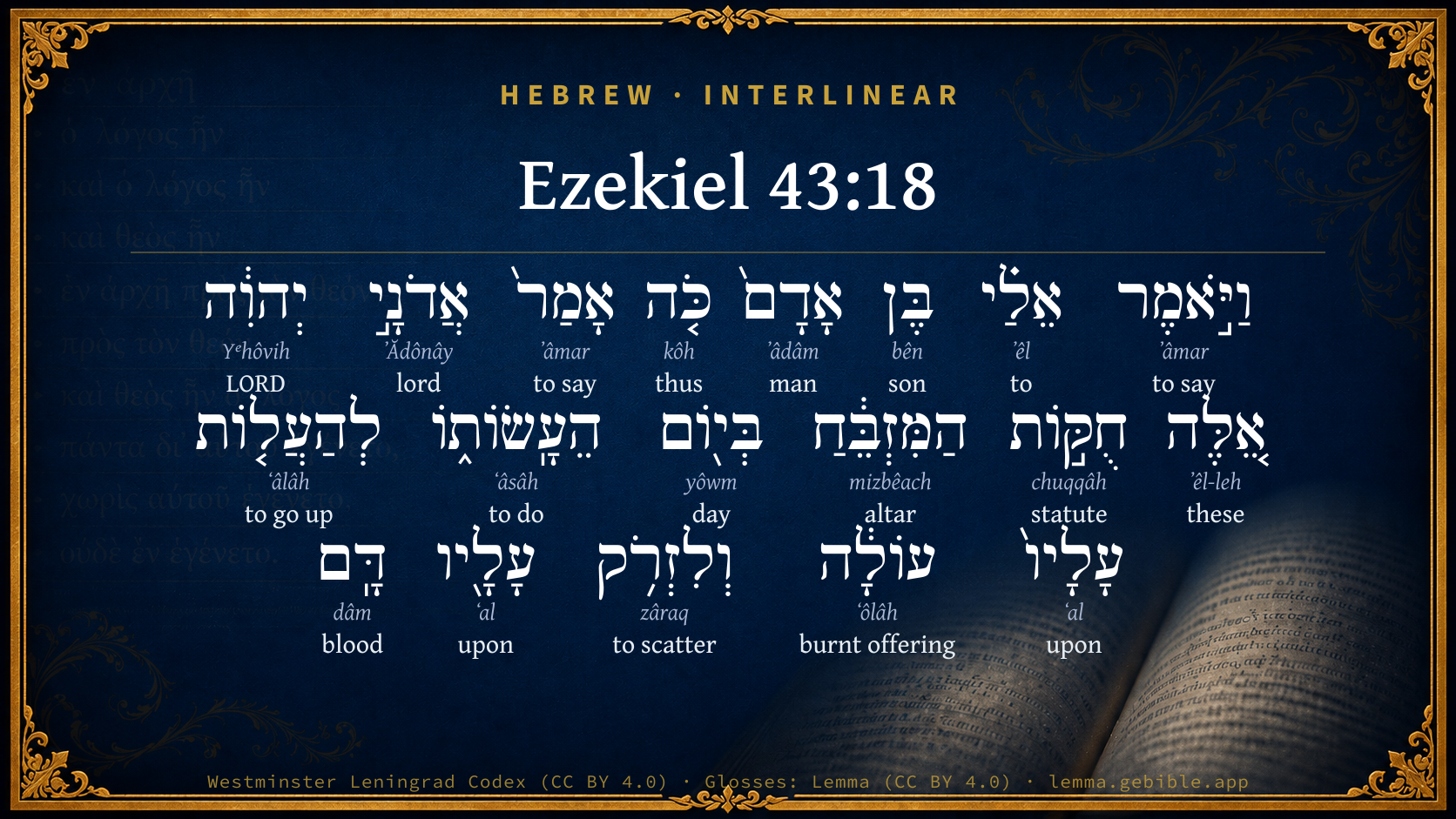
Hebrew (Westminster Leningrad Codex) Ezekiel 43:18 appears in the Hebrew Old Testament. The text above is from the Westminster Leningrad Codex. Each word links to its Strong’s number, a concise gloss, and parsing drawn from the Open Scriptures Hebrew Bible morphology. Click any word for its full Brown-Driver-Briggs (BDB) entry.
Download image
Cite this verse

Ezekiel 43:18 (World English Bible). Public Domain. Lemma interlinear Bible study tool, https://lemma.gebible.app/v/ezekiel/43/18.

Show BibTeX & RIS
BibTeX
RIS
English Translation
He said to me, Son of man, thus says the Lord Yahweh: These are the ordinances of the altar in the day when they shall make it, to offer burnt offerings thereon, and to sprinkle blood thereon.
World English Bible · Public Domain
Download a study sheet

One document with this verse’s original text, its word-by-word gloss line, the meaning frame, cross-references with their text, attributed commentary, and full source and license credits — printable, and it pastes into notes with its structure intact.

This verse Autodidact and up

Study sheet (.html) Plain text (.txt)

A passage Seminary Student

Up to 50 verses in one chapter. A passage sheet keeps up to 6 commentary sources and 12 cross-references per verse, in the order this page ranks them, and says so on the sheet whenever that leaves anything out. Ask for a single verse and you get the Autodidact verse sheet above.

Everything on this page stays free to read, with no account — the sheet is a download of what is already on screen, not access to it.

Want to remove ads? Support Godless Engineer
Compare translations 3

The same verse in 3 English versions, stacked beneath the original-language interlinear above. Click any original word for its lexicon entry.

Each is an independent rendering of the whole verse — the interlinear is not word-aligned to these translations.

Highlighted words mark where these versions differ — a whole-verse word diff, not a word-by-word alignment.

  • World English Bible Public Domain
    He said to me, Son of man, thus says the Lord Yahweh: These are the ordinances of the altar in the day when they shall make it, to offer burnt offerings thereon, and to sprinkle blood thereon.
  • King James Version Public Domain
    And he said unto me, Son of man, thus saith the Lord GOD; These are the ordinances of the altar in the day when they shall make it, to offer burnt offerings thereon, and to sprinkle blood thereon.
  • unfoldingWord Literal Text CC BY-SA 4.0
    Next he said to me, “Son of man, the Lord Yahweh says this: These are the regulations for the altar on the day they make it, for raising the burnt offering onto it, and for sprinkling blood on it.

unfoldingWord Literal Text — © unfoldingWord, licensed CC BY-SA 4.0. Word-aligned USFM3 via Door43 (git.door43.org/unfoldingWord/en_ult).

Versions to compare (up to 4)

3 of 4 selected

Show all 18 translations

Every available English version of this verse, each an independent rendering of the whole verse.

  • World English Bible Public Domain
    He said to me, Son of man, thus says the Lord Yahweh: These are the ordinances of the altar in the day when they shall make it, to offer burnt offerings thereon, and to sprinkle blood thereon.
  • Berean Standard Bible Public Domain
    Then He said to me: “Son of man, this is what the Lord GOD says: ‘These are the statutes for the altar on the day it is constructed, so that burnt offerings may be sacrificed on it and blood may be sprinkled on it:
  • Majority Standard Bible Public Domain
    Then He said to me: “Son of man, this is what the Lord GOD says: ‘These are the statutes for the altar on the day it is constructed, so that burnt offerings may be sacrificed on it and blood may be splattered on it:
  • King James Version Public Domain
    And he said unto me, Son of man, thus saith the Lord GOD; These are the ordinances of the altar in the day when they shall make it, to offer burnt offerings thereon, and to sprinkle blood thereon.
  • American Standard Version (1901) Public Domain
    And he said unto me, Son of man, thus saith the Lord Jehovah: These are the ordinances of the altar in the day when they shall make it, to offer burnt-offerings thereon, and to sprinkle blood thereon.
  • Revised Version (1885) Public Domain
    And he said unto me, Son of man, thus saith the Lord GOD: These are the ordinances of the altar in the day when they shall make it, to offer burnt offerings thereon, and to sprinkle blood thereon.
  • Geneva Bible (1599) Public Domain
    And he said vnto me, Sone of man, thus saith ye Lord God, These are ye ordinances of ye altar in the day when they shall make it to offer the burnt offring thereon, and to sprinkle blood thereon.
  • Douay-Rheims (1899) Public Domain
    And the brim was fourteen cubits long, and fourteen cubits broad in the four corners thereof: and the crown round about it was half a cubit, and the bottom of it one cubit round about: and its steps turned toward the east.
  • Young's Literal Translation Public Domain
    And He saith unto me, `Son of man, Thus said the Lord Jehovah: These `are' statutes of the altar in the day of its being made to cause burnt-offering to go up on it, and to sprinkle on it blood.
  • Literal Standard Version CC BY-SA 4.0
    And He says to me, “Son of man, thus said Lord YHWH: These [are] statutes of the altar in the day of its being made to cause burnt-offering to go up on it, and to sprinkle blood on it.
  • Unlocked Literal Bible CC BY-SA 4.0
    Next he said to me, “Son of man, the Lord Yahweh says this: These are the regulations for the altar on the day they make it, for raising the burnt offering onto it, and for sprinkling blood on it.
  • unfoldingWord Literal Text CC BY-SA 4.0
    Next he said to me, “Son of man, the Lord Yahweh says this: These are the regulations for the altar on the day they make it, for raising the burnt offering onto it, and for sprinkling blood on it.
  • Darby Bible Public Domain
    And he said unto me, Son of man, thus saith the Lord Jehovah: These are the ordinances of the altar in the day when they shall make it, to offer up burnt-offerings thereon, and to sprinkle blood thereon.
  • World Messianic Bible Public Domain
    He said to me, “Son of man, the Lord GOD says: ‘These are the ordinances of the altar in the day when they make it, to offer burnt offerings on it, and to sprinkle blood on it.
  • Webster's Bible Public Domain
    And he said to me, Son of man, thus saith the Lord GOD; These are the ordinances of the altar in the day when they shall make it, to offer burnt-offerings upon it, and to sprinkle blood upon it.
  • Free Bible Version CC BY-SA 4.0
    Then he told me: “Son of man, this is what the Lord God says: These are the regulations regarding the altar once it's built, so that it can be used to sacrifice burnt offerings and to sprinkle blood on it:
  • Bible in Basic English Public Domain
    And he said to me, Son of man, the Lord God has said, These are the rules for the altar, when they make it, for the offering of burned offerings on it and the draining out of the blood.
  • JPS Tanakh (1917) Public Domain
    And He said unto me: 'Son of man, thus saith the Lord GOD: These are the ordinances of the altar in the day when they shall make it, to offer burnt-offerings thereon, and to dash blood against it.

Literal Standard Version (2020), Covenant Press — licensed CC BY-SA 4.0. Text via the HelloAO Bible API (eBible.org). Unlocked Literal Bible (unfoldingWord) — licensed CC BY-SA 4.0. Text via the HelloAO Bible API (eBible.org). unfoldingWord Literal Text — © unfoldingWord, licensed CC BY-SA 4.0. Word-aligned USFM3 via Door43 (git.door43.org/unfoldingWord/en_ult). Free Bible Version, Dr. Jonathan Gallagher — licensed CC BY-SA 4.0. Text via the HelloAO Bible API (eBible.org).

Word by word

More ways to search: Search by grammar → Find every occurrence → Compare this word →

Practice this passage: Drill this verse → Learn its vocabulary →

וְלִזְרֹ֥ק
zâraq
H2236
“and · to scatter”
Conjunction + Preposition + Verb, Qal, Infinitive Construct
Part of Speech
Conjunction + Preposition + Verb
Stem
Qal
Form
Infinitive Construct
Full BDB Definition

Origin: a primitive root

TWOT: 585

to scatter, sprinkle, toss, throw, scatter abundantly, strew - (Qal) to scatter, sprinkle, toss - (Pual) to be sprinkled
  1. וַיֹּ֣אמֶר ʼâmar H559 “and · to say” Conjunction + Verb, Qal, Sequential Imperfect, 3rd Person, Masculine, Singular
  2. אֵלַ֗י ʼêl H413 “to · me” Preposition + Suffix, Personal, 1st Person, Common, Singular
  3. בֶּן bên H1121 “son of” Noun, Common, Masculine, Singular, Construct
  4. אָדָם֙ ʼâdâm H120 “man” Noun, Common, Masculine, Singular, Absolute
  5. כֹּ֤ה kôh H3541 “thus” Adverb
  6. אָמַר֙ ʼâmar H559 “to say” Verb, Qal, Perfect, 3rd Person, Masculine, Singular
  7. אֲדֹנָ֣י ʼĂdônây H136 “Lord · my” Noun, Common, Masculine, Plural, Construct + Suffix, Personal, 1st Person, Common, Singular
  8. יְהוִ֔ה Yᵉhôvih H3069 “LORD” Noun, Proper
  9. אֵ֚לֶּה ʼêl-leh H428 “these” Pronoun, Demonstrative, Common, Plural
  10. חֻקּ֣וֹת chuqqâh H2708 “statutes of” Noun, Common, Both, Plural, Construct
  11. הַמִּזְבֵּ֔חַ mizbêach H4196 “the · altar” Particle, Definite Article + Noun, Common, Masculine, Singular, Absolute
  12. בְּי֖וֹם yôwm H3117 “in/at · day of” Preposition + Noun, Common, Masculine, Singular, Construct
  13. הֵעָֽשׂוֹת֑וֹ ʻâsâh H6213 “to do · him” Verb, Niphal, Infinitive Construct + Suffix, Personal, 3rd Person, Masculine, Singular
  14. לְהַעֲל֤וֹת ʻâlâh H5927 “to go up” Preposition + Verb, Hiphil, Infinitive Construct
  15. עָלָיו֙ ʻal H5921 “upon · him” Preposition + Suffix, Personal, 3rd Person, Masculine, Singular
  16. עוֹלָ֔ה ʻôlâh H5930 “burnt offering” Noun, Common, Feminine, Singular, Absolute
  17. עָלָ֖יו ʻal H5921 “upon · him” Preposition + Suffix, Personal, 3rd Person, Masculine, Singular
  18. דָּֽם dâm H1818 “blood” Noun, Common, Masculine, Singular, Absolute

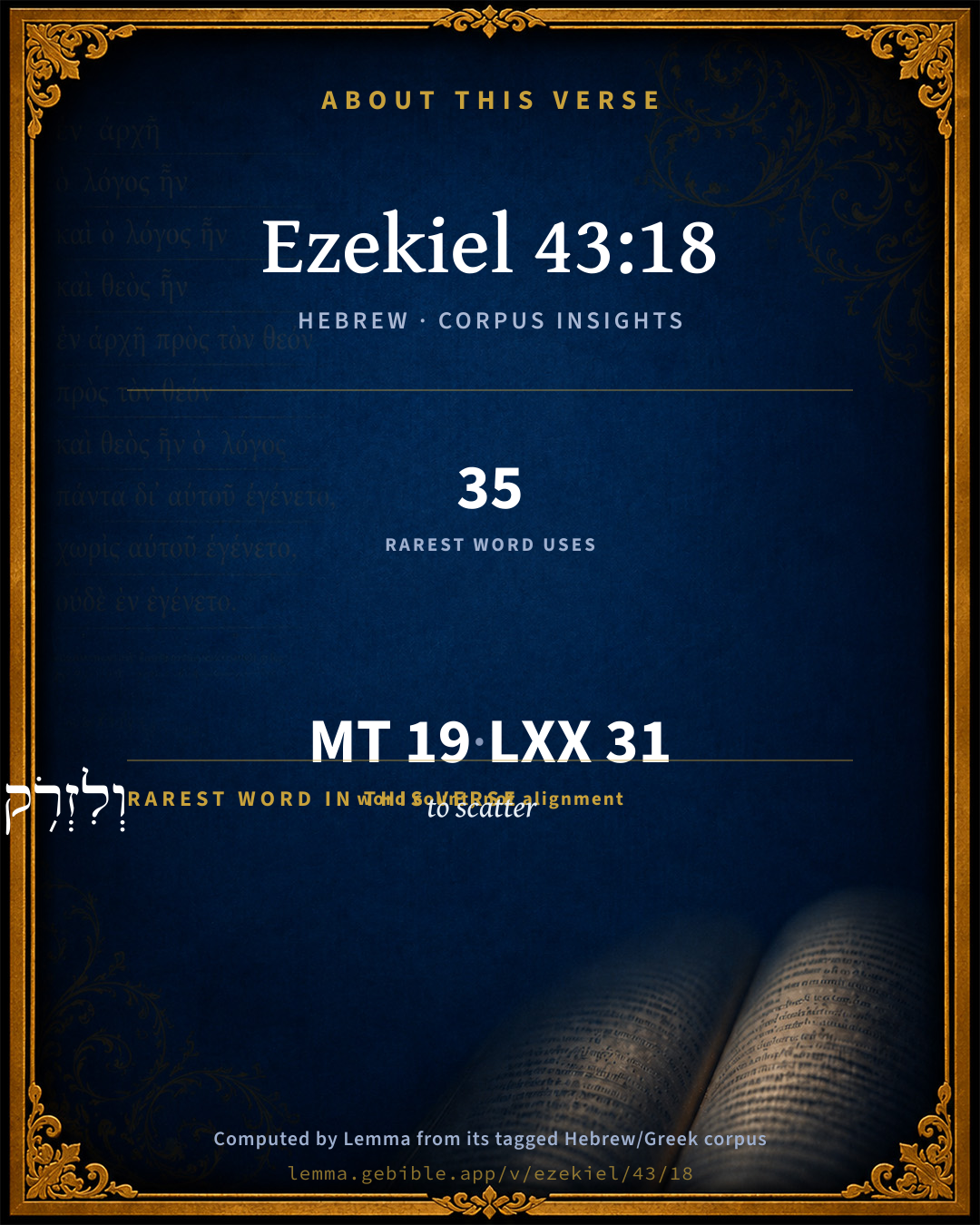
About this verse

These counts appear in no published source. They are computed here, from the morphology-tagged text and Lemma’s own curated glosses. What Lemma adds →

19
words
17
distinct lemmas
Prophets
section

Shared distinctive vocabulary

וְלִזְרֹ֥ק to scatter H2236 occurs in 33 verses of the Hebrew Bible. Also found in:

Grammatical profile

  • 5 verbs
  • 9 nouns
  • 1 pronoun
  • 3 prepositions
  • 1 adverb

Verb forms

  • וַיֹּ֣אמֶר Qal · Sequential Imperfect
  • אָמַר֙ Qal · Perfect
  • הֵעָֽשׂוֹת֑וֹ Niphal · Infinitive Construct
  • לְהַעֲל֤וֹת Hiphil · Infinitive Construct
  • וְלִזְרֹ֥ק Qal · Infinitive Construct

Repetition

Words recur within this verse — often emphatic in Hebrew:

  • וַיֹּ֣אמֶר to say H559 ×2
  • עָלָיו֙ upon H5921 ×2

Hebrew & Septuagint length

In English translation the verse runs 37 words from the Hebrew and 42 from the Septuagint (LXX English) — closely comparable.

A rough comparison of the two English renderings, which tokenize alike — not a word-level alignment.

Word counts can differ between the Hebrew and the Greek without any difference in meaning — e.g. the Hebrew direct-object marker אֵת has no separate Greek word, and Greek often adds the article ὁ.

In the original languages it is 19 Hebrew tokens and 31 Greek tokens — but the two are counted differently (Hebrew bundles its prefixes and suffixes into one token; the Greek is in lemma form), so that isn’t a like-for-like length.

Cross-references

10

Topical passages linked to Ezekiel 43:18 in the Treasury of Scripture Knowledge — connected by theme and wording, ordered by reader-vote popularity; previews shown in the World English Bible.

  • Exodus 40:29 He set the altar of burnt offering at the door of the tent of the tent of meeting, and offered on it the burnt offering and the meal-offering, as Yahweh commanded Moses.
  • Leviticus 1:5–17 He shall kill the bull before Yahweh. Aaron's sons, the priests, shall present the blood and sprinkle the blood around on the altar that is at the door of the Tent of Meeting.
  • Leviticus 8:18–21 He presented the ram of the burnt offering: and Aaron and his sons laid their hands on the head of the ram.
  • Leviticus 16:19 He shall sprinkle some of the blood on it with his finger seven times, and cleanse it, and make it holy from the uncleanness of the children of Israel.
  • Ezekiel 2:1 He said to me, Son of man, stand on your feet, and I will speak with you.
  • Ezekiel 45:18–19 Thus says the Lord Yahweh: In the first [month], in the first [day] of the month, you shall take a young bull without blemish; and you shall cleanse the sanctuary.
  • Hebrews 9:13 For if the blood of goats and bulls, and the ashes of a heifer sprinkling those who have been defiled, sanctify to the cleanness of the flesh:
  • Hebrews 9:21–22 Moreover he sprinkled the tabernacle and all the vessels of the ministry in like manner with the blood.
  • Hebrews 10:4–12 For it is impossible that the blood of bulls and goats should take away sins.
  • Hebrews 12:24 to Jesus, the mediator of a new covenant, and to the blood of sprinkling that speaks better than that of Abel.

Cross-references courtesy of OpenBible.info (CC BY 4.0).

Hebrew and Greek witnesses Masoretic Hebrew ↔ Greek Septuagint

The same verse in the two great witnesses to the Old Testament, shown verse-for-verse.

These are two independent witnesses, not word-aligned to each other, and the Septuagint is shown in lemma (dictionary) form.

Hebrew Ezekiel 43:18 Masoretic · Westminster Leningrad Codex

וַיֹּ֣אמֶר אֵלַ֗י בֶּן אָדָם֙ כֹּ֤ה אָמַר֙ אֲדֹנָ֣י יְהוִ֔ה אֵ֚לֶּה חֻקּ֣וֹת הַמִּזְבֵּ֔חַ בְּי֖וֹם הֵעָֽשׂוֹת֑וֹ לְהַעֲל֤וֹת עָלָיו֙ עוֹלָ֔ה וְלִזְרֹ֥ק עָלָ֖יו דָּֽם

He said to me, Son of man, thus says the Lord Yahweh: These are the ordinances of the altar in the day when they shall make it, to offer burnt offerings thereon, and to sprinkle blood thereon.

World English Bible · Public Domain

Greek LXX Ezekiel 43:18 Septuagint · lemma form

καί εἶπον πρός ἐγώ υἱός ἄνθρωπος ὅδε λέγω κύριος ὁ θεός ἰσραήλ οὗτος ὁ πρόσταγμα ὁ θυσιαστήριον ἐν ἡμέρα ποίησις αὐτός ὁ ἀναφέρω ἐπί αὐτός ὁλοκαύτωμα καί προςχέω πρός αὐτός αἷμα

And he said to me, Son of man, thus says the Lord God of Israel; These are the ordinances of the altar in the day of its being made, to offer upon it whole burnt offerings, and to pour blood upon it.

LXX2012 (modern English Septuagint) · Public Domain

On this verse, Keil & Delitzsch discusses the Septuagint’s reading. Read the note in Commentary ↓

Hebrew: Westminster Leningrad Codex (CC BY 4.0). Greek: Septuagint (public domain); English from LXX2012 (modern English Septuagint) (Public Domain). How the Septuagint differs from the Hebrew →

Targum (Aramaic paraphrase)

1

The Targum is the ancient Jewish Aramaic paraphrase of the Hebrew Scriptures — an interpretive translation, not the Hebrew text itself. Onkelos (literal) and Pseudo-Jonathan (expansive) render the Torah, and Jonathan the Prophets. Coverage is partial: where no permissively-licensed English translation exists for a verse, only the Aramaic is shown. This is verse-level text, not a word-by-word alignment to the Hebrew.

  1. Targum Jonathan Prophets (Joshua–Malachi)
    וַאֲמַר לִי בַּר אָדָם כִּדְנַן אֲמַר יְיָ אֱלֹהִים אִלֵין גְזֵירַת מַדְבְּחָא בְּיוֹם אִיתְעַבְּדוּתֵהּ לְאַסָקָא עֲלוֹהִי עֲלָתָא וּלְמִזְרָק עֲלוֹהִי דָם נִכְסַת קוּדְשַׁיָא:

    (no public-domain English translation for this verse)

    Targum Jonathan — Aramaic: “Mikraot Gedolot” (public domain). English: “Sefaria Community Translation” (CC0 1.0 (public-domain dedication)); “London "Chaldee Paraphrase," 1871” (public domain). Text via Sefaria.

Commentary

Notes on Ezekiel 43:18 from classic Christian and Jewish commentators (each source and its license shown beneath its notes). The classic Christian expositions comment on the surrounding passage and are grouped to its opening verse, so a note may address several verses; the Jewish commentaries on the Tanakh (Rashi and others) are per-verse, so they appear only where the commentator wrote on this verse.

Lemma curates 59 commentaries, every one of them public domain or Creative Commons licensed, each selected and text-cleaned for this edition rather than reprinted as found. About our sources →

Jamieson, Fausset & Brown

Robert Jamieson, A. R. Fausset & David Brown

The sacrifices here are not mere commemorative, but propitiatory ones. The expressions, "blood" (Eze 43:18), and "for a sin offering (Eze 43:19, Eze 43:21-22), prove this. In the literal sense they can only apply to the second temple. Under the Christian dispensation they would directly oppose the doctrine taught in Heb. 10:1-18, namely, that Christ has by one offering for ever atoned for sin. However, it is possible that they might exist with a retrospective reference to Christ's sufferings, as the Levitical sacrifices had a prospective reference to them; not propitiatory in themselves, but memorials to keep up the remembrance of His propitiatory sufferings, which form the foundation of His kingdom, lest they should be lost sight of in the glory of that kingdom [DE BURGH]. The particularity of the directions make it unlikely that they are to be understood in a merely vague spiritual sense.

Jamieson, Fausset & Brown — Commentary Critical and Explanatory on the Whole Bible (1871) — public domain (CC PDM 1.0). Text via the HelloAO Bible API.

Trapp's Complete Commentary

John Trapp

Eze 43:18 And he said unto me, Son of man, thus saith the Lord GOD; These [are] the ordinances of the altar in the day when they shall make it, to offer burnt offerings thereon, and to sprinkle blood thereon.

Ver. 18. These are the ordinances of the altar.] Christians also have their sacrifices, though of another alloy, to offer, and must look to the ordinances of their altar; ministers must especially.

John Trapp, A Commentary or Exposition upon All the Books of the Old and New Testament (1647–1656) — public domain. Text from a community e-Sword module.

Joseph Benson's Commentary

Eze 43:18-27. These are the ordinances of the altar — Here we have directions concerning the dedication of the altar at first. Seven days were to be spent in the dedication of it, and every day sacrifices were to be offered upon it, particularly a goat for a sin-offering, (Eze 43:25,) besides a young bullock for a sin-offering on the first day, Eze 43:19; which teaches us, in all our religious services, to have an eye to Christ, the great sin- offering. Neither our persons nor our performances can be acceptable to God, unless sin be taken away; and that cannot be taken away but by the blood of Christ, which both sanctifies the altar (for Christ entered by his own blood) and the gift upon the altar. There was also a bullock and a ram to be offered for a burnt-offering, (Eze 43:24,) which was intended purely for the glory of God, to teach us to have an eye to that in all our services. This dedication of the altar is called the cleansing and purging of it, Eze 43:20; Eze 43:26. Christ, our altar, though he had no pollution to be cleansed from, yet sanctified himself, Joh 17:19. And when we consecrate the altars of our hearts to God, to have holy love always burning upon them, we must see that they be purified and cleansed from the love of the world and the lust of the flesh. It is observable, that there are several differences between the rites of dedication here, and those which were appointed Exodus 29., to intimate that the ceremonial institutions were mutable things, and the changes made in them were earnests of their termination in Christ. Only here, according to the general law that all the sacrifices must be seasoned with salt, (Lev 2:14,) particular orders are given (Eze 43:24) that the priests shall cast salt upon the sacrifices. Grace is the salt with which all our religious performances must be seasoned, Col 4:6. An everlasting covenant is called a covenant of salt, because it is incorruptible. The glory reserved for us is incorruptible and undefiled; and the grace wrought in us, influencing the hidden man of the heart, is in that which is not corruptible, and therefore, in the sight of God, of great price. We may observe further here, that constant use was to be made of the altar when dedicated; the priests being directed to make their burnt-offerings and peace-offerings upon it, (Eze 43:27,) for therefore it was sanctified, that it might sanctify the gift that was offered upon it. And for their encouragement in this whole service, God promises, on condition of their observing these directions, that he would graciously accept them: for those that give themselves to God shall be accepted of him, their persons first, and then their performances, through the Mediator; and if our persons be accepted, and our services be pleasing to him, it is enough, we need no more.

Joseph Benson's Commentary on the Old and New Testaments (1811–1818) — public domain. Text from a community e-Sword module.

Keil & Delitzsch

C. F. Keil & F. Delitzsch

Consecration of the Altar

Eze 43:18. And he said to me, Son of man, Thus saith the Lord Jehovah, These are the statutes of the altar in the day when it is erected, to offer burnt-offerings upon it, and to sprinkle blood thereon. Eze 43:19. Thou shalt give to the priests of the tribe of Levi who are of the seed of Zadok, who draw near to me, is the saying of the Lord Jehovah, a bullock, a young ox, for a sin-offering. Eze 43:20. And thou shalt take of its blood, and put it upon is four horns, and upon the four corners of the enclosure, and upon the moulding round about; and so absolve and expiate it. Eze 43:21. And thou shalt take the bullock of the sin-offering, and burn it at the appointed place of the house, outside the sanctuary. Eze 43:22. And on the second day thou shalt offer a faultless he-goat for a sin-offering, that they may absolve the altar, as they absolved it with the bullock. Eze 43:23. When thou hast completed the absolution, thou shalt offer a bullock, a young ox, without fault, and a faultless ram of the flock; Eze 43:24. And shalt bring them before Jehovah, and the priests shall throw salt upon them, and sacrifice them as burnt-offering to Jehovah. Eze 43:25. Seven days shalt thou offer a sin-offering goat daily and a bullock, a young ox, and a ram of the flock without fault shall they prepare. Eze 43:26. Seven days shall they expiate the altar, and cleanse it, and fill its hand. Eze 43:27. And when they have completed these days, it shall come to pass on the eighth day and henceforward, that the priests place your burnt-offerings and your peace-offerings upon the altar, and I will accept you with delight, is the saying of the Lord Jehovah.

As the altar of the tabernacle and that of Solomon's temple were consecrated before they were used (Lev 8:11, Lev 8:15, Lev 8:19, Lev 8:33; Kg1 8:62-66; Ch2 7:4-10), and God commanded and regulated this consecration of the altar of the tabernacle (Exo 29:10.), so also is the altar of burnt-offering in the new sanctuary to be consecrated before it is used. This command is given to Ezekiel, and the consecration enjoined upon him, not as the representative of the nation, but as a prophet, upon whom, as is frequently the case in the prophetical narratives, those things are said to be enjoined, which are to be set in operation through his proclamation. This commission is given to him, however, for the day (the time) when the altar will be made or restored, from which alone we may see that the execution of the command belongs to the future, in which the temple shown him in the spirit is to be erected, and that it will take place in a manner corresponding to the realization of the temple; so that we cannot infer from this command alone that the reference is to the building of a temple and altar of stone, metal, and wood. חקּות are not the regulations prescribed for the altar service generally, but simply those relating to its consecration. If we compare these with the account of the consecration of the altars of the earlier sanctuaries, we find that no detailed description is given of the consecration of the altar of Solomon's temple, but that it is simply stated that it lasted seven days (Ch2 7:9). The consecration of the altar of the tabernacle lasted just the same time (Exo 29:37; Lev 8:33). And the same period is appointed here (Eze 43:26). But the consecration of the altar of the tabernacle was associated with the consecration of the priests. Here, on the contrary, the existence of the priesthood is presupposed, and only the altar is consecrated. The consecration of the Mosaic altar commenced with the anointing of the altar and all its utensils, by the sprinkling of it seven times by Moses with the holy anointing oil, for the purpose of sanctifying it (Lev 8:11). Here, on the other hand, nothing is said about the anointing of the altar; only the absolving of it by sacrifice is mentioned, which followed the anointing in the case of the Mosaic altar. At the altar in the tabernacle Moses performed the whole act of consecration, as the mediator of the covenant, the anointing as well as the preparation of the sacrifices. Here, however, the priests already consecrated for their service are to complete the sacrificial ceremony. It is true that the expressions used in Eze 43:20, "take of its blood," etc., and in Eze 43:21, "take the bullock of the sin-offering," etc., apparently indicate that the prophet was to perform the sprinkling of the blood and the burning of the sin-offering. But it is obvious that this is only to be understood as signifying that he was to do it through the medium of the priests, i.e., was to enjoin the performance of it upon them, from the use of the plural הטּאוּ in Eze 43:22: "they shall absolve the altar, as they have absolved it with the bullock." It is not all the priests of the tribe of Levi however, who are to perform this service, but simply those of the family of Zadok, who alone are selected in the new temple for specifically priestly service (cf. Eze 40:46 and Eze 44:15.).

The sacred ceremony commences with the offering of a young ox as a sin-offering; Eze 43:19, Eze 43:20, as in Lev 8:14, compared with Exo 29:1, Exo 29:10. The blood of the ox is to be put upon the four horns and the four corners of the enclosure, and upon the moulding below it round about; and the flesh is to be burned at an appointed place outside the sanctuary. For the article in הפּר החטּאת (Eze 43:21), see Ewald, 290b. The pouring out of the blood - that was not used for smearing the places indicated - at the foot of the altar is not mentioned, nor the burning of the fat portions of the sacrifice upon the altar. We cannot infer, from the omission of the latter circumstance, that the fat was not consumed upon the altar, but was burned, with the flesh, skin, and bones of the animal, outside the sanctuary, as Kliefoth supposes. Without the burning of certain definite portions of the victim upon the altar, the slaughtering of the animal would not have been a complete sacrifice at all; the smearing of the blood upon the altar would not have sufficed for this. And the fact that in Eze 43:21 the command is given, "take the bullock and burn it," does not prove that the animal was to be burned along with those fat portions which were to be consumed upon the altar in the case of every sin-offering. In Lev 8:17 also, את־הפּר stands in the place of את־בּשׂר הפּר, Exo 29:14. Ezekiel generally presupposes that the sacrificial ritual is well known, and therefore mentions only those points in which deviations from the ordinary ritual took place in connection with this sacrifice, such as the sprinkling of the blood, because the blood was to be smeared on particular parts of the altar, and the burning of the flesh, on account of the place where this was to be done. In the case of the burnt-offering in Eze 43:23, no directions are given concerning the ceremonial; because this was to be in conformity with the standing ritual, with the exception of the sprinkling with salt, which was not to be performed in the same manner as in the ordinary sacrifices. The burning is to take place בּמפקד , outside the sanctuary. מפקד is a place commanded or appointed; and מפקד is a place in the temple set apart for that purpose. It follows from this that the place in question, since it belonged to the house, i.e., to the temple, is to be sought for within the square of five hundred cubits in extent, which was covered by the temple and its courts; and at the same time that it was outside the מקדּשׁ, i.e., upon a spot which did not form part of the sanctuary in the stricter sense of the word. Kliefoth therefore thinks of a spot within the gizrah (Eze 41:12), the name of which implies that the space which it covered did not belong to the true מקדּשׁ. This view is the most probable one; whereas Ewald's conjecture, that the place intended is the locality of the sacrificial kitchens of the priests described in Eze 46:19, is decidedly erroneous, as these kitchens, which were set apart for the cooking of the holy sacrificial flesh to be eaten by the priests alone, were certainly reckoned as forming part of the מקדּשׁ. - Eze 43:22. On the second day, a he-goat was to be brought for a sin-offering, and the altar was to be cleansed from sin with this just as with the bullock on the first day; which implies that the same ceremonial was to be observed with this sacrifice as with that of the sin-offering.

After the completion of the expiation a burnt-offering was to be presented to the Lord of a bullock and a ram (Eze 43:23 and Eze 43:24). There is a difference of opinion as to the meaning of בּכלותך in these verses. Hitzig and Kliefoth suppose that the expiation was only completed on the second day, with the offering of the he-goat as a sin-offering. They both of them lay stress upon the fact that, on the one hand, in Eze 43:23 and Eze 43:24 the offering of the burnt-offering is mentioned on the second day, and not on the first day also; and on the other hand, in Eze 43:25, for the seven days of consecration, only the preparation of a he-goat for the sin-offering and the preparation of the two animals appointed for the burnt-offering are mentioned. Hitzig also adduces the fact that in Eze 43:26 there is no further reference to חטּא, but simply to כפּר and טהר, and draws the conclusion from this, that the sin attaching to the altar was removed with two sin-offerings on two days, and then through seven days further by means of burnt-offerings the anger of God which followed the sin was appeased (כפּר), and the uncleanness or profane character of the altar was expunged (טהר), so that the seven days of Eze 43:25 are not to be dated from Eze 43:19 onwards. According to this view, the consecration of the altar lasted nine days, and not seven, and the eighth day mentioned in Eze 43:27 would really be the tenth day, reckoning from the commencement of the consecration. To carry out this view, Hitzig is obliged to erase not only the וכפּרתּהוּ of Eze 43:20, but also the first half of Eze 43:25 as glosses; a fact which carries its condemnation with it, as even the Septuagint furnishes no warrant for the erasure of Eze 43:25. Moreover, the distinction which Hitzig draws between חטּא on the one hand, and כּפּר and טהר on the other, is quite erroneous. Purification (טהר) is never mentioned in the law as the effect produced by a burnt-offering. A sin-offering followed by a burnt-offering is invariably prescribed for the removal of uncleanness; for "reconciliation and purification take place through the absolution effected by the sin-offering; and to such a sin-offering and its purifying operation the burnt-offering is then added to secure the good pleasure of God for that which has been already cleansed" (Kliefoth).

But we cannot regard even Kliefoth's view as well founded, namely, that on the first day a sin-offering alone was presented, and it was only from the second day onwards that a sin-offering and burnt-offering were presented, and this lasted for seven days, so that the consecration of the altar continued fully eight days, and on the ninth day (not the eighth, as stated in Eze 43:27) the regular use of the altar commenced. Kliefoth bases this conclusion principally upon the fact that Eze 43:19-21 attribute only the sin-offering of a bullock to the first day; and that, on the other hand, Eze 43:25 and Eze 43:26 extend in all its details to seven days the very same ceremony as Eze 43:22-24 assign to the second day, whereas they do not contain a syllable to the effect that the sin-offering of the bullock was to be repeated every day, or that the sacrifices described in Eze 43:22-24 were also to be offered on the first day. The sinew of this demonstration consists in silentio, therefore; and this precarious basis of argument crumbles here, as in most other cases, as is evident from the words of Eze 43:26 : "seven days shall ye reconcile the altar, and purify it." This perfectly general statement, which is not connected with Eze 43:25 by any Vav copul., or placed in subordination to it, affirms in the clearest manner that the consecration of the altar was to last seven days, neither more nor less; so that if these seven days are to be reckoned from the second day, the sin-offering of the bullock upon the first day must be deprived of its reconciling and purifying worth, in direct contradiction not only to Eze 43:20, according to which the altar was to be absolved and reconciled through the sin-offering of the bullock to be offered on the first day, but also to Eze 43:22, according to which they were to absolve the altar by the sin-offering of the he-goat, in just the same manner as they had absolved it by the sin-offering of the bullock (on the first day). To take the כּפּר and מהר in Eze 43:26 merely as the effect produced by the sacrifices mentioned in Eze 43:25, renders the שׁבעת standing at the head of Eze 43:26 an impossibility. Unless, therefore, we would impose upon the words of the prophet a gross contradiction, we must lay no stress either upon the fact that in Eze 43:23 the offering of the burnt-offering is not mentioned till after the direction concerning he sin-offering to be presented on the second day, or upon the circumstance that in Eze 43:25 the he-goat is mentioned as a sin-offering for all the seven days, and no allusion is made to the fact that the sin-offering of the first day was a bullock. The former (the reference to the burnt-offering after the sin-offering of the second day) may be explained very simply, on the ground that the sin-offerings of the first two days are mentioned one after the other, because different animals were prescribed for the purpose, and then, first, the burnt-offerings, which were the same for every day. And it is obvious that the explanation is to be sought for in this formal arrangement, and not in the fact that only a sin-offering without a burnt-offering was to be presented on the first day, and consequently that the expression "on the second day" refers solely to the sin-offering of that day, from the words בּכלותך מחטּא in Eze 43:23; since מחטּא cannot be understood in a different sense from that which it bears in Eze 43:22, the clause immediately preceding, i.e., must not be restricted to the sin-offering of the second day, but must be taken as referring to the sin-offerings of both the first and second days. The meaning of the words is therefore this: when the absolution by means of the sin-offering on the first and on the second day is ended, then shalt thou bring a burnt-offering. But if this is the meaning of the words, the offering of the burnt-offering prescribed in Eze 43:23 does not fall so exclusively under the definition of time contained in the words "on the second day," as to warrant our assigning it to the second day alone, and concluding that no such offering was presented on the first day. There was no necessity for Ezekiel to express himself more clearly on this point, as there was no fear of any misunderstanding on the part of those who were acquainted with the law; since every Israelites who had been instructed in the law knew full well that no sin-offering could ever be presented without being followed by a burnt-offering, that in fact the burnt-offering was indispensable to the accomplishment of the כּפּרה, for which the sin-offering was presented. And in Eze 43:25 also, Ezekiel had no occasion to fear that the somewhat loose expression, "seven days shalt thou prepare a he-goat sin-offering for the day," would be misunderstood; as he had already stated that a bullock was to be taken for the sin-offering of the first day, and the period of seven days was so universally prescribed in the law for every act of consecration which lasted more than one day, that he would have indicated in a clearer manner any deviation from this rule. We therefore regard the change of the seven days devoted to the consecration of the altar into eight as being just as groundless as that into nine, and adhere to the traditional explanation of these verses, namely, that the consecration of the altar lasted only seven days, and that on every one of these days a sin-offering and a burnt-offering were to be presented, the sin-offering on the first day being a bullock, and on the other days a he-goat, whilst the burnt-offerings were to consist on all seven days of a young ox and a ram.

With regard to the burnt-offering, the direction given, that the priests are to throw or pour (השׁליך), and not merely to strew or sprinkle, salt upon it, is to be regarded as significant. According to Lev 2:13, salt was to be added to every קרבּן (bloody or bloodless) sacrifice. The express allusion to the salting of these consecrating burnt-offerings, and also the choice of the verb השׁליך, point to a copious strewing with salt for the purpose of giving greater intensity to the force of these sacrifices. On the significance of salt in relation to the sacrifices, see the comm. on Lev 2:13. The ו attached to the Chetib וכפּרוּ in Eze 43:26 is to be explained from the fact that the definition of the time שׁבעת is placed at the head absolutely. There is something bold in the application of the expression מלּא יד to the altar; since this expression arose from the ceremony peculiar to the consecrating sacrifice of the priests, namely, that the fat and fleshy portions of this sacrifice, which were intended partly for consumption upon the altar, and partly as a heave-offering for Jehovah, were to be given into the hands of the priests to be consecrated for the purpose of investing them symbolically with the gifts, which they were to offer in part to the Lord in the altar fire in the fulfilment of their official duties, and to receive in part for their service (see the comm. on Lev 8:25-29). Filling the hand of the altar, therefore, is equivalent to providing it with sacrificial gifts, so that it should never be without them. In this sense the symbolical act was connected with the completion of its consecration as a place of sacrifice. The Keri ידו is incorrect, and ידו the proper reading; inasmuch as even at the consecration of the priests, when the sacrificial portions were placed in the hands of the priests, מלּא only is used, and not ידים (cf. Exo 29:9; Lev 21:10, etc.).

If we compare the directions given in the section before us concerning the consecration of the altar, with the consecration which was prescribed in Ex 29 for the altar of burnt-offering in the tabernacle, and was fully carried out according to Lev 8, we find the following points of difference: - (1) the anointing of the altar is wanting here; (2) at the consecration of the Mosaic altar a bullock (young ox) was prescribed as the sin-offering for all the seven days (Exo 29:36), in Ezekiel for the first day only, and a he-goat for the rest; (3) the blood of this sin-offering is smeared upon the horns of the altar in the former consecration (Exo 29:12; Lev 8:15), in the latter upon the horns and the corners of the walls, and upon the lower moulding round about; (4) the burnt-offering there consists in a ram every day, here in a bullock and a ram daily; (5) on the other hand, the ram offered as a sacrifice of consecration in the Mosaic ceremony, which was specially connected with the institution of the priests in their office, is omitted here, as the priests were already holding their office; so that the sacrifice of consecration might be said to be here absorbed into the burnt-offering. All essential differences therefore reduce themselves to the fact that in Ezekiel the anointing of the altar is wanting, and the sin-offering of the last six days is diminished by the selection of an inferior animal, in place of which the burnt-offering is considerably intensified by the demand of a bullock and a ram for this, the same thing being also indicated by the copious pouring of salt thereon. - For the symbolical meaning of these sacrifices, compare the commentary on Lev 8. - The consecration of the altar was completed in seven days; and from the eighth day onwards the priests were to offer the regular sacrifices upon it (Eze 43:27); whereas at the Mosaic consecration of the altar and priests, the constant altar service of the priests was still further inaugurated by a solemn sacrifice on the eighth day (Lev 9). Burnt-offerings and peace-offerings are mentioned in Eze 43:27 instar omnium as being the principal and most frequent sacrifices, whilst sin-offerings and meat-offerings are implied therein.

Keil & Delitzsch — Biblical Commentary on the Old Testament (1861–1891) — public domain (CC PDM 1.0). Text via the HelloAO Bible API. (Old Testament only.)

Tyndale Open Study Notes

Tyndale Open Resources

43:18-21 The new altar had to be consecrated before it was used. • On the first day, the blood of a young bull was to be applied to the extremities of the altar, the horns and corners, as a sin offering. The body of the sin offering was then burnt outside the sacred area, as with the Tabernacle (cp. Lev 4:11-12).

Tyndale Open Study Notes — © Tyndale Open Resources, licensed CC BY-SA 4.0. Text via the HelloAO Bible API.

Ellicott's Commentary for English Readers

(18) In the day when they shall make it.—This looks to the future, and implies that the whole structure of the Temple, and its acceptance by the manifestation of the Divine glory, though necessarily represented in the vision as already done, were yet in the future. The phrase, “in the day when they shall make it,” is intended only to require the consecration of the altar before it is used. The actual time occupied by the consecration (Eze_43:25-26) was to be seven days, as in Exo_29:37.

A Bible Commentary for English Readers, edited by Charles John Ellicott (1878–1897) — public domain. Text from a community e-Sword module.

The Cambridge Bible for Schools and Colleges

gen. ed. J. J. S. Perowne

18. The general purpose of the altar. The burnt-offering was wholly consumed on the altar, of the other offerings only the fat.

18–27. Sacrifices and ceremonies by which the altar was consecrated and inaugurated

The general purpose of the altar is to offer burnt-offerings upon and to sprinkle blood thereon. The statement in Eze_43:19-20 is somewhat elliptical, the writer’s object being to advert specially to the difference between the sin-offering on the first day and that on the following days. Hence he describes the ritual of the sin-offering on the first day fully, omitting to refer to the burnt-offering, which he mentions only in connexion with the second and following days. And when in Eze_43:25 it is said that a goat for sin-offering and a young bullock and a ram were offered for seven days, the difference between the sin-offering on the first day (a bullock) and that for the following six days (a goat) is not adverted to, the burnt-offering being the same all the seven days.

The Cambridge Bible for Schools and Colleges (gen. ed. J. J. S. Perowne; Cambridge University Press, 1878–1918) — public domain. Text from a community e-Sword module.

John Gill's Exposition

And he said unto me, son of man, thus saith the Lord God,.... This is the voice of the Lord continued, speaking out of the house to the prophet; see Eze 43:6,

these are the ordinances of the altar: not what go before, concerning the measures of it, but what follow, concerning the sacrifices to be offered on it:

in the day when they shall make it, to offer burnt offerings thereon, and sprinkle blood thereon; this plainly shows that this altar is the altar of burnt offerings; such were to be offered on it, and the blood of them to be sprinkled thereon, as follows; that is, upon the horns, corners, and border of it, Eze 43:20.

John Gill's Exposition of the Whole Bible (1746–1763) — public domain (CC PDM 1.0). Text via the HelloAO Bible API.

Albert Barnes' Notes on the Bible

The rites here described are not those of the regular service, but those to be observed on the day of dedication. (Compare Lev 8:10 ff; 1Ki 8:63 ff; 2Ch 7:4 ff, In the tabernacle the priest killed the victims, but Moses sprinkled the blood. In the vision the seer is addressed as though he were to perform the part of Moses.

Albert Barnes' Notes on the Bible (1834–1885) — public domain. Text from a community e-Sword/MySword module.

Matthew Poole's English Annotations

These are the ordinances; these are the measures and proportions for building the altar.

In the day when, whensoever,

they shall make it, the returned captives shall build and use it.

To offer burnt-offerings thereon: it appears then this was the great brazen altar, of which see Exo 38:30; 39:39.

To sprinkle blood thereon, according to the law, Lev 1:5.

Matthew Poole's English Annotations on the Holy Bible (1683–1685) — public domain. Text from a community e-Sword/MySword module.

Whedon's Commentary on the Bible

Daniel D. Whedon

18-27. The consecration of the altar is here described. It is much like that in Solomon’s temple (1Ki_8:63-66; 2Ch_7:4-10) excepting that here there is no need of cleansing the house and the different vessels; for Jehovah has already entered the temple, and it is already holy. For the same reason the priests of the family of Zadok (see Eze_44:15) need no consecration before taking part in the most sacred ordinances of the dedication ceremony. These holy priests now offer for a sin offering the same sacrifice which formerly Aaron and his sons offered (Lev_8:14). Only the altar on which was laid the sins of the people had need of cleansing by the application of sacrificial blood to the uplifted horns, ledge, and border (see note Eze_43:13-17); “thus shall they cleanse it and make atonement for it.” (Compare Lev_4:7; Lev_4:34.) The body of the bullock was burned in a place outside the sanctuary. (Compare Lev_4:10; Lev_4:12; Heb_13:11; Heb_13:13.) Perhaps the “separate place” (Eze_41:12), which was outside the sanctuary proper, is meant. (See H, chart facing page 209.) The second day’s ritual (Eze_43:22), with those which followed, demanded “a he-goat without blemish” (compare Lev_4:23-24), thus deviating from the Mosaic order (Exo_29:36), after which followed the burnt offering (Eze_43:23-24; compare Lev_1:3-5; Lev_8:18), which, as in the old law, was sprinkled with salt, the well-known symbol of entire consecration (Lev_2:13; see notes Eze_16:4; Religion of the Semites, 4:435). “Seven days shall they make atonement for the altar, and purify, and consecrate it,” after which it shall be ready for the regular sacrifices (Eze_43:27). “The prominence given to ‘burnt’ and ‘peace’ offerings, as distinguished from ‘sin offerings,’ may, as Schrader suggests, have pointed to the fact that the sacrificers who should use this altar would be a people in a state of grace, to whom Jehovah was prepared to say, ‘I will accept you; not your offerings alone, but your persons as well.’” — Pulpit Commentary.

Daniel D. Whedon (gen. ed.), Commentary on the Old and New Testaments (1874–1909) — public domain. Text from a community e-Sword module.

The Pulpit Commentary

The ordinances of the altar. These were not the regulations for the sacrificial worship to be afterwards performed upon this altar, but the rites to be observed at its consecration when the day should arrive for its construction. As the altar in the tabernacle (Exo_29:1-46; Lev_8:11-33) and that in Solomon"s temple (1Ki_8:63-66; 2Ch_7:4-10) so was this in Ezekiel"s "house" dedicated by a special ceremonial before being brought into ordinary use. The particular ritual observed by Solomon is not described in detail; but a comparison between that enjoined upon and practiced by Moses with that revealed to and published by Ezekiel shows that while in some respects they agreed, in other important particulars they differed. In both the ceremony largely consisted in offering sacrifice and smearing blood, and lasted seven days; but in the former the ceremony was performed exclusively by Moses, consisted, in addition to the above, of an anointing of the altar, the holy utensils, and the tabernacle itself with oil, and was associated with the consecration of the priests; whereas in the latter, in addition to some variations in the sacrificial victims, which will be noted in the course of exposition, the priests should bear an active part there should be no anointing with oil, and no consecration of the priests, the priesthood being assumed as already existing. If in Ezekiel"s ritual there was no mention of a cleansing of the sanctuary, (that of Eze_45:18 referring to a special ease) but only of the altar, that was sufficiently explained by the circumstance that Jehovah was already in the "house." The final clause, to offer burnt offerings thereon, and to sprinkle blood thereon, indicates the purpose for which the altar was to be used.

Vers. 18-22. The sin offering.

When Ezekiel, a prophet, describes the ceremonial of a sin offering with some minuteness, it is reasonable to suppose that he intends the details to be suggestive of spiritual facts.

I THERE MUST BE AN OFFERING FOR SIN. "Without shedding of blood there is no remission of sins." The practical universality of sin offerings among various races has made it appear that the sacrifice arose from an instinct of conscience. We feel that we need a propitiation for our sins. Now, Christ has come to satisfy that need, and his one death on the cross is the great atonement for the world"s sin. How the Sacrifice is efficacious may be a matter of consideration, and may give rise to divergent views. The important point lies in the fact that Christ is a Sacrifice for sin. (Heb_10:12)

II THIS OFFERING MUST BE UNBLEMISHED. God cannot take what is not pure and perfect, even in our daily work we should give our best to God. But in making an offering for sin, no man can come before God without blemishes being seen on all he is and all he does. Christ is the one Perfect Sacrifice for sin, the Lamb without spot. No one ever convicted him of evil-doing. He is the well-beloved Son of God.

III A PRIEST MUST PRESENT THE OFFERING. It must be given by one who has a right of close access to God. With our sin we shrink back from God and dare not enter his holy presence. Therefore, though in rite and symbol priests may be found to present sacrifices, as a fact, since all men are alienated from God, no men can truly serve as priests. But Christ, who became a Man, and so our Representative, and was like us in all other points, was" unlike us in his sinlessness. He never lost his near communion with God, He is our one High Priest, and he does not need to offer sacrifices first for himself, as was the case with the Aaronic priesthood.

IV THE BLOOD OF THE OFFERING MUST BE SPRINKLED. This essential part of the ceremonial was necessary that the completed sacrifices might be efficacious by the application of its results to the worshippers. Christ has made his great sacrifice of himself once for all. But now the benefits of his death have to be shared individually by men. These benefits do not accrue spontaneously and without men"s actively receiving them. The blood must be sprinkled; the grace of Christ"s great sacrifice must be taken home.

1. There must be individual faith in Christ. Thus the sacrifice is made efficacious in the case of each man who will avail himself of it.

2. There must be an application to the whole of life. The blood of the Passover lamb was sprinkled on the lintels and doorposts of the houses of the Hebrews. We need to have our homes and all that belongs to us brought into subjection to Christ, and then brought under the gracious influences that stream from the great Sacrifice on Calvary.

The Pulpit Commentary (1880–1919), ed. H.D.M. Spence-Jones & Joseph S. Exell — public domain. Text from a community e-Sword module.

unfoldingWord translationNotes

Door43 World Missions Community

he said

"Yahweh said"

Son of man

"Son of a human being" or "Son of humanity." God calls Ezekiel this to emphasize that Ezekiel is only a human being. God is eternal and powerful, but humans are not. See how you translated this in Ezekiel 2:1. AT: "Mortal person" or "Human"

the regulations

"the rules" or "the instructions"

You will

The word "you" is singular. (See: Forms of You)

this is the Lord Yahweh's declaration

Yahweh speaks of himself by name to express the certainty of what he is declaring. See how you translated this in Ezekiel 5:11. AT: "this is what the Lord Yahweh has declared" or "this is what I, the Lord Yahweh, have declared" (See: First, Second, or Third Person)

translationWords

Lord Yahweh

burnt offering

blood

sin offering

Levi

priest

descend

Zadok

servant

declare

unfoldingWord translationNotes — © Distant Shores Media and the Door43 World Missions Community, licensed CC BY-SA 4.0. Source: git.door43.org/Door43/en_tn.

Lesson kit

Teaching starters — assembled from the data on this page, not authored interpretation. Every prompt links to the verse data it draws on. Edit before teaching.

Ezekiel, in the Prophets, opens this verse with 19 words (17 distinct Hebrew lemmas). Its most distinctive word is zâraq (“to scatter”). A historical commentator’s framing appears above. Read the whole chapter for the surrounding context.

Discussion questions

  1. How does “to scatter” (zâraq) shape what this verse is saying?
  2. How does Exodus 9:8, which shares the word «to scatter», read alongside this verse?
  3. What does the repetition of “to say” (2× in this one verse) do in this verse?
  4. The translations on this page render this verse differently — a whole-verse word diff, not a word-by-word alignment. What might account for the different wordings?
  5. «וַיֹּ֣אמֶר» is a Qal Sequential Imperfect verb. How does that grammatical form shape the action described?
  6. Compare how Jamieson, Fausset & Brown and Trapp's Complete Commentary read this verse. Where do they agree or differ?

Things to notice

Reading settings

Reading text

Shown beneath each verse's original-language words.

Old Testament
Old Testament edition

Read the OT as the Masoretic Hebrew (MT) or the Greek Septuagint (LXX).

English shown for the Greek Septuagint (in the Hebrew ↔ Greek comparison).

Comparing translations? Open the Compare panel on any verse page to stack up to four side by side.