Ezekiel 46:4

Hebrew (Westminster Leningrad Codex) Ezekiel 46:4 appears in the Hebrew Old Testament. The text above is from the Westminster Leningrad Codex. Each word links to its Strong’s number, a concise gloss, and parsing drawn from the Open Scriptures Hebrew Bible morphology. Click any word for its full Brown-Driver-Briggs (BDB) entry.
Download image
Cite this verse

Ezekiel 46:4 (World English Bible). Public Domain. Lemma interlinear Bible study tool, https://lemma.gebible.app/v/ezekiel/46/4.

Show BibTeX & RIS
BibTeX
RIS
English Translation
The burnt offering that the prince shall offer to Yahweh shall be on the Sabbath day six lambs without blemish and a ram without blemish;
World English Bible · Public Domain
Download a study sheet

One document with this verse’s original text, its word-by-word gloss line, the meaning frame, cross-references with their text, attributed commentary, and full source and license credits — printable, and it pastes into notes with its structure intact.

This verse Autodidact and up

Study sheet (.html) Plain text (.txt)

A passage Seminary Student

Up to 50 verses in one chapter. A passage sheet keeps up to 6 commentary sources and 12 cross-references per verse, in the order this page ranks them, and says so on the sheet whenever that leaves anything out. Ask for a single verse and you get the Autodidact verse sheet above.

Everything on this page stays free to read, with no account — the sheet is a download of what is already on screen, not access to it.

Want to remove ads? Support Godless Engineer
Compare translations 3

The same verse in 3 English versions, stacked beneath the original-language interlinear above. Click any original word for its lexicon entry.

Each is an independent rendering of the whole verse — the interlinear is not word-aligned to these translations.

Highlighted words mark where these versions differ — a whole-verse word diff, not a word-by-word alignment.

  • World English Bible Public Domain
    The burnt offering that the prince shall offer to Yahweh shall be on the Sabbath day six lambs without blemish and a ram without blemish;
  • King James Version Public Domain
    And the burnt offering that the prince shall offer unto the LORD in the sabbath day shall be six lambs without blemish, and a ram without blemish.
  • unfoldingWord Literal Text CC BY-SA 4.0
    The burnt offering that the prince offers to Yahweh on the Sabbath day will be six unblemished lambs and an unblemished ram.

unfoldingWord Literal Text — © unfoldingWord, licensed CC BY-SA 4.0. Word-aligned USFM3 via Door43 (git.door43.org/unfoldingWord/en_ult).

Versions to compare (up to 4)

3 of 4 selected

Show all 18 translations

Every available English version of this verse, each an independent rendering of the whole verse.

  • World English Bible Public Domain
    The burnt offering that the prince shall offer to Yahweh shall be on the Sabbath day six lambs without blemish and a ram without blemish;
  • Berean Standard Bible Public Domain
    The burnt offering that the prince presents to the LORD on the Sabbath day shall be six unblemished male lambs and an unblemished ram.
  • Majority Standard Bible Public Domain
    The burnt offering that the prince presents to the LORD on the Sabbath day shall be six unblemished male lambs and an unblemished ram.
  • King James Version Public Domain
    And the burnt offering that the prince shall offer unto the LORD in the sabbath day shall be six lambs without blemish, and a ram without blemish.
  • American Standard Version (1901) Public Domain
    And the burnt-offering that the prince shall offer unto Jehovah shall be on the sabbath day six lambs without blemish and a ram without blemish;
  • Revised Version (1885) Public Domain
    And the burnt offering that the prince shall offer unto the LORD shall be in the sabbath day six lambs without blemish and a ram without blemish;
  • Geneva Bible (1599) Public Domain
    And the burnt offring that the prince shall offer vnto the Lord on the Sabbath day, shalbe sixe lambs without blemish, and a ram without blemish.
  • Douay-Rheims (1899) Public Domain
    And the holocaust that the prince shall offer to the Lord on the sabbath day, shall be six lambs without blemish, and a ram without blemish.
  • Young's Literal Translation Public Domain
    `And the burnt-offering that the prince bringeth near to Jehovah on the day of rest `is' six lambs, perfect ones, and a ram, a perfect one.
  • Literal Standard Version CC BY-SA 4.0
    And the burnt-offering that the prince brings near to YHWH on the day of rest [is] six lambs, perfect ones, and a ram, a perfect one.
  • Unlocked Literal Bible CC BY-SA 4.0
    The burnt offering that the prince offers to Yahweh on the Sabbath day will be six unblemished lambs and an unblemished ram.
  • unfoldingWord Literal Text CC BY-SA 4.0
    The burnt offering that the prince offers to Yahweh on the Sabbath day will be six unblemished lambs and an unblemished ram.
  • Darby Bible Public Domain
    And the burnt-offering that the prince shall present unto Jehovah on the sabbath-day shall be six lambs without blemish, and a ram without blemish.
  • World Messianic Bible Public Domain
    The burnt offering that the prince shall offer to the LORD shall be on the Sabbath day, six lambs without defect and a ram without defect;
  • Webster's Bible Public Domain
    And the burnt-offering that the prince shall offer to the LORD in the sabbath day shall be six lambs without blemish, and a ram without blemish.
  • Free Bible Version CC BY-SA 4.0
    The burnt offering that the prince is to offer to the Lord on the Sabbath day shall be six male lambs and a ram, all without defects.
  • Bible in Basic English Public Domain
    And the burned offering offered to the Lord by the ruler on the Sabbath day is to be six lambs without a mark on them and a male sheep without a mark;
  • JPS Tanakh (1917) Public Domain
    And the burnt-offering that the prince shall offer unto the LORD shall be in the sabbath day six lambs without blemish and a ram without blemish;

Literal Standard Version (2020), Covenant Press — licensed CC BY-SA 4.0. Text via the HelloAO Bible API (eBible.org). Unlocked Literal Bible (unfoldingWord) — licensed CC BY-SA 4.0. Text via the HelloAO Bible API (eBible.org). unfoldingWord Literal Text — © unfoldingWord, licensed CC BY-SA 4.0. Word-aligned USFM3 via Door43 (git.door43.org/unfoldingWord/en_ult). Free Bible Version, Dr. Jonathan Gallagher — licensed CC BY-SA 4.0. Text via the HelloAO Bible API (eBible.org).

Word by word

More ways to search: Search by grammar → Find every occurrence → Compare this word →

Practice this passage: Drill this verse → Learn its vocabulary →

תְּמִימִ֖ם
tâmîym
H8549
“complete”
Adjective, Adjective, Masculine, Plural, Absolute
Part of Speech
Adjective
Type
Adjective
Gender
Masculine
Number
Plural
State
Absolute
Full BDB Definition

Origin: from H8552

TWOT: 2522d

complete, whole, entire, sound - complete, whole, entire - whole, sound, healthful - complete, entire (of time) - sound, wholesome, unimpaired, innocent, having integrity - what is complete or entirely in accord with truth and fact (neuter adjective/substantive)
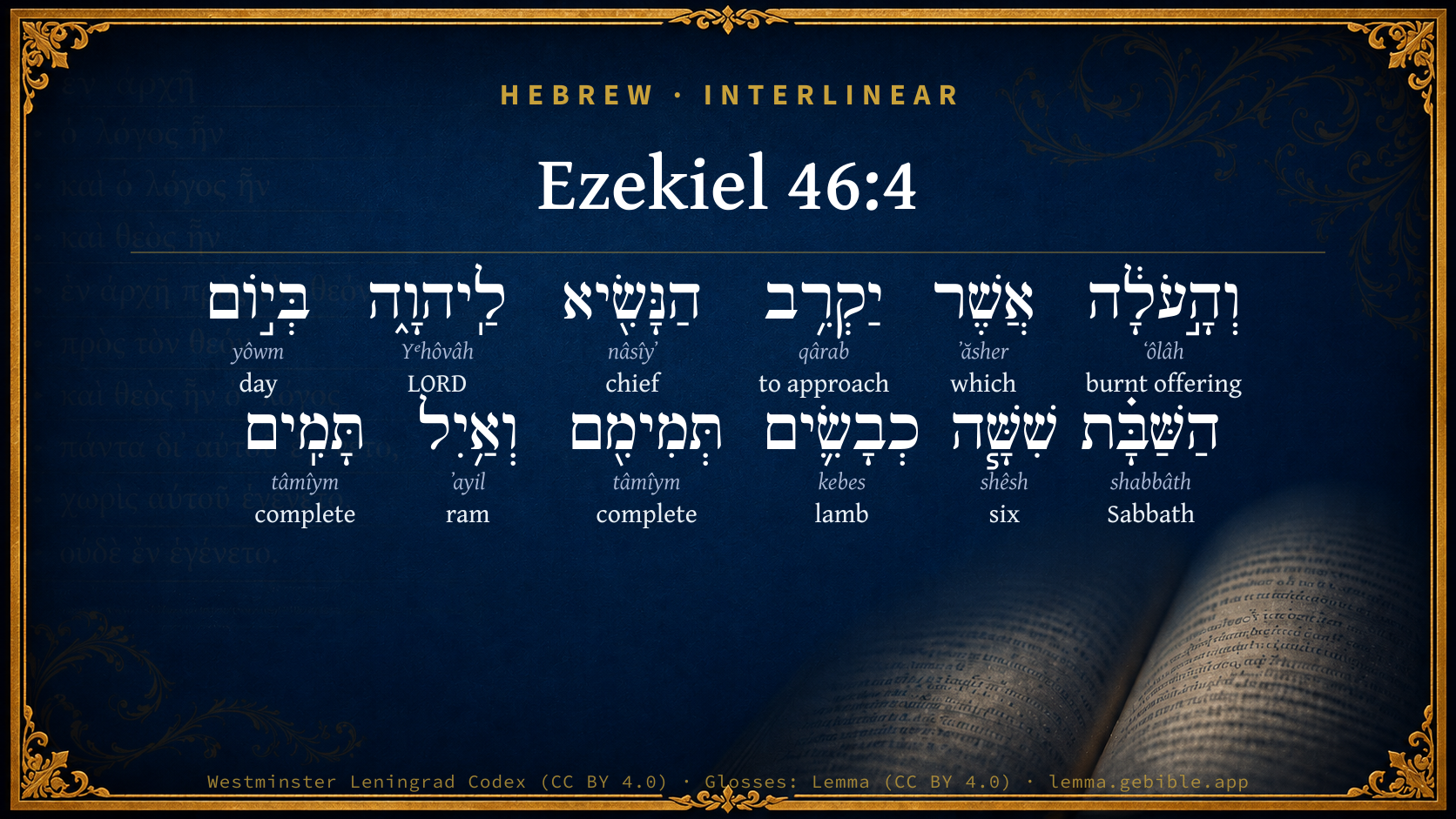
  1. וְהָ֣עֹלָ֔ה ʻôlâh H5930 “and · the · burnt offering” Conjunction + Particle, Definite Article + Noun, Common, Feminine, Singular, Absolute
  2. אֲשֶׁר ʼăsher H834 “which” Particle, Relative
  3. יַקְרִ֥ב qârab H7126 “to approach” Verb, Hiphil, Imperfect, 3rd Person, Masculine, Singular
  4. הַנָּשִׂ֖יא nâsîyʼ H5387 “the · chief” Particle, Definite Article + Noun, Common, Masculine, Singular, Absolute
  5. לַֽיהוָ֑ה Yᵉhôvâh H3068 “to/for · LORD” Preposition + Noun, Proper
  6. בְּי֣וֹם yôwm H3117 “in/at · day of” Preposition + Noun, Common, Masculine, Singular, Construct
  7. הַשַּׁבָּ֗ת shabbâth H7676 “the · Sabbath” Particle, Definite Article + Noun, Common, Both, Singular, Absolute
  8. שִׁשָּׁ֧ה shêsh H8337 “six” Adjective, Cardinal number, Masculine, Singular, Absolute
  9. כְבָשִׂ֛ים kebes H3532 “lambs” Noun, Common, Masculine, Plural, Absolute
  10. וְאַ֥יִל ʼayil H352 “and · ram” Conjunction + Noun, Common, Masculine, Singular, Absolute
  11. תָּמִֽים tâmîym H8549 “complete” Adjective, Adjective, Masculine, Singular, Absolute

About this verse

These counts appear in no published source. They are computed here, from the morphology-tagged text and Lemma’s own curated glosses. What Lemma adds →

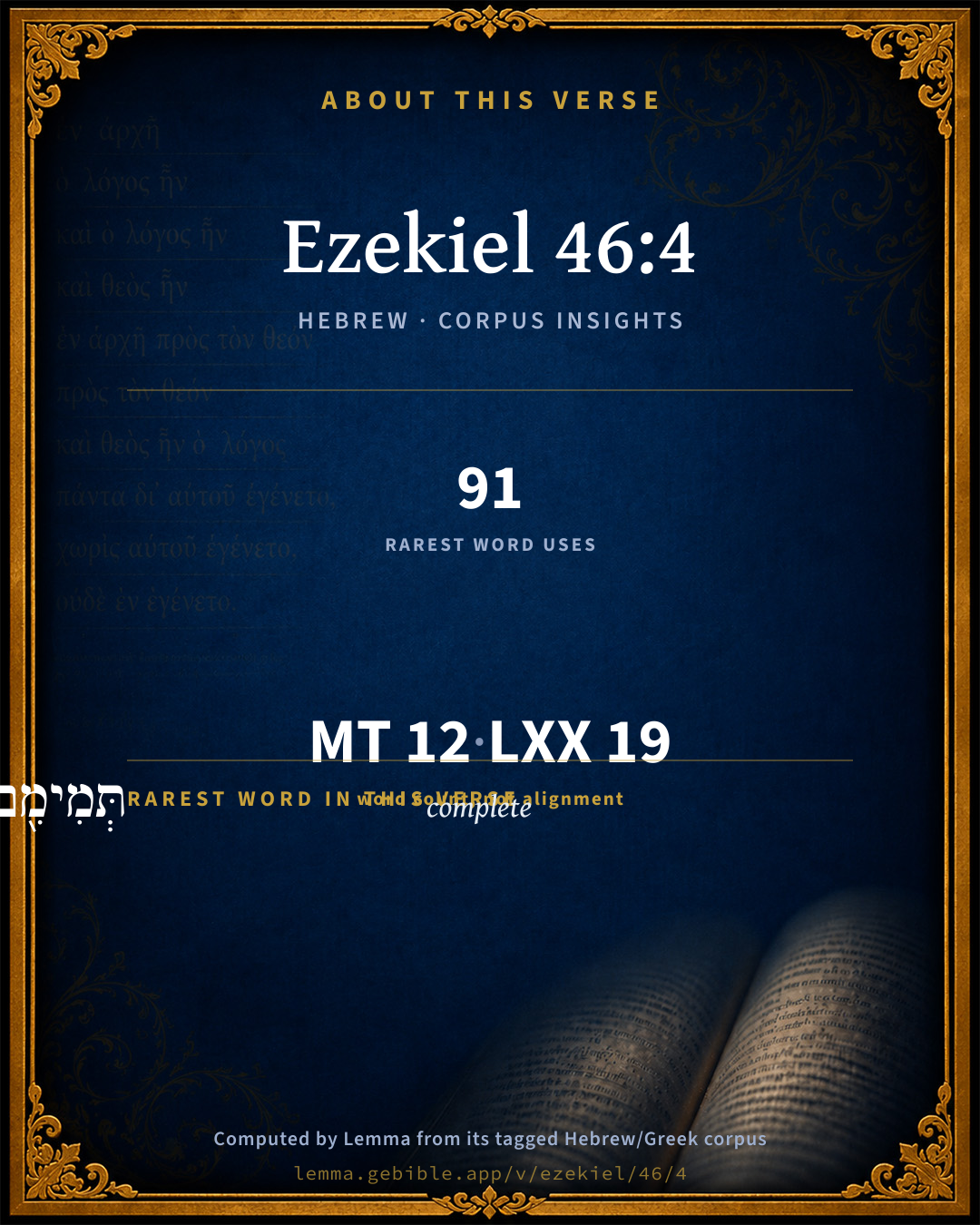
12
words
11
distinct lemmas
Prophets
section

Grammatical profile

  • 1 verb
  • 7 nouns
  • 3 adjectives
  • 1 particle

Verb forms

  • יַקְרִ֥ב Hiphil · Imperfect

Repetition

A word recurs within this verse — often emphatic in Hebrew:

  • תְּמִימִ֖ם complete H8549 ×2

Hebrew & Septuagint length

In English translation the verse runs 25 words from the Hebrew and 23 from the Septuagint (LXX English) — closely comparable.

A rough comparison of the two English renderings, which tokenize alike — not a word-level alignment.

Word counts can differ between the Hebrew and the Greek without any difference in meaning — e.g. the Hebrew direct-object marker אֵת has no separate Greek word, and Greek often adds the article ὁ.

In the original languages it is 12 Hebrew tokens and 19 Greek tokens — but the two are counted differently (Hebrew bundles its prefixes and suffixes into one token; the Greek is in lemma form), so that isn’t a like-for-like length.

Cross-references

2

Topical passages linked to Ezekiel 46:4 in the Treasury of Scripture Knowledge — connected by theme and wording, ordered by reader-vote popularity; previews shown in the World English Bible.

  • Ezekiel 45:17 It shall be the prince's part to give the burnt offerings, and the meal-offerings, and the drink-offerings, in the feasts, and on the new moons, and on the Sabbaths, in all the appointed feasts of the house of Israel: he shall prepare the sin-offering, and the meal-offering, and the burnt offering, and the peace-offerings, to make atonement for the house of Israel.
  • Numbers 28:9–10 On the Sabbath day two he-lambs a year old without blemish, and two tenth parts [of an ephah] of fine flour for a meal-offering, mixed with oil, and the drink-offering of it:

Cross-references courtesy of OpenBible.info (CC BY 4.0).

Hebrew and Greek witnesses Masoretic Hebrew ↔ Greek Septuagint

The same verse in the two great witnesses to the Old Testament, shown verse-for-verse.

These are two independent witnesses, not word-aligned to each other, and the Septuagint is shown in lemma (dictionary) form.

Hebrew Ezekiel 46:4 Masoretic · Westminster Leningrad Codex

וְהָ֣עֹלָ֔ה אֲשֶׁר יַקְרִ֥ב הַנָּשִׂ֖יא לַֽיהוָ֑ה בְּי֣וֹם הַשַּׁבָּ֗ת שִׁשָּׁ֧ה כְבָשִׂ֛ים תְּמִימִ֖ם וְאַ֥יִל תָּמִֽים

The burnt offering that the prince shall offer to Yahweh shall be on the Sabbath day six lambs without blemish and a ram without blemish;

World English Bible · Public Domain

Greek LXX Ezekiel 46:4 Septuagint · lemma form

καί ὁ ὁλοκαύτωμα προςφέρω ὁ ἀποἡγέομαι ὁ κύριος ἐν ὁ ἡμέρα ὁ σάββατον ἕξ ἀμνός ἄμωμος καί κριός ἄμωμος

And the prince shall offer whole burnt offerings to the Lord on the sabbath-day, six lambs without blemish, and a ram without blemish;

LXX2012 (modern English Septuagint) · Public Domain

Hebrew: Westminster Leningrad Codex (CC BY 4.0). Greek: Septuagint (public domain); English from LXX2012 (modern English Septuagint) (Public Domain). How the Septuagint differs from the Hebrew →

Targum (Aramaic paraphrase)

1

The Targum is the ancient Jewish Aramaic paraphrase of the Hebrew Scriptures — an interpretive translation, not the Hebrew text itself. Onkelos (literal) and Pseudo-Jonathan (expansive) render the Torah, and Jonathan the Prophets. Coverage is partial: where no permissively-licensed English translation exists for a verse, only the Aramaic is shown. This is verse-level text, not a word-by-word alignment to the Hebrew.

  1. Targum Jonathan Prophets (Joshua–Malachi)
    וַעֲלָתָא דִי יַקְרִיב רַבָּא קֳדָם יְיָ בְּיוֹמָא דְשַׁבְּתָא שִׁתָּא אִמְרִין שָׁלְמִין וּדְכַר שְׁלִים:

    (no public-domain English translation for this verse)

    Targum Jonathan — Aramaic: “Mikraot Gedolot” (public domain). English: “Sefaria Community Translation” (CC0 1.0 (public-domain dedication)); “London "Chaldee Paraphrase," 1871” (public domain). Text via Sefaria.

Commentary

Notes on Ezekiel 46:4 from classic Christian and Jewish commentators (each source and its license shown beneath its notes). The classic Christian expositions comment on the surrounding passage and are grouped to its opening verse, so a note may address several verses; the Jewish commentaries on the Tanakh (Rashi and others) are per-verse, so they appear only where the commentator wrote on this verse.

Lemma curates 59 commentaries, every one of them public domain or Creative Commons licensed, each selected and text-cleaned for this edition rather than reprinted as found. About our sources →

Trapp's Complete Commentary

John Trapp

Eze 46:4 And the burnt offering that the prince shall offer unto the LORD in the sabbath day [shall be] six lambs without blemish, and a ram without blemish.

Ver. 4. Six lambs without blemish.] This was a larger sacrifice than Moses had appointed {Num 28:9} - Christians have more cause than Jews had to sanctify the Sabbath - as that for the new moons {Eze 46:6} was lesser. See Num 28:11. Hereby it appeareth that God was about to abrogate the Mosaical worship, and the Levitical priesthood: Lex enim posterior derogat priori. This the Jewish doctors would fain say something to, but cannot tell what. The wit of these miscreants, reprobate concerning the faith, will better serve them to devise a thousand shifts to elude the truth, than their obstinace will suffer them once to yield and acknowledge it.

John Trapp, A Commentary or Exposition upon All the Books of the Old and New Testament (1647–1656) — public domain. Text from a community e-Sword module.

Albert Barnes' Notes on the Bible

The offerings prescribed here Eze 46:4-15 are generally in excess of those enjoined by the Law, to note not only the greater devotion and magnificence under the new state of things, but also the willingness (compare Deu 16:17) of king and people ready to give of their substance to the utmost of their means.

Albert Barnes' Notes on the Bible (1834–1885) — public domain. Text from a community e-Sword/MySword module.

Joseph Benson's Commentary

Eze 46:4-5. The burnt-offering that the prince shall offer, &c. — It was the prince’s part to provide sacrifices for the sabbaths and other festivals: see Eze 45:17. But this was a new ordinance; and the number of the beasts that were to be offered, and the proportions of the meat and drink- offerings, are different here from those prescribed in the law, as will appear by comparing the fourth, sixth, seventh, and fourteenth verses of this chapter, with Num 28:9-12; Num 28:15. And the meat-offering for the lambs as he shall be able to give — The Hebrew is, According to the gift of his hand; that is, as much as he shall think sufficient.

Joseph Benson's Commentary on the Old and New Testaments (1811–1818) — public domain. Text from a community e-Sword module.

Adam Clarke's Commentary

Verse 4. The burnt-offerings that the prince shall offer] The chief magistrate was always obliged to attend the public worship of God, as well as the priest, to show that the civil and ecclesiastical states were both under the same government of the Lord; and that no one was capable of being prince or priest, who did not acknowledge God in all his ways. It is no wonder that those lands mourn, where neither the established priest nor the civil magistrate either fear or love God. Ungodly priests and profligate magistrates are a curse to any land. In no country have I found both so exemplary for uprightness, as in Britain.

Adam Clarke's Commentary on the Bible (1810–1826) — public domain. Text from a community e-Sword/MySword module.

Ellicott's Commentary for English Readers

(4) Six lambs . . . and a ram.—The burnt offering for the Sabbath, according to the Mosaic law (Num_28:9), was two lambs. This is greatly increased here, and the “meat offering” for the ram is also made larger, while that for the lambs (Eze_46:5) is left to the prince’s generosity.

A Bible Commentary for English Readers, edited by Charles John Ellicott (1878–1897) — public domain. Text from a community e-Sword module.

The Cambridge Bible for Schools and Colleges

gen. ed. J. J. S. Perowne

4–6. On the sabbath the burnt-offering shall be six lambs and a ram, and the meal-offering an ephah of flour for the ram and what the prince thinks good for the lambs; and the libation a hin of oil.

The Cambridge Bible for Schools and Colleges (gen. ed. J. J. S. Perowne; Cambridge University Press, 1878–1918) — public domain. Text from a community e-Sword module.

John Gill's Exposition

And the meat offering shall be an ephah for a ram,.... See Gill on Eze 45:24,

and the meat offering for the lambs as he shall be able to give; or, and "the gift of his hand" (k); it was fixed and stinted under the law, Num 28:9, but now should be free and voluntary, and according to the ability of the giver; that is, the preacher of the word, who officiates for the prince, and in his name, and sets before the people the meat, or rather bread offering, Christ the bread of life, freely, and according to the ability and measure of the gift of grace bestowed upon him:

and an hin of oil to an ephah; which was also a larger quantity than under the law, denoting the larger measure of the gifts and graces of the Spirit, signified by oil, given unto the ministers of the word, and the people also; See Gill on Eze 45:24.

(k) "donum manus ejus", Cocceius, Starckius.

John Gill's Exposition of the Whole Bible (1746–1763) — public domain (CC PDM 1.0). Text via the HelloAO Bible API.

Haydock's Catholic Bible Commentary

Six. Moses only prescribed two lambs for every day, Numbers xxviii. 9.

George Leo Haydock (1774–1849), Haydock's Catholic Family Bible and Commentary, 1859 edition — public domain. Excludes Psalms (Douay-Rheims chapter numbering differs from Protestant) and Deuterocanonical books (Catholic canon only).

Matthew Poole's English Annotations

The burnt-offering; this is different from that Eze 42:13, as appears both from the kind of sacrifice and the occasion of it, or the time of each.

In the sabbath day; or weekly, sabbath by sabbath; this was three times as much as was required, Num 28:9.

Six lambs of the first year, and males, Eze 46:13, and as the Hebrew implies.

Without blemish; unblemished sacrifices were ever required, and so this, Lev 1:3; Num 6:14.

A ram; when it was more than a year old, the Jews accounted it a ram.

Matthew Poole's English Annotations on the Holy Bible (1683–1685) — public domain. Text from a community e-Sword/MySword module.

Whedon's Commentary on the Bible

Daniel D. Whedon

4-7. Instead of two lambs for a burnt offering the prince in this new and ideal commonwealth shall offer six on the Sabbath (Num_28:9), and instead of two tenths of an ephah of flour mingled with oil for a meat and drink offering (ibid.) an entire ephah is required and a bin of oil (about 1½ gals.) to each ephah of flour (about 9 gals.). The amount of flour for each lamb is left to the liberality of his hand (Eze_46:5; Eze_46:7). The offering at the new moons, however, is less than the Levitical law required (Num_28:11-15), and the sin offering is entirely omitted. The divergences between the directions of Ezekiel and the Pentateuchal law are as yet inexplicable, as we are too little acquainted with the sacrificial symbolism to explain them. To declare that this law was later than Ezekiel and based upon his legislation does not remove the difficulty; for such small changes as these could not have been made without sufficient reason, and we cannot now know what that reason was; though we may be pretty confident that in the Hebrew ritual, as in that of other nations, each act of the priest and each sacrifice had some definite religious meaning. (Compare Eze_43:11-12.)

Daniel D. Whedon (gen. ed.), Commentary on the Old and New Testaments (1874–1909) — public domain. Text from a community e-Sword module.

The Pulpit Commentary

Vers. 4, 5 describe the sacrifices the prince should offer unto the Lord on the sabbaths.

(1) A burnt offering of six lambs and a ram, all without blemish. The Mosaic Law, or so-called priests" code, demanded two yearling lambs. (Num_28:9)

(2) A meat offering, consisting of an ephah of fine flour for a ram, and for the lambs as he shall be able to give; literally, a gift of his hand not a handful, but, as ver. 7 explains, what his hand can attain unto, (comp. Lev_14:31 Lev_25:26) i.e. as much as he can, with a hin of oil to an ephah, for which again the Law required two-tenths of an ephah of fine flour mingled with oil. (Num_28:9)

Vers. 4-12The optional and the obligatory in the kingdom of God.

1. Here are minute and positive prescriptions, requiring exact conformity and allowing no deviation. The burnt offering was to be six lambs and one ram no more and no less (ver. 4). In the day of the new moon at that particular time the offering was to include a young bullock (ver. 6). They who entered in by the north gate were to go out by the south gate, and vice versa (ver. 9). These (and other) instructions were in full and careful detail, and there was to be no departure from them.

2. On the other hand, the prince might, at certain hours and on occasion, bring an offering that was purely "voluntary;" one that was "voluntarily" presented unto the Lord (ver. 12). Room was left for spontaneity, even in the midst of these very specific requirements. In the kingdom of Jesus Christ we have these two orders of service the obligatory and the optional, the plainly and positively enjoined, and the voluntary; and that Christian life is not complete which is lacking in either.

I THE OBLIGATORY. Of those things pertaining to our Christian life which are indispensable there are:

1. At its entrance:

(1) humility (or penitence); and

(2) faith, that living faith in Jesus Christ which includes the acceptance of him as the Savior of the soul and the Lord of the life.

2. Throughout its course:

(1) worship, or the approach of the human spirit to the Divine in prayer, in thanksgiving, in consecration;

(2) obedience, or the conformity of conduct to those precepts which are an essential part of Christian morals;

(3) love, including not only the "love of the brethren," or a special attachment to those who are the friends and followers of Jesus Christ, but also a genuine pity for those who are far from him and need to be brought nigh, and a practical determination to seek and to win these erring souls.

II THE OPTIONAL. There is room for the voluntary as well as for the necessary in our Christian life.

1. In the particulars of our worship. We have one main principle binding upon all men everywhere, (Joh_4:23, Joh_4:24) but it is left to our individualchoice to our own judgment and conscience at what times, in what forms, within what buildings, with what kind of human ministry, we shall draw nigh to God in true and pure devotion.

2. In the minutiae of obedience. What shall be the rules and the regulations we shall lay down for the observance of the great principles of purity, of temperance, of equity, of veracity, of reverential speech, of courtesy., these are not to be found in any Christian directory; they are to be decided upon m the sanctuary of every consecrated spirit and of every cultivated conscience.

3. In the measure and methods of loving service. What proportion of our income, what amount of our time, what order of personal effort, we shall devote to the cause of Christ and in the interest of our fellow-men, this rests with every individual Christian man to decide. These must be, in some sense and degree, "voluntary offerings. C.

The Pulpit Commentary (1880–1919), ed. H.D.M. Spence-Jones & Joseph S. Exell — public domain. Text from a community e-Sword module.

Rashi

Rabbi Shlomo Yitzchaki (Rashi)

On the Sabbath day shall be six lambs I do not know why, for the Torah said (Num. 28:9): “two lambs,” and “on the Sabbath Day” means either the Sabbath commemorating the Creation or a festival. I, therefore, say that this Sabbath is not the Sabbath commemorating the Creation, but a festival that requires seven lambs and two rams. Scripture comes and teaches you that [the absence of one] does not render the other one invalid, and if he does not find seven, he should bring six, and if he does not find two rams, he should bring one, as our Rabbis expounded regarding the New Moon.

Rashi on the Tanakh — English translations: “The Judaica Press complete Tanach with Rashi, translated by A. J. Rosenberg” (CC BY 4.0); “Pentateuch with Rashi's commentary by M. Rosenbaum and A.M. Silbermann, 1929-1934” (public domain); “The Metsudah Tanach series, Lakewood, N.J” (CC BY 4.0); and “The Book of Joshua, Metsudah Publications, 1997” (CC BY 4.0). Text via Sefaria.

Lesson kit

Teaching starters — assembled from the data on this page, not authored interpretation. Every prompt links to the verse data it draws on. Edit before teaching.

Ezekiel, in the Prophets, opens this verse with 12 words (11 distinct Hebrew lemmas). Its most distinctive word is tâmîym (“complete”). A historical commentator’s framing appears above. Read the whole chapter for the surrounding context.

Discussion questions

  1. What does “complete” (tâmîym) contribute to the verse as a whole?
  2. How does Ezekiel 45:17, which shares this passage’s theme, read alongside this verse?
  3. What does the repetition of “complete” (2× in this one verse) do in this verse?
  4. These translations render this verse differently; the difference is in the English rendering, not the original. What questions does that raise?
  5. «יַקְרִ֥ב» is a Hiphil Imperfect verb. How does that grammatical form shape the action described?
  6. Compare how Trapp's Complete Commentary and Albert Barnes' Notes on the Bible read this verse. Where do they agree or differ?

Things to notice

Reading settings

Reading text

Shown beneath each verse's original-language words.

Old Testament
Old Testament edition

Read the OT as the Masoretic Hebrew (MT) or the Greek Septuagint (LXX).

English shown for the Greek Septuagint (in the Hebrew ↔ Greek comparison).

Comparing translations? Open the Compare panel on any verse page to stack up to four side by side.