Jeremiah 7:21

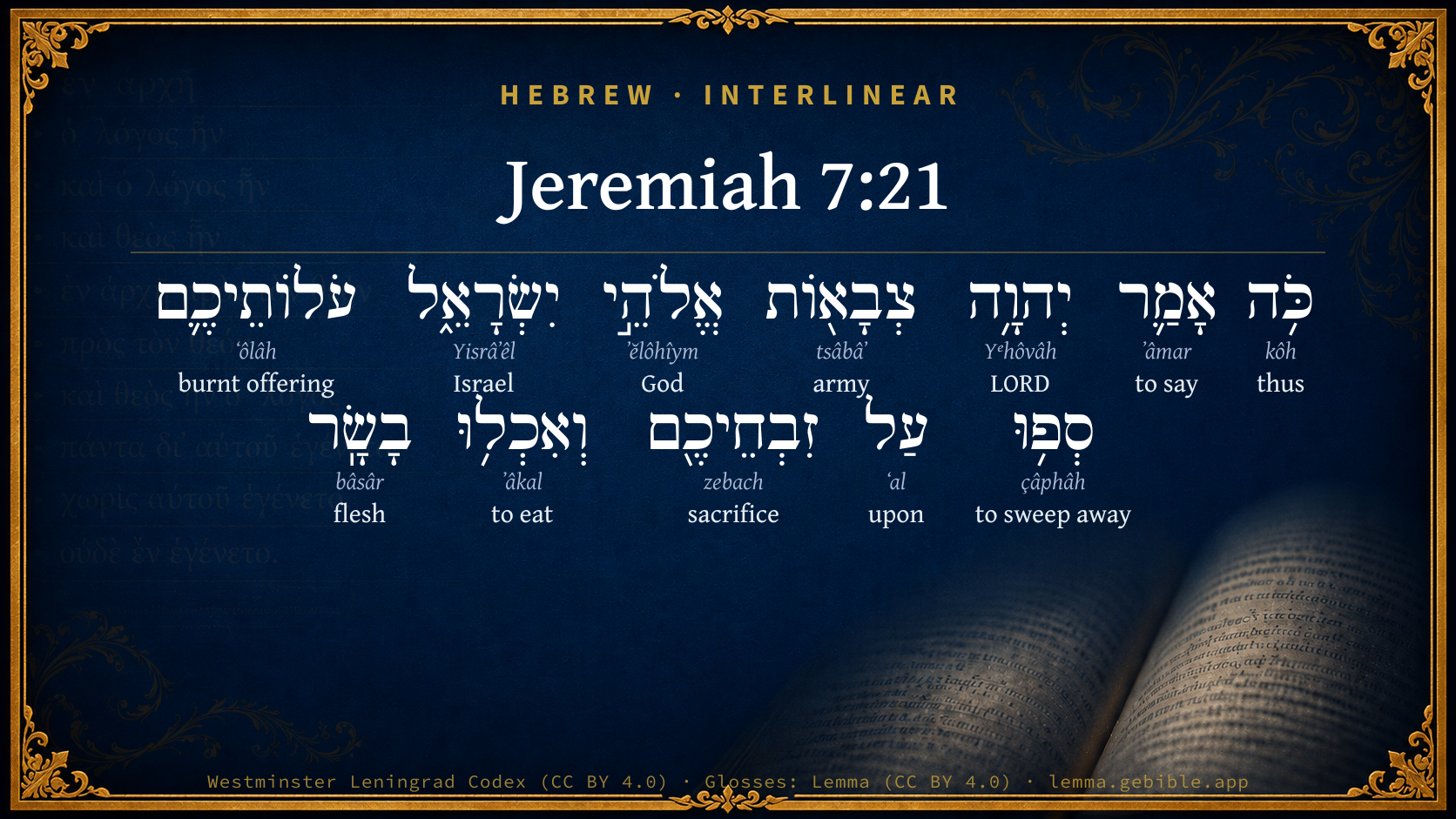
Hebrew (Westminster Leningrad Codex) Jeremiah 7:21 appears in the Hebrew Old Testament. The text above is from the Westminster Leningrad Codex. Each word links to its Strong’s number, a concise gloss, and parsing drawn from the Open Scriptures Hebrew Bible morphology. Click any word for its full Brown-Driver-Briggs (BDB) entry.
Download image
Cite this verse

Jeremiah 7:21 (World English Bible). Public Domain. Lemma interlinear Bible study tool, https://lemma.gebible.app/v/jeremiah/7/21.

Show BibTeX & RIS
BibTeX
RIS
English Translation
Thus says Yahweh of Hosts, the God of Israel: Add your burnt offerings to your sacrifices, and eat you flesh.
World English Bible · Public Domain
Download a study sheet

One document with this verse’s original text, its word-by-word gloss line, the meaning frame, cross-references with their text, attributed commentary, and full source and license credits — printable, and it pastes into notes with its structure intact.

This verse Autodidact and up

Study sheet (.html) Plain text (.txt)

A passage Seminary Student

Up to 50 verses in one chapter. A passage sheet keeps up to 6 commentary sources and 12 cross-references per verse, in the order this page ranks them, and says so on the sheet whenever that leaves anything out. Ask for a single verse and you get the Autodidact verse sheet above.

Everything on this page stays free to read, with no account — the sheet is a download of what is already on screen, not access to it.

Want to remove ads? Support Godless Engineer
Compare translations 3

The same verse in 3 English versions, stacked beneath the original-language interlinear above. Click any original word for its lexicon entry.

Each is an independent rendering of the whole verse — the interlinear is not word-aligned to these translations.

Highlighted words mark where these versions differ — a whole-verse word diff, not a word-by-word alignment.

  • World English Bible Public Domain
    Thus says Yahweh of Hosts, the God of Israel: Add your burnt offerings to your sacrifices, and eat you flesh.
  • King James Version Public Domain
    Thus saith the LORD of hosts, the God of Israel; Put your burnt offerings unto your sacrifices, and eat flesh.
  • unfoldingWord Literal Text CC BY-SA 4.0
    Thus says Yahweh of hosts, the God of Israel, ‘Add your burnt offerings to your sacrifices and eat meat.

unfoldingWord Literal Text — © unfoldingWord, licensed CC BY-SA 4.0. Word-aligned USFM3 via Door43 (git.door43.org/unfoldingWord/en_ult).

Versions to compare (up to 4)

3 of 4 selected

Show all 18 translations

Every available English version of this verse, each an independent rendering of the whole verse.

  • World English Bible Public Domain
    Thus says Yahweh of Hosts, the God of Israel: Add your burnt offerings to your sacrifices, and eat you flesh.
  • Berean Standard Bible Public Domain
    This is what the LORD of Hosts, the God of Israel, says: Add your burnt offerings to your other sacrifices and eat the meat yourselves!
  • Majority Standard Bible Public Domain
    This is what the LORD of Hosts, the God of Israel, says: Add your burnt offerings to your other sacrifices and eat the meat yourselves!
  • King James Version Public Domain
    Thus saith the LORD of hosts, the God of Israel; Put your burnt offerings unto your sacrifices, and eat flesh.
  • American Standard Version (1901) Public Domain
    Thus saith Jehovah of hosts, the God of Israel: Add your burnt-offerings unto your sacrifices, and eat ye flesh.
  • Revised Version (1885) Public Domain
    Thus saith the LORD of hosts, the God of Israel: Add your burnt offerings unto your sacrifices, and eat ye flesh.
  • Geneva Bible (1599) Public Domain
    Thus sayth the Lord of hostes, the God of Israel, Put your burnt offerings vnto your sacrifices, and eat the flesh.
  • Douay-Rheims (1899) Public Domain
    Thus saith the Lord of hosts the God of Israel: Add your burnt offerings to your sacrifices, and eat ye the flesh.
  • Young's Literal Translation Public Domain
    Thus said Jehovah of Hosts, God of Israel, Your burnt-offerings add to your sacrifices, And eat ye flesh.
  • Literal Standard Version CC BY-SA 4.0
    Thus said YHWH of Hosts, God of Israel: “Add your burnt-offerings to your sacrifices and eat flesh.
  • Unlocked Literal Bible CC BY-SA 4.0
    Yahweh of hosts, God of Israel says this, 'Add your burnt offerings to your sacrifices and the meat from them.
  • unfoldingWord Literal Text CC BY-SA 4.0
    Thus says Yahweh of hosts, the God of Israel, ‘Add your burnt offerings to your sacrifices and eat meat.
  • Darby Bible Public Domain
    Thus saith Jehovah of hosts, the God of Israel: Add your burnt-offerings to your sacrifices, and eat the flesh.
  • World Messianic Bible Public Domain
    The LORD of Hosts, the God of Israel says: “Add your burnt offerings to your sacrifices and eat meat.
  • Webster's Bible Public Domain
    Thus saith the LORD of hosts, the God of Israel; Put your burnt-offerings to your sacrifices, and eat flesh.
  • Free Bible Version CC BY-SA 4.0
    This is what the Lord Almighty, the God of Israel, says: You can add your burnt offerings to your other sacrifices and eat all the meat yourselves!
  • Bible in Basic English Public Domain
    These are the words of the Lord of armies, the God of Israel: Put your burned offerings with your offerings of beasts, and take flesh for your food.
  • JPS Tanakh (1917) Public Domain
    Thus saith the LORD of hosts, the God of Israel: Add your burnt-offerings unto your sacrifices, and eat ye flesh.

Literal Standard Version (2020), Covenant Press — licensed CC BY-SA 4.0. Text via the HelloAO Bible API (eBible.org). Unlocked Literal Bible (unfoldingWord) — licensed CC BY-SA 4.0. Text via the HelloAO Bible API (eBible.org). unfoldingWord Literal Text — © unfoldingWord, licensed CC BY-SA 4.0. Word-aligned USFM3 via Door43 (git.door43.org/unfoldingWord/en_ult). Free Bible Version, Dr. Jonathan Gallagher — licensed CC BY-SA 4.0. Text via the HelloAO Bible API (eBible.org).

Word by word

More ways to search: Search by grammar → Find every occurrence → Compare this word →

Practice this passage: Drill this verse → Learn its vocabulary →

סְפ֥וּ
çâphâh
H5595
“sweep away”
Verb, Qal, Imperative, 2nd Person, Masculine, Plural
Part of Speech
Verb
Stem
Qal
Form
Imperative
Person
2nd Person
Gender
Masculine
Number
Plural
Full BDB Definition

Origin: a primitive root

TWOT: 1531

to sweep or snatch away, catch up, destroy, consume - (Qal) - to be snatched away - to sweep or snatch away - (Niphal) - to be swept away, be destroyed - to be caught up, be captured - (Hiphil) to catch up, gather
  1. כֹּ֥ה kôh H3541 “thus” Adverb
  2. אָמַ֛ר ʼâmar H559 “to say” Verb, Qal, Perfect, 3rd Person, Masculine, Singular
  3. יְהוָ֥ה Yᵉhôvâh H3068 “LORD” Noun, Proper
  4. צְבָא֖וֹת tsâbâʼ H6635 “armies” Noun, Common, Both, Plural, Absolute
  5. אֱלֹהֵ֣י ʼĕlôhîym H430 “God(s) of” Noun, Common, Masculine, Plural, Construct
  6. יִשְׂרָאֵ֑ל Yisrâʼêl H3478 “Israel” Noun, Proper
  7. עֹלוֹתֵיכֶ֛ם ʻôlâh H5930 “burnt offerings · your” Noun, Common, Feminine, Plural, Construct + Suffix, Personal, 2nd Person, Masculine, Plural
  8. עַל ʻal H5921 “upon” Preposition
  9. זִבְחֵיכֶ֖ם zebach H2077 “sacrifices · your” Noun, Common, Masculine, Plural, Construct + Suffix, Personal, 2nd Person, Masculine, Plural
  10. וְאִכְל֥וּ ʼâkal H398 “and · eat” Conjunction + Verb, Qal, Imperative, 2nd Person, Masculine, Plural
  11. בָשָֽׂר bâsâr H1320 “flesh” Noun, Common, Masculine, Singular, Absolute

About this verse

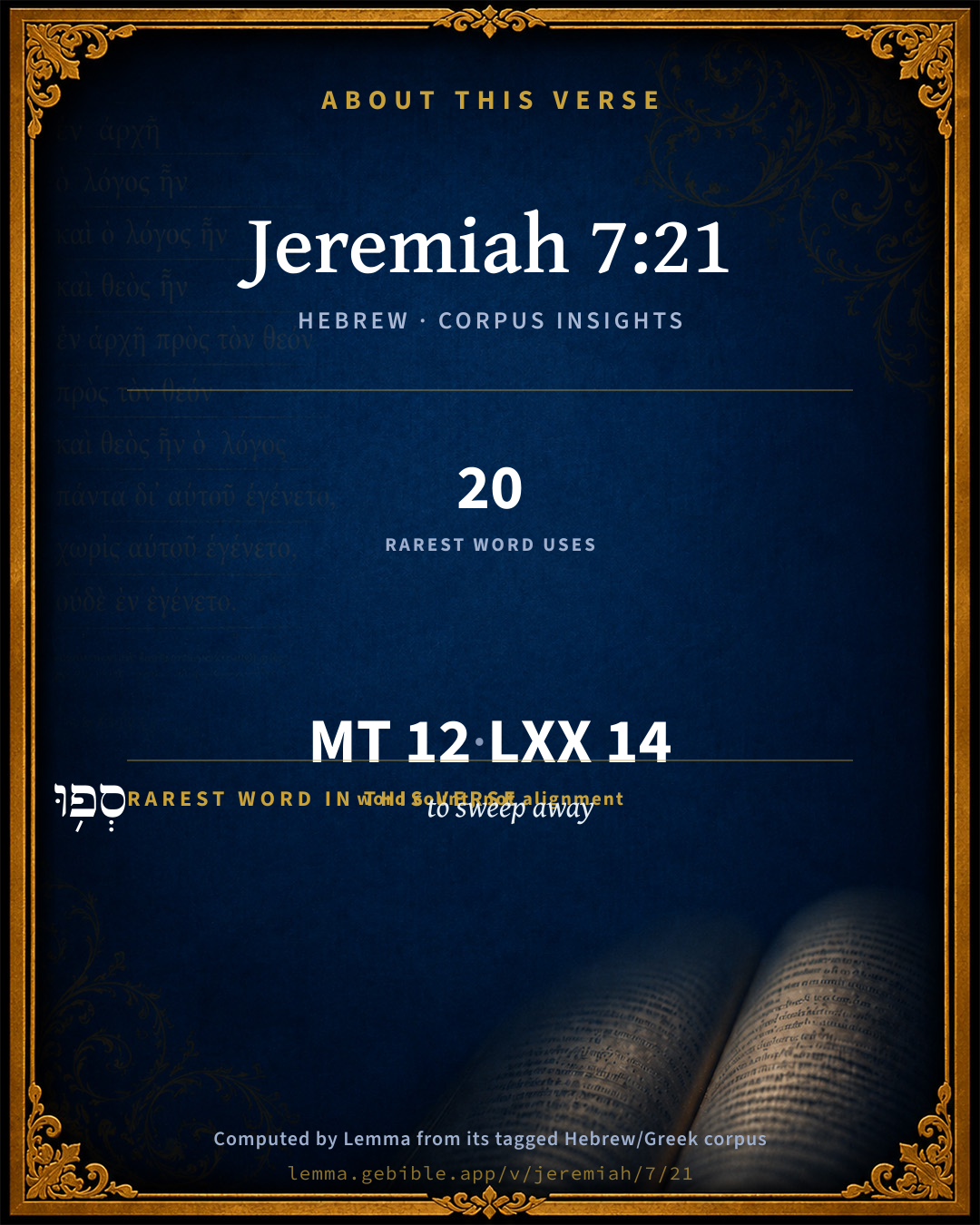
These counts appear in no published source. They are computed here, from the morphology-tagged text and Lemma’s own curated glosses. What Lemma adds →

12
words
12
distinct lemmas
Prophets
section

Notable vocabulary

The rarest word here is סְפ֥וּ to sweep away H5595 — appearing just 20 times in the whole Hebrew Bible.

Shared distinctive vocabulary

סְפ֥וּ to sweep away H5595 occurs in 20 verses of the Hebrew Bible. Also found in:

Grammatical profile

  • 3 verbs
  • 7 nouns
  • 1 preposition
  • 1 adverb

Verb forms

  • אָמַ֛ר Qal · Perfect
  • סְפ֥וּ Qal · Imperative
  • וְאִכְל֥וּ Qal · Imperative

Hebrew & Septuagint length

In the original languages it is 12 Hebrew tokens and 14 Greek tokens — but the two are counted differently (Hebrew bundles its prefixes and suffixes into one token; the Greek is in lemma form), so that isn’t a like-for-like length.

Cross-references

4

Topical passages linked to Jeremiah 7:21 in the Treasury of Scripture Knowledge — connected by theme and wording, ordered by reader-vote popularity; previews shown in the World English Bible.

  • Hosea 8:13 As for the sacrifices of my offerings, they sacrifice flesh and eat it; But Yahweh doesn't accept them. Now he will remember their iniquity, And punish their sins. They will return to Egypt.
  • Jeremiah 6:20 To what purpose comes there to me frankincense from Sheba, and the sweet cane from a far country? your burnt offerings are not acceptable, nor your sacrifices pleasing to me.
  • Isaiah 1:11–15 "What are the multitude of your sacrifices to me?," says Yahweh. "I have had enough of the burnt offerings of rams, And the fat of fed animals. I don't delight in the blood of bulls, Or of lambs, Or of male goats.
  • Amos 5:21–23 I hate, I despise your feasts, And I can't stand your solemn assemblies.

Cross-references courtesy of OpenBible.info (CC BY 4.0).

Hebrew and Greek witnesses Masoretic Hebrew ↔ Greek Septuagint

The same verse in the two great witnesses to the Old Testament, shown verse-for-verse.

These are two independent witnesses, not word-aligned to each other, and the Septuagint is shown in lemma (dictionary) form.

Hebrew Jeremiah 7:21 Masoretic · Westminster Leningrad Codex

כֹּ֥ה אָמַ֛ר יְהוָ֥ה צְבָא֖וֹת אֱלֹהֵ֣י יִשְׂרָאֵ֑ל עֹלוֹתֵיכֶ֛ם סְפ֥וּ עַל זִבְחֵיכֶ֖ם וְאִכְל֥וּ בָשָֽׂר

Thus says Yahweh of Hosts, the God of Israel: Add your burnt offerings to your sacrifices, and eat you flesh.

World English Bible · Public Domain

Greek LXX Structure differs

In the Septuagint, Jeremiah is about an eighth shorter than the Hebrew and arranges its material differently — the Oracles Against the Nations (Hebrew chapters 46–51) appear in the middle of the Greek book, after 25:13. Because the chapter and verse boundaries do not line up, a verse-for-verse comparison with the Hebrew is not shown.

A verse-for-verse comparison isn’t shown here because the chapters and verses don’t line up. Switch to the LXX edition with the MT / LXX toggle above to read the Greek directly.

Hebrew: Westminster Leningrad Codex (CC BY 4.0). Greek: Septuagint (public domain); English from a public-domain English Septuagint. How the Septuagint differs from the Hebrew →

Targum (Aramaic paraphrase)

1

The Targum is the ancient Jewish Aramaic paraphrase of the Hebrew Scriptures — an interpretive translation, not the Hebrew text itself. Onkelos (literal) and Pseudo-Jonathan (expansive) render the Torah, and Jonathan the Prophets. Coverage is partial: where no permissively-licensed English translation exists for a verse, only the Aramaic is shown. This is verse-level text, not a word-by-word alignment to the Hebrew.

  1. Targum Jonathan Prophets (Joshua–Malachi)
    כִּדְנַן אֲמַר יְיָ צְבָאוֹת אֱלָהָא דְיִשְׂרָאֵל עֲלָוָתְכוֹן אוֹסִיפוּ עַל נִכְסַת קוּדְשֵׁיכוֹן וַאֲכוּלוּ בִסְרָא:

    (no public-domain English translation for this verse)

    Targum Jonathan — Aramaic: “Mikraot Gedolot” (public domain). English: “Sefaria Community Translation” (CC0 1.0 (public-domain dedication)); “London "Chaldee Paraphrase," 1871” (public domain). Text via Sefaria.

Commentary

Notes on Jeremiah 7:21 from classic Christian and Jewish commentators (each source and its license shown beneath its notes). The classic Christian expositions comment on the surrounding passage and are grouped to its opening verse, so a note may address several verses; the Jewish commentaries on the Tanakh (Rashi and others) are per-verse, so they appear only where the commentator wrote on this verse.

Lemma curates 59 commentaries, every one of them public domain or Creative Commons licensed, each selected and text-cleaned for this edition rather than reprinted as found. About our sources →

Matthew Henry's Commentary

God, having shown the people that the temple would not protect them while they polluted it with their wickedness, here shows them that their sacrifices would not atone for them, nor be accepted, while they went on in disobedience. See with what contempt he here speaks of their ceremonial service (Jer 7:21). "Put your burnt-offerings to your sacrifices; go on in them as long as you please; add one sort of sacrifice to another; turn your burnt-offerings (which were to be wholly burnt to the honour of God) into peace-offerings" (which the offerer himself had a considerable share of), "that you may eat flesh, for that is all the good you are likely to have from your sacrifices, a good meal's meat or two; but expect not any other benefit by them while you live at this loose rate. Keep your sacrifices to yourselves" (so some understand it); "let them be served up at your own table, for they are no way acceptable at God's altars." For the opening of this,

I. He shows them that obedience was the only thing he required of them, Jer 7:22, Jer 7:23. He appeals to the original contract, by which they were first formed into a people, when they were brought out of Egypt. God made them a kingdom of priests to himself, not that he might be regaled with their sacrifices, as the devils, whom the heathen worshipped, which are represented as eating with pleasure the fat of their sacrifices and drinking the wine of their drink-offerings, Deu 32:38. No: Will God eat the flesh of bulls? Psa 50:13. I spoke not to your fathers concerning burnt-offerings or sacrifices, not of them at first. The precepts of the moral law were given before the ceremonial institutions; and those came afterwards, as trials of their obedience and assistances to their repentance and faith. The Levitical law begins thus: If any man of you will bring an offering, he must do so and so (Lev 1:2, Lev 2:1), as if it were intended rather to regulate sacrifice than to require it. But that which God commanded, which he bound them to by his supreme authority and which he insisted upon as the condition of the covenant, was, Obey my voice; see Exo 15:26, where this was the statute and the ordinance by which God proved them: Hearken diligently to the voice of the Lord thy God. The condition of their being God's peculiar people was this (Exo 19:5), If you will obey my voice indeed. "Make conscience of the duties of natural religion, observe positive institutions from a principle of obedience, and then I will be your God and you shall be my people," which is the greatest honour, happiness, and satisfaction, that any of the children of men are capable of. "Let your conversation be regular, and in every thing study to comply with the will and word of God; walk within the bounds that I have set you, and in all the ways that I have commanded you, and then you may assure yourselves that it shall be well with you." The demand here is very reasonable, that we should be directed by Infinite Wisdom to that which is fit, that he that made us should command us, and that he should give us law who gives us our being and all the supports of it; and the promise is very encouraging: Let God's will be your rule and his favour shall be your felicity.

II. He shows them that disobedience was the only thing for which he had a quarrel with them. He would not reprove them for their sacrifices, for the omission of them; they had been continually before him (Psa 50:8); with them they hoped to bribe God, and purchase a license to go on in sin. That therefore which God had all along laid to their charge was breaking his commandments in the course of their conversation, while they observed them, in some instances, in the course of their devotion, Jer 7:24, Jer 7:25, etc. 1. They set up their own will in competition with the will of God: They hearkened not to God and to his law; they never heeded that; it was to them as if it had never been given or were of no force; they inclined not their ear to attend to it, much less their hearts to comply with it. But they would have their own way, would do as they chose, and not as they were bidden. Their own counsels were their guide, and not the dictates of divine wisdom; that shall be lawful and good with them which they think so, though the word of God says quite contrary. The imagination of their evil heart, the appetites and passions of it, shall be a law to them, and they will walk in the way of it, and in the sight of their eyes. 2. If they began well, yet they did not proceed, but soon flew off. They went backward, when they talked of making a captain, and returning to Egypt again, and would not go forward under God's conduct. They promised fair: All that the Lord shall say unto us we well do; and, if they would but have kept in that good mind, all would have been well; but, instead of going on in the way of duty, they drew back into the way of sin, and were worse than ever. 3. When God sent to them by word of mouth to put them in mind of the written word, which was the business of the prophets, it was all one; still they were disobedient. God had servants of his among them in every age, since they came out of Egypt unto this day, some or other to tell them of their faults and put them in mind of their duty, whom he rose up early to send (as before, Jer 7:13), as men rise up early to call servants to their work; but they were as deaf to the prophets as they were to the law (Jer 7:26): Yet they hearkened not, nor inclined their ear. This had been their way and manner all along; they were of the same stubborn refractory disposition with those that went before them; it had all along been the genius of the nation, and an evil genius it was, that continually haunted them till it ruined them at last. 4. Their practice and character were still the same. They are worse, and not better, than their fathers. (1.) Jeremiah can himself witness against them that they were disobedient, or he shall soon find it so (Jer 7:27): "Thou shalt speak all these words to them, shalt particularly charge them with disobedience and obstinacy. But even that will not work upon them: They will not hearken to thee, nor heed thee. Thou shalt go, and call to them with all the plainness and earnestness imaginable, but they will not answer thee; they will either give thee no answer at all or not an obedient answer; they will not come at thy call." (2.) He must therefore own that they deserved the character of a disobedient people, that were ripe for destruction, and must go to them and tell them so to their faces (Jer 7:28): "Say unto them, This is a nation that obeys not the voice of the Lord their God. They are notorious for their obstinacy; they sacrifice to the Lord as their God, but they will not be ruled by him as their God; they will not receive either the instruction of his word or the correction of his rod; they will not be reclaimed or reformed by either. Truth has perished among them; they cannot receive it; they will not submit to it nor be governed by it. They will not speak truth; there is no believing a word they say, for it is cut off from their mouth, and lying comes in the room of it. They are false both to God and man."

Matthew Henry's Commentary on the Whole Bible (1708–1710) — public domain (CC PDM 1.0). Text via the HelloAO Bible API.

Trapp's Complete Commentary

John Trapp

Jer 7:21 Thus saith the LORD of hosts, the God of Israel; Put your burnt offerings unto your sacrifices, and eat flesh.

Ver. 21. Put your burnt offerings to your sacrifices, and eat flesh.] Congerite, ingerite, digerite, egerite. Take away all your sacrifices, wherewith ye fondly think to expiate your sins, and feast your carcases with them; for I wot well that you offer them to me, ventris potius gratia quam internae pietatis, rather of gourmandise than good devotion. You have therefore my good leave to make your best of them; for I account them no other than ordinary and profane food, such flesh as is bought and sold in the shambles. So their meat offering {Lev 2:5} is in scorn called "their bread for their soul," or life; {Hos 9:4} that is, for their natural sustenance. And no better are the elements in the Lord’s Supper to the unworthy receiver, whatever he may promise himself by them.

John Trapp, A Commentary or Exposition upon All the Books of the Old and New Testament (1647–1656) — public domain. Text from a community e-Sword module.

Albert Barnes' Notes on the Bible

The meaning is, Increase your sacrifices as you will. Acid burnt-offering to peace-offerings. All is in vain as long as you neglect the indispensable requirements of obedience and moral purity. Eat flesh is equivalent to sacrifice. The flesh of animals offered in sacrifice was usually eaten by the offerers, and this meal was regarded as a symbol of reconciliation. God and man partook of the same victim, and so were made friends. This passage Jer 7:21-28 is the Haphtarah (lesson) from the prophets, after the Parashah, Lev. 6–8, or Lesson from the Law. The selection of such a Haphtarah shows that the Jews thoroughly understood that their sacrifices were not the end of the Law, but a means for spiritual instruction.

Albert Barnes' Notes on the Bible (1834–1885) — public domain. Text from a community e-Sword/MySword module.

Joseph Benson's Commentary

Jer 7:21-28. Thus saith the Lord of hosts, the God of Israel — And let Israel hear when their God speaks — Put your burnt-offerings unto your sacrifices, and eat flesh — The burnt-offerings, after they were flayed, were to be consumed wholly upon the altar, Lev 1:9; whereas, in the sacrifices of the peace-offerings, only the fat was to be burned upon the altar; part of the remainder belonging to the priests, and the rest being the portion of the offerer, to be eaten with his friends in a kind of religious feast. But here the prophet tells the Jews that they may eat the flesh of their burnt-offerings as well as that of their peace-offerings; that he was equally regardless of the one and the other, and would have nothing to do with them; and that he would never accept offerings from people of so disobedient and refractory a disposition; that to be acceptable to him they must be presented with an humble and obedient mind. “This leads plainly to the interpretation of the next verses, which are by no means to be taken separately, as if God had not required burnt-offerings and sacrifices at all; but that he did not insist so much upon them as on obedience to the commands of the moral law; or, at least, that the former derived all their efficacy from the latter.” See note on 1Sa 15:22. “Sacrifices,” says Dr. Waterland, on this passage, “which were but part of duty, are here opposed to entire and universal obedience. Now the thing which God required, and chiefly insisted upon, was universal righteousness, and not partial obedience, which is next to no obedience, because not performed upon a true principle of obedience. God does not deny that he had required sacrifices: but he had primarily and principally required obedience, which included sacrifices and all other instances of duty as well as that: and he would not accept of such lame service as those sacrifices amounted to; for that was paying him part only in lieu of the whole. Or we may say, that sacrifices, the out-work, are here opposed to obeying God’s voice; that is, the shadow is opposed to the substance, apparent duty to real hypocrisy, and empty show to sincerity and truth. Sacrifices separate from true holiness, or from a sincere love of God, were not the service which God required; for hypocritical services are no services, but abominations in his sight: he expected, he demanded, religious devout sacrifices; while his people brought him only outside compliments, to flatter him; empty formalities, to affront and dishonour him. These were not the things which God spake of, or commanded: the sacrifices he spake of were pure sacrifices, to be offered up with a clean and upright heart. Those he required, and those only he would accept of as real duty and service.”

Joseph Benson's Commentary on the Old and New Testaments (1811–1818) — public domain. Text from a community e-Sword module.

Jamieson, Fausset & Brown

Robert Jamieson, A. R. Fausset & David Brown

Put . . . burnt offerings unto . . . sacrifices . . . eat flesh--Add the former (which the law required to be wholly burnt) to the latter (which were burnt only in part), and "eat flesh" even off the holocausts or burnt offerings. As far as I am concerned, saith Jehovah, you may do with one and the other alike. I will have neither (Isa 1:11; Hos 8:13; Amo 5:21-22).

Jamieson, Fausset & Brown — Commentary Critical and Explanatory on the Whole Bible (1871) — public domain (CC PDM 1.0). Text via the HelloAO Bible API.

Adam Clarke's Commentary

Verse 21. Put your burnt-offerings unto your sacrifices, and eat flesh.] I will receive neither sacrifice nor oblation from you; therefore you may take the beasts intended for sacrifice, and slay and eat them for your common nourishment. See Clarke on Jer 7:29.

Adam Clarke's Commentary on the Bible (1810–1826) — public domain. Text from a community e-Sword/MySword module.

John Calvin's Commentaries

The Prophet here taunts the Jews for being so sedulous in their attention to sacrifices, while they had no care for piety. Hence he says by way of ridicule, “Offer your sacrifices, and accumulate burnt-offerings and victims, and eat flesh.” The last clause proves that God regarded as nothing their sacrifices, and that nothing was acceptable to him, though the Jews spent much money and spared no labors. God then shews that all these things were nothing to him; eat flesh, he says, which means, “Ye sacrifice to yourselves, not to me.” There is here a contrast implied; for when they did eat flesh, there was the legitimate service of God, provided sacrifices were duly offered; but God here excludes himself, as though he had said, “These things belong not at all to me; for when ye bring sacrifices, your object is to feast: eat, then, and stuff your stomachs; nothing of this belongs to me.”

The import of the whole is, — that the feasts which the Jews celebrated were profane, though they pretended the name of God, and wished them to be deemed sacred. Eat then flesh; that is, “I repudiate your sacrifices; it is to no purpose that ye cover your iniquities by the shadow of the Temple; for your pollutions restrain me from accepting what ye pretend to offer to me.” By saying, Add sacrifices to victims, he means, that though they sacrificed every animal in the land, it would be all to no purpose; for, as I have said, in offering sacrifices to God their object was to get a feast, inasmuch as they did not regard the right end.

John Calvin's Commentaries (1540-1563) — public domain. Text from the Calvin Translation Society English edition (1840s-50s) via the Christian Classics Ethereal Library (ccel.org). Calvin's coverage is partial (roughly two-thirds of the Bible); uncommented books and verses are honest gaps, never fabricated. The 19th-century editor's footnotes and remarks are omitted so the notes are faithfully Calvin's own voice.

Ellicott's Commentary for English Readers

(21) Put your burnt offerings.—i.e., “Add one kind of sacrifice to another. Offer the victim, and then partake of the sacrificial feast. All is fruitless, unless there be the true conditions of acceptance, repentance, and holiness.”

A Bible Commentary for English Readers, edited by Charles John Ellicott (1878–1897) — public domain. Text from a community e-Sword module.

The Cambridge Bible for Schools and Colleges

gen. ed. J. J. S. Perowne

21. Add your burnt offerings unto your sacrifices] Burnt offerings were consumed whole, while of sacrifices certain portions were reserved to be eaten by the priest and the offerer. Accordingly the sense here is either (i) appropriate for your own use the offerings of which ye now consume the whole: I care not, for whether ye do this or not ye are breaking a higher law; or (ii) add one sacrifice to another. Multiply your victims ad libitum. They have no sanctity, as offered by your guilty hands, but are merely so much flesh.

In (i), which is the preferable explanation, the reference is to the fact that sacrifices were an occasion of feasting. Turn what ought to be your most solemn act of worship into a mere opportunity for self-indulgence.

21–28. See introd. note on the section.

The Cambridge Bible for Schools and Colleges (gen. ed. J. J. S. Perowne; Cambridge University Press, 1878–1918) — public domain. Text from a community e-Sword module.

John Gill's Exposition

Thus saith the Lord God of hosts, the God of Israel,.... The Lord of armies above and below, and the covenant God of the people of Israel; who were bound to serve him, not only by the laws of creation, and the bounties of Providence, but were under obligation so to do by the distinguishing blessings of his goodness bestowed upon them; wherefore their idolatry, and other sins committed against him, were the more heinous and aggravated:

put your burnt offerings unto your sacrifices, and eat flesh; that is, add one offering to another; offer every kind of sacrifice, and, when you have done, eat the flesh of them yourselves; for that is all the advantage that comes by them; they are not acceptable to me, as Jarchi observes, therefore why should you lose them? burnt offerings were wholly consumed, and nothing was left of them to eat; but of other sacrifices there were, particularly the peace offerings; which the Jewish commentators think are here meant by sacrifices; and therefore the people are bid to join them together, that they might have flesh to eat; which was all the profit arising to them by legal sacrifices. The words seem to be sarcastically spoken; showing the unacceptableness of legal sacrifices to God, when sin was indulged, and the unprofitableness of them to men.

John Gill's Exposition of the Whole Bible (1746–1763) — public domain (CC PDM 1.0). Text via the HelloAO Bible API.

Haydock's Catholic Bible Commentary

Flesh. I reject your holocausts. Keep them for yourselves. (Calmet)

George Leo Haydock (1774–1849), Haydock's Catholic Family Bible and Commentary, 1859 edition — public domain. Excludes Psalms (Douay-Rheims chapter numbering differs from Protestant) and Deuterocanonical books (Catholic canon only).

Matthew Poole's English Annotations

The ironical words of one that seems to be in a great rage: Take those that are peculiar, and to be all burnt to me, Lev 1:9, and put them to your own of what kind soever; eat them, and do what you will with them, I will have none of them; take it all and fill your own bellies, for you sacrifice not to me, but to yourselves. See Hos 9:4, where their meat-offerings are called in scorn meat for their life to nourish their bodies.

Unto your sacrifices; that part of your sacrifices which you are allowed to eat; they are but as profane food; do not you think to be sanctified by them, because I accept them not.

Matthew Poole's English Annotations on the Holy Bible (1683–1685) — public domain. Text from a community e-Sword/MySword module.

The Pulpit Commentary

Vers. 21-28. Jeremiah dispels the illusion that God"s claims are satisfied by a merely formal service.

Put your burnt offerings, etc. Throw all your sacrifices into a mass, and eat them at your pleasure. Ye have my perfect permission, for they are of no religions value. According to the Law, the burnt offerings were to be entirely consumed by fire, while the other sacrifices were mostly eaten by the offerers and by their friends. There is a touch of contempt in the phrase, eat flesh; they are merely pieces of flesh, and ye may eat them.

Vers. 21-28. Declension.

Jeremiah endeavors to rouse a sense of guilt in his hearers by pointing to the sad downward course of their history when this is regarded in the light of Divine requirements and inducements to follow them.

I THE DIVINE REQUIREMENTS. These were not for the offering of mere formal sacrifices, but for obedience to God in heart and conduct. (1Sa_15:22) Men need to be repeatedly reminded of this fact, because there is a common tendency to separate religion from morality, to believe that God is pleased with the performance of Church services by those whose lives are spent in sin and selfishness, and that the devotions of the sanctuary atone for the wickedness of daily life. Jeremiah and the prophets generally teach

(1) that religious services are worthless except as expressions of inward devotion, and

(2) that no religious service is acceptable while obedience in common life is neglected.

II THE INDUCEMENTS TO FULFILL THESE REQUIREMENTS.

1. A clear statement of them. Jeremiah was not the first to reveal them. They were well known and easily understood.

2. Rewards promised for obedience. It would be "well with" the people if they walked in all the ways that God commanded them. Disobedience led to the Captivity. Obedience is the only condition on which we can enjoy liberty.

3. Repeated warnings. (Ver. 25) By all forms in which the Divine voice reaches us God is continually reminding us of his will and urging us to obedience.

III THE CAUSES OF DECLENSION.

1. Inattention. "They hearkened not." People are too preoccupied by worldly concerns to give the requisite thought to higher interests.

2. Self-will. "They walked in the counsels and stubbornness of their evil heart." Men disobey through the conceit of superior knowledge and through the obstinacy of selfish aims.

IV THE CHARACTER OF DECLENSION.

1. Departure from God. Israel turned "the back and not the face" to God. In disobeying the will of God we necessarily cease to walk with God, lose the light of his presence, become godless.

2. A constant deterioration of morals. The contemporaries of Jeremiah "did worse than their fathers." Progress is the natural order. But, left to itself, the leaven of wickedness will spread as surely as the seed of goodness would grow if that were allowed free development.

V THE CONSEQUENCES OF DECLENSION.

1. Hardening against the reception of truth. (Ver. 27) The people have reduced themselves to such a condition that they cannot receive the prophet"s message.

2. Inability to profit by correction. "This is a nation that... receiveth not correction" (ver. 28).

3. Destruction of the value of religious services. The burnt offering should express the dedication of the worshipper. But as it does nothing of the kind, it is worthless, and may as well serve as flesh for a common meal (ver. 21). Religion, which should be the inspiration of morality, is dead and powerless in the hands of people of corrupt lives. The noblest exercise of humanity is thus reduced to a nullity.

Vers. 21-28. The indispensable condition of well-being.

This is laid down in Ver. 23 obedience to God. It is the teaching of the entire Bible, of our Lord, the prophets, his apostles. The gospel is for this to secure it more perfectly; and the sacrifices of the ancient Law were for the same reason. But men have ever rebelled against this. They were doing so in Jeremiah"s time. They sought to make their sacrifices and burnt offerings a substitute for the obedience God commanded. Hence, as Hezekiah was compelled to destroy the venerable relic, the brazen serpent, which, intended as an aid to faith, had become the object of faith, so now Jeremiah was compelled to speak slightingly of the appointed sacrifices and worship of the temple for the very same reason. Ver. 21: he mocks at their repeated sacrifices, and (Ver. 22) declares that at first God never desired or commanded any such things only that they should obey his voice, He implies that they were afterwards given but as safeguards and helps to their obedience, which, without them, could not be secured. That obedience (Ver. 23) he emphasizes as the one thing needful the only thing for which God cared, but which they had persistently and, what was worse (Ver. 26), increasingly refused. So that now (Ver. 27) they were fixed in their disobedience, and no words, however divinely authorized, however earnestly urged, would have effect, and there was nothing left but to declare (Ver. 28) their utterly abandoned character and condition. And the like conduct is seen still. Men still are ever attempting to evade the Divine rule of life. By reliance on sacraments, profession of religion, adherence to orthodox creeds, resting in feelings and periods of religious excitement when their emotional nature has been deeply stirred, in almost anything rather than in that God faith in whom is shown only by obedience to his will. And the habit of this grows, and its results, as of old, become worse and worse, and all exhortation and warning fall on deaf ears and hardened hearts, and men still become as those who "obey not the voice," etc. (ver. 28). Let us remember that this is the subtle temptation of all ages, all Churches, and all people; and let us pray that God would write upon our hearts the sure truth that the one only evidence of our having so "named the name of Christ" as to be "in him" is our "departing from iniquity. C.

The Pulpit Commentary (1880–1919), ed. H.D.M. Spence-Jones & Joseph S. Exell — public domain. Text from a community e-Sword module.

John Wesley's Explanatory Notes

Put - Ironical words, take those that are peculiar, and to be all burnt to me, and do what you will with them, I will have none of them. To your sacrifices - That part of your sacrifices, which you are allowed to eat, they are but as profane food.

John Wesley, Explanatory Notes Upon the Whole Bible (1754–1765) — public domain. Text via the GEBible commentary corpus.

Keil & Delitzsch

C. F. Keil & F. Delitzsch

The multiplication of burnt and slain offerings will not avert judgment. Your burnt-offerings add to your slain-offerings. In the case of the זבחים, the greater part of the flesh was eaten at the sacrificial meals by those who brought them. Along with these they might put the burnt-offerings, which were wont to be burnt entire upon the altar, and eat them also. The words express indignation at the sacrifices of those who were so wholly alienated from God. God had so little pleasure in their sacrifices, that they might eat of the very burnt-offerings.

To show the reason of what is here said, Jeremiah adds, in Jer 7:22, that God had not commanded their fathers, when He led them out of Egypt, in the matter of burnt and slain offerings, but this word: "Hearken to my voice, and I will be your God," etc. The Keri הוציאי is a true exegesis, acc. to Jer 11:4; Jer 34:13, but is unnecessary; cf. Gen 24:30; Gen 25:26, etc. This utterance has been erroneously interpreted by the majority of commentators, and has been misused by modern criticism to make good positions as to the late origin of the Pentateuch. To understand it aright, we must carefully take into consideration not merely the particular terms of the present passage, but the context as well. In the two verses as they stand there is the antithesis: Not על דּברי did God speak and give command to the fathers, when He led them out of Egypt, but commanded the word: Hearken to my voice, etc. The last word immediately suggests Exo 19:5 : If ye will hearken to my voice, then shall ye be my peculiar treasure out of all peoples; and it points to the beginning of the law-giving, the decalogue, and the fundamental principles of the law of Israel, in Ex 20-23, made known in order to the conclusion of the covenant in 24, after the arrival at Sinai of the people marching from Egypt. The promise: Then will I be your God, etc., is not given in these precise terms in Exo 19:5.; but it is found in the account of Moses' call to be the leader of the people in their exodus, Exo 6:7; and then repeatedly in the promises of covenant blessings, if Israel keep all the commandments of God, Lev 26:12; Deu 26:18. Hence it is clear that Jeremiah had before his mind the taking of the covenant, but did not bind himself closely to the words of Exo 19:5, adopting his expression from the passages of Leviticus and Deuteronomy which refer to and reaffirm that transaction. If there be still any doubt on this head, it will be removed by the clause: and walk in all the way which I command you this day (והלכתם is a continuation of the imper. שׁמעוּ). The expression: to walk in all the way God has commanded, is so unusual, that it occurs only once besides in the whole Old Testament, viz., Deu 5:30, after the renewed inculcation of the ten commandments. And they then occur with the addition (למען תּחיוּן וטוב, in which we cannot fail to recognise the למען ייטב לכם of our verse. Hence we assume, without fear of contradiction, that Jeremiah was keeping the giving of the law in view, and specially the promulgation of the fundamental law of the book, namely of the decalogue, which was spoken by God from out of the fire on Sinai, as Moses in Deu 5:23 repeats with marked emphasis. In this fundamental law we find no prescriptions as to burnt or slain offerings. On this fact many commentators, following Jerome, have laid stress, and suppose the prophet to be speaking of the first act of the law-giving, arguing that the Torah of offering in the Pentateuch was called for first by the worship of the golden calf, after which time God held it to be necessary to give express precepts as to the presenting of offerings, so as to prevent idolatry. But this view does not at all agree with the historical fact. For the worship of the calf was subsequent to the law on the building of the altar on which Israel was to offer burnt and slain offerings, Exo 20:24; to the institution of the daily morning and evening sacrifice, Exo 29:38.; and to the regulation as to the place of worship and the consecration of the priests, Ex 25-31. But besides, any difficulty in our verses is not solved by distinguishing between a first and a second law-giving, since no hint of any such contrast is found in our verse, but is even entirely foreign to the precise terms of it. The antithesis is a different one. The stress in Jer 7:23 lies on: hearken to the voice of the Lord, and on walking in all the way which God commanded to the people at Sinai. "To walk in all the way God commanded" is in substance the same as "not to depart from all the words which I command you this day," as Moses expands his former exhortation in Deu 28:14, when he is showing the blessings of keeping the covenant. Hearkening to God's voice, and walking in all His commandments, are the conditions under which Jahveh will be a God to the Israelites, and Israel a people to Him, i.e., His peculiar people from out of all the peoples of the earth. This word of God is not only the centre of the act of taking the covenant, but of the whole Sinaitic law-giving; and it is so both with regard to the moral law and to the ceremonial precepts, of which the law of sacrifice constituted the chief part. If yet the words demanding the observance of the whole law be set in opposition to the commandments as to sacrifices, and if it be said that on this latter head God commanded nothing when He led Israel out of Egypt, then it may be replied that the meaning of the words cannot be: God has given no law of sacrifice, and desires no offerings. The sense can only be: When the covenant was entered into, God did not speak על דּברי, i.e., as to the matters of burnt and slain offerings. על דּברי is not identical with דּברי עולה .על־דּבר are words or things that concern burnt and slain offerings; that is, practically, detailed prescriptions regarding sacrifice.

The purport of the two verses is accordingly as follows: When the Lord entered into covenant with Israel at Sinai, He insisted on their hearkening to His voice and walking in all His commandments, as the condition necessary for bringing about the covenant relationship, in which He was to be God to Israel, and Israel a people to Him; but He did not at that time give all the various commandments as to the presenting of sacrifices. Such an intimation neither denies the divine origin of the Torah of sacrifice in Leviticus, nor discredits its character as a part of the Sinaitic legislation.

(Note: After Vatke's example, Hitz. and Graf find in our verses a testimony against the Mosaic origin of the legislation of the Pentateuch as a whole, and they conclude "that at the time of Jeremiah nothing was known of a legislation on sacrifice given by God on Sinai." Here, besides interpreting our verses erroneously, they cannot have taken into account the fact that Jeremiah himself insists on the law of the Sabbath, Jer 17:20.; that amongst the blessings in which Israel will delight in Messianic times yet to come, he accounts the presenting of burnt, slain, and meat offerings, Jer 17:26; Jer 31:14; Jer 33:11, Jer 33:18. It is consequently impossible that, without contradicting himself, Jeremiah could have disallowed the sacrificial worship. The assertion that he did so is wholly incompatible with the fact recorded in 2 Kings 22, the discovery of the book of the law of Moses in the temple, in the eighteenth year of Josiah's reign; and that, too, whether, justly interpreting the passage, we hold the book of the law to be the Pentateuch, or whether, following the view maintained by the majority of modern critics, we take it to be the book of Deuteronomy, which was then for the first time composed and given to the king as Moses' work. For in Deuteronomy also the laws on sacrifice are set forth as a divine institution. Is it credible or conceivable, that in a discourse delivered, as most recent commentators believe, in the beginning of Jehoiakim's reign, Jeremiah should have spoken of the laws on sacrifice as not commanded by God? For in so doing he would have undermined the authority of the book of the law, on which his entire prophetic labours were based.)

All it implies is, that the giving of sacrifices is not the thing of primary importance in the law, is not the central point of the covenant laws, and that so long as the cardinal precepts of the decalogue are freely transgressed, sacrifices neither are desired by God, nor secure covenant blessings for those who present them. That this is what is meant is shown by the connection in which our verse stands. The words: that God did not give command as to sacrifice, refer to the sacrifices brought by a people that recklessly broke all the commandments of the decalogue (Jer 7:9.), in the thought that by means of these sacrifices they were proving themselves to be the covenant people, and that to them as such God was bound to bestow the blessings of His covenant. It is therefore with justice that Oehler, in Herzog's Realencykl. xii. S. 228, says: "In the sense that the righteousness of the people and the continuance of its covenant relationship were maintained by sacrifice as such - in this sense Jahveh did not ordain sacrifices in the Torah." Such a soulless service of sacrifice is repudiated by Samuel in Sa1 15:22, when he says to Saul: Hath Jahveh delight in burnt and slain offerings, as in hearkening to the voice of Jahveh? Behold, to hearken is better than sacrifice, etc. So in Psa 40:7; Psa 50:8., Jer 51:18, and Isa 1:11., Jer 6:20; Amo 5:22. What is here said differs from these passages only in this: Jeremiah does not simply say that God has no pleasure in such sacrifices, but adds the inference that the Lord does not desire the sacrifices of a people that have fallen away from Him. This Jeremiah gathers from the history of the giving of the law, and from the fact that, when God adopted Israel as His people, He demanded not sacrifices, but their obedience to His word and their walking in His ways. The design of Jeremiah's addition was the more thoroughly to crush all such vain confidence in sacrifices.

Keil & Delitzsch — Biblical Commentary on the Old Testament (1861–1891) — public domain (CC PDM 1.0). Text via the HelloAO Bible API. (Old Testament only.)

unfoldingWord translationNotes

Door43 World Missions Community

Connecting Statement:

Yahweh continues giving Jeremiah his message to the people of Judah.

General Information:

In these verses, "you" and "your" refer to the people of Judah.

Yahweh of hosts ... says this

Jeremiah often uses these words to introduce an important message from Yahweh. See how you translated this in Jeremiah 6:6.

Add your burnt offerings to your sacrifices and the meat from them

This is an ironic statement emphasizing that none of their sacrifices were acceptable to Yahweh. AT: "Go ahead and eat the burnt offerings along with your sacrifices and meat from them" (See: Irony)

Listen to my voice

Here listening to Yahweh's voice means to both hear his words and obey what he says. AT: "Hear and obey what I say" (See: Metonymy)

walk in all the ways that I am commanding you

Yahweh speaks of obeying his commands as if one were walking in them, like person would walk along a road. AT: "do everything that I am commanding you" (See: Metaphor)

translationWords

Yahweh of hosts

burnt offering

sacrifice

Egypt

command

voice

unfoldingWord translationNotes — © Distant Shores Media and the Door43 World Missions Community, licensed CC BY-SA 4.0. Source: git.door43.org/Door43/en_tn.

Rashi

Rabbi Shlomo Yitzchaki (Rashi)

your burnt offerings that you offer up completely it would be better for you to add them to your peace-offerings and sacrifice them as peace-offerings and eat the flesh, for they are not acceptable before Me. Why, then, should you lose them?

Rashi on the Tanakh — English translations: “The Judaica Press complete Tanach with Rashi, translated by A. J. Rosenberg” (CC BY 4.0); “Pentateuch with Rashi's commentary by M. Rosenbaum and A.M. Silbermann, 1929-1934” (public domain); “The Metsudah Tanach series, Lakewood, N.J” (CC BY 4.0); and “The Book of Joshua, Metsudah Publications, 1997” (CC BY 4.0). Text via Sefaria.

Lesson kit

Teaching starters — assembled from the data on this page, not authored interpretation. Every prompt links to the verse data it draws on. Edit before teaching.

Jeremiah, in the Prophets, opens this verse with 12 words (12 distinct Hebrew lemmas). Its most distinctive word is çâphâh (“to sweep away”). A historical commentator’s framing appears above. Read the whole chapter for the surrounding context.

Discussion questions

  1. How does “to sweep away” (çâphâh) shape what this verse is saying?
  2. How does Genesis 18:23, which shares the word «to sweep away», read alongside this verse?
  3. These translations render this verse differently. What is at stake in choosing one wording over another?
  4. «אָמַ֛ר» is a Qal Perfect verb. How does that grammatical form shape the action described?
  5. Compare how Matthew Henry's Commentary and Trapp's Complete Commentary read this verse. Where do they agree or differ?

Things to notice

Reading settings

Reading text

Shown beneath each verse's original-language words.

Old Testament
Old Testament edition

Read the OT as the Masoretic Hebrew (MT) or the Greek Septuagint (LXX).

English shown for the Greek Septuagint (in the Hebrew ↔ Greek comparison).

Comparing translations? Open the Compare panel on any verse page to stack up to four side by side.