
Psalms 50:8

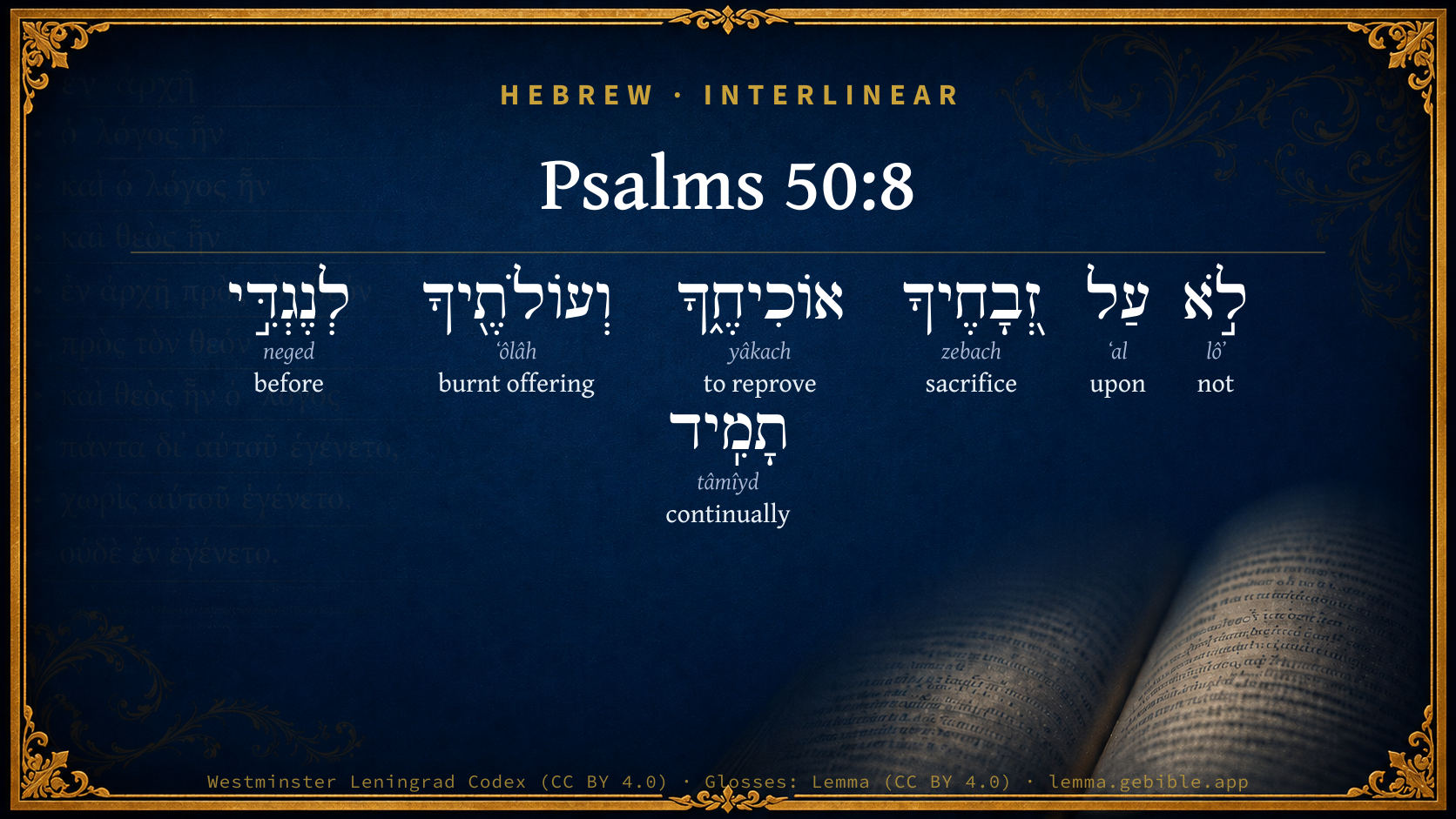
Hebrew (Westminster Leningrad Codex) Psalms 50:8 appears in the Hebrew Old Testament. The text above is from the Westminster Leningrad Codex. Each word links to its Strong’s number, a concise gloss, and parsing drawn from the Open Scriptures Hebrew Bible morphology. Click any word for its full Brown-Driver-Briggs (BDB) entry.
Download image
Cite this verse

Psalms 50:8 (World English Bible). Public Domain. Lemma interlinear Bible study tool, https://lemma.gebible.app/v/psalms/50/8.

Show BibTeX & RIS
BibTeX
RIS
English Translation
I don't rebuke you for your sacrifices. Your burnt offerings are continually before me.
World English Bible · Public Domain
Download a study sheet

One document with this verse’s original text, its word-by-word gloss line, the meaning frame, cross-references with their text, attributed commentary, and full source and license credits — printable, and it pastes into notes with its structure intact.

This verse Autodidact and up

Study sheet (.html) Plain text (.txt)

A passage Seminary Student

Up to 50 verses in one chapter. A passage sheet keeps up to 6 commentary sources and 12 cross-references per verse, in the order this page ranks them, and says so on the sheet whenever that leaves anything out. Ask for a single verse and you get the Autodidact verse sheet above.

Everything on this page stays free to read, with no account — the sheet is a download of what is already on screen, not access to it.

Want to remove ads? Support Godless Engineer
Compare translations 3

The same verse in 3 English versions, stacked beneath the original-language interlinear above. Click any original word for its lexicon entry.

Each is an independent rendering of the whole verse — the interlinear is not word-aligned to these translations.

Highlighted words mark where these versions differ — a whole-verse word diff, not a word-by-word alignment.

  • World English Bible Public Domain
    I don't rebuke you for your sacrifices. Your burnt offerings are continually before me.
  • King James Version Public Domain
    I will not reprove thee for thy sacrifices or thy burnt offerings, to have been continually before me.
  • unfoldingWord Literal Text CC BY-SA 4.0
    I do not accuse you regarding your sacrifices, for your burnt offerings are always before me.

unfoldingWord Literal Text — © unfoldingWord, licensed CC BY-SA 4.0. Word-aligned USFM3 via Door43 (git.door43.org/unfoldingWord/en_ult).

Versions to compare (up to 4)

3 of 4 selected

Show all 18 translations

Every available English version of this verse, each an independent rendering of the whole verse.

  • World English Bible Public Domain
    I don't rebuke you for your sacrifices. Your burnt offerings are continually before me.
  • Berean Standard Bible Public Domain
    I do not rebuke you for your sacrifices, and your burnt offerings are ever before Me.
  • Majority Standard Bible Public Domain
    I do not rebuke you for your sacrifices, and your burnt offerings are ever before Me.
  • King James Version Public Domain
    I will not reprove thee for thy sacrifices or thy burnt offerings, to have been continually before me.
  • American Standard Version (1901) Public Domain
    I will not reprove thee for thy sacrifices; And thy burnt-offerings are continually before me.
  • Revised Version (1885) Public Domain
    I will not reprove thee for thy sacrifices; and thy burnt offerings are continually before me.
  • Geneva Bible (1599) Public Domain
    I wil not reproue thee for thy sacrifices, or thy burnt offerings, that haue not bene continually before me.
  • Douay-Rheims (1899) Public Domain
    I will not reprove thee for thy sacrifices: and thy burnt offerings are always in my sight.
  • Young's Literal Translation Public Domain
    Not for thy sacrifices do I reprove thee, Yea, thy burnt-offerings `Are' before Me continually.
  • Literal Standard Version CC BY-SA 4.0
    I do not reprove you for your sacrifices, || Indeed, your burnt-offerings || [Are] continually before Me.
  • Unlocked Literal Bible CC BY-SA 4.0
    I will not reprove you for your sacrifices; your burnt offerings are always before me.
  • unfoldingWord Literal Text CC BY-SA 4.0
    I do not accuse you regarding your sacrifices, for your burnt offerings are always before me.
  • Darby Bible Public Domain
    I will not reprove thee for thy sacrifices, or thy burnt-offerings, continually before me;
  • World Messianic Bible Public Domain
    I don’t rebuke you for your sacrifices. Your burnt offerings are continually before me.
  • Webster's Bible Public Domain
    I will not reprove thee for thy sacrifices or thy burnt-offerings, to have been continually before me.
  • Free Bible Version CC BY-SA 4.0
    I'm not complaining about your sacrifices or burnt offerings that you offer all the time.
  • Bible in Basic English Public Domain
    I will not take up a cause against you because of your offerings, or because of your burned offerings, which are ever before me.
  • JPS Tanakh (1917) Public Domain
    I will not reprove thee for thy sacrifices; and thy burnt-offerings are continually before Me.

Literal Standard Version (2020), Covenant Press — licensed CC BY-SA 4.0. Text via the HelloAO Bible API (eBible.org). Unlocked Literal Bible (unfoldingWord) — licensed CC BY-SA 4.0. Text via the HelloAO Bible API (eBible.org). unfoldingWord Literal Text — © unfoldingWord, licensed CC BY-SA 4.0. Word-aligned USFM3 via Door43 (git.door43.org/unfoldingWord/en_ult). Free Bible Version, Dr. Jonathan Gallagher — licensed CC BY-SA 4.0. Text via the HelloAO Bible API (eBible.org).

Word by word

More ways to search: Search by grammar → Find every occurrence → Compare this word →

Practice this passage: Drill this verse → Learn its vocabulary →

אוֹכִיחֶ֑ךָ
yâkach
H3198
“to reprove · you”
Verb, Hiphil, Imperfect, 1st Person, Common, Singular + Suffix, Personal, 2nd Person, Masculine, Singular
Part of Speech
Verb
Stem
Hiphil
Form
Imperfect
Person
1st Person
Gender
Common
Number
Singular
Full BDB Definition

Origin: a primitive root

TWOT: 865

to prove, decide, judge, rebuke, reprove, correct, be right - (Hiphil) - to decide, judge - to adjudge, appoint - to show to be right, prove - to convince, convict - to reprove, chide - to correct, rebuke - (Hophal) to be chastened - (Niphal) to reason, reason together - (Hithpael) to argue
  1. לֹ֣א lôʼ H3808 “not” Particle, Negative
  2. עַל ʻal H5921 “upon” Preposition
  3. זְ֭בָחֶיךָ zebach H2077 “sacrifices · your” Noun, Common, Masculine, Plural, Construct + Suffix, Personal, 2nd Person, Masculine, Singular
  4. וְעוֹלֹתֶ֖יךָ ʻôlâh H5930 “and · burnt offerings · your” Conjunction + Noun, Common, Feminine, Plural, Construct + Suffix, Personal, 2nd Person, Masculine, Singular
  5. לְנֶגְדִּ֣י neged H5048 “to/for · before · me” Preposition + Preposition + Suffix, Personal, 1st Person, Common, Singular
  6. תָמִֽיד tâmîyd H8548 “continually” Noun, Common, Masculine, Singular, Absolute

About this verse

These counts appear in no published source. They are computed here, from the morphology-tagged text and Lemma’s own curated glosses. What Lemma adds →

7
words
7
distinct lemmas
Wisdom
section

Shared distinctive vocabulary

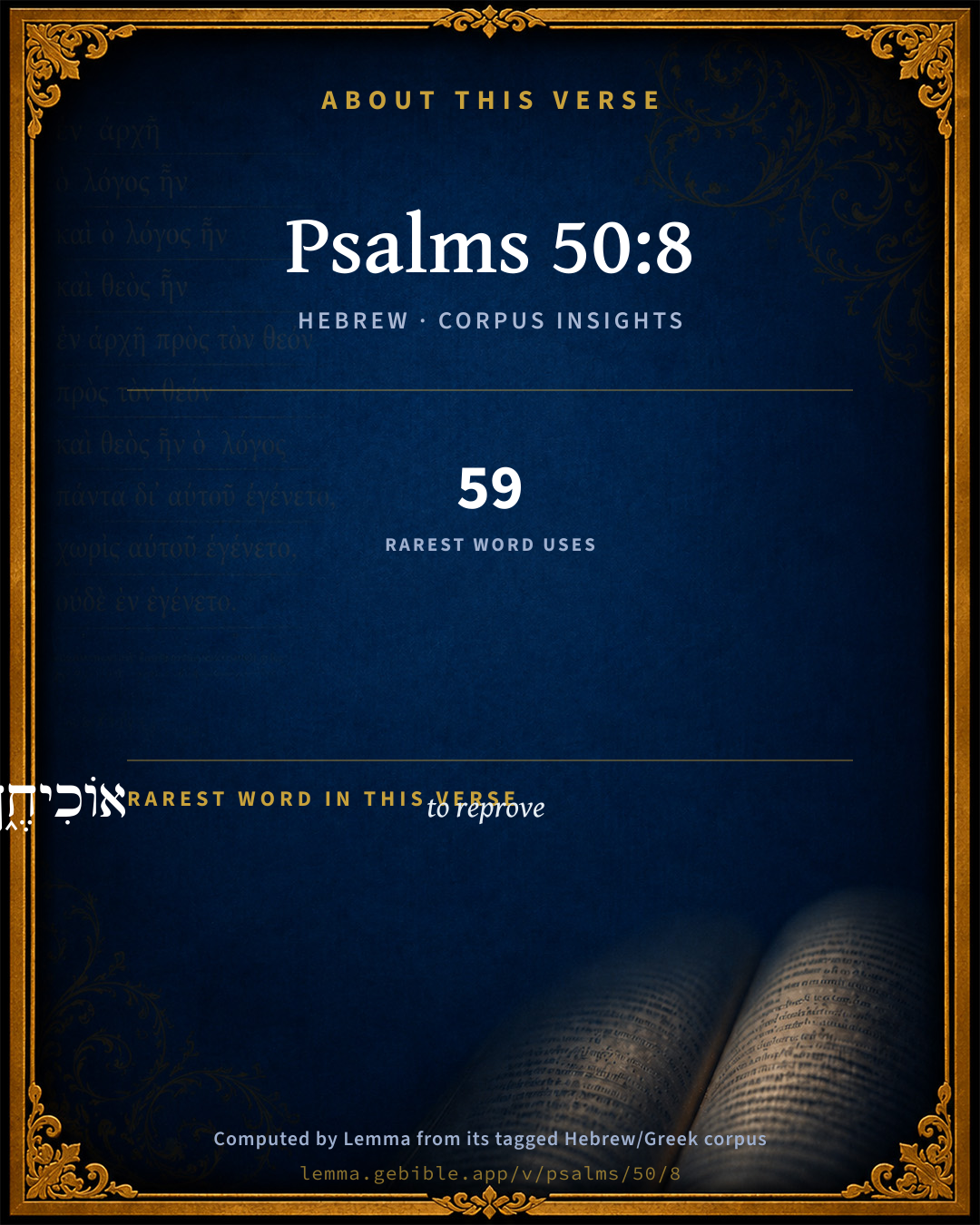
אוֹכִיחֶ֑ךָ to reprove H3198 occurs in 55 verses of the Hebrew Bible. Also found in:

Grammatical profile

  • 1 verb
  • 3 nouns
  • 2 prepositions
  • 1 particle

Verb forms

  • אוֹכִיחֶ֑ךָ Hiphil · Imperfect

Hebrew & Septuagint length

In English translation the verse runs 14 words from the Hebrew and 19 from the Septuagint (LXX English) — closely comparable.

A rough comparison of the two English renderings, which tokenize alike — not a word-level alignment.

Word counts can differ between the Hebrew and the Greek without any difference in meaning — e.g. the Hebrew direct-object marker אֵת has no separate Greek word, and Greek often adds the article ὁ.

Cross-references

6

Topical passages linked to Psalms 50:8 in the Treasury of Scripture Knowledge — connected by theme and wording, ordered by reader-vote popularity; previews shown in the World English Bible.

  • Hosea 6:6 For I desire mercy, and not sacrifice; And the knowledge of God more than burnt offerings.
  • Hebrews 10:4–10 For it is impossible that the blood of bulls and goats should take away sins.
  • Isaiah 1:11–31 "What are the multitude of your sacrifices to me?," says Yahweh. "I have had enough of the burnt offerings of rams, And the fat of fed animals. I don't delight in the blood of bulls, Or of lambs, Or of male goats.
  • Psalms 40:6–8 Sacrifice and offering you didn't desire. You have opened my ears: Burnt offering and sin offering you have not required.
  • Psalms 51:16 For you don't delight in sacrifice, or else I would give it. You have no pleasure in burnt offering.
  • Jeremiah 7:21–23 Thus says Yahweh of Hosts, the God of Israel: Add your burnt offerings to your sacrifices, and eat you flesh.

Cross-references courtesy of OpenBible.info (CC BY 4.0).

Hebrew and Greek witnesses Masoretic Hebrew ↔ Greek Septuagint

The same verse in the two great witnesses to the Old Testament, shown verse-for-verse.

You’re reading Greek Psalm 49 (Hebrew Psalm 50). The Septuagint counts the superscription, so verse numbers can differ from the Hebrew — chapter-level alignment, not verse-by-verse. Numbering follows Rahlfs.

These are two independent witnesses, not word-aligned to each other, and the Septuagint is shown in lemma (dictionary) form.

Hebrew Psalms 50:8 Masoretic · Westminster Leningrad Codex

לֹ֣א עַל זְ֭בָחֶיךָ אוֹכִיחֶ֑ךָ וְעוֹלֹתֶ֖יךָ לְנֶגְדִּ֣י תָמִֽיד

I don't rebuke you for your sacrifices. Your burnt offerings are continually before me.

World English Bible · Public Domain

Greek LXX Greek Psalm 49:8 Septuagint · lemma form

οὐ ἐπί ὁ θυσία σύ ἐλέγχω σύ ὁ δέ ὁλοκαύτωμα σύ ἐνώπιον ἐγώ εἰμί διά πᾶς

I will not reprove you on account of your sacrifices; for your whole burnt offerings are before me continually.

LXX2012 (modern English Septuagint) · Public Domain

Hebrew: Westminster Leningrad Codex (CC BY 4.0). Greek: Septuagint (public domain); English from LXX2012 (modern English Septuagint) (Public Domain). How the Septuagint differs from the Hebrew →

Commentary

Notes on Psalms 50:8 from classic Christian and Jewish commentators (each source and its license shown beneath its notes). The classic Christian expositions comment on the surrounding passage and are grouped to its opening verse, so a note may address several verses; the Jewish commentaries on the Tanakh (Rashi and others) are per-verse, so they appear only where the commentator wrote on this verse.

Lemma curates 59 commentaries, every one of them public domain or Creative Commons licensed, each selected and text-cleaned for this edition rather than reprinted as found. About our sources →

Trapp's Complete Commentary

John Trapp

Psa 50:8 I will not reprove thee for thy sacrifices or thy burnt offerings, [to have been] continually before me.

Ver. 8. I will not reprove thee for thy sacrifices] i.e. For thy neglect of them, but for thy resting in them, sticking in the bark, bringing me the bare shell without the kernel, not referring thy sacrifices to the right end and use; but satisfying thyself in the work done. This was afterwards the sin of the Pharisees, is still of the Papists, and of too many carnal gospellers, who think they have served God, for they have been at church, done their devoir, for they have said their prayers, &c. Yea, many of the better sort among us hold only a certain stint of daily duties, as malt horses their pace, or mill horses their round, that move much, remove little, out of custom or form. Yea, the best find it hard enough to be in duty in respect of performance, and out of duty in respect of dependence; to do all righteousness, and yet to rest in none but Christ’s.

Or thy burnt offerings, to have been continually before me] Heb. Thy burnt offerings have been continually before me; so that I am sated with the very sight of them, Isa 1:11; there God complained that all his senses were wearied, and his soul vexed, by the abundance of their outward ceremonies, but want of moral service.

John Trapp, A Commentary or Exposition upon All the Books of the Old and New Testament (1647–1656) — public domain. Text from a community e-Sword module.

The Biblical Illustrator

Joseph S. Exell

Psa_50:8-13

I will not reprove thee for thy sacrifices or thy burnt offerings.

Lessons

I will not reprove thee for thy sacrifices; i.e. for thy neglect of them, but for thy resting in them, sticking in the bark, bringing Me the bare shell without the kernel, not referring to the right end and use, but satisfying thyself in the work done. (John Trapp.)

Lifeless duties

Go out into the woods, where the white oak is, and where the beech is. Their leaves died last November, but they all hang on the trees yet. The trees have not strength to slough them. They always make me think of a great many people. Sap does not run in them any more, but their duties hang on them like dead leaves all over. They would not like to drop their duties: they are not quite in that state yet; but those duties are dry, sapless and enforced. (E. P. Thwing.)

The Biblical Illustrator, edited by Joseph S. Exell (c. 1880s–1900s) — public domain. Text from a community e-Sword module.

Joseph Benson's Commentary

Psa 50:8-13. I will not reprove thee for thy sacrifices, &c. — This is not the principal matter of my charge against thee, that thou hast neglected sacrifices, which thou shouldest have offered; for, although thou hast often omitted thy duty even in that respect, yet I have greater things than these to charge thee with. I will take no bullock, &c. — Be not so foolish as to imagine that thou dost lay any obligations upon me by thy sacrifices, or that I required them because I had need of them, or took any pleasure or satisfaction in them for their own sakes. Every beast of the forest is mine — I could command or dispose of them at my pleasure, without thy leave or assistance; and the cattle, &c. — Which feed upon innumerable hills, or in valleys and fields. I know all the fowls, &c. — Where they are, and whence I could easily fetch them when I please; and not only tame and domestic fowls, but even such as are wild and fly up and down upon mountains; which, though out of man’s reach, are at my command. If I were hungry — If I wanted or desired any thing, which I do not, being the all-sufficient God; I would not tell thee — That thou mightest supply my wants. For the world is mine, &c. — And all those creatures wherewith it is replenished. Will I eat the flesh of bulls? — If I did want any thing, hast thou such gross and carnal conceptions of me as to suppose that I need or delight in the blood of brute creatures?

Joseph Benson's Commentary on the Old and New Testaments (1811–1818) — public domain. Text from a community e-Sword module.

J. A. Alexander on Psalms

Joseph Addison Alexander

8. (Psa 50:8) Not for thy sacrifices will I reprove thee, and thy burnt-offerings before me always. The insertion of the words to have been, in the common version, seems to make the clause mean, that although they had neglected this external rite, it was of no importance, whereas the simple meaning of the Hebrew sentence is, that they were not chargeable with this neglect, implying that the observance was obligatory, which is in perfect keeping with the tenor of the psalm. "I do not charge thee with withholding the material offerings to which I am entitled, for in truth they are ever before me." To the generic term sacrifices, animal oblations, he adds the more specific one, burnt-offering, the usual English version of a Hebrew term, denoting the principal and ordinary expiatory offering of the Mosaic ritual. See above, on Psa 20:4 (3), Psa 407 (6).

Joseph Addison Alexander, The Psalms Translated and Explained (1850) — public domain. Text from a community e-Sword module.

Geneva Bible (1599)

Geneva Bible translators

For I pass not for sacrifices, except the true use be there, which is to confirm your faith in my promises.

Geneva Bible (1599) marginal notes — public domain. Text via Bolls.life.

Jamieson, Fausset & Brown

Robert Jamieson, A. R. Fausset & David Brown

However scrupulous in external worship, it was offered as if they conferred an obligation in giving God His own, and with a degrading view of Him as needing it [Psa 50:9-13]. Reproving them for such foolish and blasphemous notions, He teaches them to offer, or literally, "sacrifice," thanksgiving, and pay, or perform, their vows--that is, to bring, with the external symbolical service, the homage of the heart, and faith, penitence, and love. To this is added an invitation to seek, and a promise to afford, all needed help in trouble.

Jamieson, Fausset & Brown — Commentary Critical and Explanatory on the Whole Bible (1871) — public domain (CC PDM 1.0). Text via the HelloAO Bible API.

Adam Clarke's Commentary

Verse 8. I will not reprove thee] I do not mean to find fault with you for not offering sacrifices; you have offered them, they have been continually before me: but you have not offered them in the proper way.

Adam Clarke's Commentary on the Bible (1810–1826) — public domain. Text from a community e-Sword/MySword module.

John Calvin's Commentaries

8 I will not reprove thee for thy sacrifices, etc. God now proceeds to state the charge which he adduced against them. He declares, that he attached no value whatsoever to sacrifices in themselves considered. Not that he asserts this rite of the Jews to have been vain and useless, for in that case it never would have been instituted by God; but there is this difference betwixt religious exercises and others, that they can only meet the approbation of God when performed in their true spirit and meaning. On any other supposition they are deservedly rejected. Similar language we will find employed again and again by the prophets, as I have remarked in other places, and particularly in connection with the fortieth psalm. Mere outward ceremonies being therefore possessed of no value, God repudiates the idea that he had ever insisted upon them as the main thing in religion, or designed that they should be viewed in any other light than as helps to spiritual worship. Thus in Jeremiah 7:22, he denies that he had issued any commandment regarding sacrifices; and the prophet Micah says,

“Will the Lord be pleased with thousands of rams, or with ten thousands of rivers of oil? and what doth the Lord require of thee, but to do justly, and to love mercy?” — (Micah 6:7)

“I desire mercy,” he says in another place, (Hosea 6:6,) “and not sacrifice.” The same doctrine is every where declared by the prophets. I might refer especially to the prophecies of Isaiah, chapter 1:12; 58:1, 2; 66:3. The sacrifices of the ungodly are not only represented as worthless and rejected by the Lord, but as peculiarly calculated to provoke his anger. Where a right use has been made of the institution, and they have been observed merely as ceremonies for the confirmation and increase of faith, then they are described as being essentially connected with true religion; but when offered without faith, or, what is still worse, under the impression of their meriting the favor of God for such as continue in their sins, they are reprobated as a mere profanation of divine worship. It is evident, then, what God means when he says, I will not reprove thee for thy sacrifices; he looked to something beyond these. The last clause of the verse may be understood as asserting that their burnt-offerings were before the eyes of the Lord to the producing even of satiety and disgust, as we find him saying, (Isaiah 1:13,) that they were “an abomination unto him.” There are some, however, who consider the negative in the beginning of the verse as applying to both clauses, and that God here declares that he did not design to reckon with them for any want of regularity in the observance of their sacrifices. It has been well suggested by some, that the relative may be understood, Thy burnt-offerings which are continually before me; as if he had said, According to the Law these are imperative; but I will bring no accusation against you at this time for omitting your sacrifices.

John Calvin's Commentaries (1540-1563) — public domain. Text from the Calvin Translation Society English edition (1840s-50s) via the Christian Classics Ethereal Library (ccel.org). Calvin's coverage is partial (roughly two-thirds of the Bible); uncommented books and verses are honest gaps, never fabricated. The 19th-century editor's footnotes and remarks are omitted so the notes are faithfully Calvin's own voice.

Ellicott's Commentary for English Readers

(8) I will not . . .—Better, Not on account of thy sacrifices do I reprove thee, nor thy burnt offerings, which are always before me. This part of the nation is judged not for neglect of ritual, but for mistaken regard for it. (See Introduction to this psalm.)

As usual in such visions of judgment (comp. Mat_25:32) the arraigned nation is separated into two classes when brought before the bar of the judge, and the better part is first reproved.

A Bible Commentary for English Readers, edited by Charles John Ellicott (1878–1897) — public domain. Text from a community e-Sword module.

The Cambridge Bible for Schools and Colleges

gen. ed. J. J. S. Perowne

8. Render with R.V.,

I will not reprove thee for thy sacrifices;

And thy burnt offerings are continually before me.

This rendering is grammatically preferable to that of R.V. marg. Nor for thy burnt offerings, which are &c., which gives substantially the same sense. God’s indictment does not relate to sacrifice: the stated offerings are duly presented. Continually seems to allude to the ‘continual burnt offering,’ which was offered daily, morning and evening. See Num_28:3 ff.

9ff. The owner of the vast herds of animals which roam the forests and range over a thousand mountains is not like some earthly king who comes and takes the choicest of his subjects’ possessions at his will (1Sa_8:16 f.). The phrase rendered upon a thousand hills may mean upon the mountains where thousands are. The construction in either case is peculiar, and it has been conjectured that we should read upon the mountains of God, as in Psa_36:6; but the alteration is hardly necessary.

The Cambridge Bible for Schools and Colleges (gen. ed. J. J. S. Perowne; Cambridge University Press, 1878–1918) — public domain. Text from a community e-Sword module.

John Gill's Exposition

I will not reprove thee for thy sacrifices,.... For the neglect of them; this they were not chargeable with; and had they omitted them, a charge would not have been brought against them on that account, since these were not what God commanded when he brought them out of Egypt, Jer 7:22; and were now abrogated; and when they were in force, acts of mercy, kindness, and beneficence, were preferred unto them, Hos 6:6;

or thy burnt offerings, to have been continually before me; or, "for thy burnt offerings are continually before me" (u); so far were they from being reprovable for not bringing their sacrifices, that they were continually offering up before the Lord even multitudes of them, though to no purpose, being offered up without faith, and in hypocrisy; and could not take away sin, and make atonement for it; and besides, ought now to have ceased to be offered, Christ the great sacrifice being now offered up, as he was in the times to which this psalm belongs; see Isa 1:14; wherefore it follows:

(u) So Tigurine version, Vatablus, Piscator, Cocceius, and Ainsworth.

John Gill's Exposition of the Whole Bible (1746–1763) — public domain (CC PDM 1.0). Text via the HelloAO Bible API.

Albert Barnes' Notes on the Bible

I will not reprove thee for thy sacrifices or thy burnt-offerings - On the words “sacrifices” and “burnt-offerings” here used, see the notes at Isa 1:11. The meaning is, “I do not reprove or rebuke you in respect to the withholding of sacrifices. I do not charge you with neglecting the offering of such sacrifices. I do not accuse the nation of indifference in regard to the external rites or duties of religion. It is not on this ground that you are to be blamed or condemned, for that duty is outwardly and publicly performed. I do not say that such offerings are wrong; I do not say that there has been any failure in the external duties of worship. The charge - the reproof - relates to other matters; to the want of a proper spirit, to the withholding of the heart, in connection with such offerings.”

To have been continually before me - The words “to have been” are inserted by the translators, and weaken the sense. The simple idea is, that their offerings “were” continually before him; that is, they were constantly made. He had no charge of neglect in this respect to bring against them. The insertion of the words “to have been” would seem to imply that though they had neglected this external rite, it was a matter of no consequence; whereas the simple meaning is, that they were “not” chargeable with this neglect, or that there was “no” cause of complaint on this point. It was on other grounds altogether that a charge was brought against them. It was, as the following verses show, because they supposed there was special “merit” in such offerings; because they supposed that they laid God under obligation by so constant and so expensive offerings, as if they did not already belong to him, or as if he needed them; and because, while they did this, they withheld the very offering which he required, and without which all other sacrifices would be vain and worthless - a sincere, humble, thankful heart.

Albert Barnes' Notes on the Bible (1834–1885) — public domain. Text from a community e-Sword/MySword module.

Matthew Poole's English Annotations

I do not charge thee, or at least this is not the principal matter of my charge, that thou hast neglected sacrifices which thou shouldst have offered; for although thou hast many times omitted thy duty in that kind, yet I have greater things than these to charge thee with.

To have been; or, they have been. I confess thou hast been frequent in that work, and hast laid too great a stress upon it, and satisfied thy conscience with it, as if thereby thou hadst made me amends for the errors of thy life.

Matthew Poole's English Annotations on the Holy Bible (1683–1685) — public domain. Text from a community e-Sword/MySword module.

The Treasury of David

Charles H. Spurgeon

Ver. 8. I will not reprove thee for thy sacrifices or thy burnt offerings, to have been ever before me. Though they had not failed in maintaining his outward worship, or even if they had, he was not about to call them to account for this: a more weighty matter was now under consideration. They thought the daily sacrifices and the abounding burnt offerings to be everything: he counted them nothing if the inner sacrifice of heart devotion had been neglected. What was greatest with them was least with God. It is even so today. Sacraments (so called) and sacred rites are them main concern with unconverted but religious men, but with the Most High the spiritual worship which they forget is the sole matter. Let the external be maintained by all means, according to the divine command, but if the secret and spiritual be not in them, they are a vain oblation, a dead ritual, and even an abomination before the Lord.

Ver. 8. I will not reprove thee for thy sacrifices; i.e., for thy neglect of them, but for thy resting in them, sticking in the bark, bringing me the bare shell without the kernel, not referring to the right end and use, but satisfying thyself in the work done. John Trapp.

Ver. 8. I will not reprove thee for thy sacrifices or thy burnt offerings continually before me. Those words to have been, which our translators supply, may be left out, and the sense remain perfect: or if those words be continued, then the negative particle not, is to be reassumed out of the first part of the verse, and the whole read thus, I will not reprove thee for thy sacrifices, or thy burnt offerings not to have been continually before me. That is, I will not charge thee with a neglect of outward duty or worship, the inward or spiritual (of which he speaks, Ps 50:14), being that which is most pleasing unto me. Joseph Caryl.

Ver. 8-9. It is the very remonstrance which our Lord himself makes against the Pharisees of his days, for laying so much stress on the outward observance of their own traditions, the washing of pots and cups and other such like things; the paying of tithes of anise and mint and cummin; the ostentatious fulfilment of all ceremonious observances in the eyes of men, the exalting the shadow to the exclusion of the substance. And have we not seen the like in our own days, even to the very vestment of the minister, the obeisance of the knee, and the posture of the body? as if the material church were all in all, and God were not Spirit, that demanded of those that worshipped him that they should worship him in spirit and in truth; as if the gold and ornaments of the temple were far beyond the hidden man of the heart in that which is incorruptible, even the ornament of a meek and quiet spirit, which is in the sight of God of great price. Barton Bouchier.

None.

Psalms 50:9*

Ver. 8-9. It is the very remonstrance which our Lord himself makes against the Pharisees of his days, for laying so much stress on the outward observance of their own traditions, the washing of pots and cups and other such like things; the paying of tithes of anise and mint and cummin; the ostentatious fulfilment of all ceremonious observances in the eyes of men, the exalting the shadow to the exclusion of the substance. And have we not seen the like in our own days, even to the very vestment of the minister, the obeisance of the knee, and the posture of the body? as if the material church were all in all, and God were not Spirit, that demanded of those that worshipped him that they should worship him in spirit and in truth; as if the gold and ornaments of the temple were far beyond the hidden man of the heart in that which is incorruptible, even the ornament of a meek and quiet spirit, which is in the sight of God of great price. Barton Bouchier.

Charles H. Spurgeon's The Treasury of David (1869–1885) — public domain. Psalms only. Text from a community e-Sword/MySword module.

The Pulpit Commentary

I will not reprove thee for thy sacrifices or thy burnt offerings. It is for no neglect of the outward ritual of religion of sacrifice and offering that I have to reprove thee. To have been continually before me; rather, they have been continually before me. I have had enough of them, and to spare. Not only have the daily morning and evening sacrifices been regularly offered, and the national worship thus kept up without a break; but the private offerings of individuals (see vers. 9, 13) have been continuous and ample in number. But they have not been acceptable.

The Pulpit Commentary (1880–1919), ed. H.D.M. Spence-Jones & Joseph S. Exell — public domain. Text from a community e-Sword module.

John Wesley's Explanatory Notes

I will not - This is not the principal matter of my charge, that thou hast neglected sacrifices which thou shouldst have offered.

John Wesley, Explanatory Notes Upon the Whole Bible (1754–1765) — public domain. Text via the GEBible commentary corpus.

Rashi

Rabbi Shlomo Yitzchaki (Rashi)

I will not reprove you concerning your sacrifices If you do not bring Me sacrifices, and your burnt offerings are not before Me constantly. I do not set My eyes and My heart on that.

Rashi on the Tanakh — English translations: “The Judaica Press complete Tanach with Rashi, translated by A. J. Rosenberg” (CC BY 4.0); “Pentateuch with Rashi's commentary by M. Rosenbaum and A.M. Silbermann, 1929-1934” (public domain); “The Metsudah Tanach series, Lakewood, N.J” (CC BY 4.0); and “The Book of Joshua, Metsudah Publications, 1997” (CC BY 4.0). Text via Sefaria.

Lesson kit

Teaching starters — assembled from the data on this page, not authored interpretation. Every prompt links to the verse data it draws on. Edit before teaching.

Psalms, in the Wisdom, opens this verse with 7 words (7 distinct Hebrew lemmas). Its most distinctive word is yâkach (“to reprove”). A historical commentator’s framing appears above. Read the whole chapter for the surrounding context.

Discussion questions

  1. The word yâkach carries the sense “to reprove.” How does it shape the verse?
  2. How does Genesis 20:16, which shares the word «to reprove», read alongside this verse?
  3. These translations render this verse differently. What is at stake in choosing one wording over another?
  4. «אוֹכִיחֶ֑ךָ» is a Hiphil Imperfect verb. How does that grammatical form shape the action described?
  5. Compare how Trapp's Complete Commentary and The Biblical Illustrator read this verse. Where do they agree or differ?

Things to notice

Reading settings

Reading text

Shown beneath each verse's original-language words.

Old Testament
Old Testament edition

Read the OT as the Masoretic Hebrew (MT) or the Greek Septuagint (LXX).

English shown for the Greek Septuagint (in the Hebrew ↔ Greek comparison).

Comparing translations? Open the Compare panel on any verse page to stack up to four side by side.