Psalms 51:19

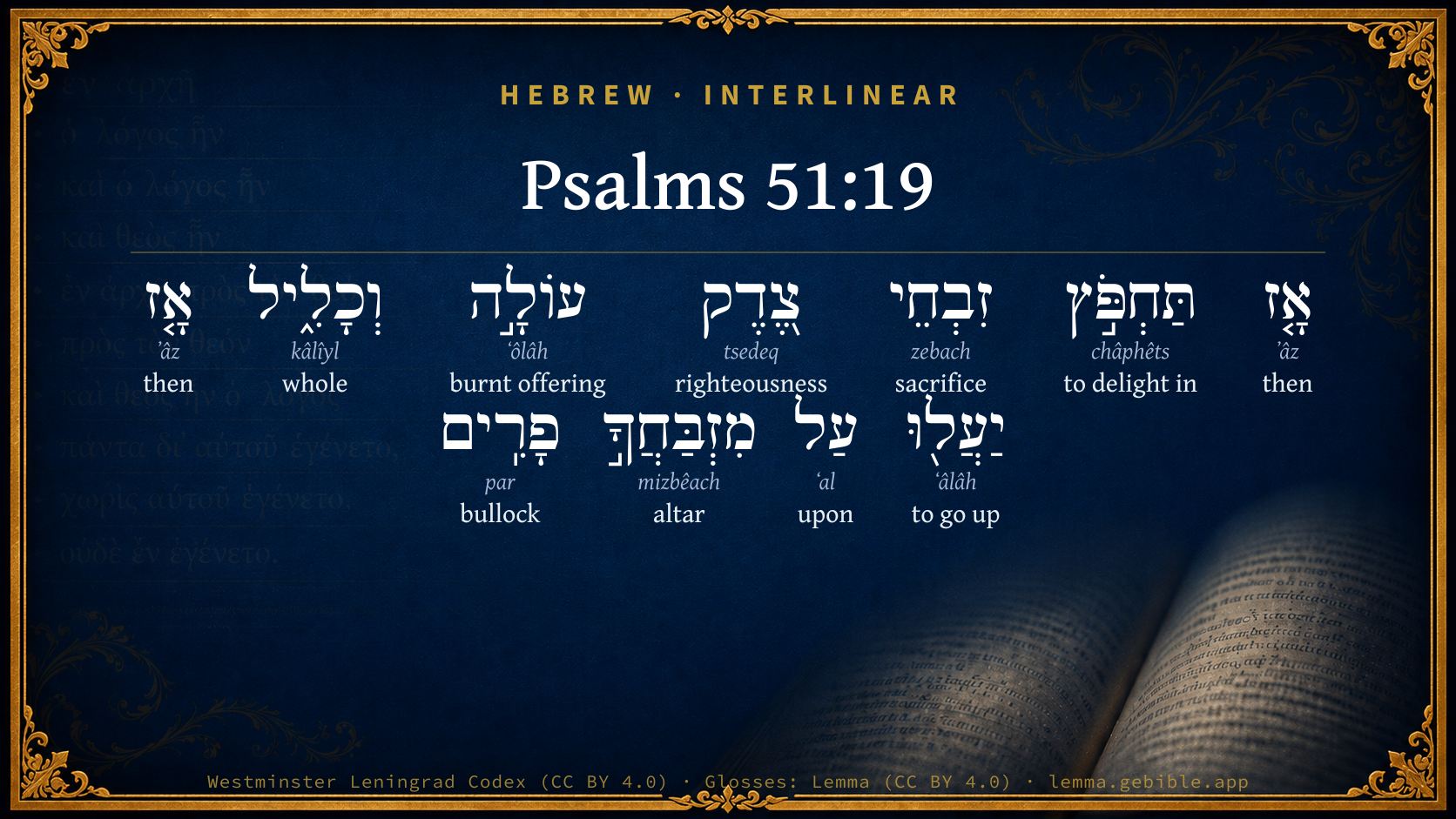
Hebrew (Westminster Leningrad Codex) Psalms 51:19 appears in the Hebrew Old Testament. The text above is from the Westminster Leningrad Codex. Each word links to its Strong’s number, a concise gloss, and parsing drawn from the Open Scriptures Hebrew Bible morphology. Click any word for its full Brown-Driver-Briggs (BDB) entry.
Download image
Cite this verse

Psalms 51:19 (World English Bible). Public Domain. Lemma interlinear Bible study tool, https://lemma.gebible.app/v/psalms/51/19.

Show BibTeX & RIS
BibTeX
RIS
English Translation
Then you will delight in the sacrifices of righteousness, In burnt offerings and in whole burnt offerings. Then they will offer bulls on your altar.
World English Bible · Public Domain
Download a study sheet

One document with this verse’s original text, its word-by-word gloss line, the meaning frame, cross-references with their text, attributed commentary, and full source and license credits — printable, and it pastes into notes with its structure intact.

This verse Autodidact and up

Study sheet (.html) Plain text (.txt)

A passage Seminary Student

Up to 50 verses in one chapter. A passage sheet keeps up to 6 commentary sources and 12 cross-references per verse, in the order this page ranks them, and says so on the sheet whenever that leaves anything out. Ask for a single verse and you get the Autodidact verse sheet above.

Everything on this page stays free to read, with no account — the sheet is a download of what is already on screen, not access to it.

Want to remove ads? Support Godless Engineer
Compare translations 3

The same verse in 3 English versions, stacked beneath the original-language interlinear above. Click any original word for its lexicon entry.

Each is an independent rendering of the whole verse — the interlinear is not word-aligned to these translations.

Highlighted words mark where these versions differ — a whole-verse word diff, not a word-by-word alignment.

  • World English Bible Public Domain
    Then you will delight in the sacrifices of righteousness, In burnt offerings and in whole burnt offerings. Then they will offer bulls on your altar.
  • King James Version Public Domain
    Then shalt thou be pleased with the sacrifices of righteousness, with burnt offering and whole burnt offering: then shall they offer bullocks upon thine altar.
  • unfoldingWord Literal Text CC BY-SA 4.0
    Then you will delight in sacrifices of righteousness, a burnt offering and a whole. Then they will offer bulls on your altar.

unfoldingWord Literal Text — © unfoldingWord, licensed CC BY-SA 4.0. Word-aligned USFM3 via Door43 (git.door43.org/unfoldingWord/en_ult).

Versions to compare (up to 4)

3 of 4 selected

Show all 18 translations

Every available English version of this verse, each an independent rendering of the whole verse.

  • World English Bible Public Domain
    Then you will delight in the sacrifices of righteousness, In burnt offerings and in whole burnt offerings. Then they will offer bulls on your altar.
  • Berean Standard Bible Public Domain
    Then You will delight in righteous sacrifices, in whole burnt offerings; then bulls will be offered on Your altar.
  • Majority Standard Bible Public Domain
    Then You will delight in righteous sacrifices, in whole burnt offerings; then bulls will be offered on Your altar.
  • King James Version Public Domain
    Then shalt thou be pleased with the sacrifices of righteousness, with burnt offering and whole burnt offering: then shall they offer bullocks upon thine altar.
  • American Standard Version (1901) Public Domain
    Then will thou delight in the sacrifices of righteousness, In burnt-offering and in whole burnt-offering: Then will they offer bullocks upon thine altar. Psalm 52 For the Chief Musician. Maschil of David; when Doeg the Edomite came and told Saul, and said unto him, David is come to the house of Abimelech.
  • Revised Version (1885) Public Domain
    Then shalt thou delight in the sacrifices of righteousness, in burnt offering and whole burnt offering: then shall they offer bullocks upon thine altar.
  • Geneva Bible (1599) Public Domain
    Then shalt thou accept ye sacrifices of righteousnes, euen the burnt offering and oblation: then shall they offer calues vpon thine altar.
  • Douay-Rheims (1899) Public Domain
    A sacrifice to God is an afflicted spirit: a contrite and humbled heart, O God, thou wilt not despise.
  • Young's Literal Translation Public Domain
    Then Thou desirest sacrifices of righteousness, Burnt-offering, and whole burnt-offering, Then they offer bullocks on thine altar!
  • Literal Standard Version CC BY-SA 4.0
    Then You desire sacrifices of righteousness, || Burnt-offering, and whole burnt-offering, || Then they offer bullocks on your altar!
  • Unlocked Literal Bible CC BY-SA 4.0
    Then will you delight in the sacrifices of righteousness, in burnt offerings and whole burnt offerings; then our people will offer bulls on your altar.
  • unfoldingWord Literal Text CC BY-SA 4.0
    Then you will delight in sacrifices of righteousness, a burnt offering and a whole. Then they will offer bulls on your altar.
  • Darby Bible Public Domain
    Then shalt thou have sacrifices of righteousness, burnt-offering, and whole burnt-offering; then shall they offer up bullocks upon thine altar.
  • World Messianic Bible Public Domain
    Then you will delight in the sacrifices of righteousness, in burnt offerings and in whole burnt offerings. Then they will offer bulls on your altar.
  • Webster's Bible Public Domain
    \\51:17\\The sacrifices of God are a broken spirit: a broken and a contrite heart, O God, thou wilt not despise.
  • Free Bible Version CC BY-SA 4.0
    Then you will be pleased with sacrifices given in the right spirit, for all kinds of burnt offerings, and bulls sacrificed on your altar once more.
  • Bible in Basic English Public Domain
    Then you will have delight in the offerings of righteousness, in burned offerings and offerings of beasts; then they will make offerings of oxen on your altar.
  • JPS Tanakh (1917) Public Domain
    (51-21) Then wilt Thou delight in the sacrifices of righteousness, in burnt-offering and whole offering; then will they offer bullocks upon Thine altar.

Literal Standard Version (2020), Covenant Press — licensed CC BY-SA 4.0. Text via the HelloAO Bible API (eBible.org). Unlocked Literal Bible (unfoldingWord) — licensed CC BY-SA 4.0. Text via the HelloAO Bible API (eBible.org). unfoldingWord Literal Text — © unfoldingWord, licensed CC BY-SA 4.0. Word-aligned USFM3 via Door43 (git.door43.org/unfoldingWord/en_ult). Free Bible Version, Dr. Jonathan Gallagher — licensed CC BY-SA 4.0. Text via the HelloAO Bible API (eBible.org).

Word by word

More ways to search: Search by grammar → Find every occurrence → Compare this word →

Practice this passage: Drill this verse → Learn its vocabulary →

וְכָלִ֑יל
kâlîyl
H3632
“and · whole”
Conjunction + Adjective, Adjective, Masculine, Singular, Absolute
Part of Speech
Conjunction + Adjective
Type
Adjective
Gender
Masculine
Number
Singular
State
Absolute
Full BDB Definition

Origin: from H3634

TWOT: 985b

entire, all, perfect (adjective) - entirety (substantive) - whole, whole burnt offering, holocaust, entirety (substantive)
  1. אָ֤ז ʼâz H227 “then” Adverb
  2. תַּחְפֹּ֣ץ châphêts H2654 “to delight in” Verb, Qal, Imperfect, 2nd Person, Masculine, Singular
  3. זִבְחֵי zebach H2077 “sacrifices of” Noun, Common, Masculine, Plural, Construct
  4. צֶ֭דֶק tsedeq H6664 “righteousness” Noun, Common, Masculine, Singular, Absolute
  5. עוֹלָ֣ה ʻôlâh H5930 “burnt offering” Noun, Common, Feminine, Singular, Absolute
  6. אָ֤ז ʼâz H227 “then” Adverb
  7. יַעֲל֖וּ ʻâlâh H5927 “to go up” Verb, Hiphil, Imperfect, 3rd Person, Masculine, Plural
  8. עַל ʻal H5921 “upon” Preposition
  9. מִזְבַּחֲךָ֣ mizbêach H4196 “altar · your” Noun, Common, Masculine, Singular, Construct + Suffix, Personal, 2nd Person, Masculine, Singular
  10. פָרִֽים par H6499 “bullocks” Noun, Common, Masculine, Plural, Absolute

About this verse

These counts appear in no published source. They are computed here, from the morphology-tagged text and Lemma’s own curated glosses. What Lemma adds →

11
words
10
distinct lemmas
Wisdom
section

Notable vocabulary

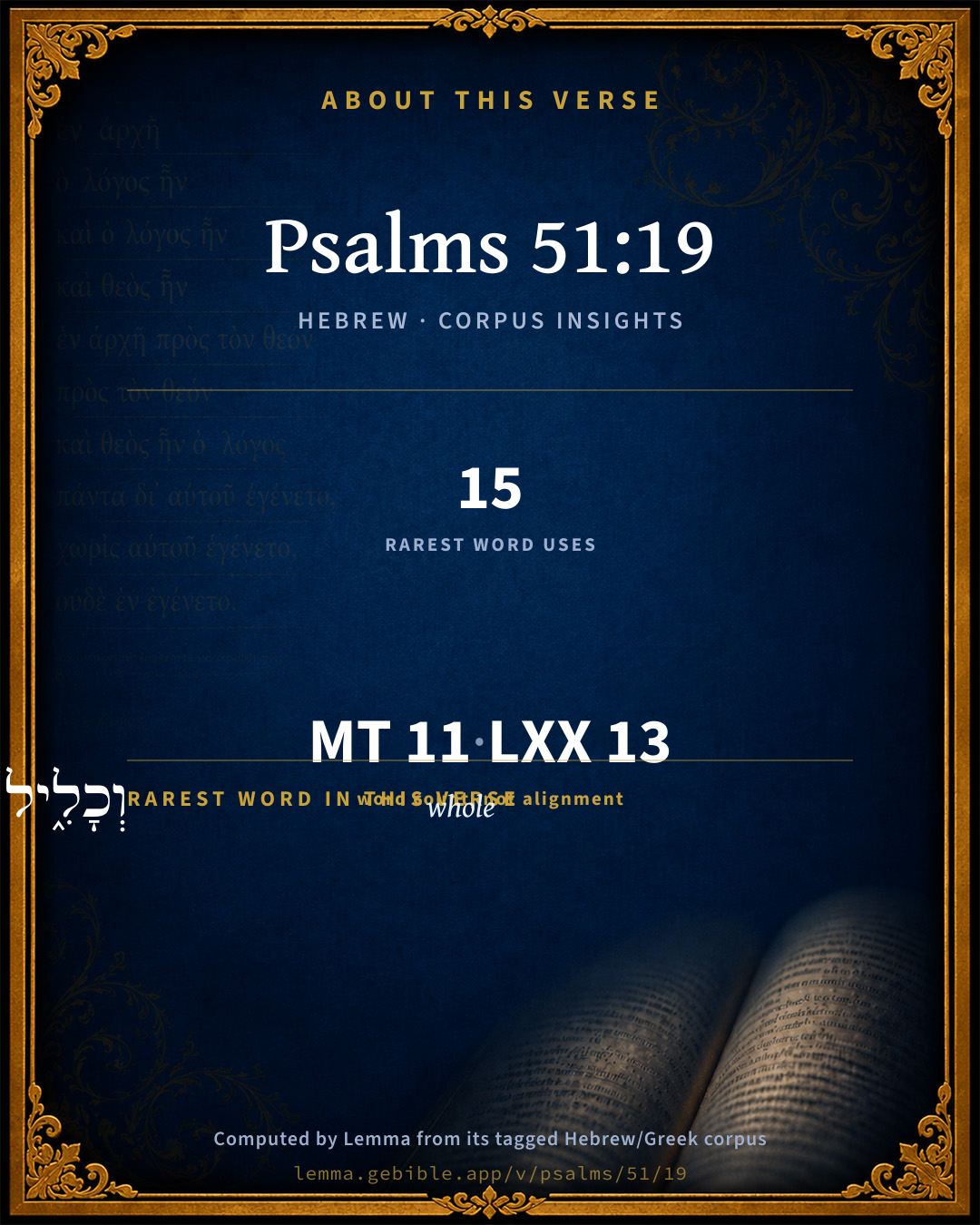
The rarest word here is וְכָלִ֑יל whole H3632 — appearing just 15 times in the whole Hebrew Bible.

Shared distinctive vocabulary

וְכָלִ֑יל whole H3632 occurs in 15 verses of the Hebrew Bible. Also found in:

Grammatical profile

  • 2 verbs
  • 5 nouns
  • 1 adjective
  • 1 preposition
  • 2 adverbs

Verb forms

  • תַּחְפֹּ֣ץ Qal · Imperfect
  • יַעֲל֖וּ Hiphil · Imperfect

Repetition

A word recurs within this verse — often emphatic in Hebrew:

  • אָ֤ז then H227 ×2

Hebrew & Septuagint length

In English translation the verse runs 25 words from the Hebrew and 23 from the Septuagint (LXX English) — closely comparable.

A rough comparison of the two English renderings, which tokenize alike — not a word-level alignment.

Word counts can differ between the Hebrew and the Greek without any difference in meaning — e.g. the Hebrew direct-object marker אֵת has no separate Greek word, and Greek often adds the article ὁ.

In the original languages it is 11 Hebrew tokens and 13 Greek tokens — but the two are counted differently (Hebrew bundles its prefixes and suffixes into one token; the Greek is in lemma form), so that isn’t a like-for-like length.

Cross-references

6

Topical passages linked to Psalms 51:19 in the Treasury of Scripture Knowledge — connected by theme and wording, ordered by reader-vote popularity; previews shown in the World English Bible.

  • Psalms 4:5 Offer the sacrifices of righteousness. Put your trust in Yahweh.
  • Malachi 3:3 and he will sit as a refiner and purifier of silver, and he will purify the sons of Levi, and refine them as gold and silver; and they shall offer to Yahweh offerings in righteousness.
  • Ephesians 5:2 Walk in love, even as Christ also loved you, and gave himself up for us, an offering and a sacrifice to God for a sweet-smelling fragrance.
  • Psalms 66:13–15 I will come into your temple with burnt offerings. I will pay my vows to you,
  • Romans 12:1 Therefore I urge you, brothers, by the mercies of God, to present your bodies a living sacrifice, holy, acceptable to God, which is your spiritual service.
  • Psalms 118:27 Yahweh is God, and he has given us light. Bind the sacrifice with cords, even to the horns of the altar.

Cross-references courtesy of OpenBible.info (CC BY 4.0).

Hebrew and Greek witnesses Masoretic Hebrew ↔ Greek Septuagint

The same verse in the two great witnesses to the Old Testament, shown verse-for-verse.

You’re reading Greek Psalm 50 (Hebrew Psalm 51). The Septuagint counts the superscription, so verse numbers can differ from the Hebrew — chapter-level alignment, not verse-by-verse. Numbering follows Rahlfs.

These are two independent witnesses, not word-aligned to each other, and the Septuagint is shown in lemma (dictionary) form.

Hebrew Psalms 51:19 Masoretic · Westminster Leningrad Codex

אָ֤ז תַּחְפֹּ֣ץ זִבְחֵי צֶ֭דֶק עוֹלָ֣ה וְכָלִ֑יל אָ֤ז יַעֲל֖וּ עַל מִזְבַּחֲךָ֣ פָרִֽים

Then you will delight in the sacrifices of righteousness, In burnt offerings and in whole burnt offerings. Then they will offer bulls on your altar.

World English Bible · Public Domain

Greek LXX Greek Psalm 50:19 Septuagint · lemma form

θυσία ὁ θεός πνεῦμα συντρίβω καρδία συντρίβω καί ταπεινόω ὁ θεός οὐ ἐκοὐθενόω

Then shall you be pleased with a sacrifice of righteousness, offering, and whole burnt sacrifices: then shall they offer calves upon your altar.

LXX2012 (modern English Septuagint) · Public Domain

Hebrew: Westminster Leningrad Codex (CC BY 4.0). Greek: Septuagint (public domain); English from LXX2012 (modern English Septuagint) (Public Domain). How the Septuagint differs from the Hebrew →

Commentary

Notes on Psalms 51:19 from classic Christian and Jewish commentators (each source and its license shown beneath its notes). The classic Christian expositions comment on the surrounding passage and are grouped to its opening verse, so a note may address several verses; the Jewish commentaries on the Tanakh (Rashi and others) are per-verse, so they appear only where the commentator wrote on this verse.

Lemma curates 59 commentaries, every one of them public domain or Creative Commons licensed, each selected and text-cleaned for this edition rather than reprinted as found. About our sources →

Trapp's Complete Commentary

John Trapp

Psa 51:19 Then shalt thou be pleased with the sacrifices of righteousness, with burnt offering and whole burnt offering: then shall they offer bullocks upon thine altar.

Ver. 19. Then shalt thou be pleased with the sacrifices, &c.] i.e. Such as are offered in faith, and according to the will of God, Psa 4:6.

Then shall they offer bullocks upon thine altar] They shall be free hearted and frequent in thy work and service; Vae torpori nostro, Woe to our dulness and backwardness in these happy days of peace and free profession, which we had need improve as they did, Act 9:31. Otherwise, we may desire to see one of the days of the Son of man, and not see it, Luk 17:22. Go to Shiloh, &c.

John Trapp, A Commentary or Exposition upon All the Books of the Old and New Testament (1647–1656) — public domain. Text from a community e-Sword module.

The Biblical Illustrator

Joseph S. Exell

Psa_51:19

Then shalt Thou be pleased with the sacrifices of righteousness, with burnt-offering and whole burnt-offering.

Sacrifices of righteousness

They are called the sacrifices of righteousness, which are offered rightly, and according to the true intent and meaning, and order of Gods law. The law of God is the rule of righteousness, they are the sacrifices of righteousness which are presented to God according to this rule. And this interpretation doth easily reconcile the difference, which may seem to be betwixt this verse and the sixteenth. There David said, God desired no sacrifice; here he saith, God shall accept burnt-offering and oblation; when these services may be truly called the sacrifices of righteousness, then God likes of them, and approves them; for that which is rightly performed according to His own prescript, He cannot but approve; but when this righteousness wants, and they are nothing but matters of form and compliment, He cannot endure them.

I. It is a great blessing when the services which men present and tender unto God do find acceptance with Him, and are approved by Him.

1. Touching the state of the person, he must be one who is himself in favour with God. A mans person must be first accepted before his gift can please. If there be any one thing which thou knowest to be an evil; nay, if there be any one particular in thy practice, which thou art not sure is lawful in Gods sight, surely God loathes thy person, and He cannot but even abhor all the devotions.

2. Concerning the substance of that which is offered unto good, and what he requireth of thee. This rule may well put the greatest part out of all hope of acceptance with God. There are two branches of will-worship, of one of which the greatest part be guilty. First is, when that which is used in worshipping God is grounded only upon mans invention, and cannot at all be proved out of Gods Word to be of his ordaining. Secondly, when though it may be that which is done, is in itself simply of Gods appointing; yet that it is so is more than he knows, or cares to know, that useth it.

3. The third is for the manner of using. For that is as necessary as the two former. That which is in itself good may yet be spoiled and made distasteful to God by the usage thereof. There were of the Israelites many, who were baptized under Moses in the cloud and in the sea, did eat of the same spiritual meat, and drink of the same spiritual drink, yet with them God was not pleased. Now, the special matter in the manner of using Gods ordinances is that spoken of by David, In Thy fear will I worship towards Thine holy temple. Let us have grace whereby we may serve God, pleasing Him with reverence and fear. Now, this fear moveth a man to two things. One in respect of his carriage before he cometh into the presence of God; the other in respect of his behaviour there. Before he comes, this fear causeth him to consider with himself into whose presence he is going, and who it is with whom he must have to do, and what a weighty business it is which he must discharge. Then, when a man is in, and now the action is begun, that fear which moved him to prepare, continueth still with him, and causeth him to do reverence before God; that is, to demean himself with a kind of diligent watchfulness over his own thoughts, that he may keep them together, and may prevent those roving and unfitting imaginations, which are wont to fall in most, when a man is best employed, and are like the fowls which fell on the sacrifices which Abraham offered to God, and were driven away by him, It is fit to this purpose that which we find (Mal_3:16).

II. It is a great mercy of God, when there is a general freedom and forwardness in the people, in respect of the public acts and exercises of devotion. We must thus, for the declaring of this doctrine, conceive of this place; that David reckoneth up here a twofold good, which shall follow that twofold blessing, for which he was a suitor in the former verse. If God should please to receive Zion into favour, and to forgive that sin by which the prosperity of the Church was now endangered, then it could not be, but the sacrifices which were offered by the children of Zion should find grace; and then, withal, if He should vouchsafe to continue and establish the peace of the state, then they, being encouraged by so many evidences of Gods favour, and enjoying such sweet quiet, should be frequent in public duties, and keep the altar of the Lord in continual use by multitudes of sacrifices. This teacheth us, first at what a high rate we ought to value this freedom and liberty of serving God publicly in peace, which David here conceived as one of the blessings which would ensue his prayer, and therefore, no doubt, was a matter principally aimed at by him in his request. And in the second place let us learn, as of David, to be glad of his freedom, so of the people here touching whom he speaks, to make use of this freedom; while we have the light let us walk in the light; while the way lieth open to the Lords altars, let us beat the path that leadeth to them. Remember ever the good use which the Churches of old made of their peace (Act_9:31). (S. Hieron.)

The sacrifice of righteousness

The first impulse of a generous soul, when he sees the ruin, the desolation, the broken wall, and the gaps of sin, is to offer reparation, to make restitution, to restore, to do something to make good the desolating ravages of sin. Alas! this is not always possible. Mummius, the Roman general, to whose lot it fell to sack Corinth, with all its treasures of art and monuments of antiquity, is said to have told his rough soldiers that if they broke any of these works of art they would have to replace them. Perhaps his is not a less ludicrous conception who thinks to repair the ravages of sin. It is just here that David seems to look forward, not only to a more perfect contrition, a more prevailing confession, but also to a more acceptable satisfaction for sin. The sacrifice of Calvary, in the Zion of the Church, in the Jerusalem above,--in this, and by this alone will it be possible to repair, to restore, to make God again well-pleased, by virtue of the atonement of His dear Son. It has that wonderful power, as we have seen, of weaving all our life together. All the different failures, incongruities, half-beginnings, impulses, longings of our life, are brought together, in some marvellous way, by His master hand; our very sins have been seized upon, to strengthen or beautify, or even tone down, our life. In heaven I shall be myself. Tenderness, gentleness, self-distrust, and many delicate virtues like them, have been brought into our lives, in places where once were ruinous gaps, Truly God is very merciful! Who but He could ever have made life righteous? The prayer of the generous heart in all ages is to be made conformable unto His death; to reproduce, however faintly, the pangs, the afflictions, the generous self-sacrifice, the agony of Gethsemane, the shame of Calvary; to offer in person to God a sacrifice of righteousness, righteous because in union with Him, righteous because sprinkled with His blood, righteous because it is the best which we can offer. And it is here described.

I. The burnt-offering. You know what that means. It is that sacrifice where all is burned and consumed--a type of the complete exhaustion of wrath against sin. It must be taken from the herd and from the flock, things ready to hand, just round about the home, and be killed, flayed, cut into pieces, and burnt. Is not this the sacrifice which we fain would offer, the vengeance on ourselves, the sorrow after a godly sort, with its carefulness, its clearing of ourselves, etc.? (2Co_8:11). Are we dead to the old temptation, are we mortified?

II. The oblation, the peace-offering--that offering which the soul can make when it is at peace with God. Ours is to be the life of oblation, the life in which there is the perpetual offering up of self. This, too, is a lesson to learn on Calvary, to offer ourselves to God, and to whatever work He may give us to do.

III. But he goes higher still. Young bullocks will be offered on the altar. This means the best and the costliest offering. It is the sacrifice of a life which God demands from the priest. It is the sacrifice of a life which God asks us to contemplate on Calvary. Be ye therefore perfect. Is this an idle dream? He was perfect. Which of you convinceth Me of sin? He asks, without fear of the answer. Can we be perfect too? At least, we are bound to try. We can make a resolution never to put up with that which is imperfect, whether it be something which we shrink back from, beaten and hopeless, saying, I cannot attain unto it; whether it be some disposition or some habit, whose attainment ever eludes it; whether it be those little traits of Christianity, which more than anything else give the likeness to the ideal, which we are seeking to reproduce. (Canon Newbolt.)

.

Psa_52:1-9

The Biblical Illustrator, edited by Joseph S. Exell (c. 1880s–1900s) — public domain. Text from a community e-Sword module.

Joseph Benson's Commentary

Psa 51:19. Then — When thou hast granted my humble requests, expressed in the former verses; when thou hast renewed, and pardoned, and comforted me, and restored thy favour unto thy people and this city; shalt thou be pleased with the sacrifices of righteousness — Which I and my people, being justified and reconciled to thee, shall offer with sincere and penitent hearts. These are opposed to the sacrifices of the wicked, which God abhors, Pro 15:8; Isa 1:11; and, withal, by thus speaking, he intimates that God, for their sins, might justly now reject their sacrifices as not being, properly speaking, sacrifices of righteousness, because they who offered them were not righteous. Then shall they, &c. — That is, they who, by thy appointment, are to do that work, namely, the priests in the name and on the behalf of thy people. Offer bullocks upon thine altar — The best and most costly sacrifices, and that in great numbers, in testimony of their gratitude for thy great favour, in pardoning mine and their sins, and preventing that total ruin which we had reason to expect and fear upon that account.

Joseph Benson's Commentary on the Old and New Testaments (1811–1818) — public domain. Text from a community e-Sword module.

J. A. Alexander on Psalms

Joseph Addison Alexander

21. (Psa 51:19). Then shalt thou be pleased with sacrifices of righteousness, burnt-offering and holocaust; then shall they offer on thine altar bullocks. Then i.e. when thou past done good to Zion and fortified Jerusalem. Sacrifices of righteousness, righteous or right sacrifices. See above, on Psa 4:6 (5). Some have inferred from this verse, that the psalm was written in the Babylonish exile, when the temple was in ruins and the ceremonial law suspended, and that the Psalmist here anticipates the time when both should he restored. But this is forbidden by his saying, in Psa 51:18 (16), that if God desired burnt-offerings he would give them, plainly implying the continued observance of the sacrificial system. There is no ground, therefore, for disputing either the correctness of the title, which ascribes the psalm to David, or the genuineness of the last two verses, which some have rejected as an addition by a later hand. These verses are not only appropriate but necessary as a conclusion to the psalm, and every difficulty is removed by giving them their natural but figurative meaning, as an expression of desire and hope that God would favour his own people and graciously accept their service. Holocaust is here used to translate a single Hebrew word, meaning a sacrifice entirely consumed upon the altar. It does not describe something wholly distinct from the burnt-offering, but the burnt-offering itself considered as a complete and unreserved oblation. See 1Sa 7:9. Bullocks are mentioned as the choicest victims in point of species, size, and age. By a slight change of construction we obtain the bold and striking declaration that the bullocks shall themselves ascend the altar, i.e. as a living and spontaneous sacrifice. Compare Isa 60:7.

Joseph Addison Alexander, The Psalms Translated and Explained (1850) — public domain. Text from a community e-Sword module.

Tyndale Open Study Notes

Tyndale Open Resources

51:19 Sacrifices offered in the right spirit come from a heart that is right with God and with others (see 15:2-5; 24:3-6; 50:14; Matt 5:23-24).

Tyndale Open Study Notes — © Tyndale Open Resources, licensed CC BY-SA 4.0. Text via the HelloAO Bible API.

Geneva Bible (1599)

Geneva Bible translators

That is, just and lawful, applied to the right end, which is the exercise of faith and repentance.

Geneva Bible (1599) marginal notes — public domain. Text via Bolls.life.

Jamieson, Fausset & Brown

Robert Jamieson, A. R. Fausset & David Brown

God reconciled, material sacrifices will be acceptable (Psa 4:5; compare Isa 1:11-17).

Next: Psalms Chapter 52

Jamieson, Fausset & Brown — Commentary Critical and Explanatory on the Whole Bible (1871) — public domain (CC PDM 1.0). Text via the HelloAO Bible API.

John Calvin's Commentaries

19 Then shalt thou accept sacrifices of righteousness In these words there is an apparent, but only an apparent, inconsistency with others which he had used in the preceding context. He had declared sacrifices to be of no value when considered in themselves, but now he acknowledges them to be acceptable to God when viewed as expressions or symbols of faith, penitence, and thanksgiving. He calls them distinctly sacrifices of righteousness, right, warrantable, and such as are offered in strict accordance with the commandment of God. The expression is the same employed in Psalm 4:5, where David uses it with a tacit condemnation of those who gloried in the mere outward form of ceremonies. We find him again exciting himself and others by his example to the exercise of gratitude, and to the expression of it openly in the solemn assembly. Besides sacrifices in general, two particular kinds of sacrifice are specified. Although some consider כליל, calil, and עולה, olah, to be both of one signification, others maintain with more correctness, that the first is to be understood as meaning the priest’s sacrifice, because in it the offering was consumed or burnt with fire. In the enumeration which he makes, David designs to teach us that none of all the legal rites can find acceptance with God, unless they be used with a reference to the proper end of their institution. The whole of this verse has been figuratively applied by some to the kingdom of Christ, but the interpretation is unnatural and too refined. Thanksgivings are indeed called by Hosea “the calves of the lips,” (Hosea 14:2;) but it seems evident that in the passage before us there are conjoined along with the frame or disposition of the heart those solemn ceremonies which constituted part of the ancient worship.

John Calvin's Commentaries (1540-1563) — public domain. Text from the Calvin Translation Society English edition (1840s-50s) via the Christian Classics Ethereal Library (ccel.org). Calvin's coverage is partial (roughly two-thirds of the Bible); uncommented books and verses are honest gaps, never fabricated. The 19th-century editor's footnotes and remarks are omitted so the notes are faithfully Calvin's own voice.

The Cambridge Bible for Schools and Colleges

gen. ed. J. J. S. Perowne

19. Then shalt thou be pleased with] R.V., Then shalt thou delight in, as in Psa_51:16.

the sacrifices of righteousness] Those offered in a right spirit. Cp. Psa_4:5; Deu_33:19.

with burnt offering and whole burnt offering] R.V., in burnt offering &c. The term ‘ôlâh, ‘burnt-offering,’ denotes the sacrifice as ‘ascending’ in smoke and flame: kâlîl, ‘whole burnt offering,’ denotes the sacrifice as entirely consumed. It was the rule that the burnt offering should be wholly consumed, to symbolise the entire self-dedication of the worshipper; and the second designation is added in order to emphasise this idea of the sacrifice. Cp. Deu_33:10; 1Sa_7:9.

This anticipation of the restoration of material sacrifices in Jerusalem seems a poor ending to a Psalm of such profound spirituality. But a material Temple and visible sacrifices still had their work to do in forming a centre for the Jewish Church and serving as a visible sign of God’s covenant with His people. Not until Christ had come and offered one sacrifice for sins for ever, could they be finally dispensed with, and the full truth of such words as those of this Psalm be understood.

The Cambridge Bible for Schools and Colleges (gen. ed. J. J. S. Perowne; Cambridge University Press, 1878–1918) — public domain. Text from a community e-Sword module.

John Gill's Exposition

Then shall thou be pleased with the sacrifices of righteousness,.... Which must be different from the legal ones he desired not, and did not delight in, Psa 51:16; but design sacrifices under the Gospel dispensation, as the word "then" shows, which connects this verse with Psa 51:18, and in the first place intend the sacrifice of Christ, which is of a sweet smelling savour to God; and his righteousness, with which he is well pleased, because the law is magnified and made honourable by it; and next the saints themselves, who present their bodies to him a holy, living, and acceptable sacrifice, they being accepted with him in Christ the beloved; as also their good works, particularly acts of charity and beneficence, with which sacrifices God is well pleased; and especially the spiritual sacrifices of praise and thanksgiving, which are acceptable to him through Jesus Christ; as all are that are offered in faith through him, and from love, and with a view to the glory of God; see Eph 5:2, Rom 12:1;

with burnt offering, and whole burnt offering; the difference between these two, according to Aben Ezra and Kimchi, was, that the "olah", or "burnt offering", was the daily sacrifice; and the additional ones, which were of beasts and birds, Lev 1:1, and the "calil", was the meat offering of the priests, which was wholly consumed, Lev 6:22; though this also is sometimes used of beasts, Sa1 7:9; and both may signify love to God, and to our neighbour; or a man's devoting himself to the Lord in the flames of love, as a whole burnt offering to him, and which is better than all burnt offerings, Mar 12:33;

then shall they offer bullocks upon thine altar; or "calves" (r); meaning the calves of the lips, Hos 14:2; interpreted the fruit of the lips, even giving thanks to the name of God, Heb 13:16; which sacrifices of praise being offered up on the altar Christ, come with acceptance before God, Heb 13:10.

(r) "vitulos", V. L. Pagninus, Tigurine version, Musculus.

Next: Psalms Chapter 52

John Gill's Exposition of the Whole Bible (1746–1763) — public domain (CC PDM 1.0). Text via the HelloAO Bible API.

Albert Barnes' Notes on the Bible

Then shalt thou be pleased with the sacrifices of righteousness - “Then,” that is, when God should have thus showed favor to Zion; when he should have poured out his blessing on Jerusalem; when religion should prosper and prevail; when there should be an increase of the pure worship of God. In such offerings as would “then” be made - in sacrifices presented not in mere form, but with sincerity, humility, and penitence - in the outward offering of blood presented with a corresponding sincerity of feeling, and with true contrition, and a proper acknowledgment of the guilt designed to be represented by the shedding of blood in sacrifice - God would be pleased, and would approve the worship thus rendered to him. Sacrifice would then be acceptable, for it would not be presented as a mere form, but would be so offered, that it might be called a “sacrifice of righteousness” - a sacrifice offered with a right spirit; in a manner which God would deem right.

With burnt-offering - See the notes at Isa 1:11.

And whole burnt-offering - The word here means that which is wholly consumed, no part of which was reserved to be eaten by the priests, as was the case in many of the sacrifices. See Deu 33:10. Compare Lev 6:9; Lev 1:3-17.

Then shall they offer bullocks upon thine altar - That is, then shall bullocks be offered. The meaning is, that all the offerings prescribed in the law would then be brought, and that those sacrifices would be made with a right spirit - a spirit of true devotion - the offering of the heart accompanying the outward form. In other words, there would be manifested the spirit of humble worship; of pure religion.

Albert Barnes' Notes on the Bible (1834–1885) — public domain. Text from a community e-Sword/MySword module.

Matthew Poole's English Annotations

Then; when thou hast granted my humble requests expressed in the former verses, when thou hast renewed, and pardoned, and comforted me, and restored thy favour unto thy people and this city.

The sacrifices; which now for our sins thou mayst justly reject and abhor.

Of righteousness; which I and my people, being justified and reconciled to thee, shall offer with sincere and penitent hearts. These are opposed to the sacrifices of the wicked, which God abhors, Pro 15:8; Isa 1:11, &c.

Then shall they offer, i.e. they who by thy appointment are to do that work, the priests in the name and on the behalf of thy people.

Bullocks; the best and costliest sacrifices, and that in great numbers, in testimony of their gratitude to God, for thy great favour in pardoning mine and their sins, and preventing that total ruin which we had reason to expect and fear upon that account.

Matthew Poole's English Annotations on the Holy Bible (1683–1685) — public domain. Text from a community e-Sword/MySword module.

The Treasury of David

Charles H. Spurgeon

Ver. 19. In those days of joyful prosperity thy saints shall present in great abundance the richest and holiest thank offerings to thee, and thou shalt be pleased to accept them. A saved soul expects to see its prayers answered in a revived church, and then is assured that God will be greatly glorified. Though we bring no more sacrifices for sin, yet as priests unto God our solemn praises and votive gifts are thank offerings acceptable to God by Jesus Christ. We bring not the Lord our least things--our doves and pigeons; but we present him with our best possessions--our bullocks. We are glad that in this present time we are able to fulfil in person the declaration of this verse: we also, forecasting the future, wait for days of the divine presence, when the church of God, with unspeakable joy, shall offer gifts upon the altar of God, which will far eclipse anything beheld in these less enthusiastic days. Hasten it, O Lord.

Ver. 19.

1. When we are accepted of God our offerings are accepted. "Then, "etc.

2. We should then make the richest offerings in our power, our time, talents, influence, etc.

1. Holy obedience.

2. Self sacrifices, not half offerings, but whole "burnt offerings; "not lambs merely, but "bullocks."

3. Zeal for divine ordinances. "Upon thine altar."

3. God will take pleasure in such services. "Then shalt thou be pleased."

1. Because from his own redeemed.

2. Because given in the name of the Redeemer. With such sacrifices God is well pleased.

Charles H. Spurgeon's The Treasury of David (1869–1885) — public domain. Psalms only. Text from a community e-Sword/MySword module.

Whedon's Commentary on the Bible

Daniel D. Whedon

19. Sacrifices of righteousness—The construct or genitive relation of the nouns yields the sense of sacrifice in order to justification—expiatory sacrifices. So the word denotes Psa_51:16. In perfect analogy with this construction, the phrase sacrifices of thanksgiving, the exact opposite, occurs; that is, sacrifices for, or to express, thanksgiving for justifying favour received. See Psa_107:22; Psa_116:17.

Burnt offering and whole burnt offering—Two synonymous words, the latter in apposition to the former, and added for emphasis, as in 1Sa_7:9. The order of sacrifices here observed is to be noticed. The “sacrifices of righteousness” were for expiation, or atonement; the “burnt offering” “was the sacrifice of entire, full, unconditional surrender to Jehovah.” The former for justification, the latter expressive of complete self-consecration.

Bullocks—Young “bullocks,” as being fat, vigorous, and full of life. The description gives the climax of acceptable worship and of national prosperity.

Daniel D. Whedon (gen. ed.), Commentary on the Old and New Testaments (1874–1909) — public domain. Text from a community e-Sword module.

The Pulpit Commentary

Then shalt thou be pleased with the sacrifices of righteousness. "Then when the walls are completed thou shalt receive the public sacrifices which will naturally be offered on the accomplishment of such a work. (Neh_12:43) And these sacrifices, offered willingly by grateful hearts, will be pleasing and acceptable unto thee. With burnt offering, and whole burnt offering. Only the head, the fat, and certain portions of the interior were ordinarily burnt when a victim was offered; (Lev_1:8, 12 3:3, 4, etc.) but sometimes, when the offerer"s heart was full, and he desired to indicate its complete and undivided surrender to God, the entire victim was consumed (see Hengstenberg, ad loc. ). Then shall they offer bullocks upon thine altar. Bullocks, or oxen, were offered on all great occasions. (see 2Sa_24:22-25 1Ki_8:63 1Ch_29:21 2Ch_7:5 2Ch_29:32, 33 35:7, 9 Ezr_6:17, etc.)

The Pulpit Commentary (1880–1919), ed. H.D.M. Spence-Jones & Joseph S. Exell — public domain. Text from a community e-Sword module.

Lesson kit

Teaching starters — assembled from the data on this page, not authored interpretation. Every prompt links to the verse data it draws on. Edit before teaching.

Psalms, in the Wisdom, opens this verse with 11 words (10 distinct Hebrew lemmas). Its most distinctive word is kâlîyl (“whole”). A historical commentator’s framing appears above. Read the whole chapter for the surrounding context.

Discussion questions

  1. How does “whole” (kâlîyl) shape what this verse is saying?
  2. Exodus 28:31 shares the word «whole» with this verse. How do the two illuminate each other?
  3. “then” occurs 2× in this one verse. What is the effect of the repetition?
  4. These translations render this verse differently. What is at stake in choosing one wording over another?
  5. The verb «תַּחְפֹּ֣ץ» is Qal Imperfect. How does its form color the action?
  6. Reading how Trapp's Complete Commentary and The Biblical Illustrator read this verse, where do the two commentators agree and where do they part?

Things to notice

Reading settings

Reading text

Shown beneath each verse's original-language words.

Old Testament
Old Testament edition

Read the OT as the Masoretic Hebrew (MT) or the Greek Septuagint (LXX).

English shown for the Greek Septuagint (in the Hebrew ↔ Greek comparison).

Comparing translations? Open the Compare panel on any verse page to stack up to four side by side.