
Isaiah 40:16

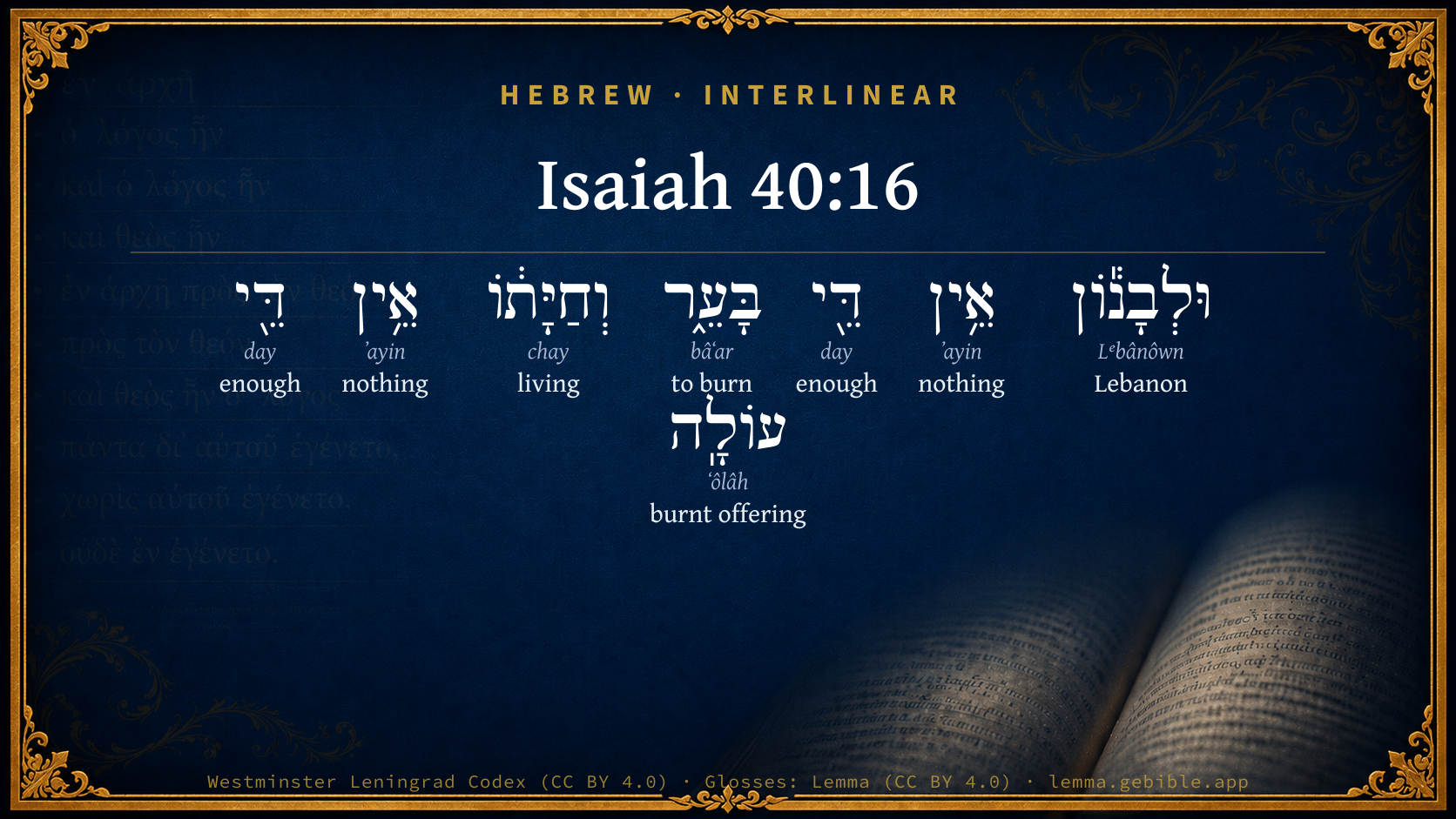
Hebrew (Westminster Leningrad Codex) Isaiah 40:16 appears in the Hebrew Old Testament. The text above is from the Westminster Leningrad Codex. Each word links to its Strong’s number, a concise gloss, and parsing drawn from the Open Scriptures Hebrew Bible morphology. Click any word for its full Brown-Driver-Briggs (BDB) entry.
Download image
Cite this verse

Isaiah 40:16 (World English Bible). Public Domain. Lemma interlinear Bible study tool, https://lemma.gebible.app/v/isaiah/40/16.

Show BibTeX & RIS
BibTeX
RIS
English Translation
Lebanon is not sufficient to burn, nor the animals of it sufficient for a burnt offering.
World English Bible · Public Domain
Download a study sheet

One document with this verse’s original text, its word-by-word gloss line, the meaning frame, cross-references with their text, attributed commentary, and full source and license credits — printable, and it pastes into notes with its structure intact.

This verse Autodidact and up

Study sheet (.html) Plain text (.txt)

A passage Seminary Student

Up to 50 verses in one chapter. A passage sheet keeps up to 6 commentary sources and 12 cross-references per verse, in the order this page ranks them, and says so on the sheet whenever that leaves anything out. Ask for a single verse and you get the Autodidact verse sheet above.

Everything on this page stays free to read, with no account — the sheet is a download of what is already on screen, not access to it.

Want to remove ads? Support Godless Engineer
Compare translations 3

The same verse in 3 English versions, stacked beneath the original-language interlinear above. Click any original word for its lexicon entry.

Each is an independent rendering of the whole verse — the interlinear is not word-aligned to these translations.

Highlighted words mark where these versions differ — a whole-verse word diff, not a word-by-word alignment.

  • World English Bible Public Domain
    Lebanon is not sufficient to burn, nor the animals of it sufficient for a burnt offering.
  • King James Version Public Domain
    And Lebanon is not sufficient to burn, nor the beasts thereof sufficient for a burnt offering.
  • unfoldingWord Literal Text CC BY-SA 4.0
    And Lebanon not enough to burn, and its beasts not enough a burnt offering.

unfoldingWord Literal Text — © unfoldingWord, licensed CC BY-SA 4.0. Word-aligned USFM3 via Door43 (git.door43.org/unfoldingWord/en_ult).

Versions to compare (up to 4)

3 of 4 selected

Show all 18 translations

Every available English version of this verse, each an independent rendering of the whole verse.

  • World English Bible Public Domain
    Lebanon is not sufficient to burn, nor the animals of it sufficient for a burnt offering.
  • Berean Standard Bible Public Domain
    Lebanon is not sufficient for fuel, nor its animals enough for a burnt offering.
  • Majority Standard Bible Public Domain
    Lebanon is not sufficient for fuel, nor its animals enough for a burnt offering.
  • King James Version Public Domain
    And Lebanon is not sufficient to burn, nor the beasts thereof sufficient for a burnt offering.
  • American Standard Version (1901) Public Domain
    And Lebanon is not sufficient to burn, nor the beasts thereof sufficient for a burnt-offering.
  • Revised Version (1885) Public Domain
    And Lebanon is not sufficient to burn, nor the beasts thereof sufficient for a burnt offering.
  • Geneva Bible (1599) Public Domain
    And Lebanon is not sufficient for fire, nor the beastes thereof sufficient for a burnt offering.
  • Douay-Rheims (1899) Public Domain
    And Libanus shall not be enough to burn, nor the beasts thereof sufficient for a burnt offering.
  • Young's Literal Translation Public Domain
    And Lebanon is not sufficient to burn, Nor its beasts sufficient for a burnt-offering.
  • Literal Standard Version CC BY-SA 4.0
    And Lebanon is not sufficient to burn, || Nor its beasts sufficient for a burnt-offering.
  • Unlocked Literal Bible CC BY-SA 4.0
    Lebanon is not sufficient fuel, nor its wild animals sufficient for a burnt offering.
  • unfoldingWord Literal Text CC BY-SA 4.0
    And Lebanon not enough to burn, and its beasts not enough a burnt offering.
  • Darby Bible Public Domain
    And Lebanon is not sufficient to burn, nor the beasts thereof sufficient for a burnt-offering.
  • World Messianic Bible Public Domain
    Lebanon is not sufficient to burn, nor its animals sufficient for a burnt offering.
  • Webster's Bible Public Domain
    And Lebanon is not sufficient to burn, nor the beasts of it sufficient for a burnt-offering.
  • Free Bible Version CC BY-SA 4.0
    All the wood in Lebanon for a fire and all its animals as a sacrifice wouldn't be enough to provide a burnt offering.
  • Bible in Basic English Public Domain
    And Lebanon is not enough to make a fire with, or all its cattle enough for a burned offering.
  • JPS Tanakh (1917) Public Domain
    And Lebanon is not sufficient fuel, nor the beasts thereof sufficient for burnt-offerings.

Literal Standard Version (2020), Covenant Press — licensed CC BY-SA 4.0. Text via the HelloAO Bible API (eBible.org). Unlocked Literal Bible (unfoldingWord) — licensed CC BY-SA 4.0. Text via the HelloAO Bible API (eBible.org). unfoldingWord Literal Text — © unfoldingWord, licensed CC BY-SA 4.0. Word-aligned USFM3 via Door43 (git.door43.org/unfoldingWord/en_ult). Free Bible Version, Dr. Jonathan Gallagher — licensed CC BY-SA 4.0. Text via the HelloAO Bible API (eBible.org).

Word by word

More ways to search: Search by grammar → Find every occurrence → Compare this word →

Practice this passage: Drill this verse → Learn its vocabulary →

About this verse

These counts appear in no published source. They are computed here, from the morphology-tagged text and Lemma’s own curated glosses. What Lemma adds →

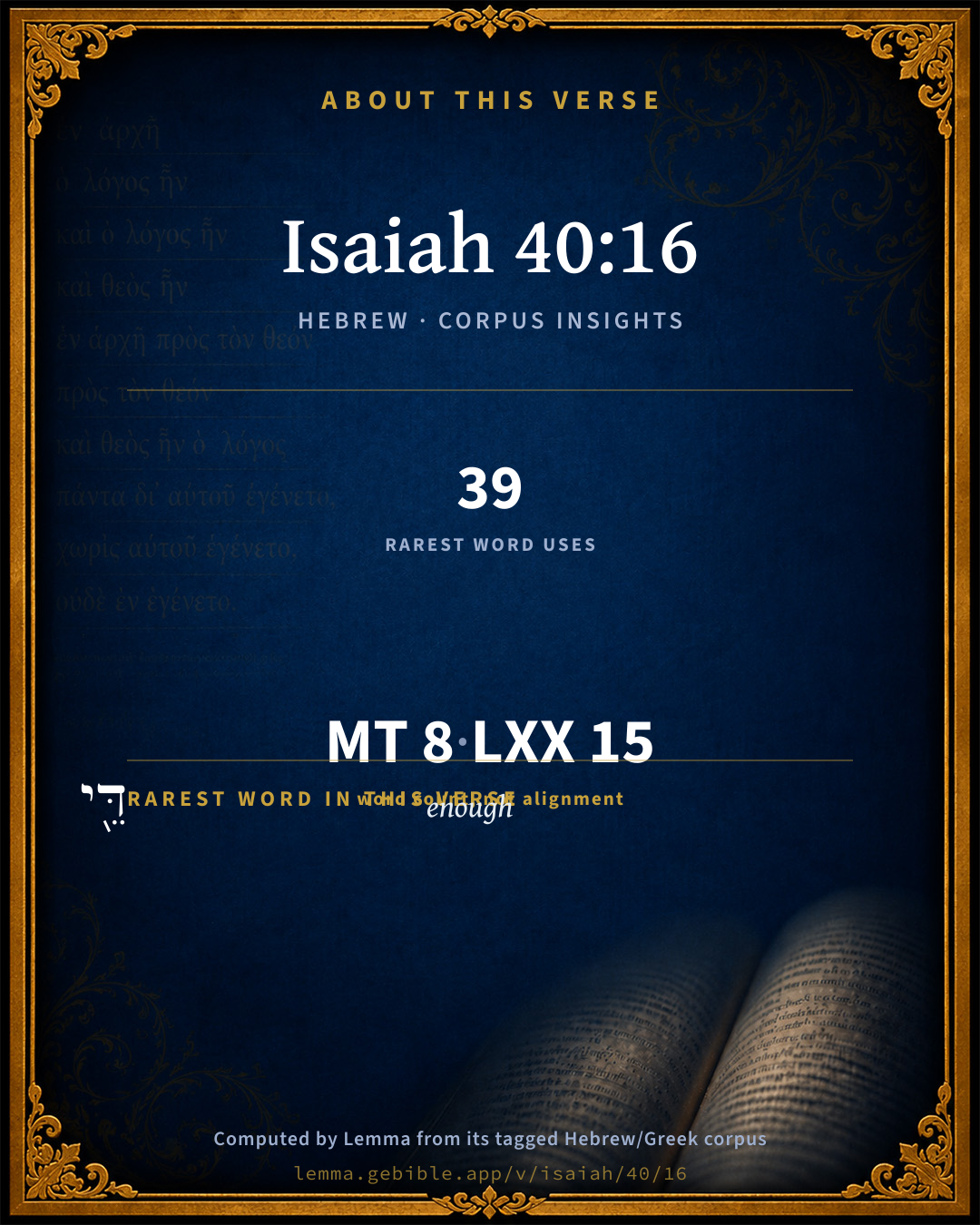
8
words
6
distinct lemmas
Prophets
section

Shared distinctive vocabulary

דֵּ֖י enough H1767 occurs in 35 verses of the Hebrew Bible. Also found in:

Grammatical profile

  • 1 verb
  • 5 nouns
  • 2 particles

Verb forms

  • בָּעֵ֑ר Piel · Infinitive Construct

Repetition

Words recur within this verse — often emphatic in Hebrew:

  • אֵ֥ין nothing H369 ×2
  • דֵּ֖י enough H1767 ×2

Hebrew & Septuagint length

In English translation the verse runs 16 words from the Hebrew and 16 from the Septuagint (LXX English) — the same length.

A rough comparison of the two English renderings, which tokenize alike — not a word-level alignment.

Word counts can differ between the Hebrew and the Greek without any difference in meaning — e.g. the Hebrew direct-object marker אֵת has no separate Greek word, and Greek often adds the article ὁ.

In the original languages it is 8 Hebrew tokens and 15 Greek tokens — but the two are counted differently (Hebrew bundles its prefixes and suffixes into one token; the Greek is in lemma form), so that isn’t a like-for-like length.

Cross-references

4

Topical passages linked to Isaiah 40:16 in the Treasury of Scripture Knowledge — connected by theme and wording, ordered by reader-vote popularity; previews shown in the World English Bible.

  • Micah 6:6–7 How shall I come before Yahweh, And bow myself before the exalted God? Shall I come before him with burnt offerings, With calves a year old?
  • Psalms 40:6 Sacrifice and offering you didn't desire. You have opened my ears: Burnt offering and sin offering you have not required.
  • Psalms 50:9–12 I have no need for a bull from your stall, Nor male goats from your pens.
  • Hebrews 10:5–10 Therefore when he comes into the world, he says, "Sacrifice and offering you didn't desire, But a body did you prepare for me;

Cross-references courtesy of OpenBible.info (CC BY 4.0).

Hebrew and Greek witnesses Masoretic Hebrew ↔ Greek Septuagint

The same verse in the two great witnesses to the Old Testament, shown verse-for-verse.

These are two independent witnesses, not word-aligned to each other, and the Septuagint is shown in lemma (dictionary) form.

Hebrew Isaiah 40:16 Masoretic · Westminster Leningrad Codex

וּלְבָנ֕וֹן אֵ֥ין דֵּ֖י בָּעֵ֑ר וְחַיָּת֔וֹ אֵ֥ין דֵּ֖י עוֹלָֽה

Lebanon is not sufficient to burn, nor the animals of it sufficient for a burnt offering.

World English Bible · Public Domain

Greek LXX Isaiah 40:16 Septuagint · lemma form

ὁ δέ λίβανος οὐ ἱκανός εἰς καῦσις καί πᾶς ὁ τετράποδος οὐ ἱκανός εἰς ὁλοκάρπωσις

And Libanus is not enough to burn, nor all beasts enough for a whole burnt offering:

LXX2012 (modern English Septuagint) · Public Domain

Hebrew: Westminster Leningrad Codex (CC BY 4.0). Greek: Septuagint (public domain); English from LXX2012 (modern English Septuagint) (Public Domain). How the Septuagint differs from the Hebrew →

Targum (Aramaic paraphrase)

1

The Targum is the ancient Jewish Aramaic paraphrase of the Hebrew Scriptures — an interpretive translation, not the Hebrew text itself. Onkelos (literal) and Pseudo-Jonathan (expansive) render the Torah, and Jonathan the Prophets. Coverage is partial: where no permissively-licensed English translation exists for a verse, only the Aramaic is shown. This is verse-level text, not a word-by-word alignment to the Hebrew.

  1. Targum Jonathan Prophets (Joshua–Malachi)
    וְאִילָנֵי לִבְנָן לָא יְסַפְקוּן לְאַדְלָקָא וְחֵיוָתָא דְבָהּ לֵית הִיא כְּמִיסַת לַעֲלָתָא:

    And the trees of Lebanon are not sufficient for fire, nor the beasts in it sufficient for a holocaust.

    Targum Jonathan — Aramaic: “Mikraot Gedolot” (public domain). English: “Sefaria Community Translation” (CC0 1.0 (public-domain dedication)); “London "Chaldee Paraphrase," 1871” (public domain). Text via Sefaria.

Commentary

Notes on Isaiah 40:16 from classic Christian and Jewish commentators (each source and its license shown beneath its notes). The classic Christian expositions comment on the surrounding passage and are grouped to its opening verse, so a note may address several verses; the Jewish commentaries on the Tanakh (Rashi and others) are per-verse, so they appear only where the commentator wrote on this verse.

Lemma curates 59 commentaries, every one of them public domain or Creative Commons licensed, each selected and text-cleaned for this edition rather than reprinted as found. About our sources →

Trapp's Complete Commentary

John Trapp

Isa 40:16 And Lebanon [is] not sufficient to burn, nor the beasts thereof sufficient for a burnt offering.

Ver. 16. And Lebanon is not sufficient to burn.] So infinitely great is God; so absolutely insufficient is man to give God satisfaction. Let those think on this who talk of setting off with God, and of making amends, by their good deeds, for their bad.

John Trapp, A Commentary or Exposition upon All the Books of the Old and New Testament (1647–1656) — public domain. Text from a community e-Sword module.

The Biblical Illustrator

Joseph S. Exell

Isa_40:16

And Lebanon is not sufficient to burn

Gods independence

He is not only independent of the power, but also of the goodwill of His creatures.

This general allusion to oblation as an act of homage or of friendship suits the connection better than a specific reference to expiation. The insufficiency of these offerings is set forth, not in a formal proposition, but by means of a striking individualisation. If Lebanon could not suffice, what could? (J. A. Alexander.)

The Biblical Illustrator, edited by Joseph S. Exell (c. 1880s–1900s) — public domain. Text from a community e-Sword module.

Tyndale Open Study Notes

Tyndale Open Resources

40:16 Lebanon was prized for its abundance of wood and its wildlife (see 2:13-16; Ps 104:16-17).

Tyndale Open Study Notes — © Tyndale Open Resources, licensed CC BY-SA 4.0. Text via the HelloAO Bible API.

Jamieson, Fausset & Brown

Robert Jamieson, A. R. Fausset & David Brown

All Lebanon's forest would not supply fuel enough to burn sacrifices worthy of the glory of God (Isa 66:1; Kg1 8:27; Psa 50:8-13).

beasts--which abounded in Lebanon.

Jamieson, Fausset & Brown — Commentary Critical and Explanatory on the Whole Bible (1871) — public domain (CC PDM 1.0). Text via the HelloAO Bible API.

Adam Clarke's Commentary

Verse 16. And Lebanon is not sufficient] The image is beautiful and uncommon. It has been imitated by an apocryphal writer, who however comes far short of the original: -

"For all sacrifice is too little for a sweet savour unto thee:

And all the fat is not sufficient for thy burnt-offering."

Judith 16:16.

Does not the prophet mean here that all the burnt-offerings and sacrifices that could be offered were insufficient to atone for sin? That the nations were as nothing before him, not merely because of his immensity, but because of their insufficiency to make any atonement by their oblations for the iniquities which they had committed? Therefore the Redeemer was to come to Zion, &c.

Adam Clarke's Commentary on the Bible (1810–1826) — public domain. Text from a community e-Sword/MySword module.

Ellicott's Commentary for English Readers

(16) Lebanon is not sufficient.—The thought is the same as that of Psa_50:10-12. Lebanon is chosen as the type of the forests that supply the wood for burnt-offerings, in which Judah was comparatively poor. In Nehemiah’s organisation of the Temple ritual the task of supplying wood for this purpose was assigned by lot to priests or Levites (Neh_10:34).

A Bible Commentary for English Readers, edited by Charles John Ellicott (1878–1897) — public domain. Text from a community e-Sword module.

The Cambridge Bible for Schools and Colleges

gen. ed. J. J. S. Perowne

16. So infinitely great is Jehovah that the forests of Lebanon would not yield fuel enough, nor its wild animals victims enough, for a holocaust worthy of Him.

The Cambridge Bible for Schools and Colleges (gen. ed. J. J. S. Perowne; Cambridge University Press, 1878–1918) — public domain. Text from a community e-Sword module.

John Gill's Exposition

And Lebanon is not sufficient to burn,.... The trees of it, as the Targum; these are not sufficient to burn a sacrifice with, suitable to the dignity and majesty of God, and as his justice can require for offences committed:

nor the beasts thereof sufficient for a burnt offering, though it was a mountain and forest which abounded with trees, and especially cedars, and there was a great quantity of cattle in it, yet neither were sufficient to furnish out a proper burnt offering to the Lord; he only himself could provide a Lamb sufficient for a burnt offering, and he has done it, the only begotten Son of God; he has offered himself an offering and a sacrifice to God, of a sweet smelling savour, by which he has put away sin, and made full atonement for it, Jarchi thinks this is said to aggravate the sins of men, of the wicked, which were so great, that Lebanon with all its wood and cattle could not furnish out a sacrifice sufficient to expiate them.

John Gill's Exposition of the Whole Bible (1746–1763) — public domain (CC PDM 1.0). Text via the HelloAO Bible API.

Albert Barnes' Notes on the Bible

And Lebanon - The expression here refers to the trees or the cedars of Lebanon. Thus it is rendered by the Chaldee: ‘And the trees of Lebanon.’ For a description of Lebanon, see the note at Isa 10:34. It is probable that the word Lebanon here is not used in the limited sense in which it is sometimes employed, to denote a single mountain, or a single range of mountains, but includes the entire ranges lying north of Palestine, and which were comprehended under the general name of Libanus. The idea here is, that all these ranges of mountains, abounding in magnificent trees and forests, would not furnish fuel sufficient to burn the sacrifices which would be an appropriate offering to the majesty and glory of God.

To burn - To burn for the purpose of consuming the sacrifice.

Nor the beasts thereof for a burnt-offering - As the mountains of Lebanon were extensive forests, they would abound with wild animals. The idea is, that all those animals, if offered in sacrifice, would not be an appropriate expression of what was due to God. It may be remarked here, if all the vast forests of Lebanon on fire, and all its animals consumed as an offering to God, were not sufficient to show forth his glory, how little can our praises express the proper sense of his majesty and honor! How profound should be our reverence for God! With what awful veneration should we come before him! The image employed here by Isaiah is one of great poetic beauty; and nothing, perhaps, could give a deeper impression of the majesty and honor of the great Yahweh.

Albert Barnes' Notes on the Bible (1834–1885) — public domain. Text from a community e-Sword/MySword module.

Matthew Poole's English Annotations

And although he is pleased to accept of poor and small sacrifices from his people, yet if men were to offer a sacrifice agreeable to his infinite excellency, the whole forest of Lebanon could not afford either a sufficient number of beasts to be sacrificed, or a sufficient quantity of wood to consume the sacrifice.

Matthew Poole's English Annotations on the Holy Bible (1683–1685) — public domain. Text from a community e-Sword/MySword module.

Whedon's Commentary on the Bible

Daniel D. Whedon

16. Lebanon is not sufficient — To express adequate adoration of such a Being, all the “cedars of Lebanon” — the most massive timber to be found in that land — are not “sufficient” for the sacrifices that should be offered. Nor are there animals enough for such sacrifices.

Daniel D. Whedon (gen. ed.), Commentary on the Old and New Testaments (1874–1909) — public domain. Text from a community e-Sword module.

The Pulpit Commentary

Lebanon is not sufficient to burn. Man may think that he must be of some account, since God has required of him sacrifice and burnt offering, from which he may suppose God to derive some satisfaction. But, the prophet says, even if man were to burn all Lebanon as firewood on God"s altar, and offer there all the (clean) beasts of the entire tract, still God would be put under no obligation. Man would even then have paid less than his debt.

Vers. 16-26. The hopelessness and the simplicity of Divine service.

"Lebanon is not sufficient to burn," etc.; "Not one faileth." If we were asked whether it was a very difficult or a very simple thing to serve the Lord, we should say, "It is both the one and the other; everything depends upon the way and the spirit in which we proceed." We learn

I THAT MERE QUANTITY OF SERVICE IS VAIN AND FUTILE. "Lebanon is not sufficient to burn, nor will all the beasts thereof suffice for a burnt offering," if the acceptable element in worship be absent. Great hecatombs are heathenish things; they are based on the essentially false idea that God can be enriched by human gifts though he needed anything," as though, "if he were hungry, he would tell us." And all ideas as to quantity in service are erroneous. It is not by "thousands of rams or tens of thousands of rivers of oil," that he is to be placated. It is a hopeless and impossible task which so many set themselves to accomplish to please and serve the living God by a multitude of services, of celebrations, of privations, of prayers ("much speaking"), of acts of outward benevolence. As all Lebanon with all its beasts would not be sufficient for one acceptable sacrifice, taken of itself and of themselves, so millions of Masses and multitudes of charities, and innumerable acts of service, whether good or bad in themselves, would take a man no nearer to the favour of God and the kingdom of heaven, if there were not present something apart from these things and of more intrinsic excellence than they. Without this last, service is either formal, or superstitious, or selfish; in any case it is worthless.

II THAT THE SMALLEST SERVICE RIGHTLY RENDERED IS EFFECTUAL WITH GOD. Not one of the vast army of the heavenly hosts fails to take its place and exert its influence and do its appointed work in the vast plans of the Creator. Every smallest star gives its light, and helps to keep everything in the sidereal universe in equipoise and in orderly movement. Not one faileth. So may this be true in the great army of Divine worshippers and of Christian workers. With a reverent and a loving spirit, the service of God is the simplest thing in the world.

1. The ejaculation of a moment is an effectual prayer.

2. The gift of two mites is a liberal offering.

3. The cup of cold water will by no means lose its reward.

4. The simple sentence of encouragement to the tired traveller along the road of life, or of comfort to the wounded soldier in the battle of life, or of good cheer to the baffled workman in the Master"s vineyard, is eloquent in the ear of the Lord of love.

5. The household duty conscientiously and devoutly discharged will be owned and blessed by him who observes and rewards the "bond and free.

6. The simplest act of magnanimity, rendered in the interchange of our homeliest relations, by which a brother, or sister, or neighbour is frankly forgiven the hard word, or the inconsiderate silence, or the unloving deed, weighs in the scales of him who was the first to say, "Love your enemies." Every soldier among the rank-and-file can serve the Divine Captain. With love in the heart there is no need of Lebanon and its beasts for an altar or a sacrifice. Not one need fail to do, day by day, hour after hour, act after act, that which is well pleasing in the eyes of him "with whom we have to do," whose good. pleasure with us is the gladness of our heart and the music of our life. C.

The Pulpit Commentary (1880–1919), ed. H.D.M. Spence-Jones & Joseph S. Exell — public domain. Text from a community e-Sword module.

John Wesley's Explanatory Notes

Lebanon - If men were to offer a sacrifice agreeable to his infinite excellency, the whole forest of Lebanon could not afford either a sufficient number of beasts to be sacrificed: or, a sufficient quantity of wood to consume the sacrifice.

John Wesley, Explanatory Notes Upon the Whole Bible (1754–1765) — public domain. Text via the GEBible commentary corpus.

Keil & Delitzsch

C. F. Keil & F. Delitzsch

By the side of this vanishing diminutiveness on the part of man as contrasted with Jehovah, everything by which man could express his adoration of the exalted One comes incomparably short of His exaltation. "And Lebanon is not a sufficiency of burning, nor its game a sufficiency of burnt-offerings;" i.e., there is not enough wood to sustain the fire, nor a sufficient supply of sacrificial animals to be slaughtered, and to ascend in fire. דּי (constr. דּי) signifies that which suffices (and then that which is plentiful); it differs therefore from τὸ δέον, what is requisite.

(Note: The derivation of דּי is still more obscure than that of δεῖ, which signifies, according to Benfey (Wurzelwrterbuch, ii. 205), "there needs;" according to Sonne, "it binds, scil. ἡ ἀνάγκη.")

Keil & Delitzsch — Biblical Commentary on the Old Testament (1861–1891) — public domain (CC PDM 1.0). Text via the HelloAO Bible API. (Old Testament only.)

J. A. Alexander on Isaiah

Joseph Addison Alexander

“And Lebanon is not enough for burning, and its beasts are not enough for a sacrifice.” The supremacy and majesty of God are now presented in a more religious aspect; by expressions borrowed from the Mosaic ritual. He is not only independent of the power but also of the good-will of His creatures. This general allusion to oblation, as an act of homage or of friendship, suits the connection better than a specific reference to expiation. The insufficiency of these sufferings is set forth, not in a formal proposition, but by means of a striking individualization. For general terms he substitutes one striking instance, and asserts of that what might be asserted of the rest. If Lebanon could not suffice, what could? (Compare with this verse Isa 66:1; 1Ki 8:27; 2Ch 6:18; Psa 50:8-13).

Joseph Addison Alexander, The Prophecies of Isaiah (1846–1847; New York: Scribner, 1870–1878) — public domain. Text from a community e-Sword module.

Rashi

Rabbi Shlomo Yitzchaki (Rashi)

there is not enough to burn on His altar.

and its beasts (the beasts] of the Lebanonthere is not enough for burnt offerings. Another explanation is: And the Lebanon etc. to expiate the iniquity of the heathens.

Rashi on the Tanakh — English translations: “The Judaica Press complete Tanach with Rashi, translated by A. J. Rosenberg” (CC BY 4.0); “Pentateuch with Rashi's commentary by M. Rosenbaum and A.M. Silbermann, 1929-1934” (public domain); “The Metsudah Tanach series, Lakewood, N.J” (CC BY 4.0); and “The Book of Joshua, Metsudah Publications, 1997” (CC BY 4.0). Text via Sefaria.

Ibn Ezra

Rabbi Abraham ibn Ezra

And Lebanon is not sufficient, etc. God does not want burnt offerings; Lebanon would not suffice for fuel, if He wanted offerings. Lebanon is mentioned by the prophet simply as an example which his hearers can understand; in reality, however, he refers to all the woods of the earth. The same remark applies to the words and the beasts thereof.

Ibn Ezra on the Tanakh — English translations: “Sefaria Community Translation” (CC0 1.0 (public-domain dedication)); “Yalkut, Sifsei Chachomim Chumash, Metsudah Publications, 2009” (CC BY 4.0); and “Commentary of Ibn Ezra on Isaiah - trans. by M. Friedlander, 1873” (public domain). Text via Sefaria.

Lesson kit

Teaching starters — assembled from the data on this page, not authored interpretation. Every prompt links to the verse data it draws on. Edit before teaching.

Isaiah, in the Prophets, opens this verse with 8 words (6 distinct Hebrew lemmas). Its most distinctive word is day (“enough”). A historical commentator’s framing appears above. Read the whole chapter for the surrounding context.

Discussion questions

  1. What does “enough” (day) contribute to the verse as a whole?
  2. Exodus 36:5 shares the word «enough» with this verse. How do the two illuminate each other?
  3. “nothing” occurs 2× in this one verse. What is the effect of the repetition?
  4. These translations render this verse differently; the difference is in the English rendering, not the original. What questions does that raise?
  5. The verb «בָּעֵ֑ר» is Piel Infinitive Construct. How does its form color the action?
  6. Reading how Trapp's Complete Commentary and The Biblical Illustrator read this verse, where do the two commentators agree and where do they part?

Things to notice

Reading settings

Reading text

Shown beneath each verse's original-language words.

Old Testament
Old Testament edition

Read the OT as the Masoretic Hebrew (MT) or the Greek Septuagint (LXX).

English shown for the Greek Septuagint (in the Hebrew ↔ Greek comparison).

Comparing translations? Open the Compare panel on any verse page to stack up to four side by side.