
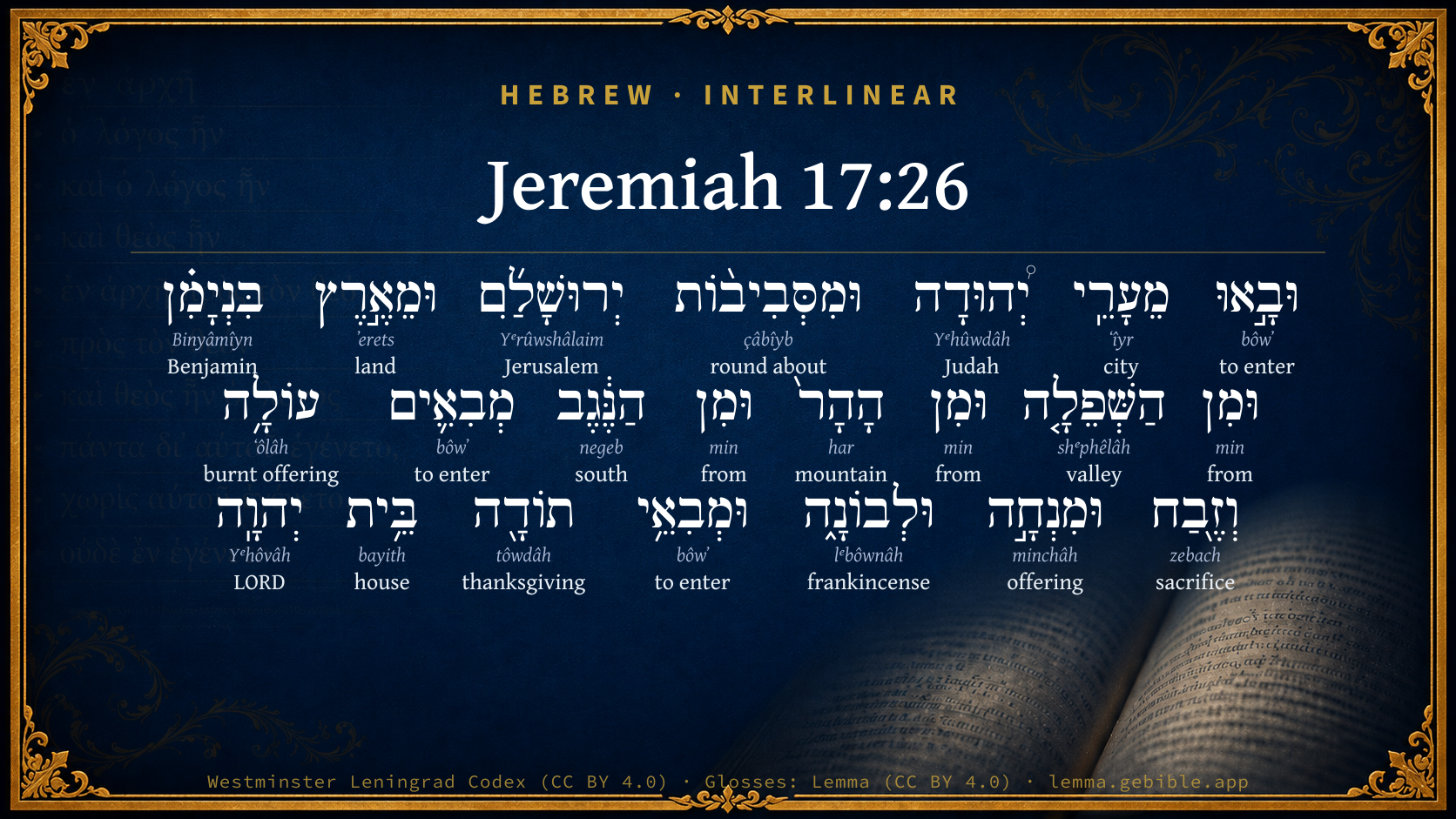
Jeremiah 17:26

Hebrew (Westminster Leningrad Codex) Jeremiah 17:26 appears in the Hebrew Old Testament. The text above is from the Westminster Leningrad Codex. Each word links to its Strong’s number, a concise gloss, and parsing drawn from the Open Scriptures Hebrew Bible morphology. Click any word for its full Brown-Driver-Briggs (BDB) entry.
Download image
Cite this verse

Jeremiah 17:26 (World English Bible). Public Domain. Lemma interlinear Bible study tool, https://lemma.gebible.app/v/jeremiah/17/26.

Show BibTeX & RIS
BibTeX
RIS
English Translation
They shall come from the cities of Judah, and from the places round about Jerusalem, and from the land of Benjamin, and from the lowland, and from the hill-country, and from the South, bringing burnt offerings, and sacrifices, and meal-offerings, and frankincense, and bringing [sacrifices of] thanksgiving, to the house of Yahweh.
World English Bible · Public Domain
Download a study sheet

One document with this verse’s original text, its word-by-word gloss line, the meaning frame, cross-references with their text, attributed commentary, and full source and license credits — printable, and it pastes into notes with its structure intact.

This verse Autodidact and up

Study sheet (.html) Plain text (.txt)

A passage Seminary Student

Up to 50 verses in one chapter. A passage sheet keeps up to 6 commentary sources and 12 cross-references per verse, in the order this page ranks them, and says so on the sheet whenever that leaves anything out. Ask for a single verse and you get the Autodidact verse sheet above.

Everything on this page stays free to read, with no account — the sheet is a download of what is already on screen, not access to it.

Want to remove ads? Support Godless Engineer
Compare translations 3

The same verse in 3 English versions, stacked beneath the original-language interlinear above. Click any original word for its lexicon entry.

Each is an independent rendering of the whole verse — the interlinear is not word-aligned to these translations.

Highlighted words mark where these versions differ — a whole-verse word diff, not a word-by-word alignment.

  • World English Bible Public Domain
    They shall come from the cities of Judah, and from the places round about Jerusalem, and from the land of Benjamin, and from the lowland, and from the hill-country, and from the South, bringing burnt offerings, and sacrifices, and meal-offerings, and frankincense, and bringing [sacrifices of] thanksgiving, to the house of Yahweh.
  • King James Version Public Domain
    And they shall come from the cities of Judah, and from the places about Jerusalem, and from the land of Benjamin, and from the plain, and from the mountains, and from the south, bringing burnt offerings, and sacrifices, and meat offerings, and incense, and bringing sacrifices of praise, unto the house of the LORD.
  • unfoldingWord Literal Text CC BY-SA 4.0
    And they shall come from the cities of Judah and from all around Jerusalem, and from the land of Benjamin, and from the Shephelah, and from the hill country, and from the Negev, bringing burnt offerings and sacrifices and grain offerings and frankincense and bringing thank offerings to the house of Yahweh.

unfoldingWord Literal Text — © unfoldingWord, licensed CC BY-SA 4.0. Word-aligned USFM3 via Door43 (git.door43.org/unfoldingWord/en_ult).

Versions to compare (up to 4)

3 of 4 selected

Show all 18 translations

Every available English version of this verse, each an independent rendering of the whole verse.

  • World English Bible Public Domain
    They shall come from the cities of Judah, and from the places round about Jerusalem, and from the land of Benjamin, and from the lowland, and from the hill-country, and from the South, bringing burnt offerings, and sacrifices, and meal-offerings, and frankincense, and bringing [sacrifices of] thanksgiving, to the house of Yahweh.
  • Berean Standard Bible Public Domain
    And people will come from the cities of Judah and the places around Jerusalem, from the land of Benjamin, and from the foothills, the hill country, and the Negev, bringing burnt offerings and sacrifices, grain offerings and frankincense, and thank offerings to the house of the LORD.
  • Majority Standard Bible Public Domain
    And people will come from the cities of Judah and the places around Jerusalem, from the land of Benjamin, and from the foothills, the hill country, and the Negev, bringing burnt offerings and sacrifices, grain offerings and frankincense, and thank offerings to the house of the LORD.
  • King James Version Public Domain
    And they shall come from the cities of Judah, and from the places about Jerusalem, and from the land of Benjamin, and from the plain, and from the mountains, and from the south, bringing burnt offerings, and sacrifices, and meat offerings, and incense, and bringing sacrifices of praise, unto the house of the LORD.
  • American Standard Version (1901) Public Domain
    And they shall come from the cities of Judah, and from the places round about Jerusalem, and from the land of Benjamin, and from the lowland, and from the hill-country, and from the South, bringing burnt-offerings, and sacrifices, and meal-offerings, and frankincense, and bringing `sacrifices of' thanksgiving, unto the house of Jehovah.
  • Revised Version (1885) Public Domain
    And they shall come from the cities of Judah, and from the places round about Jerusalem, and from the land of Benjamin, and from the lowland, and from the mountains, and from the South, bringing burnt offerings, and sacrifices, and oblations, and frankincense, and bringing sacrifices of thanksgiving, unto the house of the LORD.
  • Geneva Bible (1599) Public Domain
    And they shall come from the cities of Iudah, and from about Ierusalem, and from the land of Beniamin, and from the plaine, and from the mountaines, and from the South, which shall bring burnt offrings, and sacrifices, and meate offrings, and incense, and shall bring sacrifice of prayse into the house of the Lord.
  • Douay-Rheims (1899) Public Domain
    And they shall come from the cities of Juda, and from the places round about Jerusalem, and from the land of Benjamin, and from the plains, and from the mountains, and from the south, bringing holocausts, and victims, and sacrifices, and frankincense, and they shall bring in an offering into the house of the Lord.
  • Young's Literal Translation Public Domain
    And they have come in from cities of Judah, And from suburbs of Jerusalem, And from the land of Benjamin, And from the low country, And from the hill-country, and from the south, Bringing in burnt-offering, and sacrifice, And present, and frankincense, And bringing praise `to' the house of Jehovah.
  • Literal Standard Version CC BY-SA 4.0
    And they have come in from cities of Judah, || And from outskirts of Jerusalem, || And from the land of Benjamin, || And from the low country, || And from the hill-country, || And from the south, || Bringing in burnt-offering, and sacrifice, || And present, and frankincense, || And bringing praise [to] the house of YHWH.
  • Unlocked Literal Bible CC BY-SA 4.0
    They will come from the cities of Judah and from all around Jerusalem, from the land of Benjamin and the lowlands, from the mountains, and from the Negev, bringing burnt offerings and sacrifices, grain offerings and frankincense, thank offerings to the house of Yahweh.
  • unfoldingWord Literal Text CC BY-SA 4.0
    And they shall come from the cities of Judah and from all around Jerusalem, and from the land of Benjamin, and from the Shephelah, and from the hill country, and from the Negev, bringing burnt offerings and sacrifices and grain offerings and frankincense and bringing thank offerings to the house of Yahweh.
  • Darby Bible Public Domain
    And they shall come from the cities of Judah, and from the places around Jerusalem, and from the land of Benjamin, and from the lowland, and from the hill-country, and from the south, bringing burnt-offerings, and sacrifices, and oblations, and incense, and bringing thanksgiving unto the house of Jehovah.
  • World Messianic Bible Public Domain
    They will come from the cities of Judah, and from the places around Jerusalem, from the land of Benjamin, from the lowland, from the hill country, and from the South, bringing burnt offerings, sacrifices, meal offerings, and frankincense, and bringing sacrifices of thanksgiving to the LORD’s house.
  • Webster's Bible Public Domain
    And they shall come from the cities of Judah, and from the places about Jerusalem, and from the land of Benjamin, and from the plain, and from the mountains, and from the south, bringing burnt-offerings, and sacrifices, and meat-offerings, and incense, and bringing sacrifices of praise, to the house of the LORD.
  • Free Bible Version CC BY-SA 4.0
    People will come from the towns of Judah and everywhere around Jerusalem, from the land of Benjamin, and from the lowlands the hill country, and the Negev. They will bring burnt offerings and sacrifices, grain offerings and frankincense, and thank offerings to the Lord's Temple.
  • Bible in Basic English Public Domain
    And they will come from the towns of Judah, and from the places round about Jerusalem, and from the land of Benjamin, and from the lowlands, and from the mountains, and from the South, with burned offerings and offerings of beasts and meal offerings and perfume and offerings of praise, to the house of the Lord.
  • JPS Tanakh (1917) Public Domain
    And they shall come from the cities of Judah, and from the places round about Jerusalem, and from the land of Benjamin, and from the Lowland, and from the mountains, and from the South, bringing burnt-offerings, and sacrifices, and meal-offerings, and frankincense, and bringing sacrifices of thanksgiving, unto the house of the LORD.

Literal Standard Version (2020), Covenant Press — licensed CC BY-SA 4.0. Text via the HelloAO Bible API (eBible.org). Unlocked Literal Bible (unfoldingWord) — licensed CC BY-SA 4.0. Text via the HelloAO Bible API (eBible.org). unfoldingWord Literal Text — © unfoldingWord, licensed CC BY-SA 4.0. Word-aligned USFM3 via Door43 (git.door43.org/unfoldingWord/en_ult). Free Bible Version, Dr. Jonathan Gallagher — licensed CC BY-SA 4.0. Text via the HelloAO Bible API (eBible.org).

Word by word

More ways to search: Search by grammar → Find every occurrence → Compare this word →

Practice this passage: Drill this verse → Learn its vocabulary →

הַשְּׁפֵלָ֤ה
shᵉphêlâh
H8219
“the · valley”
Particle, Definite Article + Noun, Common, Feminine, Singular, Absolute
Part of Speech
Particle + Noun
Type
Common
Gender
Feminine
Number
Singular
State
Absolute
Full BDB Definition

Origin: from H8213

TWOT: 2445d

lowland, valley - lowland - strip west of Judean mountains (technical term) - the Shephelah - strip near coast north of Carmel
  1. וּבָ֣אוּ bôwʼ H935 “and · to enter” Conjunction + Verb, Qal, Perfect, 3rd Person, Common, Plural
  2. מֵעָרֵֽי ʻîyr H5892 “from · cities of” Preposition + Noun, Common, Feminine, Plural, Construct
  3. יְ֠הוּדָה Yᵉhûwdâh H3063 “Judah” Noun, Proper
  4. וּמִסְּבִיב֨וֹת çâbîyb H5439 “and · from · surroundings of” Conjunction + Preposition + Noun, Common, Both, Plural, Construct
  5. יְרוּשָׁלִַ֜ם Yᵉrûwshâlaim H3389 “Jerusalem” Noun, Proper
  6. וּמֵאֶ֣רֶץ ʼerets H776 “and · from · land of” Conjunction + Preposition + Noun, Common, Both, Singular, Construct
  7. בִּנְיָמִ֗ן Binyâmîyn H1144 “Benjamin” Noun, Proper
  8. וּמִן min H4480 “and · from” Conjunction + Preposition
  9. וּמִן min H4480 “and · from” Conjunction + Preposition
  10. הָהָר֙ har H2022 “the · mountain” Particle, Definite Article + Noun, Common, Masculine, Singular, Absolute
  11. וּמִן min H4480 “and · from” Conjunction + Preposition
  12. הַנֶּ֔גֶב negeb H5045 “the · south” Particle, Definite Article + Noun, Common, Masculine, Singular, Absolute
  13. מְבִאִ֛ים bôwʼ H935 “entering” Verb, Hiphil, Participle Active, Masculine, Plural, Absolute
  14. עוֹלָ֥ה ʻôlâh H5930 “burnt offering” Noun, Common, Feminine, Singular, Absolute
  15. וְזֶ֖בַח zebach H2077 “and · sacrifice” Conjunction + Noun, Common, Masculine, Singular, Absolute
  16. וּמִנְחָ֣ה minchâh H4503 “and · offering” Conjunction + Noun, Common, Feminine, Singular, Absolute
  17. וּלְבוֹנָ֑ה lᵉbôwnâh H3828 “and · frankincense” Conjunction + Noun, Common, Feminine, Singular, Absolute
  18. וּמְבִאֵ֥י bôwʼ H935 “and · entering” Conjunction + Verb, Hiphil, Participle Active, Masculine, Plural, Construct
  19. תוֹדָ֖ה tôwdâh H8426 “thanksgiving” Noun, Common, Feminine, Singular, Absolute
  20. בֵּ֥ית bayith H1004 “house of” Noun, Common, Masculine, Singular, Construct
  21. יְהוָֽה Yᵉhôvâh H3068 “LORD” Noun, Proper

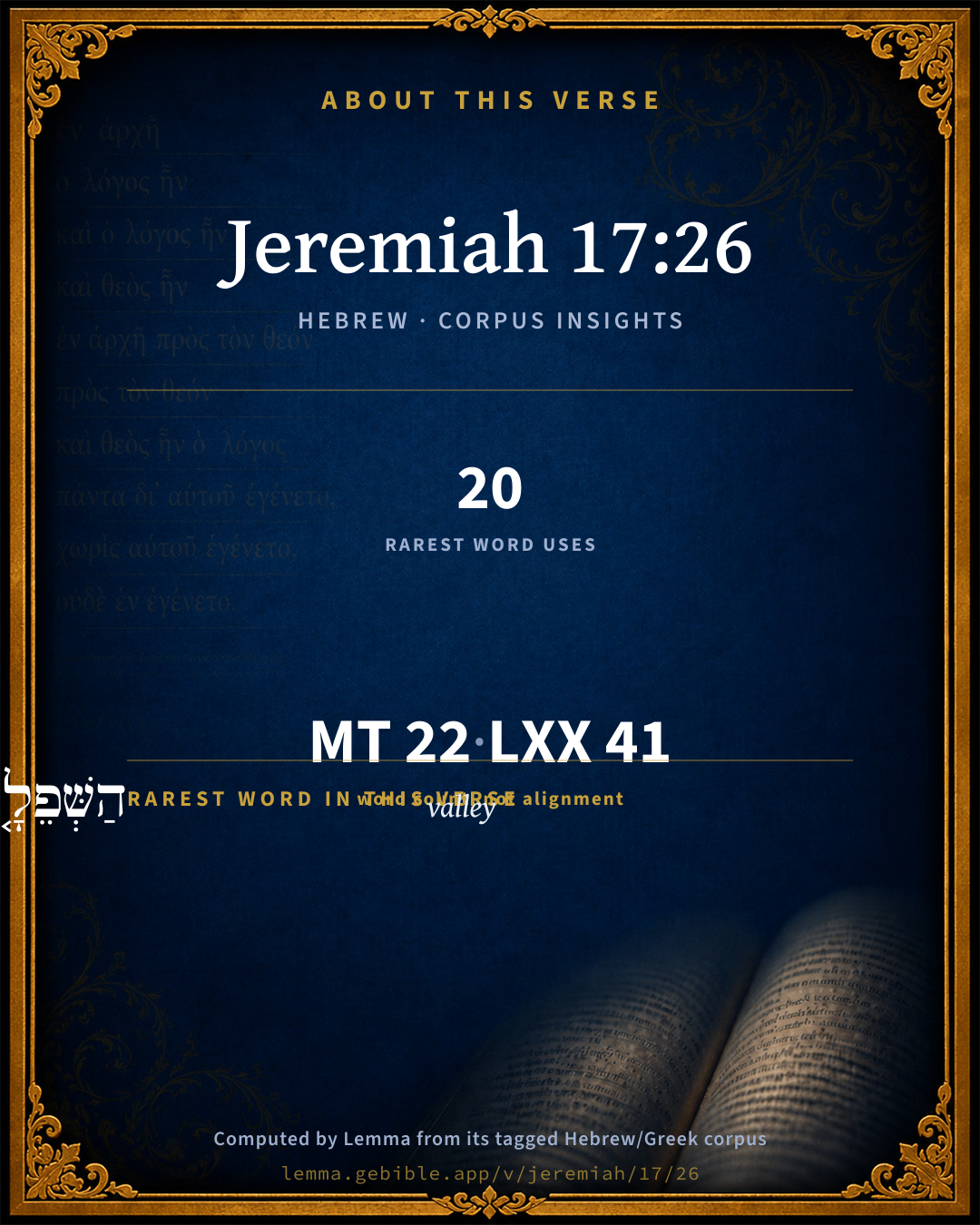
About this verse

These counts appear in no published source. They are computed here, from the morphology-tagged text and Lemma’s own curated glosses. What Lemma adds →

22
words
18
distinct lemmas
Prophets
section

Notable vocabulary

The rarest word here is הַשְּׁפֵלָ֤ה valley H8219 — appearing just 20 times in the whole Hebrew Bible.

Shared distinctive vocabulary

הַשְּׁפֵלָ֤ה valley H8219 occurs in 19 verses of the Hebrew Bible. Also found in:

Grammatical profile

  • 3 verbs
  • 16 nouns
  • 3 prepositions

Verb forms

  • וּבָ֣אוּ Qal · Perfect
  • מְבִאִ֛ים Hiphil · Participle Active
  • וּמְבִאֵ֥י Hiphil · Participle Active

Repetition

Words recur within this verse — often emphatic in Hebrew:

  • וּבָ֣אוּ to enter H935 ×3
  • וּמִן from H4480 ×3

Hebrew & Septuagint length

In the original languages it is 22 Hebrew tokens and 41 Greek tokens — but the two are counted differently (Hebrew bundles its prefixes and suffixes into one token; the Greek is in lemma form), so that isn’t a like-for-like length.

Cross-references

14

Topical passages linked to Jeremiah 17:26 in the Treasury of Scripture Knowledge — connected by theme and wording, ordered by reader-vote popularity; previews shown in the World English Bible.

  • Jeremiah 32:44 Men shall buy fields for money, and subscribe the deeds, and seal them, and call witnesses, in the land of Benjamin, and in the places about Jerusalem, and in the cities of Judah, and in the cities of the hill-country, and in the cities of the lowland, and in the cities of the South: for I will cause their captivity to return, says Yahweh.
  • Jeremiah 33:13 In the cities of the hill-country, in the cities of the lowland, and in the cities of the South, and in the land of Benjamin, and in the places about Jerusalem, and in the cities of Judah, shall the flocks again pass under the hands of him who numbers them, says Yahweh.
  • Zechariah 7:7 Aren't these the words which Yahweh proclaimed by the former prophets, when Jerusalem was inhabited and in prosperity, and its cities around her, and the South and the lowland were inhabited?'"
  • Psalms 107:22 Let them offer the sacrifices of thanksgiving, And declare his works with singing.
  • Psalms 116:17 I will offer to you the sacrifice of thanksgiving, And will call on the name of Yahweh.
  • Jeremiah 33:11 the voice of joy and the voice of gladness, the voice of the bridegroom and the voice of the bride, the voice of those who say, Give thanks to Yahweh of Hosts, for Yahweh is good, for his loving kindness endures forever; [and of them] who bring [sacrifices of] thanksgiving into the house of Yahweh. For I will cause the captivity of the land to return as at the first, says Yahweh.
  • Leviticus 1:1–7 Yahweh called to Moses, and spoke to him out of the Tent of Meeting, saying,
  • Joshua 15:21–63 The uttermost cities of the tribe of the children of Judah toward the border of Edom in the South were Kabzeel, and Eder, and Jagur,
  • Ezra 3:3–6 They set the altar on its base; for fear was on them because of the peoples of the countries: and they offered burnt offerings thereon to Yahweh, even burnt offerings morning and evening.
  • Ezra 3:11 They sang one to another in praising and giving thanks to Yahweh, [saying], For he is good, for his loving kindness endures forever toward Israel. All the people shouted with a great shout, when they praised Yahweh, because the foundation of the house of Yahweh was laid.
  • Hebrews 13:15 Through him, then, let us offer up a sacrifice of praise to God continually, that is, the fruit of lips which make confession to his name.
  • 1 Peter 2:5 You also, as living stones, are built up as a spiritual house, to be a holy priesthood, to offer up spiritual sacrifices, acceptable to God through Jesus Christ.
  • 1 Peter 2:9–10 But you are a chosen race, a royal priesthood, a holy nation, a people for God's own possession, that you may show forth the excellencies of him who called you out of darkness into his marvelous light:
  • Revelation 1:5 and from Jesus Christ, the faithful witness, the firstborn of the dead, and the ruler of the kings of the earth. To him who loves us, and washed us from our sins by his blood;

Cross-references courtesy of OpenBible.info (CC BY 4.0).

Hebrew and Greek witnesses Masoretic Hebrew ↔ Greek Septuagint

The same verse in the two great witnesses to the Old Testament, shown verse-for-verse.

These are two independent witnesses, not word-aligned to each other, and the Septuagint is shown in lemma (dictionary) form.

Hebrew Jeremiah 17:26 Masoretic · Westminster Leningrad Codex

וּבָ֣אוּ מֵעָרֵֽי יְ֠הוּדָה וּמִסְּבִיב֨וֹת יְרוּשָׁלִַ֜ם וּמֵאֶ֣רֶץ בִּנְיָמִ֗ן וּמִן הַשְּׁפֵלָ֤ה וּמִן הָהָר֙ וּמִן הַנֶּ֔גֶב מְבִאִ֛ים עוֹלָ֥ה וְזֶ֖בַח וּמִנְחָ֣ה וּלְבוֹנָ֑ה וּמְבִאֵ֥י תוֹדָ֖ה בֵּ֥ית יְהוָֽה

They shall come from the cities of Judah, and from the places round about Jerusalem, and from the land of Benjamin, and from the lowland, and from the hill-country, and from the South, bringing burnt offerings, and sacrifices, and meal-offerings, and frankincense, and bringing [sacrifices of] thanksgiving, to the house of Yahweh.

World English Bible · Public Domain

Greek LXX Structure differs

In the Septuagint, Jeremiah is about an eighth shorter than the Hebrew and arranges its material differently — the Oracles Against the Nations (Hebrew chapters 46–51) appear in the middle of the Greek book, after 25:13. Because the chapter and verse boundaries do not line up, a verse-for-verse comparison with the Hebrew is not shown.

A verse-for-verse comparison isn’t shown here because the chapters and verses don’t line up. Switch to the LXX edition with the MT / LXX toggle above to read the Greek directly.

Hebrew: Westminster Leningrad Codex (CC BY 4.0). Greek: Septuagint (public domain); English from a public-domain English Septuagint. How the Septuagint differs from the Hebrew →

Targum (Aramaic paraphrase)

1

The Targum is the ancient Jewish Aramaic paraphrase of the Hebrew Scriptures — an interpretive translation, not the Hebrew text itself. Onkelos (literal) and Pseudo-Jonathan (expansive) render the Torah, and Jonathan the Prophets. Coverage is partial: where no permissively-licensed English translation exists for a verse, only the Aramaic is shown. This is verse-level text, not a word-by-word alignment to the Hebrew.

  1. Targum Jonathan Prophets (Joshua–Malachi)
    וְיֵתוּן מִקִרְוַיָא דְבֵית יְהוּדָה וּמִסַחֲרָנֵי יְרוּשְׁלֵם וּמֵאֲרַע שְׁבַט בִנְיָמִן וּמִן שְׁפֵילְתָּא וּמִן טוּרָא וּמִן דָרוֹמָא מַיְתָן עֲלָוָן וְנִכְסַת קוּדְשִׁין וְקוּרְבְּנִין וּלְבוֹנְתָּא וּמְעַלֵי תוֹדְתָא לְבֵית מַקְדְּשָׁא דַיָי:

    (no public-domain English translation for this verse)

    Targum Jonathan — Aramaic: “Mikraot Gedolot” (public domain). English: “Sefaria Community Translation” (CC0 1.0 (public-domain dedication)); “London "Chaldee Paraphrase," 1871” (public domain). Text via Sefaria.

Commentary

Notes on Jeremiah 17:26 from classic Christian and Jewish commentators (each source and its license shown beneath its notes). The classic Christian expositions comment on the surrounding passage and are grouped to its opening verse, so a note may address several verses; the Jewish commentaries on the Tanakh (Rashi and others) are per-verse, so they appear only where the commentator wrote on this verse.

Lemma curates 59 commentaries, every one of them public domain or Creative Commons licensed, each selected and text-cleaned for this edition rather than reprinted as found. About our sources →

Trapp's Complete Commentary

John Trapp

Jer 17:26 And they shall come from the cities of Judah, and from the places about Jerusalem, and from the land of Benjamin, and from the plain, and from the mountains, and from the south, bringing burnt offerings, and sacrifices, and meat offerings, and incense, and bringing sacrifices of praise, unto the house of the LORD.

Ver. 26. And they shall come.] All the solemnity of the temple shall continue, with the exaltation of all the neighbourhood. When the high priests would so work that day like to beg the body, seal the sepulchre, and set the watch on the Sabbath - called, by an irony, the day that followed the day of the preparation {Mat 27:62} - they forfeited all.

John Trapp, A Commentary or Exposition upon All the Books of the Old and New Testament (1647–1656) — public domain. Text from a community e-Sword module.

Tyndale Open Study Notes

Tyndale Open Resources

17:26 If the people repented, the Lord’s blessings would extend to the towns of Judah and Benjamin. • The western foothills stretched north and south between the coastal plain of the Mediterranean Sea and the hill country, where Jerusalem rested. • The Negev was the desert that stretched from Beersheba southward to the Gulf of Aqaba. People from all these areas would come with their offerings to worship the Lord in his Temple.

Tyndale Open Study Notes — © Tyndale Open Resources, licensed CC BY-SA 4.0. Text via the HelloAO Bible API.

Jamieson, Fausset & Brown

Robert Jamieson, A. R. Fausset & David Brown

plain mountains . . . south-- (Jos 15:1-4). The southern border had extended to the river of Egypt, but was now much curtailed by Egyptian invasions (Ch2 35:20; Ch2 36:3-4). The Hebrew for "south" means dry; the arid desert south of Judea is meant. The enumeration of all the parts of Judea, city, country, plain, hill, and desert, implies that no longer shall there be aught wanting of the integrity of the Jewish land (Zac 7:7).

sacrifices--As in Jer 17:22, one constituent of Judea's prosperity is mentioned, namely, its kings on David's throne, the pledge of God being its guardian; so in this verse another constituent, namely, its priests, a pledge of God being propitious to it (Psa 107:22).

Jamieson, Fausset & Brown — Commentary Critical and Explanatory on the Whole Bible (1871) — public domain (CC PDM 1.0). Text via the HelloAO Bible API.

John Calvin's Commentaries

Here he mentions the second part of the blessing; for the whole people would be preserved safe in the possession of their kingdom and priesthood, as in both the favor of God appeared; for both the king and the priest were types of Christ. For as by the priesthood they knew that God was propitious to them, they being reconciled to him by sacrifices, and as by the kingdom they knew that God was the protector and guardian of their safety, so these two things constituted a real and complete happiness. Hence the Prophet, having mentioned one of these things, now proceeds to the other, —

They shall come from the cities of Judah ad from the whole circuit of Jerusalem, and from the land of Benjamin, and from other places, to offer sacrifices in the Temple. Sacrifices of themselves could not indeed serve the people; but Jeremiah assumed this principle, — that reconciliation was not in vain promised to the people by the sacrifices; for sins were really atoned, and Godas it were came forth to gather a people for himself. It was the same as though God said, that he would by all means be gracious to them, if only they observed the Sabbath, that is, if they with a pure heart devoted themselves to his service. The country, as I have said, was in a great measure laid waste; but the Prophet, after having spoken of the city, now adds, that all Judea would become inhabited, for from thence they would ascend to the Temple to offer sacrifices. After having mentioned the whole circuit, he names the land of Benjamin, the half tribe of whom, as it is well known, had continued in the faith, and had not separated from the family of David; indeed a part of the city was in the tribe of Benjamin.

He afterwards adds, the plain and the mountains, as though he had said, God’s worshippers would come from all the neighboring region to celebrate the feasts and to offer sacrifices as usual.

At last he mentions burnt-offering, sacrifice, and oblation, מנחה, meneche; the three principal offerings. But Jeremiah wished to shew briefiy that God would cause religion to flourish and prevail among them as before. But after having spoken of the external worship, he then refers to the end, They shall bring, he says, confession, or praise, תודה, tude, into the Temple. Here by one word Jeremiah includes the chief thing in sacrifices, as we may learn from Psalm 50:14, 23; where it is said,

“sacrifice praise unto God.”

God there rejects the sacrifices which were offered by the Jews without a right motive: he then shews what he required, commanding them to sacrifice praise. So now Jeremiah teaches us that the design of all sacrifices was to celebrate the name of God, that is, that the Jews might profess that they owed all things to him, that they received their life and their safcty freely from him. in short, they were thereby to testify their gratitude before God. So at this day this truth remains the same, though the types have been abolished: we do not offer calves or oxen or rams, but the sacrifice of praise, by confessing and proclaiming his benefits and blessings, according to what the Apostle says in Hebrews 13:15. But what ought to prevail among us apart from types, was formerly accompanied with types; and yet this truth was observed by the Jews in common with us, — that while they offered their sacrifices under the Law, they were to testify their gratitude by visible symbols. Let us proceed —

John Calvin's Commentaries (1540-1563) — public domain. Text from the Calvin Translation Society English edition (1840s-50s) via the Christian Classics Ethereal Library (ccel.org). Calvin's coverage is partial (roughly two-thirds of the Bible); uncommented books and verses are honest gaps, never fabricated. The 19th-century editor's footnotes and remarks are omitted so the notes are faithfully Calvin's own voice.

Ellicott's Commentary for English Readers

(26) They shall come . . .—The verse has a special interest (1) as a topographical description of the country about Jerusalem, and (2) as a summary of the chief forms of sacrifice under the Mosaic Law. (1) The “plain” (Shephelah) is the lowland country of Philistia, stretching to the Mediterranean; the “mountain” the hill-country of Judah; the “south” (Negeb) the region lying to the south of Hebron, and including Beersheba (comp. Jos_15:21; Jos_15:28). Each name, though descriptive in meaning, was used in almost as definite a sense as that in which we speak of the “Campagna” of Rome or the “Weald” of Kent. (2) The list includes the “burnt offerings,” in which the flesh of the victim was consumed entirely on the altar; the “sacrifices,” in which the flesh of the victim was eaten partly by the priest and partly by the worshipper; the “meat offerings,” which were of meal and salt, not of flesh, and were always accompanied by incense (Lev_2:1); and, lastly, praise—the word “sacrifice” not being found in the Hebrew—the utterance of prayer and psalm, which the Psalmist had named as more acceptable than the flesh of bulls and goats (Psa_50:14).

A Bible Commentary for English Readers, edited by Charles John Ellicott (1878–1897) — public domain. Text from a community e-Sword module.

The Cambridge Bible for Schools and Colleges

gen. ed. J. J. S. Perowne

26. Cp. for this kind of enumeration Jer_32:44, Jer_33:13.

the land of Benjamin] lying north of Judah.

the lowland] the low hills and flat valley-land stretching down towards the Philistine plain on the W. and S.W. of Judah.

the mountains] the loftier part S. of Jerusalem in the neighbourhood of Hebron.

the South] See on Jer_13:19. The cities in these three districts are enumerated in Joshua , 15, viz. 33–44; 48–60; 21–32.

burnt offerings, and sacrifices, and oblations, and frankincense] Three sorts of offerings are here mentioned, two bloody and one unbloody. The “oblations” (mg. “meal offerings”) consisted of flour and oil, and had (Lev_2:1) frankincense (see on Jer_6:20) strewn upon them.

sacrifices of thanksgiving] thanksgiving. The word “sacrifices,” omitted here and in Jer_33:11, is supplied in the directions given in Lev_7:12.

The Cambridge Bible for Schools and Colleges (gen. ed. J. J. S. Perowne; Cambridge University Press, 1878–1918) — public domain. Text from a community e-Sword module.

John Gill's Exposition

And they shall come from the cities of Judah,.... That is, men shall come from all parts of the land of Judea to the city of Jerusalem, and to the temple; especially at the times of their solemn feasts, three times a year, as the law directed:

and from the places about Jerusalem; and from all the towns and villages adjacent to it, such as Bethany and Bethphage, and many others:

and from the land of Benjamin; which tribe continued with the tribe of Judah when the rest revolted, and was now with it, and still would continue with it, and join with it in religious worship, were they careful to observe what the Lord commanded them:

and from the plain, and from the mountains, and from the south; these respect the several parts of the land of Judah, which, the Jews (i) say, was divided into three parts, the mountain, plain or champaign country, and the valley: the "plain" was that part where Lydda and other cities were; the "mountain" is the same with the hill country of Judea, Luk 1:39; and the "south" the southern part of the land, that which is called the wilderness of Judea, of which see Jos 15:20. The above Jewish writers say (k), that from Bethhoron to Emmaus was the mountain or hill country; from Emmaus to Lydda the plain; and from Lydda to the sea the valley; now, from all these places should persons come to the temple:

bringing burnt offerings and sacrifices, and meat offerings and incense; sacrifices and offerings of all sorts, according to the law; hereby signifying, that if the sabbath was observed, as it would go well with the kings and princes of Judah, they would keep a splendid court, and have a numerous retinue, so it would be well with the priests that served at the altar; sacrifices would be brought to them; of which they would have their part, as well as God have glory by an obedience to his laws; and, besides these, other sacrifices would also be brought, as follows:

and bringing sacrifices of praise unto the house of the Lord; thank offerings for mercies received and deliverances wrought, as well as sacrifices for sins committed; and this was one sort of the peace offerings, Lev 7:11.

(i) Misna Sheviith, c 9. sect. 2. (k) Hieros. Sheviith, foI. 38. 4.

John Gill's Exposition of the Whole Bible (1746–1763) — public domain (CC PDM 1.0). Text via the HelloAO Bible API.

Haydock's Catholic Bible Commentary

Sacrifices. Hebrew mincha, (Haydock) "offerings" of flour, wine, &c. (Calmet)

George Leo Haydock (1774–1849), Haydock's Catholic Family Bible and Commentary, 1859 edition — public domain. Excludes Psalms (Douay-Rheims chapter numbering differs from Protestant) and Deuterocanonical books (Catholic canon only).

Matthew Poole's English Annotations

The sum of all these three verses is, that if they would sanctify the Lord’s sabbath, they should either continue in, or be restored unto, their ancient, civil, and ecclesiastical order, they should have kings and princes in their former order and splendour, and men should come from all parts of the country bringing their usual sacrifices and offerings to the temple, and those of all sorts. Some think this promise is to be understood synecdochically, one principal part of the law of God, and such a one as was in their power to obey, being put for the whole law of God. Those who desire to be satisfied in the niceties as to the terms and places here mentioned, may find satisfaction in the English Annotations upon this verse. The general sense is no more than that both their city and their temple, their civil and ecclesiastical state, should continue and flourish in that order wherein it was.

Matthew Poole's English Annotations on the Holy Bible (1683–1685) — public domain. Text from a community e-Sword/MySword module.

Whedon's Commentary on the Bible

Daniel D. Whedon

26. They shall come — An answering description of religious grandeur and prosperity. The specifications are such as give completeness to the picture. As to offerings, the two great classes are mentioned, namely, bloody — burnt offerings and sacrifices, and unbloody — meat offerings and incense. As to localities, we have cities of Judah, places about Jerusalem, land of Benjamin, the plain, the mountains, and the south — showing the universal participation of the people.

Daniel D. Whedon (gen. ed.), Commentary on the Old and New Testaments (1874–1909) — public domain. Text from a community e-Sword module.

The Pulpit Commentary

Parallel passage for the catalogue of the districts of Judah, Jer_32:44. Three divisions are mentioned.

(1) The neighborhood of Jerusalem (including the "cities of Judah");

(2) the land of Benjamin, i.e. the northern part of the kingdom; and

(3) the tribe of Judah, with its three subdivisions the Shefela or lowland country by the Mediterranean Sea, the hill country, and the Negeb or "dry" south country. (comp. Jos_15:21-62) The sacrifices are described with equal explicitness; they fall into two classes, the bloody (burnt offerings and other sacrifices) and the unbloody. (the vegetable offering or minkhah, and the incense which was strewed upon the min-khah, Lev_2:1) And bringing sacrifices of praise. This was, no doubt, the title of a particular variety of sacrifices; (Lev_7:12 Lev_22:29) here, however, it seems as if all the preceding sacrifices were summed up under this designation. St. Paul says, "In everything give thanks;" and this seems to have been the prophet"s ideal of the sacrifices of the future.

The Pulpit Commentary (1880–1919), ed. H.D.M. Spence-Jones & Joseph S. Exell — public domain. Text from a community e-Sword module.

unfoldingWord translationNotes

Door43 World Missions Community

I will light a fire in its gates

"I will set the gates of Jerusalem on fire"

it cannot be put out

This can be stated in active form. AT: "people cannot put it out" (See: Active or Passive)

translationWords

kingdom of Judah

Jerusalem

Benjamin

Negev

burnt offering

sacrifice

frankincense

house

gate

fire

consume

stronghold

unfoldingWord translationNotes — © Distant Shores Media and the Door43 World Missions Community, licensed CC BY-SA 4.0. Source: git.door43.org/Door43/en_tn.

Lesson kit

Teaching starters — assembled from the data on this page, not authored interpretation. Every prompt links to the verse data it draws on. Edit before teaching.

Jeremiah, in the Prophets, opens this verse with 22 words (18 distinct Hebrew lemmas). Its most distinctive word is shᵉphêlâh (“valley”). A historical commentator’s framing appears above. Read the whole chapter for the surrounding context.

Discussion questions

  1. The word shᵉphêlâh carries the sense “valley.” How does it shape the verse?
  2. How does Deuteronomy 1:7, which shares the word «valley», read alongside this verse?
  3. What does the repetition of “to enter” (3× in this one verse) do in this verse?
  4. These translations render this verse differently; the difference is in the English rendering, not the original. What questions does that raise?
  5. «וּבָ֣אוּ» is a Qal Perfect verb. How does that grammatical form shape the action described?
  6. Compare how Trapp's Complete Commentary and Tyndale Open Study Notes read this verse. Where do they agree or differ?

Things to notice

Reading settings

Reading text

Shown beneath each verse's original-language words.

Old Testament
Old Testament edition

Read the OT as the Masoretic Hebrew (MT) or the Greek Septuagint (LXX).

English shown for the Greek Septuagint (in the Hebrew ↔ Greek comparison).

Comparing translations? Open the Compare panel on any verse page to stack up to four side by side.