
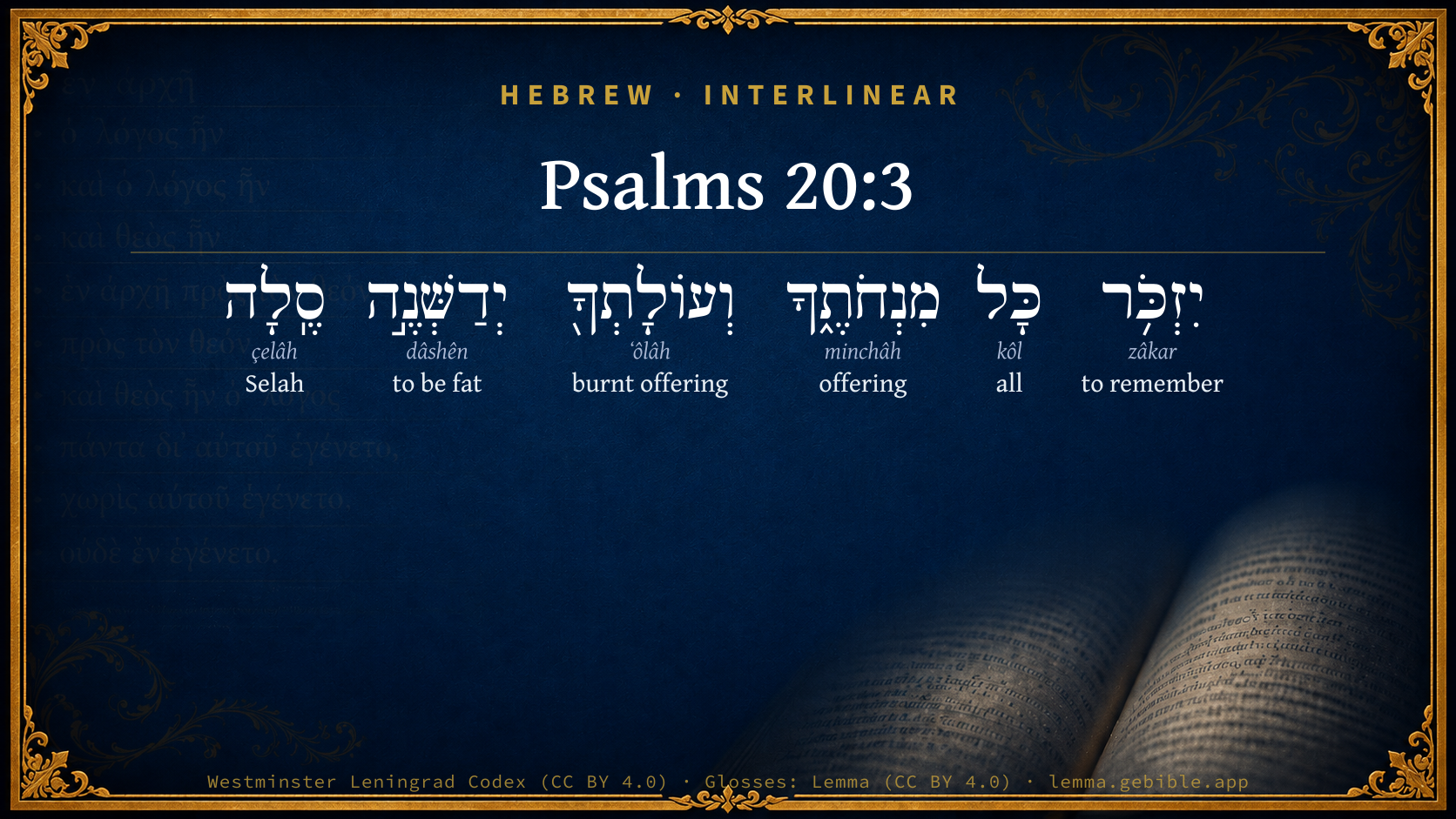
Psalms 20:3

Hebrew (Westminster Leningrad Codex) Psalms 20:3 appears in the Hebrew Old Testament. The text above is from the Westminster Leningrad Codex. Each word links to its Strong’s number, a concise gloss, and parsing drawn from the Open Scriptures Hebrew Bible morphology. Click any word for its full Brown-Driver-Briggs (BDB) entry.
Download image
Cite this verse

Psalms 20:3 (World English Bible). Public Domain. Lemma interlinear Bible study tool, https://lemma.gebible.app/v/psalms/20/3.

Show BibTeX & RIS
BibTeX
RIS
English Translation
Remember all your offerings, And accept your burnt sacrifice. Selah.
World English Bible · Public Domain
Download a study sheet

One document with this verse’s original text, its word-by-word gloss line, the meaning frame, cross-references with their text, attributed commentary, and full source and license credits — printable, and it pastes into notes with its structure intact.

This verse Autodidact and up

Study sheet (.html) Plain text (.txt)

A passage Seminary Student

Up to 50 verses in one chapter. A passage sheet keeps up to 6 commentary sources and 12 cross-references per verse, in the order this page ranks them, and says so on the sheet whenever that leaves anything out. Ask for a single verse and you get the Autodidact verse sheet above.

Everything on this page stays free to read, with no account — the sheet is a download of what is already on screen, not access to it.

Want to remove ads? Support Godless Engineer
Compare translations 3

The same verse in 3 English versions, stacked beneath the original-language interlinear above. Click any original word for its lexicon entry.

Each is an independent rendering of the whole verse — the interlinear is not word-aligned to these translations.

Highlighted words mark where these versions differ — a whole-verse word diff, not a word-by-word alignment.

  • World English Bible Public Domain
    Remember all your offerings, And accept your burnt sacrifice. Selah.
  • King James Version Public Domain
    Remember all thy offerings, and accept thy burnt sacrifice; Selah.
  • unfoldingWord Literal Text CC BY-SA 4.0
    May he remember all of your grain offerings and regard as fat your burnt offering. Selah

unfoldingWord Literal Text — © unfoldingWord, licensed CC BY-SA 4.0. Word-aligned USFM3 via Door43 (git.door43.org/unfoldingWord/en_ult).

Versions to compare (up to 4)

3 of 4 selected

Show all 18 translations

Every available English version of this verse, each an independent rendering of the whole verse.

  • World English Bible Public Domain
    Remember all your offerings, And accept your burnt sacrifice. Selah.
  • Berean Standard Bible Public Domain
    May He remember all your gifts and look favorably on your burnt offerings. Selah
  • Majority Standard Bible Public Domain
    May He remember all your gifts and look favorably on your burnt offerings. Selah
  • King James Version Public Domain
    Remember all thy offerings, and accept thy burnt sacrifice; Selah.
  • American Standard Version (1901) Public Domain
    Remember all thy offerings, And accept thy burnt-sacrifice; Selah
  • Revised Version (1885) Public Domain
    Remember all thy offerings, and accept thy burnt sacrifice; Selah
  • Geneva Bible (1599) Public Domain
    Let him remember all thine offerings, and turne thy burnt offerings into asshes. Selah:
  • Douay-Rheims (1899) Public Domain
    May he send thee help from the sanctuary: and defend thee out of Sion.
  • Young's Literal Translation Public Domain
    He doth remember all thy presents, And thy burnt-offering doth reduce to ashes. Selah.
  • Literal Standard Version CC BY-SA 4.0
    He remembers all your presents, || And reduces your burnt-offering to ashes. Selah.
  • Unlocked Literal Bible CC BY-SA 4.0
    May he call to mind all your offerings and accept your burnt sacrifice. Selah
  • unfoldingWord Literal Text CC BY-SA 4.0
    May he remember all of your grain offerings and regard as fat your burnt offering. Selah
  • Darby Bible Public Domain
    Remember all thine oblations, and accept thy burnt-offering; Selah.
  • World Messianic Bible Public Domain
    remember all your offerings, and accept your burned sacrifice. Selah.
  • Webster's Bible Public Domain
    \\20:2\\Send thee help from the sanctuary, and strengthen thee out of Zion.
  • Free Bible Version CC BY-SA 4.0
    May the Lord remember all your offerings, and accept all your burnt sacrifices. Selah.
  • Bible in Basic English Public Domain
    May he keep all your offerings in mind, and be pleased with the fat of your burned offerings; (Selah.)
  • JPS Tanakh (1917) Public Domain
    (20-4) Receive the memorial of all thy meal-offerings, and accept the fat of thy burnt-sacrifice; Selah

Literal Standard Version (2020), Covenant Press — licensed CC BY-SA 4.0. Text via the HelloAO Bible API (eBible.org). Unlocked Literal Bible (unfoldingWord) — licensed CC BY-SA 4.0. Text via the HelloAO Bible API (eBible.org). unfoldingWord Literal Text — © unfoldingWord, licensed CC BY-SA 4.0. Word-aligned USFM3 via Door43 (git.door43.org/unfoldingWord/en_ult). Free Bible Version, Dr. Jonathan Gallagher — licensed CC BY-SA 4.0. Text via the HelloAO Bible API (eBible.org).

Word by word

More ways to search: Search by grammar → Find every occurrence → Compare this word →

Practice this passage: Drill this verse → Learn its vocabulary →

About this verse

These counts appear in no published source. They are computed here, from the morphology-tagged text and Lemma’s own curated glosses. What Lemma adds →

6
words
6
distinct lemmas
Wisdom
section

Notable vocabulary

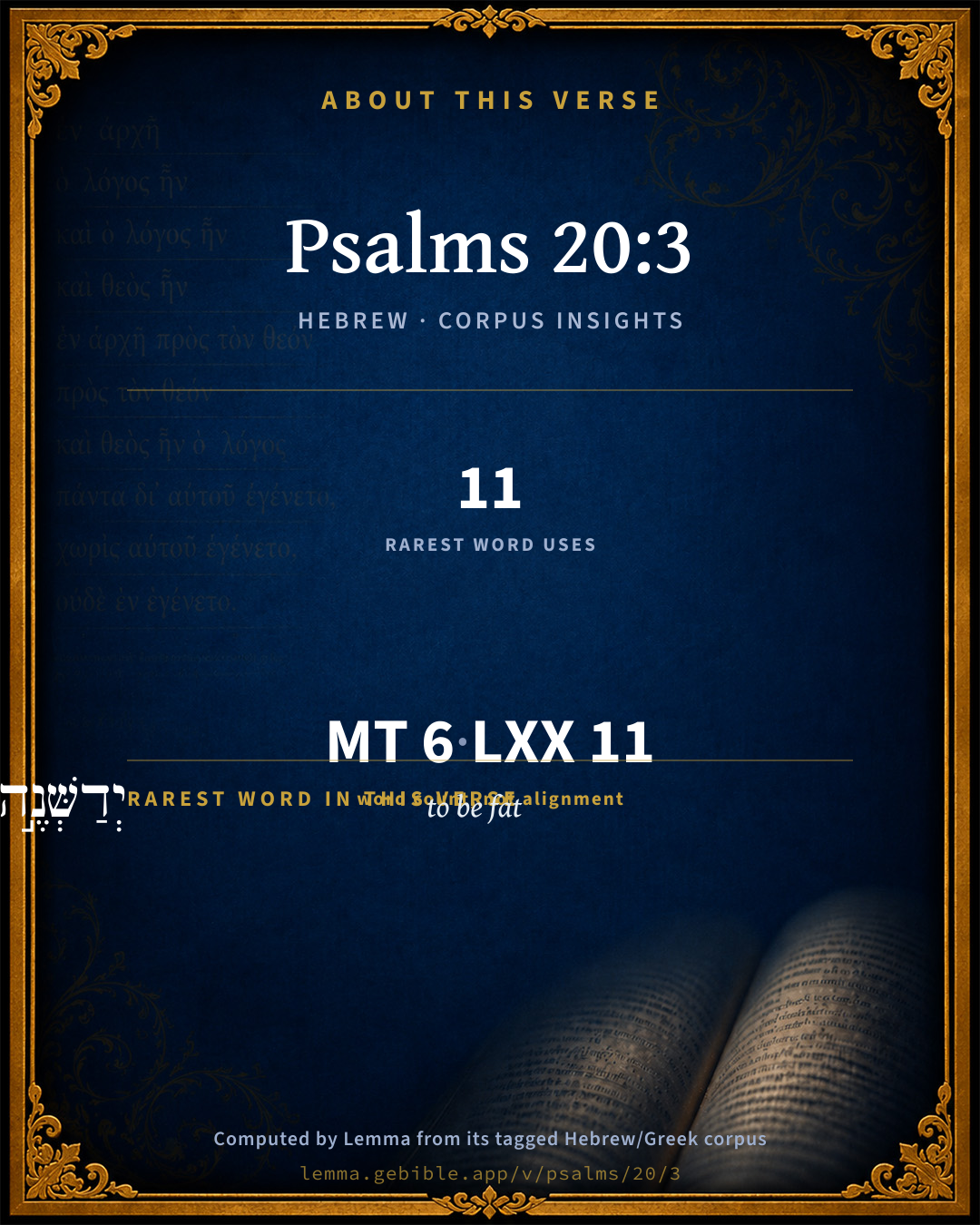
The rarest word here is יְדַשְּׁנֶ֣ה to be fat H1878 — appearing just 11 times in the whole Hebrew Bible.

Shared distinctive vocabulary

יְדַשְּׁנֶ֣ה to be fat H1878 occurs in 11 verses of the Hebrew Bible. Also found in:

Grammatical profile

  • 2 verbs
  • 3 nouns
  • 1 particle

Verb forms

  • יִזְכֹּ֥ר Qal · Imperfect
  • יְדַשְּׁנֶ֣ה Piel · Imperfect

Hebrew & Septuagint length

In English translation the verse runs 10 words from the Hebrew and 11 from the Septuagint (LXX English) — closely comparable.

A rough comparison of the two English renderings, which tokenize alike — not a word-level alignment.

Word counts can differ between the Hebrew and the Greek without any difference in meaning — e.g. the Hebrew direct-object marker אֵת has no separate Greek word, and Greek often adds the article ὁ.

In the original languages it is 6 Hebrew tokens and 11 Greek tokens — but the two are counted differently (Hebrew bundles its prefixes and suffixes into one token; the Greek is in lemma form), so that isn’t a like-for-like length.

Cross-references

9

Topical passages linked to Psalms 20:3 in the Treasury of Scripture Knowledge — connected by theme and wording, ordered by reader-vote popularity; previews shown in the World English Bible.

  • 2 Chronicles 7:1 Now when Solomon had made an end of praying, the fire came down from heaven, and consumed the burnt offering and the sacrifices; and the glory of Yahweh filled the house.
  • Psalms 51:19 Then you will delight in the sacrifices of righteousness, In burnt offerings and in whole burnt offerings. Then they will offer bulls on your altar.
  • Acts 10:4 He, fastening his eyes on him, and being frightened, said, "What is it, Lord?" He said to him, "Your prayers and your gifts to the needy have gone up for a memorial before God.
  • Genesis 4:4 Abel also brought some of the firstborn of his flock and of the fat of it. Yahweh respected Abel and his offering,
  • 1 Chronicles 21:26 David built there an altar to Yahweh, and offered burnt offerings and peace-offerings, and called on Yahweh; and he answered him from the sky by fire on the altar of burnt offering.
  • Ephesians 5:2 Walk in love, even as Christ also loved you, and gave himself up for us, an offering and a sacrifice to God for a sweet-smelling fragrance.
  • Leviticus 9:24 There came forth fire from before Yahweh, and consumed the burnt offering and the fat upon the altar: and when all the people saw it, they shouted, and fell on their faces.
  • Isaiah 60:7 All the flocks of Kedar shall be gathered together to you, the rams of Nebaioth shall minister to you; they shall come up with acceptance on my altar; and I will glorify the house of my glory.
  • 1 Peter 2:5 You also, as living stones, are built up as a spiritual house, to be a holy priesthood, to offer up spiritual sacrifices, acceptable to God through Jesus Christ.

Cross-references courtesy of OpenBible.info (CC BY 4.0).

Hebrew and Greek witnesses Masoretic Hebrew ↔ Greek Septuagint

The same verse in the two great witnesses to the Old Testament, shown verse-for-verse.

You’re reading Greek Psalm 19 (Hebrew Psalm 20). The Septuagint counts the superscription, so verse numbers can differ from the Hebrew — chapter-level alignment, not verse-by-verse. Numbering follows Rahlfs.

These are two independent witnesses, not word-aligned to each other, and the Septuagint is shown in lemma (dictionary) form.

Hebrew Psalms 20:3 Masoretic · Westminster Leningrad Codex

יִזְכֹּ֥ר כָּל מִנְחֹתֶ֑ךָ וְעוֹלָתְךָ֖ יְדַשְּׁנֶ֣ה סֶֽלָה

Remember all your offerings, And accept your burnt sacrifice. Selah.

World English Bible · Public Domain

Greek LXX Greek Psalm 19:3 Septuagint · lemma form

ἐκ ἀποστέλλω σύ βοήθεια ἐκ ἅγιος καί ἐκ σιων ἀντιλαμβάνω σύ

Remember all your sacrifice, and enrich your whole burnt offering. Pause.

LXX2012 (modern English Septuagint) · Public Domain

Hebrew: Westminster Leningrad Codex (CC BY 4.0). Greek: Septuagint (public domain); English from LXX2012 (modern English Septuagint) (Public Domain). How the Septuagint differs from the Hebrew →

Commentary

Notes on Psalms 20:3 from classic Christian and Jewish commentators (each source and its license shown beneath its notes). The classic Christian expositions comment on the surrounding passage and are grouped to its opening verse, so a note may address several verses; the Jewish commentaries on the Tanakh (Rashi and others) are per-verse, so they appear only where the commentator wrote on this verse.

Lemma curates 59 commentaries, every one of them public domain or Creative Commons licensed, each selected and text-cleaned for this edition rather than reprinted as found. About our sources →

Trapp's Complete Commentary

John Trapp

Psa 20:3 Remember all thy offerings, and accept thy burnt sacrifice; Selah.

Ver. 3. Remember all thy offerings] Before they went to war they were wont to offer sacrifices, as did Saul; though by his haste therein he lost his kingdom, 1Sa 13:9. From the people of God the heathens had also learned this course and custom. Io Paean is the force of Jehovah Peneh that is, Lord, look upon us. The devil (God’s ape) had taught the Athenians, when they began the battle, to use these words, and thereby to hearten one another. The Romans also did the like, and would not desist till they had an auspicious answer; hence also they called a sacrifice hostiam because when they went against their enemies they offered it.

And accept thy burnt sacrifice] Or turn it to ashes (and so seal up his acceptance); or make it fat, i.e. take delight in it, as men do in fat things full of marrow, saith R. Solomon.

Selah] This is added to show, saith Vatablus, with how great fervency the people ought to pray for their king.

John Trapp, A Commentary or Exposition upon All the Books of the Old and New Testament (1647–1656) — public domain. Text from a community e-Sword module.

Albert Barnes' Notes on the Bible

Remember all thy offerings - On the meaning of the word here used, see the note at Isa 1:13, where it is rendered oblations. The word occurs often in the Scriptures, and is sometimes rendered offering, and sometimes oblation. The word means an offering of any kind or anything that is presented to God, except a bloody sacrifice - anything offered as an expression of thankfulness, or with a view to obtain his favor. It is distinguished from bloody sacrifices, which are expressed by the word in the following clause. The word here employed occurs in the Psalms only in the following places: Psa 20:3; Psa 40:6; Psa 96:8; where it is rendered offering and offerings; Psa 45:12, rendered gift; Psa 72:10, rendered presents; and Psa 141:2, rendered sacrifice. The use of the word in this place proves that such offerings had been made to God by him who was about to go forth to the war; and the prayer of the people here is that God would remember all those offerings; that is, that he would grant the blessing which he who had offered them had sought to obtain.

And accept - Margin, turn to ashes, or make fat. The Hebrew word - דשׁן dâshên - means properly to make fat, or marrowy, Pro 15:30; to pronounce or regard as fat; to be fat or satiated, or abundantly satisfied, Pro 13:4. It conveys also the notion of reducing to ashes; perhaps from the fact that the victim which had been fattened for sacrifice was reduced to ashes; or, as Gesenius supposes (Lexicon, see דשׁן deshen), because “ashes were used by the ancients for fattening, that is, manuring the soil.” The prayer here seems to be that God would “pronounce the burnt-offering fat;” that is, that he would regard it favorably, or would accept it. This proves, also, that a sacrifice had been made with a view to propitiate the divine favor in regard to the expedition which had been undertaken; that is, a solemn act of devotion, according to the manner of worship which then obtained, had been performed with a view to secure the divine favor and protection. The example is one which suggests the propriety of always entering upon any enterprise by solemn acts of worship, or by supplicating the divine blessing; that is, by acknowledging our dependence on God, and asking his guidance and his protecting care.

Thy burnt sacrifice - The word used here denotes bloody offerings; see the note at Isa 1:11. These offerings were designed especially for the expiation of sin, and for thus securing the divine favor. They were an acknowledgment of guilt, and they were offered with a view to secure the pardon of sin, and, in connection with that, the favor of God. In similar circumstances we approach God, not by an offering which we make, whether bloody or bloodless, but through the one great sacrifice made by the Redeemer on the cross for the sins of the world.

Albert Barnes' Notes on the Bible (1834–1885) — public domain. Text from a community e-Sword/MySword module.

The Biblical Illustrator

Joseph S. Exell

Psa_20:3

Remember all thy offerings.

Holy offerings

What shall I render unto the Lord for all His benefits towards me? There are people who will say that we can give nothing to God, who giveth all. These are the selfish folk, who really mean, even if they do not say so, Get all you can from God, God wants no return. Now, the Bible says just the opposite. The Bible says Present our bodies a living sacrifice, holy, acceptable unto God. The people who talk about the finished Work of Christ, and who say that He has done all, and that therefore there is nothing for us to do, forget that there are two parts in the scheme of salvation. Jesus has indeed done His part, but He bids us do certain things also. We have nothing to pay. But would it not be base ingratitude if someone had been good and kind to you in trouble, and you had not tried to make some return, however small? Well then, how much owest thou unto my Lord? Do you remember what the Lord Jesus paid for us? Have we nothing to pay or to give to Him? You will answer that you have nothing good enough to give to Him. But you have; you can give Him what He asks for, your heart, your love. How, then, can we show our love to God, what offerings can we present to Him? In a word, one of the holiest offerings we can present to God is worship. And to do this should be our chief motive for attending church. How various and how unworthy--some of them--are the motives which govern us in this. The common notion about church going springs from mere selfishness. The question is, how can I best honour Him who has done all for me? Above all, we offer an holy offering of praise in the highest act of worship, in the celebration of the blessed sacrament. In the service of the Holy Communion we take part with the saints and angels in heaven in worshipping God. Is there, then, nothing to pay? Oh, yes! a life of devotion, a life of thanksgiving; there is everything to pay, even the best we have. I will pay my vows now in the presence of all His people, says holy David; and yet there are some who tell us there is nothing to pay. Thus far we have seen that we can show our love to God by giving Him the offering of a holy worship. Again, we can make an offering to God by giving alms to His Church. God gives us all we have, our money, and our means of making money; and we are bound to dedicate, to consecrate a part of what we have to Him. Again, this false teaching goes on to tell us that there is nothing to do, and nothing to tear. You know that it is written, without holiness no man can see the Lord. Now, do you think that you have nothing to do? Do you find it very easy to lead good lives; to keep yourselves pure, and gentle, and patient, and forgiving? Do you find nothing to do in resisting temptation, in keeping under your temper, in checking bad thoughts? But, as said a saint of old, God, who made us without ourselves, will not save us without ourselves. Jesus has done His part, but He nowhere tells you that you have nothing to do. Often when people say, I belong to Jesus, I am safe, they are simply deceiving themselves. Some of the most atrocious criminals have talked in this way. By their fruits ye shall know them. If you do really love the Lord Jesus you will try to obey Him: There is yet another offering which we can give to God, the sacrifice of self. Every act of self-denial, every pleasure abandoned for the sake of others, will be accepted by Him who gave up all for us. (H. J. Wilmot Buxton, M. A.)

The Biblical Illustrator, edited by Joseph S. Exell (c. 1880s–1900s) — public domain. Text from a community e-Sword module.

J. A. Alexander on Psalms

Joseph Addison Alexander

4. (Psa 20:3). (May Jehovah) remember all thy gifts and accept thy offering. Selah. The word remember in the first clause seems to involve an allusion to the memorial, a name given in the sacrificial ritual to that part of the vegetable offering which was burnt upon the altar. See Lev 2:2; Lev 6:8 (15).—The word translated gifts, although properly generic, is specially used to denote the vegetable offerings of the law, while the word translated offering is the technical name of the principal animal sacrifice. They are put together to describe these two species of obligation. Compare Psa 40:7 (6), Jer 17:26, Dan 9:27.—The verb translated accept means elsewhere to make fat (Psa 18:5), or to remove the ashes of the altar. (Exo 27:3, Num 4:13). Some give it here the sense of turning into ashes or consuming, others that of pronouncing fat, and therefore fit for sacrifice. In either case acceptance is implied. The optative form of the verb in the original seems to confirm the sense already put upon the foregoing futures. From this verse it has been inferred, with some probability, that the whole psalm was specially intended to be used at the sacrifice offered by the Israelites before a campaign or a battle. (See 1Sa 13:9-10). To this some add the supposition, that the selah, in the verse before us, marks the pause in the performance of the psalm, during which the sacrifice was actually offered. See above, on Psa 3:3 (2).

Joseph Addison Alexander, The Psalms Translated and Explained (1850) — public domain. Text from a community e-Sword module.

Tyndale Open Study Notes

Tyndale Open Resources

20:3 Gifts and burnt offerings express submission to the Lord (cp. 40:6).

Tyndale Open Study Notes — © Tyndale Open Resources, licensed CC BY-SA 4.0. Text via the HelloAO Bible API.

Geneva Bible (1599)

Geneva Bible translators

In token that they are acceptable unto him.

Geneva Bible (1599) marginal notes — public domain. Text via Bolls.life.

Jamieson, Fausset & Brown

Robert Jamieson, A. R. Fausset & David Brown

all thy offerings--or gifts, vegetable offerings.

accept--literally, "turn to ashes" (compare Kg1 18:38).

Selah--(See on Psa 3:2).

Jamieson, Fausset & Brown — Commentary Critical and Explanatory on the Whole Bible (1871) — public domain (CC PDM 1.0). Text via the HelloAO Bible API.

Adam Clarke's Commentary

Verse 3. Remember all thy offerings] The minchah, which is here mentioned, was a gratitude-offering. It is rarely used to signify a bloody sacrifice.

Burnt sacrifice] The olah here mentioned was a bloody sacrifice. The blood of the victim was spilt at the altar, and the flesh consumed. One of these offerings implied a consciousness of sin in the offerer; and this sacrifice he brought as an atonement: the other implied a sense of mercies already received, and was offered in the way of gratitude.

David presents himself before the Lord with offerings of both kinds.

This prayer of the people is concluded with Selah, which we have taken up in the general sense of so be it. Hear and answer. It will and must be so, &c.

Adam Clarke's Commentary on the Bible (1810–1826) — public domain. Text from a community e-Sword/MySword module.

John Calvin's Commentaries

3. May he remember. I understand the word remember as meaning to have regard to, as it is to be understood in many other places; just as to forget often signifies to neglect, or not to deign to regard, nor even to behold, the object to which it is applied. It is, in short, a prayer that God would actually show that the king’s sacrifices were acceptable to him. Two kinds of them are here mentioned; first, the מנחה, mincha, mentioned in the first clause of the verse, which was the appointed accompaniment of all sacrifices, and which was also sometimes offered by itself; and, secondly, the holocaust, or whole burnt-sacrifice. But under these two kinds David intended to comprehend, by synecdoche, all sacrifices; and under sacrifices he comprehends requests and prayers. We know that whenever the fathers prayed under the law, their hope of obtaining what they asked was founded upon their sacrifices; and, in like manner, at this day our prayers are acceptable to God only in so far as Christ sprinkles and sanctifies them with the perfume of his own sacrifice. The faithful, therefore, here desire that the solemn prayers of the king, which were accompanied with sacrifices and oblations, might have their effect in the prosperous issue of his affairs. That this is the meaning may be gathered still more clearly from the following verse, in which they commend to God the desires and counsels of the king. But as it would be absurd to ask God to grant foolish and wicked desires, it is to be regarded as certain, that there is here described a king who was neither given to ambition, nor inflamed with avarice, nor actuated by the desire of whatever the unruly passions might suggest, but wholly intent on the charge which was committed to him, and entirely devoted to the advancement of the public good; so that he asks nothing but what the Holy Spirit dictated to him, and what God, by his own mouth, commanded him to ask.

John Calvin's Commentaries (1540-1563) — public domain. Text from the Calvin Translation Society English edition (1840s-50s) via the Christian Classics Ethereal Library (ccel.org). Calvin's coverage is partial (roughly two-thirds of the Bible); uncommented books and verses are honest gaps, never fabricated. The 19th-century editor's footnotes and remarks are omitted so the notes are faithfully Calvin's own voice.

Ellicott's Commentary for English Readers

(3) All thy offerings.—The king is sacrificing, according to custom, before battle (1Sa_13:9), the burnt offering (ôlah, from root to “go up,” i.e., of the smoke) and the bloodless offering (minchah, from root “to portion out”) of fine flour. (See Lev_2:1). Since the word rendered in our version memorial (Lev_24:7), which is a derivative of the verb here rendered “remember,” has been proved by eminent scholars to signify “incense,” we may believe the psalmist meant—

“Accept the incense of all thy minchah,

And the fat of thy ôlah”

Indeed Mr. Burgess would render “smell” and “relish.”

Accept.—Literally, make fat (Psa_23:5, “anointest”) i.e., regard or receive as a fat or a worthy offering. The objection to the alternative rendering, “turn to ashes,” i.e., “consume,” (Lev_9:24; 1Ki_18:38), is that the Hebrew word never elsewhere has that sense, but only that of “cleansing from ashes.”

A Bible Commentary for English Readers, edited by Charles John Ellicott (1878–1897) — public domain. Text from a community e-Sword module.

The Cambridge Bible for Schools and Colleges

gen. ed. J. J. S. Perowne

3. May He remember all the offerings by which in past time the king has expressed his self-devotion and his dependence on Jehovah, and accept those by which he is now consecrating the present expedition. For sacrifice before a war see 1Sa_7:9-10; 1Sa_13:9-12; and cp. the phrase to sanctify a war (Jer_6:4, R.V. marg.). Offering properly denotes the so-called meal-offering, which accompanied the burnt-offering.

Remember) Possibly an allusion to the memorial, or part of the meal-offering which was burnt by the priest on the altar, as it were bringing the worshippers for whom it was offered to God’s remembrance (Lev_2:2; Lev_2:9; Lev_2:16; Act_10:4).

accept] Lit., regard as fat. The fat, as the choicest part, was Jehovah’s portion, and was always to be burnt (Lev_3:3 ff. Lev_3:16). Less probable is the alternative in A.V. marg., turn to ashes, by fire from heaven (Lev_9:24).

The Cambridge Bible for Schools and Colleges (gen. ed. J. J. S. Perowne; Cambridge University Press, 1878–1918) — public domain. Text from a community e-Sword module.

John Gill's Exposition

Remember all thy offerings,.... The spiritual sacrifices of prayer and praise which Christ, as the great High Priest, offers up for his people; or which they offer by him, and are acceptable to God through him, by virtue of the incense of his mediation; or the offering up of himself, which answers to, and is the body, the sum and substance, of all the offerings of the law; they were types of this, and what they could not do this did; and therefore it is expressed in the singular number in the next clause;

and accept thy burnt sacrifice. The word rendered "accept" signifies to "reduce to ashes" (o); and the way in which it was known that sacrifices were acceptable to God was by fire coming down from heaven upon them and consuming them, Lev 9:24; and therefore the word is rightly rendered "accept"; and Christ's sacrifice of himself, putting away sin, and perfecting for ever them that are sanctified, is of a sweet smelling savour to God; for hereby his justice is satisfied, his law is magnified and made honourable, the sins of his people are atoned for, their persons are accepted, and their sacrifices of prayer and praise come up also with acceptance to him through the virtue of this sacrifice; and so these petitions have their accomplishment.

Selah; on this word; see Gill on Psa 3:2.

(o) "incineret", Pagninus, Montanus, Cocceius; "in cinerem vertat", Vatablus; so Junius & Tremellius, Piscator, Gejerus, Ainsworth.

John Gill's Exposition of the Whole Bible (1746–1763) — public domain (CC PDM 1.0). Text via the HelloAO Bible API.

Matthew Poole's English Annotations

Remember, to wit, with acceptance, as it follows.

Thy offerings; offered either by thee at thy entrance upon this expedition; or by us thy people on thy behalf, or by thine appointment.

Accept, Heb. turn to ashes, by fire sent from heaven in token of his acceptance, as was usual; of which see Lev 9:24; 1Ki 18:38.

Matthew Poole's English Annotations on the Holy Bible (1683–1685) — public domain. Text from a community e-Sword/MySword module.

The Treasury of David

Charles H. Spurgeon

Ver. 3. Remember all thy offerings, and accept thy burnt sacrifice. Selah. Before war kings offered sacrifice, upon the acceptance of which the depended for success; our blessed Lord presented himself as a victim, and was a sweet savour unto the Most High, and then he met and routed the embattled legions of hell. Still does his burnt sacrifice perfume the courts of heaven, and through him the offerings of his people are received as his sacrifices and oblations. We ought in our spiritual conflicts to have an eye to the sacrifice of Jesus, and never venture to war until first the Lord has given us a token for good at the altar of the cross, where faith beholds her bleeding Lord.

Selah. It is well to pause at the cross before we march onward to battle, and with the psalmist cry "Selah." We are too much in a hurry to make good haste. A little pausing might greatly help our speed. Stay, good man, there is a haste which hinders; rest awhile, meditate on the burnt sacrifice, and put thy heart right for the stern work which lieth before thee.

Ver. 3. Remember all thy offerings, and accept thy burnt sacrifice. All thy offerings; the humiliation that brought him from heaven to earth; the patient tabernacling in the womb of the holy Virgin; the poor nativity; the hard manger; ox and ass for courtiers; the weary flight into Egypt; the poor cottage at Nazareth; the doing all good, and bearing all evil; the miracles, the sermons, the teachings; the being called a man gluttonous and a wine bibber, the friend of publicans and sinners; the attribution of his wondrous deeds to Beelzebub. And accept thy burnt sacrifice. As every part of the victim was consumed in a burnt sacrifice, so what limb, what sense of our dear Lord did not agonize in his passion? The thorny crown on his head; the nails in his hands and feet; the reproaches that filled his ears; the gloating multitude on whom his dying gaze rested; the vinegar and the gall; the evil odours of the hill of death and corruption. The ploughers ploughed upon his back, and made long furrows; his most sacred face was smitten with the palm of the hand, his head with the reed. What could have been done more for the vineyard than he did not do in it? Isa 5:4. So, what more could have been borne by the vine, that this dear Vine did not bear? "Remember" them now, O Father, call to mind for us sinners, for us miserable sinners, and for our salvation, "all" these "offerings; ""accept, "instead of our eternal punishment, who are guilty, his "burnt sacrifice, "who did no sin, neither was guile found in his mouth! Dionysius, and Gerhohus (1093-1169), quoted by J. M. Neale.

Ver. 3. Accept: Hebrew, "turn to ashes, "by fire form heaven, in token of his acceptance, as was usual. Matthew Poole.

Ver. 3. That thy burnt offering may be fat. That is, abundant, fruitful, and full. But here we must understand this burnt offering, as we did the sacrifice, in a spiritual sense, as we have before observed. Thus Christ offered up himself wholly upon the cross to be consumed by the fire of love. And here, instead of "all thy sacrifice, "it might be rendered "the whole of thy sacrifice." Even as burnt sacrifice (holocaustum) signifies the whole of it being burnt with fire. By which groanings of the Spirit, he shows and teaches the righteous, that they should pray and hope that none of their sufferings shall be vain, but that all shall be well pleasing, remembered, and fully acceptable. Martin Luther.

Ver. 3. Selah. This word, in the judgment of the learned, is sometime vox optantis, the voice of one that wishes, equivalent to amen; of vox admirantis, the voice of one admiring, showing some special matter; or vox affirmantis, of one affirming, avouching what is said; or vox meditantis, of one meditating, requiring consideration of what is said. But withal, it is a rest in music. Jerome saith it is commutatio metri, or vicissitudo canendi. Edward Marbury.

Ver. 3. God's ceaseless respect to the sacrifice of Jesus.

Ver. 3-4. The great privilege of this fourfold acceptance in the Beloved.

Psalms 20:4*

Ver. 3-4. The great privilege of this fourfold acceptance in the Beloved.

Psalms 20:5*

Charles H. Spurgeon's The Treasury of David (1869–1885) — public domain. Psalms only. Text from a community e-Sword/MySword module.

Whedon's Commentary on the Bible

Daniel D. Whedon

3. Offerings—The מנחה, (minchah,) was an unbloody offering of whatever material.

Burnt sacrifice—The עלה, (‘olah,) was the burnt offering to be consumed upon the altar, always an animal sacrifice. The two terms seem here used genetically of all offerings whatsoever. Psa_40:6; Jer_14:12. The korbanim, or gifts to Jehovah, to be offered upon the altar, were divided into bloodless and bloody offerings, and these again into several varieties.

Accept—Literally, make fat; but declaratively to pronounce fat, to consider and approve as of an excellent kind. Heb_11:4. Such will God do, whatever may be the external form and circumstances of the sacrifice, wherever it is a true expression of a sincere and humble heart.

Daniel D. Whedon (gen. ed.), Commentary on the Old and New Testaments (1874–1909) — public domain. Text from a community e-Sword module.

The Pulpit Commentary

Remember all thy offerings. (On David"s offerings, see 2Sa_6:13, 17 24:25 1Ch_15:26 1Ch_16:1 1Ch_21:28 1Ch_29:21) It is not to be supposed, however, that David ever sacrificed victims with his own hand, or without the intervention of a priest. And accept thy burnt sacrifice; Selah. It is a reasonable conjecture that the "Selah" here marks a "pause," during which special sacrifices were offered, with a view of entreating God"s favour and protection in the coming war (Hengstenberg).

The Pulpit Commentary (1880–1919), ed. H.D.M. Spence-Jones & Joseph S. Exell — public domain. Text from a community e-Sword module.

unfoldingWord translationNotes

Door43 World Missions Community

May he call to mind

The phrase "call to mind" is a way of saying "remember." It does not mean God forgot. It means to consider or think about. AT: "May he remember" (See: Idiom)

May he

The word "he" refers to Yahweh.

Selah

This may be a musical term that tells people how to sing or play their instruments. Some translations write the Hebrew word, and some translations do not include it. See how you translated this in Psalms 3:2. (See: Copy or Borrow Words)

May he grant

"May he give"

your heart's desire

Here "heart" stands for the entire person. The abstract noun "desire" can be stated as a verb. AT: "what you desire" or "what you want" (See: Synecdoche and Abstract Nouns)

fulfill all your plans

The abstract noun "plans" can be stated as a verb. AT: "may he help you to accomplish everything that you plan to do" (See: Abstract Nouns)

translationWords

mind

sacrifice

burnt offering

selah

heart

fulfill

unfoldingWord translationNotes — © Distant Shores Media and the Door43 World Missions Community, licensed CC BY-SA 4.0. Source: git.door43.org/Door43/en_tn.

Rashi

Rabbi Shlomo Yitzchaki (Rashi)

from His sanctuary From His Holy Temple, in which He dwells.

Rashi on the Tanakh — English translations: “The Judaica Press complete Tanach with Rashi, translated by A. J. Rosenberg” (CC BY 4.0); “Pentateuch with Rashi's commentary by M. Rosenbaum and A.M. Silbermann, 1929-1934” (public domain); “The Metsudah Tanach series, Lakewood, N.J” (CC BY 4.0); and “The Book of Joshua, Metsudah Publications, 1997” (CC BY 4.0). Text via Sefaria.

Lesson kit

Teaching starters — assembled from the data on this page, not authored interpretation. Every prompt links to the verse data it draws on. Edit before teaching.

Psalms, in the Wisdom, opens this verse with 6 words (6 distinct Hebrew lemmas). Its most distinctive word is dâshên (“to be fat”). A historical commentator’s framing appears above. Read the whole chapter for the surrounding context.

Discussion questions

  1. How does “to be fat” (dâshên) shape what this verse is saying?
  2. How does Exodus 27:3, which shares the word «to be fat», read alongside this verse?
  3. The translations on this page render this verse differently — a whole-verse word diff, not a word-by-word alignment. What might account for the different wordings?
  4. «יִזְכֹּ֥ר» is a Qal Imperfect verb. How does that grammatical form shape the action described?
  5. Compare how Trapp's Complete Commentary and Albert Barnes' Notes on the Bible read this verse. Where do they agree or differ?

Things to notice

Reading settings

Reading text

Shown beneath each verse's original-language words.

Old Testament
Old Testament edition

Read the OT as the Masoretic Hebrew (MT) or the Greek Septuagint (LXX).

English shown for the Greek Septuagint (in the Hebrew ↔ Greek comparison).

Comparing translations? Open the Compare panel on any verse page to stack up to four side by side.