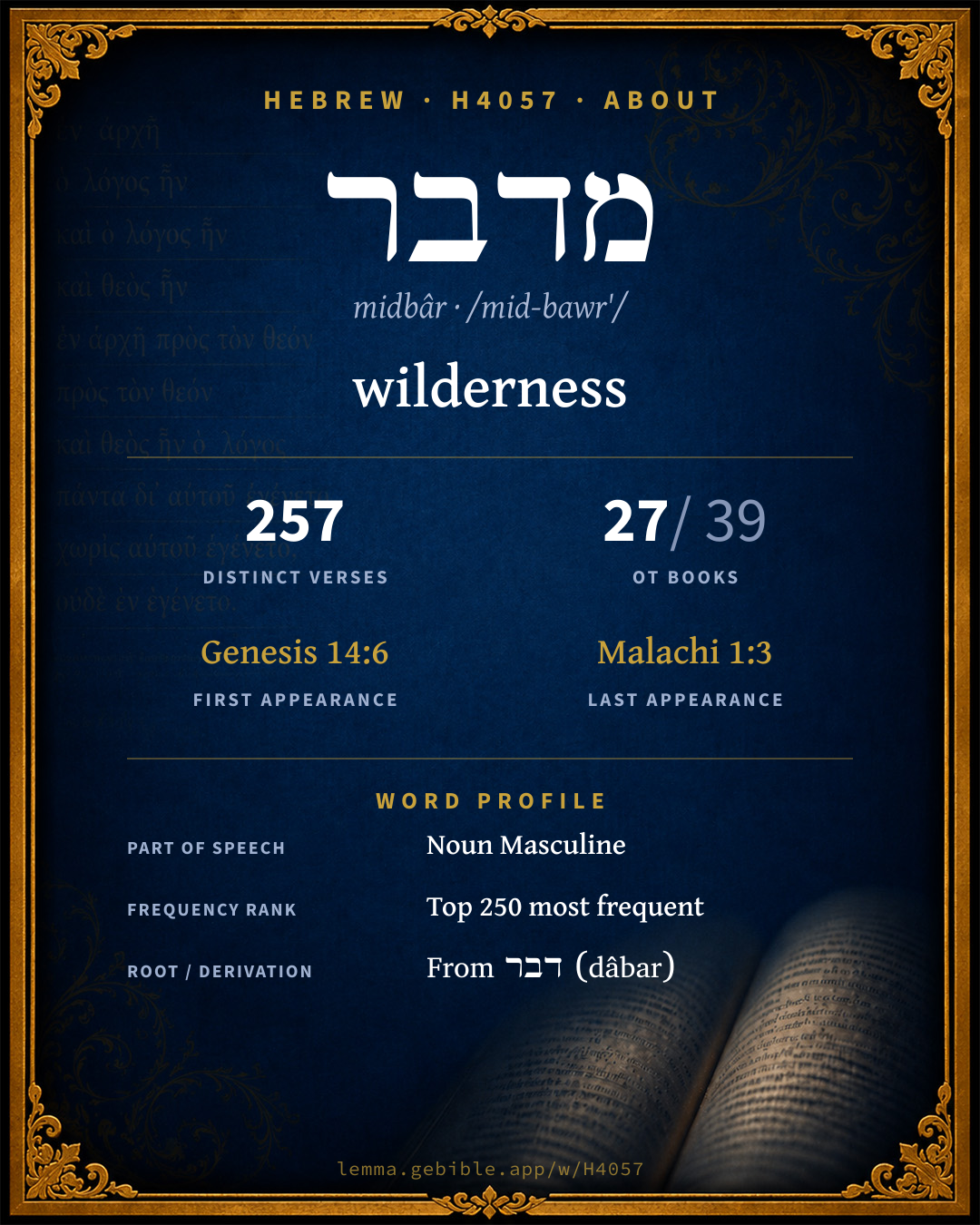
מִדְבָּר
wilderness
‘wilderness’ is one of 2 main senses fuller range ↓
Full lexicon entry — Brown-Driver-Briggs (BDB)
From Brown-Driver-Briggs (BDB)
Where this word appears
See every Absolute-state word in the Hebrew Bible →
Grammar key — what these labels mean
Part of speech
- Noun
- A naming word — a person, place, thing, or idea.
Noun type
- Common
- A common noun — a general class of person, place, or thing (“king,” “city,” “water”), not a specific name.
State
- Absolute
- The independent form of a noun, not bound to a following word.
- Construct
- A noun bound to a following noun in a possessive / “of” relationship (the construct chain).
Gender
- Masculine
- Grammatically masculine.
Number
- Singular
- One.
Every verse where H4057 appears in the Book of Numbers — 44 distinct verses. Click any verse to open its interlinear word-by-word view. Verse text shown in the World English Bible for context — . Each verse’s Hebrew form is shown with its reference; the English is not keyword-highlighted, since the data carries no word-level English alignment. Use “Compare translations” on any verse to read it across multiple English versions. This concordance covers the Hebrew Bible; Septuagint (Greek Old Testament) occurrences are not indexed here.
Numbers
- Numbers 1:1 בְּ/מִדְבַּ֥ר prep + n c ms cs Yahweh spoke to Moses in the wilderness of Sinai, in the Tent of Meeting, on the first day of the second month, in the second year after they had come out of the land of Egypt, saying,
- Numbers 1:19 בְּ/מִדְבַּ֥ר prep + n c ms cs As Yahweh commanded Moses, so he numbered them in the wilderness of Sinai.
- Numbers 3:4 בְּ/מִדְבַּ֣ר prep + n c ms cs Nadab and Abihu died before Yahweh, when they offered strange fire before Yahweh, in the wilderness of Sinai, and they had no children. Eleazar and Ithamar ministered in the priest's office in the presence of Aaron their father.
- Numbers 3:14 בְּ/מִדְבַּ֥ר prep + n c ms cs Yahweh spoke to Moses in the wilderness of Sinai, saying,
- Numbers 9:1 בְ/מִדְבַּר prep + n c ms cs Yahweh spoke to Moses in the wilderness of Sinai, in the first month of the second year after they had come out of the land of Egypt, saying,
- Numbers 9:5 בְּ/מִדְבַּ֣ר prep + n c ms cs They kept the Passover in the first month, on the fourteenth day of the month, at evening, in the wilderness of Sinai. According to all that Yahweh commanded Moses, so the children of Israel did.
- Numbers 10:12 מִ/מִּדְבַּ֣ר בְּ/מִדְבַּ֥ר prep + n c ms cs prep + n c ms cs The children of Israel set forward according to their journeys out of the wilderness of Sinai; and the cloud abode in the wilderness of Paran.
- Numbers 10:31 בַּ/מִּדְבָּ֔ר prep det + n c ms He said, Don't leave us, please; because you know how we are to encamp in the wilderness, and you shall be to us instead of eyes.
- Numbers 12:16 בְּ/מִדְבַּ֥ר prep + n c ms cs Afterward the people traveled from Hazeroth, and encamped in the wilderness of Paran.
- Numbers 13:3 מִ/מִּדְבַּ֥ר prep + n c ms cs Moses sent them from the wilderness of Paran according to the commandment of Yahweh: all of them men who were heads of the children of Israel.
- Numbers 13:21 מִ/מִּדְבַּר prep + n c ms cs So they went up, and spied out the land from the wilderness of Zin to Rehob, to the entrance of Hamath.
- Numbers 13:26 מִדְבַּ֥ר n c ms cs They went and came to Moses, and to Aaron, and to all the congregation of the children of Israel, to the wilderness of Paran, to Kadesh; and brought back word to them, and to all the congregation, and shown them the fruit of the land.
- Numbers 14:2 בַּ/מִּדְבָּ֥ר prep det + n c ms All the children of Israel murmured against Moses and against Aaron: and the whole congregation said to them, Would that we had died in the land of Egypt! or would that we had died in this wilderness!
- Numbers 14:16 בַּ/מִּדְבָּֽר prep det + n c ms Because Yahweh was not able to bring this people into the land which he swore to them, therefore he has slain them in the wilderness.
- Numbers 14:22 וּ/בַ/מִּדְבָּ֑ר conj + prep det + n c ms because all those men who have seen my glory, and my signs, which I worked in Egypt and in the wilderness, yet have tempted me these ten times, and have not listened to my voice;
- Numbers 14:25 הַ/מִּדְבָּ֖ר ptcl def.art + n c ms Now the Amalekite and the Canaanite dwell in the valley: tomorrow turn you, and get you into the wilderness by the way to the Red Sea.
- Numbers 14:29 בַּ/מִּדְבָּ֣ר prep det + n c ms your dead bodies shall fall in this wilderness; and all who were numbered of you, according to your whole number, from twenty years old and upward, who have murmured against me,
- Numbers 14:32 בַּ/מִּדְבָּ֥ר prep det + n c ms But as for you, your dead bodies shall fall in this wilderness.
- Numbers 14:33 בַּ/מִּדְבָּר֙ בַּ/מִּדְבָּֽר prep det + n c ms prep det + n c ms Your children shall be wanderers in the wilderness forty years, and shall bear your prostitution, until your dead bodies be consumed in the wilderness.
- Numbers 14:35 בַּ/מִּדְבָּ֥ר prep det + n c ms I, Yahweh, have spoken, surely this will I do to all this evil congregation, who are gathered together against me: in this wilderness they shall be consumed, and there they shall die.
- Numbers 15:32 בַּ/מִּדְבָּ֑ר prep det + n c ms While the children of Israel were in the wilderness, they found a man gathering sticks on the Sabbath day.
- Numbers 16:13 בַּ/מִּדְבָּ֑ר prep det + n c ms is it a small thing that you have brought us up out of a land flowing with milk and honey, to kill us in the wilderness, but you must needs make yourself also a prince over us?
- Numbers 20:1 מִדְבַּר n c ms cs The children of Israel, even the whole congregation, came into the wilderness of Zin in the first month: and the people abode in Kadesh; and Miriam died there, and was buried there.
- Numbers 20:4 הַ/מִּדְבָּ֖ר ptcl def.art + n c ms Why have you brought the assembly of Yahweh into this wilderness, that we should die there, we and our animals?
- Numbers 21:5 בַּ/מִּדְבָּ֑ר prep det + n c ms The people spoke against God, and against Moses, Why have you brought us up out of Egypt to die in the wilderness? for there is no bread, and there is no water; and our soul loathes this light bread.
- Numbers 21:11 בַּ/מִּדְבָּר֙ prep det + n c ms They traveled from Oboth, and encamped at Iyeabarim, in the wilderness which is before Moab, toward the sunrise.
- Numbers 21:13 בַּ/מִּדְבָּ֔ר prep det + n c ms From there they traveled, and encamped on the other side of the Arnon, which is in the wilderness, that comes out of the border of the Amorites: for the Arnon is the border of Moab, between Moab and the Amorites.
- Numbers 21:18 וּ/מִ/מִּדְבָּ֖ר conj + prep + n c ms The well, which the princes dug, Which the nobles of the people dug, With the scepter, [and] with their poles. From the wilderness [they traveled] to Mattanah;
- Numbers 21:23 הַ/מִּדְבָּ֔רָ/ה ptcl def.art + n c ms + sfx dem Sihon would not allow Israel to pass through his border: but Sihon gathered all his people together, and went out against Israel into the wilderness, and came to Jahaz; and he fought against Israel.
- Numbers 24:1 הַ/מִּדְבָּ֖ר ptcl def.art + n c ms When Balaam saw that it pleased Yahweh to bless Israel, he didn't go, as at the other times, to meet with enchantments, but he set his face toward the wilderness.
- Numbers 26:64 בְּ/מִדְבַּ֥ר prep + n c ms cs But among these there was not a man of them who were numbered by Moses and Aaron the priest, who numbered the children of Israel in the wilderness of Sinai.
- Numbers 26:65 בַּ/מִּדְבָּ֑ר prep det + n c ms For Yahweh had said of them, They shall surely die in the wilderness. There was not left a man of them, save Caleb the son of Jephunneh, and Joshua the son of Nun.
- Numbers 27:3 בַּ/מִּדְבָּר֒ prep det + n c ms Our father died in the wilderness, and he was not among the company of those who gathered themselves together against Yahweh in the company of Korah: but he died in his own sin; and he had no sons.
- Numbers 27:14 בְּ/מִדְבַּר מִדְבַּר prep + n c ms cs n c ms cs because you rebelled against my word in the wilderness of Zin, in the strife of the congregation, to sanctify me at the waters before their eyes. (These are the waters of Meribah of Kadesh in the wilderness of Zin.)
- Numbers 32:13 בַּ/מִּדְבָּ֔ר prep det + n c ms Yahweh's anger was kindled against Israel, and he made them wander back and forth in the wilderness forty years, until all the generation, who had done evil in the sight of Yahweh, was consumed.
- Numbers 32:15 בַּ/מִּדְבָּ֑ר prep det + n c ms For if you turn away from after him, he will yet again leave them in the wilderness; and you will destroy all this people.
- Numbers 33:6 הַ/מִּדְבָּֽר ptcl def.art + n c ms They traveled from Succoth, and encamped in Etham, which is in the edge of the wilderness.
- Numbers 33:8 הַ/מִּדְבָּ֑רָ/ה בְּ/מִדְבַּ֣ר ptcl def.art + n c ms + sfx dem prep + n c ms cs They traveled from before Hahiroth, and passed through the midst of the sea into the wilderness: and they went three days' journey in the wilderness of Etham, and encamped in Marah.
- Numbers 33:11 בְּ/מִדְבַּר prep + n c ms cs They traveled from the Red Sea, and encamped in the wilderness of Sin.
- Numbers 33:12 מִ/מִּדְבַּר prep + n c ms cs They traveled from the wilderness of Sin, and encamped in Dophkah.
- Numbers 33:15 בְּ/מִדְבַּ֥ר prep + n c ms cs They traveled from Rephidim, and encamped in the wilderness of Sinai.
- Numbers 33:16 מִ/מִּדְבַּ֣ר prep + n c ms cs They traveled from the wilderness of Sinai, and encamped in Kibroth-hattaavah.
- Numbers 33:36 בְ/מִדְבַּר prep + n c ms cs They traveled from Ezion Geber, and encamped in the wilderness of Zin (the same is Kadesh).
- Numbers 34:3 מִ/מִּדְבַּר prep + n c ms cs then your south quarter shall be from the wilderness of Zin along by the side of Edom, and your south border shall be from the end of the Salt Sea eastward;
About this entry
At a glance — auto-summarized from this page’s data, not written by a person. Every figure links to its source below. This summary describes the numbers; it doesn’t interpret them.
At its core, מדבר (midbâr) means “wilderness.” It first appears in Genesis 14:6. It turns up in 257 verses across 27 books, a common footprint. Not a single-sense word: explore its full sense range. It clusters with דבר, דבורה and דביר under a shared root. Dig into 257-verse concordance and the renderings breakdown below.
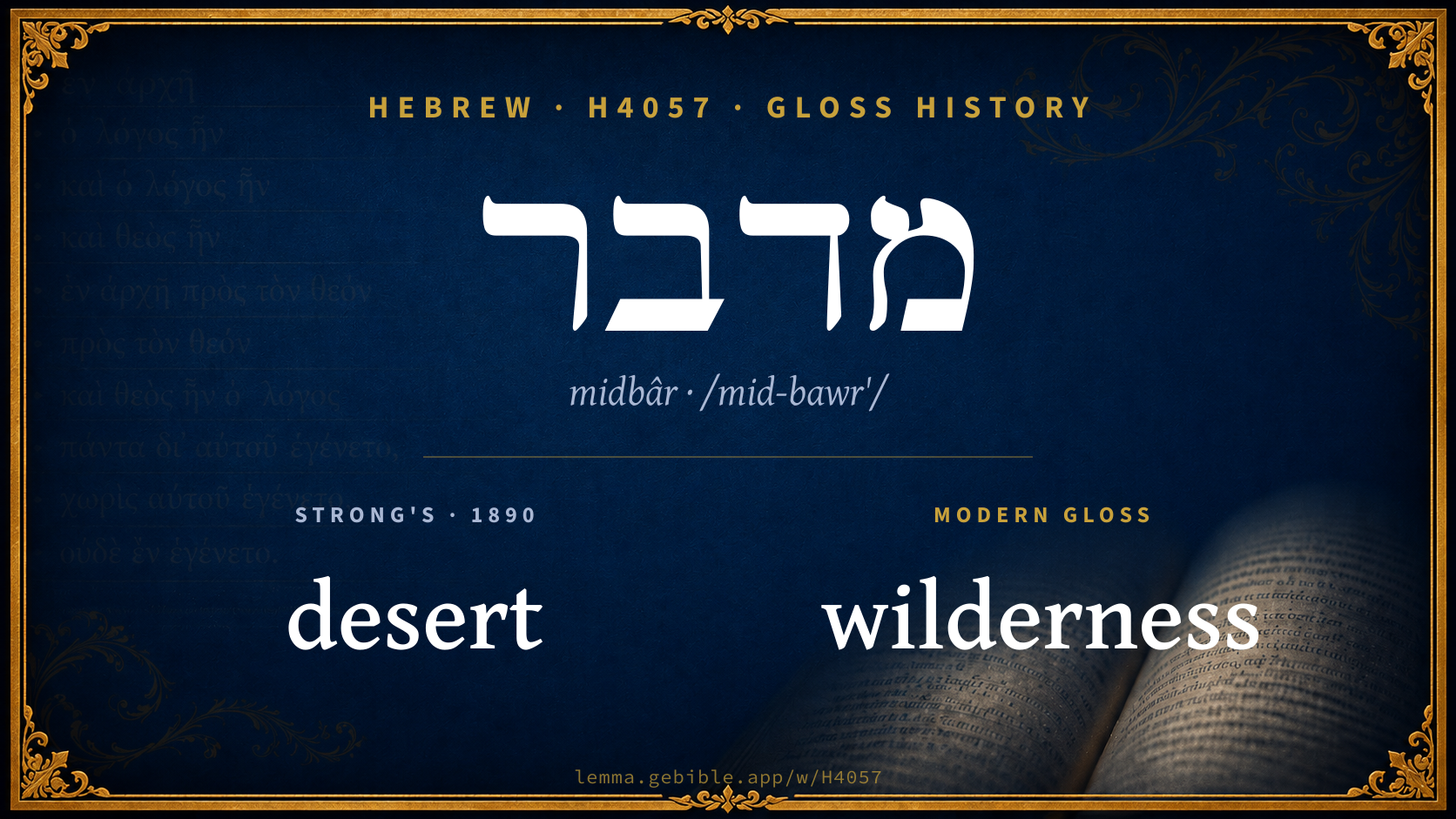
Gloss history
Strong's 1890 vs modern scholarship
About this word
Strong's H4057 catalogs a Hebrew word from the Hebrew Old Testament.
These counts are not copied from any lexicon or concordance. They are computed here, from the morphology-tagged Hebrew Old Testament. What Lemma adds →
- 257
- distinct verses
- The word appears in 257 distinct verses.
- 27 / 39
- OT books
- The word appears in 27 of 39 Old Testament books.
- #183
- by frequency
- Top 250 most frequent Hebrew words (rank 183 of 8,640 Hebrew words by occurrence).
View all 257 occurrences in the concordance →
By section of the Old Testament
By traditional corpus
Conventional, traditional groupings — biblical authorship is debated, so this is a traditional corpus grouping, not an authorship claim. Each share is this word’s portion of its verses in that division of the Hebrew canon. Each figure is a share of the word’s 257 distinct verses.
- Prophets (Nevi'im) 117 verses · 46%
- Torah (Pentateuch) 99 verses · 39%
- Writings (Ketuvim) 41 verses · 16%
How translations render this word
Counts come from each version’s own published word-to-Strong’s tagging or interlinear alignment — an approximate guide to how each version renders this word, not a word-level alignment the data otherwise carries. Because each total is that version’s own tagged count, the per-version totals vary from one another and need not match the appearance or distinct-verse counts above. These counts may also differ from a printed concordance because Lemma counts each distinctly tagged rendering and does not collapse phrase taggings into a single head-word total. This is a fixed set of word-tagged versions (KJV, ASV, BSB, ULT) and does not change with the reading translation you choose elsewhere. Each version’s license is shown beside its name below (and on Sources).
BDB lists this Strong’s number as 2 distinct words (homographs). Each count above pools all of them and is not split by sense — see the Senses section below. A low-frequency rendering may belong to a different one of those words, not the primary meaning.
- King James Version†: Wilderness 207×, Desert 13×, Through the wilderness 9×
- American Standard Version†: Wilderness 212×, Toward the wilderness 5×, Through the wilderness 3×
- Berean Standard Bible†: Wilderness 194×, Desert 44×, Through the wilderness 5×
- unfoldingWord Literal Text†: Wilderness 201×, Wilderness of 39×, Desert 6×
King James Version Public Domain
Renders H4057 across 270† tagged occurrences — most commonly:
Plus 23 renderings that appear only once — usually multi-word phrases or single function words the recovered tagging swept in, not distinct renderings. Not rendered by a distinct English word in 1 further occurrence.
American Standard Version Public Domain
Renders H4057 across 269† tagged occurrences — most commonly:
Plus 39 renderings that appear only once — usually multi-word phrases or single function words the recovered tagging swept in, not distinct renderings.
Berean Standard Bible Public Domain
Renders H4057 across 269† tagged occurrences — most commonly:
Plus 16 renderings that appear only once — usually multi-word phrases or single function words the recovered tagging swept in, not distinct renderings. Not rendered by a distinct English word in 2 further occurrences.
unfoldingWord Literal Text CC BY-SA 4.0
Renders H4057 across 276† tagged occurrences — most commonly:
Plus 14 renderings that appear only once — usually multi-word phrases or single function words the recovered tagging swept in, not distinct renderings.
Senses in the full BDB
What do BDB’s symbols mean?
BDB uses these scholarly abbreviations:
| Symbol | Meaning |
|---|---|
| 𝔊 | the Septuagint (the ancient Greek translation, LXX) |
| 𝔙 | the Vulgate (the Latin translation) |
| 𝔖 | the Syriac version (the Peshitta) |
| 𝔗 | the Targum (the Aramaic translation) |
| ψ | the Psalms |
| √ | root (the underlying root or stem) |
| ‖ | parallel passage (a synonymous or contrasted parallel) |
| † | the dagger: every passage where the word occurs is cited |
The 4 senses and sub-senses the full Brown-Driver-Briggs lexicon distinguishes for this word, in lexicon order (not ranked by frequency), with BDB’s own verbatim wording and sub-sense lettering. Shown in Hebrew script with BDB’s own scholarly abbreviations. The condensed entry is in the Lexicon Entry tab. See also the Forms in the corpus table below.
מדבר I mouth, as organ of speech,
מדבר II wilderness
- 1. tracts of land, used for the pasturage of flocks and herds, דָּֽשְׁאוּ נְאוֹת מִדְבָּר the pastures of the wilderness put forth green grass Jo 2:22; יִרְעֲפוּ נ׳ מ׳ the pastures of the wilderness drop (fertility) ψ 65:13; יָֽבְשׁוּ נ׳ מ׳ are dried up Je 23:10, cf. Je 9:9 Jo 1:19, 20. e.g. Joel 2:22
- 2. uninhabited land, מִדְבָּר לֹא־אָדָם בּוֹ wilderness in which is no man Jb 38:26; the abode of pelicans ψ 102:7; wild asses Jb 24:5 Je 2:24; jackals Mal 1:3; ostriches Lam 4:3; מִי־יִתְּנֵנִי בַמִּדְבָּר מְלוֹן אֹרְחִים וְאֶֽעֶזְבָה אֶת־עַמִּי O that I had in the wilderness a lodging place of wayfarers, that I might leave my people Je 9:1; טוֹב שֶׁבֶת בְּאֶרֶץ מִדְבָּר better to dwell in a desert land, than with a contentious woman Pr 21:19; בְּאֶרֶץ מִדְבָּר וּבְתֹהוּ יְלֵל יְשִׁמֹן in a desert land, and in a waste howling wilderness Dt 32:10. e.g. Job 38:26
- 3. large tracts of such land bearing various names, in certain districts of which there might be towns and cities: יִשְׂאוּ מִדְבָּר וְעָרָיו חֲצֵרִים תֵּשֵׁב קֵדָר let the wilderness and its cities lift up (their voice), the villages that Kedar doth inhabit Is 42:11. There were six cities in the wilderness of Judah Jos 15:61, 62; הַמִּדְבָּר usually = wilderness of the wanderings Gn 14:6 Nu 14:16, 29, 32, 33(×2) +, or the great Arabian desert Ju 11:22 +; but may also refer to any other Ct 3:6; 8:5. Special tracts—(a) of the wilderness of the wanderings were מ׳ שׁוּר Ex 15:22, סין Ex 16:1 +, סיני Ex 19:1 +, פארן Nu 13:26 +, צן Nu 20:1 +, קדשׁ ψ 29:8, אתם Nu 33:8; (b) in W. Pal. מ׳ יהודה Ju 1:16 ψ 63:1 cf. Jos 15:61, מעוֹן 1 S 23:24, 25, זיף 1 S 23:15; 26:2, באר שׁבע Gn 21:14, עין גדי 1 S 24:2, תקוע 2 Ch 20:20, ירואל 2 Ch 20:16, גבעון 2 S 2:24; (c) in East. Palestine מואב Dt 2:8, אדום 2 K 3:8, קדמות Dt 2:26. e.g. Isaiah 42:11
- 4. fig. וְשַׂמְתִּיהָ כַמִּדְבָּר וְשַׁתִּהָ כְּאֶרֶץ צִיָּה and (lest I) make her as a wilderness and set her like a dry land Ho 2:5; הֲמִדְבָּר הָיִיתִי לְיִשְׂרָאֵל have I been a wilderness to Israel? Je 2:31. e.g. Hosea 2:5
Senses from the full Brown-Driver-Briggs lexicon (Brown, Driver, Briggs; Oxford 1906 — public domain), digitized via Sefaria, supplemented by the OpenScriptures HebrewLexicon (CC BY 4.0). Full attribution on Sources.
Word origin
I. n.m. mouth, as organ of speech,—מִדְבָּרֵךְ נָאוֶה thy mouth is lovely Ct 4:3 ‖שִׂפְתוֹתַיִךְ, 𝔊 λαλιά, Jer eloquium.
II. n.m. wilderness—Dt 32:10 +; c. ה loc. מִדְבָּ֫רָה Jos 18:12 + 15 times; cstr. Ex 15:22 +; מִדְבַּ֫רָה 1 K 19:15; sf. מִדְבָּרָהּ Is 51:3;—
— Brown-Driver-Briggs (Oxford 1906, public domain), digitized via Sefaria, supplemented by the OpenScriptures HebrewLexicon (CC BY 4.0). See Sources.
Derived from דבר (dâbar) (H1696) — to speak.
Jastrow Dictionary
A second Hebrew/Aramaic lexicon for comparison, covering Aramaic and post-biblical (Talmudic, Targumic, Midrashic) usage that the biblical-Hebrew BDB does not. Matched by lemma rather than by Strong’s number, so a lemma may carry more than one Jastrow headword (shown separately below), and the entries cover usage well beyond the Bible.
דָּבַר
- (b. h.) to join, arrange, lead (the flock); v. next w.
- (b. h.) to converse, speak. Ber. 31ᵇ, a. fr. דִּבְּרָה תורה כלשון ב"א the Torah speaks according to the language of men, i.e. uses metaphors and phrases adapted to human understanding. Sot. 12ᵇ שעתיד לְדַבֵּר וכ׳ destined to speak to Divinity. Ter. I, 2 חרש שדִּבְּרוּ … מְדַבֵּר wherever the scholars use the word ḥērēsh, they mean one who neither hears nor talks. Mekh. Bo 7, end, a. fr. או אינו מְדַבֵּר אלא ב־ or does perhaps the text speak only of—? [מְדַבֵּר as a noun, v. s. v.].
- to hold communion, converse. Mekh. Bo, introd. לא נ׳ עמו וכ׳ the Lord did not hold communion with him outside the capital of Egypt. Ib. fr.
- , same, esp. part. f. מִדַּבֶּרֶת being on terms of intimacy with a man. Keth. I, 8 ראוה מד׳ עם אחד (omit בשוק); expl. ib. 13ᵃ. Ib. VII, 6 מד׳ עם כל אדם she is intimate with everybody. Ib. לכשהיא מד׳ בתוך ביתה וכ׳ when her neighbors can hear her voice in moments of intimacy with her husband.
- to make submissive, persuade, v. דִּיבּוּר. Macc. 11ᵃ דִבֵּר לחוד יַדְבֵּר לחוד the Piel dibber has one meaning (speaking harshly), and the Hif. yadber another.
דְּבַר
- 1. to seize, take, lead, drive. Targ. Gen. XIX, 15; a. fr. (h. לקח).—Ib. XXXI, 18; a. fr. (h. נהג).
- 2. to conduct one’s self (cmp. נָהַג). Erub. 14ᵇ, a. e. פוק חזי מאי עמא ד׳ go out and see how the people conduct themselves (what the religious usage is). Koh. R. to IX, 10, v. כְּלוּם.
- 1. to lead, drive. Targ. O. Ex. III, 1 ed. Berl. (ed. דְּבַר). Ib. XIV, 21 (ed. דְּבַר, h. text ויולך). Targ. Ez. XVI, 12; a. e.—Keth. 62ᵇ sq. עד כמה קא מְדַבְּרַת אלמנות חיים how long yet wilt thou lead a life of living widowhood (separation from a living husband)?
- 2. to carry off. Targ. Ezek. XXXIII, 6; a. e.
- to take, lead. Targ. Is. XIV, 2; a. fr.—Bets. 21ᵇ אַדְבְּרֵיה וכ׳ took him out on a walk; ib. 29ᵃ. Y. Yeb. XIII, 13ᶜ bot. מַדְבְּרוּן לה גבר they introduce to her a suitor.
- 1. to be seized, taken away. Targ. Prov. XXIV, 11. Targ. Ez. XXXIII, 6. Targ. II Kings II, 9 sq.; a. e.
- 2. to conduct one’s self. Targ. Gen. XXXIII, 14 אֵידַבַּר ed. Berl. (h. text אתנהלה).
דָּבָר
- preced.)
- 1. word, utterance, command (cmp. דִּיבּוּר). B. Bath. 56ᵇ (ref. to Deut. XIX, 15) ד׳ ולא חצי ד׳ a statement (testimony) but not a partial statement. Mekh. Bo, introd. היה הד׳ לאהרן (Tanḥ. ib. 5 דבור) the word of the Lord came to &c.; a. fr.—דְּבַר תורה according to the Biblical law. Erub. 81; a. fr.—Pl. דְּבָרִים, constr. דִּבְרֵי. ד׳ תורה Biblical laws; ד׳ סופרים Rabbinical laws. Ib. Yeb. IX, 3; a. fr.—ד׳ קבלה prophetic exhortations or incidental utterances in other Biblical books than the Pentateuch. Ḥag. 10ᵇ; Nidd. 23ᵃ; a. e.—B. Mets. 49ᵃ; Bekh. 13ᵇ ד׳ יש בהם משום מחוסרי אמנה to word of mouth the rules concerning the faithless are applied, i.e. a verbal agreement is morally binding. B. Mets. 48ᵃ הנושא ונותן בד׳ וכ׳ he who contracts verbally has no legal claim. Ib. ד׳ ואיכא … קאי באבל he who retracts a verbal transaction with which a payment of money was connected, comes under the category of those against whom the words ‘but the scholars declared’ (ib. IV, 2) has been pronounced.—דִּבְרֵי הַיָּמִים the Book of Chronicles. Lev. R. s. 1. B. Bath. 14ᵇ.—דָּבָר אַחֵר (abbrev. ד"א) another interpretation (is this). Gen. R. s. 1, beg.; a. fr.—2) thing, affair, object, occurrence &c. Sot. 28ᵇ ד׳ שיש בו דעת לישאל an object which has sense to ask, i.e. a rational being, opp. ד׳ שאין וכ׳ dumb creatures &c.—Num. R. s. 11 ד׳ שבינך לבינו that which concerns only thy relation to God; v. בֵּין.—ד׳ שבממון a monetary affair. B. Mets. 94ᵃ; a. fr.—ד׳ הלמד מענינו a thing (law) derived from the context on the very subject. Sifra, introd.; a. fr.—ד׳ אחר (abbr. ד"א) something not to be named, a) idolatry. Men. XIII, 10 ואין צריך לומר לד"א much less priests who have been offering to idols; a. fr.—b) swine. Ber. 43ᵇ (prov.) תלה ליה קורא לד"א וכ׳ hang a palm shoot around the swine and it will follow its habits (of wallowing in the mud). Sabb. 129ᵃ sq.; a. e.—c) leprosy Ib. אי פגע בד"א קשה לד"א if he meets a swine (after blood letting), he is in danger of becoming a leper.—d) unchaste conduct, sexual intercourse, sodomy &c. Ib. 17ᵇ על בנותיהן משום ד"א ועל ד"א משום ד"א they forbade connection with their daughters on account of idolatry, and decreed something else (that a gentile child should be unclean as though afflicted with gonorrhœa) on account of sodomy. Ber. 8ᵇ צנועין בד"א chaste in marital life; a. fr.—Pl. as above.—בעל ד׳ the person to deal with, opponent, party. B. Mets. 14ᵃ לאו ב"ד דידי את I have nothing to do with thee; a. fr.—לא היו ד׳ מעולם there were no such things, I deny it outright. Shebu. 41ᵇ; a. fr.—ד׳ בגב, ד׳ בגו, v. גַּב, גֵּו. e.g. Deuteronomy 19:15
דֶּבֶר
- , esp. Targ. Ez. XXXIII, 6) death, pestilence. Ab. V, 8. Sabb. 33ᵃ; a. fr.—Esp. the plague of pestilence in Egypt. Ex. R. s. 12. Tanḥ. Vaëra 14; a. fr.
דַּבָּר
- (דבר) leader.—Pl. דַּבָּרִין. Snh. 8ᵃ ד׳ אחד וכ׳ a generation must have one leader, but not two.
מְדַבֵּר
- (דָּבַר)
- 1. speaker.—Pl. מְדַבְּרִים. Ber. 63ᵇ, a. e. ראש המ׳ וכ׳ the first among the speakers on all occasions (attribute of R. Judah).–
- 2. the anterior part of the tongue. Bekh. VI, 8; Tosef. ib. IV, 11; Kidd. 25ᵃ
מִדְבָּר
- v. דְּבַר) pasture-ground, desert. Gen. R. s. 31, end. Cant. R. to IV, 4 (play on מדברך ib. 3) אע"פ שהוא מ׳וכ׳ although the Temple is a desert, you are bound to observe the sacredness of its precincts now that it is ruined &c.; a. fr.—מֵתֵי מ׳ the generation that died in the wilderness. B. Bath. 73ᵇ bot.; a. fr.—Tosef. Macc. III (II), 2; Macc. 9ᵇ; Y. ib. II, 31ᵈ top בצר במ׳ (b. h.) Bezer in the Wilderness, on the eastern side of the Jordan.—Tosef. Men. IX, 13 כבשים ממ׳, read: ממִדְבַּר חברון from the pasture-ground of Hebron; v. Men. 87ᵃ; Sot. 34ᵇ.—Pl. מִדְבָּרוֹת. Ber. IX, 2. Ib. 54ᵇ הולכי מ׳ those travelling in the deserts; a. e.
A Dictionary of the Targumim, the Talmud Babli and Yerushalmi, and the Midrashic Literature (Marcus Jastrow; London, Luzac, 1903) — Public Domain. Digitized via Sefaria. Digitized via Sefaria. Full attribution on Sources.
Forms in the corpus
The 82 distinct written forms H4057 takes in the Hebrew Bible, most frequent first — each parse links to that state’s occurrences in the concordance. Hebrew forms include their vowel points and cantillation, so a single lemma takes many written forms.
The 60 most common forms are shown; 22 rarer forms follow in the full concordance.
Same root — word family
Other BDB entries built from the same root as H4057, grouped by Strong’s listed origin. These share a root / origin per the lexicon — not necessarily a shared meaning. Each links to that word’s own entry.
Derives from
Shares the same root
- דבורה dᵉbôwrâh H1682 bee
- דביר dᵉbîyr H1687 holy of holies
- דבר dâbâr H1697 word
- דבר deber H1698 pestilence
- דבר dôber H1699 pasture
- דברה dôbᵉrâh H1702 raft
- דברה dabbârâh H1703 word
Compare all same-root words → Showing 4 of 9 — not the complete family. They share a root, not necessarily a meaning.
Septuagint verse parallels
This word appears in 242 verses that also exist in the Greek Old Testament (Septuagint), out of the 257 Hebrew verses it occurs in. You can read those verses in Greek by switching the Old Testament edition to the Septuagint.
Read these verses in the Septuagint
- Genesis 14:6
- Exodus 3:1
- Leviticus 7:38
- Numbers 1:1
- Deuteronomy 1:1
- Joshua 1:4
- Judges 1:16
- 1 Samuel 4:8
- 2 Samuel 2:24
- 1 Kings 2:34
- 2 Kings 3:8
- 1 Chronicles 5:9
This is a verse-level parallel only — the same verses exist in both the Hebrew and Greek Old Testaments. No word-level Hebrew↔Greek correspondence is claimed: the data carries no such alignment, so no Greek word is shown as this Hebrew word’s translation. Coverage is not total — the Septuagint omits the deuterocanon and renumbers the Psalms, so some Hebrew verses have no direct Greek parallel.