
Deuteronomy 8:16

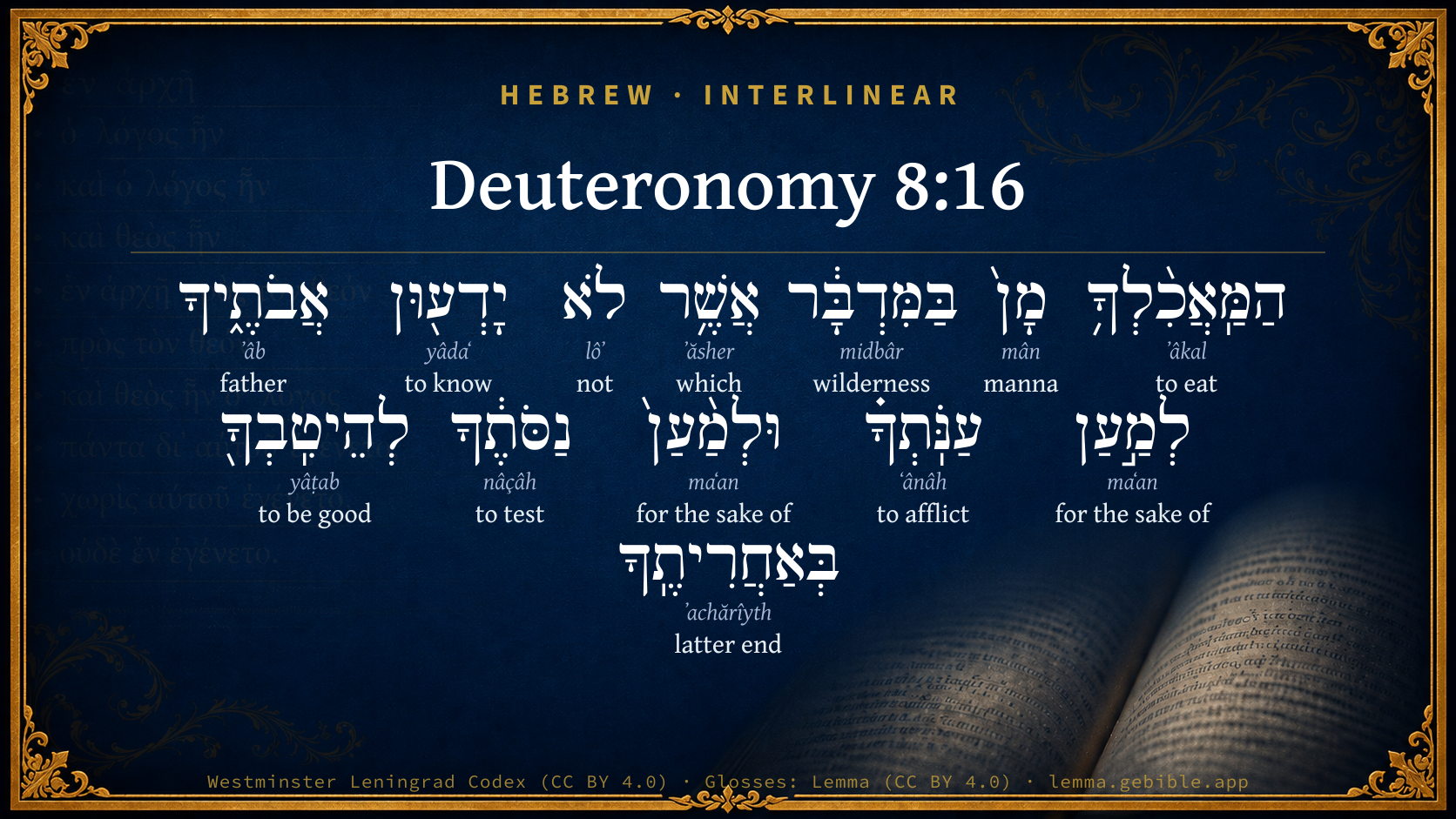
Hebrew (Westminster Leningrad Codex) Deuteronomy 8:16 appears in the Hebrew Old Testament. The text above is from the Westminster Leningrad Codex. Each word links to its Strong’s number, a concise gloss, and parsing drawn from the Open Scriptures Hebrew Bible morphology. Click any word for its full Brown-Driver-Briggs (BDB) entry.
Download image
Cite this verse

Deuteronomy 8:16 (World English Bible). Public Domain. Lemma interlinear Bible study tool, https://lemma.gebible.app/v/deuteronomy/8/16.

Show BibTeX & RIS
BibTeX
RIS
English Translation
who fed you in the wilderness with manna, which your fathers didn't know; that he might humble you, and that he might prove you, to do you good at your latter end:
World English Bible · Public Domain
Download a study sheet

One document with this verse’s original text, its word-by-word gloss line, the meaning frame, cross-references with their text, attributed commentary, and full source and license credits — printable, and it pastes into notes with its structure intact.

This verse Autodidact and up

Study sheet (.html) Plain text (.txt)

A passage Seminary Student

Up to 50 verses in one chapter. A passage sheet keeps up to 6 commentary sources and 12 cross-references per verse, in the order this page ranks them, and says so on the sheet whenever that leaves anything out. Ask for a single verse and you get the Autodidact verse sheet above.

Everything on this page stays free to read, with no account — the sheet is a download of what is already on screen, not access to it.

Want to remove ads? Support Godless Engineer
Compare translations 3

The same verse in 3 English versions, stacked beneath the original-language interlinear above. Click any original word for its lexicon entry.

Each is an independent rendering of the whole verse — the interlinear is not word-aligned to these translations.

Highlighted words mark where these versions differ — a whole-verse word diff, not a word-by-word alignment.

  • World English Bible Public Domain
    who fed you in the wilderness with manna, which your fathers didn't know; that he might humble you, and that he might prove you, to do you good at your latter end:
  • King James Version Public Domain
    Who fed thee in the wilderness with manna, which thy fathers knew not, that he might humble thee, and that he might prove thee, to do thee good at thy latter end;
  • unfoldingWord Literal Text CC BY-SA 4.0
    He fed you manna in the wilderness that your fathers had not known so that he might humble you and so that he might test you, to do you good in your end.

unfoldingWord Literal Text — © unfoldingWord, licensed CC BY-SA 4.0. Word-aligned USFM3 via Door43 (git.door43.org/unfoldingWord/en_ult).

Versions to compare (up to 4)

3 of 4 selected

Show all 18 translations

Every available English version of this verse, each an independent rendering of the whole verse.

  • World English Bible Public Domain
    who fed you in the wilderness with manna, which your fathers didn't know; that he might humble you, and that he might prove you, to do you good at your latter end:
  • Berean Standard Bible Public Domain
    He fed you in the wilderness with manna that your fathers had not known, in order to humble you and test you, so that in the end He might cause you to prosper.
  • Majority Standard Bible Public Domain
    He fed you in the wilderness with manna that your fathers had not known, in order to humble you and test you, so that in the end He might cause you to prosper.
  • King James Version Public Domain
    Who fed thee in the wilderness with manna, which thy fathers knew not, that he might humble thee, and that he might prove thee, to do thee good at thy latter end;
  • American Standard Version (1901) Public Domain
    who fed thee in the wilderness with manna, which thy fathers knew not; that he might humble thee, and that he might prove thee, to do thee good at thy latter end:
  • Revised Version (1885) Public Domain
    who fed thee in the wilderness with manna, which thy fathers knew not; that he might humble thee, and that he might prove thee, to do thee good at thy latter end:
  • Geneva Bible (1599) Public Domain
    Who fed thee in the wildernesse with MAN, which thy fathers knewe not) to humble thee, and and to proue thee, that he might doe thee good at thy latter ende.
  • Douay-Rheims (1899) Public Domain
    And fed thee in the wilderness with manna which thy fathers knew not. And after he had afflicted and proved thee, at the last he had mercy on thee,
  • Young's Literal Translation Public Domain
    who is causing thee to eat manna in the wilderness, which thy fathers have not known, in order to humble thee, and in order to try thee, to do thee good in thy latter end),
  • Literal Standard Version CC BY-SA 4.0
    who is causing you to eat manna in the wilderness, which your fathers have not known, in order to humble you, and in order to try you, to do you good in your latter end;
  • Unlocked Literal Bible CC BY-SA 4.0
    He fed you in the wilderness with manna that your ancestors had never known, so that he might humble you and test you, to do you good in the end,
  • unfoldingWord Literal Text CC BY-SA 4.0
    He fed you manna in the wilderness that your fathers had not known so that he might humble you and so that he might test you, to do you good in your end.
  • Darby Bible Public Domain
    who fed thee in the wilderness with manna, which thy fathers knew not, that he might humble thee, and that he might prove thee, to do thee good at thy latter end;
  • World Messianic Bible Public Domain
    who fed you in the wilderness with manna, which your fathers didn’t know, that he might humble you, and that he might prove you, to do you good at your latter end;
  • Webster's Bible Public Domain
    Who fed thee in the wilderness with manna, which thy fathers knew not, that he might humble thee, and that he might prove thee, to do thee good at thy latter end.
  • Free Bible Version CC BY-SA 4.0
    He fed you in the desert with manna that your forefathers had never known, humbling you and testing you, so that eventually you would do well in the future.
  • Bible in Basic English Public Domain
    Who gave you manna for your food in the waste land, a food which your fathers had never seen; so that your pride might be broken and your hearts tested for your good in the end;
  • JPS Tanakh (1917) Public Domain
    who fed thee in the wilderness with manna, which thy fathers knew not, that He might afflict thee, and that He might prove thee, to do thee good at thy latter end;

Literal Standard Version (2020), Covenant Press — licensed CC BY-SA 4.0. Text via the HelloAO Bible API (eBible.org). Unlocked Literal Bible (unfoldingWord) — licensed CC BY-SA 4.0. Text via the HelloAO Bible API (eBible.org). unfoldingWord Literal Text — © unfoldingWord, licensed CC BY-SA 4.0. Word-aligned USFM3 via Door43 (git.door43.org/unfoldingWord/en_ult). Free Bible Version, Dr. Jonathan Gallagher — licensed CC BY-SA 4.0. Text via the HelloAO Bible API (eBible.org).

Word by word

More ways to search: Search by grammar → Find every occurrence → Compare this word →

Practice this passage: Drill this verse → Learn its vocabulary →

מָן֙
mân
H4478
“manna”
Noun, Common, Masculine, Singular, Absolute
Part of Speech
Noun
Type
Common
Gender
Masculine
Number
Singular
State
Absolute
Full BDB Definition

Origin: from H4100

TWOT: 1208 , 1209

manna - the bread from Heaven that fed the Israelites for 40 years of wilderness wanderings - means 'What is it?'
  1. הַמַּֽאֲכִ֨לְךָ֥ ʼâkal H398 “the · eating · you” Particle, Definite Article + Verb, Hiphil, Participle Active, Masculine, Singular, Construct + Suffix, Personal, 2nd Person, Masculine, Singular
  2. בַּמִּדְבָּ֔ר midbâr H4057 “in/at the · wilderness” Preposition, Determined + Noun, Common, Masculine, Singular, Absolute
  3. אֲשֶׁ֥ר ʼăsher H834 “which” Particle, Relative
  4. לֹא lôʼ H3808 “not” Particle, Negative
  5. יָדְע֖וּן yâdaʻ H3045 “to know” Verb, Qal, Perfect, 3rd Person, Common, Plural + Suffix, n
  6. אֲבֹתֶ֑יךָ ʼâb H1 “fathers · your” Noun, Common, Masculine, Plural, Construct + Suffix, Personal, 2nd Person, Masculine, Singular
  7. לְמַ֣עַן maʻan H4616 “for the sake of” Preposition
  8. עַנֹּֽתְךָ֗ ʻânâh H6031 “to afflict · you” Verb, Piel, Infinitive Construct + Suffix, Personal, 2nd Person, Masculine, Singular
  9. וּלְמַ֨עַן֙ maʻan H4616 “and · for the sake of” Conjunction + Preposition
  10. נַסֹּתֶ֔ךָ nâçâh H5254 “to test · you” Verb, Piel, Infinitive Construct + Suffix, Personal, 2nd Person, Masculine, Singular
  11. לְהֵיטִֽבְךָ֖ yâṭab H3190 “to be good · you” Preposition + Verb, Hiphil, Infinitive Construct + Suffix, Personal, 2nd Person, Masculine, Singular
  12. בְּאַחֲרִיתֶֽךָ ʼachărîyth H319 “in/at · latter end · your” Preposition + Noun, Common, Feminine, Singular, Construct + Suffix, Personal, 2nd Person, Masculine, Singular

About this verse

These counts appear in no published source. They are computed here, from the morphology-tagged text and Lemma’s own curated glosses. What Lemma adds →

13
words
12
distinct lemmas
Pentateuch
section

Notable vocabulary

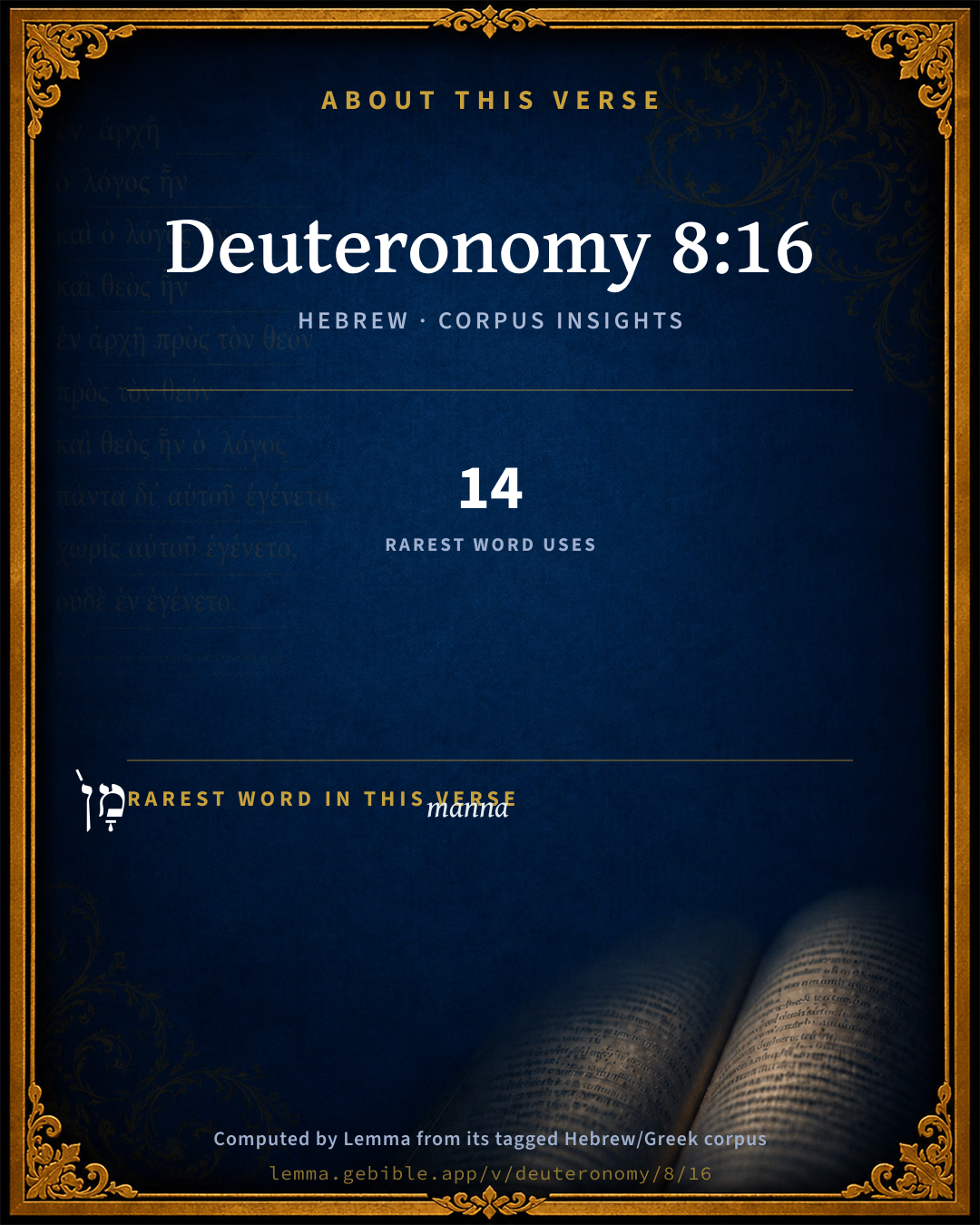
The rarest word here is מָן֙ manna H4478 — appearing just 14 times in the whole Hebrew Bible.

Shared distinctive vocabulary

מָן֙ manna H4478 occurs in 12 verses of the Hebrew Bible. Also found in:

Grammatical profile

  • 5 verbs
  • 4 nouns
  • 2 prepositions
  • 2 particles

Verb forms

  • הַמַּֽאֲכִ֨לְךָ֥ Hiphil · Participle Active
  • יָדְע֖וּן Qal · Perfect
  • עַנֹּֽתְךָ֗ Piel · Infinitive Construct
  • נַסֹּתֶ֔ךָ Piel · Infinitive Construct
  • לְהֵיטִֽבְךָ֖ Hiphil · Infinitive Construct

Repetition

A word recurs within this verse — often emphatic in Hebrew:

  • לְמַ֣עַן for the sake of H4616 ×2

Hebrew & Septuagint length

In English translation the verse runs 32 words from the Hebrew and 34 from the Septuagint (LXX English) — closely comparable.

A rough comparison of the two English renderings, which tokenize alike — not a word-level alignment.

Word counts can differ between the Hebrew and the Greek without any difference in meaning — e.g. the Hebrew direct-object marker אֵת has no separate Greek word, and Greek often adds the article ὁ.

Cross-references

9

Topical passages linked to Deuteronomy 8:16 in the Treasury of Scripture Knowledge — connected by theme and wording, ordered by reader-vote popularity; previews shown in the World English Bible.

  • Deuteronomy 8:3 He humbled you, and allowed you to hunger, and fed you with manna, which you didn't know, neither did your fathers know; that he might make you know that man does not live by bread only, but by everything that proceeds out of the mouth of Yahweh does man live.
  • Exodus 16:15 When the children of Israel saw it, they said one to another, "What is it?" For they didn't know what it was. Moses said to them, "It is the bread which Yahweh has given you to eat."
  • James 1:12 Blessed is the man who endures temptation, for when he has been approved, he will receive the crown of life, which the Lord promised to those who love him.
  • Jeremiah 24:5–6 Thus says Yahweh, the God of Israel: Like these good figs, so will I regard the captives of Judah, whom I have sent out of this place into the land of the Chaldeans, for good.
  • Hebrews 12:10–11 For they indeed, for a few days, punished us as seemed good to them; but he for our profit, that we may be partakers of his holiness.
  • 1 Peter 1:7 that the proof of your faith, which is more precious than gold that perishes even though it is tested by fire, may be found to result in praise, glory, and honor at the revelation of Jesus Christ--
  • Lamentations 3:26–33 It is good that a man should hope and quietly wait for the salvation of Yahweh.
  • Romans 8:28 We know that all things work together for good for those who love God, to those who are called according to his purpose.
  • 2 Corinthians 4:17 For our light affliction, which is for the moment, works for us more and more exceedingly an eternal weight of glory;

Cross-references courtesy of OpenBible.info (CC BY 4.0).

Hebrew and Greek witnesses Masoretic Hebrew ↔ Greek Septuagint

The same verse in the two great witnesses to the Old Testament, shown verse-for-verse.

These are two independent witnesses, not word-aligned to each other, and the Septuagint is shown in lemma (dictionary) form.

Hebrew Deuteronomy 8:16 Masoretic · Westminster Leningrad Codex

הַמַּֽאֲכִ֨לְךָ֥ מָן֙ בַּמִּדְבָּ֔ר אֲשֶׁ֥ר לֹא יָדְע֖וּן אֲבֹתֶ֑יךָ לְמַ֣עַן עַנֹּֽתְךָ֗ וּלְמַ֨עַן֙ נַסֹּתֶ֔ךָ לְהֵיטִֽבְךָ֖ בְּאַחֲרִיתֶֽךָ

who fed you in the wilderness with manna, which your fathers didn't know; that he might humble you, and that he might prove you, to do you good at your latter end:

World English Bible · Public Domain

Greek LXX Deuteronomy 8:16 Septuagint · lemma form

ὁ ψωμίζω σύ ὁ μαννα ἐν ὁ ἔρημος ὅς οὐ ὁράω ὁ πατήρ σύ ἵνα κακόω σύ καί ἐκπειράζω σύ καί εὖ σύ ποιέω ἐπί ἔσχατο ὁ ἡμέρα σύ

who fed you with manna in the wilderness, which you knew not, and your fathers knew not; that he might afflict you, and thoroughly try you, and do you good in your latter days.

LXX2012 (modern English Septuagint) · Public Domain

Hebrew: Westminster Leningrad Codex (CC BY 4.0). Greek: Septuagint (public domain); English from LXX2012 (modern English Septuagint) (Public Domain). How the Septuagint differs from the Hebrew →

Targum (Aramaic paraphrase)

2

The Targum is the ancient Jewish Aramaic paraphrase of the Hebrew Scriptures — an interpretive translation, not the Hebrew text itself. Onkelos (literal) and Pseudo-Jonathan (expansive) render the Torah, and Jonathan the Prophets. Coverage is partial: where no permissively-licensed English translation exists for a verse, only the Aramaic is shown. This is verse-level text, not a word-by-word alignment to the Hebrew.

  1. Targum Onkelos Torah (Genesis–Deuteronomy)
    דְאוֹכָלָךְ מַנָא בְּמַדְבְּרָא דִי לָא יָדְעוּן אֲבָהָתָךְ בְּדִיל לְעַנָיוּתָךְ וּבְדִיל לְנַסָיוּתָךְ לְאוֹטָבָא לָךְ בְּסוֹפָךְ

    (no public-domain English translation for this verse)

    Targum Onkelos — Aramaic: “Onkelos Genesis” (public domain); “Onkelos Exodus” (public domain); “Onkelos Leviticus” (public domain); “Onkelos Numbers” (public domain); “Onkelos Deuteronomy” (public domain). English: “Sefaria Community Translation” (CC0 1.0 (public-domain dedication)); “J.W. Etheridge. The Targums of Onkelos and Jonathan Ben Uzziel on the Pentateuch. London: Longmans, Green, 1862” (public domain). Text via Sefaria.

  2. Targum Pseudo-Jonathan Torah (Genesis–Deuteronomy)
    דְּאוֹכְלָךְ מַנָא בְּמַדְבְּרָא דְּלָא יַדְעוּן אַבְהָתָךְ מִן בִּגְלַל לְסַגְפוּתָךְ וּמִן בִּגְלַל לְנַסְיוֹתָךְ לְאוֹטָבָא לָךְ בְּסוֹפָךְ

    and fed thee in the desert with manna which thy fathers knew not, to humble thee and to prove thee, that He may do thee good in thine end.

    Targum Pseudo-Jonathan — Aramaic: “Targum Jonathan on Genesis” (public domain); “Targum Jonathan on Exodus” (public domain); “Targum Jonathan on Leviticus” (public domain); “Targum Jonathan on Numbers” (public domain); “Targum Jonathan on Deuteronomy” (public domain). English: “The Targum of Jonathan ben Uzziel, trans. J. W. Etheridge, London, 1862” (public domain). Text via Sefaria.

Commentary

Notes on Deuteronomy 8:16 from classic Christian and Jewish commentators (each source and its license shown beneath its notes). The classic Christian expositions comment on the surrounding passage and are grouped to its opening verse, so a note may address several verses; the Jewish commentaries on the Tanakh (Rashi and others) are per-verse, so they appear only where the commentator wrote on this verse.

Lemma curates 59 commentaries, every one of them public domain or Creative Commons licensed, each selected and text-cleaned for this edition rather than reprinted as found. About our sources →

The Cambridge Bible for Schools and Colleges

gen. ed. J. J. S. Perowne

16. See on Deu_8:2-3 and Deu_4:34.

to do thee good] Deu_28:63, Pl., Deu_30:5, Sg.

thy latter end] Misleading translation. Lit. thine afterness, thy later years. There is nothing eschatological in the phrase. Steuernagel marks Deu_8:14 b, Deu_8:15 and Deu_8:16 as an intrusion on the grounds that they but repeat Deu_8:2 b, Deu_8:3, and spoil the connection between Deu_8:14 a and Deu_8:17. But the deuteronomic style is given to repetition, and here the writer not only repeats but carries his argument to a climax in the phrase to do thee good in thy later days.

The Cambridge Bible for Schools and Colleges (gen. ed. J. J. S. Perowne; Cambridge University Press, 1878–1918) — public domain. Text from a community e-Sword module.

Trapp's Complete Commentary

John Trapp

Deu 8:16 Who fed thee in the wilderness with manna, which thy fathers knew not, that he might humble thee, and that he might prove thee, to do thee good at thy latter end;

Ver. 16. Who fed thee.] God will give his people Pluviam escatilem, et petram aquatilem. {a} He will set the flint abroach, and rain corn from heaven, rather than they shall pine and perish. {Psa 78:20; Psa 78:24}

{a} Tertul., De Patient.

John Trapp, A Commentary or Exposition upon All the Books of the Old and New Testament (1647–1656) — public domain. Text from a community e-Sword module.

Joseph Benson's Commentary

Deu 8:16. That he might humble thee — By keeping thee in constant dependance upon himself for every day’s food, and convincing thee what an impotent, helpless creature thou art, having nothing whereon to subsist, and being supported wholly by the alms of divine goodness from day to day. The mercies of God, if duly considered, are as powerful a means to humble us as the greatest afflictions, because they increase our debts to God, and manifest our dependance upon him, and by making God great, they make us little in our own eyes. To do thee good — That is, that after he hath purged and prepared thee by afflictions, thou mayest receive and enjoy his blessings with less disadvantage, while by the remembrance of former afflictions thou art made thankful for those blessings, and more cautious not to abuse them.

Joseph Benson's Commentary on the Old and New Testaments (1811–1818) — public domain. Text from a community e-Sword module.

Adam Clarke's Commentary

Verse 16. Who fed thee - with manna] See this miracle described See Clarke on Ex 16:13, &c.

Adam Clarke's Commentary on the Bible (1810–1826) — public domain. Text from a community e-Sword/MySword module.

John Gill's Exposition

And thou say in thine heart,.... These words are in connection with the former part of the Deu 8:14,

and thou forget the Lord thy God; the author and giver of all the good things enjoyed, and think within themselves, though they might not express it in words at length:

my power and the might of mine hand hath gotten me this wealth; so ascribing that to themselves, their labour, and diligence, which ought to be ascribed to the bounty and blessing of God; see Hos 12:8.

John Gill's Exposition of the Whole Bible (1746–1763) — public domain (CC PDM 1.0). Text via the HelloAO Bible API.

Albert Barnes' Notes on the Bible

To do thee good at thy latter end - This is presented as the result of God’s dealings.

Albert Barnes' Notes on the Bible (1834–1885) — public domain. Text from a community e-Sword/MySword module.

Matthew Poole's English Annotations

That he night humble thee, by keeping thee in a constant dependence upon him for every day’s food, and convincing thee what an impotent, helpless, and beggarly creature thou art in thyself, having nothing whereon to subsist, but from hand to mouth, and being supported wholly by the alms of Divine goodness given to thee from day to day. The mercies of God, if duly considered, are as powerful an argument or mean to humble us as the greatest afflictions, because they increase our debts to God, and manifest our dependence upon him, and insufficiency without him; and by making God great, they make us little in our own eyes; though this clause, as well as that which follows, may have respect to their afflictions, mentioned Deu 8:15.

At thy latter end, i.e. that after he hath purged and prepared thee by afflictions, he may give thee, and thou mayst receive and enjoy, his blessings with less disadvantage, whilst by the remembrance of former afflictions thou art made thankful for them, and more cautious not to abuse and forfeit them again.

Matthew Poole's English Annotations on the Holy Bible (1683–1685) — public domain. Text from a community e-Sword/MySword module.

Whedon's Commentary on the Bible

Daniel D. Whedon

16. At thy latter end — The Hebrew word which our translators have rendered latter end is the same that is used in Gen_49:1, and Isa_2:2. In both cases it is rendered last days. “In this instance Moses refers to the period of their life in Canaan, in contrast with which the period of their sojourn in Egypt and their wandering in the desert is regarded as the beginning; consequently the expression does not relate to death as the end of life, as in Num_33:10.” — Keil.

Daniel D. Whedon (gen. ed.), Commentary on the Old and New Testaments (1874–1909) — public domain. Text from a community e-Sword module.

The Pulpit Commentary

The grand end of all God"s dealings with the Israelites in the desert, both the trials to which they were subjected and the benefits they received, was that he might do them good ultimately. Thy latter end; not the end of life, as in Num_23:10, but the state ensuing on the termination of their period of discipline and probation in the desert. (cf. Job_8:7 Job_42:12; 2Pe_2:20) God thus dealt with the Israelites as he still deals with his people; he afflicts them not for his pleasure but for their profit; (Heb_11:12) he subjects them to trial and varied discipline that he may fit them for the rest and joy that in the end are to be theirs.

See Homiletics: (Deu_8:1-6)

Good at the latter end.

I GOD"S DISCIPLINE OF US IS NOT WITHOUT ITS END. No man even, whose action has any meaning in it, but has an end in what he does. It may be alleged that God"s action has regard to men only in the mass; that in that view of it his action has an end; but that a special purpose is not traceable in his dealings with individuals. The truer philosophy sees purpose everywhere. The individual soul is of interest to God. He deems it worthy of being an end in itself. Though subordinately to the general good, he shapes his providence with a view to its individual well-being. (Mat_10:29-31) For

II GOD"S DISCIPLINE OF US IS MEANT TO TURN TO OUR ULTIMATE ADVANTAGE. "To do thee good at thy latter end." The immediate object of God"s discipline is to form character; to create and develop love, trust, and obedience; to uproot evil dispositions; to break down self-will and self-dependence. The ultimate end of it is the service and blessedness of heaven. There may be some service which God is preparing us for on earth, some possession he wishes to give us, some trust he is about to repose in us. But heaven is the goal of all. (1Pe_1:7; Rev_3:10-13 Rev_7:13-17)

III THE END OF GOD"S DISCIPLINE OF US WILL NOT RE FULLY SEEN TILL THE GOAL IS REACHED. Till then our duty is to do present work, and improve by present training. J.O.

The Pulpit Commentary (1880–1919), ed. H.D.M. Spence-Jones & Joseph S. Exell — public domain. Text from a community e-Sword module.

John Wesley's Explanatory Notes

That he might humble thee - By keeping thee in a constant dependence upon him for every day's food, and convincing thee what an impotent, helpless creature thou art, having nothing whereon to subsist, and being supported wholly by the alms of divine goodness from day to day. The mercies of God, if duly considered, are as powerful a mean to humble us as the greatest afflictions, because they increase our debts to God, and manifest our dependance upon him, and by making God great, they make us little in our own eyes. To do thee good - That is, that after he hath purged and prepared thee by afflictions, thou mayest receive and enjoy his blessings with less disadvantage, whilst by the remembrance of former afflictions. thou art made thankful for them, and more cautious not to abuse them.

John Wesley, Explanatory Notes Upon the Whole Bible (1754–1765) — public domain. Text via the GEBible commentary corpus.

Lesson kit

Teaching starters — assembled from the data on this page, not authored interpretation. Every prompt links to the verse data it draws on. Edit before teaching.

Deuteronomy, in the Pentateuch, opens this verse with 13 words (12 distinct Hebrew lemmas). Its most distinctive word is mân (“manna”). A historical commentator’s framing appears above. Read the whole chapter for the surrounding context.

Discussion questions

  1. The word mân carries the sense “manna.” How does it shape the verse?
  2. Exodus 16:15 shares the word «manna» with this verse. How do the two illuminate each other?
  3. “for the sake of” occurs 2× in this one verse. What is the effect of the repetition?
  4. These translations render this verse differently; the difference is in the English rendering, not the original. What questions does that raise?
  5. The verb «הַמַּֽאֲכִ֨לְךָ֥» is Hiphil Participle Active. How does its form color the action?
  6. Reading how The Cambridge Bible for Schools and Colleges and Trapp's Complete Commentary read this verse, where do the two commentators agree and where do they part?

Things to notice

  • These translations choose different wording for 11 words in this verse.
  • “for the sake of” occurs 2× in this single verse.
  • 12 distinct Hebrew lemmas span 13 words in this verse.

Reading settings

Reading text

Shown beneath each verse's original-language words.

Old Testament
Old Testament edition

Read the OT as the Masoretic Hebrew (MT) or the Greek Septuagint (LXX).

English shown for the Greek Septuagint (in the Hebrew ↔ Greek comparison).

Comparing translations? Open the Compare panel on any verse page to stack up to four side by side.