
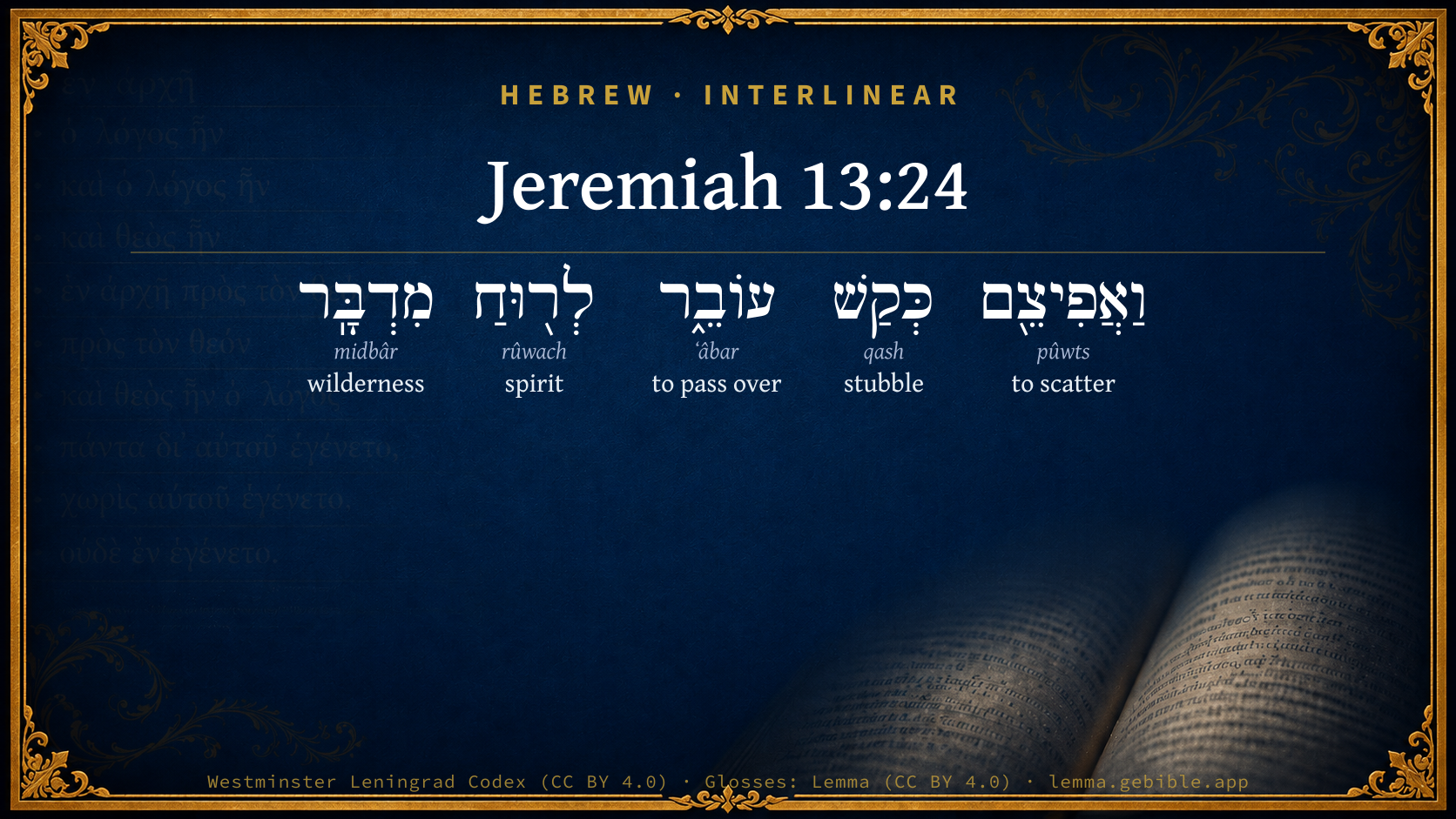
Jeremiah 13:24

Hebrew (Westminster Leningrad Codex) Jeremiah 13:24 appears in the Hebrew Old Testament. The text above is from the Westminster Leningrad Codex. Each word links to its Strong’s number, a concise gloss, and parsing drawn from the Open Scriptures Hebrew Bible morphology. Click any word for its full Brown-Driver-Briggs (BDB) entry.
Download image
Cite this verse

Jeremiah 13:24 (World English Bible). Public Domain. Lemma interlinear Bible study tool, https://lemma.gebible.app/v/jeremiah/13/24.

Show BibTeX & RIS
BibTeX
RIS
English Translation
Therefore will I scatter them, as the stubble that passes away, by the wind of the wilderness.
World English Bible · Public Domain
Download a study sheet

One document with this verse’s original text, its word-by-word gloss line, the meaning frame, cross-references with their text, attributed commentary, and full source and license credits — printable, and it pastes into notes with its structure intact.

This verse Autodidact and up

Study sheet (.html) Plain text (.txt)

A passage Seminary Student

Up to 50 verses in one chapter. A passage sheet keeps up to 6 commentary sources and 12 cross-references per verse, in the order this page ranks them, and says so on the sheet whenever that leaves anything out. Ask for a single verse and you get the Autodidact verse sheet above.

Everything on this page stays free to read, with no account — the sheet is a download of what is already on screen, not access to it.

Want to remove ads? Support Godless Engineer
Compare translations 3

The same verse in 3 English versions, stacked beneath the original-language interlinear above. Click any original word for its lexicon entry.

Each is an independent rendering of the whole verse — the interlinear is not word-aligned to these translations.

Highlighted words mark where these versions differ — a whole-verse word diff, not a word-by-word alignment.

  • World English Bible Public Domain
    Therefore will I scatter them, as the stubble that passes away, by the wind of the wilderness.
  • King James Version Public Domain
    Therefore will I scatter them as the stubble that passeth away by the wind of the wilderness.
  • unfoldingWord Literal Text CC BY-SA 4.0
    Therefore I will scatter them like stubble passing away by the wind of the wilderness.

unfoldingWord Literal Text — © unfoldingWord, licensed CC BY-SA 4.0. Word-aligned USFM3 via Door43 (git.door43.org/unfoldingWord/en_ult).

Versions to compare (up to 4)

3 of 4 selected

Show all 18 translations

Every available English version of this verse, each an independent rendering of the whole verse.

  • World English Bible Public Domain
    Therefore will I scatter them, as the stubble that passes away, by the wind of the wilderness.
  • Berean Standard Bible Public Domain
    “I will scatter you like chaff driven by the desert wind.
  • Majority Standard Bible Public Domain
    “I will scatter you like chaff driven by the desert wind.
  • King James Version Public Domain
    Therefore will I scatter them as the stubble that passeth away by the wind of the wilderness.
  • American Standard Version (1901) Public Domain
    Therefore will I scatter them, as the stubble that passeth away, by the wind of the wilderness.
  • Revised Version (1885) Public Domain
    Therefore will I scatter them, as the stubble that passeth away, by the wind of the wilderness.
  • Geneva Bible (1599) Public Domain
    Therefore will I scatter them, as the stubble that is taken away with the South winde.
  • Douay-Rheims (1899) Public Domain
    And I will scatter them as stubble, which is carried away by the wind in the desert.
  • Young's Literal Translation Public Domain
    And I scatter them as stubble, Passing away, by a wind of the wilderness.
  • Literal Standard Version CC BY-SA 4.0
    And I scatter them as stubble, || Passing away, by a wind of the wilderness.
  • Unlocked Literal Bible CC BY-SA 4.0
    So I will scatter them like chaff that perishes in the desert wind.
  • unfoldingWord Literal Text CC BY-SA 4.0
    Therefore I will scatter them like stubble passing away by the wind of the wilderness.
  • Darby Bible Public Domain
    And I will scatter them as stubble that passeth away by the wind of the wilderness.
  • World Messianic Bible Public Domain
    “Therefore I will scatter them as the stubble that passes away by the wind of the wilderness.
  • Webster's Bible Public Domain
    Therefore will I scatter them as the stubble that passeth away by the wind of the wilderness.
  • Free Bible Version CC BY-SA 4.0
    I'm going to scatter you like chaff blown away by the desert wind.
  • Bible in Basic English Public Domain
    So I will send them in all directions, as dry grass is taken away by the wind of the waste land.
  • JPS Tanakh (1917) Public Domain
    Therefore will I scatter them, as the stubble that passeth away by the wind of the wilderness.

Literal Standard Version (2020), Covenant Press — licensed CC BY-SA 4.0. Text via the HelloAO Bible API (eBible.org). Unlocked Literal Bible (unfoldingWord) — licensed CC BY-SA 4.0. Text via the HelloAO Bible API (eBible.org). unfoldingWord Literal Text — © unfoldingWord, licensed CC BY-SA 4.0. Word-aligned USFM3 via Door43 (git.door43.org/unfoldingWord/en_ult). Free Bible Version, Dr. Jonathan Gallagher — licensed CC BY-SA 4.0. Text via the HelloAO Bible API (eBible.org).

Word by word

More ways to search: Search by grammar → Find every occurrence → Compare this word →

Practice this passage: Drill this verse → Learn its vocabulary →

About this verse

These counts appear in no published source. They are computed here, from the morphology-tagged text and Lemma’s own curated glosses. What Lemma adds →

5
words
5
distinct lemmas
Prophets
section

Notable vocabulary

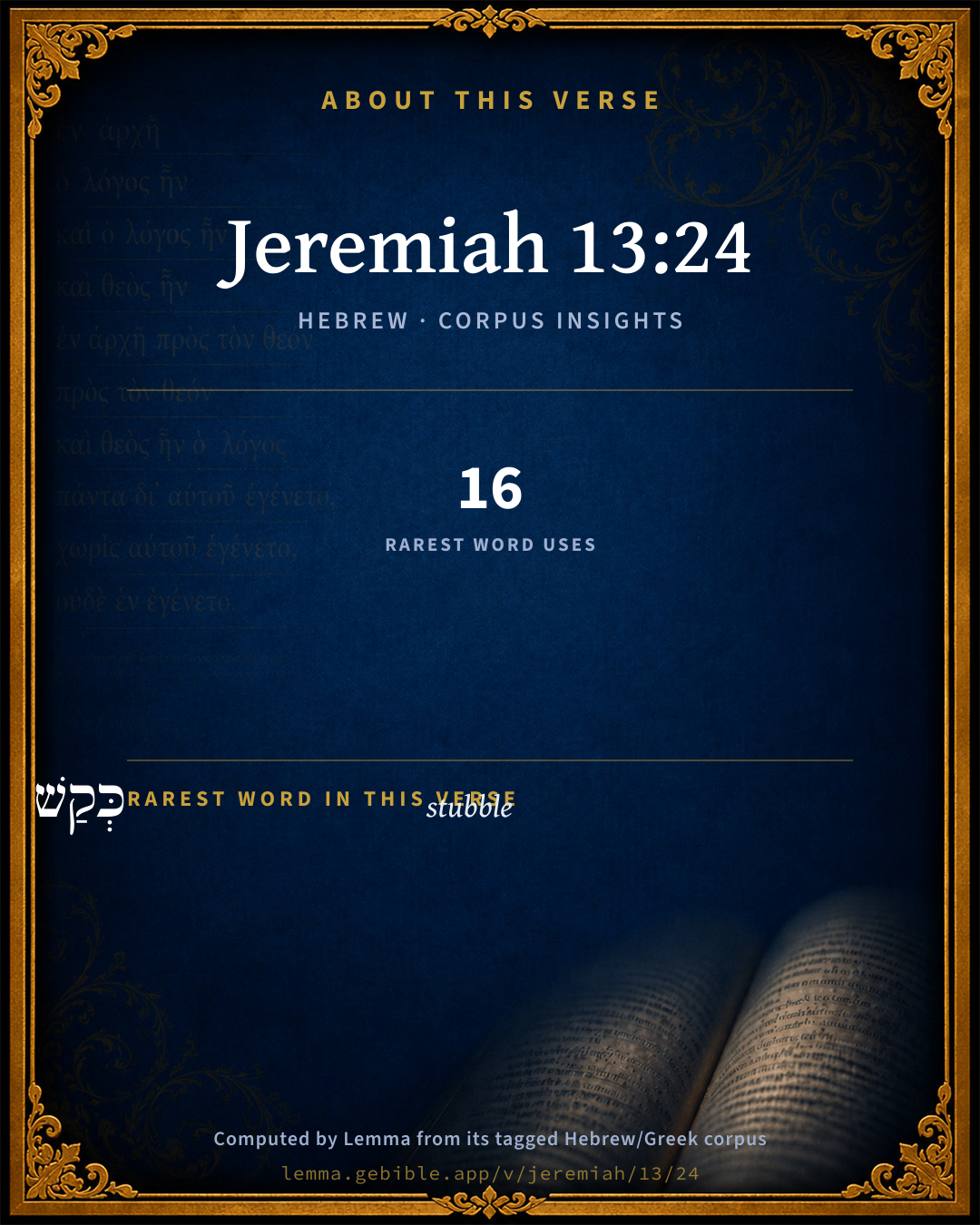
The rarest word here is כְּקַשׁ stubble H7179 — appearing just 16 times in the whole Hebrew Bible.

Shared distinctive vocabulary

כְּקַשׁ stubble H7179 occurs in 16 verses of the Hebrew Bible. Also found in:

Grammatical profile

  • 2 verbs
  • 3 nouns

Verb forms

  • וַאֲפִיצֵ֖ם Hiphil · Imperfect
  • עוֹבֵ֑ר Qal · Participle Active

Cross-references

16

Topical passages linked to Jeremiah 13:24 in the Treasury of Scripture Knowledge — connected by theme and wording, ordered by reader-vote popularity; previews shown in the World English Bible.

  • Psalms 1:4 The wicked are not so, But are like the chaff which the wind drives away.
  • Leviticus 26:33 I will scatter you among the nations, and I will draw out the sword after you: and your land will be a desolation, and your cities shall be a waste.
  • Ezekiel 5:2 A third part shall you burn in the fire in the midst of the city, when the days of the siege are fulfilled; and you shall take a third part, and strike with the sword round about it; and a third part you shall scatter to the wind, and I will draw out a sword after them.
  • Ezekiel 5:12 A third part of you shall die with the pestilence, and with famine shall they be consumed in the midst of you; and a third part shall fall by the sword round about you; and a third part I will scatter to all the winds, and will draw out a sword after them.
  • Hosea 13:3 Therefore they will be like the morning cloud, And like the dew that passes away early, Like the chaff that is driven with the whirlwind out of the threshing floor, And like the smoke out of the chimney.
  • Deuteronomy 4:27 Yahweh will scatter you among the peoples, and you shall be left few in number among the nations, where Yahweh shall lead you away.
  • Deuteronomy 28:64 Yahweh will scatter you among all peoples, from the one end of the earth even to the other end of the earth; and there you shall serve other gods, which you have not known, you nor your fathers, even wood and stone.
  • Deuteronomy 32:26 I said, I would scatter them afar, I would make the memory of them to cease from among men;
  • Psalms 83:13–15 My God, make them like tumbleweed; Like chaff before the wind.
  • Isaiah 17:13 The nations shall rush like the rushing of many waters: but he shall rebuke them, and they shall flee far off, and shall be chased as the chaff of the mountains before the wind, and like the whirling dust before the storm.
  • Isaiah 41:16 You shall winnow them, and the wind shall carry them away, and the whirlwind shall scatter them; and you shall rejoice in Yahweh, you shall glory in the Holy One of Israel.
  • Jeremiah 4:11–12 At that time shall it be said to this people and to Jerusalem, A hot wind from the bare heights in the wilderness toward the daughter of my people, not to winnow, nor to cleanse;
  • Ezekiel 6:8 Yet will I leave a remnant, in that you shall have some that escape the sword among the nations, when you shall be scattered through the countries.
  • Ezekiel 17:21 All his fugitives in all his bands shall fall by the sword, and those who remain shall be scattered toward every wind: and you shall know that I, Yahweh, have spoken it.
  • Zephaniah 2:2 before the appointed time when the day passes as the chaff, before the fierce anger of Yahweh comes on you, before the day of Yahweh's anger comes on you.
  • Luke 21:24 They will fall by the edge of the sword, and will be led captive into all the nations. Jerusalem will be trampled down by the Gentiles, until the times of the Gentiles are fulfilled.

Cross-references courtesy of OpenBible.info (CC BY 4.0).

Hebrew and Greek witnesses Masoretic Hebrew ↔ Greek Septuagint

The same verse in the two great witnesses to the Old Testament, shown verse-for-verse.

These are two independent witnesses, not word-aligned to each other, and the Septuagint is shown in lemma (dictionary) form.

Hebrew Jeremiah 13:24 Masoretic · Westminster Leningrad Codex

וַאֲפִיצֵ֖ם כְּקַשׁ עוֹבֵ֑ר לְר֖וּחַ מִדְבָּֽר

Therefore will I scatter them, as the stubble that passes away, by the wind of the wilderness.

World English Bible · Public Domain

Greek LXX Structure differs

In the Septuagint, Jeremiah is about an eighth shorter than the Hebrew and arranges its material differently — the Oracles Against the Nations (Hebrew chapters 46–51) appear in the middle of the Greek book, after 25:13. Because the chapter and verse boundaries do not line up, a verse-for-verse comparison with the Hebrew is not shown.

A verse-for-verse comparison isn’t shown here because the chapters and verses don’t line up. Switch to the LXX edition with the MT / LXX toggle above to read the Greek directly.

Hebrew: Westminster Leningrad Codex (CC BY 4.0). Greek: Septuagint (public domain); English from a public-domain English Septuagint. How the Septuagint differs from the Hebrew →

Targum (Aramaic paraphrase)

1

The Targum is the ancient Jewish Aramaic paraphrase of the Hebrew Scriptures — an interpretive translation, not the Hebrew text itself. Onkelos (literal) and Pseudo-Jonathan (expansive) render the Torah, and Jonathan the Prophets. Coverage is partial: where no permissively-licensed English translation exists for a verse, only the Aramaic is shown. This is verse-level text, not a word-by-word alignment to the Hebrew.

  1. Targum Jonathan Prophets (Joshua–Malachi)
    וָאֱבַדְרִינוּן כְּקַשָׁא דְעָדֵי מִן קֳדָם רוּחָא לְמַדְבְּרָא:

    (no public-domain English translation for this verse)

    Targum Jonathan — Aramaic: “Mikraot Gedolot” (public domain). English: “Sefaria Community Translation” (CC0 1.0 (public-domain dedication)); “London "Chaldee Paraphrase," 1871” (public domain). Text via Sefaria.

Commentary

Notes on Jeremiah 13:24 from classic Christian and Jewish commentators (each source and its license shown beneath its notes). The classic Christian expositions comment on the surrounding passage and are grouped to its opening verse, so a note may address several verses; the Jewish commentaries on the Tanakh (Rashi and others) are per-verse, so they appear only where the commentator wrote on this verse.

Lemma curates 59 commentaries, every one of them public domain or Creative Commons licensed, each selected and text-cleaned for this edition rather than reprinted as found. About our sources →

Trapp's Complete Commentary

John Trapp

Jer 13:24 Therefore will I scatter them as the stubble that passeth away by the wind of the wilderness.

Ver. 24. Therefore I will scatter them.] This was no small aggravation of their misery, that they should be thus severed one from another. So the persecutors of the primitive times relegated and confined the poor Christians to isles and mines, where they could not have access one to another for mutual comfort and support, as Cyprian complaineth. {a}

{a} Cyprian. Epist.

John Trapp, A Commentary or Exposition upon All the Books of the Old and New Testament (1647–1656) — public domain. Text from a community e-Sword module.

Joseph Benson's Commentary

Jer 13:24-25. Therefore will I scatter them — Separate them from one another, and disperse them abroad in that strange and remote country to which they are carried captive; as the stubble, or chaff, rather, that passeth away by the wind — That is dissipated and carried far away by a fierce wind: he adds, of the wilderness, to render the declaration the more emphatical, the chaff being more easily and effectually scattered by the wind in an open place, where there are no houses. This is the portion of thy measures from me — What thou wilt receive of my hand; because thou hast forgotten me — The favours I have bestowed upon thee, and the obligations thou art under to me: of these thou hast no sense, no remembrance; and trusted in falsehood — In idols, in an arm of flesh, in the self-flatteries of a deceitful heart.

Joseph Benson's Commentary on the Old and New Testaments (1811–1818) — public domain. Text from a community e-Sword module.

Tyndale Open Study Notes

Tyndale Open Resources

13:24-27 The divine Judge decreed condemnation.

13:24 I will scatter you like chaff: This word-picture represented the exile of the people of Judah. Cp. Ps 1:4-5.

Tyndale Open Study Notes — © Tyndale Open Resources, licensed CC BY-SA 4.0. Text via the HelloAO Bible API.

Jamieson, Fausset & Brown

Robert Jamieson, A. R. Fausset & David Brown

(Psa 1:4).

by the wind--before the wind.

of the wilderness--where the wind has full sweep, not being broken by any obstacle.

Jamieson, Fausset & Brown — Commentary Critical and Explanatory on the Whole Bible (1871) — public domain (CC PDM 1.0). Text via the HelloAO Bible API.

Adam Clarke's Commentary

Verse 24. The wind of the wilderness.] Some strong tempestuous wind, proverbially severe, coming from the desert to the south of Judea.

Adam Clarke's Commentary on the Bible (1810–1826) — public domain. Text from a community e-Sword/MySword module.

John Calvin's Commentaries

This is an inference which Jeremiah draws from the last verse. As long as there is any hope of repentance, there is also room for mercy; God often declares that he is long-suffering. Then the most wicked might object and say, that God is too rigid, because he waits not until they return to a sound mind. Now the Prophet had said that it was all over with the people: here therefore he meets the objection, and shews that extreme calamity was justly brought on them by God, because the Jews had obstinately hardened themselves in their vices and wickedness.

After having shewn, therefore, that corruption was inherent in them, as blackness in the skin of an Ethiopian, and as spots in panthers, he now comes to this conclusion — I will scatter them as stubble which passes away by the wind of the desert This scattering denotes their exile; as though he had said, “I will banish them, that they may know that they are deprived of the inheritance in which they place their safety and their happiness.” For the Jews gloried in this only — that they were God’s people, because the Temple was built among them, and because they dwelt in the land promised to them. They then thought that God was in a manner tied to them, while they possessed that inheritance. Hence Jeremiah declares, that they would become like stubble carried away by the wind.

He mentions the wind of the desert, that is, the wind of the south, which was the most violent in that country. The south wind, as we know, was also pestilential; the air also was more disturbed by the south wind than by any other, for it raised storms and tempests. Therefore the Scripture, in setting forth any turbulent movement, often adopts this similitude. Some think that Jeremiah alludes to the Egyptians; but I see no reason to seek out any refined explanation, when this mode of speaking is commonly adopted. Then by this similitude of south wind God intimates the great power of his vengeance; as though he had said, “Even if the Jews think that they have a firm standing in the promised land, they are wholly deceived, for God will with irresistible force expel them.” And he compares them to stubble, while yet they boasted that they were like trees planted in that land; and we have before seen that they had been planted as it were by the hand of God; but they wanted the living root of piety, they were therefore to be driven far away like stubble.

Let us then learn from this passage not to abuse the patience of God: for though he may suspend for a time the punishment we deserve, yet when he sees that we go on in our wickedness, he will come to extreme measures, and will deal with us without mercy as those who are past remedy. It follows —

John Calvin's Commentaries (1540-1563) — public domain. Text from the Calvin Translation Society English edition (1840s-50s) via the Christian Classics Ethereal Library (ccel.org). Calvin's coverage is partial (roughly two-thirds of the Bible); uncommented books and verses are honest gaps, never fabricated. The 19th-century editor's footnotes and remarks are omitted so the notes are faithfully Calvin's own voice.

Ellicott's Commentary for English Readers

(24) Stubble.—Our English word means the “stalks of the corn left in the field by the reaper” (Johnson). The Hebrew word is applied to the broken straw left on the threshing-floor after the oxen had been driven over the corn, which was liable to be carried away by the first gale (Isa_40:24; Isa_41:2).

The wind of the wilderness.—i.e., the simoom blowing from the Arabian desert (Jer_4:11; Job_1:19).

A Bible Commentary for English Readers, edited by Charles John Ellicott (1878–1897) — public domain. Text from a community e-Sword module.

The Cambridge Bible for Schools and Colleges

gen. ed. J. J. S. Perowne

24. See on Jer_4:11.

by the wina] better, with mg. unto the wind.

The Cambridge Bible for Schools and Colleges (gen. ed. J. J. S. Perowne; Cambridge University Press, 1878–1918) — public domain. Text from a community e-Sword module.

John Gill's Exposition

Therefore will I discover thy skirts upon thy face,.... Turn them up, or throw them over the head or face; that is, expose to public shame and disgrace; which was done when their city and temple were burnt, and they were carried captive; hence it follows:

that thy shame may appear; that their sins might appear to themselves and others, of which they had reason to be ashamed. The allusion is to the treatment which captive women sometimes meet with, or adulterous women, to which the Jews are here compared. The Targum is,

"and I also will reveal the confusion of thy sin upon thy face, and thy shame shall be seen.''

John Gill's Exposition of the Whole Bible (1746–1763) — public domain (CC PDM 1.0). Text via the HelloAO Bible API.

Albert Barnes' Notes on the Bible

Stubble - Broken straw separated from the wheat after the grain had been trampled out by the oxen. Sometimes it was burned as useless; at other times left to be blown away by the wind from the desert.

Albert Barnes' Notes on the Bible (1834–1885) — public domain. Text from a community e-Sword/MySword module.

Matthew Poole's English Annotations

The words denote a great and clear dispersion, like that of the scattering of stubble by a fierce wind.

Matthew Poole's English Annotations on the Holy Bible (1683–1685) — public domain. Text from a community e-Sword/MySword module.

Whedon's Commentary on the Bible

Daniel D. Whedon

24. Stubble — The broken straw which has to be separated from the wheat after the threshing.

Daniel D. Whedon (gen. ed.), Commentary on the Old and New Testaments (1874–1909) — public domain. Text from a community e-Sword module.

The Pulpit Commentary

As the stubble. "The word means not what we call stubble, but the broken straw which had to be separated from the wheat after the corn had been trampled out by the oxen. Sometimes it was burnt as useless; at other times left to be blown away by the wind coming from the desert," on which see Jer_4:11Jo Jer_1:19 (Payne Smith).

The Pulpit Commentary (1880–1919), ed. H.D.M. Spence-Jones & Joseph S. Exell — public domain. Text from a community e-Sword module.

Lesson kit

Teaching starters — assembled from the data on this page, not authored interpretation. Every prompt links to the verse data it draws on. Edit before teaching.

Jeremiah, in the Prophets, opens this verse with 5 words (5 distinct Hebrew lemmas). Its most distinctive word is qash (“stubble”). A historical commentator’s framing appears above. Read the whole chapter for the surrounding context.

Discussion questions

  1. How does “stubble” (qash) shape what this verse is saying?
  2. How does Exodus 5:12, which shares the word «stubble», read alongside this verse?
  3. These translations render this verse differently; the difference is in the English rendering, not the original. What questions does that raise?
  4. «וַאֲפִיצֵ֖ם» is a Hiphil Imperfect verb. How does that grammatical form shape the action described?
  5. Compare how Trapp's Complete Commentary and Joseph Benson's Commentary read this verse. Where do they agree or differ?

Things to notice

Reading settings

Reading text

Shown beneath each verse's original-language words.

Old Testament
Old Testament edition

Read the OT as the Masoretic Hebrew (MT) or the Greek Septuagint (LXX).

English shown for the Greek Septuagint (in the Hebrew ↔ Greek comparison).

Comparing translations? Open the Compare panel on any verse page to stack up to four side by side.