Exodus 18:5

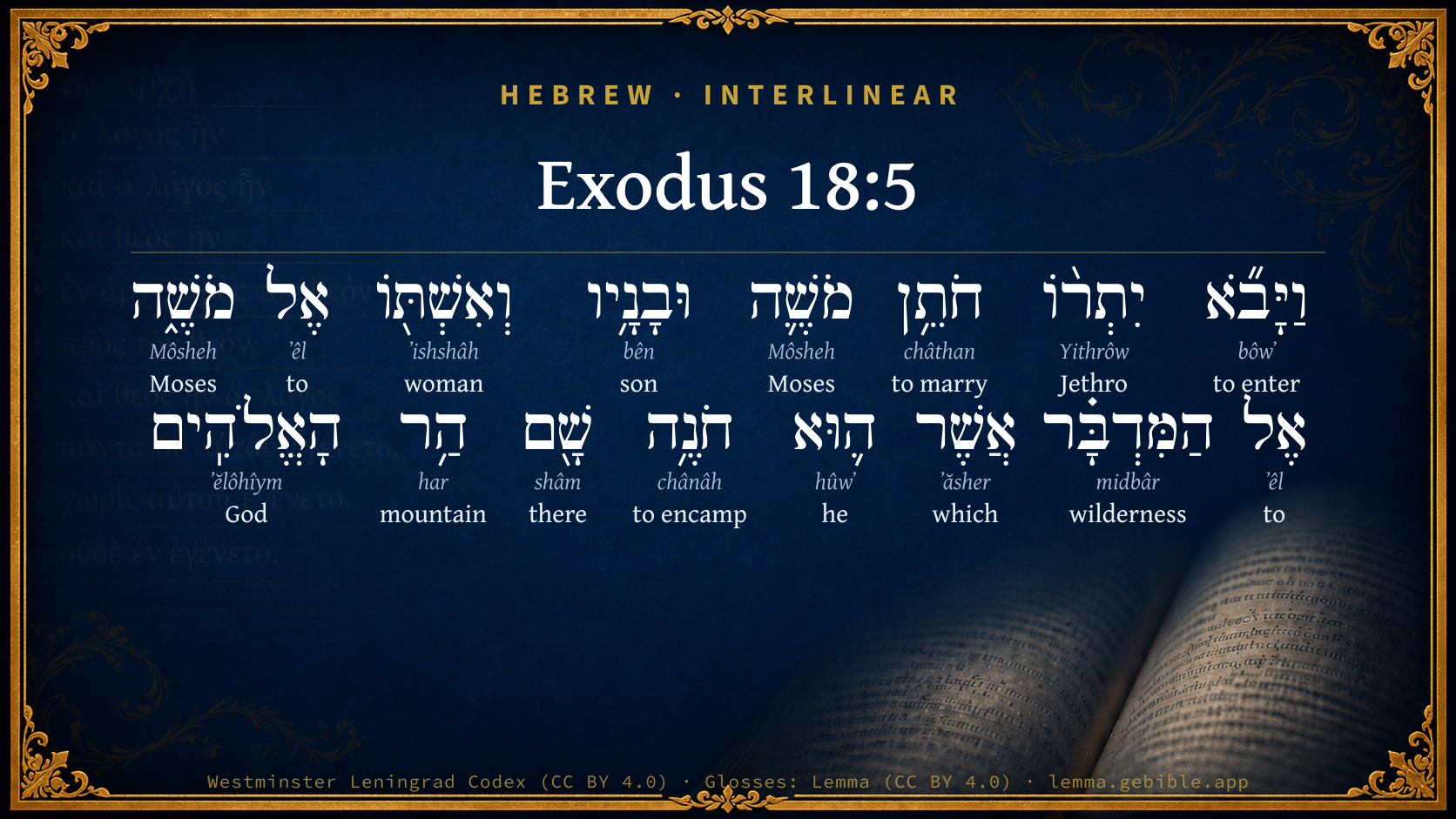
Hebrew (Westminster Leningrad Codex) Exodus 18:5 appears in the Hebrew Old Testament. The text above is from the Westminster Leningrad Codex. Each word links to its Strong’s number, a concise gloss, and parsing drawn from the Open Scriptures Hebrew Bible morphology. Click any word for its full Brown-Driver-Briggs (BDB) entry.
Download image
Cite this verse

Exodus 18:5 (World English Bible). Public Domain. Lemma interlinear Bible study tool, https://lemma.gebible.app/v/exodus/18/5.

Show BibTeX & RIS
BibTeX
RIS
English Translation
Jethro, Moses' father-in-law, came with his sons and his wife to Moses into the wilderness where he was encamped, at the Mountain of God.
World English Bible · Public Domain
Download a study sheet

One document with this verse’s original text, its word-by-word gloss line, the meaning frame, cross-references with their text, attributed commentary, and full source and license credits — printable, and it pastes into notes with its structure intact.

This verse Autodidact and up

Study sheet (.html) Plain text (.txt)

A passage Seminary Student

Up to 50 verses in one chapter. A passage sheet keeps up to 6 commentary sources and 12 cross-references per verse, in the order this page ranks them, and says so on the sheet whenever that leaves anything out. Ask for a single verse and you get the Autodidact verse sheet above.

Everything on this page stays free to read, with no account — the sheet is a download of what is already on screen, not access to it.

Want to remove ads? Support Godless Engineer
Compare translations 3

The same verse in 3 English versions, stacked beneath the original-language interlinear above. Click any original word for its lexicon entry.

Each is an independent rendering of the whole verse — the interlinear is not word-aligned to these translations.

Highlighted words mark where these versions differ — a whole-verse word diff, not a word-by-word alignment.

  • World English Bible Public Domain
    Jethro, Moses' father-in-law, came with his sons and his wife to Moses into the wilderness where he was encamped, at the Mountain of God.
  • King James Version Public Domain
    And Jethro, Moses' father in law, came with his sons and his wife unto Moses into the wilderness, where he encamped at the mount of God:
  • unfoldingWord Literal Text CC BY-SA 4.0
    And Jethro, the father-in-law of Moses, came, and his sons and his wife, to Moses, to the wilderness where he was camping, at the mountain of God.

unfoldingWord Literal Text — © unfoldingWord, licensed CC BY-SA 4.0. Word-aligned USFM3 via Door43 (git.door43.org/unfoldingWord/en_ult).

Versions to compare (up to 4)

3 of 4 selected

Show all 18 translations

Every available English version of this verse, each an independent rendering of the whole verse.

  • World English Bible Public Domain
    Jethro, Moses' father-in-law, came with his sons and his wife to Moses into the wilderness where he was encamped, at the Mountain of God.
  • Berean Standard Bible Public Domain
    Moses’ father-in-law Jethro, along with Moses’ wife and sons, came to him in the desert, where he was encamped at the mountain of God.
  • Majority Standard Bible Public Domain
    Moses’ father-in-law Jethro, along with Moses’ wife and sons, came to him in the desert, where he was encamped at the mountain of God.
  • King James Version Public Domain
    And Jethro, Moses' father in law, came with his sons and his wife unto Moses into the wilderness, where he encamped at the mount of God:
  • American Standard Version (1901) Public Domain
    And Jethro, Moses' father-in-law, came with his sons and his wife unto Moses into the wilderness where he was encamped, at the mount of God:
  • Revised Version (1885) Public Domain
    and Jethro, Moses’ father in law, came with his sons and his wife unto Moses into the wilderness where he was encamped, at the mount of God:
  • Geneva Bible (1599) Public Domain
    And Iethro Moses father in law came with his two sonnes, and his wife vnto Moses into the wildernes, where he camped by ye mout of God.
  • Douay-Rheims (1899) Public Domain
    And Jethro the kinsman of Moses came with his sons and his wife, to Moses into the desert, where he was camped by the mountain of God.
  • Young's Literal Translation Public Domain
    And Jethro, father-in-law of Moses, cometh, and his sons, and his wife, unto Moses, unto the wilderness where he is encamping -- the mount of God;
  • Literal Standard Version CC BY-SA 4.0
    And Jethro, father-in-law of Moses, comes, and his sons, and his wife, to Moses, to the wilderness where he is encamping—the mountain of God;
  • Unlocked Literal Bible CC BY-SA 4.0
    Jethro, Moses' father-in-law, came with Moses' sons and his wife to Moses in the wilderness where he was camped at the mountain of God.
  • unfoldingWord Literal Text CC BY-SA 4.0
    And Jethro, the father-in-law of Moses, came, and his sons and his wife, to Moses, to the wilderness where he was camping, at the mountain of God.
  • Darby Bible Public Domain
    And Jethro, Moses' father-in-law, came to Moses with his sons and his wife into the wilderness, where he encamped at the mountain of God.
  • World Messianic Bible Public Domain
    Jethro, Moses’ father-in-law, came with Moses’ sons and his wife to Moses into the wilderness where he was encamped, at the Mountain of God.
  • Webster's Bible Public Domain
    And Jethro, Moses's father-in-law, came with his sons and his wife to Moses into the wilderness, where he encamped at the mount of God:
  • Free Bible Version CC BY-SA 4.0
    Moses' father-in-law Jethro, together with Moses' wife and sons, came to see him in the desert at the camp near the mountain of God.
  • Bible in Basic English Public Domain
    And Jethro, Moses' father-in-law, came with his sons and his wife to where Moses had put up his tent in the waste land, by the mountain of God.
  • JPS Tanakh (1917) Public Domain
    And Jethro, Moses' father-in-law, came with his sons and his wife unto Moses into the wilderness where he was encamped, at the mount of God;

Literal Standard Version (2020), Covenant Press — licensed CC BY-SA 4.0. Text via the HelloAO Bible API (eBible.org). Unlocked Literal Bible (unfoldingWord) — licensed CC BY-SA 4.0. Text via the HelloAO Bible API (eBible.org). unfoldingWord Literal Text — © unfoldingWord, licensed CC BY-SA 4.0. Word-aligned USFM3 via Door43 (git.door43.org/unfoldingWord/en_ult). Free Bible Version, Dr. Jonathan Gallagher — licensed CC BY-SA 4.0. Text via the HelloAO Bible API (eBible.org).

Word by word

More ways to search: Search by grammar → Find every occurrence → Compare this word →

Practice this passage: Drill this verse → Learn its vocabulary →

יִתְר֨וֹ
Yithrôw
H3503
“Jethro”
Noun, Proper
Part of Speech
Noun
Type
Proper
Full BDB Definition

Origin: from H3499 with pron. suffix

TWOT: None

Jethro = "his abundance" - father-in-law of Moses; also 'Jether'
  1. וַיָּבֹ֞א bôwʼ H935 “and · to enter” Conjunction + Verb, Qal, Sequential Imperfect, 3rd Person, Masculine, Singular
  2. חֹתֵ֥ן châthan H2859 “marrying” Verb, Qal, Participle Active, Masculine, Singular, Construct
  3. מֹשֶׁ֛ה Môsheh H4872 “Moses” Noun, Proper
  4. וּבָנָ֥יו bên H1121 “and · sons · his” Conjunction + Noun, Common, Masculine, Plural, Construct + Suffix, Personal, 3rd Person, Masculine, Singular
  5. וְאִשְׁתּ֖וֹ ʼishshâh H802 “and · woman · his” Conjunction + Noun, Common, Feminine, Singular, Construct + Suffix, Personal, 3rd Person, Masculine, Singular
  6. אֶל ʼêl H413 “to” Preposition
  7. מֹשֶׁ֑ה Môsheh H4872 “Moses” Noun, Proper
  8. אֶל ʼêl H413 “to” Preposition
  9. הַמִּדְבָּ֗ר midbâr H4057 “the · wilderness” Particle, Definite Article + Noun, Common, Masculine, Singular, Absolute
  10. אֲשֶׁר ʼăsher H834 “which” Particle, Relative
  11. ה֛וּא hûwʼ H1931 “he” Pronoun, Personal, 3rd Person, Masculine, Singular
  12. חֹנֶ֥ה chânâh H2583 “encamping” Verb, Qal, Participle Active, Masculine, Singular, Absolute
  13. שָׁ֖ם shâm H8033 “there” Adverb
  14. הַ֥ר har H2022 “mountain of” Noun, Common, Masculine, Singular, Construct
  15. הָאֱלֹהִֽים ʼĕlôhîym H430 “the · God(s)” Particle, Definite Article + Noun, Common, Masculine, Plural, Absolute

About this verse

These counts appear in no published source. They are computed here, from the morphology-tagged text and Lemma’s own curated glosses. What Lemma adds →

16
words
14
distinct lemmas
Pentateuch
section

Notable vocabulary

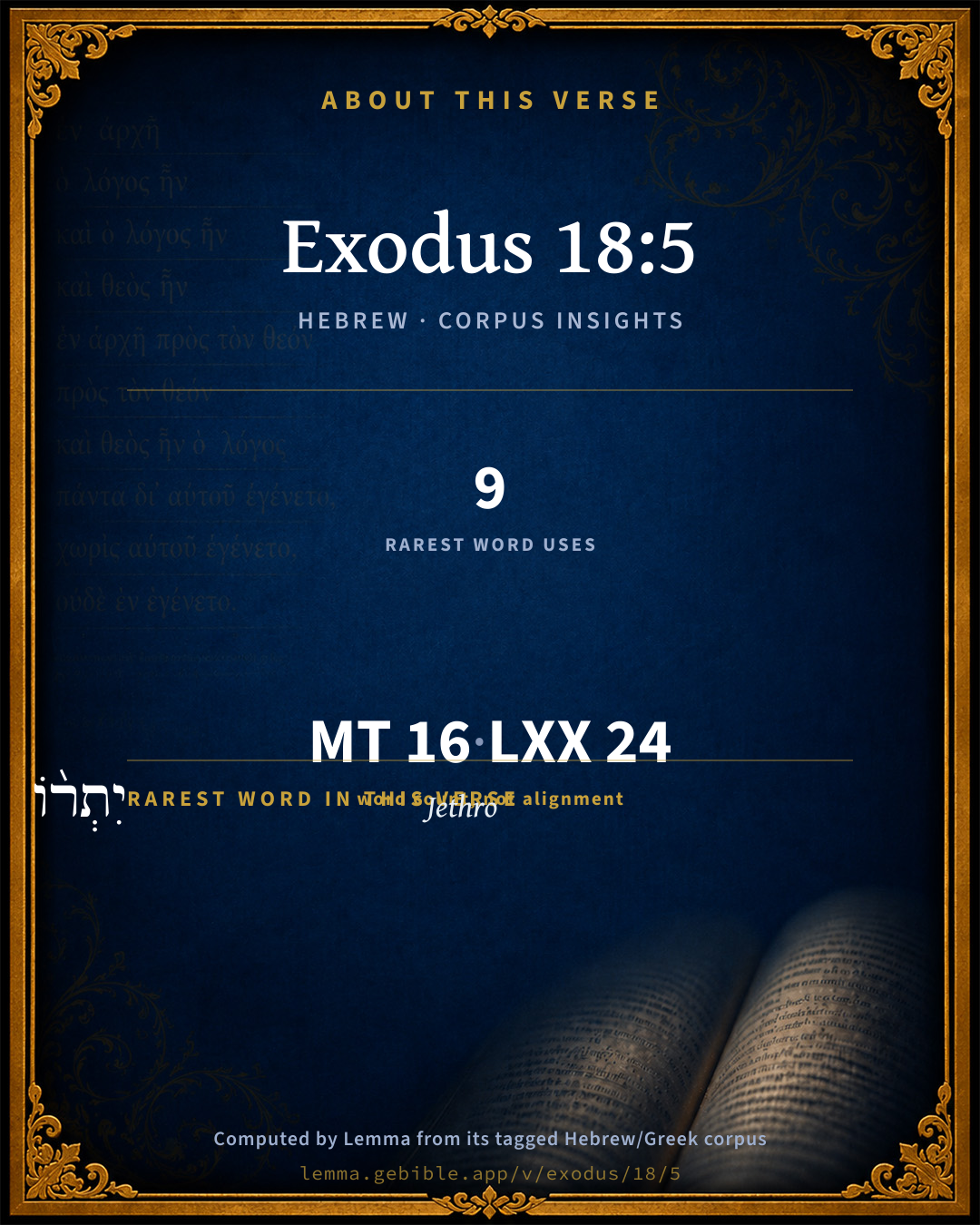
The rarest word here is יִתְר֨וֹ Jethro H3503 — appearing just 9 times in the whole Hebrew Bible.

Shared distinctive vocabulary

יִתְר֨וֹ Jethro H3503 occurs in 9 verses of the Hebrew Bible. Also found in:

Grammatical profile

  • 3 verbs
  • 8 nouns
  • 1 pronoun
  • 2 prepositions
  • 1 adverb
  • 1 particle

Verb forms

  • וַיָּבֹ֞א Qal · Sequential Imperfect
  • חֹתֵ֥ן Qal · Participle Active
  • חֹנֶ֥ה Qal · Participle Active

Repetition

Words recur within this verse — often emphatic in Hebrew:

  • מֹשֶׁ֛ה Moses H4872 ×2
  • אֶל to H413 ×2

Hebrew & Septuagint length

In English translation the verse runs 24 words from the Hebrew and 27 from the Septuagint (LXX English) — closely comparable.

A rough comparison of the two English renderings, which tokenize alike — not a word-level alignment.

Word counts can differ between the Hebrew and the Greek without any difference in meaning — e.g. the Hebrew direct-object marker אֵת has no separate Greek word, and Greek often adds the article ὁ.

In the original languages it is 16 Hebrew tokens and 24 Greek tokens — but the two are counted differently (Hebrew bundles its prefixes and suffixes into one token; the Greek is in lemma form), so that isn’t a like-for-like length.

Cross-references

6

Topical passages linked to Exodus 18:5 in the Treasury of Scripture Knowledge — connected by theme and wording, ordered by reader-vote popularity; previews shown in the World English Bible.

  • Exodus 3:1 Now Moses was keeping the flock of Jethro, his father-in-law, the priest of Midian, and he led the flock to the back of the wilderness, and came to God's mountain, to Horeb.
  • Exodus 3:12 He said, "Certainly I will be with you. This will be the token to you, that I have sent you: when you have brought forth the people out of Egypt, you shall serve God on this mountain."
  • Exodus 19:11 and be ready against the third day; for on the third day Yahweh will come down in the sight of all the people on Mount Sinai.
  • Exodus 19:20 Yahweh came down on Mount Sinai, to the top of the mountain. Yahweh called Moses to the top of the mountain, and Moses went up.
  • Exodus 24:16–17 The glory of Yahweh settled on Mount Sinai, and the cloud covered it six days. The seventh day he called to Moses out of the midst of the cloud.
  • 1 Kings 19:8 He arose, and ate and drink, and went in the strength of that food forty days and forty nights to Horeb the Mount of God.

Cross-references courtesy of OpenBible.info (CC BY 4.0).

Hebrew and Greek witnesses Masoretic Hebrew ↔ Greek Septuagint

The same verse in the two great witnesses to the Old Testament, shown verse-for-verse.

These are two independent witnesses, not word-aligned to each other, and the Septuagint is shown in lemma (dictionary) form.

Hebrew Exodus 18:5 Masoretic · Westminster Leningrad Codex

וַיָּבֹ֞א יִתְר֨וֹ חֹתֵ֥ן מֹשֶׁ֛ה וּבָנָ֥יו וְאִשְׁתּ֖וֹ אֶל מֹשֶׁ֑ה אֶל הַמִּדְבָּ֗ר אֲשֶׁר ה֛וּא חֹנֶ֥ה שָׁ֖ם הַ֥ר הָאֱלֹהִֽים

Jethro, Moses' father-in-law, came with his sons and his wife to Moses into the wilderness where he was encamped, at the Mountain of God.

World English Bible · Public Domain

Greek LXX Exodus 18:5 Septuagint · lemma form

καί ἐκἔρχομαι ιοθορ ὁ γαμβρός μωυσῆς καί ὁ υἱός καί ὁ γυνή πρός μωυσῆς εἰς ὁ ἔρημος οὗ παρα ἐνβάλλω ἐπί ὄρος ὁ θεός

And Jothor the father-in-law of Moses, and his sons and his wife, went forth to Moses into the wilderness, where he encamped on the mount of God.

LXX2012 (modern English Septuagint) · Public Domain

Hebrew: Westminster Leningrad Codex (CC BY 4.0). Greek: Septuagint (public domain); English from LXX2012 (modern English Septuagint) (Public Domain). How the Septuagint differs from the Hebrew →

Targum (Aramaic paraphrase)

2

The Targum is the ancient Jewish Aramaic paraphrase of the Hebrew Scriptures — an interpretive translation, not the Hebrew text itself. Onkelos (literal) and Pseudo-Jonathan (expansive) render the Torah, and Jonathan the Prophets. Coverage is partial: where no permissively-licensed English translation exists for a verse, only the Aramaic is shown. This is verse-level text, not a word-by-word alignment to the Hebrew.

  1. Targum Onkelos Torah (Genesis–Deuteronomy)
    וַאֲתָא יִתְרוֹ חֲמוּהִי דְמשֶׁה וּבְנוֹהִי וְאִתְּתֵהּ לְוָת משֶׁה לְמַדְבְּרָא דִי הוּא שָׁרֵי תַמָן לְטוּרָא דְאִתְגְלֵי עֲלוֹהִי יְקָרָא דַיְיָ:

    (no public-domain English translation for this verse)

    Targum Onkelos — Aramaic: “Onkelos Genesis” (public domain); “Onkelos Exodus” (public domain); “Onkelos Leviticus” (public domain); “Onkelos Numbers” (public domain); “Onkelos Deuteronomy” (public domain). English: “Sefaria Community Translation” (CC0 1.0 (public-domain dedication)); “J.W. Etheridge. The Targums of Onkelos and Jonathan Ben Uzziel on the Pentateuch. London: Longmans, Green, 1862” (public domain). Text via Sefaria.

  2. Targum Pseudo-Jonathan Torah (Genesis–Deuteronomy)
    וְאָתָא יִתְרוֹ חָמוֹי דְמשֶׁה וּבְנוֹי דְמשֶׁה וְאִנְתְּתֵיהּ לְוַת משֶׁה לְמַדְבְּרָא דְהוּא שָׁרֵי תַּמָּן סְמִיךְ לְטַוְורָא דְאִתְגְּלֵי עֲלוֹי יְקָרָא דַיְיָ לְמשֶׁה מִן שֵׁירוּיָא

    And Jethro the father-in-law of Mosheh, and the sons of Mosheh, and his wife came to Mosheh at the desert in which be was sojourning hard by the mountain upon which the glory of the Lord was revealed to Mosheh at the beginning.

    Targum Pseudo-Jonathan — Aramaic: “Targum Jonathan on Genesis” (public domain); “Targum Jonathan on Exodus” (public domain); “Targum Jonathan on Leviticus” (public domain); “Targum Jonathan on Numbers” (public domain); “Targum Jonathan on Deuteronomy” (public domain). English: “The Targum of Jonathan ben Uzziel, trans. J. W. Etheridge, London, 1862” (public domain). Text via Sefaria.

Commentary

Notes on Exodus 18:5 from classic Christian and Jewish commentators (each source and its license shown beneath its notes). The classic Christian expositions comment on the surrounding passage and are grouped to its opening verse, so a note may address several verses; the Jewish commentaries on the Tanakh (Rashi and others) are per-verse, so they appear only where the commentator wrote on this verse.

Lemma curates 59 commentaries, every one of them public domain or Creative Commons licensed, each selected and text-cleaned for this edition rather than reprinted as found. About our sources →

Trapp's Complete Commentary

John Trapp

Exo 18:5 And Jethro, Moses’ father in law, came with his sons and his wife unto Moses into the wilderness, where he encamped at the mount of God:

Ver. 5. At the mount of God.] Horeb; whither they were removed from Rephidim, though the remove be not mentioned.

John Trapp, A Commentary or Exposition upon All the Books of the Old and New Testament (1647–1656) — public domain. Text from a community e-Sword module.

Geneva Bible (1599)

Geneva Bible translators

Horeb is called the mount of God, because God wrought many miracles there. So Peter calleth the mount where Christ was transfigured, the holy mount: for by Christ’s presence it was holy for a time, 2 Pet. 1:18.

Geneva Bible (1599) marginal notes — public domain. Text via Bolls.life.

Adam Clarke's Commentary

Verse 5. Jethro - came with his sons] There are several reasons to induce us to believe that the fact related here is out of its due chronological order, and that Jethro did not come to Moses till the beginning of the second year of the exodus, (see Nu 10:11), some time after the tabernacle had been erected, and the Hebrew commonwealth established, both in things civil and ecclesiastical. This opinion is founded on the following reasons: -

1. On this verse, where it is said that Jethro came to Moses while he was encamped at the mount of God. Now it appears, from Ex 19:1-2, that they were not yet come to Horeb, the mount of God, and that they did not arrive there till the third month after their departure from Egypt; and the transactions with which this account is connected certainly took place in the second month; see Ex 16:1.

2. Moses, in De 1:6; De 1:9; De 1:10; De 1:12-15, relates that when they were about to depart from Horeb, which was on the 20th day of the second month of the second year from their leaving Egypt, that he then complained that he was not able to bear the burden alone of the government of a people so numerous; and that it was at that time that he established judges and captains over thousands and hundreds and fifties and tens, which appears to be the very transaction recorded in this place; the measure itself being recommended by Jethro, and done in consequence of his advice.

3. From Nu 10:11; Nu 10:29, c., we find that when the cloud was taken up, and the Israelites were about to depart from Horeb, that Moses addressed Hobab, who is supposed to have been the same as Jethro, and who then was about to return to Midian, his own country, entreating him to stay with them as a guide while they travelled through the wilderness. It therefore seems necessary that the transaction recorded in this chapter should be inserted Num. x. between the 10th and 11th verses. Nu 10:10-11.

4. It has been remarked, that shortly after they had departed from Sinai the dispute took place between Miriam, Aaron, and Moses, concerning the AEthiopian woman Zipporah whom he had married, (see Nu 12:1, c.); and this is supposed to have taken place shortly after she had been brought back by Jethro.

5. In the discourse between Moses and Jethro, mentioned in this chapter, we find that Moses speaks of the statutes and laws of the Lord as things already revealed and acknowledged, which necessarily implies that these laws had already been given, (Ex 18:16), which we know did not take place till several months after the transactions mentioned in the preceding chapters.

6. Jethro offers burnt-offerings and sacrifices to God apparently in that way in which they were commanded in the law. Now the law respecting burnt-offerings was not given till after the transactions mentioned here, unless we refer this chapter to a time posterior to that in which it appears in this place. See Clarke on Ex 18:12.

From all these reasons, but particularly from the two first and the two last, it seems most likely that this chapter stands out of its due chronological order, and therefore I have adjusted the chronology in the margin to the time in which, from the reasons above alleged, I suppose these transactions to have taken place but the matter is not of much importance, and the reader is at liberty to follow the common opinion. As Moses had in the preceding chapter related the war with Amalek and the curse under which they were laid, he may be supposed to have introduced here the account concerning Jethro the Midianite, to show that he was free from that curse, although the Midianites and the Kenites, the family of Jethro, were as one people, dwelling with the Amalekites. See Jdg 1:16; 1Ch 2:55; 1Sa 15:6. For although the Kenites were some of those people whose lands God had promised to the descendants of Abraham, (see Ge 15:18-19), yet, in consideration of Jethro, the relative of Moses, all of them who submitted to the Hebrews were suffered to live in their own country; the rest are supposed to have taken refuge among the Edomites and Amalekites. See Calmet, Locke, &c.

Adam Clarke's Commentary on the Bible (1810–1826) — public domain. Text from a community e-Sword/MySword module.

Ellicott's Commentary for English Readers

(5) Where he encamped at the mount of God.—It is quite possible that “the mount of God” may be here used, in a broad sense, of the entire Sinaitic mountain-region, as “wilderness” is just before used in the broad sense of the infertile region between Egypt and Palestine. Or the movement described in Exo_19:1-2 may have taken place before Jethro’s arrival, though not related until after it. We must bear in mind that Exodus was probably composed in detached portions, and arranged afterwards. The present chapter has every appearance of being one such detached portion.

A Bible Commentary for English Readers, edited by Charles John Ellicott (1878–1897) — public domain. Text from a community e-Sword module.

The Cambridge Bible for Schools and Colleges

gen. ed. J. J. S. Perowne

5. into the wilderness, &c.] The ‘mount of God’ (Exo_3:1) is Horeb, the ‘wilderness’ consequently can be only the ‘wilderness of Sinai,’ ‘in font of the mount,’ which, however, the Israelites do not reach till Exo_19:1-2, and which (if Rephidim be in W. Feiran, and Jebel Mûsâ be Sinai) was at least 24 miles beyond Rephidim (see on Exo_19:1 b, 2). The passage affords a strong argument for the supposition (see above) that Exodus 18 stood originally at a later point in the narrative.

The Cambridge Bible for Schools and Colleges (gen. ed. J. J. S. Perowne; Cambridge University Press, 1878–1918) — public domain. Text from a community e-Sword module.

John Gill's Exposition

And Jethro, Moses's father in law,.... This is the third time he is so called in the chapter already, and many more times besides after in it; the reason of which seems to be, either to distinguish him from another of the same name, or to do him honour, that he should be in such a relation to so great and distinguished a man as Moses now was:

came with his sons and his wife unto Moses into the wilderness; not with his own sons and wife, but with the sons and wife of Moses; Zipporah and her sons, as before related; with those he came into the wilderness of Arabia, where Moses now was, and which was not at a great distance from Midian, since about the same spot Moses, when he dwelt there, had, and fed the flock of his father-in-law, Exo 3:1, that part of the land of Midian where Jethro lived lay somewhere eastward of Mount Sinai, and was probably situated where Sharme now stands; which, according to Dr. Pocock (i), is about a day and a half's journey from Mount Sinai, from whence the monks of Mount Sinai are chiefly supplied with fish (k): it follows: where he encamped at the mount of God: at Horeb, where the Lord had appeared to Moses; and so the Targum of Jonathan adds,"where the glory of the Lord was revealed to Moses at the beginning;''and where, afterwards, the Lord, appeared again, and gave the law, and therefore is called the Mount of God; the one as well as the other being past when Moses wrote this book, and called the mountain by this name: it is matter of question at what time Jethro came hither, whether before or after the giving of the law: it seems, by the order in which this story is here placed, as if it was immediately after the battle with Amalek; and Saadiah Gaon is of opinion it was before the giving of the law; and one would think it most reasonable and natural that Jethro would take the first opportunity of visiting Moses, and that Moses would not long defer sending for his wife and children: but Aben Ezra thinks he did not come till the second year after the tabernacle was set up, since, in the context, mention is made of burnt offerings and sacrifices, and no account is given of a new altar built by Moses; and besides, he says, "I do make them know the statutes of God and his laws", Exo 18:16, and it is certain from hence, that the children of Israel were removed from Rephidim, and were now encamped at the mount of God, at Horeb; but whether they had got to the other side of the mount of Sinai as yet is not so clear; though it looks as if what Moses did, by the advice of Jethro, was after the law was given on Sinai, see Deu 1:6 so that, upon the whole, it seems as if this account, according to the order of time, should be placed after Num 10:28, or, as Dr. Lightfoot (l) thinks, between the tenth and eleventh verses of that chapter, and is put here to show that though Midian was near Amalek, as he observes, yet Jethro was exempt from the curse and destruction threatened to that, see Sa1 15:6.

(i) Travels, p. 137. (k) See the Bishop of Clogher's Chronology of the Hebrew Bible, p. 214. (l) Works, vol. 1. p. 710, 711.

John Gill's Exposition of the Whole Bible (1746–1763) — public domain (CC PDM 1.0). Text via the HelloAO Bible API.

Albert Barnes' Notes on the Bible

The wilderness - i. e., according to the view which seems on the whole most probable, the plain near the northern summit of Horeb, the mountain of God. The valley which opens upon Er Rahah on the left of Horeh is called “Wady Shueib” by the Arabs, i. e. the vale of Hobab.

Albert Barnes' Notes on the Bible (1834–1885) — public domain. Text from a community e-Sword/MySword module.

Haydock's Catholic Bible Commentary

Mountain. Horeb, (chap. iii. 1,) or Sinai. (Menochius)

George Leo Haydock (1774–1849), Haydock's Catholic Family Bible and Commentary, 1859 edition — public domain. Excludes Psalms (Douay-Rheims chapter numbering differs from Protestant) and Deuterocanonical books (Catholic canon only).

Matthew Poole's English Annotations

Jethro came, not at this time, but after the delivery of the law at Mount Sinai; as it may appear,

1. Because he finds them encamped, as it here follows, at the mount of God, i.e. Sinai, whither they came not till Exo 19:2.

2. Because the laws of sacrifices were given before his coming, as appears from Exo 18:12.

3. Because the execution of this counsel here given about the choice of magistrates, Exo 18:19, is related after the Israelites’ departure from Sinai, Deu 1:7, &c. And therefore here is a transposal in this history, which is also frequent in other places of Holy Scripture.

Matthew Poole's English Annotations on the Holy Bible (1683–1685) — public domain. Text from a community e-Sword/MySword module.

Whedon's Commentary on the Bible

Daniel D. Whedon

5. Where he encamped at the mount of God — This most naturally means that Jethro’s visit occurred after the Israelites had reached Sinai and encamped before the mountain. No other view, probably, would have been entertained were it not for the statement of Exo_19:2, which seems to place the arrival at Sinai chronologically subsequent to this visit of Jethro. The mount of God means, in this verse, the same as in Exo_3:1; but there appears no insuperable objection to understanding by it the whole Sinaitic range or mass of mountains known as Horeb. So far, therefore, as the words here used determine the question, we may admit that Jethro’s visit might have occurred either at the encampment of Rephidim or of Sinai. But the account of what was done during this visit — especially the laborious work of Moses in Exo_18:13, and the appointment of judges recommended by Jethro, Exo_18:14-26, implies more time than the halt at Rephidim supposes. A comparison of Exo_16:1; Exo_19:1, appears to put all the journeys and events between the arrival at the wilderness of Sin and the arrival at Sinai within about fifteen days. This perhaps was time enough for all that is here recorded, including the visit of Jethro; and yet it is certainly more natural to understand that the adoption of Jethro’s counsel and the appointment of judges occupied more time than such a crowding of events assumes. The adoption of Jethro’s counsel, however, and the choosing of judges described in Exo_18:24-26 need not be supposed to have occurred until a later time. The writer might have introduced the statement at this point to show that the valuable advice of the aged Midianite priest was observed, without meaning to say that all this occurred during Jethro’s stay. But, on the other hand, it is not probable that such a sitting to judge the people as is described in Exo_18:13-16 would occur at Rephidim; but, after the more permanent encampment “before the mount,” (Exo_19:2,) such appointed seasons of judgment became a necessity. We incline, therefore, to the opinion that the events of this chapter belong to a period subsequent to the arrival at Sinai, and are designedly introduced out of their strict chronological order for the purpose of separating them from the more sacred revelation and legislation which proceeded from Jehovah, and which the writer wished to place by themselves. The friendly Midianite, as we have observed, is brought to our attention in immediate contrast with the hostile Amalekite, and such associations and contrasts are made more prominent by the sacred writer than mere chronological order.

Daniel D. Whedon (gen. ed.), Commentary on the Old and New Testaments (1874–1909) — public domain. Text from a community e-Sword module.

The Pulpit Commentary

The wilderness. This term, which has the article, seems to be here used in that wide sense with which we are familiar from Exo_3:18 Exo_4:27 Exo_5:3 Exo_7:16; etc. It is not" the wilderness of Sin," or "the wilderness of Sinai," that is intended, but generally the tract between Egypt and Palestine. Jethro, having entered this tract from Midian, had no difficulty in discovering from the inhabitants that Moses was encamped at the mount of God, i.e. , Sinai, and there sought and found him. There is no trace of any previous "engagement" to meet at a particular spot.

HOMILIES BY G. A. GOODHART Ver. 5. Ye are come unto Mount Zion.

The way in which we view facts depends a great deal on the eyes through which we look at them. Here, as regards Moses and the Israelites in the wilderness, we may look on them through the eyes of Jethro, or of Zipporah, or of the children; for a change let us use the children"s eyes, and enquire how they transmit the facts to us. Sketch previous history of the children, their stay in Midian, and journey to the comp. Notice:

I WHAT THE CHILDREN SAW AND HEARD. As they came they would notice, first, the mountains, then the camp in the plain, then, perhaps, people moving about and cloudy pillar suspended over all. At last, one man comes to meet them; their father is the leader of the host.

1. A new flock. In the old days Gershom must often have looked out for his coming home; then (cf. Exo_3:1) he had sheep to care for, now his flock is of another kind. (Psa_77:20) No longer Jethro"s shepherd, but the shepherd of Jehovah. Not really changed his profession still the same kind of work only, having served his apprenticeship with Jethro, he has been called to a higher grade of service.

2. A memorable spot. How had he come to change his service? The very place would remind them of the answer. There is the rough hill-side there, perhaps, the very bush where the angel appeared. The whole scene a fulfilment of God"s promise and a pledge of his faithfulness. (cf. Exo_3:12)

3. New-found relatives. A new uncle and aunt, never seen before could tell them about the old life in Egypt, their father"s birth and escape the cruel slavery of their kindred all the past would seem more real now that they were confronted by these witnesses to its reality. Comparing the past with the present, a suggestive commentary on Eliezer"s name; Moses had good reason for saying, "my God is a help.

II PARALLEL WITH OURSELVES. (cf. Heb_12:22-24) We, too, like the sons of Moses, have been brought into new relations with our Father. As we approach him, what may we see and hear?

1. We find him in a holy place. Not a camp of wanderers in the wilderness, but a holy city, one which hath foundations, the settled home of its redeemed inhabitants. Pleasant for Gershom and his brother to find their father, but they still had to look on to the day when they should find their home; for us homo is our Father"s house in the holy city upon the holy mountain.

2. He introduces us to holy fellowships. As Moses" children found new relatives, so do we: "an innumerable company, the general assembly of the angels, and the Church of the first-born, and the spirits of the justified." We may picture the interest with which Gershom and Eliezer must have viewed the camp and listened to the story of deliverance; but the company to which they had come was very different to that to which we have come; the deliverance of which they heard was but a first step to freedom. They, no doubt, learnt to sing, perhaps from Miriam, the song of Moses; from those with whom we have communion we may learn the song of the Lamb.

Conclusion. After all, the children, amid all the new sights, would rejoice most at meeting their father at seeing him, and remaining with him. As Jethro led them towards the mount, their father was, doubtless, the subject of their talk; all else derived its interest only from its relation to him. Just so, too, with us. Heaven is our Father"s house; it is our Father"s presence that makes it home to us. As our Lord leads us thitherward, it is still of the Father whom he speaks. Those whom the Father has given into his care he will bring to their" journey"s end in safety. G.

The Pulpit Commentary (1880–1919), ed. H.D.M. Spence-Jones & Joseph S. Exell — public domain. Text from a community e-Sword module.

unfoldingWord translationNotes

Door43 World Missions Community

where he was camped

This can be stated in active form. AT: "where he camped with the Israelites" (See: Active or Passive and Assumed Knowledge and Implicit Information)

translationWords

Jethro

son

desert

unfoldingWord translationNotes — © Distant Shores Media and the Door43 World Missions Community, licensed CC BY-SA 4.0. Source: git.door43.org/Door43/en_tn.

Rashi

Rabbi Shlomo Yitzchaki (Rashi)

אל המדבר INTO THE DESERT — Indeed we know that they were in the wilderness, and it appears unnecessary to state that Jethro came to Moses there. But by stressing this Scripture is speaking in praise of Jethro: that he was living amidst all the splendour that the world could provide, and nevertheless his heart prompted him to go forth into the desert, a waste place (Mekhilta), to hearken to the words of the Torah.

Rashi on the Tanakh — English translations: “The Judaica Press complete Tanach with Rashi, translated by A. J. Rosenberg” (CC BY 4.0); “Pentateuch with Rashi's commentary by M. Rosenbaum and A.M. Silbermann, 1929-1934” (public domain); “The Metsudah Tanach series, Lakewood, N.J” (CC BY 4.0); and “The Book of Joshua, Metsudah Publications, 1997” (CC BY 4.0). Text via Sefaria.

Lesson kit

Teaching starters — assembled from the data on this page, not authored interpretation. Every prompt links to the verse data it draws on. Edit before teaching.

Exodus, in the Pentateuch, opens this verse with 16 words (14 distinct Hebrew lemmas). Its most distinctive word is Yithrôw (“Jethro”). A historical commentator’s framing appears above. Read the whole chapter for the surrounding context.

Discussion questions

  1. The word Yithrôw carries the sense “Jethro.” How does it shape the verse?
  2. Exodus 3:1 shares the word «Jethro» with this verse. How do the two illuminate each other?
  3. “Moses” occurs 2× in this one verse. What is the effect of the repetition?
  4. The translations on this page render this verse differently — a whole-verse word diff, not a word-by-word alignment. What might account for the different wordings?
  5. The verb «וַיָּבֹ֞א» is Qal Sequential Imperfect. How does its form color the action?
  6. Reading how Trapp's Complete Commentary and Geneva Bible (1599) read this verse, where do the two commentators agree and where do they part?

Things to notice

Reading settings

Reading text

Shown beneath each verse's original-language words.

Old Testament
Old Testament edition

Read the OT as the Masoretic Hebrew (MT) or the Greek Septuagint (LXX).

English shown for the Greek Septuagint (in the Hebrew ↔ Greek comparison).

Comparing translations? Open the Compare panel on any verse page to stack up to four side by side.