Isaiah 32:15

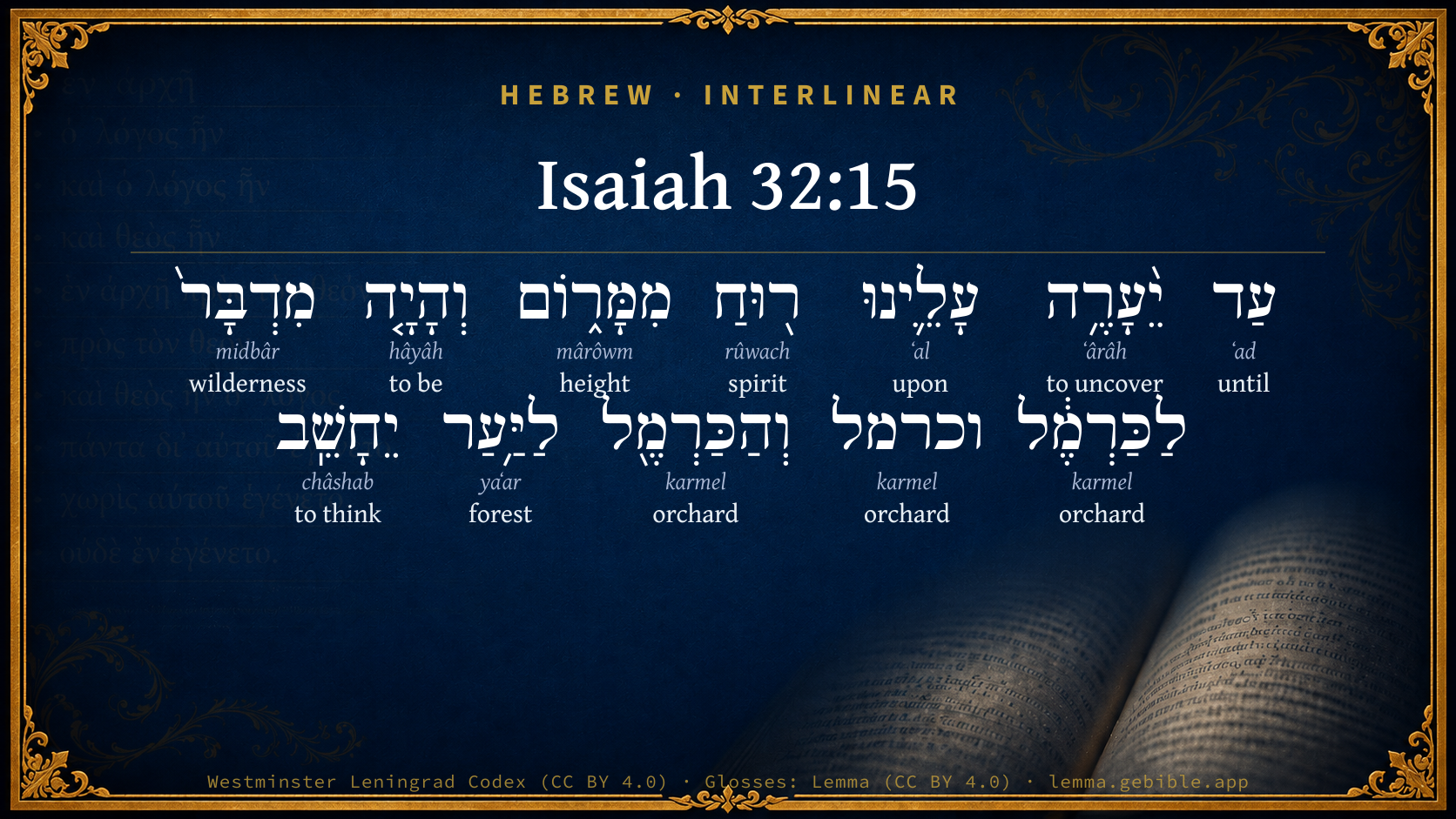
Hebrew (Westminster Leningrad Codex) Isaiah 32:15 appears in the Hebrew Old Testament. The text above is from the Westminster Leningrad Codex. Each word links to its Strong’s number, a concise gloss, and parsing drawn from the Open Scriptures Hebrew Bible morphology. Click any word for its full Brown-Driver-Briggs (BDB) entry.
Download image
Cite this verse

Isaiah 32:15 (World English Bible). Public Domain. Lemma interlinear Bible study tool, https://lemma.gebible.app/v/isaiah/32/15.

Show BibTeX & RIS
BibTeX
RIS
English Translation
until the Spirit be poured on us from on high, and the wilderness become a fruitful field, and the fruitful field be esteemed as a forest.
World English Bible · Public Domain
Download a study sheet

One document with this verse’s original text, its word-by-word gloss line, the meaning frame, cross-references with their text, attributed commentary, and full source and license credits — printable, and it pastes into notes with its structure intact.

This verse Autodidact and up

Study sheet (.html) Plain text (.txt)

A passage Seminary Student

Up to 50 verses in one chapter. A passage sheet keeps up to 6 commentary sources and 12 cross-references per verse, in the order this page ranks them, and says so on the sheet whenever that leaves anything out. Ask for a single verse and you get the Autodidact verse sheet above.

Everything on this page stays free to read, with no account — the sheet is a download of what is already on screen, not access to it.

Want to remove ads? Support Godless Engineer
Compare translations 3

The same verse in 3 English versions, stacked beneath the original-language interlinear above. Click any original word for its lexicon entry.

Each is an independent rendering of the whole verse — the interlinear is not word-aligned to these translations.

Highlighted words mark where these versions differ — a whole-verse word diff, not a word-by-word alignment.

  • World English Bible Public Domain
    until the Spirit be poured on us from on high, and the wilderness become a fruitful field, and the fruitful field be esteemed as a forest.
  • King James Version Public Domain
    Until the spirit be poured upon us from on high, and the wilderness be a fruitful field, and the fruitful field be counted for a forest.
  • unfoldingWord Literal Text CC BY-SA 4.0
    until the Spirit is poured on us from the height, and the wilderness becomes agricultural land and agricultural land is regarded as a forest. q1

unfoldingWord Literal Text — © unfoldingWord, licensed CC BY-SA 4.0. Word-aligned USFM3 via Door43 (git.door43.org/unfoldingWord/en_ult).

Versions to compare (up to 4)

3 of 4 selected

Show all 18 translations

Every available English version of this verse, each an independent rendering of the whole verse.

  • World English Bible Public Domain
    until the Spirit be poured on us from on high, and the wilderness become a fruitful field, and the fruitful field be esteemed as a forest.
  • Berean Standard Bible Public Domain
    until the Spirit is poured out upon us from on high. Then the desert will be an orchard, and the orchard will seem like a forest.
  • Majority Standard Bible Public Domain
    until the Spirit is poured out upon us from on high. Then the desert will be an orchard, and the orchard will seem like a forest.
  • King James Version Public Domain
    Until the spirit be poured upon us from on high, and the wilderness be a fruitful field, and the fruitful field be counted for a forest.
  • American Standard Version (1901) Public Domain
    until the Spirit be poured upon us from on high, and the wilderness become a fruitful field, and the fruitful field be esteemed as a forest.
  • Revised Version (1885) Public Domain
    until the spirit be poured upon us from on high, and the wilderness become a fruitful field, and the fruitful field be counted for a forest.
  • Geneva Bible (1599) Public Domain
    Vntill the Spirit be powred vpon vs from aboue, and the wildernes become a fruitfull fielde, and the plenteous fielde be counted as a forest.
  • Douay-Rheims (1899) Public Domain
    Until the spirit be poured upon us from on high: and the desert shall be se a charmel, and charmel shall be counted for a forest.
  • Young's Literal Translation Public Domain
    Till emptied out on us is the Spirit from on high, And a wilderness hath become a fruitful field, And the fruitful field for a forest is reckoned.
  • Literal Standard Version CC BY-SA 4.0
    Until the Spirit is emptied out on us from on high, || And a wilderness has become a fruitful field, || And the fruitful field is reckoned for a forest.
  • Unlocked Literal Bible CC BY-SA 4.0
    until the Spirit is poured on us from on high, and the wilderness becomes a fruitful field, and the fruitful field is considered as a forest.
  • unfoldingWord Literal Text CC BY-SA 4.0
    until the Spirit is poured on us from the height, and the wilderness becomes agricultural land and agricultural land is regarded as a forest. q1
  • Darby Bible Public Domain
    until the Spirit be poured upon us from on high, and the wilderness become a fruitful field, and the fruitful field be counted for a forest.
  • World Messianic Bible Public Domain
    until the Spirit is poured on us from on high, and the wilderness becomes a fruitful field, and the fruitful field is considered a forest.
  • Webster's Bible Public Domain
    Until the spirit shall be poured upon us from on high, and the wilderness shall be a fruitful field, and the fruitful field shall be counted for a forest.
  • Free Bible Version CC BY-SA 4.0
    until the Spirit is poured out on us from above, and the desert becomes like a good field full of crops, and a good field will grow like a forest.
  • Bible in Basic English Public Domain
    Till the spirit comes on us from on high, and the waste land becomes a fertile field, and the fertile field is changed into a wood.
  • JPS Tanakh (1917) Public Domain
    Until the spirit be poured upon us from on high, and the wilderness become a fruitful field, and the fruitful field be counted for a forest.

Literal Standard Version (2020), Covenant Press — licensed CC BY-SA 4.0. Text via the HelloAO Bible API (eBible.org). Unlocked Literal Bible (unfoldingWord) — licensed CC BY-SA 4.0. Text via the HelloAO Bible API (eBible.org). unfoldingWord Literal Text — © unfoldingWord, licensed CC BY-SA 4.0. Word-aligned USFM3 via Door43 (git.door43.org/unfoldingWord/en_ult). Free Bible Version, Dr. Jonathan Gallagher — licensed CC BY-SA 4.0. Text via the HelloAO Bible API (eBible.org).

Word by word

More ways to search: Search by grammar → Find every occurrence → Compare this word →

Practice this passage: Drill this verse → Learn its vocabulary →

יֵ֨עָרֶ֥ה
ʻârâh
H6168
“to uncover”
Verb, Niphal, Imperfect, 3rd Person, Masculine, Singular
Part of Speech
Verb
Stem
Niphal
Form
Imperfect
Person
3rd Person
Gender
Masculine
Number
Singular
Full BDB Definition

Origin: a primitive root

TWOT: 1692

to be bare, be nude, uncover, leave destitute, discover, empty, raze, pour out - (Piel) - to bare, lay bare - to lay bare by emptying, empty - to pour out - (Hiphil) - to make naked, strip bare (of sexual offences) - to pour out - (Niphal) to be poured out, be exposed - (Hithpael) - to expose oneself, make oneself naked - pouring oneself, spreading oneself (participle)
  1. עַד ʻad H5704 “until” Preposition
  2. עָלֵ֛ינוּ ʻal H5921 “upon · us” Preposition + Suffix, Personal, 1st Person, Common, Plural
  3. ר֖וּחַ rûwach H7307 “spirit” Noun, Common, Both, Singular, Absolute
  4. מִמָּר֑וֹם mârôwm H4791 “from · height” Preposition + Noun, Common, Masculine, Singular, Absolute
  5. וְהָיָ֤ה hâyâh H1961 “and · to be” Conjunction + Verb, Qal, Sequential Perfect, 3rd Person, Masculine, Singular
  6. מִדְבָּר֙ midbâr H4057 “wilderness” Noun, Common, Masculine, Singular, Absolute
  7. לַכַּרְמֶ֔ל karmel H3759 “to/for the · orchard” Preposition, Determined + Noun, Common, Masculine, Singular, Absolute
  8. וכרמל karmel H3759 “and · orchard” Conjunction + Noun, Common, Masculine, Singular, Absolute
  9. וְהַכַּרְמֶ֖ל karmel H3759 “and · the · orchard” Conjunction + Particle, Definite Article + Noun, Common, Masculine, Singular, Absolute
  10. לַיַּ֥עַר yaʻar H3293 “to/for the · forest” Preposition, Determined + Noun, Common, Masculine, Singular, Absolute
  11. יֵחָשֵֽׁב châshab H2803 “to think” Verb, Niphal, Imperfect, 3rd Person, Masculine, Singular

About this verse

These counts appear in no published source. They are computed here, from the morphology-tagged text and Lemma’s own curated glosses. What Lemma adds →

12
words
10
distinct lemmas
Prophets
section

Notable vocabulary

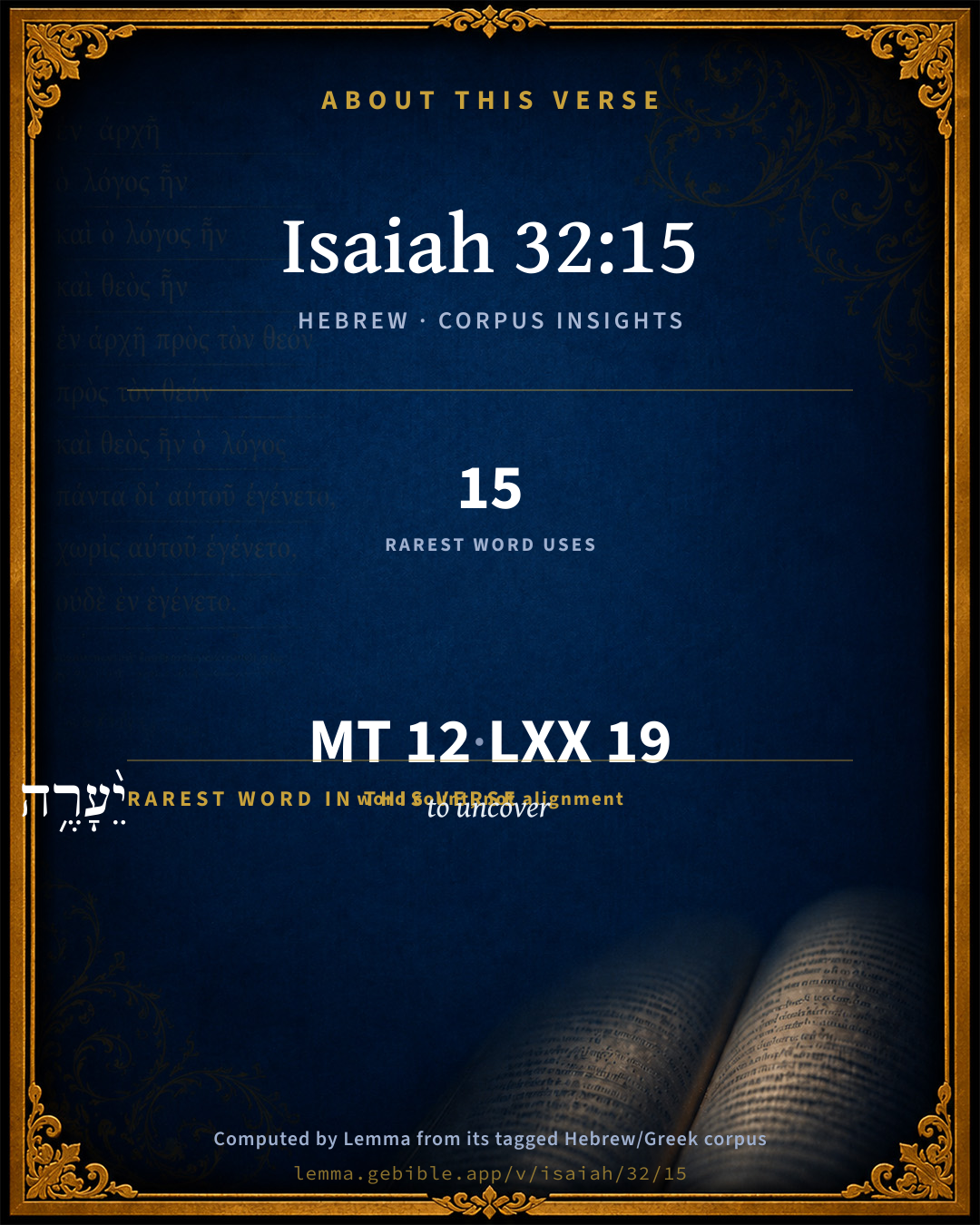
The rarest word here is יֵ֨עָרֶ֥ה to uncover H6168 — appearing just 15 times in the whole Hebrew Bible.

Shared distinctive vocabulary

יֵ֨עָרֶ֥ה to uncover H6168 occurs in 14 verses of the Hebrew Bible. Also found in:

Grammatical profile

  • 3 verbs
  • 7 nouns
  • 2 prepositions

Verb forms

  • יֵ֨עָרֶ֥ה Niphal · Imperfect
  • וְהָיָ֤ה Qal · Sequential Perfect
  • יֵחָשֵֽׁב Niphal · Imperfect

Repetition

A word recurs within this verse — often emphatic in Hebrew:

  • לַכַּרְמֶ֔ל orchard H3759 ×3

Hebrew & Septuagint length

In English translation the verse runs 26 words from the Hebrew and 23 from the Septuagint (LXX English) — closely comparable.

A rough comparison of the two English renderings, which tokenize alike — not a word-level alignment.

Word counts can differ between the Hebrew and the Greek without any difference in meaning — e.g. the Hebrew direct-object marker אֵת has no separate Greek word, and Greek often adds the article ὁ.

In the original languages it is 12 Hebrew tokens and 19 Greek tokens — but the two are counted differently (Hebrew bundles its prefixes and suffixes into one token; the Greek is in lemma form), so that isn’t a like-for-like length.

Cross-references

26

Topical passages linked to Isaiah 32:15 in the Treasury of Scripture Knowledge — connected by theme and wording, ordered by reader-vote popularity; previews shown in the World English Bible.

  • Isaiah 29:17 Is it not yet a very little while, and Lebanon shall be turned into a fruitful field, and the fruitful field shall be esteemed as a forest?
  • Ezekiel 39:29 neither will I hide my face any more from them; for I have poured out my Spirit on the house of Israel, says the Lord Yahweh.
  • Isaiah 44:3 For I will pour water on him who is thirsty, and streams on the dry ground; I will pour my Spirit on your seed, and my blessing on your offspring:
  • Titus 3:5–6 not by works of righteousness, which we did ourselves, but according to his mercy, he saved us, through the washing of regeneration and renewing by the Holy Spirit,
  • Luke 24:49 Behold, I send forth the promise of my Father on you. But wait in the city of Jerusalem until you are clothed with power from on high."
  • Isaiah 59:19–60:22 So shall they fear the name of Yahweh from the west, and his glory from the rising of the sun; for he will come as a rushing stream, which the breath of Yahweh drives.
  • Joel 2:28–29 "It will happen afterward, that I will pour out my Spirit on all flesh; And your sons and your daughters will prophesy. Your old men will dream dreams. Your young men will see visions.
  • Isaiah 11:2–3 The Spirit of Yahweh shall rest on him, the spirit of wisdom and understanding, the spirit of counsel and might, the spirit of knowledge and of the fear of Yahweh.
  • Zechariah 12:10 I will pour on the house of David, and on the inhabitants of Jerusalem, the spirit of grace and of supplication; and they will look to me whom they have pierced; and they shall mourn for him, as one mourns for his only son, and will grieve bitterly for him, as one grieves for his firstborn.
  • Acts 2:33 Being therefore exalted by the right hand of God, and having received from the Father the promise of the Holy Spirit, he has poured out this, which you now see and hear.
  • Psalms 104:30 You send forth your Spirit: they are created. You renew the face of the ground.
  • Isaiah 35:1–2 The wilderness and the dry land shall be glad; and the desert shall rejoice, and blossom as the rose.
  • 2 Corinthians 3:8 won't service of the Spirit be with much more glory?
  • Isaiah 63:11 Then he remembered the days of old, Moses [and] his people, [saying], Where is he who brought them up out of the sea with the shepherds of his flock? where is he who put his holy Spirit in the midst of them?
  • Psalms 107:33 He turns rivers into a desert, Water springs into a thirsty ground,
  • Isaiah 45:8 Distil, you heavens, from above, and let the skies pour down righteousness: let the earth open, that it may bring forth salvation, and let it cause righteousness to spring up together; I, Yahweh, have created it.
  • Isaiah 61:3–5 to appoint to those who mourn in Zion, to give to them a garland for ashes, the oil of joy for mourning, the garment of praise for the spirit of heaviness; that they may be called trees of righteousness, the planting of Yahweh, that he may be glorified.
  • Psalms 107:35 He turns a desert into a pool of water, And a dry land into water springs.
  • Isaiah 35:7 The glowing sand shall become a pool, and the thirsty ground springs of water: in the habitation of jackals, where they lay, shall be grass with reeds and rushes.
  • Hosea 1:10–11 Yet the number of the children of Israel will be as the sand of the sea, which can't be measured nor numbered; and it will come to pass that, in the place where it was said to them, 'You are not my people,' they will be called 'sons of the living God.'
  • John 7:39 But he said this about the Spirit, which those believing in him were to receive. For the Holy Spirit was not yet given, because Jesus wasn't yet glorified.
  • Proverbs 1:23 Turn at my reproof. Behold, I will pour out my spirit on you. I will make known my words to you.
  • Isaiah 55:11–13 so shall my word be that goes forth out of my mouth: it shall not return to me void, but it shall accomplish that which I please, and it shall prosper in the thing whereto I sent it.
  • Acts 2:17–18 'It will be in the last days, says God, That I will pour out my Spirit on all flesh. Your sons and your daughters will prophesy. Your young men will see visions. Your old men will dream dreams.
  • Romans 11:18–26 don't boast over the branches. But if you boast, it is not you who support the root, but the root supports you.
  • Isaiah 54:1–3 Sing, barren, you who didn't bear; break forth into singing, and cry aloud, you who did not travail with child: for more are the children of the desolate than the children of the married wife, says Yahweh.

Cross-references courtesy of OpenBible.info (CC BY 4.0).

Hebrew and Greek witnesses Masoretic Hebrew ↔ Greek Septuagint

The same verse in the two great witnesses to the Old Testament, shown verse-for-verse.

These are two independent witnesses, not word-aligned to each other, and the Septuagint is shown in lemma (dictionary) form.

Hebrew Isaiah 32:15 Masoretic · Westminster Leningrad Codex

עַד יֵ֨עָרֶ֥ה עָלֵ֛ינוּ ר֖וּחַ מִמָּר֑וֹם וְהָיָ֤ה מִדְבָּר֙ לַכַּרְמֶ֔ל וכרמל וְהַכַּרְמֶ֖ל לַיַּ֥עַר יֵחָשֵֽׁב

until the Spirit be poured on us from on high, and the wilderness become a fruitful field, and the fruitful field be esteemed as a forest.

World English Bible · Public Domain

Greek LXX Isaiah 32:15 Septuagint · lemma form

ἕως ἄν ἐπιἔρχομαι ἐπί σύ πνεῦμα ἀπό ὑψηλός καί εἰμί ἔρημος ὁ χερμελ καί ὁ χερμελ εἰς δρυμός λογίζομαι

until the Spirit shall come upon you from on high, and Chermel shall be desert, and Chermel shall be counted for a forest.

LXX2012 (modern English Septuagint) · Public Domain

Hebrew: Westminster Leningrad Codex (CC BY 4.0). Greek: Septuagint (public domain); English from LXX2012 (modern English Septuagint) (Public Domain). How the Septuagint differs from the Hebrew →

Targum (Aramaic paraphrase)

1

The Targum is the ancient Jewish Aramaic paraphrase of the Hebrew Scriptures — an interpretive translation, not the Hebrew text itself. Onkelos (literal) and Pseudo-Jonathan (expansive) render the Torah, and Jonathan the Prophets. Coverage is partial: where no permissively-licensed English translation exists for a verse, only the Aramaic is shown. This is verse-level text, not a word-by-word alignment to the Hebrew.

  1. Targum Jonathan Prophets (Joshua–Malachi)
    כָּל דְנָא עַד דְיֵיתֵי לָנָא רְוַח מִן קֳדָם דִשְׁכִנְתֵּהּ בִּשְׁמֵי מְרוֹמָא וִיהֵי מַדְבְּרָא לְכַרְמְלָא וְכַרְמְלָא קִירְוִין סַגִיאִין יְתִיב:

    All these things shall come upon us until refreshing shall come to us from the face of Him, whose Shekinah is in the highest heavens. The wilderness shall become a fruitful field, and the fruitful field shall be inhabited by many cities.

    Targum Jonathan — Aramaic: “Mikraot Gedolot” (public domain). English: “Sefaria Community Translation” (CC0 1.0 (public-domain dedication)); “London "Chaldee Paraphrase," 1871” (public domain). Text via Sefaria.

Commentary

Notes on Isaiah 32:15 from classic Christian and Jewish commentators (each source and its license shown beneath its notes). The classic Christian expositions comment on the surrounding passage and are grouped to its opening verse, so a note may address several verses; the Jewish commentaries on the Tanakh (Rashi and others) are per-verse, so they appear only where the commentator wrote on this verse.

Lemma curates 59 commentaries, every one of them public domain or Creative Commons licensed, each selected and text-cleaned for this edition rather than reprinted as found. About our sources →

Trapp's Complete Commentary

John Trapp

Isa 32:15 Until the spirit be poured upon us from on high, and the wilderness be a fruitful field, and the fruitful field be counted for a forest.

Ver. 15. Until the Spirit be poured upon us from on high.] Donec Dominus dignabitar suum favorem et gratiam denuo nobis impertiri, Till God shall please once more to impart unto us his grace and favour. So he sets them no certain time of restoration; as desirous thereby to stir them up to pray continually, and to bring forth fruits worthy amendment of life. This effusion of "the Spirit upon all flesh" {Joe 2:28} - that is, of the best thing upon the basest - is a very great mercy.

And the wilderness be a fruitful field.] Heb., A Carmel. Such a change worketh the Spirit of grace - it maketh barren hearts fruitful, and manifesteth hypocrites, whatever they seem, to be no better than wild trees that bear no good fruit.

John Trapp, A Commentary or Exposition upon All the Books of the Old and New Testament (1647–1656) — public domain. Text from a community e-Sword module.

The Biblical Illustrator

Joseph S. Exell

Isa_32:15-17

Until the Spirit be poured upon us from on high

Spiritual influences

I.

THERE IS PROVIDED IN CONNECTION WITH THE CHRISTIAN ECONOMY, THE BESTOWMENT OF SPIRITUAL INFLUENCES ON MANKIND.

1. In what manner is the Spirit poured from on high? It cannot but be expected that there must be not a little of mystery on such a subject. Yet the information we possess is distinct and important. There was a distinct communication of this influence made to the apostles, which was accompanied by immediate and visible signs. But it was intended that this Spirit should influence the hearts of men in general: an arrangement was made, in the Divine goodness, by which the Gospel should be rendered powerful and effectual to produce great moral results in the hearts and on the lives of men. We speak of this influence as common and permanent. We pretend not to state how this Spirit comes down to influence the minds of men: the wind bloweth where it listeth, and thou hearest the sound thereof, but canst not tell whence it cometh, and whither it goeth; so is everyone that is born of the Spirit. But we do regard it as an essential principle, that the Spirit of God is poured out upon mankind; and we declare that to reject this doctrine is most perilous to the immortal soul!

2. For what purposes is the Spirit poured from on high? One effect of this influence on the minds of the apostles at first was a great and a public one; it was intended to endow them with those miraculous gifts and graces which were commensurate with the divinity of their claims--the truth of their mission--the importance of their object. But the more ordinary influences of the Spirit are still poured out, and are most important to effect the salvation of the soul. He is the Spirit of repentance--of faith--of power--of knowledge--of wisdom and revelation in the knowledge of Christ roof holiness--of comfort--of love--of anticipation.

3. To what extent is the Spirit poured from on high? It is evidently the design of God that there should be a very wide extension of this influence.

4. Under what necessity is the Spirit poured from on high? Excepting it were the case that such an arrangement had been made, in the mercy of God, for changing the state of mankind, there could have been no prospect of happiness on earth, or of everlasting glory hereafter.

II. THE FACTS REGARDING THE BESTOWMENT OF SPIRITUAL INFLUENCE UPON MANKIND OUGHT TO PRODUCE ON OUR MINDS THE MOST POWERFUL EFFECTS.

1. We ought carefully to ascertain whether we have the communication of this influence of the Spirit.

2. Pray that there may be an outpouring of this communication. Pray for this gift for yourselves--for your families--for the Church of God--for the world. (James Parsons.)

The pouring-out of the Spirit

Whoever has paid any serious attention to religion must be convinced of his natural weakness and inability to fulfil even his own wishes and resolutions. It is to meet this undoubted fact of mans natural inability to do the will of God that the Divine influence of the Holy Spirit was arranged and promised.

I. THE INFLUENCE OF THE SPIRIT IN THE PROGRESS OF THE GOSPEL. The Bible shows us our dependence on God as Creator, Preserver, and Lord.

1. On the first page we find the creation, with all its wonders, recorded. The earth was without form, and void. But the Spirit of God moved on the face of the waters, and forthwith light and order proceeded, life appeared, the heavens and the earth, and all was very good.

2. Sin came and devastated the social world. The evil spirit of temptation was at work.

3. During the times of the prophets the limited range of the Spirit was felt and more favoured days proclaimed.

4. These promises were revived in the words of Christ, who more particularly entered into the offices and working of the Holy Ghost and its influence on the future Church as well as on the individual lives of Christians. On Him also the Spirit descended in a bodily form. He gives definite promises of the particular gift--promises which the disciples did not rightly apprehend.

5. In subsequent history all was made plain and clear. On the day of Pentecost was the great promise fully realised.

6. The apostles, in all their writings, enter fully into its power and influence. Do the converts need wisdom? The Father will give the Spirit of wisdom. Or, deliverance from corruption? The Spirit works in them to will and to do the good pleasure. The distinguishing marks of a Christian are that he walks after the Spirit; is spiritually minded; that the Spirit dwells in a man as a Spirit of adoption, confidence, and love; while the apostle glories in tribulation because of the Holy Ghost, and prays that the disciples may be filled with hope by the power of the Holy Ghost. Thus we see the nature and office of the Spirit.

II. ITS PRACTICAL APPLICATION TO OURSELVES. All persons are divided into two classes.

1. Those who have no adequate apprehension of the nature or value of divine things. The natural man receiveth not the things of God, for they are foolishness unto him. They are therefore ignorant for want of spiritual illumination. But, continues the apostle, God hath shined in our hearts to give the light of the knowledge of the glory of God in the face of Jesus Christ. This reveals to us the knowledge of ourselves as ruined and lost.

2. But as there may be light without heat, so there may be knowledge without practice. The Word of God may be received with joy, but it may not take root in the soul. It is the glory of the Gospel that it not only inculcates what is right, but gives strength to perform it: it teaches what is evil, and helps to subdue that evil. All this is wrought by the Holy Ghost. (Homilist.)

A national Pentecost

I. THE NATIONAL IMPORT OF THESE WORDS. That the thought of Isaiah was national, and not individual, may easily be gathered from his opening words, and from the whole burden of his message. It is of a king he speaks, and of the effects of a righteous rule. The words of our text are especially addressed to women, and reveal the sad state of society as it was when Isaiah addressed it. There is no hope for the nation when its women are careless daughters, and contemptible of holy things. Woman is the last bulwark of godliness. If women are lost to God, all is lost. Yet though the prophets heart groans under the lamentable state of the women of his day, he sees a glad day coming, when the Spirit shall be so outpoured, that society will be purified. Upon the outpouring of the Spirit, three things are to take place.

1. There is to be a godly revolution. It may be silent and natural, but is to be very real. The very wilderness is to become a fruitful field. The desert is to blossom as the rose. If we study the prophecy of Joel, we see the signs are revolutionary. And no language employed by Carlyle in his French Revolution is more potent, more expressive. I will show wonders in the heaven and in the earth, blood, and fire, and pillars of smoke; the sun shall be turned into darkness and the moon into blood. It is the recreation of the nation that the prophet has in his mind. Ezekiels valley of dry bones is to be re-animated. The national identity as well as the national life is to be restored.

2. There is to be an outburst of new life. The wilderness is to blossom, the fruitful field is to become a forest. Mazzini must foster a Young Italy to-day if he is to create a new Italy to-morrow. The Spirit generates new life. The visions of possibilities in the young, the fresh dreams of the old, all make for a new existence.

3. There is also to be a newly organised government. A king rules in righteousness. And even the wilderness, type of lawless oppression, is to be under a just government. Judgment shall rule in the wilderness. Righteousness is the basis of peace. Pascal says, Philosophy says, know thyself. Christianity says, know thy God. That is all the difference between the maxims of the world and the new force that Pentecost created in the world. When men fall into right relationship with God, they will soon fall into right relations with one another.

II. THE EFFECT OF THE OUTPOURING OF THE HOLY GHOST. Pentecost was only a promise, a first-fruit, a miniature fulfilment of the prophets great words.

1. There is in our prophecy a restoration of blessing. Acquainted as Isaiah was with vast reaches of arid desert, he sees it a fruitful field. Out of death life comes, and into barrenness, fruitfulness.

2. There is to be a multiplication of blessing. That vast, dreary stretch of desert in the East is to be as the Vale of Carmel, luxuriant and beautiful, and Carmels valley is to be as precious as Lebanons forest. And righteousness is to sway its sceptre over all. The effect of righteousness is to be quietness and assurance for ever. The Church of apostolic days was a beautiful miniature of still larger things, of richer spiritual results.

3. There is to be a social betterment for all. Wherever Christianity goes it uplifts the races. Unbelief may sneer at Christianity, but it still remains the greatest civilising force in the world.

III. THINGS ESSENTIAL TO THE NEW ORDER. The Holy Spirit is to effect regeneration, by convicting men of sin, of righteousness and of judgment. By breathing into them a new life, and by Divine illumination. Three things are essential to a new kingdom. Power to create it, authority to govern it, a cause for its existence. Garibaldi found his cause in the degraded condition of his people. Jesus finds His cause not only in the lost condition of the human race, but also in the Fathers eternal love and purpose. Christ is said to be seated at the right hand of power. That word power is the same as that from which we get dynamics. The very strength of power, a mighty force. Christ is at the right hand of Almighty power. There are certain powers in the world which we call forces; such as gravity, steam, hydraulics, liquid air, electricity. These forces operate along definite lines, just as surely as a train of railway carriages runs along the track of its lines of steel. It is said, Whenever you obey the law of power, the law of power obeys you. Now, in fact, this is just what Peter says. The Holy Ghost is given to them that obey Him. If the Holy Spirit is to use a man, work through and by a man, he must obey the laws of the Spirit. He must be conformed to Gods will. Let me now quote to you some cases where men have been obedient to the Holy Spirit, and as a result have been filled with power from on high. In each case they have obeyed Christs word--Tarry ye . . . until ye be endued with power from on high. Jonathan Edwards, a quiet, strong intellect, strongly Calvinistic, whose influence in the world has been most mighty, says, I found from time to time an inward sweetness that would carry me away in my contemplations. This I know not how to express otherwise than as a calm, sweet abstraction of the soul from all the concerns of the world, and sometimes a kind of vision of being alone on the mountains, far from all mankind, sweetly conversing with Christ, and wrapped and swallowed up in God. Then there is John Flavel, who one day journeying alone, had such concentration of mind, such ravishing tastes of heavenly joys, that he utterly lost sight and sense of this world, and for some hours knew no more where he was than if a deep sleep had fallen upon him in the night. Thus we see that these men wholly consecrated to God, obeying His will, placing themselves in direct communication with the Spirit of God, leaving their whole being open to the Spirits operations, were filled with a Divine power that is inexpressible. And may we not thus lie open to His gracious incoming, and wait daily upon God until the Spirit be poured out upon us from on high?

IV. THE NATURE OF THE SPIRITS MANIFESTATIONS. The Holy Spirits presence is seen in His conviction of the sinner. When He is among us, men realise their sinfulness, and cry unto God. (F. James.)

Judgment and mercy

Some time ago, amid a very heavy thunderstorm, I heard, between two of the heaviest peals, the carolling of a lark! It was a strange and welcome contrast. All around us the thunder was growling and roaring, but in one of the brief interludes there came this burst of bird-song. And all about this chapter one hears the growl of the threatening thunder. There is a gathering storm of judgment. The future is full of menace. And yet, in the midst of all the approaching terror, there sounds out this sweet little paean about fruitful fields, and righteous relationships, and peaceful homes, and happy, restful days. It was ever the way of this great prophet. The hard note of judgment was alternated with the softer note of mercy. The larks song is frequently heard amid the thunder. (J. H.Jowett, M. A.)

The Spirit poured out

I. Here is A GREAT PROPHET FORESEEING THE OUTPOURING OF THE SPIRIT OF GOD. That in itself would be interesting, but it is rendered doubly so by the fact that--

II. HE PROCEEDS TO NAME THE RESULTS WHICH WOULD FOLLOW THE OUTPOURING (Isa_32:15-17). (J. H. Jowett, M. A.)

Results of the outpouring of the Spirit

Here is the problem: If the Spirit of God were to be poured out upon a nation, what would happen?

1. The unfolding of creation in accordance with the fullest design of God. The wilderness a fruitful field, &c. Is that to be taken literally or only figuratively? Shall we interpret it as only meaning that the wilderness of meanness and niggardliness and greed shall break into the fruitful field of benevolence and philanthropy, or shall we interpret it according to its literal meaning that nature itself shall pass into larger bounteousness and perfection? I think the literal interpretation is the right one. I think Isaiah means just what he says, that the beautifying of humanity will elicit higher beauty in the world about us. Throughout the whole book you will find this doctrine taught, that the perfection of nature is involved in the redemption of men. Nature cannot put on all the fulness of her beautiful garments until man puts on the beauty of holiness. The unfolding of one awaits the evolution of the other. Scripture affirms that nature is held in bondage. She is fettered, and unable to realise the full glory of her design, and this because of the moral and spiritual bondage of man. This is not the teaching only of the prophet Isaiah. It is apostolic teaching. Have you ever paused at that profound word of the Apostle Paul, where he says that, the earnest expectation of creation waiteth for the revealing of the sons of God? English translation does not in any degree express the extraordinary force of the figure which the apostle employs. What is the figure? It is this. Paul represents nature standing bound, with uplifted head, scanning with longing eyes the horizon from which she looks for help, her hands stretched out to grasp and welcome the redemption into freedom and perfection which she yearns for and confidently expects. That is the figure: creation, bound and imperfect, yearning and waiting for her redemption and perfection, which is to come through redeemed man.

2. Judgment and righteousness shall dwell among them as abiding guests. Righteousness shall dwell there! It shall not be an occasional visitor, a spasmodic impulse, an inconstant and irregular desire. It shall dwell there as a permanent disposition. It shall not be a weak emotion. It shall be a mighty passion. When the Spirit of God is poured out upon a people, that people shall hunger for righteousness. You know how it is with mountain air. Down in the sultry valley we are sluggish and languid. We are indifferent about our food. We come to it as a custom; we take it as a task.

But if we get up into the pure, strong air of the higher moorlands, our languor drops from us, and our appetite awakes, and we turn to our food with hunger, and take it with relish.

3. The creation of social peace. Put things right, and peace will come. Maladjustments always produce unrest in the physical and moral life. (J. H.Jowett, D. D.)

The Biblical Illustrator, edited by Joseph S. Exell (c. 1880s–1900s) — public domain. Text from a community e-Sword module.

Joseph Benson's Commentary

Isa 32:15. Until the Spirit be poured upon us, &c. — And this calamity shall, in a manner, continue until the time come in which God will pour, or, as יערה, properly signifies, reveal, that is, evidently and plentifully confer his Spirit upon his people. Which was done, in some sort, upon their return from Babylon, when God, by his Spirit, moved Cyrus to give them liberty of returning to Jerusalem, and the people to return and build the city and temple. But it was far more clearly and fully accomplished in the days of the Messiah, when God’s Spirit was in a most evident and glorious manner poured forth upon the apostles and other believing Jews, to the astonishment of their very adversaries; and when the following promises were, in a good measure, fulfilled, and are more fully to be accomplished in God’s due time. And the wilderness be a fruitful field — Which expressions are to be understood allegorically of the conversion of the Gentile nations, which had been long barren, and of the rejection of the Jews in the time of the Messiah. See on Isa 29:17.

Joseph Benson's Commentary on the Old and New Testaments (1811–1818) — public domain. Text from a community e-Sword module.

Tyndale Open Study Notes

Tyndale Open Resources

32:15 The Spirit would transform the nation into a godly community and bring in an era of justice and righteousness (see also Joel 2:28-32). The Spirit is connected to the Messiah (Isa 11:1) and the servant (42:1; 61:1). • wilderness . . . bountiful crops: When the people are transformed, nature will be too.

Tyndale Open Study Notes — © Tyndale Open Resources, licensed CC BY-SA 4.0. Text via the HelloAO Bible API.

Geneva Bible (1599)

Geneva Bible translators

The field which is now fruitful, shall be but as a barren forest in comparison of that it shall be then, as Isa. 29:17, which shall be fulfilled in Christ’s time, for then they that were before as the barren wilderness, being regenerate shall be fruitful, and they that had some beginning of godliness, shall bring forth fruits in such abundance, that their former life shall seem but as a wilderness where no fruits were.

That is, when the Church shall be restored: thus the Prophets, after they have denounced God’s judgments against the wicked, used to comfort the godly, lest they should faint.

Geneva Bible (1599) marginal notes — public domain. Text via Bolls.life.

Jamieson, Fausset & Brown

Robert Jamieson, A. R. Fausset & David Brown

This can only partially apply to the spiritual revival in Hezekiah's time; its full accomplishment belongs to the Christian dispensation, first at Pentecost (Joe 2:28; Act 2:17), perfectly in coming times (Psa 104:30; Eze 36:26; Eze 39:29; Zac 12:10), when the Spirit shall be poured on Israel, and through it on the Gentiles (Mic 5:7).

wilderness . . . fruitful field . . . forest--when Judea, so long waste, shall be populous and fruitful, and the land of the enemies of God shall be desolate. Or, "the field, now fruitful, shall be but as a barren forest in comparison with what it shall be then" (Isa 29:17). The barren shall become fruitful by regeneration; those already regenerate shall bring forth fruits in such abundance that their former life shall seem but as a wilderness where no fruits were.

Jamieson, Fausset & Brown — Commentary Critical and Explanatory on the Whole Bible (1871) — public domain (CC PDM 1.0). Text via the HelloAO Bible API.

Adam Clarke's Commentary

Verse 15. And the fruitful field] והכרמל vehaccarmel. So fifteen MSS., six ancient, and two editions; which seems to make the noun an appellative.

Adam Clarke's Commentary on the Bible (1810–1826) — public domain. Text from a community e-Sword/MySword module.

Ellicott's Commentary for English Readers

(15) Until the spirit be poured upon us from on high . . .—There was, then, a fixed limit of the desolation then described. Isaiah dwelt, as Joel (Joe_2:28) had dwelt before him, on the outpouring of the Spirit which should sweep away the frivolities of a profligate luxury and lead to a nobler life. The effect of that outpouring is described in symbolic language which had been used before (see Note on Isa_29:17), the “wilderness” taking the place of Lebanon.

A Bible Commentary for English Readers, edited by Charles John Ellicott (1878–1897) — public domain. Text from a community e-Sword module.

The Cambridge Bible for Schools and Colleges

gen. ed. J. J. S. Perowne

15. At last the great transformation of all things will be ushered in, by an outpouring of spirit (the Heb. has no art.) from on high; i.e. from heaven, as in ch. Isa_33:5. The spirit, conceived as a subtle essence descending upon and then permeating the human world, is said to be “poured out” as in ch. Isa_29:10; Eze_39:29; Joe_2:28 f. (although different verbs are there used). Any supernatural influence, even when acting to the injury of man, might be so spoken of (ch. Isa_19:14, Isa_29:10), just as a personal “spirit from Jehovah” may be evil or false (1Sa_16:14; 1Ki_22:21 ff.). Here the word is used absolutely and denotes the Divine principle of life, and especially the power by which the will of God is made to prevail in human society (Isa_32:16 f.).

On the second half of the verse see ch. Isa_29:17.

The Cambridge Bible for Schools and Colleges (gen. ed. J. J. S. Perowne; Cambridge University Press, 1878–1918) — public domain. Text from a community e-Sword module.

John Gill's Exposition

Until the Spirit be poured upon us from on high,.... That is, Jerusalem shall lie in ruins until this time comes; which therefore cannot be understood of the effusion of the Spirit on the day of Pentecost, which, as it was before the destruction of the city by the Romans, so the desolation it was brought to by the Chaldeans did not last so long; but must be interpreted of a pouring forth of the Spirit in his gifts and graces yet to come, which will bring on the fulness of the Gentiles, and the conversion of the Jews, and till that time comes Jerusalem will continue in a ruinous condition; the sense is the same with that of Luk 21:24 "Jerusalem shall be trodden down of the Gentiles, until the times of the Gentiles are fulfilled". The Targum of the place is,

"until refreshing comes to us from the face of him, whose Shechinah, or Majesty, is in the highest heavens;''

with which may be compared Act 3:19,

and the wilderness be a fruitful field, and the fruitful field be counted for a forest; this will be the consequence, fruit, and effect of the effusion of the Spirit in the latter day; that such parts of the world as were like a wilderness, barren and unfruitful, producing nothing but the briers and thorns of impiety, infidelity, superstition, and idolatry, should now become like a fruitful field; the Gospel being now preached everywhere, multitudes of souls converted, churches raised and formed, and these filled with such as were laden with the fruits of righteousness; and such places where the Gospel had been preached and professed, and where churches had been planted, and there were some good degree of fruitfulness in word and works, now should be abundantly more fruitful, and the professors of religion more numerous, and look more like a forest, for number of trees, than a field. Kimchi says this whole paragraph shall be accomplished in the days of the Messiah.

John Gill's Exposition of the Whole Bible (1746–1763) — public domain (CC PDM 1.0). Text via the HelloAO Bible API.

Albert Barnes' Notes on the Bible

Until the Spirit - The Spirit of God, as the source of all blessings, and especially as able to meet and remove the ills of the long calamity and desolation. This evidently refers to some future period, when the evils which the prophet was contemplating would be succeeded by the spread of the true religion. If the prophet meant to confine his description of calamities to those which would attend the invasion of Sennacherib, then this refers to the piety and prosperity which would prevail after that during the reign of Hezekiah. If he designed, as Lowth supposes, to describe the calamites which would attend the invasion of the Chaldeans and the desolation of the city of Jerusalem during the captivity, then this refers to the prosperous times that would occur after their return to their own land. And if he looked forward beyond even that, then this refers to the times of the Messiah also, and he designed to describe the happy period when the Messiah should have come, and when the Spirit should be poured out. Vitringa supposes that all three of these events are referred to. But although the expressions are such as are used in reference to the times of the Messiah, yet the word ‘until’ seems to limit the prediction to some event previous to that. The plain sense of the passage is, that the city would lie waste, and would be a pasture for flocks, until the Spirit should be poured out; that is, would lie waste a long time, and then be succeeded by the merciful interposition of God restoring them to their land and privileges. This idea would seem to limit it. at the utmost, to the return from Babylon.

Be poured out - This is a common and usual mode of indicating that the influences of the Spirit of God would be imparted Isa 44:3; Eze 39:29; Joe 2:28-29; Act 2:17-18.

From on high - From heaven (compare Luk 24:49).

And the wilderness be a fruitful field - Until that change shall come when the places that are desolate shall become fertile, and the places which are now fertile and prosperous shall become desolate and barren. This may refer to the time when Jerusalem, that would have lain so long waste, would be again inhabited and cultivated, and when Babylon, then so prosperous, would become desolate and ruined. The expression has a proverbial cast and denotes change and revolution (see the note at Isa 29:17).

Albert Barnes' Notes on the Bible (1834–1885) — public domain. Text from a community e-Sword/MySword module.

Haydock's Catholic Bible Commentary

High, as Ezechiel (xxxvii. 10.) saw the dry bones rise again. Under this idea prosperity is frequently described. The rest of the chapter may very well be explained of the propagation of the gospel. --- Forest. Carmel was a fertile spot. Judea shall flourish, and Assyria shall be laid waste. The synagogue will be rejected, while the Gentiles, (Calmet) formerly so barren, shall embrace the faith and true piety. (Haydock)

George Leo Haydock (1774–1849), Haydock's Catholic Family Bible and Commentary, 1859 edition — public domain. Excludes Psalms (Douay-Rheims chapter numbering differs from Protestant) and Deuterocanonical books (Catholic canon only).

Matthew Poole's English Annotations

Until the Spirit be poured upon us from on high: and this calamity and desolation shall, in a manner, continue until the time come, in which God will pour, or, as the Hebrew word properly signifies, reveal, i.e. evidently and plentifully pour out, his Spirit from heaven upon his people; which was done in some sort upon the return of the people from Babylon, when God, by his Spirit, stirred up the spirit, both of Cyrus to give them liberty of returning to Jerusalem, and of the people to return and build the city and temple; but was far more clearly and fully accomplished in the days of the Messiah. And indeed the promises contained in these and the following words and verses were not fulfilled upon their coming out of Babylon, after which time they had but a little reviving in their bond. age, as is said, Ezr 9:8, and continued in servitude and distress under the Persian emperors, Neh 9:36,37, and afterward suffered many and grievous calamities from the kings of Syria and Egypt, and from the Romans; which suits very ill with that glorious promise here following, Isa 32:18. And therefore these promises concern the times of the gospel, when God’s Spirit was in a most evident and glorious manner poured forth upon the apostles, and other believing Jews, to the astonishment of their very adversaries; and when the following promises were in a good measure fulfilled, and are more fully to be accomplished in God’s due time.

The wilderness be a fruitful field, and the fruitful field be counted for a forest; which is allegorically understood. The meaning may be this; God’s people, who were desolate and destroyed, shall be revived and flourish, and their flourishing enemies shall be brought to desolation and destruction. It may also signify the conversion of the barren and despised Gentiles, and the rejection of the Jews, in the time of the Messiah.

Matthew Poole's English Annotations on the Holy Bible (1683–1685) — public domain. Text from a community e-Sword/MySword module.

Whedon's Commentary on the Bible

Daniel D. Whedon

15-17. Until the Spirit be poured upon us — Then shall begin the dispensation of the great moral changes referred to in Isa_32:1-8. The captivity will sift the just from the unjust and disobedient. The remnant shall return. Morally, the land shall become a fruitful field, where righteousness shall flourish, and peace, its result, shall abide with quietness and assurance for ever; that is, for a long, long time.

Daniel D. Whedon (gen. ed.), Commentary on the Old and New Testaments (1874–1909) — public domain. Text from a community e-Sword module.

The Pulpit Commentary

Until. The expression "until" modifies the previous "forever," showing that the desolation was not always to continue. The Spirit be poured upon us from on high. An effluence from the Holy Spirit of God on individuals of eminence, prophets, kings, artificers, to fit them for their tasks, is recognized in many of the earlier books of Scripture, and especially in the Davidical psalms. But a general effluence of the Spirit of holiness on a nation, to produce a change of heart, seems to be first announced by Isaiah. The nearly contemporary prophecy of Joel (Joe_2:28, Joe_2:29) is, perhaps, as wide in its scope, but limited to the prophetic gift, which is not necessarily conjoined with spiritual-minded-ness or holiness of life. Isaiah, the "evangelical prophet," first teaches that the conversion of a nation is God"s work, effected by the Holy Spirit, and effectual to the entire change of the heart of a people. And the wilderness be a fruitful field; i.e. "the community long cursed with barrenness of good works" (ver. 10) "becomes once more fruitful of them." And the fruitful field be counted for a forest. An order of climax seems to be here intended. The midbar, the bare pasturage-ground, becomes a Carmel, i.e. carefully cultivated; the Carmel becomes like Lebanon, a rich and luxurious forest. There is no close parallel between this verse and ver. 17 of Isaiah 29. The prophet is not tied down by his previous metaphors.

Vers. 15-17. The fruits of the Spirit in a community.

The first result of the effluence of the Holy Spirit on man is fruitfulness: "the wilderness becomes a fruitful field, and the fruitful field a forest." The dry ground of a stony heart is changed into a cultivated garden, which "brings forth much fruit." The heart which already bore some fruit is "purged, that it may bring forth more fruit". (Joh_15:2) Then, when individuals have been thus changed and "purged" and perfected one by one, judgment and righteousness "dwell" in the land the King "reigns in righteousness," and his princes rule in judgment" far and wide there is a reign of justice, right, equity. Next comes a further consequence. "The work of righteousness is peace," peace subjective and objective, in the heart and in the life the peace of quiet consciences assured of God"s favor, knowing that their sins are atoned for, and feeling that they are at one with God; and the peace of internal concord and agreement among all members of the community, mutual respect of class towards class, and of man towards man, general good will of all towards all, kindliness, courtesy, ready aid, sympathy, consideration. The complete result has not been seen as yet, because men have resisted God"s Spirit, and the copious outpouring of it, which he is willing to give, has never yet been given. But if this impediment were removed, if God"s Spirit had free course, and a kingdom or society of perfectly virtuous men were once formed, then we should see such further consequences as are pointed out by Bishop Butler in his "Analogy: such a state there would be no such thing as faction; but men of the greatest capacity would, of course, all along have the chief direction of affairs willingly yielded to them; and they would share it among themselves without envy. Each of these would have the part assigned him to which his genius was peculiarly adapted; and others, who had not any distinguished genius, would be safe, and think themselves very happy, by being under the protection and guidance of those who had. Public determinations would really be the result of the united wisdom of the community; and they would be faithfully executed by the united strength of it. Some would in a higher way contribute, but all would in some way contribute, to the public prosperity; and in it, each would enjoy the fruits of his own virtue. And as injustice, whether by fraud or force, would be unknown among themselves, so they would be sufficiently secured from it in their neighbors. For cunning and false self-interest, confederacies in injustice, ever slight, and accompanied with faction and intestine treachery, these, on one hand, would be found mere childish folly and weakness, when set in opposition against wisdom, public spirit, union inviolable, and fidelity on the other; allowing both a sufficient length of years to try their force. Add the general influence, which such a kingdom would have over the face of the earth, by way of example particularly, and the reverence which would be paid it. It would plainly be superior to all others, and the world must gradually come under its empire; not by means of lawless violence, but partly by what must be allowed to be just conquest, and partly by other kingdoms submitting themselves voluntarily to it, throughout a course of ages, and claiming its protection, one after another, in successive exigencies. The head of it would be a universal monarch, in another sense than any mortal has as yet been; and the Eastern style would be literally applicable to him, that all people, nations, and languages should serve him". (part 1: Isa

3.

The Spirit as a quickening Rain.

The results produced by heavy rains in the East are so striking that these rains become a suggestive figure of the influence of God"s Spirit on souls and on Churches. In times of prolonged drought, the ground is burnt up and chapped, and every sign of vegetation is destroyed. Then come the rains, the life in the soil responds, and in a few hours the world is green again. The figure of pouring forth," or pouring out," needs, however, to be very carefully used in relation to God"s Spirit. It is only suited to the one aspect of the Spirit as an influence. It may be misconceived if applied to God the Spirit regarded, as a Person. When we use this term "pouring" nowadays, we should carefully keep in mind the figure of the rains, with which it is properly associated. The Jewish Church thought of the Spirit as an influence. The Christian Church has received the larger revelation, and knows of the Holy Ghost as a Divine Person, "dwelling with us, and being in us." He comes to us. We may grieve him. He may depart. But only as a figure can we now speak of him as being "poured on us." The figure of "pouring" is also given in Joe_3:1.

I CHRIST"S CHURCH IS TOO OFTEN AS A DEAD THING. Illustrate from a parched field. Only noxious weeds can get vitality out of such a soil. Fields are dead because God withholds his rains. Souls are dead, Churches are dead, because God withholds his Spirit. Such withholding is done in judgment. The deadness of a Church is always begun in neglect of God, and self-indulgence. The first love fades out; and then spiritual death waits, crouching at the door." Dead, for there are no expressions indicating the life of trust and love.

II ONLY GOD CAN QUICKEN THE DEAD. This one thing is always and altogether out of human reach. Man can do much; but he cannot make anything live. God quickens dead souls, and dead Churches, by the gift of his Spirit. Life wakens life. The Spirit of God moved on the face of the waters, and brought forth life. That Spirit of God comes down, like refreshing rains, upon the thirsty fields. That Spirit of God enters the temple of a human soul, and the response is life, finding all due expression in activity: "The wilderness becomes a fruitful field." "The kingdom of Messiah was brought in, and set up, by the pouring out of the Spirit; and so it is still kept up, and will be to the end." Then, with unceasing constancy and earnestness it becomes us to pray for the quickening, reviving grace of God the Holy Ghost. R.T.

The Pulpit Commentary (1880–1919), ed. H.D.M. Spence-Jones & Joseph S. Exell — public domain. Text from a community e-Sword module.

John Wesley's Explanatory Notes

Until - Until the time come, in which God will pour, or, as the Hebrew word properly signifies, reveal, evidently and plentifully pour out his spirit from heaven upon his people, which was fully accomplished in the days of the Messiah. The fruitful field - God's people who were desolate, shall be revived and flourish, and their flourishing enemies shall be brought to destruction.

John Wesley, Explanatory Notes Upon the Whole Bible (1754–1765) — public domain. Text via the GEBible commentary corpus.

Keil & Delitzsch

C. F. Keil & F. Delitzsch

The state would then continue long, very long, until at last the destruction of the false rest would be followed by the realization of the true. "Until the Spirit is poured out over us from on high, and the wilderness becomes a fruitful field, and the fruitful field is counted as the forest. And justice makes its abode in the desert, and righteousness settles down upon the fruit-field. And the effect of righteousness will be peace, and the reward of righteousness rest and security for ever. And my people dwells in a place of peace, and in trustworthy, safe dwellings, and in cheerful resting-places. And it hails with the overthrow of the forest, and into lowliness must the city be brought low." There is a limit, therefore, to the "for ever" of Isa 32:14. The punishment would last till the Spirit, which Israel had not then dwelling in the midst of it (see Hag 2:5), and whose fulness was like a closed vessel to Israel, should be emptied out over Israel from the height of heaven (compare the piel ערה, Gen 24:20), i.e., should be poured out in all its fulness. When that was done, a great change would take place, the spiritual nature of which is figuratively represented in the same proverbial manner as in Isa 29:17. At the same time, a different turn is given to the second half in the passage before us. The meaning is, not that what was now valued as a fruit-bearing garden would be brought down from its false eminence, and be only regarded as forest; but that the whole would be so glorious, that what was now valued as a fruit-garden, would be thrown into the shade by something far more glorious still, in comparison with which it would have the appearance of a forest, in which everything grew wild. The whole land, the uncultivated pasture-land as well as the planted fruitful fields of corn and fruit, would then become the tent and seat of justice and righteousness. "Justice and righteousness' (mishpât and tsedâqâh) are throughout Isaiah the stamp of the last and perfect time. As these advance towards self-completion, the produce and result of these will be peace (ma‛ăseh and abhōdâh are used to denote the fruit or self-reward of work and painstaking toil; compare פּעלּה). But two things must take place before this calm, trustworthy, happy peace, of which the existing carnal security is only a caricature, can possibly be realized. In the first place, it must hail, and the wood must fall, being beaten down with hail. We already know, from Isa 10:34, that "the wood" was an emblem of Assyria; and in Isa 30:30-31, we find "the hail" mentioned as one of the forces of nature that would prove destructive to Assyria. And secondly, "the city" (העיר, a play upon the word, and a counterpart to היּער) must first of all be brought low into lowliness (i.e., be deeply humiliated). Rosenmller and others suppose the imperial city to be intended, according to parallels taken from chapters 24-27; but in this cycle of prophecies, in which the imperial city is never mentioned at all, "the city" must be Jerusalem, whose course from the false peace to the true lay through a humiliating punishment (Isa 29:2-4; Isa 30:19., Isa 31:4.).

Keil & Delitzsch — Biblical Commentary on the Old Testament (1861–1891) — public domain (CC PDM 1.0). Text via the HelloAO Bible API. (Old Testament only.)

J. A. Alexander on Isaiah

Joseph Addison Alexander

The desolation having been described in v. 14 as of indefinite duration, this verse states more explicitly how long it is to last. “Until the Spirit is poured out upon us from on high, and the wilderness becomes a fruitful field and the fruitful field is reckoned to the forest.” The general meaning evidently is, until by a special divine influence a total revolution shall take place in the character, and as a necessary consequence in the condition, of the people. The attempt to restrict it to the return from exile, or the day of Pentecost, or some great effusion of the Spirit on the Jews still future, perverts the passage by making that its whole meaning which at most is but a part. For the meaning of the figures, see the exposition of Isa 29:17. In this connection, they would seem to denote nothing more than total change, whereas in the other case the idea of an interchange appears to be made prominent.

Joseph Addison Alexander, The Prophecies of Isaiah (1846–1847; New York: Scribner, 1870–1878) — public domain. Text from a community e-Sword module.

Rashi

Rabbi Shlomo Yitzchaki (Rashi)

Until...be poured upon us (יֵעָרֶה) He shall pour upon us. Comp. (Gen. 24:2) “And she emptied (וַתְּעַר) her pitcher.” An expression of pouring applies to spirit. Comp. (Zech. 12:10) “And I will pour upon the house of David...a spirit of grace.” Comp. also (Joel 3:1) “I will pour My spirit upon all flesh.”

shall be regarded as a forest (Jonathan renders:) Great cities, like this forest, which is full of trees.

Rashi on the Tanakh — English translations: “The Judaica Press complete Tanach with Rashi, translated by A. J. Rosenberg” (CC BY 4.0); “Pentateuch with Rashi's commentary by M. Rosenbaum and A.M. Silbermann, 1929-1934” (public domain); “The Metsudah Tanach series, Lakewood, N.J” (CC BY 4.0); and “The Book of Joshua, Metsudah Publications, 1997” (CC BY 4.0). Text via Sefaria.

Ibn Ezra

Rabbi Abraham ibn Ezra

יערה Be poured. Niphal. עד יערה עלינו רוח Until the decreed evil, the approach of the King of Assyria to the land of Judah, be poured upon us. רוח signifies here the divine decree.

And the plain, that is cultivated, will be like Karmel, and Karmel, etc. Comp. 29:17

Ibn Ezra on the Tanakh — English translations: “Sefaria Community Translation” (CC0 1.0 (public-domain dedication)); “Yalkut, Sifsei Chachomim Chumash, Metsudah Publications, 2009” (CC BY 4.0); and “Commentary of Ibn Ezra on Isaiah - trans. by M. Friedlander, 1873” (public domain). Text via Sefaria.

Lesson kit

Teaching starters — assembled from the data on this page, not authored interpretation. Every prompt links to the verse data it draws on. Edit before teaching.

Isaiah, in the Prophets, opens this verse with 12 words (10 distinct Hebrew lemmas). Its most distinctive word is ʻârâh (“to uncover”). A historical commentator’s framing appears above. Read the whole chapter for the surrounding context.

Discussion questions

  1. What does “to uncover” (ʻârâh) contribute to the verse as a whole?
  2. Genesis 24:20 shares the word «to uncover» with this verse. How do the two illuminate each other?
  3. “orchard” occurs 3× in this one verse. What is the effect of the repetition?
  4. The translations on this page render this verse differently — a whole-verse word diff, not a word-by-word alignment. What might account for the different wordings?
  5. The verb «יֵ֨עָרֶ֥ה» is Niphal Imperfect. How does its form color the action?
  6. Reading how Trapp's Complete Commentary and The Biblical Illustrator read this verse, where do the two commentators agree and where do they part?

Things to notice

Reading settings

Reading text

Shown beneath each verse's original-language words.

Old Testament
Old Testament edition

Read the OT as the Masoretic Hebrew (MT) or the Greek Septuagint (LXX).

English shown for the Greek Septuagint (in the Hebrew ↔ Greek comparison).

Comparing translations? Open the Compare panel on any verse page to stack up to four side by side.