
Joel 2:22

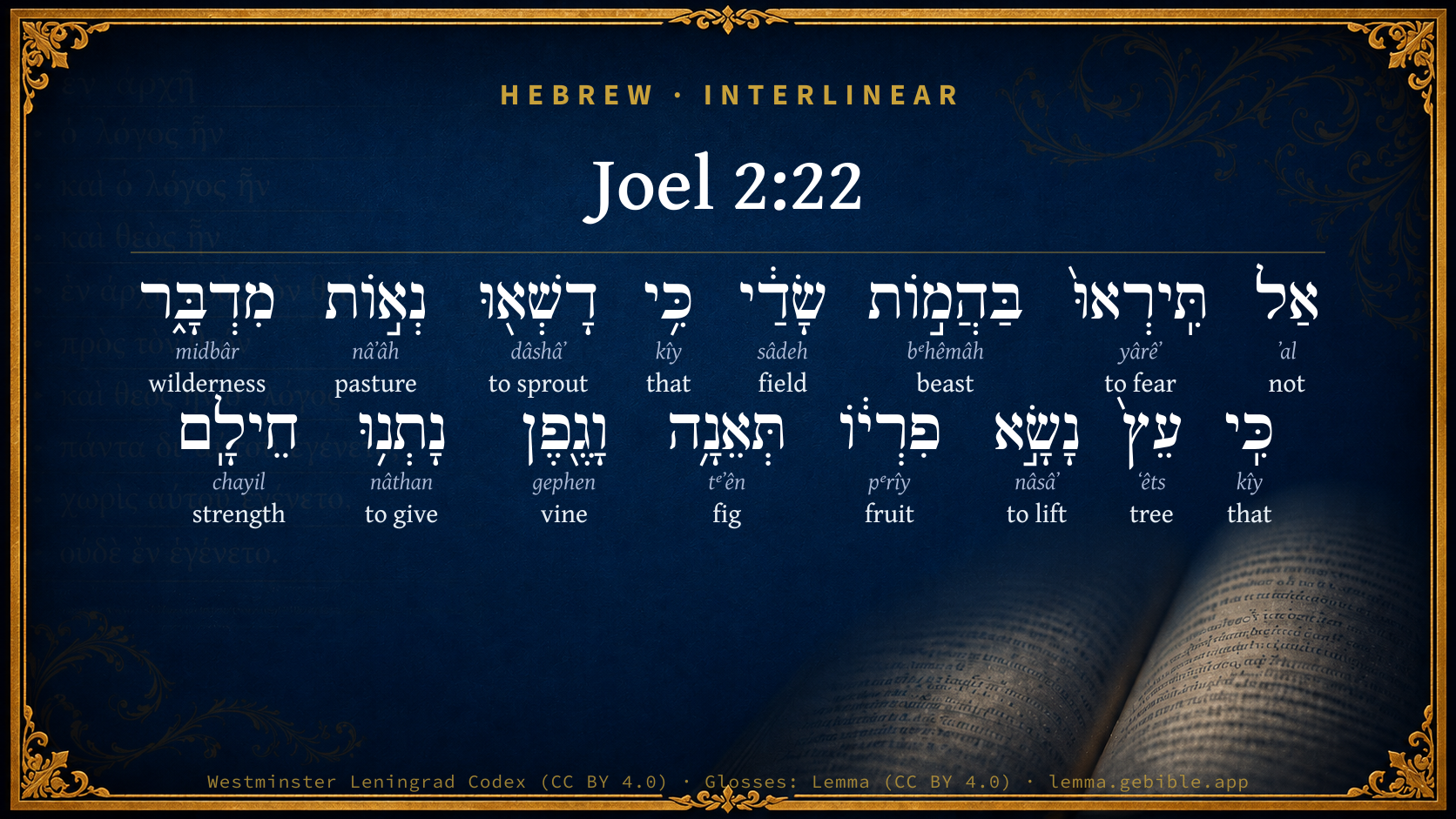
Hebrew (Westminster Leningrad Codex) Joel 2:22 appears in the Hebrew Old Testament. The text above is from the Westminster Leningrad Codex. Each word links to its Strong’s number, a concise gloss, and parsing drawn from the Open Scriptures Hebrew Bible morphology. Click any word for its full Brown-Driver-Briggs (BDB) entry.
Download image
Cite this verse

Joel 2:22 (World English Bible). Public Domain. Lemma interlinear Bible study tool, https://lemma.gebible.app/v/joel/2/22.

Show BibTeX & RIS
BibTeX
RIS
English Translation
Don't be afraid, you animals of the field; For the pastures of the wilderness spring up, For the tree bears its fruit. The fig tree and the vine yield their strength.
World English Bible · Public Domain
Download a study sheet

One document with this verse’s original text, its word-by-word gloss line, the meaning frame, cross-references with their text, attributed commentary, and full source and license credits — printable, and it pastes into notes with its structure intact.

This verse Autodidact and up

Study sheet (.html) Plain text (.txt)

A passage Seminary Student

Up to 50 verses in one chapter. A passage sheet keeps up to 6 commentary sources and 12 cross-references per verse, in the order this page ranks them, and says so on the sheet whenever that leaves anything out. Ask for a single verse and you get the Autodidact verse sheet above.

Everything on this page stays free to read, with no account — the sheet is a download of what is already on screen, not access to it.

Want to remove ads? Support Godless Engineer
Compare translations 3

The same verse in 3 English versions, stacked beneath the original-language interlinear above. Click any original word for its lexicon entry.

Each is an independent rendering of the whole verse — the interlinear is not word-aligned to these translations.

Highlighted words mark where these versions differ — a whole-verse word diff, not a word-by-word alignment.

  • World English Bible Public Domain
    Don't be afraid, you animals of the field; For the pastures of the wilderness spring up, For the tree bears its fruit. The fig tree and the vine yield their strength.
  • King James Version Public Domain
    Be not afraid, ye beasts of the field: for the pastures of the wilderness do spring, for the tree beareth her fruit, the fig tree and the vine do yield their strength.
  • unfoldingWord Literal Text CC BY-SA 4.0
    Do not fear, beasts of the field, for the pastures of the wilderness have sprouted, for the tree has borne its fruit, the fig tree and the vine have yielded their strength.

unfoldingWord Literal Text — © unfoldingWord, licensed CC BY-SA 4.0. Word-aligned USFM3 via Door43 (git.door43.org/unfoldingWord/en_ult).

Versions to compare (up to 4)

3 of 4 selected

Show all 18 translations

Every available English version of this verse, each an independent rendering of the whole verse.

  • World English Bible Public Domain
    Don't be afraid, you animals of the field; For the pastures of the wilderness spring up, For the tree bears its fruit. The fig tree and the vine yield their strength.
  • Berean Standard Bible Public Domain
    Do not be afraid, O beasts of the field, for the open pastures have turned green, the trees bear their fruit, and the fig tree and vine yield their best.
  • Majority Standard Bible Public Domain
    Do not be afraid, O beasts of the field, for the open pastures have turned green, the trees bear their fruit, and the fig tree and vine yield their best.
  • King James Version Public Domain
    Be not afraid, ye beasts of the field: for the pastures of the wilderness do spring, for the tree beareth her fruit, the fig tree and the vine do yield their strength.
  • American Standard Version (1901) Public Domain
    Be not afraid, ye beasts of the field; for the pastures of the wilderness do spring, for the tree beareth its fruit, the fig-tree and the vine do yield their strength.
  • Revised Version (1885) Public Domain
    Be not afraid, ye beasts of the field; for the pastures of the wilderness do spring, for the tree beareth her fruit, the fig tree and the vine do yield their strength.
  • Geneva Bible (1599) Public Domain
    Be not afrayde, ye beastes of the fielde: for the pastures of the wildernesse are greene: for the tree beareth her fruite: the figge tree and the vine do giue their force.
  • Douay-Rheims (1899) Public Domain
    Fear not, ye beasts of the fields: for the beautiful places of the wilderness are sprung, for the tree hath brought forth its fruit, the fig tree, and the vine have yielded their strength.
  • Young's Literal Translation Public Domain
    Do not fear, O cattle of the field! For sprung forth have pastures of a wilderness, For the tree hath borne its fruit, Fig-tree and vine have given their strength!
  • Literal Standard Version CC BY-SA 4.0
    Do not fear, O livestock of the field! For pastures of a wilderness have sprung up, || For the tree has borne its fruit, || Fig tree and vine have given their strength!
  • Unlocked Literal Bible CC BY-SA 4.0
    Do not fear, beasts of the field, for the pastures of the wilderness will sprout, the trees will bear their fruit, and the fig trees and the vines will yield their full harvest.
  • unfoldingWord Literal Text CC BY-SA 4.0
    Do not fear, beasts of the field, for the pastures of the wilderness have sprouted, for the tree has borne its fruit, the fig tree and the vine have yielded their strength.
  • Darby Bible Public Domain
    Be not afraid, ye beasts of the field: for the pastures of the wilderness do spring; for the tree beareth its fruit; the fig-tree and the vine yield full increase.
  • World Messianic Bible Public Domain
    Don’t be afraid, you animals of the field; for the pastures of the wilderness spring up, for the tree bears its fruit. The fig tree and the vine yield their strength.
  • Webster's Bible Public Domain
    Be not afraid, ye beasts of the field: for the pastures of the wilderness do spring, for the tree beareth its fruit, the fig-tree and the vine do yield their strength.
  • Free Bible Version CC BY-SA 4.0
    Don't be afraid, wild animals! For the pastures of the wilderness are turning green. The trees are fruiting again—the fig trees and the grapevines are producing a good crop.
  • Bible in Basic English Public Domain
    Have no fear, you beasts of the field, for the grass-lands of the waste are becoming green, for the trees are producing fruit, the fig-tree and the vine give out their strength.
  • JPS Tanakh (1917) Public Domain
    Be not afraid, ye beasts of the field; for the pastures of the wilderness do spring, for the tree beareth its fruit, the fig-tree and the vine do yield their strength.

Literal Standard Version (2020), Covenant Press — licensed CC BY-SA 4.0. Text via the HelloAO Bible API (eBible.org). Unlocked Literal Bible (unfoldingWord) — licensed CC BY-SA 4.0. Text via the HelloAO Bible API (eBible.org). unfoldingWord Literal Text — © unfoldingWord, licensed CC BY-SA 4.0. Word-aligned USFM3 via Door43 (git.door43.org/unfoldingWord/en_ult). Free Bible Version, Dr. Jonathan Gallagher — licensed CC BY-SA 4.0. Text via the HelloAO Bible API (eBible.org).

Word by word

More ways to search: Search by grammar → Find every occurrence → Compare this word →

Practice this passage: Drill this verse → Learn its vocabulary →

דָשְׁא֖וּ
dâshâʼ
H1876
“to sprout”
Verb, Qal, Perfect, 3rd Person, Common, Plural
Part of Speech
Verb
Stem
Qal
Form
Perfect
Person
3rd Person
Gender
Common
Number
Plural
Full BDB Definition

Origin: a primitive root

TWOT: 456

to sprout, shoot, grow green - (Qal) to sprout, grow green - (Hiphil) to cause to sprout, cause to shoot forth
  1. אַל ʼal H408 “not” Particle, Negative
  2. תִּֽירְאוּ֙ yârêʼ H3372 “to fear” Verb, Qal, Jussive, 2nd Person, Masculine, Plural
  3. בַּהֲמ֣וֹת bᵉhêmâh H929 “beasts of” Noun, Common, Feminine, Plural, Construct
  4. שָׂדַ֔י sâdeh H7704 “field” Noun, Common, Masculine, Singular, Absolute
  5. כִּ֥י kîy H3588 “that” Conjunction
  6. נְא֣וֹת nâʼâh H4999 “pastures of” Noun, Common, Feminine, Plural, Construct
  7. מִדְבָּ֑ר midbâr H4057 “wilderness” Noun, Common, Masculine, Singular, Absolute
  8. כִּֽי kîy H3588 “that” Conjunction
  9. עֵץ֙ ʻêts H6086 “tree” Noun, Common, Masculine, Singular, Absolute
  10. נָשָׂ֣א nâsâʼ H5375 “to lift” Verb, Qal, Perfect, 3rd Person, Masculine, Singular
  11. פִרְי֔וֹ pᵉrîy H6529 “fruit · his” Noun, Common, Masculine, Singular, Construct + Suffix, Personal, 3rd Person, Masculine, Singular
  12. תְּאֵנָ֥ה tᵉʼên H8384 “fig” Noun, Common, Feminine, Singular, Absolute
  13. וָגֶ֖פֶן gephen H1612 “and · vine” Conjunction + Noun, Common, Both, Singular, Absolute
  14. נָתְנ֥וּ nâthan H5414 “to give” Verb, Qal, Perfect, 3rd Person, Common, Plural
  15. חֵילָֽם chayil H2428 “strength · their” Noun, Common, Masculine, Singular, Construct + Suffix, Personal, 3rd Person, Masculine, Plural

About this verse

These counts appear in no published source. They are computed here, from the morphology-tagged text and Lemma’s own curated glosses. What Lemma adds →

16
words
15
distinct lemmas
Prophets
section

Notable vocabulary

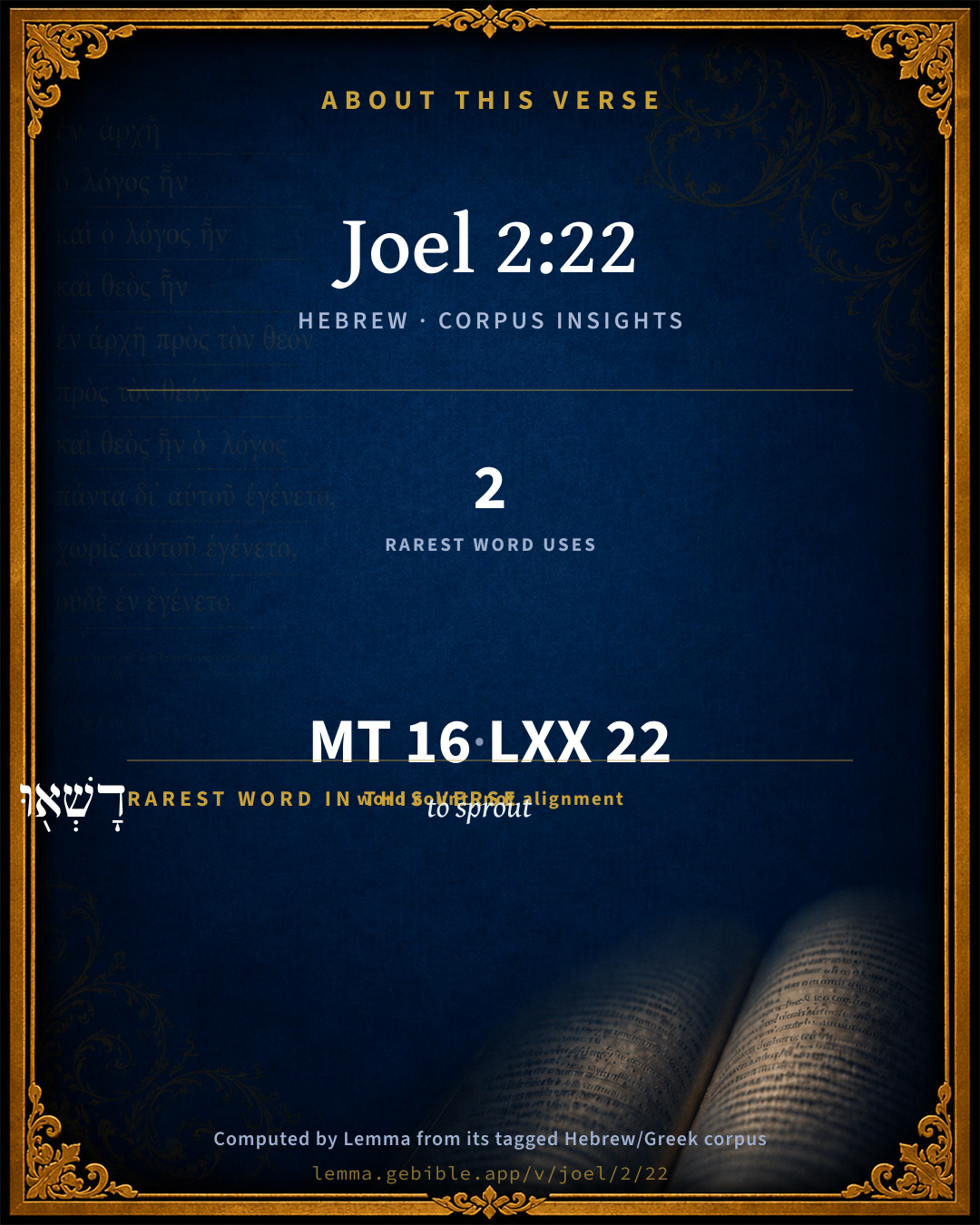
The rarest word here is דָשְׁא֖וּ to sprout H1876 — appearing just 2 times in the whole Hebrew Bible.

Shared distinctive vocabulary

דָשְׁא֖וּ to sprout H1876 occurs in 2 verses of the Hebrew Bible. Also found in:

Grammatical profile

  • 4 verbs
  • 9 nouns
  • 2 conjunctions
  • 1 particle

Verb forms

  • תִּֽירְאוּ֙ Qal · Jussive
  • דָשְׁא֖וּ Qal · Perfect
  • נָשָׂ֣א Qal · Perfect
  • נָתְנ֥וּ Qal · Perfect

Repetition

A word recurs within this verse — often emphatic in Hebrew:

  • כִּ֥י that H3588 ×2

Hebrew & Septuagint length

In English translation the verse runs 31 words from the Hebrew and 34 from the Septuagint (LXX English) — closely comparable.

A rough comparison of the two English renderings, which tokenize alike — not a word-level alignment.

Word counts can differ between the Hebrew and the Greek without any difference in meaning — e.g. the Hebrew direct-object marker אֵת has no separate Greek word, and Greek often adds the article ὁ.

In the original languages it is 16 Hebrew tokens and 22 Greek tokens — but the two are counted differently (Hebrew bundles its prefixes and suffixes into one token; the Greek is in lemma form), so that isn’t a like-for-like length.

Cross-references

24

Topical passages linked to Joel 2:22 in the Treasury of Scripture Knowledge — connected by theme and wording, ordered by reader-vote popularity; previews shown in the World English Bible.

  • Zechariah 8:12 "For the seed of peace and the vine will yield its fruit, and the ground will give its increase, and the heavens will give their dew; and I will cause the remnant of this people to inherit all these things.
  • Psalms 65:12 The wilderness grasslands overflow. The hills are clothed with gladness.
  • Psalms 67:6 The earth has yielded its increase. God, even our own God, will bless us.
  • Psalms 107:35–38 He turns a desert into a pool of water, And a dry land into water springs.
  • Psalms 145:15–16 The eyes of all wait for you. You give them their food in due season.
  • Psalms 147:8–9 Who covers the sky with clouds, Who prepares rain for the earth, Who makes grass grow on the mountains.
  • Isaiah 30:23–24 He will give the rain for your seed, with which you shall sow the ground; and bread of the increase of the ground, and it shall be fat and plenteous. In that day shall your cattle feed in large pastures;
  • Isaiah 51:3 For Yahweh has comforted Zion; he has comforted all her waste places, and has made her wilderness like Eden, and her desert like the garden of Yahweh; joy and gladness shall be found therein, thanksgiving, and the voice of melody.
  • Joel 1:18–20 How the animals groan! The herds of cattle are perplexed, because they have no pasture. Yes, the flocks of sheep are made desolate.
  • Amos 9:14–15 I will bring back the captivity of my people Israel, And they will rebuild the ruined cities, and inhabit them; and they will plant vineyards, and drink wine from them. They shall also make gardens, And eat the fruit of them.
  • Genesis 4:12 From now on, when you till the ground, it won't yield its strength to you. You shall be a fugitive and a wanderer in the earth."
  • Leviticus 26:4–5 then I will give you your rains in their season, and the land shall yield its increase, and the trees of the field shall yield their fruit.
  • Psalms 36:6 Your righteousness is like the mountains of God. Your judgments are like a great deep. Yahweh, you preserve man and animal.
  • Psalms 104:11–14 They give drink to every animal of the field. The wild donkeys quench their thirst.
  • Psalms 104:27–29 These all wait for you, That you may give them their food in due season.
  • Ezekiel 34:26–27 I will make them and the places round about my hill a blessing; and I will cause the shower to come down in its season; there shall be showers of blessing.
  • Ezekiel 36:8 But you, mountains of Israel, you shall shoot forth your branches, and yield your fruit to my people Israel; for they are at hand to come.
  • Ezekiel 36:30 I will multiply the fruit of the tree, and the increase of the field, that you may receive no more the reproach of famine among the nations.
  • Ezekiel 36:35 They shall say, This land that was desolate is become like the garden of Eden; and the waste and desolate and ruined cities are fortified and inhabited.
  • Jonah 4:11 Shouldn't I be concerned for Nineveh, that great city, in which are more than one hundred twenty thousand persons who can't discern between their right hand and their left hand; and also much cattle?"
  • Haggai 2:16 Through all that time, when one came to a heap of twenty measures, there were only ten. When one came to the wine vat to draw out fifty, there were only twenty.
  • 1 Corinthians 3:7 So then neither he who plants is anything, nor he who waters, but God who gives the increase.
  • Hosea 14:5–7 I will be like the dew to Israel. He will blossom like the lily, And send down his roots like Lebanon.
  • Malachi 3:10–12 Bring the whole tithe into the store-house, that there may be food in my house, and test me now in this," says Yahweh of hosts, "if I will not open you the windows of heaven, and pour you out a blessing, that there shall not be room enough for.

Cross-references courtesy of OpenBible.info (CC BY 4.0).

Hebrew and Greek witnesses Masoretic Hebrew ↔ Greek Septuagint

The same verse in the two great witnesses to the Old Testament, shown verse-for-verse.

These are two independent witnesses, not word-aligned to each other, and the Septuagint is shown in lemma (dictionary) form.

Hebrew Joel 2:22 Masoretic · Westminster Leningrad Codex

אַל תִּֽירְאוּ֙ בַּהֲמ֣וֹת שָׂדַ֔י כִּ֥י דָשְׁא֖וּ נְא֣וֹת מִדְבָּ֑ר כִּֽי עֵץ֙ נָשָׂ֣א פִרְי֔וֹ תְּאֵנָ֥ה וָגֶ֖פֶן נָתְנ֥וּ חֵילָֽם

Don't be afraid, you animals of the field; For the pastures of the wilderness spring up, For the tree bears its fruit. The fig tree and the vine yield their strength.

World English Bible · Public Domain

Greek LXX Joel 2:22 Septuagint · lemma form

θαρρέω κτῆνος ὁ πεδίον ὅτι βλαστάνω πεδίον ὁ ἔρημος ὅτι ξύλον φέρω ὁ καρπός αὐτός ἄμπελος καί συκῆ δίδωμι ὁ ἰσχύς αὐτός

Be of good courage, you⌃ beasts of the plain, for the plains of the wilderness have budded, for the trees have borne their fruit, the fig tree and the vine have yielded their strength.

LXX2012 (modern English Septuagint) · Public Domain

Hebrew: Westminster Leningrad Codex (CC BY 4.0). Greek: Septuagint (public domain); English from LXX2012 (modern English Septuagint) (Public Domain). How the Septuagint differs from the Hebrew →

Targum (Aramaic paraphrase)

1

The Targum is the ancient Jewish Aramaic paraphrase of the Hebrew Scriptures — an interpretive translation, not the Hebrew text itself. Onkelos (literal) and Pseudo-Jonathan (expansive) render the Torah, and Jonathan the Prophets. Coverage is partial: where no permissively-licensed English translation exists for a verse, only the Aramaic is shown. This is verse-level text, not a word-by-word alignment to the Hebrew.

  1. Targum Jonathan Prophets (Joshua–Malachi)
    לָא תִדְחֲלוּן חֵיוַת בָּרָא אֲרֵי אִתְעַטְרוּ דִרְוַת מַדְבְּרָא אֲרֵי אִילָנָא אַצְלַח אִבֵּיהּ תֵּינַיָא וְגוּפְנַיָא טְעַנוּ פֵּרֵיהוֹן:

    (no public-domain English translation for this verse)

    Targum Jonathan — Aramaic: “Mikraot Gedolot” (public domain). English: “Sefaria Community Translation” (CC0 1.0 (public-domain dedication)); “London "Chaldee Paraphrase," 1871” (public domain). Text via Sefaria.

Commentary

Notes on Joel 2:22 from classic Christian and Jewish commentators (each source and its license shown beneath its notes). The classic Christian expositions comment on the surrounding passage and are grouped to its opening verse, so a note may address several verses; the Jewish commentaries on the Tanakh (Rashi and others) are per-verse, so they appear only where the commentator wrote on this verse.

Lemma curates 59 commentaries, every one of them public domain or Creative Commons licensed, each selected and text-cleaned for this edition rather than reprinted as found. About our sources →

Trapp's Complete Commentary

John Trapp

Joe 2:22 Be not afraid, ye beasts of the field: for the pastures of the wilderness do spring, for the tree beareth her fruit, the fig tree and the vine do yield their strength.

Ver. 22. Be not afraid, ye beasts of the field] q.d. Ye shall have no cause to fear for the future: though hitherto ye have suffered hardship, Joe 1:18. Beasts and birds do in diem vivere to live for the day, (as Quintilian saith of them), and take no further thought than for present sustenance. But by a personification (as before the land, so here) the beasts that till it are forbidden to fear want; for God, the great housekeeper of the world, will provide them their meat in due season, Psa 104:27-28, and several meats according to their various appetites. He will hear the heaven, the heaven shall hear the earth, the earth shall bear all kind of fruits, both natural, as herbs of the field and grass of the wilderness, and such as are sown and planted, as wine, oil, figs; so that neither man nor beast shall want anything ad esum, vel ad usum, to eat or to use but have plenty without penury, &c. It shall be said of Judea, as Solinus saith of Spain, In Hispania nihil infructuosum, nihil sterile, that there is no unfruitfulness in any part of it; or, as it is said of Campania, in Italy, that it is the most fruitful plat of earth that is in the universe.

The fig tree and the vine] That before had been barked and wasted, Joe 1:7; Joe 1:12,

do yield their strength] i.e. their utmost fruits; which they could not do without God, into whom therefore the prophet Hosea rightly resolveth the genealogy of grain, wine, oil, &c., Hos 2:22. It is no otherwise with us in spiritual regards. For though we have grace, yet we cannot bring forth that grace to act without new grace; like as trees, though they be fitted to bear fruits, yet, without the influence of the heavens, they cannot put forth that fitness in fruit. Nolentem praevenit Deus ut velit: volentem subsequitur, ne frustra velit (Aug. Enchir. chap. 32).

John Trapp, A Commentary or Exposition upon All the Books of the Old and New Testament (1647–1656) — public domain. Text from a community e-Sword module.

Jamieson, Fausset & Brown

Robert Jamieson, A. R. Fausset & David Brown

(Zac 8:12). As before (Joe 1:18, Joe 1:20) he represented the beasts as groaning and crying for want of food in the "pastures," so now he reassures them by the promise of springing pastures.

Jamieson, Fausset & Brown — Commentary Critical and Explanatory on the Whole Bible (1871) — public domain (CC PDM 1.0). Text via the HelloAO Bible API.

John Calvin's Commentaries

Here the Prophet turns his address to the beasts; not that his instruction suited them; but it was a more efficacious mode of speaking, when he invited the very beasts to a participation of the people’s joy; for except the Jews had been made to know that God’s wrath was now nigh at hand, no consolation which the Prophet has hitherto applied would have been of any weight with them. But now since they perceived that God’s wrath did not only suspend over them, but extended much farther, even to the beasts, and since the Lord would have mercy on them, so that his blessing would be partaken in common by the beasts and brute animals, the address was far more impressive. We hence see that the Prophet, for the best reason, directed his discourse to the very beasts, though destitute of mind and discernment. For in addressing brute animals he addressed men with double force; that is, he impressed their minds more effectually, so that they might seriously confess how great was God’s wrath, and also how great would be his blessing.

Beasts, he says, fear not. Then the beasts of the field ought to have dreaded the judgment of God which he had before denounced; for except God had been pacified to his people, the fire of his wrath would have consumed the whole land, trees and pastures; so all the beasts must have been famished. But now when God is reconciled to his people, his blessing will smile on the brute animals. What then is to be said of men? For God is properly propitious to them, and not to brute animals. We hence see that the fruit of reconciliation is made more evident, when it is in part extended to the brute creation.

He therefore says, Fear not, ye beasts of the field: for the pastures of the desert will grow, the trees will bring forth their fruit. By these words the Prophet intimates, that had God’s wrath toward his people been implacable, the sterility of the land would not have been improved. Now then whence came so sudden a change that the pastures grew, that the trees produced their fruits, both the fig-tree and the vine, except that God was pleased to bless the land, after having received men into favor? We now then apprehend the meaning of the Prophet, even this, — that the land would be made by an angry God to execute his judgment, and that there would be no remedy for the barrenness of the land until men propitiated God. This is the sum of the whole. It now follows —

John Calvin's Commentaries (1540-1563) — public domain. Text from the Calvin Translation Society English edition (1840s-50s) via the Christian Classics Ethereal Library (ccel.org). Calvin's coverage is partial (roughly two-thirds of the Bible); uncommented books and verses are honest gaps, never fabricated. The 19th-century editor's footnotes and remarks are omitted so the notes are faithfully Calvin's own voice.

The Cambridge Bible for Schools and Colleges

gen. ed. J. J. S. Perowne

22. The beasts of the field, whose sufferings were described in Joe_1:18; Joe_1:20 need now fear no longer: the “pastures of the wilderness,” which but recently were burnt up (Joe_1:19), will now soon begin to spring.

spring] lit. have young grass: the verb being cognate with the word for “young grass,” Gen_1:11 (“let the earth grass forth young grass”), 12; Psa_23:2 (lit. “pastures of young grass”).

the fig tree and the vine] which were described as ravaged in Joe_1:7; Joe_1:12. The tenses in this verse are in the Hebrew perfects, to be explained as the perfect in Joe_2:21.

The Cambridge Bible for Schools and Colleges (gen. ed. J. J. S. Perowne; Cambridge University Press, 1878–1918) — public domain. Text from a community e-Sword module.

John Gill's Exposition

Be not afraid, ye beasts of the field,.... Which before groaned, and were perplexed for want of pasture, and cried because of the drought, Joe 1:18; perhaps the Gentiles may be here designed, in the mystic and spiritual sense, in distinction from the Jews, the children of Zion, in Joe 2:23;

for the pastures of the wilderness do spring; grass in abundance springs up in them, and covers them, so that there was plenty of food for the beasts of the field:

for the tree beareth her fruit; brings forth and bears fruit suitable to it, agreeable to its nature:

the fig tree and the vine do yield their strength; send forth their branches, put forth their buds, their leaves and fruit. This and the preceding clause cannot be understood as a reason why the beasts of the field should not be afraid, for they relate not to them, but to men; and may serve to confirm the mystic sense of the words, as they may refer to the great fruitfulness produced in the wilderness of the Gentile world, through the preaching of the Gospel in the times of the Messiah; which are more clearly pointed at in Joe 2:23; and which were introduced with great outward peace and plenty; and the Jews (f) by the tree bearing her fruit, in the preceding clause, understand barren trees bearing fruit.

(f) T. Bab. Cetubot, fol. 112. 2.

John Gill's Exposition of the Whole Bible (1746–1763) — public domain (CC PDM 1.0). Text via the HelloAO Bible API.

Albert Barnes' Notes on the Bible

The reversal of the whole former sentence is continued up to man. The beasts of the field “groaned, were perplexed, cried” unto God; now they are bidden, “be not afraid;” before, “the pastures of the wilderness were devoured by fire;” now, they “spring” with fresh tender life; before, “the fig tree” was “withered, the vine languished;” now, they should “yield their strength, put out their full” vigor. For God was reconciled to His people; and all things served them, serving Him.

Albert Barnes' Notes on the Bible (1834–1885) — public domain. Text from a community e-Sword/MySword module.

Haydock's Catholic Bible Commentary

Strength; fruit, as formerly.

George Leo Haydock (1774–1849), Haydock's Catholic Family Bible and Commentary, 1859 edition — public domain. Excludes Psalms (Douay-Rheims chapter numbering differs from Protestant) and Deuterocanonical books (Catholic canon only).

Matthew Poole's English Annotations

Be not afraid, ye beasts of the field. In Joe 1:18-20, the poor beasts were represented as in greatest perplexity, for want of pasture they were like to perish; but now they are (as if capable of fears or joy from foresight of what was coming toward them) encouraged, they should find pasture, both the tamer which are under man’s hand, and the wilder which range the mountains.

The pastures of the wilderness: see Joe 1:19. Do spring; begin to look green, and the grass fresh promise the food for you. The tree beareth her fruit; all sorts of trees, though they were withered, and seemed to be dead, Joe 1:12, now they recover their strength and bring forth fruit.

The fig tree does not, as Joe 1:12, languish.

The vine is not, as before, dried up, but with change of season hath changed its hue.

Do yield their strength; both these trees do mightily bear, are full of fruit, and bring forth as much as ever they are able to stand under.

Matthew Poole's English Annotations on the Holy Bible (1683–1685) — public domain. Text from a community e-Sword/MySword module.

The Pulpit Commentary

Be not afraid, ye beasts of the field. The dumb animals had groaned in distress for food, but now they too have cause to rejoice, and are here called on to do so; and the suitable cause in their case is also specified. It is as follows: For the pastures of the wilderness do spring, for the tree beareth her fruit, the fig tree and the vine do yield their strength. He thus specifies the ground of gladness in their case also, pointing to the fresh green of the pastures and the fruit hanging in rich abundance and variety on the trees. The fruits of vines and fig trees are net, it is true, the food of the beasts of the fields; but the revival of vegetation in trees, the higher and larger growths, the chief factor in which is moisture, comprehends the revival of the smaller growths of herbs, grasses, and plants, the proper sustenance of cattle. Kimchi"s explanation is that "as the tree bears its fruit in the inhabited part of the world, so in the wilderness the places of pasture grow green." Aben Ezra, who never loses an opportunity of directing attention to contrasts wherever they exist, contrasts "Be not afraid, ye beasts of the field," in this verse with "the beasts of the field cry also unto thee" at the close of the preceding chapter; also "the pastures of the wilderness do spring" with "the fire hath devoured the pastures of the wilderness;" likewise "the tree beareth her fruit" with "all the trees of the field are withered." It has been observed that all plants, even shrubs and trees, spring up at the first as the fresh young juicy green of plants, avD; then they develop into qry or ryxij, grass: into herb, bce; and into tree, xe yrc is not the plural for but singular, after the analogy of ymv. (Psa_96:12) Nasaperi, equivalent to "lift up, bear," is more poetical than asah peri, equivalent to "make fruit;" so in Latin, surgunt fruges. The expression, "yield their strength," puts the cause for the effect; the strength of the tree produces the fruit and centres in it.

The Pulpit Commentary (1880–1919), ed. H.D.M. Spence-Jones & Joseph S. Exell — public domain. Text from a community e-Sword module.

John Wesley's Explanatory Notes

Their strength - Bring forth as much as they are able to stand under.

John Wesley, Explanatory Notes Upon the Whole Bible (1754–1765) — public domain. Text via the GEBible commentary corpus.

Lesson kit

Teaching starters — assembled from the data on this page, not authored interpretation. Every prompt links to the verse data it draws on. Edit before teaching.

Joel, in the Prophets, opens this verse with 16 words (15 distinct Hebrew lemmas). Its most distinctive word is dâshâʼ (“to sprout”). A historical commentator’s framing appears above. Read the whole chapter for the surrounding context.

Discussion questions

  1. What does “to sprout” (dâshâʼ) contribute to the verse as a whole?
  2. Genesis 1:11 shares the word «to sprout» with this verse. How do the two illuminate each other?
  3. “that” occurs 2× in this one verse. What is the effect of the repetition?
  4. These translations render this verse differently; the difference is in the English rendering, not the original. What questions does that raise?
  5. The verb «תִּֽירְאוּ֙» is Qal Jussive. How does its form color the action?
  6. Reading how Trapp's Complete Commentary and Jamieson, Fausset & Brown read this verse, where do the two commentators agree and where do they part?

Things to notice

Reading settings

Reading text

Shown beneath each verse's original-language words.

Old Testament
Old Testament edition

Read the OT as the Masoretic Hebrew (MT) or the Greek Septuagint (LXX).

English shown for the Greek Septuagint (in the Hebrew ↔ Greek comparison).

Comparing translations? Open the Compare panel on any verse page to stack up to four side by side.