
Joshua 12:8

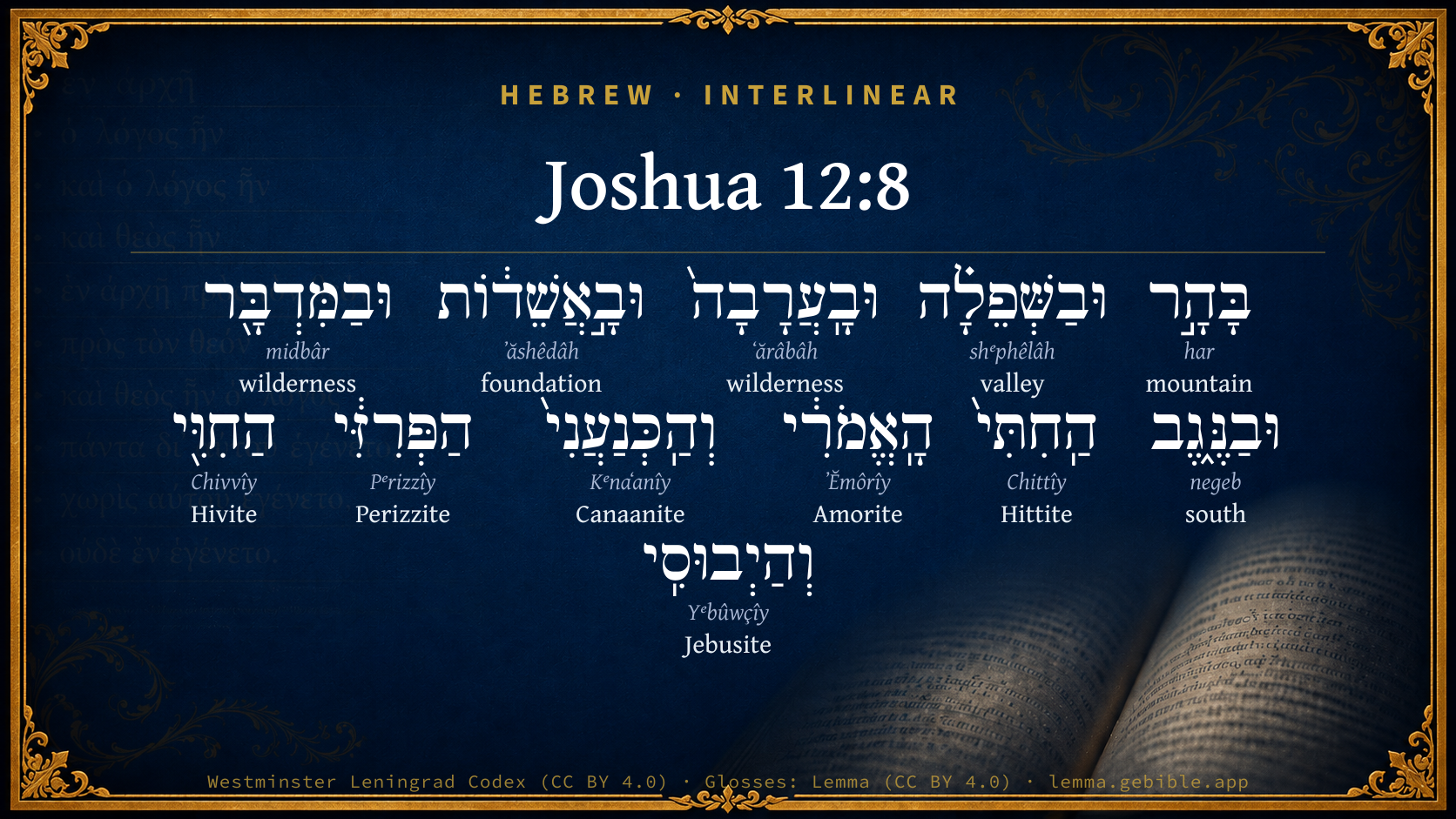
Hebrew (Westminster Leningrad Codex) Joshua 12:8 appears in the Hebrew Old Testament. The text above is from the Westminster Leningrad Codex. Each word links to its Strong’s number, a concise gloss, and parsing drawn from the Open Scriptures Hebrew Bible morphology. Click any word for its full Brown-Driver-Briggs (BDB) entry.
Download image
Cite this verse

Joshua 12:8 (World English Bible). Public Domain. Lemma interlinear Bible study tool, https://lemma.gebible.app/v/joshua/12/8.

Show BibTeX & RIS
BibTeX
RIS
English Translation
in the hill-country, and in the lowland, and in the Arabah, and in the slopes, and in the wilderness, and in the South; the Hittite, the Amorite, and the Canaanite, the Perizzite, the Hivite, and the Jebusite:
World English Bible · Public Domain
Download a study sheet

One document with this verse’s original text, its word-by-word gloss line, the meaning frame, cross-references with their text, attributed commentary, and full source and license credits — printable, and it pastes into notes with its structure intact.

This verse Autodidact and up

Study sheet (.html) Plain text (.txt)

A passage Seminary Student

Up to 50 verses in one chapter. A passage sheet keeps up to 6 commentary sources and 12 cross-references per verse, in the order this page ranks them, and says so on the sheet whenever that leaves anything out. Ask for a single verse and you get the Autodidact verse sheet above.

Everything on this page stays free to read, with no account — the sheet is a download of what is already on screen, not access to it.

Want to remove ads? Support Godless Engineer
Compare translations 3

The same verse in 3 English versions, stacked beneath the original-language interlinear above. Click any original word for its lexicon entry.

Each is an independent rendering of the whole verse — the interlinear is not word-aligned to these translations.

Highlighted words mark where these versions differ — a whole-verse word diff, not a word-by-word alignment.

  • World English Bible Public Domain
    in the hill-country, and in the lowland, and in the Arabah, and in the slopes, and in the wilderness, and in the South; the Hittite, the Amorite, and the Canaanite, the Perizzite, the Hivite, and the Jebusite:
  • King James Version Public Domain
    In the mountains, and in the valleys, and in the plains, and in the springs, and in the wilderness, and in the south country; the Hittites, the Amorites, and the Canaanites, the Perizzites, the Hivites, and the Jebusites:
  • unfoldingWord Literal Text CC BY-SA 4.0
    in the hill country, and in the lowland, and in the Arabah, and on the slopes, and in the wilderness, and in the Negev—the Hittite, the Amorite, and the Canaanite, the Perizzite, the Hivite, and the Jebusite:

unfoldingWord Literal Text — © unfoldingWord, licensed CC BY-SA 4.0. Word-aligned USFM3 via Door43 (git.door43.org/unfoldingWord/en_ult).

Versions to compare (up to 4)

3 of 4 selected

Show all 18 translations

Every available English version of this verse, each an independent rendering of the whole verse.

  • World English Bible Public Domain
    in the hill-country, and in the lowland, and in the Arabah, and in the slopes, and in the wilderness, and in the South; the Hittite, the Amorite, and the Canaanite, the Perizzite, the Hivite, and the Jebusite:
  • Berean Standard Bible Public Domain
    the hill country, the foothills, the Arabah, the slopes, the wilderness, and the Negev—the lands of the Hittites, Amorites, Canaanites, Perizzites, Hivites, and Jebusites):
  • Majority Standard Bible Public Domain
    the hill country, the foothills, the Arabah, the slopes, the wilderness, and the Negev—the lands of the Hittites, Amorites, Canaanites, Perizzites, Hivites, and Jebusites):
  • King James Version Public Domain
    In the mountains, and in the valleys, and in the plains, and in the springs, and in the wilderness, and in the south country; the Hittites, the Amorites, and the Canaanites, the Perizzites, the Hivites, and the Jebusites:
  • American Standard Version (1901) Public Domain
    in the hill-country, and in the lowland, and in the Arabah, and in the slopes, and in the wilderness, and in the South; the Hittite, the Amorite, and the Canaanite, the Perizzite, the Hivite, and the Jebusite:
  • Revised Version (1885) Public Domain
    in the hill country, and in the lowland, and in the Arabah, and in the slopes, and in the wilderness, and in the South; the Hittite, the Amorite, and the Canaanite, the Perizzite, the Hivite, and the Jebusite:
  • Geneva Bible (1599) Public Domain
    In the mountaines, and in the valleys, and in the plaines, and in the hill sides, and in the wildernes, and in the South, where were the Hittites, the Amorites, and the Canaanites, the Perizzites, the Hiuites, and the Iebusites.
  • Douay-Rheims (1899) Public Domain
    As well in the mountains as in the plains and the champaign countries. In Asedoth, and in the wilderness, and in the south was the Hethite and the Amorrhite, the Chanaanite and the Pherezite, the Hevite and the Jebusite.
  • Young's Literal Translation Public Domain
    in the hill-country, and in the low country, and in the plain, and in the springs, and in the wilderness, and in the south; the Hittite, the Amorite, and the Canaanite, the Perizzite, the Hivite, and the Jebusite:
  • Literal Standard Version CC BY-SA 4.0
    in the hill-country, and in the low country, and in the plain, and in the springs, and in the wilderness, and in the south; the Hittite, the Amorite, and the Canaanite, the Perizzite, the Hivite, and the Jebusite:
  • Unlocked Literal Bible CC BY-SA 4.0
    He gave them the hill country, the lowlands, the Arabah, the sides of the mountains, the wilderness, and the Negev—the land of the Hittites, Amorites, Canaanites, Perizzites, Hivites, and Jebusites.
  • unfoldingWord Literal Text CC BY-SA 4.0
    in the hill country, and in the lowland, and in the Arabah, and on the slopes, and in the wilderness, and in the Negev—the Hittite, the Amorite, and the Canaanite, the Perizzite, the Hivite, and the Jebusite:
  • Darby Bible Public Domain
    in the mountain, and in the lowland, and in the plain, and on the hill-slopes, and in the wilderness, and in the south: the Hittites, and the Amorites, and the Canaanites, the Perizzites, the Hivites and the Jebusites:
  • World Messianic Bible Public Domain
    in the hill country, and in the lowland, and in the Arabah, and in the slopes, and in the wilderness, and in the South; the Hittite, the Amorite, and the Canaanite, the Perizzite, the Hivite, and the Jebusite:
  • Webster's Bible Public Domain
    In the mountains, and in the valleys, and in the plains, and in the springs, and in the wilderness, and in the south country; the Hittites, the Amorites, and the Canaanites, the Perizzites, the Hivites, and the Jebusites:
  • Free Bible Version CC BY-SA 4.0
    The land included the hill country, the foothills, the Jordan Valley, the slopes, and the Negev desert—the land of the Hittites, Amorites, Canaanites, Perizzites, Hivites, and Jebusites.
  • Bible in Basic English Public Domain
    In the hill-country, and in the lowland, and in the Arabah, and on the mountain slopes, and in the waste land, and in the South; the Hittites, the Amorites, and the Canaanites, the Perizzites, the Hivites, and the Jebusites.
  • JPS Tanakh (1917) Public Domain
    in the hill-country, and in the Lowland, and in the Arabah, and in the slopes, and in the wilderness, and in the South; the Hittite, the Amorite, and the Canaanite, the Perizzite, the Hivite, and the Jebusite:

Literal Standard Version (2020), Covenant Press — licensed CC BY-SA 4.0. Text via the HelloAO Bible API (eBible.org). Unlocked Literal Bible (unfoldingWord) — licensed CC BY-SA 4.0. Text via the HelloAO Bible API (eBible.org). unfoldingWord Literal Text — © unfoldingWord, licensed CC BY-SA 4.0. Word-aligned USFM3 via Door43 (git.door43.org/unfoldingWord/en_ult). Free Bible Version, Dr. Jonathan Gallagher — licensed CC BY-SA 4.0. Text via the HelloAO Bible API (eBible.org).

Word by word

More ways to search: Search by grammar → Find every occurrence → Compare this word →

Practice this passage: Drill this verse → Learn its vocabulary →

וּבָ֣אֲשֵׁד֔וֹת
ʼăshêdâh
H794
“and · in/at the · foundations”
Conjunction + Preposition, Determined + Noun, Common, Feminine, Plural, Absolute
Part of Speech
Conjunction + Preposition + Noun
Type
Common
Gender
Feminine
Number
Plural
State
Absolute
Full BDB Definition

Origin: from H793

TWOT: 174b

foundation, slope
  1. בָּהָ֣ר har H2022 “in/at the · mountain” Preposition, Determined + Noun, Common, Masculine, Singular, Absolute
  2. וּבַשְּׁפֵלָ֗ה shᵉphêlâh H8219 “and · in/at the · valley” Conjunction + Preposition, Determined + Noun, Common, Feminine, Singular, Absolute
  3. וּבָֽעֲרָבָה֙ ʻărâbâh H6160 “and · in/at the · wilderness” Conjunction + Preposition, Determined + Noun, Common, Feminine, Singular, Absolute
  4. וּבַמִּדְבָּ֖ר midbâr H4057 “and · in/at the · wilderness” Conjunction + Preposition, Determined + Noun, Common, Masculine, Singular, Absolute
  5. וּבַנֶּ֑גֶב negeb H5045 “and · in/at the · south” Conjunction + Preposition, Determined + Noun, Common, Masculine, Singular, Absolute
  6. הַֽחִתִּי֙ Chittîy H2850 “the · Hittite” Particle, Definite Article + Noun, Gentilic, Masculine, Singular, Absolute
  7. הָֽאֱמֹרִ֔י ʼĔmôrîy H567 “the · Amorite” Particle, Definite Article + Noun, Gentilic, Masculine, Singular, Absolute
  8. וְהַֽכְּנַעֲנִי֙ Kᵉnaʻanîy H3669 “and · the · Canaanite” Conjunction + Particle, Definite Article + Noun, Gentilic, Masculine, Singular, Absolute
  9. הַפְּרִזִּ֔י Pᵉrizzîy H6522 “the · Perizzite” Particle, Definite Article + Noun, Gentilic, Masculine, Singular, Absolute
  10. הַחִוִּ֖י Chivvîy H2340 “the · Hivite” Particle, Definite Article + Noun, Gentilic, Masculine, Singular, Absolute
  11. וְהַיְבוּסִֽי Yᵉbûwçîy H2983 “and · the · Jebusite” Conjunction + Particle, Definite Article + Noun, Gentilic, Masculine, Singular, Absolute

About this verse

These counts appear in no published source. They are computed here, from the morphology-tagged text and Lemma’s own curated glosses. What Lemma adds →

12
words
12
distinct lemmas
Historical
section

Notable vocabulary

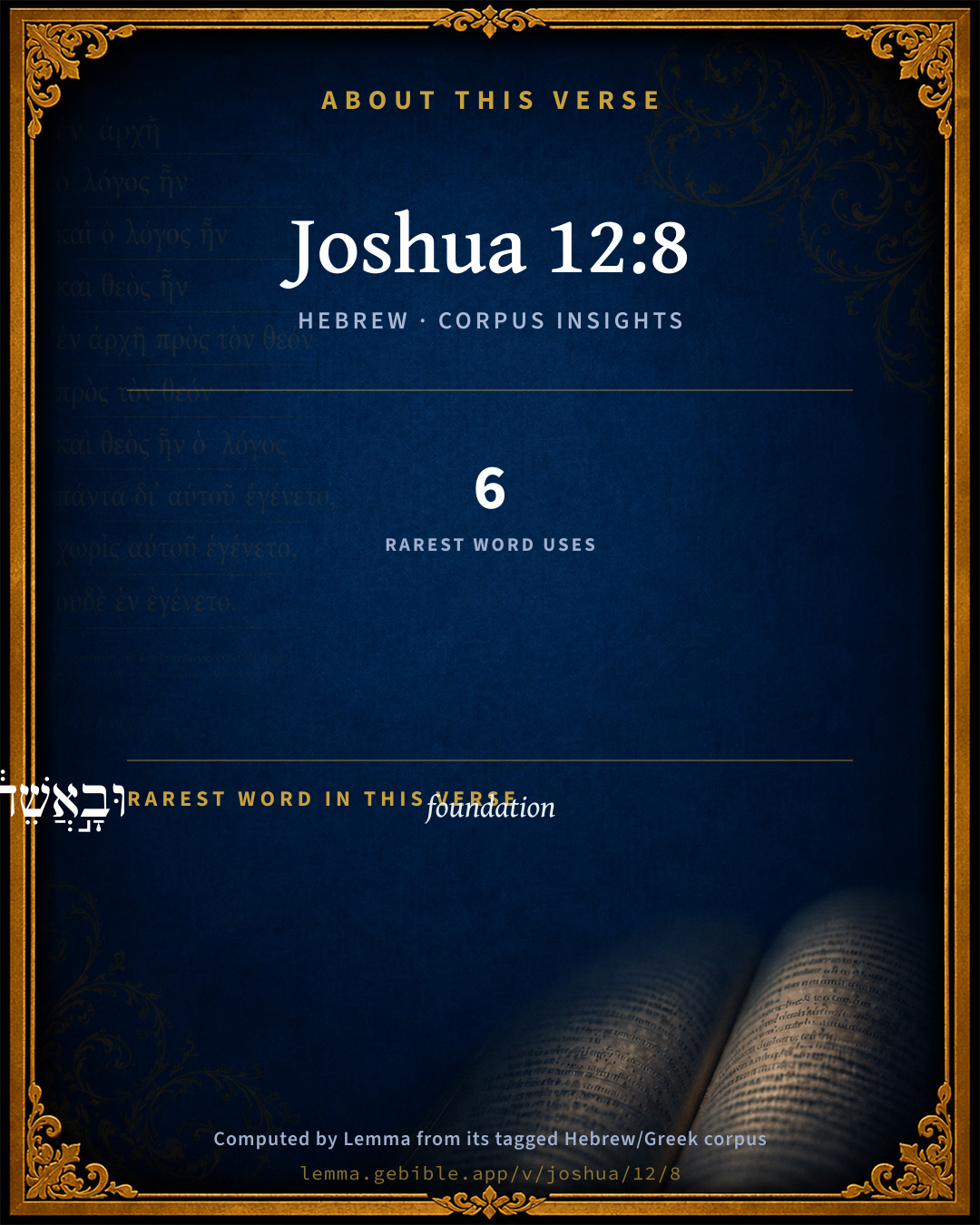
The rarest word here is וּבָ֣אֲשֵׁד֔וֹת foundation H794 — appearing just 6 times in the whole Hebrew Bible.

Shared distinctive vocabulary

וּבָ֣אֲשֵׁד֔וֹת foundation H794 occurs in 6 verses of the Hebrew Bible. Also found in:

Grammatical profile

  • 12 nouns

Hebrew & Septuagint length

In English translation the verse runs 37 words from the Hebrew and 36 from the Septuagint (LXX English) — closely comparable.

A rough comparison of the two English renderings, which tokenize alike — not a word-level alignment.

Word counts can differ between the Hebrew and the Greek without any difference in meaning — e.g. the Hebrew direct-object marker אֵת has no separate Greek word, and Greek often adds the article ὁ.

Cross-references

9

Topical passages linked to Joshua 12:8 in the Treasury of Scripture Knowledge — connected by theme and wording, ordered by reader-vote popularity; previews shown in the World English Bible.

  • Joshua 11:16 So Joshua took all that land, the hill-country, and all the South, and all the land of Goshen, and the lowland, and the Arabah, and the hill-country of Israel, and the lowland of the same;
  • Joshua 9:1 It happened, when all the kings who were beyond the Jordan, in the hill-country, and in the lowland, and on all the shore of the great sea in front of Lebanon, the Hittite, and the Amorite, the Canaanite, the Perizzite, the Hivite, and the Jebusite, heard of it;
  • Joshua 10:40 So Joshua struck all the land, the hill-country, and the South, and the lowland, and the slopes, and all their kings: he left none remaining, but he utterly destroyed all that breathed, as Yahweh, the God of Israel, commanded.
  • Genesis 15:18–21 In that day Yahweh made a covenant with Abram, saying, "To your seed have I given this land, from the river of Egypt to the great river, the river Euphrates:
  • Exodus 3:8 I have come down to deliver them out of the hand of the Egyptians, and to bring them up out of that land to a good and large land, to a land flowing with milk and honey; to the place of the Canaanite, the Hittite, the Amorite, the Perizzite, the Hivite, and the Jebusite.
  • Exodus 23:23 For my angel shall go before you, and bring you in to the Amorite, the Hittite, the Perizzite, the Canaanite, the Hivite, and the Jebusite; and I will cut them off.
  • Deuteronomy 7:1 When Yahweh your God shall bring you into the land where you go to possess it, and shall cast out many nations before you, the Hittite, and the Girgashite, and the Amorite, and the Canaanite, and the Perizzite, and the Hivite, and the Jebusite, seven nations greater and mightier than you;
  • Deuteronomy 9:1 Hear, Israel: you are to pass over the Jordan this day, to go in to dispossess nations greater and mightier than yourself, cities great and fortified up to the sky,
  • Exodus 23:28–31 I will send the hornet before you, which will drive out the Hivite, the Canaanite, and the Hittite, from before you.

Cross-references courtesy of OpenBible.info (CC BY 4.0).

Hebrew and Greek witnesses Masoretic Hebrew ↔ Greek Septuagint

The same verse in the two great witnesses to the Old Testament, shown verse-for-verse.

These are two independent witnesses, not word-aligned to each other, and the Septuagint is shown in lemma (dictionary) form.

Hebrew Joshua 12:8 Masoretic · Westminster Leningrad Codex

בָּהָ֣ר וּבַשְּׁפֵלָ֗ה וּבָֽעֲרָבָה֙ וּבָ֣אֲשֵׁד֔וֹת וּבַמִּדְבָּ֖ר וּבַנֶּ֑גֶב הַֽחִתִּי֙ הָֽאֱמֹרִ֔י וְהַֽכְּנַעֲנִי֙ הַפְּרִזִּ֔י הַחִוִּ֖י וְהַיְבוּסִֽי

in the hill-country, and in the lowland, and in the Arabah, and in the slopes, and in the wilderness, and in the South; the Hittite, the Amorite, and the Canaanite, the Perizzite, the Hivite, and the Jebusite:

World English Bible · Public Domain

Greek LXX Joshua 12:8 Septuagint · lemma form

ἐν ὁ ὄρος καί ἐν ὁ πεδίον καί ἐν ἀραβά καί ἐν ασηδωθ καί ἐν ὁ ἔρημος καί ἐν ναγεβ ὁ χετταῖος καί ὁ ἀμορραῖος καί ὁ χαναναῖος καί ὁ φερεζαῖος καί ὁ ευαῖος καί ὁ ιεβουσαῖος

in the mountain, and in the plain, and in Araba, and in Asedoth, and in the wilderness, and Nageb; the Chettite, and the Amorite, and the Chananite, and the Pherezite, and the Evite, and the Jebusite.

LXX2012 (modern English Septuagint) · Public Domain

Hebrew: Westminster Leningrad Codex (CC BY 4.0). Greek: Septuagint (public domain); English from LXX2012 (modern English Septuagint) (Public Domain). How the Septuagint differs from the Hebrew →

Targum (Aramaic paraphrase)

1

The Targum is the ancient Jewish Aramaic paraphrase of the Hebrew Scriptures — an interpretive translation, not the Hebrew text itself. Onkelos (literal) and Pseudo-Jonathan (expansive) render the Torah, and Jonathan the Prophets. Coverage is partial: where no permissively-licensed English translation exists for a verse, only the Aramaic is shown. This is verse-level text, not a word-by-word alignment to the Hebrew.

  1. Targum Jonathan Prophets (Joshua–Malachi)
    בְּטוּרָא וּבַשְׁפֶלְתָּא וּבְמֵישְׁרָא וּבְמַשְׁפַּךְ מְרָמָתָא וּבְמַדְבְּרָא וּבְדָרוֹמָא חִתָּאֵי וֶאֱמוֹרָאֵי וּכְנַעֲנָאֵי וּפְרִיזָאֵי וְחִוָאֵי וִיבוּסָאֵי:

    (no public-domain English translation for this verse)

    Targum Jonathan — Aramaic: “Mikraot Gedolot” (public domain). English: “Sefaria Community Translation” (CC0 1.0 (public-domain dedication)); “London "Chaldee Paraphrase," 1871” (public domain). Text via Sefaria.

Commentary

Notes on Joshua 12:8 from classic Christian and Jewish commentators (each source and its license shown beneath its notes). The classic Christian expositions comment on the surrounding passage and are grouped to its opening verse, so a note may address several verses; the Jewish commentaries on the Tanakh (Rashi and others) are per-verse, so they appear only where the commentator wrote on this verse.

Lemma curates 59 commentaries, every one of them public domain or Creative Commons licensed, each selected and text-cleaned for this edition rather than reprinted as found. About our sources →

Trapp's Complete Commentary

John Trapp

Jos 12:8 In the mountains, and in the valleys, and in the plains, and in the springs, and in the wilderness, and in the south country; the Hittites, the Amorites, and the Canaanites, the Perizzites, the Hivites, and the Jebusites:

Ver. 8. {See Trapp on "Jos 12:7"}

John Trapp, A Commentary or Exposition upon All the Books of the Old and New Testament (1647–1656) — public domain. Text from a community e-Sword module.

Joseph Benson's Commentary

Jos 12:8. In the wilderness and in the south country — These are joined together because the wilderness was southerly, in the hottest and driest part of the land: but we are not to suppose that the wilderness was a country without people, but only such as was thinly inhabited, in comparison with other parts of the land: for we read of houses and towns in the wilderness, 1Ki 11:34; 1Ki 9:18.

Joseph Benson's Commentary on the Old and New Testaments (1811–1818) — public domain. Text from a community e-Sword module.

Tyndale Open Study Notes

Tyndale Open Resources

12:8 Hittites . . . Jebusites: See study note on 3:10.

Tyndale Open Study Notes — © Tyndale Open Resources, licensed CC BY-SA 4.0. Text via the HelloAO Bible API.

Geneva Bible (1599)

Geneva Bible translators

Or, in Ashdoth.

Geneva Bible (1599) marginal notes — public domain. Text via Bolls.life.

John Gill's Exposition

In the mountains, and in the valleys, and in the plains, and in the springs, and in the wilderness, and in the south country,.... Which is a description of the whole land of Canaan; some parts of which were hills and mountains, others vales and champaign fields; others were dry and barren, and others well watered; some part of it lay to the north, as towards Lebanon, and others to the south, towards Seir:

the Hittites, the Amorites, and the Canaanites, the Perizzites, the Hivites, and the Jebusites; which were the nations that inhabited the land of Canaan before it was taken and possessed by the Israelites.

John Gill's Exposition of the Whole Bible (1746–1763) — public domain (CC PDM 1.0). Text via the HelloAO Bible API.

Haydock's Catholic Bible Commentary

Asedoth, or "in the springs," or valleys, ver. 3.

George Leo Haydock (1774–1849), Haydock's Catholic Family Bible and Commentary, 1859 edition — public domain. Excludes Psalms (Douay-Rheims chapter numbering differs from Protestant) and Deuterocanonical books (Catholic canon only).

Matthew Poole's English Annotations

The wilderness: this word here and elsewhere in Scripture notes not a land wholly desert and uninhabited, but one thin of inhabitants, as 1Ki 2:34; 9:18; Mat 3:1,3.

Matthew Poole's English Annotations on the Holy Bible (1683–1685) — public domain. Text from a community e-Sword/MySword module.

The Pulpit Commentary

The mountains. "Which, as the mountains of Judah, (Jos_15:48) Ephraim, (Jos_16:1) and Naphtali, (Jos_19:32) ran through the midst of the land" (Knobel). See Jos_11:16, Jos_11:21, and note.

The Pulpit Commentary (1880–1919), ed. H.D.M. Spence-Jones & Joseph S. Exell — public domain. Text from a community e-Sword module.

John Wesley's Explanatory Notes

The wilderness - This word here and elsewhere in scripture notes not a land wholly desert and uninhabited, but one thin of inhabitants, as 1 Kings ii, 34; ix, 18 Matt. iii, 1, 3. The Gargashites either were now incorporated with some other of these nations, or as the tradition of the Jews is, upon the approach of Israel under Joshua, they all withdrew and went unto Africk, leaving their land to be possessed by the Israelites, with whom they saw, it was fruitless to contend.

John Wesley, Explanatory Notes Upon the Whole Bible (1754–1765) — public domain. Text via the GEBible commentary corpus.

Lesson kit

Teaching starters — assembled from the data on this page, not authored interpretation. Every prompt links to the verse data it draws on. Edit before teaching.

Joshua, in the Historical, opens this verse with 12 words (12 distinct Hebrew lemmas). Its most distinctive word is ʼăshêdâh (“foundation”). A historical commentator’s framing appears above. Read the whole chapter for the surrounding context.

Discussion questions

  1. The word ʼăshêdâh carries the sense “foundation.” How does it shape the verse?
  2. How does Deuteronomy 3:17, which shares the word «foundation», read alongside this verse?
  3. The translations on this page render this verse differently — a whole-verse word diff, not a word-by-word alignment. What might account for the different wordings?
  4. Compare how Trapp's Complete Commentary and Joseph Benson's Commentary read this verse. Where do they agree or differ?

Things to notice

Reading settings

Reading text

Shown beneath each verse's original-language words.

Old Testament
Old Testament edition

Read the OT as the Masoretic Hebrew (MT) or the Greek Septuagint (LXX).

English shown for the Greek Septuagint (in the Hebrew ↔ Greek comparison).

Comparing translations? Open the Compare panel on any verse page to stack up to four side by side.