

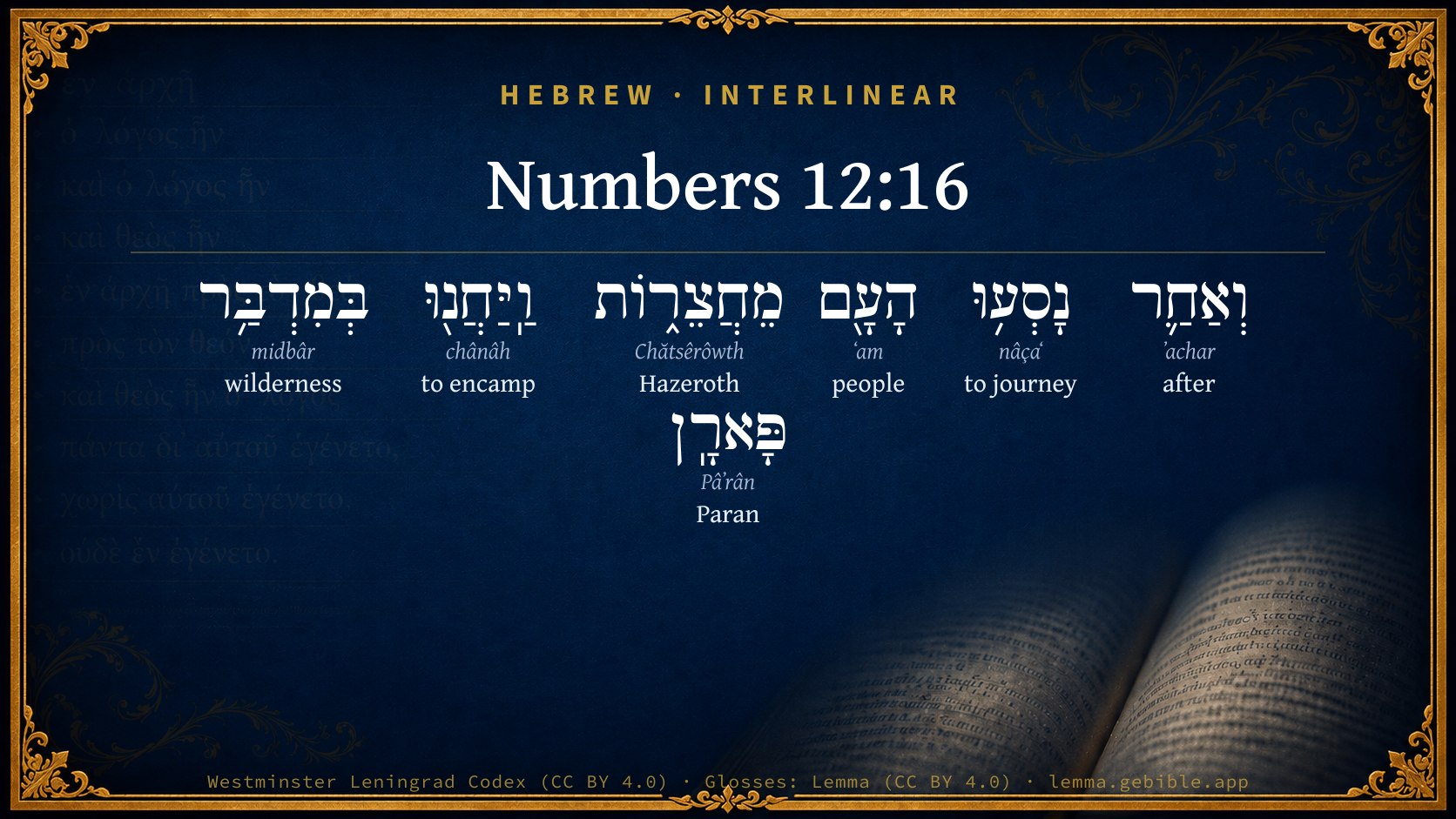
וְאַחַ֛ר נָסְע֥וּ הָעָ֖ם מֵחֲצֵר֑וֹת וַֽיַּחֲנ֖וּ בְּמִדְבַּ֥ר פָּארָֽן
Afterward the people traveled from Hazeroth, and encamped in the wilderness of Paran.
World English Bible · Public Domain
Afterward the people traveled from Hazeroth, and encamped in the wilderness of Paran.
One document with this verse’s original text, its word-by-word gloss line, the meaning frame, cross-references with their text, attributed commentary, and full source and license credits — printable, and it pastes into notes with its structure intact.
This verse Autodidact and up
A passage Seminary Student
Up to 50 verses in one chapter. A passage sheet keeps up to 6 commentary sources and 12 cross-references per verse, in the order this page ranks them, and says so on the sheet whenever that leaves anything out. Ask for a single verse and you get the Autodidact verse sheet above.
Everything on this page stays free to read, with no account — the sheet is a download of what is already on screen, not access to it.
The same verse in 3 English versions, stacked beneath the original-language interlinear above. Click any original word for its lexicon entry.
Each is an independent rendering of the whole verse — the interlinear is not word-aligned to these translations.
Highlighted words mark where these versions differ — a whole-verse word diff, not a word-by-word alignment.
Afterward the people traveled from Hazeroth, and encamped in the wilderness of Paran.
And afterward the people removed from Hazeroth, and pitched in the wilderness of Paran.
And after, the people set out from Hazeroth, and they camped in the wilderness of Paran.
unfoldingWord Literal Text — © unfoldingWord, licensed CC BY-SA 4.0. Word-aligned USFM3 via Door43 (git.door43.org/unfoldingWord/en_ult).
Every available English version of this verse, each an independent rendering of the whole verse.
Afterward the people traveled from Hazeroth, and encamped in the wilderness of Paran.
After that, the people set out from Hazeroth and camped in the Wilderness of Paran.
After that, the people set out from Hazeroth and camped in the Wilderness of Paran.
And afterward the people removed from Hazeroth, and pitched in the wilderness of Paran.
And afterward the people journeyed from Hazeroth, and encamped in the wilderness of Paran.
And afterward the people journeyed from Hazeroth, and pitched in the wilderness of Paran.
and afterwards have the people journeyed from Hazeroth, and they encamp in the wilderness of Paran.
and afterward the people have journeyed from Hazeroth, and they encamp in the wilderness of Paran.
After that, the people journeyed from Hazeroth and camped in the wilderness of Paran.
And after, the people set out from Hazeroth, and they camped in the wilderness of Paran.
And afterwards the people journeyed from Hazeroth, and encamped in the wilderness of Paran.
Afterward the people traveled from Hazeroth, and encamped in the wilderness of Paran.
And afterward the people removed from Hazeroth, and encamped in the wilderness of Paran.
Then the people left Hazeroth and set up camp in the Desert of Paran.
After that, the people went on from Hazeroth and put up their tents in the waste land of Paran.
And afterward the people journeyed from Hazeroth, and pitched in the wilderness of Paran.
Literal Standard Version (2020), Covenant Press — licensed CC BY-SA 4.0. Text via the HelloAO Bible API (eBible.org). Unlocked Literal Bible (unfoldingWord) — licensed CC BY-SA 4.0. Text via the HelloAO Bible API (eBible.org). unfoldingWord Literal Text — © unfoldingWord, licensed CC BY-SA 4.0. Word-aligned USFM3 via Door43 (git.door43.org/unfoldingWord/en_ult). Free Bible Version, Dr. Jonathan Gallagher — licensed CC BY-SA 4.0. Text via the HelloAO Bible API (eBible.org).
More ways to search: Search by grammar → Find every occurrence → Compare this word →
Practice this passage: Drill this verse → Learn its vocabulary →
These counts appear in no published source. They are computed here, from the morphology-tagged text and Lemma’s own curated glosses. What Lemma adds →
Notable vocabulary
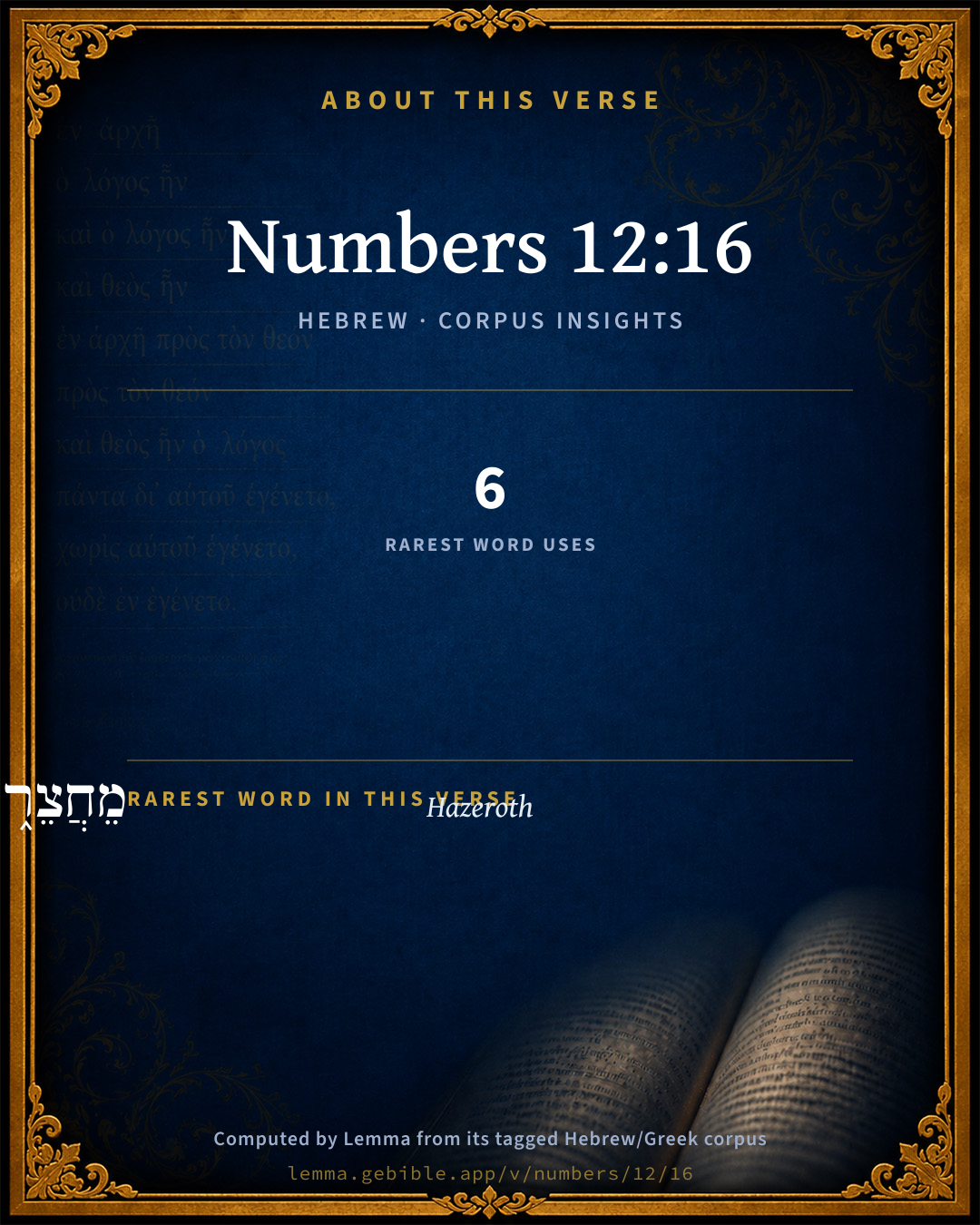
The rarest word here is מֵחֲצֵר֑וֹת Hazeroth H2698 — appearing just 6 times in the whole Hebrew Bible.
Shared distinctive vocabulary
מֵחֲצֵר֑וֹת Hazeroth H2698 occurs in 5 verses of the Hebrew Bible. Also found in:
Grammatical profile
Verb forms
Topical passages linked to Numbers 12:16 in the Treasury of Scripture Knowledge — connected by theme and wording, ordered by reader-vote popularity; previews shown in the World English Bible.
Cross-references courtesy of OpenBible.info (CC BY 4.0).
The same verse in the two great witnesses to the Old Testament, shown verse-for-verse.
These are two independent witnesses, not word-aligned to each other, and the Septuagint is shown in lemma (dictionary) form.
וְאַחַ֛ר נָסְע֥וּ הָעָ֖ם מֵחֲצֵר֑וֹת וַֽיַּחֲנ֖וּ בְּמִדְבַּ֥ר פָּארָֽן
Afterward the people traveled from Hazeroth, and encamped in the wilderness of Paran.
World English Bible · Public Domain
καί μετά οὗτος ἐκαἴρω ὁ λαός ἐκ ασηρωθ καί παρα ἐνβάλλω ἐν ὁ ἔρημος ὁ φαραν
No English rendering of this Greek verse — the small residue in the structurally divergent books.
Hebrew: Westminster Leningrad Codex (CC BY 4.0). Greek: Septuagint (public domain); English from a public-domain English Septuagint. How the Septuagint differs from the Hebrew →
The Targum is the ancient Jewish Aramaic paraphrase of the Hebrew Scriptures — an interpretive translation, not the Hebrew text itself. Onkelos (literal) and Pseudo-Jonathan (expansive) render the Torah, and Jonathan the Prophets. Coverage is partial: where no permissively-licensed English translation exists for a verse, only the Aramaic is shown. This is verse-level text, not a word-by-word alignment to the Hebrew.
וּבָתַר כֵּן נְטָלוּ עַמָא מֵחֲצֵרוֹת וּשְׁרוֹ בְּמַדְבְּרָא דְפָארָן
(no public-domain English translation for this verse)
Targum Onkelos — Aramaic: “Onkelos Genesis” (public domain); “Onkelos Exodus” (public domain); “Onkelos Leviticus” (public domain); “Onkelos Numbers” (public domain); “Onkelos Deuteronomy” (public domain). English: “Sefaria Community Translation” (CC0 1.0 (public-domain dedication)); “J.W. Etheridge. The Targums of Onkelos and Jonathan Ben Uzziel on the Pentateuch. London: Longmans, Green, 1862” (public domain). Text via Sefaria.
אַף עַל גַב דְאִתְחַיָיבַת מִרְיָם נְבִיאֲתָא לְמִלְקֵי בְּצוֹרְעָא בְּעַלְמָא הָדֵין אוּלְפַן סַגִי אִית לְהוּ לְעַלְמָא דְאָתֵי לְצַדִיקַיָא וּלְנַטְרֵי פִּקוּדֵי אוֹרַיְיתָא לְפוּם דְאִתְיְעָדַת מִרְיָם נְבִיאֲתָא שָׁעָא זְעֵירָא לְמִידוֹעַ מָה הֲוָה בְסֵיפֵיהּ דְמשֶׁה בְּהַהוּא זְכוּתָא הֲווֹן כָּל יִשְרָאֵל אַשִׁתִּין רִבְוָון דְהִינוּן סְכוֹם תְּמַנְיָן לִגְיוֹנִין וַעֲנָנֵי יְקָרָא וּמַשְׁכְּנָא וּבֵירָא לָא זַיְיעִין וְלָא נַטְלִין עַד זְמַן דְאִיתְסִיאַת מִרְיָם נְבִיאֲתָא וּמִן בָּתַר כְּדֵין נְטָלוּ עַמָא מֵחֲצֵרוֹת וּשְׁרוֹן בְּמַדְבְּרָא דְפָארָן
But though Miriam the prophetess had made herself liable to be stricken with leprosy in this world, the doctrine is ample that in the world to come (there remaineth a reward) for the just, and for them who keep the commandments of the law. And because Miriam the prophetess had watched for a little hour to know what would be the fate of Mosheh; (Exod. ii) for the sake of that merit all Israel, numbering sixty myriads, being eighty legions, and the Cloud of Glory, the tabernacle, and the well, went not, nor proceeded, till the time that she was healed: and afterward the people journeyed from Hatseroth, and encamped in the wilderness of Pharan.
Targum Pseudo-Jonathan — Aramaic: “Targum Jonathan on Genesis” (public domain); “Targum Jonathan on Exodus” (public domain); “Targum Jonathan on Leviticus” (public domain); “Targum Jonathan on Numbers” (public domain); “Targum Jonathan on Deuteronomy” (public domain). English: “The Targum of Jonathan ben Uzziel, trans. J. W. Etheridge, London, 1862” (public domain). Text via Sefaria.
Teaching starters — assembled from the data on this page, not authored interpretation. Every prompt links to the verse data it draws on. Edit before teaching.
Numbers, in the Pentateuch, opens this verse with 7 words (7 distinct Hebrew lemmas). Its most distinctive word is Chătsêrôwth (“Hazeroth”). A historical commentator’s framing appears above. Read the whole chapter for the surrounding context.
Commentary
Notes on Numbers 12:16 from classic Christian and Jewish commentators (each source and its license shown beneath its notes). The classic Christian expositions comment on the surrounding passage and are grouped to its opening verse, so a note may address several verses; the Jewish commentaries on the Tanakh (Rashi and others) are per-verse, so they appear only where the commentator wrote on this verse.
Lemma curates 59 commentaries, every one of them public domain or Creative Commons licensed, each selected and text-cleaned for this edition rather than reprinted as found. About our sources →
Trapp's Complete Commentary
John Trapp
John Trapp, A Commentary or Exposition upon All the Books of the Old and New Testament (1647–1656) — public domain. Text from a community e-Sword module.
Whedon's Commentary on the Bible
Daniel D. Whedon
Daniel D. Whedon (gen. ed.), Commentary on the Old and New Testaments (1874–1909) — public domain. Text from a community e-Sword module.
Tyndale Open Study Notes
Tyndale Open Resources
Tyndale Open Study Notes — © Tyndale Open Resources, licensed CC BY-SA 4.0. Text via the HelloAO Bible API.
Jamieson, Fausset & Brown
Robert Jamieson, A. R. Fausset & David Brown
Jamieson, Fausset & Brown — Commentary Critical and Explanatory on the Whole Bible (1871) — public domain (CC PDM 1.0). Text via the HelloAO Bible API.
Adam Clarke's Commentary
Adam Clarke's Commentary on the Bible (1810–1826) — public domain. Text from a community e-Sword/MySword module.
Ellicott's Commentary for English Readers
A Bible Commentary for English Readers, edited by Charles John Ellicott (1878–1897) — public domain. Text from a community e-Sword module.
The Cambridge Bible for Schools and Colleges
gen. ed. J. J. S. Perowne
The Cambridge Bible for Schools and Colleges (gen. ed. J. J. S. Perowne; Cambridge University Press, 1878–1918) — public domain. Text from a community e-Sword module.
John Gill's Exposition
John Gill's Exposition of the Whole Bible (1746–1763) — public domain (CC PDM 1.0). Text via the HelloAO Bible API.
Matthew Poole's English Annotations
Matthew Poole's English Annotations on the Holy Bible (1683–1685) — public domain. Text from a community e-Sword/MySword module.
The Pulpit Commentary
The Pulpit Commentary (1880–1919), ed. H.D.M. Spence-Jones & Joseph S. Exell — public domain. Text from a community e-Sword module.
John Wesley's Explanatory Notes
John Wesley, Explanatory Notes Upon the Whole Bible (1754–1765) — public domain. Text via the GEBible commentary corpus.
unfoldingWord translationNotes
Door43 World Missions Community
unfoldingWord translationNotes — © Distant Shores Media and the Door43 World Missions Community, licensed CC BY-SA 4.0. Source: git.door43.org/Door43/en_tn.
Ramban (Nachmanides)
Rabbi Moshe ben Nachman (Ramban / Nachmanides)
Ramban (Nachmanides) on the Tanakh — English translation: “Commentary on the Torah by Ramban (Nachmanides). Translated and annotated by Charles B. Chavel. New York, Shilo Pub. House, 1971-1976” (CC BY 4.0). Text via Sefaria.