
Numbers 3:14

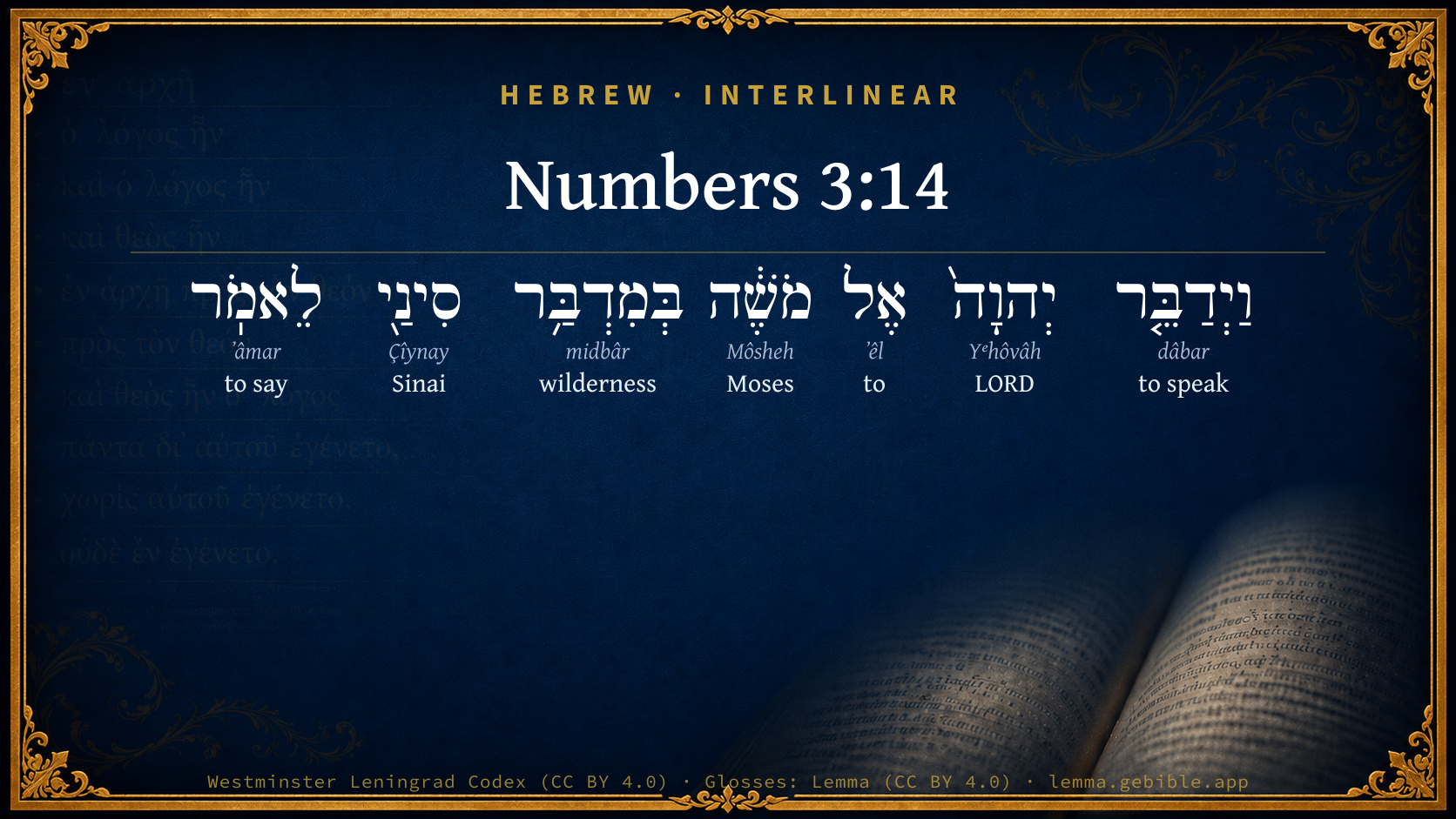
Hebrew (Westminster Leningrad Codex) Numbers 3:14 appears in the Hebrew Old Testament. The text above is from the Westminster Leningrad Codex. Each word links to its Strong’s number, a concise gloss, and parsing drawn from the Open Scriptures Hebrew Bible morphology. Click any word for its full Brown-Driver-Briggs (BDB) entry.
Download image
Cite this verse

Numbers 3:14 (World English Bible). Public Domain. Lemma interlinear Bible study tool, https://lemma.gebible.app/v/numbers/3/14.

Show BibTeX & RIS
BibTeX
RIS
English Translation
Yahweh spoke to Moses in the wilderness of Sinai, saying,
World English Bible · Public Domain
Download a study sheet

One document with this verse’s original text, its word-by-word gloss line, the meaning frame, cross-references with their text, attributed commentary, and full source and license credits — printable, and it pastes into notes with its structure intact.

This verse Autodidact and up

Study sheet (.html) Plain text (.txt)

A passage Seminary Student

Up to 50 verses in one chapter. A passage sheet keeps up to 6 commentary sources and 12 cross-references per verse, in the order this page ranks them, and says so on the sheet whenever that leaves anything out. Ask for a single verse and you get the Autodidact verse sheet above.

Everything on this page stays free to read, with no account — the sheet is a download of what is already on screen, not access to it.

Want to remove ads? Support Godless Engineer
Compare translations 3

The same verse in 3 English versions, stacked beneath the original-language interlinear above. Click any original word for its lexicon entry.

Each is an independent rendering of the whole verse — the interlinear is not word-aligned to these translations.

Highlighted words mark where these versions differ — a whole-verse word diff, not a word-by-word alignment.

  • World English Bible Public Domain
    Yahweh spoke to Moses in the wilderness of Sinai, saying,
  • King James Version Public Domain
    And the LORD spake unto Moses in the wilderness of Sinai, saying,
  • unfoldingWord Literal Text CC BY-SA 4.0
    And Yahweh spoke to Moses in the wilderness of Sinai, saying,

unfoldingWord Literal Text — © unfoldingWord, licensed CC BY-SA 4.0. Word-aligned USFM3 via Door43 (git.door43.org/unfoldingWord/en_ult).

Versions to compare (up to 4)

3 of 4 selected

Show all 18 translations

Every available English version of this verse, each an independent rendering of the whole verse.

  • World English Bible Public Domain
    Yahweh spoke to Moses in the wilderness of Sinai, saying,
  • Berean Standard Bible Public Domain
    Then the LORD spoke to Moses in the Wilderness of Sinai, saying,
  • Majority Standard Bible Public Domain
    Then the LORD spoke to Moses in the Wilderness of Sinai, saying,
  • King James Version Public Domain
    And the LORD spake unto Moses in the wilderness of Sinai, saying,
  • American Standard Version (1901) Public Domain
    And Jehovah spake unto Moses in the wilderness of Sinai, saying,
  • Revised Version (1885) Public Domain
    And the LORD spake unto Moses in the wilderness of Sinai, saying,
  • Geneva Bible (1599) Public Domain
    Moreouer, the Lord spake vnto Moses in the wildernesse of Sinai, saying,
  • Douay-Rheims (1899) Public Domain
    And the Lord spoke to Moses in the desert of Sinai, saying:
  • Young's Literal Translation Public Domain
    And Jehovah speaketh unto Moses in the wilderness of Sinai, saying,
  • Literal Standard Version CC BY-SA 4.0
    And YHWH speaks to Moses in the wilderness of Sinai, saying,
  • Unlocked Literal Bible CC BY-SA 4.0
    Yahweh spoke to Moses in the wilderness of Sinai. He said,
  • unfoldingWord Literal Text CC BY-SA 4.0
    And Yahweh spoke to Moses in the wilderness of Sinai, saying,
  • Darby Bible Public Domain
    And Jehovah spoke to Moses in the wilderness of Sinai, saying,
  • World Messianic Bible Public Domain
    The LORD spoke to Moses in the wilderness of Sinai, saying,
  • Webster's Bible Public Domain
    And the LORD spoke to Moses in the wilderness of Sinai, saying,
  • Free Bible Version CC BY-SA 4.0
    The Lord spoke to Moses in the Sinai desert. He told him,
  • Bible in Basic English Public Domain
    And the Lord said to Moses in the waste land of Sinai,
  • JPS Tanakh (1917) Public Domain
    And the LORD spoke unto Moses in the wilderness of Sinai, saying:

Literal Standard Version (2020), Covenant Press — licensed CC BY-SA 4.0. Text via the HelloAO Bible API (eBible.org). Unlocked Literal Bible (unfoldingWord) — licensed CC BY-SA 4.0. Text via the HelloAO Bible API (eBible.org). unfoldingWord Literal Text — © unfoldingWord, licensed CC BY-SA 4.0. Word-aligned USFM3 via Door43 (git.door43.org/unfoldingWord/en_ult). Free Bible Version, Dr. Jonathan Gallagher — licensed CC BY-SA 4.0. Text via the HelloAO Bible API (eBible.org).

Word by word

More ways to search: Search by grammar → Find every occurrence → Compare this word →

Practice this passage: Drill this verse → Learn its vocabulary →

About this verse

These counts appear in no published source. They are computed here, from the morphology-tagged text and Lemma’s own curated glosses. What Lemma adds →

7
words
7
distinct lemmas
Pentateuch
section

Shared distinctive vocabulary

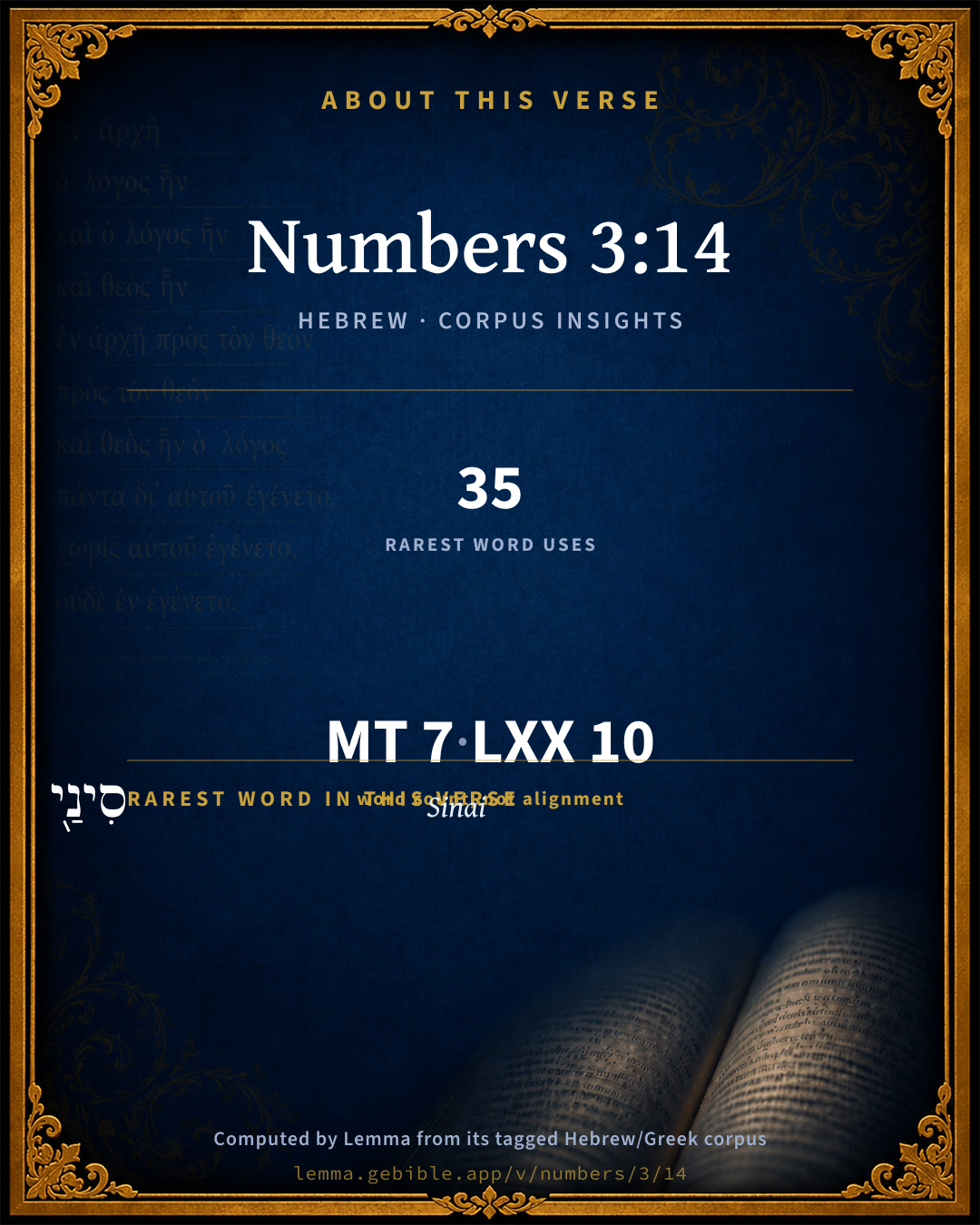
סִינַ֖י Sinai H5514 occurs in 34 verses of the Hebrew Bible. Also found in:

Grammatical profile

  • 2 verbs
  • 4 nouns
  • 1 preposition

Verb forms

  • וַיְדַבֵּ֤ר Piel · Sequential Imperfect
  • לֵאמֹֽר Qal · Infinitive Construct

Hebrew & Septuagint length

In English translation the verse runs 10 words from the Hebrew and 12 from the Septuagint (LXX English) — closely comparable.

A rough comparison of the two English renderings, which tokenize alike — not a word-level alignment.

Word counts can differ between the Hebrew and the Greek without any difference in meaning — e.g. the Hebrew direct-object marker אֵת has no separate Greek word, and Greek often adds the article ὁ.

In the original languages it is 7 Hebrew tokens and 10 Greek tokens — but the two are counted differently (Hebrew bundles its prefixes and suffixes into one token; the Greek is in lemma form), so that isn’t a like-for-like length.

Hebrew and Greek witnesses Masoretic Hebrew ↔ Greek Septuagint

The same verse in the two great witnesses to the Old Testament, shown verse-for-verse.

These are two independent witnesses, not word-aligned to each other, and the Septuagint is shown in lemma (dictionary) form.

Hebrew Numbers 3:14 Masoretic · Westminster Leningrad Codex

וַיְדַבֵּ֤ר יְהוָה֙ אֶל מֹשֶׁ֔ה בְּמִדְבַּ֥ר סִינַ֖י לֵאמֹֽר

Yahweh spoke to Moses in the wilderness of Sinai, saying,

World English Bible · Public Domain

Greek LXX Numbers 3:14 Septuagint · lemma form

καί λαλέω κύριος πρός μωυσῆς ἐν ὁ ἔρημος σινα λέγω

And the Lord spoke to Moses in the wilderness of Sina, saying,

LXX2012 (modern English Septuagint) · Public Domain

On this verse, Whedon's Commentary on the Bible discusses the Septuagint’s reading. Read the note in Commentary ↓

Hebrew: Westminster Leningrad Codex (CC BY 4.0). Greek: Septuagint (public domain); English from LXX2012 (modern English Septuagint) (Public Domain). How the Septuagint differs from the Hebrew →

Targum (Aramaic paraphrase)

2

The Targum is the ancient Jewish Aramaic paraphrase of the Hebrew Scriptures — an interpretive translation, not the Hebrew text itself. Onkelos (literal) and Pseudo-Jonathan (expansive) render the Torah, and Jonathan the Prophets. Coverage is partial: where no permissively-licensed English translation exists for a verse, only the Aramaic is shown. This is verse-level text, not a word-by-word alignment to the Hebrew.

  1. Targum Onkelos Torah (Genesis–Deuteronomy)
    וּמַלִיל יְיָ עִם משֶׁה בְּמַדְבְּרָא דְסִינַי לְמֵימָר

    (no public-domain English translation for this verse)

    Targum Onkelos — Aramaic: “Onkelos Genesis” (public domain); “Onkelos Exodus” (public domain); “Onkelos Leviticus” (public domain); “Onkelos Numbers” (public domain); “Onkelos Deuteronomy” (public domain). English: “Sefaria Community Translation” (CC0 1.0 (public-domain dedication)); “J.W. Etheridge. The Targums of Onkelos and Jonathan Ben Uzziel on the Pentateuch. London: Longmans, Green, 1862” (public domain). Text via Sefaria.

  2. Targum Pseudo-Jonathan Torah (Genesis–Deuteronomy)
    וּמַלֵיל יְיָ עִם משֶׁה בְּמַדְבְּרָא דְסִינַי לְמֵימָר

    And the Lord spake with Mosheh in the wilderness of Sinai, saying:

    Targum Pseudo-Jonathan — Aramaic: “Targum Jonathan on Genesis” (public domain); “Targum Jonathan on Exodus” (public domain); “Targum Jonathan on Leviticus” (public domain); “Targum Jonathan on Numbers” (public domain); “Targum Jonathan on Deuteronomy” (public domain). English: “The Targum of Jonathan ben Uzziel, trans. J. W. Etheridge, London, 1862” (public domain). Text via Sefaria.

Commentary

Notes on Numbers 3:14 from classic Christian and Jewish commentators (each source and its license shown beneath its notes). The classic Christian expositions comment on the surrounding passage and are grouped to its opening verse, so a note may address several verses; the Jewish commentaries on the Tanakh (Rashi and others) are per-verse, so they appear only where the commentator wrote on this verse.

Lemma curates 59 commentaries, every one of them public domain or Creative Commons licensed, each selected and text-cleaned for this edition rather than reprinted as found. About our sources →

Whedon's Commentary on the Bible

Daniel D. Whedon

THE NUMBERING OF THE LEVITES, Num_3:14-39.

14. Unto Moses — To whom alone this order is given, probably because Aaron and his sons had a pecuniary interest in the result, inasmuch as the redemption money for the excess of the firstborn was to be paid to them.

In Num_3:39 of this chapter Aaron is spoken of as taking part with Moses in the enumeration; but in the Hebrew the Masoretic marks indicate a spurious reading. The same unauthorized reading occurs again in the Septuagint in Num_3:16.

Daniel D. Whedon (gen. ed.), Commentary on the Old and New Testaments (1874–1909) — public domain. Text from a community e-Sword module.

Tyndale Open Study Notes

Tyndale Open Resources

3:14-39 This first phase of a two-stage registration of the tribe of Levi (see 4:34-49 for stage two) summarized each family group’s special responsibilities (described in greater detail in 4:1-33). This numbering was not linked with military duties, so it enrolled male Levites from the age of one month (3:40-41). • Three family groups are descended from Gershon, Kohath, and Merari, the three sons of Levi. These clans (often called the Gershonites, Kohathites, and Merarites) later inherited the “cities of refuge” (Josh 21) and filled various important posts in the Jerusalem Temple (2 Chr 29:3-17).

Tyndale Open Study Notes — © Tyndale Open Resources, licensed CC BY-SA 4.0. Text via the HelloAO Bible API.

Matthew Henry's Commentary

The Levites being granted to Aaron to minister to him, they are here delivered to him by tale, that he might know what he had, and employ them accordingly. Observe,

I. By what rule they were numbered: Every male from a month old and upward, Num 3:15. The rest of the tribes were numbered only from twenty years old and upwards, and of them those only that were able to go forth to war; but into the number of the Levites they must take in both infants, and infirm; being exempted from the war, it was not insisted upon that they should be of age and strength for the wars. Though it appears afterwards that little more than a third part of the Levites were fit to be employed in the service of the tabernacle (about 8000 out of 22,000, Num 4:47, Num 4:48), yet God would have them all numbered as retainers to his family; that none may think themselves disowned and rejected of God because they are not in a capacity of doing him that service which they see others do him. The Levites of a month old could not honour God and serve the tabernacle, as those that had grown up; yet out of the mouths of babes and sucklings the Levites' praise was perfected. Let not little children be hindered from being enrolled among the disciples of Christ, for such was the tribe of Levi, of such is the kingdom of heaven, that kingdom of priests. The redemption of the first-born was reckoned from a month old (Num 18:15, Num 18:16), therefore from that age the Levites were numbered. They were numbered after the house of their fathers, not their mothers, for, if the daughter of a Levite married one of another tribe, her son was not a Levite; but we read of a spiritual priest to out God who inherited the unfeigned faith which dwelt in his mother and grandmother, Ti2 1:5.

II. How they were distributed into three classes, according to the number of the sons of Levi, Gershon, Kohath, and Merari, and these subdivided into several families, Num 3:17-20.

1. Concerning each of these three classes we have an account, (1.) Of their number. The Gershonites were 7500. The Kohathites were 8600. The Merarites were 6200. The rest of the tribes had not their subordinate families numbered by themselves as those of Levi; this honour God put upon his own tribe. (2.) Of their post about the tabernacle on which they were to attend. The Gershonites pitched behind the tabernacle, westward, Num 3:23. The Kohathites on the right hand, southward, Num 3:29. The Merarites on the left hand, northward, Num 3:35. And, to complete the square, Moses and Aaron, with the priests, encamped in the front, eastward, Num 3:38. Thus was the tabernacle surrounded with its guards; and thus does the angel of the Lord encamp round about those that fear him, those living temples, Psa 34:7. Every one knew his place, and must therein abide with God. (3.) Of their chief or head. As each class had its own place, so each had its own prince. The commander of the Gershonites was Eliasaph (Num 3:24); of the Kohathites Elizaphan (Num 3:30), of whom we read (Lev 10:4) that he was one of the bearers at the funeral of Nadab and Abihu; of the Merarites Zuriel, Num 3:35. (4.) Of their charge, when the camp moved. Each class knew their own business; it was requisite they should, for that which is every body's work often proves nobody's work. The Gershonites were charged with the custody and carriage of all the curtains and hangings and coverings of the tabernacle and court (Num 3:25, Num 3:26), the Kohathites of all the furniture of the tabernacle - the ark, altar, table, etc. (Num 3:31, Num 3:32), the Merarites of the heavy carriage, boards, bars, pillars, etc., Num 3:36, Num 3:37.

2. Here we may observe, (1.) That the Kohathites, though they were the second house, yet were preferred before the elder family of the Gershonites. Besides that Aaron and the priests were of that family, they were more numerous, and their post and charge more honourable, which probably was ordered to put an honour upon Moses, who was of that family. Yet, (2.) The posterity of Moses were not at all dignified or privileged, but stood upon the level with other Levites, that it might appear he did not seek the advancement of his own family, nor to entail any honours upon it either in church or state; he that had honour enough himself coveted not to have his name shine by that borrowed light, but rather to have the Levites borrow honour from his name. Let none think contemptibly of the Levites, though inferior to the priests, for Moses himself though it preferment enough for his sons to be Levites. Probably it was because the family of Moses were Levites only that in the title of this chapter, which is concerning that tribe (Num 3:1), Aaron is put before Moses.

III. The sum total of the numbers of this tribe. They are computed in all 22,000, Num 3:39. The sum of the particular families amounts to 300 more; if this had been added to the sum total, the Levites, instead of being 273 fewer than the first-born, as they were (Num 3:43), would have been twenty-seven more, and so the balance would have fallen the other way; but it is supposed that the 300 which were struck off from the account when the exchange was to be made were the first-born of the Levites themselves, born since their coming out of Egypt, which could not be put into the exchange, because they were already sanctified to God. But that which is especially observable here is that the tribe of Levi was by much the least of all the tribes. Note, God's part in the world is too often the smallest part. His chosen are comparatively a little flock.

Matthew Henry's Commentary on the Whole Bible (1708–1710) — public domain (CC PDM 1.0). Text via the HelloAO Bible API.

Jamieson, Fausset & Brown

Robert Jamieson, A. R. Fausset & David Brown

Number the children of Levi--They were numbered as well as the other tribes; but the enumeration was made on a different principle--for while in the other tribes the number of males was calculated from twenty years and upward [Num 1:3], in that of Levi they were counted "from a month old and upward." The reason for the distinction is obvious. In the other tribes the survey was made for purposes of war [Num 1:3], from which the Levites were totally exempt. But the Levites were appointed to a work on which they entered as soon as they were capable of instruction. They are mentioned under the names of Gershon, Kohath, and Merari, sons of Levi, and chiefs or ancestral heads of three subdivisions into which this tribe was distributed. Their duties were to assist in the conveyance of the tabernacle when the people were removing the various encampments, and to form its guard while stationary--the Gershonites being stationed on the west, the Kohathites on the south, and the families of Merari on the north. The Kohathites had the principal place about the tabernacle, and charge of the most precious and sacred things--a distinction with which they were honored, probably, because the Aaronic family belonged to this division of the Levitical tribe. The Gershonites, being the oldest, had the next honorable post assigned them, while the burden of the drudgery was thrown on the division of Merari.

Jamieson, Fausset & Brown — Commentary Critical and Explanatory on the Whole Bible (1871) — public domain (CC PDM 1.0). Text via the HelloAO Bible API.

The Cambridge Bible for Schools and Colleges

gen. ed. J. J. S. Perowne

14–20. Summary of the Levitical families.

The Cambridge Bible for Schools and Colleges (gen. ed. J. J. S. Perowne; Cambridge University Press, 1878–1918) — public domain. Text from a community e-Sword module.

John Gill's Exposition

And the Lord spake unto Moses in the wilderness of Sinai,.... At the same time he gave the order, and made the declaration before mentioned, and in the place where now the children of Israel were, and from whence they shortly removed:

saying; as follows.

John Gill's Exposition of the Whole Bible (1746–1763) — public domain (CC PDM 1.0). Text via the HelloAO Bible API.

Keil & Delitzsch

C. F. Keil & F. Delitzsch

The muster of the Levites included all the males from a month old and upwards, because they were to be sanctified to Jehovah in the place of the first-born; and it was at the age of a month that the latter were either to be given up or redeemed (comp. Num 3:40 and Num 3:43 with Num 18:16). In Num 3:17-20 the sons of Levi and their sons are enumerated, who were the founders of the mishpachoth among the Levites, as in Exo 6:16-19.

Keil & Delitzsch — Biblical Commentary on the Old Testament (1861–1891) — public domain (CC PDM 1.0). Text via the HelloAO Bible API. (Old Testament only.)

Kretzmann's Popular Commentary

Paul E. Kretzmann

The Formal Mustering

v. 14. And the Lord spake unto Moses in the Wilderness of Sinai, saying,

v. 15. Number the children of Levi after the house of their fathers, by their families, as had been done in the case of the other tribes; every male from a month old and upward shalt thou number them.

v. 16. And Moses numbered them according to the word of the Lord, as he was commanded, thus completing the census of all the tribes.

v. 17. And these were the sons of Levi by their names: Gershon and Kohath and Merari.

v. 18. And these are the names of the sons of Gershon by their families: Libni and Shimei.

v. 19. And the sons of Kohath by their families: Amram, the father of Moses and Aaron, these two, however, not being reckoned with the Kohathites, but in a separate category, and Izehar, Hebron, and Uzziel.

v. 20. And the sons of Merari by their families: Mabli and Mushi. These are the families of the Levites according to the house of their fathers, as they reckoned their descent from these princes among their ancestors.

Paul E. Kretzmann, Popular Commentary of the Bible (1921–1924) — public domain. Text from a community e-Sword module.

unfoldingWord translationNotes

Door43 World Missions Community

Count the descendants

Yahweh was commanding Moses to only count the male descendants. AT: "Count the male descendants" (See: Assumed Knowledge and Implicit Information)

following the word of Yahweh, just as he was commanded to do

These two phrases mean basically the same thing and are used together to emphasize that he obeyed Yahweh. (See: Parallelism)

translationWords

desert

Sinai

descend

family

house

word of God

command

unfoldingWord translationNotes — © Distant Shores Media and the Door43 World Missions Community, licensed CC BY-SA 4.0. Source: git.door43.org/Door43/en_tn.

Ramban (Nachmanides)

Rabbi Moshe ben Nachman (Ramban / Nachmanides)

AND THE ETERNAL SPOKE UNTO MOSES IN THE WILDERNESS OF SINAI. The reason for this statement is that since Scripture said above in the day that the Eternal spoke with Moses in Mount Sinai, it refers back and says [here] that the command for counting the Levites was not given in Mount Sinai; for only the choosing of the [four] children of Aaron [as priests] took place in Mount Sinai on the day that He commanded Moses about the making of the Tabernacle, but he was not given the command about the choosing of [all] the Levites [as ministers to the priests] at Mount Sinai, but in the wilderness of Sinai in the Tent of Meeting, just like the commandment mentioned [above] concerning [the counting of] the children of Israel [about which it is clearly stated that it was in the wilderness of Sinai, in the Tent of Meeting]. Now the tribe of Levi was not like all the other tribes, for [even though they were counted] from a month old and upward [unlike the other tribes who were counted only from the age of twenty years and over], they were still only twenty and two thousand, and from thirty years old and over they were all together [only] eight thousand [and five hundred and fourscore]., 4:48. Thus, their number from twenty years old and over does not reach even a half of the [number of the] smallest of [the other] tribes of Israel! And they did not as yet carry the ark, [that we should say] that its holiness took a toll of them! This is indeed astonishing, that His servants and His pious ones should not be blessed of the Eternal as were the rest of the people!Therefore I am of the opinion that this is a confirmation of what our Rabbis have said, 6. See also Ramban on Exodus 5:4. that the tribe of Levi was not [subject to] the enslavement of Egyptian bondage and the rigorous work [that was imposed on the rest of the tribes]. Now since the children of Israel’s lives were made bitter by the Egyptians with hard work in order to diminish them, the Holy One, blessed be He, increased them [miraculously] to overcome the decree of the Egyptians, just as He said, And as they afflicted them, so they multiplied and so they grew, Verse 12. and just as it is said also with reference to the decree that if it be a son, then ye shall kill him, Verse 16. — and the people multiplied, and waxed very mighty, Verse 20. — since the Holy One, blessed be He, said: “We shall see whose words shall stand, Mine or theirs. ” But the tribe of Levi [which was not subject to bondage] reproduced and increased in a normal way, and therefore they did not become as numerous as the other tribes. Perhaps also [their small numbers were] on account of the anger of the patriarch [Jacob] towards them, for the tribe of Shimon which now had a large population. decreased, so that at the time of their entry into the Land [they numbered only] twenty-two thousand [and two hundred — whereas most of the other tribes increased in the same period, or decreased relatively slightly]; similarly, Levi, the tribe of His pious ones, was not decreased in the plague [caused because of Peor, and yet at the time of entry into the Land they numbered only one thousand more, 26:62. than their present twenty-two thousand! Thus we see that it was the anger of the patriarch which affected the numbers of both Shimon and Levi.]

Ramban (Nachmanides) on the Tanakh — English translation: “Commentary on the Torah by Ramban (Nachmanides). Translated and annotated by Charles B. Chavel. New York, Shilo Pub. House, 1971-1976” (CC BY 4.0). Text via Sefaria.

Lesson kit

Teaching starters — assembled from the data on this page, not authored interpretation. Every prompt links to the verse data it draws on. Edit before teaching.

Numbers, in the Pentateuch, opens this verse with 7 words (7 distinct Hebrew lemmas). Its most distinctive word is Çîynay (“Sinai”). A historical commentator’s framing appears above. Read the whole chapter for the surrounding context.

Discussion questions

  1. What does “Sinai” (Çîynay) contribute to the verse as a whole?
  2. Exodus 16:1 shares the word «Sinai» with this verse. How do the two illuminate each other?
  3. The translations on this page render this verse differently — a whole-verse word diff, not a word-by-word alignment. What might account for the different wordings?
  4. The verb «וַיְדַבֵּ֤ר» is Piel Sequential Imperfect. How does its form color the action?
  5. Reading how Whedon's Commentary on the Bible and Tyndale Open Study Notes read this verse, where do the two commentators agree and where do they part?

Things to notice

Reading settings

Reading text

Shown beneath each verse's original-language words.

Old Testament
Old Testament edition

Read the OT as the Masoretic Hebrew (MT) or the Greek Septuagint (LXX).

English shown for the Greek Septuagint (in the Hebrew ↔ Greek comparison).

Comparing translations? Open the Compare panel on any verse page to stack up to four side by side.