
Exodus 13:20

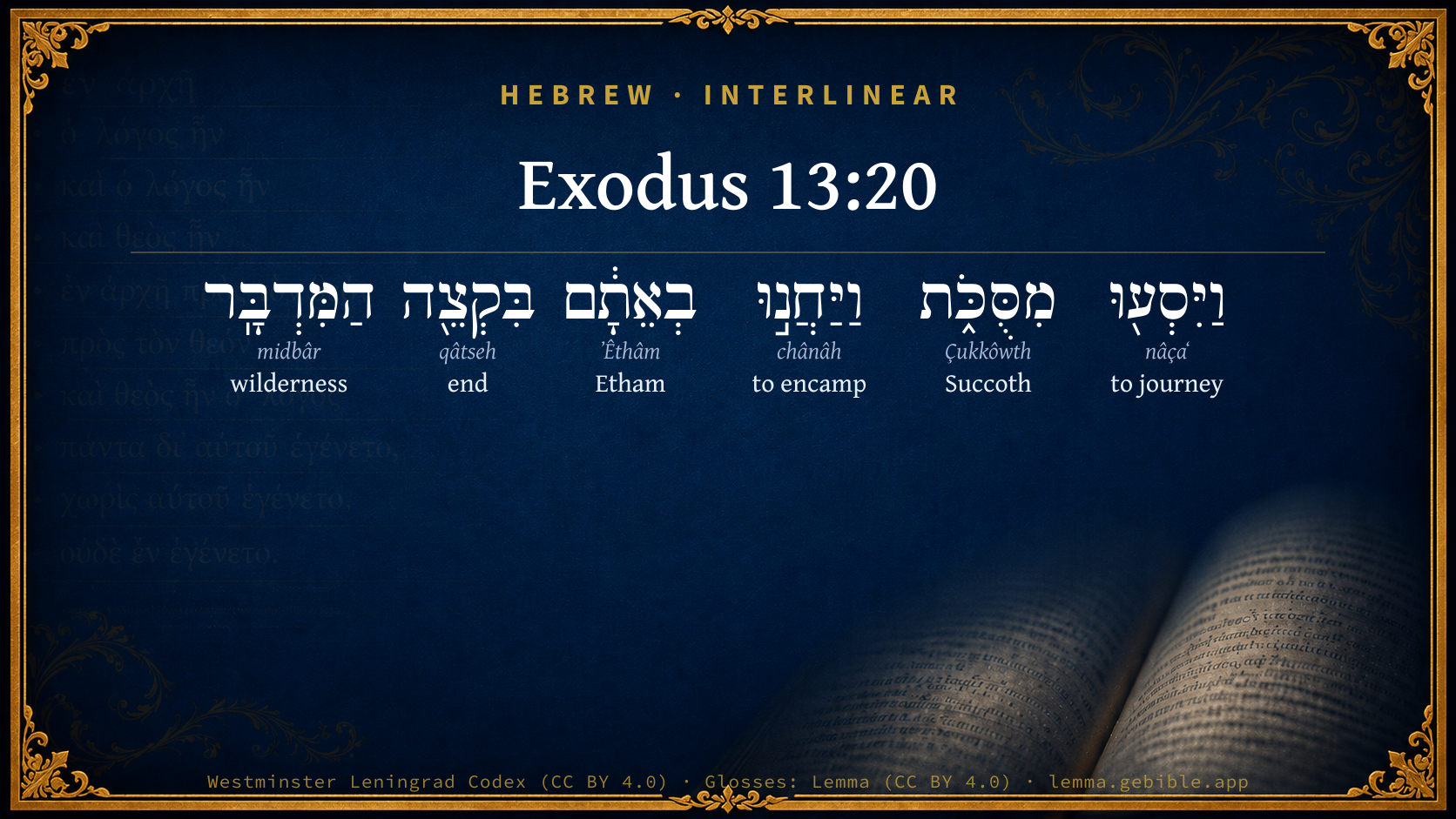
Hebrew (Westminster Leningrad Codex) Exodus 13:20 appears in the Hebrew Old Testament. The text above is from the Westminster Leningrad Codex. Each word links to its Strong’s number, a concise gloss, and parsing drawn from the Open Scriptures Hebrew Bible morphology. Click any word for its full Brown-Driver-Briggs (BDB) entry.
Download image
Cite this verse

Exodus 13:20 (World English Bible). Public Domain. Lemma interlinear Bible study tool, https://lemma.gebible.app/v/exodus/13/20.

Show BibTeX & RIS
BibTeX
RIS
English Translation
They took their journey from Succoth, and encamped in Etham, in the edge of the wilderness.
World English Bible · Public Domain
Highlights
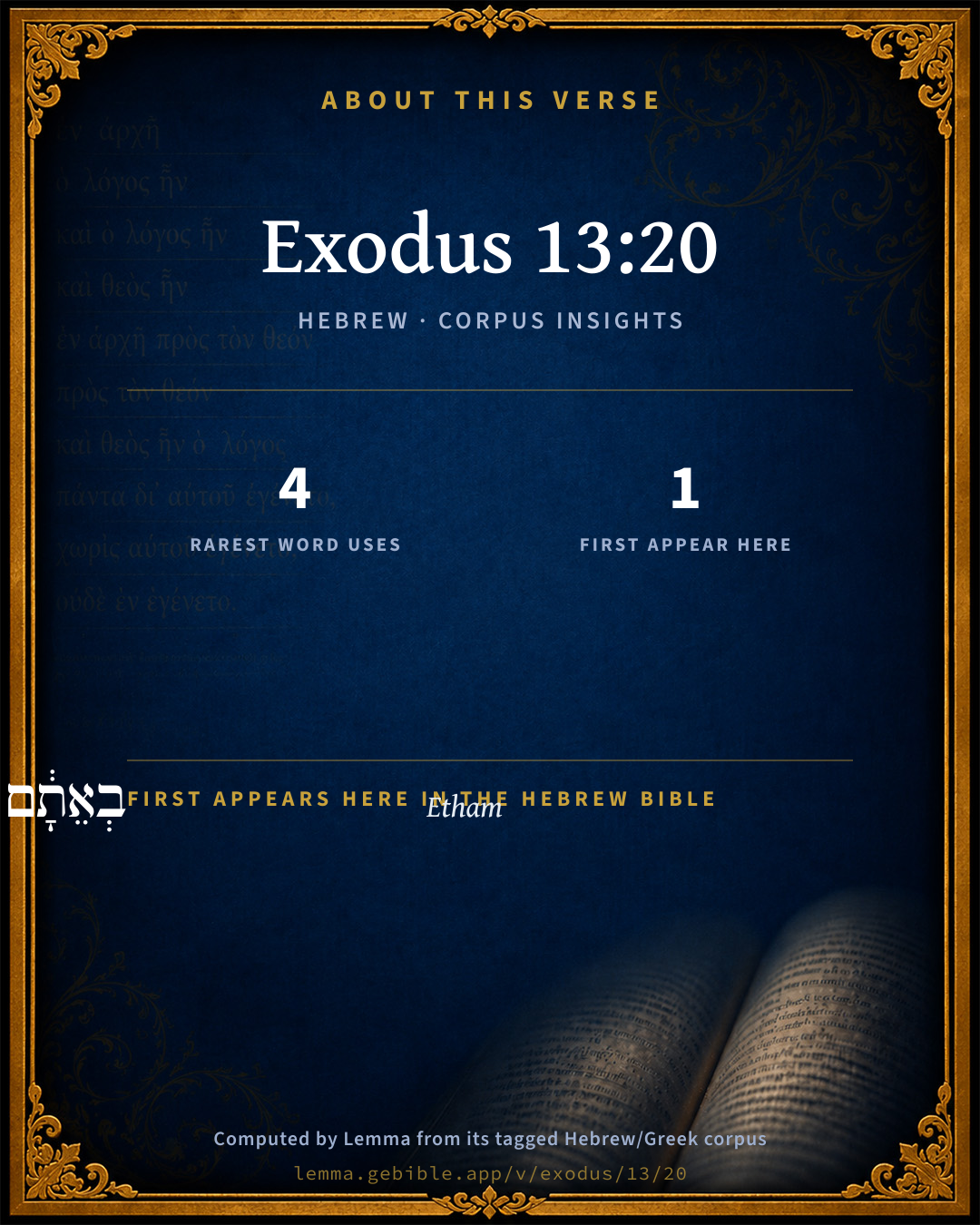
  • 1 first appearance in the Hebrew Bible
Full analysis ↓
Download a study sheet

One document with this verse’s original text, its word-by-word gloss line, the meaning frame, cross-references with their text, attributed commentary, and full source and license credits — printable, and it pastes into notes with its structure intact.

This verse Autodidact and up

Study sheet (.html) Plain text (.txt)

A passage Seminary Student

Up to 50 verses in one chapter. A passage sheet keeps up to 6 commentary sources and 12 cross-references per verse, in the order this page ranks them, and says so on the sheet whenever that leaves anything out. Ask for a single verse and you get the Autodidact verse sheet above.

Everything on this page stays free to read, with no account — the sheet is a download of what is already on screen, not access to it.

Want to remove ads? Support Godless Engineer
Compare translations 3

The same verse in 3 English versions, stacked beneath the original-language interlinear above. Click any original word for its lexicon entry.

Each is an independent rendering of the whole verse — the interlinear is not word-aligned to these translations.

Highlighted words mark where these versions differ — a whole-verse word diff, not a word-by-word alignment.

  • World English Bible Public Domain
    They took their journey from Succoth, and encamped in Etham, in the edge of the wilderness.
  • King James Version Public Domain
    And they took their journey from Succoth, and encamped in Etham, in the edge of the wilderness.
  • unfoldingWord Literal Text CC BY-SA 4.0
    And they journeyed from Succoth, and they camped at Etham on the edge of the wilderness.

unfoldingWord Literal Text — © unfoldingWord, licensed CC BY-SA 4.0. Word-aligned USFM3 via Door43 (git.door43.org/unfoldingWord/en_ult).

Versions to compare (up to 4)

3 of 4 selected

Show all 18 translations

Every available English version of this verse, each an independent rendering of the whole verse.

  • World English Bible Public Domain
    They took their journey from Succoth, and encamped in Etham, in the edge of the wilderness.
  • Berean Standard Bible Public Domain
    They set out from Succoth and camped at Etham on the edge of the wilderness.
  • Majority Standard Bible Public Domain
    They set out from Succoth and camped at Etham on the edge of the wilderness.
  • King James Version Public Domain
    And they took their journey from Succoth, and encamped in Etham, in the edge of the wilderness.
  • American Standard Version (1901) Public Domain
    And they took their journey from Succoth, and encamped in Etham, in the edge of the wilderness.
  • Revised Version (1885) Public Domain
    And they took their journey from Succoth, and encamped in Etham, in the edge of the wilderness.
  • Geneva Bible (1599) Public Domain
    So they tooke their iourney from Succoth, and camped in Etham in the edge of the wildernesse.
  • Douay-Rheims (1899) Public Domain
    And marching from Socoth they encamped in Etham in the utmost coasts of the wilderness.
  • Young's Literal Translation Public Domain
    And they journey from Succoth, and encamp in Etham at the extremity of the wilderness,
  • Literal Standard Version CC BY-SA 4.0
    And they journey from Succoth, and encamp in Etham at the extremity of the wilderness,
  • Unlocked Literal Bible CC BY-SA 4.0
    The Israelites journeyed from Succoth and camped at Etham on the edge of the wilderness.
  • unfoldingWord Literal Text CC BY-SA 4.0
    And they journeyed from Succoth, and they camped at Etham on the edge of the wilderness.
  • Darby Bible Public Domain
    And they took their journey from Succoth, and encamped in Etham, at the end of the wilderness.
  • World Messianic Bible Public Domain
    They took their journey from Succoth, and encamped in Etham, in the edge of the wilderness.
  • Webster's Bible Public Domain
    And they took their journey from Succoth, and encamped in Etham, in the edge of the wilderness.
  • Free Bible Version CC BY-SA 4.0
    They traveled on from Succoth and camped at Etham on the edge of the desert.
  • Bible in Basic English Public Domain
    Then they went on their journey from Succoth, and put up their tents in Etham at the edge of the waste land.
  • JPS Tanakh (1917) Public Domain
    And they took their journey from Succoth, and encamped in Etham, in the edge of the wilderness.

Literal Standard Version (2020), Covenant Press — licensed CC BY-SA 4.0. Text via the HelloAO Bible API (eBible.org). Unlocked Literal Bible (unfoldingWord) — licensed CC BY-SA 4.0. Text via the HelloAO Bible API (eBible.org). unfoldingWord Literal Text — © unfoldingWord, licensed CC BY-SA 4.0. Word-aligned USFM3 via Door43 (git.door43.org/unfoldingWord/en_ult). Free Bible Version, Dr. Jonathan Gallagher — licensed CC BY-SA 4.0. Text via the HelloAO Bible API (eBible.org).

Word by word

More ways to search: Search by grammar → Find every occurrence → Compare this word →

Practice this passage: Drill this verse → Learn its vocabulary →

About this verse

These counts appear in no published source. They are computed here, from the morphology-tagged text and Lemma’s own curated glosses. What Lemma adds →

6
words
6
distinct lemmas
Pentateuch
section

Notable vocabulary

The rarest word here is בְאֵתָ֔ם Etham H864 — appearing just 4 times in the whole Hebrew Bible.

First appearance in Scripture

This word makes its first canonical appearance in the Hebrew Bible here:

  • בְאֵתָ֔ם Etham H864

Shared distinctive vocabulary

בְאֵתָ֔ם Etham H864 occurs in 4 verses of the Hebrew Bible. Also found in:

Grammatical profile

  • 2 verbs
  • 4 nouns

Verb forms

  • וַיִּסְע֖וּ Qal · Sequential Imperfect
  • וַיַּחֲנ֣וּ Qal · Sequential Imperfect

Hebrew & Septuagint length

In English translation the verse runs 16 words from the Hebrew and 15 from the Septuagint (LXX English) — closely comparable.

A rough comparison of the two English renderings, which tokenize alike — not a word-level alignment.

Word counts can differ between the Hebrew and the Greek without any difference in meaning — e.g. the Hebrew direct-object marker אֵת has no separate Greek word, and Greek often adds the article ὁ.

Cross-references

2

Topical passages linked to Exodus 13:20 in the Treasury of Scripture Knowledge — connected by theme and wording, ordered by reader-vote popularity; previews shown in the World English Bible.

  • Numbers 33:5–6 The children of Israel traveled from Rameses, and encamped in Succoth.
  • Exodus 12:37 The children of Israel traveled from Rameses to Succoth, about six hundred thousand on foot who were men, besides children.

Cross-references courtesy of OpenBible.info (CC BY 4.0).

Hebrew and Greek witnesses Masoretic Hebrew ↔ Greek Septuagint

The same verse in the two great witnesses to the Old Testament, shown verse-for-verse.

These are two independent witnesses, not word-aligned to each other, and the Septuagint is shown in lemma (dictionary) form.

Hebrew Exodus 13:20 Masoretic · Westminster Leningrad Codex

וַיִּסְע֖וּ מִסֻּכֹּ֑ת וַיַּחֲנ֣וּ בְאֵתָ֔ם בִּקְצֵ֖ה הַמִּדְבָּֽר

They took their journey from Succoth, and encamped in Etham, in the edge of the wilderness.

World English Bible · Public Domain

Greek LXX Exodus 13:20 Septuagint · lemma form

ἐκαἴρω δέ ὁ υἱός ἰσραήλ ἐκ σοκχωθ στρατοπεδεύω ἐν οθομ παρά ὁ ἔρημος

And the children of Israel departed from Socchoth, and encamped in Othom by the wilderness.

LXX2012 (modern English Septuagint) · Public Domain

On this verse, Haydock's Catholic Bible Commentary discusses the Septuagint’s reading. Read the note in Commentary ↓

Hebrew: Westminster Leningrad Codex (CC BY 4.0). Greek: Septuagint (public domain); English from LXX2012 (modern English Septuagint) (Public Domain). How the Septuagint differs from the Hebrew →

Targum (Aramaic paraphrase)

2

The Targum is the ancient Jewish Aramaic paraphrase of the Hebrew Scriptures — an interpretive translation, not the Hebrew text itself. Onkelos (literal) and Pseudo-Jonathan (expansive) render the Torah, and Jonathan the Prophets. Coverage is partial: where no permissively-licensed English translation exists for a verse, only the Aramaic is shown. This is verse-level text, not a word-by-word alignment to the Hebrew.

  1. Targum Onkelos Torah (Genesis–Deuteronomy)
    וּנְטָלוּ מִסֻכּוֹת וּשְׁרוֹ בְאֵתָם בִּסְטַר מַדְבְּרָא:

    (no public-domain English translation for this verse)

    Targum Onkelos — Aramaic: “Onkelos Genesis” (public domain); “Onkelos Exodus” (public domain); “Onkelos Leviticus” (public domain); “Onkelos Numbers” (public domain); “Onkelos Deuteronomy” (public domain). English: “Sefaria Community Translation” (CC0 1.0 (public-domain dedication)); “J.W. Etheridge. The Targums of Onkelos and Jonathan Ben Uzziel on the Pentateuch. London: Longmans, Green, 1862” (public domain). Text via Sefaria.

  2. Targum Pseudo-Jonathan Torah (Genesis–Deuteronomy)
    וּנְטָלוּ מִסֻּכּוֹת אָתַר דְּאִתְחַפִּיּוּ בַּעֲנָנֵי יְקָרָא וּשְׁרוֹ בְאֵיתָם דְּבִסְטַר מַדְבְּרָא

    And they journeyed from Succoth, the place where they had been covered with the clouds of glory, and sojourned in Ethan, which is on the side of the desert.

    Targum Pseudo-Jonathan — Aramaic: “Targum Jonathan on Genesis” (public domain); “Targum Jonathan on Exodus” (public domain); “Targum Jonathan on Leviticus” (public domain); “Targum Jonathan on Numbers” (public domain); “Targum Jonathan on Deuteronomy” (public domain). English: “The Targum of Jonathan ben Uzziel, trans. J. W. Etheridge, London, 1862” (public domain). Text via Sefaria.

Commentary

Notes on Exodus 13:20 from classic Christian and Jewish commentators (each source and its license shown beneath its notes). The classic Christian expositions comment on the surrounding passage and are grouped to its opening verse, so a note may address several verses; the Jewish commentaries on the Tanakh (Rashi and others) are per-verse, so they appear only where the commentator wrote on this verse.

Lemma curates 59 commentaries, every one of them public domain or Creative Commons licensed, each selected and text-cleaned for this edition rather than reprinted as found. About our sources →

Trapp's Complete Commentary

John Trapp

Exo 13:20 And they took their journey from Succoth, and encamped in Etham, in the edge of the wilderness.

Ver. 20. From Succoth.] Their first rendezvous. {Exo 12:37}

John Trapp, A Commentary or Exposition upon All the Books of the Old and New Testament (1647–1656) — public domain. Text from a community e-Sword module.

The Preacher's Complete Homiletical Commentary

Joseph S. Exell (gen. ed.)

CRITICAL NOTES.—

Exo_13:21. A pillar of cloud] Most interesting is it to trace the Scripture allusions to this pillar. How completely the Hebrew camp was controlled in its movements by it may be seen in Num_9:15-23; Num_10:33-36 : hints as to its form may be found in its name and in Psa_105:39, and 1Co_10:1 (cf. Isa_4:5): that God spoke from it is directly affirmed in Psa_99:7, and may be more fully seen in chap, Exo_40:34-38 (where, however, observe the definite article, הענן, the [well known, familiar] cloud,” the cloud of guidance which had gone before them hitherto). (Lev_1:1; Num_1:1,) &c. Some have thought there were two pillars, one of cloud and the other of fire; but, judging simply from a comparison of the various passages, we are led to conceive of the whole matter thus:—That within the outer shrine of cloud was placed the central symbol of glory more immediately betokening the Divine Presence; that in the darkness of night, this inner glory shone forth through the cloud as fire, visible from afar; that, when the tabernacle was completed, the cloud rested above it, and the glory entered within it, and ultimately took up its abode beneath the outspread wings of the cherubim; and that when the camp was to move forward, and the tabernacle therefore needed to be taken down, the glory resumed its original place of enshrinement within the cloud. In this manner, too, Exo_14:19-20, may be quite simply understood.

MAIN HOMILETICS OF THE PARAGRAPH.—Exo_13:20-21

THE DIVINE LEADERSHIP OF THE GOOD

The children of Israel have now left Egypt, and are boardering on the edge of the wilderness. They have left Succoth, the place of booths. They are now commencing the hardships of their journey. The young convert has soon to encounter the stern realities of the Christian life, and strangely different are they from those anticipated. But in all wanderings he has a Divine Guide.

I. That the good are divinely led in the wanderings of life. “And the Lord went before them.” The cloud here named was the symbol of the Divine Presence (Exo_16:10). In the New Testament, clouds are often spoken of in reference to Christ (Act_1:9; Rev_1:7).

1. The Israelites were not left to guide themselves in the wanderings of the desert. If they had they would have been lost in the wilderness. When men are freed from the bondage of sin it is eminently needful that they should be led by the same hand which has wrought their freedom. They can no more lead than free themselves. The good are dependent upon God in every circumstance of their life, both in Egypt and in the wilderness. They are led by Him through the wilderness of affliction and woe. They are led by Him in the pillar of His Providence, by the pillar of His Book, and by the pillar of His sacraments and ordinances. The good are not left to the guidance of reason or impulse, if they were they would often go astray; they are led by an unerring Guide. They have a Divine companionship in all their travels. Hence they are safe, and ought to be trustful and cheerful at all times.

1. The Israelites were led by a visible guide. The pillar of cloud and fire was visible to the whole camp of Israel. What a huge phenomenon it must have been, thus to be within view of such a multitude. Christ the Guide of the soul has appeared to men. His Divine glory was wrapped in the cloud of human nature, else none could have endured the splendour of His appearing. “The Word was made flesh and dwelt among us” (Joh_1:14). He was seen by men, women, and by little children. He sought to guide their feet into right paths. But He is no longer seen by the bodily eye. He has entered within the veil. He is now only visible to the inner eye of the soul. Faith brings Him near to us, and His guidance is as real and reliable as ever. The leadings of the Unseen are more in harmony with the spiritual dispensation under which we live, and tax the nobler energies of the soul.

2. The Israelites were led by a competent guide. The pillar of cloud and of fire was sure to pursue the right way, so that the children of Israel would not be lost in the desert. It would protect them from the shining of the sun and from the scorching of the wind. It would give them the illumination they needed in their journeyings at night. Hence it was indeed a competent guide. The good have a Guide, quite as competent, who knows the best way in which they should travel, so as to culture them for their future inheritance and to enhance the glory of God. They are often brought into perplexing circumstances, but the hand which leads is always able to provide deliverance from enemies, and from hunger and thirst. The good are also protected by the canopy of Divine love, which is carefully spread over their lives (Isa_4:5-6; Psa_121:5). They have Divine illumination in the night time, as they must travel day and night to the promised land. They may truly say in reference to their life journey, “I will fear no evil, for Thou art with me (Psa_23:4).

3. The Israelites were led by a faithful guide. The Israelites were always conducted in paths which were ultimately best for their true welfare, even though they were at the time unwelcome. The pillar of cloud and of fire never left them while they were in the wilderness. And so the Divine Guide of the Christian life is faithful to the moral interests of those whom He leads. He yields not to their murmurings, He bears long with their rebellion, He remembers His covenant, though often His anger is kindled. But notwithstanding the wayward conduct of the good the Divine Leadership is still permitted to them (Psa_48:14). God will not leave His Church. He loves it. He has redeemed it. There is none other to help it. He will guide it to the end, till the Church militant comes to the Church triumphant.

II. That the good are often divinely led during the wanderings of life into varied and unexpected paths. “The edge of the wilderness.” The Israelites would no doubt be greatly perplexed and astonished at the way in which they were being led to the land of promise. They would know it to be circuitous. They would see it to be dangerous. They had made no provision for it. Their food was nearly exhausted. What were they doing? Where were they going? Their circumstances were getting more critical every hour. They were obliged to look only to the pillar of cloud and of fire. Hence we see—

1. That God sometimes leads His people contrary to their expectation. No doubt the children on Israel had indulged glowing expectations of the freedom that was to be theirs, and of all its consequent privileges. But how greatly were they mistaken. And young Christians often form very erroneous notions of what their subsequent life will be; they little expect, in the glow of their first experience, that a great wilderness is stretched out before them.

2. That God sometimes leads His people contrary to the dictates of their reason. If the best men of Israel had been consulted as to the path they were to take to Canaan, not one of them, not even Moses, would have selected that divinely chosen. The good are often led in ways that they know not, and which they consider to be contrary to the reason able line of march, but faith in the Lord is the highest reason, and this they must continually exercise.

3. That God always leads His people into those paths which shall yield the most sacred and safe discipline to them. The wilderness journey was a way of severe discipline to the children of Israel, whereas the shorter route would have been a discipline beyond their present strength to endure. God was considerate to them. But the discipline of a freed life advances in severity with the journey. First there is the discipline of the tents, then of the edge o the wilderness, and then of the Red Sea, each manifesting anew the power and love of God. If the way were not rough and perplexing there would have been no pillar of cloud and of fire, there would have been no manna, there would have been no Horeb. The sorrow of life is permeated with the love of God, and hence relieved of its severity, and made a benediction to those who are prayerful and patient under it. If we are Christians, we must follow the cloud, though sometimes with weary step, yet with obedient heart.

III. That the method of the Divine Leadership is adapted to the changing circumstances of the good. “By day in a pillar of cloud, by night in a pillar of fire.” The life of the good has its alternations of day and night, and consequently needs that the guidance of heaven shall be peculiarly adapted thereto. When the right is dark then the Divine Leadership is as a fire, can be readily seen, is sublimely majestic, and gives evidence of solicitous care for those who are in need of it. There are times in the history of the soul when the Bible is all aflame to it, and when it shines with a lustre hitherto concealed. Hence the Divine guidance is adapted to the special need of life. In the dark night of sorrow how many promises have passed, in majestic grandeur, through the heavens of the soul with warming and consoling influence. God does not guide the good in the day time of prosperity and then leave them in the hour of grief: He says to them, “I will never leave thee nor forsake thee.” “At eventide there shall be light.” But sometimes the light is at the back of the Christian soul, and cannot well be seen, but he may be always sure that it is somewhere near him, even in the darkest providence, even though it may be hard to find (Exo_14:20).

IV. That the Divine Leadership should not be mistaken in association with the ordinary agencies of life. No Israelite would mistake the ordinary cloud for the pillar of cloud divinely given. He would distinctly recognise, and without the slightest difficulty, the cloud he was to follow. If he went the wrong path it would be through wilful neglect. And no really good man need mistake the fancied voice of conscience for the voice of God, the two are distinct phenomena, and may be readily recognised apart. He may always know the cloud he is to follow. The principles and precepts of a true life are clearly revealed, are before each heart, and only the foolish will go astray. The truth is always known from the natural inventions of men, by the fire it gives forth to the soul in trouble. The clouds of earth are minus the fire. They cannot give light. They lack the Divine glory. Fire is an emblem of God.

V. That the Divine Leadership is solicitous to lead the good to the promised and peaceful destiny. The pillar of cloud and fire was given to lead the children of Israel to Canaan. And it is for this purpose that God now guides His people, not to lead them into the secrets of human learning, not to lead them into the wealth of commerce, but into the eternal rest of the soul; and how welcome will it be after the fatigue of the wilderness life.

Guide me, O Thou great Jehovah!

When I tread the verge of Jordan,

Pilgrim through this barren land;

Bid my anxious fears subside,

I am weak, but Thou art mighty;

Death of death, and hell’s destruction,

Hold me with Thy powerful hand.

Land me safe on Canaan’s side.

Bread of heaven!

Songs of praises

Feed me now and evermore!

I will ever give to thee!

THE CLOUDY AND FIERY PILLAR A SYMBOL OF THE BIBLE

I. As the pillar of cloud was given to guide and comfort, so the Bible is designed to lead the thought and console the sorrow of man. The cloud-pillar was given to guide the Israelites during their wanderings in the wilderness, and to comfort them in all their exigencies. To this end it was admirably adapted. So the Bible is designed to guide the mind into all the rich heritage of heavenly truth, and without it man would be lost in the wide waste of error. It is also intended to console the human heart in all the troubled moods of life, when its joys grow dim, when it is rendered lonely by bereavement, and when it comes to death. At such times the Bible is our chief consolation, it enables us to sorrow in hope, it shows us One who is the Resurrection and the Life.

II. As the pillar combined both cloud and fire, so the Bible unites illumination and mystery. The Israelites saw the cloud, but it concealed more than it revealed. God dwelt in that cloud. He dwelleth in light which no man can approach. Yet there was light in the cloud. And thus it seemed to combine natural and miraculous phenomena. Thus is it with the Bible. There is mystery in it which the finest genius cannot attain, which angelic intelligence cannot interpret, and which eternity may not simplify. Deity dwells in the volume, and we expect that clouds and darkness will be round about Him. This is the God-ward side to the revelation. But there is fire in the book, which illumines the doctrines and morality of the Christian life. This is the man-ward side of the revelation. The Book was inspired by God, and was about God, here is the supernatural; it was written by man and was about man, here is the natural.

III. As the pillar of cloud aided the outgoing of Israel from bondage to rest, so the Bible is the best help man can have in walking through this life to the next. What could the Israelites have done in the wilderness without the pillar of cloud and fire? they would never have reached Canaan. And man without the inspired Word of God would be in utter ignorance and danger. Moral freedom would be a mockery to him, for there would be nothing to take the direction or culture of his emancipated energies. They walk the best in the wilderness of life who pay the most heed to the Word of God (Psa_119:105) LESSONS:—

1. Be thankful for the Bible.

2. Follow the directions of the Bible.

3. Seek the consolation of the Bible.

SUGGESTIVE COMMENTS ON THE VERSES

Exo_13:20. God’s redemptive work is progressive, from state to state.

Whenever God brings His people in the way of redemption, they are encamped.

The encamped Church:—

1. Christ is Captain.

2. The battle before it in the wilderness.

3. Slavery left behind.

4. Secure.

5. Progressive.

6. Finally triumphant.

At Etham:—

1. We know not the sorrow of the future.

2. We know not the wondrous events of the future.

3. We know not our sins of the future.

4. On the edge of the wilderness we are on the verge of a great mystery.

Exo_13:21-22. Visible signs will God give of His presence with His Church.

Signs do not comprehend God, but represent Him graciously to His Church.

The pillar of cloud and fire is a standing memorial of God’s care over His Church.

Day and night Providence equally takes care of the good of God’s people.

Guidance, protection comfort, and sanctification are in the use of God’s signals.

Israel’s cloud and fire are eminently distinct from those of the world.

Neither the hottest day nor the darkest night shall stop the redemption of the Church.

God is not mutable in His purpose and work of grace to His redeemed people.

The pillar:—

1. The same in substance, so is Christ.

2. Firm and solid, yields not to the storm.

3. All could see it, all can see Christ.

4. It was upraised, the life of the good must be upward.

5. It never failed.

6. The boundless grace of Jesus.

7. Whom do you follow?

The Divine Guide:—

1. Acquainted with the way.

2. Accessible.

3. Friendly.

4. Willing.

5. Safe.

6. Continuous.

7. Supreme.

Some can guide through the difficulties of the day, but they cannot guide through the dangers of the night; but here is One to whom the night is as the day, “To go by day and by night.” What if He awake thee to travel through the night! what if the cloud move when the world is asleep, or when enemies, as the army of Pharaoh, are behind and in pursuit! Thou hast a light, and that light is darkness to them: they cannot come nigh thee all the night. It is a sweet view of the condition of the Church in all these seasons of trial, when she cannot sleep and rest for her enemies, but is awake to the midnight march, or the midnight watch. There is a light within the camp, the light of heaven, the fire of the Lord flaming over every tent. And the light that guides is the light that comforts. Who minds travelling in the night that can see his way? And who should fear following the shining of the Lord?—(W. Seaton.)

The pillar is taken away, the cloud is no more by day, nor the fire by night, yet is there light in the Church, a directing light, a comforting light, a protecting light—day-light and night-light. And serene the night, and cheerful the day, that has this light.—(W. Seaton.)

ILLUSTRATIONS

BY

REV. WM. ADAMSON

Fire-Pillar! Exo_13:20-21. The speaker’s Commentary gives an inscription of the ancient empire of Egypt, in which the general is compared to a flame streaming in advance of his army. On a well-known papyrus, the commander of an expedition is called a flame in the darkness at the head of his soldiers. Burning lights were carried before the armies of Egypt and other ancient nations on the march to battle. The march of Alexander the Great—in his burning, eagle-like swoop eastward—was preceded by an altar of silver, on which flamed “the sacred and eternal fire;” and by huge torches raised on lofty poles, the fire of which was visible by night, and the smoke by day. The Divine Fire-Pillar eclipsed the gleam and glow of these masses of light; while it announced to Pharaoh that Israel was God’s army. Its appearance—more especially when a moved from the front to the rear—was a challenge of defiance to Pharaoh, as well as an admonition not to contend with Jehovah. When God arouses a people to defend their rights with the Fire-Pillar of the Holy Bible, there is little fear of the result. The Vaudois of the Valleys fought under the shelter and guidance of this divine pillar; and their foes were discomfited. So—

“Mine enemies behold it,—so with fears

They pause, and hesitate to venture on.”

Pillar-Guidance! Exo_13:21. When Leech the painter was a boy, he was placed at a boarding-school where he had to spend his vacations, as well as his schooldays. His mother pined to see her boy, but the rules of the school precluded her from gratifying this desire. She therefore hired an upper room in one of the houses overlooking the playground. Here she watched her little boy. He did not know that any one was looking down upon him; but that eye followed him wherever he moved. Within the cloudy canopy was the omniscient eye of Israel’s ever-watchful God. True, as law remarks, the eye of nature sees not a moving or a halting mass; but, nevertheless, the eye of faith can realize the Divine watchfulness, can trace the unseen hand of heavenly guidance, and can read the monitions of loving faithfulness. When thou goest, says Solomon, it shall lead thee; when thou sleepest, it shall keep thee; when thou wakest, it shall talk with thee: for the commandment is a lamp, and the law is light. The Light of Scripture is the Light of Life. It is the hand of Christ; aye, it is the heart of Christ.

“Welcome alike, when on mine eyelids beat

Red scorching rays, or fades the evening light.”

Cloud-Shade! Exo_13:21. So long as Israel remained in Egypt, Nature furnished them with cool shadows. It is true that there were no groves of patrician trees or fresh plantations, such as make up the beauty and richness of an English landscape; but still, its scenes were adorned with tamarisks and palms, which are to the Egyptian what the bread fruit-trees are for the Polynesian. Even on the border land of the desert there bloomed bright, sweet gardens of jessamine and orange. In the beautiful valleys myriads of roses burdened the air with fragrance. So that as long as Israel continued in Egypt there was abundance of natural shade. But no sooner did they enter upon the sandy barrenness than God gave them supernatural shades in the pillar of cloud by day. M’Cheyne, referring to Isa_25:5, affords some idea of the importance of this cloud in sandy deserts, where little or no vegetation existed, so that the sunbeams glance along the level waste of the wilderness, scorching hands and faces. He says that about mid-day, when the heat was very oppressive, a small cloud, scarcely observable by the eye, passed over the disc of the burning sun. Immediately the intense heat abated, a gentle breeze sprang up, and the travellers were refreshed. So God wards His pilgrim church from the scorching rays of the sandy desert of sin, in fulfilment of His promise in Psa_121:6,

“He is a shadow from the noontide heat,

Although a burning fire in gloom of night.”

Night and Day! Exo_13:22. Samuel Rutherford quaintly remarks that as night and shadow are good for flowers, and moonlight and dews are better than continual sun, so Christ’s absence is of special use. It has some nourishing virtue in it, and giveth up sap to humility. It furnishes a fair occasion for faith to put forth her hand, and lay hold on what it does not see. And yet God was not absent during the night, for the column shone as a flaming fire. So Christ is never really absent from the true Israel of His Church. True, the night often recurs to them as to the typical Israel; but such night is good. When its mantle wraps the “spiritual life,” the Pillar is clad in robes of fire, and a glory is seen which before was invisible. When gloom oppresses the believer on his pilgrim way, then unwonted glories illumine the road. The smiling face of Jesus glows from out the deep and darkling shadows, speaking silently, yet forcibly: Fear not, for I am with thee.

“The gleaming token from afar appears,

To show God’s pilgrims are not left alone.”

Bible-Guidance! Exo_13:21. A traveller relates that he embarked on a steamer one beautiful evening, but towards morning a dense fog enveloped them. No observations could be made, and the vessel was directed by the compass alone. They were lost in the fog on a dangerous coast, and dared not proceed except by the guidance of the compass. In an hour they heard a fog-bell, knew whereabouts they were, and soon safely reached the desired haven. What the compass was to the mariners the pillar of fire was designed to be to Israel—to direct them in the right way. And such is the Word of God. It is my compass, my pillar of fire, which guides me safely to the haven of rest.

“I have no choice! The pillar of the cloud

Precedes me, hour by hour, to mark my way.”

Desert-Shadows! Exo_13:22. Three travellers in Egypt decided to reach the Holy Land by traversing the sand-wastes which separate them one from the other. Day by day the heat increased its oppressiveness. The hillocks of sand—between which they slowly moved at the usual pace of the camel—reflected the sun’s rays upon them until their faces glowed, as if they were beside a burning, fiery furnace. Here and there were tufts of verdant plants and stunted shrubs, but too small to afford a shadow from the heat. How great a blessing the pillar of the cloud must have been! Towering over the camp, it cast a delightful shadow upon the sand, over over which they moved. The true Israel—wandering in the wilderness of the world—are similarly circumstanced. They have nothing to relieve the burning beams of the sun save the cloud of shadow which the Word of God casts. And it is associated with the assurances that in the Promised Land of Rev. chaps. 21 and 22, there shall be no hunger, thirst, or burning sun; but green shady pastures and living fountains of waters—

“Shaded on either side by trees of life

Which yielded in unwearying interchange

Their ripe vicissitude of monthly fruits.”

Bickersteth.

Pillar-Stability! Exo_13:22. Whether at sea or on land, the vast phenomena of water or sand columns are unstable. The cloudy sea or sand masses bend quickly before a driving breath; or the storm beats on them, and they vanish. A vivid account of such water-pillar instability is given in “The Young Castaways;” while a similar illustration of the transitory character of the desert sand-columns is supplied by the author of “The Tropical World.” In the burning deserts of Peru, when a strong wind blows, huge sand-spouts rise to a height of one hundred feet, advance whirling through the expansive waste, encompass the laggard traveller over these solitudes, and overweighted at the summit totter and fall from top to base. All earthly pillar-shadows or shields, guides or guards, are uncertain and unstable; but the Divine Pillar of Truth mocks the lash of desert-hurricane or water-floods. Amidst the uproar and upheaval of elements, it smiles immovable; for against it; the gates of hell cannot prevail. No assaults can shake this magnificent column of salvation, so that as ancient Israel, God’s true people may trust in the Lord Jehovah, for in Him is everlasting strength, and He is the same yesterday, to-day, and for ever—

“E’en in the wilderness, He gives sweet sense

Of sure protection, when by dangers press’d.”

The Preacher's Complete Homiletical Commentary (gen. ed. Joseph S. Exell; Funk & Wagnalls, c. 1892) — public domain (pre-1929). A full-Bible homiletical/sermon-outline anthology covering 65 of 66 books (2 John is absent from the source module). Text from a community e-Sword module.

Tyndale Open Study Notes

Tyndale Open Resources

13:20 The locations of Succoth and Etham are uncertain, although the reference to the edge of the wilderness suggests that they were in the region southeast of the Nile delta toward the Gulf of Suez.

Tyndale Open Study Notes — © Tyndale Open Resources, licensed CC BY-SA 4.0. Text via the HelloAO Bible API.

Jamieson, Fausset & Brown

Robert Jamieson, A. R. Fausset & David Brown

encamped in Etham--This place is supposed by the most intelligent travellers to be the modern Ajrud, where is a watering-place, and which is the third stage of the pilgrim-caravans to Mecca. "It is remarkable that either of the different routes eastward from Heliopolis, or southward from Heroopolis, equally admit of Ajrud being Etham. It is twelve miles northwest from Suez, and is literally on the edge of the desert" [Pictorial Bible].

Jamieson, Fausset & Brown — Commentary Critical and Explanatory on the Whole Bible (1871) — public domain (CC PDM 1.0). Text via the HelloAO Bible API.

Adam Clarke's Commentary

Verse 20. Encamped in Etham.] As for the reasons assigned on Ex 13:17, God would not lead the Israelites by the way of the Philistines' country, he directed them towards the wilderness of Shur, Ex 15:22, upon the edge or extremity of which, next to Egypt, at the bottom of the Arabian Gulf, lay Etham, which is the second place of encampment mentioned. See the extracts from Dr. Shaw at the end of Exodus. See Clarke on Ex 40:38.

Adam Clarke's Commentary on the Bible (1810–1826) — public domain. Text from a community e-Sword/MySword module.

Ellicott's Commentary for English Readers

THE JOURNEY RESUMED.

(20) They took their journey from Succoth, and encamped in Etham.—The exact positions of both Succoth and Etham are uncertain, and can only be conjectured; but they probably lay to the southeast of Tanis, between that city and the Bitter Lakes. Succoth may have been at or near Tel Dafneh, about fifteen miles from Tanis, and Etham near the modern Ismailia, on the verge of the desert. Dr. Brugsch’s identification of Etham with the Egyptian Khetam is highly improbable, since the Hebrew aleph never replaces the Egyptian kh, which is a very strong guttural. E-tham would mean “the house of Turn,” and point to a temple of the Sun-god, who was specially worshipped in the Eastern Delta, at Heliopolis, Patumus, and elsewhere.

A Bible Commentary for English Readers, edited by Charles John Ellicott (1878–1897) — public domain. Text from a community e-Sword module.

The Cambridge Bible for Schools and Colleges

gen. ed. J. J. S. Perowne

20. The form of the verse is that usual in P’s itineraries: cf. Exo_17:1, Exo_19:2, Num_21:10 f., Exo_22:1, and esp. Exo_33:5-23.

Etham] On the ‘edge (lit. end) of the wilderness,’ i.e. of the wilderness on the East of the Isthmus of Suez (in Num_33:8 [P] called the ‘wilderness of Etham,’ in which the Israelites journeyed for three days after the passage of the Red Sea); the ‘edge’ of this wilderness here meant will be the N. part of what we call the Isthmus of Suez. The precise site of Etham on this ‘edge’ is, however, quite uncertain, as the name has not been satisfactorily identified. Khetem in Egyptian means a ‘closed place, fortress, castle’; and there was a ‘Castle (Khetem) in Zaru (or Zalu),’ corresponding to the Selle of the Roman itineraries, often mentioned in the Inscriptions as passed by the Eg. kings on their expeditions into, or return from, Asia (see Maspero, ii. 122, 123, 370; and cf. the writer’s essay, with citation of inscriptions, in Hogarth’s Authority and Archaeology, pp. 58–61), which has been supposed to be the place meant. Selle is the modern Tell Abu-Sêfeh, at the N. end of L. Ballâḥ, 18 miles N. of L. Timsâḥ (Masp. i. 75, 201 n. 4: see further reff. in DB. s.v. Shur). This however seems to be too far to the N.: a stronger guttural than א would also have been expected at the beginning of ‘’ Etham,’ if it had been the transcription of the Eg. khetem. A site more to the S. seems to be more probable: Di. suggests the E. end of the sand-ridge el-Gisr, 3 miles N. of L. Timsaḥ (see p. 126); Dawson and Naville the N. end of L. Timsâḥ.

The Cambridge Bible for Schools and Colleges (gen. ed. J. J. S. Perowne; Cambridge University Press, 1878–1918) — public domain. Text from a community e-Sword module.

John Gill's Exposition

And they took their journey from Succoth,.... On the second day, as Jarchi observes, from their coming out of Egypt, which was the sixteenth of Nisan:

and encamped in Etham, in the edge of the wilderness which had its name from it, and was called the wilderness of Etham, Num 33:8. Etham is said to be eight miles from Succoth (s). Josephus (t) calls Succoth Latopolis, which had its name from the fish Latus, formerly worshipped them, where, he says, Babylon was built when Cambyses destroyed Egypt, and is thought by many (u) to be the same with Troglodytis, by the Red sea; and Etham is supposed to be the Buto of Herodotus (w), where were the temple of Apollo and Diana, and the oracle of Latona.

(s) Bunting's Travels, p. 81. (t) Antiqu. l. 2. c. 15. sect. 1. (u) See the Universal History, vol. 3. p. 387. (w) Enterpe, sive, l. 2. c. 59, 63, 83, 155.

John Gill's Exposition of the Whole Bible (1746–1763) — public domain (CC PDM 1.0). Text via the HelloAO Bible API.

Albert Barnes' Notes on the Bible

Etham - The house or “sanctuary of Tum” (the Sun God worshipped especially by that name in Lower Egypt), was in the immediate vicinity of Heliopolis, called by the Egyptians the fortress of Zar, or Zalu (i. e. of foreigners); the frontier city where the Pharaohs of the 18th dynasty reviewed their forces when about to enter upon a campaign on Syria. The name Pithom (see Exo 1:11) has precisely the same meaning with Etham, and may possibly be identified with it.

Albert Barnes' Notes on the Bible (1834–1885) — public domain. Text from a community e-Sword/MySword module.

Haydock's Catholic Bible Commentary

Etham. A city on the banks of the Red Sea, giving its name to one of the gulfs, which the Greeks called after the city of Heropolis. (Pliny, Natural History vi. 29.) The Septuagint translate, "They encamped at Othon, which is near the desert;" and (Numbers xxxii. 6,) the Hebrews marched three days in the desert of Buthan, before they arrived at Mara.

George Leo Haydock (1774–1849), Haydock's Catholic Family Bible and Commentary, 1859 edition — public domain. Excludes Psalms (Douay-Rheims chapter numbering differs from Protestant) and Deuterocanonical books (Catholic canon only).

Whedon's Commentary on the Bible

Daniel D. Whedon

20. Etham, in the edge of the wilderness — The Wady et Tumey-lat, through which the Israelites commenced their march, leads to the ancient Bitter Lakes, (now a swampy basin, which, except at the inundation, is a dry, deep, white salt plain,) and runs southeast towards Suez. Along the western (or rather southwestern) margin of this basin the Israelites moved, and reached Etham, probably on its southern border, a place on the line where the cultivable land ends and the desert begins. Etham is an Egyptian word, meaning, according to Chabas, the house or temple of Atum, “the setting sun,” which was worshipped at Heliopolis. Du Bois Ayme identified Etham with Bir Suweis, “the well of Suez,” where are now two deep wells of brackish water. Robinson placed it farther east, near the present head of the Gulf. It must have been not far from what was then the head of the Gulf. Travellers generally agree with Du Bois Ayme, (Descr. de l’Egypte, 11,371,) that the Gulf of Suez once extended much farther north, probably about fifty miles, joining the Bitter Lakes. Etham in that event would be much north of the present Suez.

It is often assumed that the Israelites reached Succoth at the end of the first day, and Etham at the end of the second, but the narrative hardly warrants this. These were the “encampments,” but they may have halted more than a day at each, for the stations are nowhere said to have been a day’s march apart. When we consider the hurry and confusion of the start — the vast population — of at least two millions — which was moved, taking up one portion after another on the march; and the immense number of cattle, sheep, and goats which were gathered together — it is not probable that they moved ten miles a day, nor that they marched each day successively. Yet some have so laid out the route as to necessitate a march of from thirty to fifty miles for three successive days! Fourteen miles is a usual day’s march, and twenty-five miles a forced march, for a Prussian soldier in service, and here were women, and children, and cattle.

It seems probable that the Israelites followed about the line of the ancient Canal till they reached the Red Sea. When at Etham they were north of the Sea, and could from thence strike northeast direct to Palestine, or southeast along the east shore of the Sea to Sinai, by either route avoiding the Sea; but instead of being led on either of these courses, they were, to their surprise, commanded to “turn” down the west shore of the Sea, where they had Mount Attaka on the south and southwest, and the Sea on the east. Thus they appeared to Pharaoh to be “entangled in the land,” or, rather, bewildered, perplexed in their movements. Exo_14:3.

Daniel D. Whedon (gen. ed.), Commentary on the Old and New Testaments (1874–1909) — public domain. Text from a community e-Sword module.

The Pulpit Commentary

And they took their journey from Succoth and encamped in Etham. On the probable position of Etham, see the "Introduction" to this book. The word probably means "House of Turn," and implies the existence at the place of a temple of the Sun-God, who was commonly worshipped as Tuna or Atum. The name, therefore, is nearly equivalent to Pithom, (Exo_1:11) which means "City of Turn;" but it is not likely that Moses designated the same place by two distinct appellations. The site of Etham, moreover, does not agree with that of the Patumos of Herodotus (2:158), which is generally allowed to be Pithom.

The Pulpit Commentary (1880–1919), ed. H.D.M. Spence-Jones & Joseph S. Exell — public domain. Text from a community e-Sword module.

Keil & Delitzsch

C. F. Keil & F. Delitzsch

From Succoth they went to Etham. With regard to the situation of Succoth (from סכּת huts, probably a shepherd encampment), only so much can be determined, that this place was to the south-east of Ramses, on the way to Etham. Etham was "at the end of the desert," which is called the desert of Etham in Num 33:8, and the desert of Shur (Jifar, see Gen 16:7) in Exo 15:22; so that it was where Egypt ends and the desert of Arabia begins, in a line which curves from the northern extremity of the Gulf of Arabia up to the Birket Temseh, or Crocodile Lake, and then on to Lake Menzalet. According to the more precise statements of travellers, this line is formed from the point of the gulf northwards, by a broad sandy tract of land to the east of Ajrud, which never rises more than about three feet above the water-mark (Robinson, Pal. i. p. 80). It takes in the banks of the old canal, which commence about an hour and a half to the north of Suez, and run northwards for a distance which Seetzen accomplished in 4 hours upon camels (Rob. Pal. i. p. 548; Seetzen, R. iii. p. 151, 152). Then follow the so-called Bitter Lakes, a dry, sometimes swampy basin, or deep white salt plain, the surface of which, according to the measurements of French engineers, is 40 or 50 feet lower than the ordinary water-mark at Suez. On the north this basin is divided from the Birket Temseh by a still higher tract of land, the so-called Isthmus of Arbek. Hence "Etham at the end of the desert" is to be sought for either on the Isthmus of Arbek, in the neighbourhood of the later Serapeum, or at the southern end of the Bitter Lakes. The distance is a conclusive argument against the former, and in favour of the latter; for although Seetzen travelled from Suez to Arbek in 8 hours, yet according to the accounts of the French savan, de Bois Aym, who passed through this basin several times, from the northern extremity of the Bitter Lakes to Suez is 60,000 mtres (16 hours' journey), - a distance so great, that the children of Israel could not possibly have gone from Etham to Hachiroth in a day's march. Hence we must look for Etham at the southern extremity of the basin of the Bitter Lake,

(Note: There is no force in the objection to this situation, that according to different geognostic indications, the Gulf of Suez formerly stretched much farther north, and covered the basin of the Bitter Lake; for there is no evidence that it reached as far as this in the time of Moses; and the statements of early writers as to the position of Heroopolis in the inner corner of the Arabian Gulf, and not far to the north of Klysma, furnish no clear evidence of this, as Knobel has already observed.)

which Israel might reach in two days from Abu Keishib, and then on the third day arrive at the plain of Suez, between Ajrud and the sea. Succoth, therefore, must be sought on the western border of the Bitter Lake.

Keil & Delitzsch — Biblical Commentary on the Old Testament (1861–1891) — public domain (CC PDM 1.0). Text via the HelloAO Bible API. (Old Testament only.)

Rashi

Rabbi Shlomo Yitzchaki (Rashi)

ויסעו מסכת AND THEY JOURNEYED FROM SUCCOTH — on the second day, for on the first day they had come from Rameses to Succoth (Exodus 12:37).

Rashi on the Tanakh — English translations: “The Judaica Press complete Tanach with Rashi, translated by A. J. Rosenberg” (CC BY 4.0); “Pentateuch with Rashi's commentary by M. Rosenbaum and A.M. Silbermann, 1929-1934” (public domain); “The Metsudah Tanach series, Lakewood, N.J” (CC BY 4.0); and “The Book of Joshua, Metsudah Publications, 1997” (CC BY 4.0). Text via Sefaria.

Lesson kit

Teaching starters — assembled from the data on this page, not authored interpretation. Every prompt links to the verse data it draws on. Edit before teaching.

Exodus, in the Pentateuch, opens this verse with 6 words (6 distinct Hebrew lemmas). Its most distinctive word is ʼÊthâm (“Etham”). A historical commentator’s framing appears above. Read the whole chapter for the surrounding context.

Discussion questions

  1. What does “Etham” (ʼÊthâm) contribute to the verse as a whole?
  2. The word “Etham” first appears here in Scripture. What is being introduced at this debut?
  3. Numbers 33:6 shares the word «Etham» with this verse. How do the two illuminate each other?
  4. These translations render this verse differently. What is at stake in choosing one wording over another?
  5. The verb «וַיִּסְע֖וּ» is Qal Sequential Imperfect. How does its form color the action?
  6. Reading how Trapp's Complete Commentary and The Preacher's Complete Homiletical Commentary read this verse, where do the two commentators agree and where do they part?

Things to notice

  • 1 word makes its first canonical appearance in Scripture here.
  • These translations choose different wording for 5 words in this verse.
  • 6 distinct Hebrew lemmas span 6 words in this verse.

Reading settings

Reading text

Shown beneath each verse's original-language words.

Old Testament
Old Testament edition

Read the OT as the Masoretic Hebrew (MT) or the Greek Septuagint (LXX).

English shown for the Greek Septuagint (in the Hebrew ↔ Greek comparison).

Comparing translations? Open the Compare panel on any verse page to stack up to four side by side.