
Isaiah 43:20

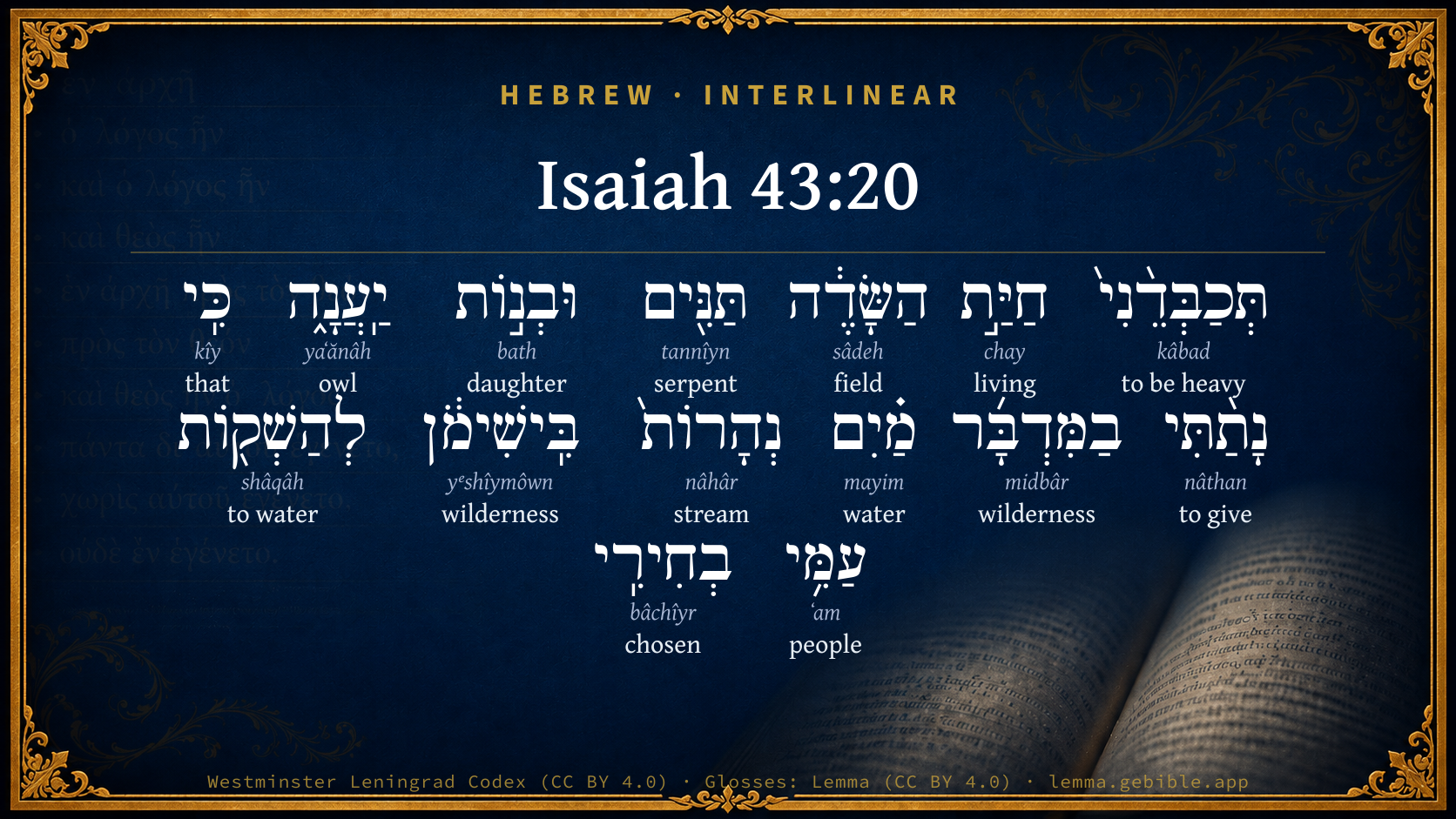
Hebrew (Westminster Leningrad Codex) Isaiah 43:20 appears in the Hebrew Old Testament. The text above is from the Westminster Leningrad Codex. Each word links to its Strong’s number, a concise gloss, and parsing drawn from the Open Scriptures Hebrew Bible morphology. Click any word for its full Brown-Driver-Briggs (BDB) entry.
Download image
Cite this verse

Isaiah 43:20 (World English Bible). Public Domain. Lemma interlinear Bible study tool, https://lemma.gebible.app/v/isaiah/43/20.

Show BibTeX & RIS
BibTeX
RIS
English Translation
The animals of the field shall honor me, the jackals and the ostriches; because I give waters in the wilderness, and rivers in the desert, to give drink to my people, my chosen,
World English Bible · Public Domain
Download a study sheet

One document with this verse’s original text, its word-by-word gloss line, the meaning frame, cross-references with their text, attributed commentary, and full source and license credits — printable, and it pastes into notes with its structure intact.

This verse Autodidact and up

Study sheet (.html) Plain text (.txt)

A passage Seminary Student

Up to 50 verses in one chapter. A passage sheet keeps up to 6 commentary sources and 12 cross-references per verse, in the order this page ranks them, and says so on the sheet whenever that leaves anything out. Ask for a single verse and you get the Autodidact verse sheet above.

Everything on this page stays free to read, with no account — the sheet is a download of what is already on screen, not access to it.

Want to remove ads? Support Godless Engineer
Compare translations 3

The same verse in 3 English versions, stacked beneath the original-language interlinear above. Click any original word for its lexicon entry.

Each is an independent rendering of the whole verse — the interlinear is not word-aligned to these translations.

Highlighted words mark where these versions differ — a whole-verse word diff, not a word-by-word alignment.

  • World English Bible Public Domain
    The animals of the field shall honor me, the jackals and the ostriches; because I give waters in the wilderness, and rivers in the desert, to give drink to my people, my chosen,
  • King James Version Public Domain
    The beast of the field shall honour me, the dragons and the owls: because I give waters in the wilderness, and rivers in the desert, to give drink to my people, my chosen.
  • unfoldingWord Literal Text CC BY-SA 4.0
    The beasts of the field will honor me, the jackals and the daughters of the ostrich, because I will give waters in the wilderness, rivers in the wasteland, for my people, my chosen, to drink.

unfoldingWord Literal Text — © unfoldingWord, licensed CC BY-SA 4.0. Word-aligned USFM3 via Door43 (git.door43.org/unfoldingWord/en_ult).

Versions to compare (up to 4)

3 of 4 selected

Show all 18 translations

Every available English version of this verse, each an independent rendering of the whole verse.

  • World English Bible Public Domain
    The animals of the field shall honor me, the jackals and the ostriches; because I give waters in the wilderness, and rivers in the desert, to give drink to my people, my chosen,
  • Berean Standard Bible Public Domain
    The beasts of the field will honor Me, the jackals and the ostriches, because I provide water in the wilderness and rivers in the desert, to give drink to My chosen people.
  • Majority Standard Bible Public Domain
    The beasts of the field will honor Me, the jackals and the ostriches, because I provide water in the wilderness and rivers in the desert, to give drink to My chosen people.
  • King James Version Public Domain
    The beast of the field shall honour me, the dragons and the owls: because I give waters in the wilderness, and rivers in the desert, to give drink to my people, my chosen.
  • American Standard Version (1901) Public Domain
    The beasts of the field shall honor me, the jackals and the ostriches; because I give waters in the wilderness, and rivers in the desert, to give drink to my people, my chosen,
  • Revised Version (1885) Public Domain
    The beasts of the field shall honour me, the jackals and the ostriches: because I give waters in the wilderness, and rivers in the desert, to give drink to my people, my chosen:
  • Geneva Bible (1599) Public Domain
    The wilde beastes shall honour mee, the dragons and the ostriches, because I gaue water in the desert, and floods in the wildernesse to giue drinke to my people, euen to mine elect.
  • Douay-Rheims (1899) Public Domain
    The beast of the field shall glorify me, the dragons and the ostriches: because I have given waters in the wilderness, rivers in the desert, to give drink to my people, to my chosen.
  • Young's Literal Translation Public Domain
    Honour me doth the beast of the field, Dragons and daughters of an ostrich, For I have given in a wilderness waters, Floods in a desolate place, To give drink to My people -- My chosen.
  • Literal Standard Version CC BY-SA 4.0
    The beast of the field honors Me, || Dragons and daughters of an ostrich, || For I have given waters in a wilderness, || Floods in a desolate place, || To give drink to My people—My chosen.
  • Unlocked Literal Bible CC BY-SA 4.0
    The wild animals of the field will honor me, the jackals and the ostriches, because I give water in the wilderness, and rivers in the desert, for my chosen people to drink,
  • unfoldingWord Literal Text CC BY-SA 4.0
    The beasts of the field will honor me, the jackals and the daughters of the ostrich, because I will give waters in the wilderness, rivers in the wasteland, for my people, my chosen, to drink.
  • Darby Bible Public Domain
    The beast of the field shall glorify me, the jackals and the ostriches; for I will give waters in the wilderness, rivers in the waste, to give drink to my people, my chosen.
  • World Messianic Bible Public Domain
    The animals of the field, the jackals and the ostriches, shall honor me, because I give water in the wilderness and rivers in the desert, to give drink to my people, my chosen,
  • Webster's Bible Public Domain
    The beast of the field shall honor me, the dragons and the owls: because I give waters in the wilderness, and rivers in the desert, to give drink to my people, my chosen.
  • Free Bible Version CC BY-SA 4.0
    The wild animals will be grateful to me—the jackals and the owls—because I'm providing water in the wilderness, rivers in the desert, so my people, my chosen people, can drink.
  • Bible in Basic English Public Domain
    The beasts of the field will give me honour, the jackals and the ostriches: because I send out waters in the waste land, and rivers in the dry country, to give drink to the people whom I have taken for myself:
  • JPS Tanakh (1917) Public Domain
    The beasts of the field shall honour Me, the jackals and the ostriches; because I give waters in the wilderness, and rivers in the desert, to give drink to My people, Mine elect;

Literal Standard Version (2020), Covenant Press — licensed CC BY-SA 4.0. Text via the HelloAO Bible API (eBible.org). Unlocked Literal Bible (unfoldingWord) — licensed CC BY-SA 4.0. Text via the HelloAO Bible API (eBible.org). unfoldingWord Literal Text — © unfoldingWord, licensed CC BY-SA 4.0. Word-aligned USFM3 via Door43 (git.door43.org/unfoldingWord/en_ult). Free Bible Version, Dr. Jonathan Gallagher — licensed CC BY-SA 4.0. Text via the HelloAO Bible API (eBible.org).

Word by word

More ways to search: Search by grammar → Find every occurrence → Compare this word →

Practice this passage: Drill this verse → Learn its vocabulary →

יַֽעֲנָ֑ה
yaʻănâh
H3284
“owl”
Noun, Common, Feminine, Singular, Absolute
Part of Speech
Noun
Type
Common
Gender
Feminine
Number
Singular
State
Absolute
Full BDB Definition

Origin: from H3283

TWOT: 884b

an unclean bird - owl, ostrich, literally translated as " daughters of the owl" - perhaps an extinct bird, exact meaning unknown
  1. תְּכַבְּדֵ֨נִי֙ kâbad H3513 “to be heavy · me” Verb, Piel, Imperfect, 3rd Person, Feminine, Singular + Suffix, Personal, 1st Person, Common, Singular
  2. חַיַּ֣ת chay H2416 “living of” Noun, Common, Feminine, Singular, Construct
  3. הַשָּׂדֶ֔ה sâdeh H7704 “the · field” Particle, Definite Article + Noun, Common, Masculine, Singular, Absolute
  4. תַּנִּ֖ים tannîyn H8577 “serpents” Noun, Common, Masculine, Plural, Absolute
  5. וּבְנ֣וֹת bath H1323 “and · daughters of” Conjunction + Noun, Common, Feminine, Plural, Construct
  6. כִּֽי kîy H3588 “that” Conjunction
  7. נָתַ֨תִּי nâthan H5414 “to give” Verb, Qal, Perfect, 1st Person, Common, Singular
  8. בַמִּדְבָּ֜ר midbâr H4057 “in/at the · wilderness” Preposition, Determined + Noun, Common, Masculine, Singular, Absolute
  9. מַ֗יִם mayim H4325 “water(s)” Noun, Common, Masculine, Plural, Absolute
  10. נְהָרוֹת֙ nâhâr H5104 “streams” Noun, Common, Masculine, Plural, Absolute
  11. בִּֽישִׁימֹ֔ן yᵉshîymôwn H3452 “in/at · wilderness” Preposition + Noun, Common, Masculine, Singular, Absolute
  12. לְהַשְׁק֖וֹת shâqâh H8248 “to water” Preposition + Verb, Hiphil, Infinitive Construct
  13. עַמִּ֥י ʻam H5971 “people · my” Noun, Common, Masculine, Singular, Construct + Suffix, Personal, 1st Person, Common, Singular
  14. בְחִירִֽי bâchîyr H972 “chosen · my” Adjective, Adjective, Masculine, Singular, Construct + Suffix, Personal, 1st Person, Common, Singular

About this verse

These counts appear in no published source. They are computed here, from the morphology-tagged text and Lemma’s own curated glosses. What Lemma adds →

15
words
15
distinct lemmas
Prophets
section

Notable vocabulary

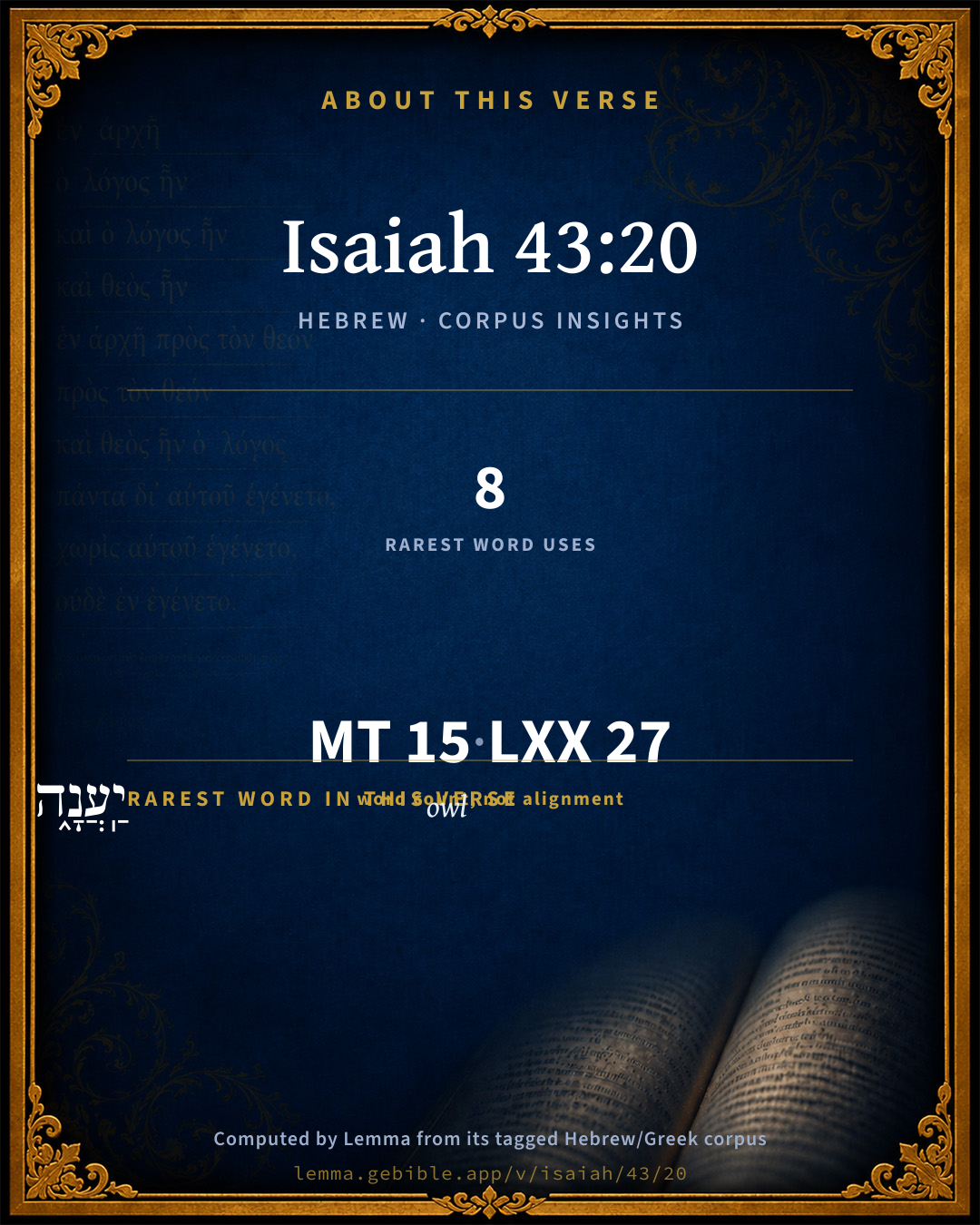
The rarest word here is יַֽעֲנָ֑ה owl H3284 — appearing just 8 times in the whole Hebrew Bible.

Shared distinctive vocabulary

יַֽעֲנָ֑ה owl H3284 occurs in 8 verses of the Hebrew Bible. Also found in:

Grammatical profile

  • 3 verbs
  • 10 nouns
  • 1 adjective
  • 1 conjunction

Verb forms

  • תְּכַבְּדֵ֨נִי֙ Piel · Imperfect
  • נָתַ֨תִּי Qal · Perfect
  • לְהַשְׁק֖וֹת Hiphil · Infinitive Construct

Hebrew & Septuagint length

In English translation the verse runs 33 words from the Hebrew and 34 from the Septuagint (LXX English) — closely comparable.

A rough comparison of the two English renderings, which tokenize alike — not a word-level alignment.

Word counts can differ between the Hebrew and the Greek without any difference in meaning — e.g. the Hebrew direct-object marker אֵת has no separate Greek word, and Greek often adds the article ὁ.

In the original languages it is 15 Hebrew tokens and 27 Greek tokens — but the two are counted differently (Hebrew bundles its prefixes and suffixes into one token; the Greek is in lemma form), so that isn’t a like-for-like length.

Cross-references

22

Topical passages linked to Isaiah 43:20 in the Treasury of Scripture Knowledge — connected by theme and wording, ordered by reader-vote popularity; previews shown in the World English Bible.

  • Isaiah 41:17 The poor and needy seek water, and there is none, and their tongue fails for thirst; I, Yahweh, will answer them, I, the God of Israel, will not forsake them.
  • Isaiah 48:21 They didn't thirst when he led them through the deserts; he caused the waters to flow out of the rock for them; he split the rock also, and the waters gushed out.
  • Isaiah 49:10 They shall not hunger nor thirst; neither shall the heat nor sun strike them: for he who has mercy on them will lead them, even by springs of water will he guide them.
  • Isaiah 13:22 Wolves shall cry in their castles, and jackals in the pleasant palaces: and her time is near to come, and her days shall not be prolonged.
  • John 4:14 but whoever drinks of the water that I will give him will never thirst again; but the water that I will give him will become in him a well of water springing up to eternal life."
  • 1 Peter 2:9 But you are a chosen race, a royal priesthood, a holy nation, a people for God's own possession, that you may show forth the excellencies of him who called you out of darkness into his marvelous light:
  • Revelation 17:14 These will war against the Lamb, and the Lamb will overcome them, for he is Lord of lords, and King of kings. They also will overcome who are with him, called and chosen and faithful."
  • 1 Chronicles 16:13 You seed of Israel his servant, You children of Jacob, his chosen ones.
  • Psalms 33:12 Blessed is the nation whose God is Yahweh, The people whom he has chosen for his own inheritance.
  • Psalms 104:21 The young lions roar after their prey, And seek their food from God.
  • Psalms 148:10 Wild animals and all cattle; Small creatures and flying birds;
  • Isaiah 11:6–10 The wolf shall dwell with the lamb, and the leopard shall lie down with the kid; and the calf and the young lion and the fattened calf together; and a little child shall lead them.
  • Isaiah 43:19 Behold, I will do a new thing; now shall it spring forth; shall you not know it? I will even make a way in the wilderness, and rivers in the desert.
  • Isaiah 55:1–2 Ho, everyone who thirsts, come you to the waters, and he who has no money; come you, buy, and eat; yes, come, buy wine and milk without money and without price.
  • Isaiah 65:15 You shall leave your name for a curse to my chosen; and the Lord Yahweh will kill you; and he will call his servants by another name:
  • Jeremiah 31:9 They shall come with weeping; and with petitions will I lead them: I will cause them to walk by rivers of waters, in a straight way in which they shall not stumble; for I am a father to Israel, and Ephraim is my firstborn.
  • Joel 3:18 It will happen in that day, That the mountains will drop down sweet wine, The hills will flow with milk, All the brooks of Judah will flow with waters; And a fountain will come forth from the house of Yahweh, And will water the valley of Shittim.
  • Mark 13:20 Unless the Lord had shortened the days, no flesh would have been saved; but for the sake of the chosen ones, whom he picked out, he shortened the days.
  • John 4:10 Jesus answered her, "If you knew the gift of God, and who it is who says to you, 'Give me a drink,' you would have asked him, and he would have given you living water."
  • John 7:37–39 Now on the last and greatest day of the feast, Jesus stood and cried out, "If anyone is thirsty, let him come to me and drink!
  • Revelation 21:6 He said to me, "It is done! I am the Alpha and the Omega, the Beginning and the End. I will give freely to him who is thirsty from the spring of the water of life.
  • Revelation 22:17 The Spirit and the bride say, "Come!" He who hears, let him say, "Come!" He who is thirsty, let him come. He who desires, let him take the water of life freely.

Cross-references courtesy of OpenBible.info (CC BY 4.0).

Hebrew and Greek witnesses Masoretic Hebrew ↔ Greek Septuagint

The same verse in the two great witnesses to the Old Testament, shown verse-for-verse.

These are two independent witnesses, not word-aligned to each other, and the Septuagint is shown in lemma (dictionary) form.

Hebrew Isaiah 43:20 Masoretic · Westminster Leningrad Codex

תְּכַבְּדֵ֨נִי֙ חַיַּ֣ת הַשָּׂדֶ֔ה תַּנִּ֖ים וּבְנ֣וֹת יַֽעֲנָ֑ה כִּֽי נָתַ֨תִּי בַמִּדְבָּ֜ר מַ֗יִם נְהָרוֹת֙ בִּֽישִׁימֹ֔ן לְהַשְׁק֖וֹת עַמִּ֥י בְחִירִֽי

The animals of the field shall honor me, the jackals and the ostriches; because I give waters in the wilderness, and rivers in the desert, to give drink to my people, my chosen,

World English Bible · Public Domain

Greek LXX Isaiah 43:20 Septuagint · lemma form

εὐλογέω ἐγώ ὁ θηρίον ὁ ἀγρός σειρήν καί θυγάτηρ στρουθός ὅτι δίδωμι ἐν ὁ ἔρημος ὕδωρ καί ποταμός ἐν ὁ ἄνυδρος ποτίζω ὁ γένος ἐγώ ὁ ἐκλεκτός

the beasts of the field shall bless me, the owls and young ostriches; for I have given water in the wilderness, and rivers in the dry land, to give drink to my chosen race,

LXX2012 (modern English Septuagint) · Public Domain

On this verse, Albert Barnes' Notes on the Bible discusses the Septuagint’s reading. Read the note in Commentary ↓

Hebrew: Westminster Leningrad Codex (CC BY 4.0). Greek: Septuagint (public domain); English from LXX2012 (modern English Septuagint) (Public Domain). How the Septuagint differs from the Hebrew →

Targum (Aramaic paraphrase)

1

The Targum is the ancient Jewish Aramaic paraphrase of the Hebrew Scriptures — an interpretive translation, not the Hebrew text itself. Onkelos (literal) and Pseudo-Jonathan (expansive) render the Torah, and Jonathan the Prophets. Coverage is partial: where no permissively-licensed English translation exists for a verse, only the Aramaic is shown. This is verse-level text, not a word-by-word alignment to the Hebrew.

  1. Targum Jonathan Prophets (Joshua–Malachi)
    יְיַקְרוּן קֳדָמַי כַּד אַיְתֵב מְדִינָן דְצַדְיָן אֲתַר דַהֲוָאָה שָׁרְיָן יְרוּדִין וּבְנָת נַעֲמִין אֲרֵי יְהָבִית בְּמַדְבְּרָא מַיָא נַהֲרִין בְּצַדְיוּתָא לְאַשְׁקָאָה גַלְוַת עַמִי דְאִתְרְעֵיתִי בָהּ:

    They shall honour me, when I make habitable provinces at the desert, and the places where the dragons and the daughters of the ostrich dwell; because I will give water in the wilderness, rivers in the desert, to give drink to the captives of my people, in whom I delight.

    Targum Jonathan — Aramaic: “Mikraot Gedolot” (public domain). English: “Sefaria Community Translation” (CC0 1.0 (public-domain dedication)); “London "Chaldee Paraphrase," 1871” (public domain). Text via Sefaria.

Commentary

Notes on Isaiah 43:20 from classic Christian and Jewish commentators (each source and its license shown beneath its notes). The classic Christian expositions comment on the surrounding passage and are grouped to its opening verse, so a note may address several verses; the Jewish commentaries on the Tanakh (Rashi and others) are per-verse, so they appear only where the commentator wrote on this verse.

Lemma curates 59 commentaries, every one of them public domain or Creative Commons licensed, each selected and text-cleaned for this edition rather than reprinted as found. About our sources →

Trapp's Complete Commentary

John Trapp

Isa 43:20 The beast of the field shall honour me, the dragons and the owls: because I give waters in the wilderness, [and] rivers in the desert, to give drink to my people, my chosen.

Ver. 20. The beasts of the field shall honour me,] i.e., In their kind they shall. So shall brutish and savage persons when tamed and turned by the word of God’s grace. The malignities of all creatures are in man; as Plato {a} also observed, In doloso enim est vulpes, in crudeli leo, in libidinoso amica lute sus, &c. Gregory, {b} by dragons, here understands profane and carnal people; by owls or ostriches, hypocrites. These being converted shall sing hallelujahs to God; but let them take heed that they turn not, with the dog, to their own vomit again, &c. {2Pe 2:22} For,

{a} De Rep., lib. iii.

{b} Mor., lib. xxxi. cap. 5.

John Trapp, A Commentary or Exposition upon All the Books of the Old and New Testament (1647–1656) — public domain. Text from a community e-Sword module.

The Biblical Illustrator

Joseph S. Exell

Isa_43:20

The beast of the field shall honour Me

Hope respecting the profanest persons

I have sometimes laid hold of this text, and have been comforted by it concerning the conversion of the very worst of men.

Some people say, What is the good of going among blasphemers and profane persons with the Word of God? Well, if the beast of the field, and the dragons, and the owls shall honour Him, we need never think of leaving any of the sons of men to perish. It is not what they are, but what God is, that should give us confidence concerning them. (C. H.Spurgeon.)

The Biblical Illustrator, edited by Joseph S. Exell (c. 1880s–1900s) — public domain. Text from a community e-Sword module.

Joseph Benson's Commentary

Isa 43:20. The beast of the field shall honour me — Shall have cause, if they had abilities, to honour and praise me for their share in this mercy; the dragons, &c. — Which live in dry and barren deserts. “The image,” says Bishop Lowth, “is elegant and highly poetical. God will give such an abundant, miraculous supply of water to his people traversing the dry desert, in their return to their country, that even the wild beasts, the serpents, the ostriches, and other animals that haunt those adust regions, shall be sensible of the blessing, and shall break forth into thanksgiving and praises to him for the unusual refreshment which they receive from his so plentifully watering the sandy wastes of Arabia Deserta, for the benefit of his people passing through them.”

Joseph Benson's Commentary on the Old and New Testaments (1811–1818) — public domain. Text from a community e-Sword module.

Geneva Bible (1599)

Geneva Bible translators

They shall have such abundance of all things as they return home, even in the dry and barren places, that the very beasts shall feel my benefits, and shall acknowledge them: much more men ought to be thankful for the same.

Geneva Bible (1599) marginal notes — public domain. Text via Bolls.life.

Jamieson, Fausset & Brown

Robert Jamieson, A. R. Fausset & David Brown

beast--image of idolaters, defiled with blood and pollutions, dwelling like dragons, &c., in the wastes of Gentile ignorance: even they shall be converted. Or else, literally, such copious floods of water shall be given by God in the desert, that the very beasts shall (in poetic language) praise the Lord (Psa 148:10) [JEROME].

dragons--"serpents," or else jackals (see on Isa 13:22).

owls--rather, "ostriches."

Jamieson, Fausset & Brown — Commentary Critical and Explanatory on the Whole Bible (1871) — public domain (CC PDM 1.0). Text via the HelloAO Bible API.

Adam Clarke's Commentary

Verse 20. The beast of the field shall honour me - "The wild beast of the field shall glorify me"] The image is elegant and highly poetical. God will give such an abundant miraculous supply of water to his people traversing the dry desert in their return to their country, that even the wild beasts, the serpents, the ostriches, and other animals that haunt those arid regions, shall be sensible of the blessing, and shall break forth into thanksgiving and praises to him for the unusual refreshment which they receive from his so plentifully watering the sandy wastes of Arabia Deserta, for the benefit of his people passing through them.

Adam Clarke's Commentary on the Bible (1810–1826) — public domain. Text from a community e-Sword/MySword module.

The Cambridge Bible for Schools and Colleges

gen. ed. J. J. S. Perowne

20. Even the wild beasts shall honour Jehovah, unconsciously, through their joy at the abundant supply of water.

the dragons and the owls] Render as R.V. the jackals and the ostriches. see on ch. Isa_13:21-22.

The Cambridge Bible for Schools and Colleges (gen. ed. J. J. S. Perowne; Cambridge University Press, 1878–1918) — public domain. Text from a community e-Sword module.

John Gill's Exposition

This people have I formed for myself,.... The Gentiles, compared to a desert and wilderness, wild and uncultivated, distinguished from Jacob and Israel in the next verse, and the same with the chosen people before mentioned; who being chosen of God, and redeemed by Christ, are formed anew by the Spirit of Christ, made new creatures, regenerated, and transformed by the renewing of their minds, and conformed to the image of Christ, and having him formed in their souls, and principles of grace and holiness wrought in them; in consequence of which they reformed in their lives and conversation, and were also formed into a Gospel church state, and all this done by the Lord for himself, his service, and his glory. The Targum is,

"this people have I prepared for my worship:''

they shall show forth my praise; with their lips, by ascribing their formation to the power and grace of God, and even their whole salvation to it, and express their thankfulness for the same; and likewise by their actions, by a subjection to the ordinances of the Gospel, and by their lives and conversations being agreeably to it. Joseph Kimchi, as Abendana observes, interprets this people of the beasts of the field, spoken of in the preceding verse, that should honour the Lord, and here said to be formed for himself, and should show forth his praise; and which is taken notice of to aggravate the sins of the people of the Jews, who called not on the Lord, &c. as in the following verses; so the ants and conies are called a people not strong, and the locusts a people great and strong, Pro 30:25.

John Gill's Exposition of the Whole Bible (1746–1763) — public domain (CC PDM 1.0). Text via the HelloAO Bible API.

Albert Barnes' Notes on the Bible

The beast of the field shall honor me - The sense of this passage is plain, and the image is highly poetical and beautiful. God would pour such copious floods of waters through the waste sandy deserts to supply his people, that even the wild beasts would be sensible of his abundant goodness, and would break forth into thanksgiving and praise for the unusual supply.

The dragons - (See the note at Isa 13:22). The Septuagint renders the word used here (תנין tannı̂yn), by σειρῆνες seirēnes - ’sirens’ - among the ancients a marine monster that was fabled to use sweet and alluring tones of music. It is probable, however, that the Septuagint understood here some species of wild-fowl which responded to one another. The Syriac translator here interprets it as denoting some wild animal of the canine species - a wood-dog.

And the owls - Margin, as Hebrew, ‘Daughters of the owl, or ostrich’ (see the note at Isa 13:21).

Albert Barnes' Notes on the Bible (1834–1885) — public domain. Text from a community e-Sword/MySword module.

Haydock's Catholic Bible Commentary

Chosen. We know not that rivers were found in Arabia. But the people were equally favoured. Christ facilitates the road to heaven by his example and graces, while the most savage tempers are changed in baptism.

George Leo Haydock (1774–1849), Haydock's Catholic Family Bible and Commentary, 1859 edition — public domain. Excludes Psalms (Douay-Rheims chapter numbering differs from Protestant) and Deuterocanonical books (Catholic canon only).

Matthew Poole's English Annotations

The beast of the field shall honour me; shall have cause, if they had abilities, to honour and praise me for their share in this mercy. Possibly the beast of the field may mystically signify the Gentiles, whom the Jews reputed as beasts, and who were as destitute of all saving knowledge as the beasts which perish, yet should become the Lord’s people, as they seem to be called, Isa 43:21. The dragons; which live in dry and barren deserts, and are very thirsty, and therefore more sensible of this mercy.

To give drink to my people; to whom these waters were principally designed, but the beasts fared better for their sakes. Thus Christ was primarily sent to the lost sheep of Israel, Mat 15:24; yet the Gentiles, there compared to dogs, fared better for the children, picking up some crumbs of their bread; and the Jews generally rejecting Christ, the Gentiles came in their stead.

Matthew Poole's English Annotations on the Holy Bible (1683–1685) — public domain. Text from a community e-Sword/MySword module.

The Pulpit Commentary

The beast of the field shall honour me. The animal creation shall, participate in the benefits of the "new thing" introduced by the restoration of Israel, and in their dumb way shall show their gratitude. The dragons and the owls. The recent mention of the desert causes animals of the desert (Isa_13:21, Isa_13:22) to be taken as examples. (On the animals intended, see the comment on Isa_34:13) If even the beasts of the desert honoured God, much more would the rest of the animal creation. (Isa_11:6-8)

The Pulpit Commentary (1880–1919), ed. H.D.M. Spence-Jones & Joseph S. Exell — public domain. Text from a community e-Sword module.

John Wesley's Explanatory Notes

The beast - Shall have cause, if they had abilities, to praise me for their share in this mercy. Dragons - Which live in dry and barren deserts.

John Wesley, Explanatory Notes Upon the Whole Bible (1754–1765) — public domain. Text via the GEBible commentary corpus.

J. A. Alexander on Isaiah

Joseph Addison Alexander

“The living creature of the field shall honor me, jackals (or wolves) and ostriches; because I have given in the wilderness waters, and streams in the desert, to give drink to my people, my chosen.” The change is farther described by representing the irrational inmates of the desert as rejoicing in its irrigation. This bold conception makes it still more probable that what precedes does not relate to a literal journey through a literal desert. As the first phrase seems to be a general one, including the two species afterwards mentioned, the translation beast is too restricted, and should give way to that which is etymologically most exact, viz. top animal, or living creature. The form is singular, the sense collective. The two species represent the whole class of animals inhabiting the wilderness. (compare Isa 13:21-22). The common version of the last words of this verse is an exact one. My chosen people would be otherwise expressed. To the simple designation of my people, he adds, by a kind of afterthought, my chosen or elect.

Joseph Addison Alexander, The Prophecies of Isaiah (1846–1847; New York: Scribner, 1870–1878) — public domain. Text from a community e-Sword module.

unfoldingWord translationNotes

Door43 World Missions Community

wild animals of the field will honor me, the jackals and the ostriches

Here animals honor Yahweh as if they were people. (See: Personification)

the jackals and the ostriches

These are examples of the kinds of animals that will honor Yahweh. See how you translated the names of these animals in Isaiah 13:21-22. The understood information can be supplied to make the meaning clear. AT: "the jackals and the ostriches will honor me" (See: Ellipsis)

translationWords

honor

desert

chosen one

praise

unfoldingWord translationNotes — © Distant Shores Media and the Door43 World Missions Community, licensed CC BY-SA 4.0. Source: git.door43.org/Door43/en_tn.

Rashi

Rabbi Shlomo Yitzchaki (Rashi)

The beasts of the field shall honor Me The place that is desolate and a habitat of the beasts of the field, for the jackals and for the ostriches.

for I gave water in the desert i.e., in a desolate land I will place a settlement.

Rashi on the Tanakh — English translations: “The Judaica Press complete Tanach with Rashi, translated by A. J. Rosenberg” (CC BY 4.0); “Pentateuch with Rashi's commentary by M. Rosenbaum and A.M. Silbermann, 1929-1934” (public domain); “The Metsudah Tanach series, Lakewood, N.J” (CC BY 4.0); and “The Book of Joshua, Metsudah Publications, 1997” (CC BY 4.0). Text via Sefaria.

Ibn Ezra

Rabbi Abraham ibn Ezra

The beast of the field shall honour me, for the good which I am doing for it. The dragons are mentioned, because they live in the wilderness. To give drink to my people. I shall do this unto the beasts for the sake of my people.

Ibn Ezra on the Tanakh — English translations: “Sefaria Community Translation” (CC0 1.0 (public-domain dedication)); “Yalkut, Sifsei Chachomim Chumash, Metsudah Publications, 2009” (CC BY 4.0); and “Commentary of Ibn Ezra on Isaiah - trans. by M. Friedlander, 1873” (public domain). Text via Sefaria.

Lesson kit

Teaching starters — assembled from the data on this page, not authored interpretation. Every prompt links to the verse data it draws on. Edit before teaching.

Isaiah, in the Prophets, opens this verse with 15 words (15 distinct Hebrew lemmas). Its most distinctive word is yaʻănâh (“owl”). A historical commentator’s framing appears above. Read the whole chapter for the surrounding context.

Discussion questions

  1. How does “owl” (yaʻănâh) shape what this verse is saying?
  2. Leviticus 11:16 shares the word «owl» with this verse. How do the two illuminate each other?
  3. These translations render this verse differently. What is at stake in choosing one wording over another?
  4. The verb «תְּכַבְּדֵ֨נִי֙» is Piel Imperfect. How does its form color the action?
  5. Reading how Trapp's Complete Commentary and The Biblical Illustrator read this verse, where do the two commentators agree and where do they part?

Things to notice

Reading settings

Reading text

Shown beneath each verse's original-language words.

Old Testament
Old Testament edition

Read the OT as the Masoretic Hebrew (MT) or the Greek Septuagint (LXX).

English shown for the Greek Septuagint (in the Hebrew ↔ Greek comparison).

Comparing translations? Open the Compare panel on any verse page to stack up to four side by side.