Exodus 19:2

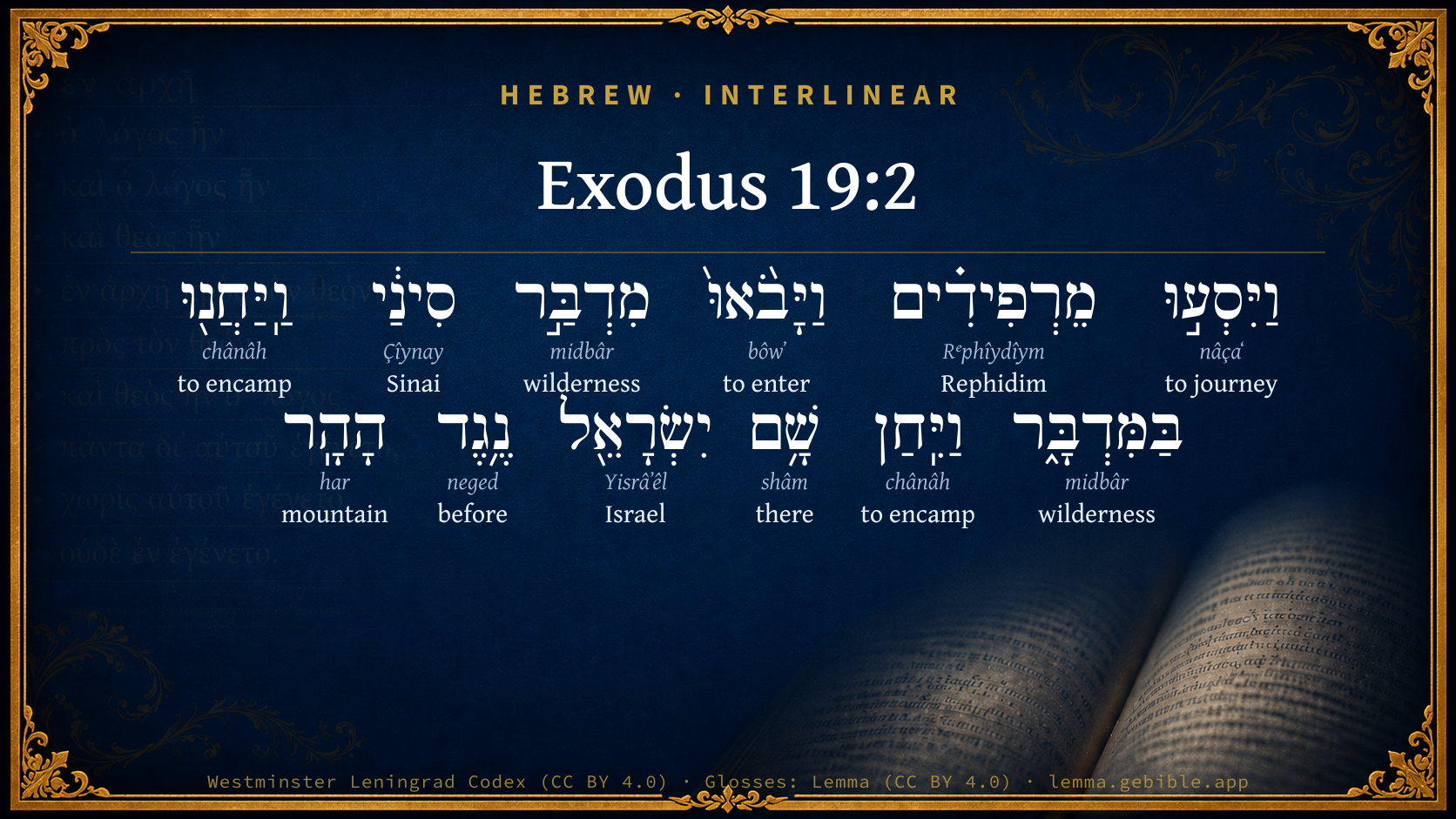
Hebrew (Westminster Leningrad Codex) Exodus 19:2 appears in the Hebrew Old Testament. The text above is from the Westminster Leningrad Codex. Each word links to its Strong’s number, a concise gloss, and parsing drawn from the Open Scriptures Hebrew Bible morphology. Click any word for its full Brown-Driver-Briggs (BDB) entry.
Download image
Cite this verse

Exodus 19:2 (World English Bible). Public Domain. Lemma interlinear Bible study tool, https://lemma.gebible.app/v/exodus/19/2.

Show BibTeX & RIS
BibTeX
RIS
English Translation
When they had departed from Rephidim, and had come to the wilderness of Sinai, they encamped in the wilderness; and there Israel encamped before the mountain.
World English Bible · Public Domain
Download a study sheet

One document with this verse’s original text, its word-by-word gloss line, the meaning frame, cross-references with their text, attributed commentary, and full source and license credits — printable, and it pastes into notes with its structure intact.

This verse Autodidact and up

Study sheet (.html) Plain text (.txt)

A passage Seminary Student

Up to 50 verses in one chapter. A passage sheet keeps up to 6 commentary sources and 12 cross-references per verse, in the order this page ranks them, and says so on the sheet whenever that leaves anything out. Ask for a single verse and you get the Autodidact verse sheet above.

Everything on this page stays free to read, with no account — the sheet is a download of what is already on screen, not access to it.

Want to remove ads? Support Godless Engineer
Compare translations 3

The same verse in 3 English versions, stacked beneath the original-language interlinear above. Click any original word for its lexicon entry.

Each is an independent rendering of the whole verse — the interlinear is not word-aligned to these translations.

Highlighted words mark where these versions differ — a whole-verse word diff, not a word-by-word alignment.

  • World English Bible Public Domain
    When they had departed from Rephidim, and had come to the wilderness of Sinai, they encamped in the wilderness; and there Israel encamped before the mountain.
  • King James Version Public Domain
    For they were departed from Rephidim, and were come to the desert of Sinai, and had pitched in the wilderness; and there Israel camped before the mount.
  • unfoldingWord Literal Text CC BY-SA 4.0
    And they departed from Rephidim, and they entered the wilderness of Sinai, and they camped in the wilderness. And Israel camped there in front of the mountain.

unfoldingWord Literal Text — © unfoldingWord, licensed CC BY-SA 4.0. Word-aligned USFM3 via Door43 (git.door43.org/unfoldingWord/en_ult).

Versions to compare (up to 4)

3 of 4 selected

Show all 18 translations

Every available English version of this verse, each an independent rendering of the whole verse.

  • World English Bible Public Domain
    When they had departed from Rephidim, and had come to the wilderness of Sinai, they encamped in the wilderness; and there Israel encamped before the mountain.
  • Berean Standard Bible Public Domain
    After they had set out from Rephidim, they entered the Wilderness of Sinai, and Israel camped there in front of the mountain.
  • Majority Standard Bible Public Domain
    After they had set out from Rephidim, they entered the Wilderness of Sinai, and Israel camped there in front of the mountain.
  • King James Version Public Domain
    For they were departed from Rephidim, and were come to the desert of Sinai, and had pitched in the wilderness; and there Israel camped before the mount.
  • American Standard Version (1901) Public Domain
    And when they were departed from Rephidim, and were come to the wilderness of Sinai, they encamped in the wilderness; and there Israel encamped before the mount.
  • Revised Version (1885) Public Domain
    And when they were departed from Rephidim, and were come to the wilderness of Sinai, they pitched in the wilderness; and there Israel camped before the mount.
  • Geneva Bible (1599) Public Domain
    For they departed from Rephidim, and came to the desart of Sinai, and camped in the wildernesse: euen there Israel camped before the mount.
  • Douay-Rheims (1899) Public Domain
    For departing out of Raphidim, and coming to the desert of Sinai, they camped in the same place, and there Israel pitched their tents over against the mountain.
  • Young's Literal Translation Public Domain
    and they journey from Rephidim, and enter the wilderness of Sinai, and encamp in the wilderness; and Israel encampeth there before the mount.
  • Literal Standard Version CC BY-SA 4.0
    and they journey from Rephidim, and enter the wilderness of Sinai, and encamp in the wilderness; and Israel encamps there before the mountain.
  • Unlocked Literal Bible CC BY-SA 4.0
    After they left Rephidim and came to the wilderness of Sinai, they camped in the wilderness in front of the mountain.
  • unfoldingWord Literal Text CC BY-SA 4.0
    And they departed from Rephidim, and they entered the wilderness of Sinai, and they camped in the wilderness. And Israel camped there in front of the mountain.
  • Darby Bible Public Domain
    they departed from Rephidim, and came [into] the wilderness of Sinai, and encamped in the wilderness; and Israel encamped there before the mountain.
  • World Messianic Bible Public Domain
    When they had departed from Rephidim, and had come to the wilderness of Sinai, they encamped in the wilderness; and there Israel encamped before the mountain.
  • Webster's Bible Public Domain
    For they had departed from Rephidim, and had come to the desert of Sinai, and had pitched in the wilderness; and there Israel encamped before the mount.
  • Free Bible Version CC BY-SA 4.0
    They had set out from Rephidim, and after they entered the Sinai desert they camped there in front of the mountain.
  • Bible in Basic English Public Domain
    And when they had gone away from Rephidim and had come into the waste land of Sinai, they put up their tents in the waste land before the mountain: there Israel put up its tents.
  • JPS Tanakh (1917) Public Domain
    And when they were departed from Rephidim, and were come to the wilderness of Sinai, they encamped in the wilderness; and there Israel encamped before the mount.

Literal Standard Version (2020), Covenant Press — licensed CC BY-SA 4.0. Text via the HelloAO Bible API (eBible.org). Unlocked Literal Bible (unfoldingWord) — licensed CC BY-SA 4.0. Text via the HelloAO Bible API (eBible.org). unfoldingWord Literal Text — © unfoldingWord, licensed CC BY-SA 4.0. Word-aligned USFM3 via Door43 (git.door43.org/unfoldingWord/en_ult). Free Bible Version, Dr. Jonathan Gallagher — licensed CC BY-SA 4.0. Text via the HelloAO Bible API (eBible.org).

Word by word

More ways to search: Search by grammar → Find every occurrence → Compare this word →

Practice this passage: Drill this verse → Learn its vocabulary →

מֵרְפִידִ֗ים
Rᵉphîydîym
H7508
“from · Rephidim”
Preposition + Noun, Proper
Part of Speech
Preposition + Noun
Type
Proper
Full BDB Definition

Origin: from the same as H7507

TWOT: None

Rephidim = "rests" or " stays" or " resting places" - a station of Israel in the wilderness between Egypt and Sinai
  1. וַיִּסְע֣וּ nâçaʻ H5265 “and · to journey” Conjunction + Verb, Qal, Sequential Imperfect, 3rd Person, Masculine, Plural
  2. וַיָּבֹ֨אוּ֙ bôwʼ H935 “and · to enter” Conjunction + Verb, Qal, Sequential Imperfect, 3rd Person, Masculine, Plural
  3. מִדְבַּ֣ר midbâr H4057 “wilderness of” Noun, Common, Masculine, Singular, Construct
  4. סִינַ֔י Çîynay H5514 “Sinai” Noun, Proper
  5. וַֽיַּחֲנ֖וּ chânâh H2583 “and · to encamp” Conjunction + Verb, Qal, Sequential Imperfect, 3rd Person, Masculine, Plural
  6. בַּמִּדְבָּ֑ר midbâr H4057 “in/at the · wilderness” Preposition, Determined + Noun, Common, Masculine, Singular, Absolute
  7. וַיִּֽחַן chânâh H2583 “and · to encamp” Conjunction + Verb, Qal, Sequential Imperfect, 3rd Person, Masculine, Singular
  8. שָׁ֥ם shâm H8033 “there” Adverb
  9. יִשְׂרָאֵ֖ל Yisrâʼêl H3478 “Israel” Noun, Proper
  10. נֶ֥גֶד neged H5048 “before” Preposition
  11. הָהָֽר har H2022 “the · mountain” Particle, Definite Article + Noun, Common, Masculine, Singular, Absolute

About this verse

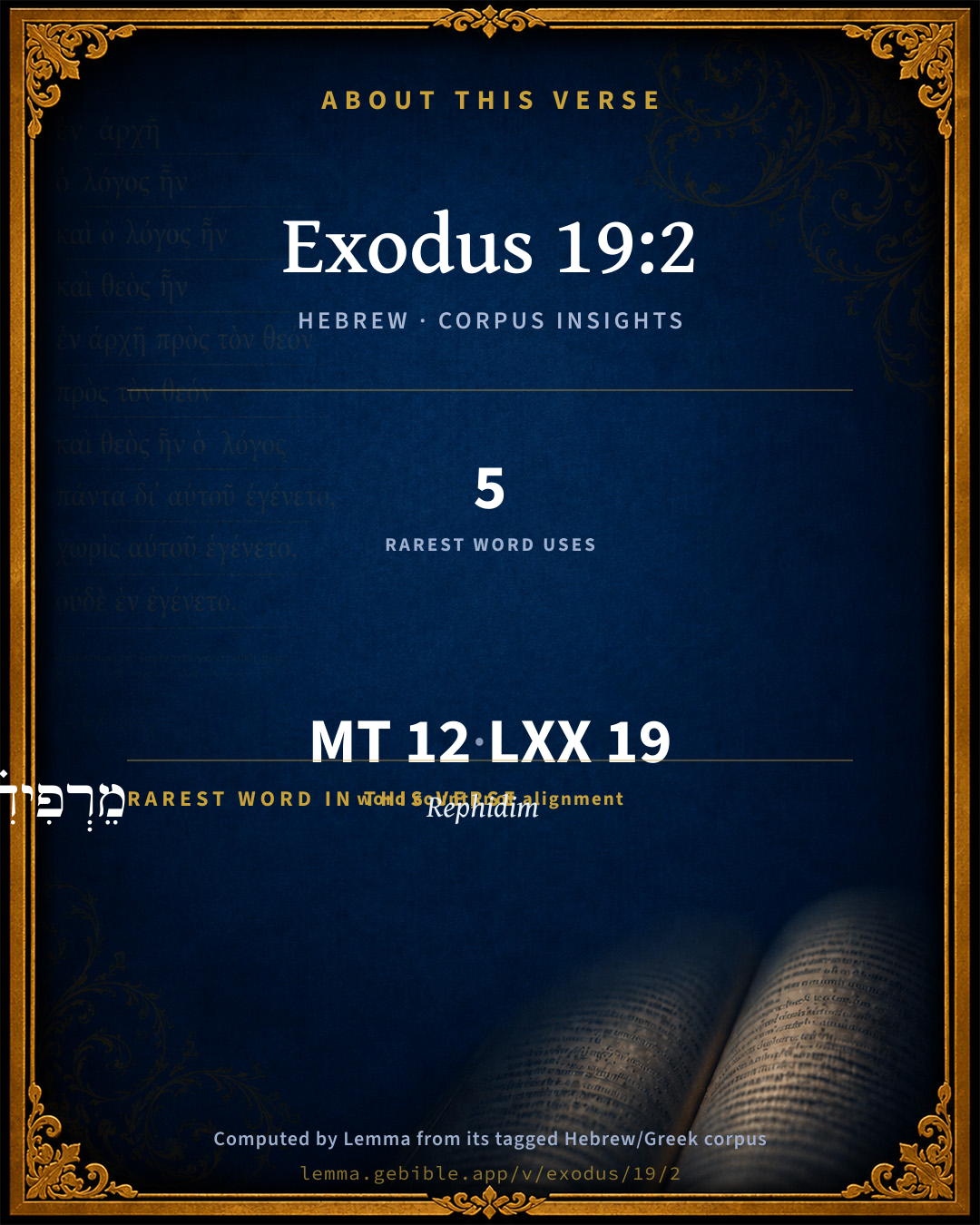
These counts appear in no published source. They are computed here, from the morphology-tagged text and Lemma’s own curated glosses. What Lemma adds →

12
words
10
distinct lemmas
Pentateuch
section

Notable vocabulary

The rarest word here is מֵרְפִידִ֗ים Rephidim H7508 — appearing just 5 times in the whole Hebrew Bible.

Shared distinctive vocabulary

מֵרְפִידִ֗ים Rephidim H7508 occurs in 5 verses of the Hebrew Bible. Also found in:

Grammatical profile

  • 4 verbs
  • 6 nouns
  • 1 preposition
  • 1 adverb

Verb forms

  • וַיִּסְע֣וּ Qal · Sequential Imperfect
  • וַיָּבֹ֨אוּ֙ Qal · Sequential Imperfect
  • וַֽיַּחֲנ֖וּ Qal · Sequential Imperfect
  • וַיִּֽחַן Qal · Sequential Imperfect

Repetition

Words recur within this verse — often emphatic in Hebrew:

  • מִדְבַּ֣ר wilderness H4057 ×2
  • וַֽיַּחֲנ֖וּ to encamp H2583 ×2

Hebrew & Septuagint length

In English translation the verse runs 26 words from the Hebrew and 19 from the Septuagint (LXX English) — closely comparable.

A rough comparison of the two English renderings, which tokenize alike — not a word-level alignment.

Word counts can differ between the Hebrew and the Greek without any difference in meaning — e.g. the Hebrew direct-object marker אֵת has no separate Greek word, and Greek often adds the article ὁ.

In the original languages it is 12 Hebrew tokens and 19 Greek tokens — but the two are counted differently (Hebrew bundles its prefixes and suffixes into one token; the Greek is in lemma form), so that isn’t a like-for-like length.

Cross-references

8

Topical passages linked to Exodus 19:2 in the Treasury of Scripture Knowledge — connected by theme and wording, ordered by reader-vote popularity; previews shown in the World English Bible.

  • Exodus 3:1 Now Moses was keeping the flock of Jethro, his father-in-law, the priest of Midian, and he led the flock to the back of the wilderness, and came to God's mountain, to Horeb.
  • Exodus 17:1 All the congregation of the children of Israel traveled from the wilderness of Sin, by their journeys, according to Yahweh's commandment, and encamped in Rephidim; but there was no water for the people to drink.
  • Exodus 3:12 He said, "Certainly I will be with you. This will be the token to you, that I have sent you: when you have brought forth the people out of Egypt, you shall serve God on this mountain."
  • Exodus 17:8 Then Amalek came and fought with Israel in Rephidim.
  • Exodus 18:5 Jethro, Moses' father-in-law, came with his sons and his wife to Moses into the wilderness where he was encamped, at the Mountain of God.
  • Acts 7:30 "When forty years were fulfilled, an angel of the Lord appeared to him in the wilderness of Mount Sinai, in a flame of fire in a bush.
  • Acts 7:38 This is he who was in the assembly in the wilderness with the angel that spoke to him on Mount Sinai, and with our fathers, who received living oracles to give to us,
  • Galatians 4:24 These things contain an allegory, for these are two covenants. One is from Mount Sinai, bearing children to bondage, which is Hagar.

Cross-references courtesy of OpenBible.info (CC BY 4.0).

Hebrew and Greek witnesses Masoretic Hebrew ↔ Greek Septuagint

The same verse in the two great witnesses to the Old Testament, shown verse-for-verse.

These are two independent witnesses, not word-aligned to each other, and the Septuagint is shown in lemma (dictionary) form.

Hebrew Exodus 19:2 Masoretic · Westminster Leningrad Codex

וַיִּסְע֣וּ מֵרְפִידִ֗ים וַיָּבֹ֨אוּ֙ מִדְבַּ֣ר סִינַ֔י וַֽיַּחֲנ֖וּ בַּמִּדְבָּ֑ר וַיִּֽחַן שָׁ֥ם יִשְׂרָאֵ֖ל נֶ֥גֶד הָהָֽר

When they had departed from Rephidim, and had come to the wilderness of Sinai, they encamped in the wilderness; and there Israel encamped before the mountain.

World English Bible · Public Domain

Greek LXX Exodus 19:2 Septuagint · lemma form

καί ἐκαἴρω ἐκ ραφιδιν καί ἔρχομαι εἰς ὁ ἔρημος ὁ σινα καί παρα ἐνβάλλω ἐκεῖ ἰσραήλ κατέναντι ὁ ὄρος

And they departed from Raphidin, and came into the wilderness of Sina, and there Israel encamped before the mountain.

LXX2012 (modern English Septuagint) · Public Domain

Hebrew: Westminster Leningrad Codex (CC BY 4.0). Greek: Septuagint (public domain); English from LXX2012 (modern English Septuagint) (Public Domain). How the Septuagint differs from the Hebrew →

Targum (Aramaic paraphrase)

2

The Targum is the ancient Jewish Aramaic paraphrase of the Hebrew Scriptures — an interpretive translation, not the Hebrew text itself. Onkelos (literal) and Pseudo-Jonathan (expansive) render the Torah, and Jonathan the Prophets. Coverage is partial: where no permissively-licensed English translation exists for a verse, only the Aramaic is shown. This is verse-level text, not a word-by-word alignment to the Hebrew.

  1. Targum Onkelos Torah (Genesis–Deuteronomy)
    וּנְטָלוּ מֵרְפִידִים וַאֲתוֹ לְמַדְבְּרָא דְסִינָי וּשְׁרוֹ בְּמַדְבְּרָא וּשְׁרָא תַמָן יִשְׂרָאֵל לָקֳבֵל טוּרָא:

    (no public-domain English translation for this verse)

    Targum Onkelos — Aramaic: “Onkelos Genesis” (public domain); “Onkelos Exodus” (public domain); “Onkelos Leviticus” (public domain); “Onkelos Numbers” (public domain); “Onkelos Deuteronomy” (public domain). English: “Sefaria Community Translation” (CC0 1.0 (public-domain dedication)); “J.W. Etheridge. The Targums of Onkelos and Jonathan Ben Uzziel on the Pentateuch. London: Longmans, Green, 1862” (public domain). Text via Sefaria.

  2. Targum Pseudo-Jonathan Torah (Genesis–Deuteronomy)
    וּנְטָלוּ מֵרְפִידִים וְאָתוֹ לְמַדְבְּרָא דְסִינַי וּשְׁרוֹ בְּמַדְבְּרָא וּשְׁרָא תַּמָן יִשְרָאֵל בְּלֵב מְיַיחֵד כָּל קְבֵיל טַוְורָא

    for they had journeyed from Rephidim, and had come to the desert of Sinai and Israel encamped there in the desert, of one heart, nigh to the mountain.

    Targum Pseudo-Jonathan — Aramaic: “Targum Jonathan on Genesis” (public domain); “Targum Jonathan on Exodus” (public domain); “Targum Jonathan on Leviticus” (public domain); “Targum Jonathan on Numbers” (public domain); “Targum Jonathan on Deuteronomy” (public domain). English: “The Targum of Jonathan ben Uzziel, trans. J. W. Etheridge, London, 1862” (public domain). Text via Sefaria.

Commentary

Notes on Exodus 19:2 from classic Christian and Jewish commentators (each source and its license shown beneath its notes). The classic Christian expositions comment on the surrounding passage and are grouped to its opening verse, so a note may address several verses; the Jewish commentaries on the Tanakh (Rashi and others) are per-verse, so they appear only where the commentator wrote on this verse.

Lemma curates 59 commentaries, every one of them public domain or Creative Commons licensed, each selected and text-cleaned for this edition rather than reprinted as found. About our sources →

Trapp's Complete Commentary

John Trapp

Exo 19:2 For they were departed from Rephidim, and were come [to] the desert of Sinai, and had pitched in the wilderness; and there Israel camped before the mount.

Ver. 2. For they were departed.] {See Trapp on "Exo 18:5"}

John Trapp, A Commentary or Exposition upon All the Books of the Old and New Testament (1647–1656) — public domain. Text from a community e-Sword module.

Tyndale Open Study Notes

Tyndale Open Resources

19:2 The arrival at Sinai was a fulfillment of the promise made earlier to Moses at this same spot (3:12).

Tyndale Open Study Notes — © Tyndale Open Resources, licensed CC BY-SA 4.0. Text via the HelloAO Bible API.

Jamieson, Fausset & Brown

Robert Jamieson, A. R. Fausset & David Brown

were come to the desert of Sinai--The desert has its provinces, or divisions, distinguished by a variety of names; and the "desert of Sinai" is that wild and desolate region which occupies the very center of the peninsula, comprising the lofty range to which the mount of God belongs. It is a wilderness of shaggy rocks of porphyry and red granite, and of valleys for the most part bare of verdure.

and there Israel camped before the mount--Sinai, so called from Seneh, or acacia bush. It is now called Jebel Musa. Their way into the interior of the gigantic cluster was by Wady Feiran, which would lead the bulk of the hosts with their flocks and herds into the high valleys of Jebel Musa, with their abundant springs, especially into the great thoroughfare of the desert--the longest, widest, and most continuous of all the valleys, the Wady-es-Sheikh, while many would be scattered among the adjacent valleys; so that thus secluded from the world in a wild and sublime amphitheatre of rocks, they "camped before the mount." "In this valley--a long flat valley--about a quarter of a mile in breadth, winding northwards, Israel would find ample room for their encampment. Of all the wadys in that region, it seems the most suitable for a prolonged sojourn. The 'goodly tents' of Israel could spread themselves without limit" [BONAR].

Jamieson, Fausset & Brown — Commentary Critical and Explanatory on the Whole Bible (1871) — public domain (CC PDM 1.0). Text via the HelloAO Bible API.

Ellicott's Commentary for English Readers

XIX.

THE MANIFESTATION OF GOD TO THE PEOPLE ON MOUNT SINAI.

(2) They were departed from Rephidim.—If Rephidim was where we have placed it, in the Wady Feiran, the march to “the wilderness of Sinai” (Er Rahah) must have been by the Wady Solaf, or the Wady esh Sheikh, or possibly by both. The distance by Wady Solaf is about eighteen, by Wady esh Sheikh about twenty-five miles. The wilderness of Sinai, now generally identified with Er Rahah, is a plain two miles long by half a mile wide, “enclosed between two precipitous mountain ranges of black and yellow granite, and having at its end the prodigious mountain block of Ras Sufsafeh” (Stanley, Sinai and Palestine, p. 74). It is nearly fiat, and covered at present with stunted tamarisk bushes. “No spot in the whole peninsula is so well supplied with water” (Our Work in Palestine, p. 268).

Israel camped before the mount.—On the capacity of the plain Er Rahah to receive the entire multitude, see Stanley (Sinai and Palestine, p. 42), and comp. The comment on Exo_12:37-41. The Ras Sufsafeh is visible from every part of the plain.

A Bible Commentary for English Readers, edited by Charles John Ellicott (1878–1897) — public domain. Text from a community e-Sword module.

The Cambridge Bible for Schools and Colleges

gen. ed. J. J. S. Perowne

2b. camped] The Heb. is the same as ‘pitched,’ just before. Major Palmer’s argument, founded on the supposed difference between the two expressions (Sinai, p. 201, ed. 2, 1906, p. 209), thus falls to the ground.

2. The covenant of Exo_34:10; Exo_34:27-28 (see p. 364 f.), concluded with Israel on the basis of the laws contained in Exo_34:14; Exo_34:17-26.

In E:—1. The covenant of Exo_24:7-8, concluded with Israel on the basis of the ‘Book of the Covenant’ (Exo_20:22 to Exo_23:33). The same covenant is also referred to in Exo_19:5 (compiler of JE).

In Dt.:—1. The covenant with the patriarchs, Exo_4:31, Exo_7:12, Exo_8:18.

2. The covenant concluded with Israel at Horeb on the basis of the Decalogue, Deu_4:13; Deu_4:23; Deu_5:2-3; Deu_7:9; Deu_29:1 b (hence the Deut. expression, ‘the tables, and ark, of the covenant,’ Deu_9:9; Deu_9:11; Deu_9:15, Deu_10:8, Deu_31:9; Deu_31:25-26, Jos_8:33 D[161]: in Num_10:33; Num_14:44 J, ‘the covenant of’ is probably an addition made by one familiar with the Deut. phraseology; cf. often in Joshua 3, 4, Jos_6:6; Jos_6:8). The terms of this covenant are stated in Deu_26:17 f. Dt. is silent as to any covenant made at Horeb, and based on the ‘Book of the Covenant.’

[161] Deuteronomic passages in Josh., Jud., Kings.

2. The covenant made with Abraham and his seed, Gen_17:2; Gen_17:4; Gen_17:7; Gen_17:9-10; with Isaac and his seed, vv. 19, 21; with Abraham, Isaac, and Jacob, Exo_2:24; Exo_6:4 (see the note), 5.

See also (in H) Lev_26:9; Lev_26:15; Lev_26:42; Lev_26:44-45; and (in P) Exo_31:16 (of the sabbath), Lev_2:13; Lev_24:8 (of the shewbread), Num_18:19 (of the priestly dues), Exo_25:12 f. (with Phinehas).

In P, as was remarked on Exo_19:5, God confirms a former covenant by bringing His people out of Egypt, and He gives Israel a body of ceremonial regulations at Sinai; but there is not in P any mention of a covenant made by Him with Israel at Sinai. See further A. B. Davidson’s art. Covenant in DB.

The Cambridge Bible for Schools and Colleges (gen. ed. J. J. S. Perowne; Cambridge University Press, 1878–1918) — public domain. Text from a community e-Sword module.

John Gill's Exposition

For they were departed from Rephidim,.... After they had fought with Amalek, and came to the western part of the mount to Horeb, where the rock was smitten for them; and they were come from that now, and encamped at Sinai, after Jethro had paid a visit to Moses:

and were come to the desert of Sinai, and had pitched in this wilderness; that is, of Sinai, as in the preceding verse:

and there Israel encamped before the mount; Mount Sinai, from whence the desert or wilderness was called. This, as Jarchi says, was on the east side of the mount; Horeb and Sinai were but one and the same mountain, which had two tops. Horeb was on the western side, near to which lay the plain of Rephidim; and Sinai was on the eastern side, on which the wilderness of that name bordered: so that the children of Israel, when they came from Rephidim, came from the western side, and took a circuit about and came to the eastern; which, according to a fore mentioned writer, was eight miles, and was the twelfth station or mansion of the children of Israel. This number twelve is taken notice of by some, as having something singular and peculiar in it; there were the twelve tribes of Israel, and at their twelfth mansion the law was given them; Christ had twelve apostles, and there are twelve foundations of the new Jerusalem, and 12,000 were sealed out of every tribe of Israel.

John Gill's Exposition of the Whole Bible (1746–1763) — public domain (CC PDM 1.0). Text via the HelloAO Bible API.

Matthew Poole's English Annotations

To the desert of Sinai, i.e. to that part of the desert which adjoined to Mount Sinai, as Rephidim, from whence they came, was in that part of the wilderness adjoining to Horeb, which was another part of the same mountain. See Exo 17:6. So they seem to have fetched a large compass, and to have come from one side of the mountain to the other.

Matthew Poole's English Annotations on the Holy Bible (1683–1685) — public domain. Text from a community e-Sword/MySword module.

Whedon's Commentary on the Bible

Daniel D. Whedon

2. For they were departed from Rephidim — Rather, And they departed from Rephidim. This verse is but a fuller statement of what was said in the preceding verse, omitting, however, the mention of time and date. The emphasis is on the fact that there, in the solemn and sublime amphitheatre among the mountains, and before the mount which was to be forever consecrated in the history of the chosen people, Israel camped. The word here rendered pitched and camped is one and the same in Hebrew, (חנה.) In front of the sacred mountain the people now settled down to receive revelations from Him who had declared himself from the burning bush, I AM THAT I AM. Exo_3:14. We need not suppose that the entire body of people who came out of Egypt with Moses actually encamped and remained for a year in this one place. Probably only the heads of the nation, “the elders of the people,” (Exo_19:7,) and the leading families remained permanently in this place of encampment. The rest would naturally be distributed through the various adjacent valleys and plains, wherever the best pasturage for their numerous flocks could be found. According to Exo_34:3, the flocks and herds were not permitted to feed before the mount. It is a carping and unworthy criticism that makes difficulties in the Scripture narrative by assuming as recorded fact things on which the sacred writers are silent. But for incidental allusions, like those of Exo_3:1, and Gen_37:17, no one would have supposed that either Moses or the sons of Jacob went off scores of miles from home to pasture their flocks. We need to keep in mind that such terms as “all Israel,” “all the land,” “all the world,” and even “all the high hills that were under the whole heaven,” (Gen_7:19, where see note, and also on page 123,) need not to be taken in their extreme literal import.

Daniel D. Whedon (gen. ed.), Commentary on the Old and New Testaments (1874–1909) — public domain. Text from a community e-Sword module.

The Pulpit Commentary

They were departed from Rephidim. See the comment on Exo_17:1, and compare Num_33:15. There Israel en-camped before the mountain. The bulk of the tents were no doubt pitched in the plain, Er-Rahah; but this may not have sufficed, and some may have been located in the Wady-ed-Deir, north-east of the Ras Sufsafeh, and others in the Seil-Leja to the west. The Ras Sufsafeh is visible from both these valleys.

The Pulpit Commentary (1880–1919), ed. H.D.M. Spence-Jones & Joseph S. Exell — public domain. Text from a community e-Sword module.

Rashi

Rabbi Shlomo Yitzchaki (Rashi)

ויסעו מרפידים AND THEY JOURNEYED FROM REPHIDIM — What does Scripture teach us by again expressly stating from where they set forth on the journey, for is it not already written (Exodus 17:1) that they had encamped at Rephidim and it is therefore evident that they set forth from there?! But Scripture repeats it in order to make a comparison with the character of their journey from Rephidim to that of their arrival in the wilderness of Sinai! How was it in the case of their arrival in the wilderness of Sinai? They were in a state of penitence (as shown by the unanimity with which they encamped before the mountain: cf. Rashi on the end of this verse)! Thus, too, their setting forth from Rephidim was in a state of repentance for the sin they had committed there (see Exodus 17:2) (Mekhilta).

ויחן שם ישראל AND THERE ISRAEL ENCAMPED as one man and with one mind — but all their other encampments were made in a murmuring spirit and in a spirit of dissension (Mekhilta).

נגד ההר BEFORE THE MOUNTAIN — i. e. at its east side (Mekhilta), for wherever you find the word נגד referring to a locality it signifies with the face towards the east of the place mentioned.

Rashi on the Tanakh — English translations: “The Judaica Press complete Tanach with Rashi, translated by A. J. Rosenberg” (CC BY 4.0); “Pentateuch with Rashi's commentary by M. Rosenbaum and A.M. Silbermann, 1929-1934” (public domain); “The Metsudah Tanach series, Lakewood, N.J” (CC BY 4.0); and “The Book of Joshua, Metsudah Publications, 1997” (CC BY 4.0). Text via Sefaria.

Lesson kit

Teaching starters — assembled from the data on this page, not authored interpretation. Every prompt links to the verse data it draws on. Edit before teaching.

Exodus, in the Pentateuch, opens this verse with 12 words (10 distinct Hebrew lemmas). Its most distinctive word is Rᵉphîydîym (“Rephidim”). A historical commentator’s framing appears above. Read the whole chapter for the surrounding context.

Discussion questions

  1. The word Rᵉphîydîym carries the sense “Rephidim.” How does it shape the verse?
  2. Exodus 17:1 shares the word «Rephidim» with this verse. How do the two illuminate each other?
  3. “wilderness” occurs 2× in this one verse. What is the effect of the repetition?
  4. These translations render this verse differently. What is at stake in choosing one wording over another?
  5. The verb «וַיִּסְע֣וּ» is Qal Sequential Imperfect. How does its form color the action?
  6. Reading how Trapp's Complete Commentary and Tyndale Open Study Notes read this verse, where do the two commentators agree and where do they part?

Things to notice

Reading settings

Reading text

Shown beneath each verse's original-language words.

Old Testament
Old Testament edition

Read the OT as the Masoretic Hebrew (MT) or the Greek Septuagint (LXX).

English shown for the Greek Septuagint (in the Hebrew ↔ Greek comparison).

Comparing translations? Open the Compare panel on any verse page to stack up to four side by side.