
Amos 5:25

Hebrew (Westminster Leningrad Codex) Amos 5:25 appears in the Hebrew Old Testament. The text above is from the Westminster Leningrad Codex. Each word links to its Strong’s number, a concise gloss, and parsing drawn from the Open Scriptures Hebrew Bible morphology. Click any word for its full Brown-Driver-Briggs (BDB) entry.
Download image
Cite this verse

Amos 5:25 (World English Bible). Public Domain. Lemma interlinear Bible study tool, https://lemma.gebible.app/v/amos/5/25.

Show BibTeX & RIS
BibTeX
RIS
English Translation
"Did you bring to me sacrifices and offerings in the wilderness forty years, house of Israel?
World English Bible · Public Domain
Download a study sheet

One document with this verse’s original text, its word-by-word gloss line, the meaning frame, cross-references with their text, attributed commentary, and full source and license credits — printable, and it pastes into notes with its structure intact.

This verse Autodidact and up

Study sheet (.html) Plain text (.txt)

A passage Seminary Student

Up to 50 verses in one chapter. A passage sheet keeps up to 6 commentary sources and 12 cross-references per verse, in the order this page ranks them, and says so on the sheet whenever that leaves anything out. Ask for a single verse and you get the Autodidact verse sheet above.

Everything on this page stays free to read, with no account — the sheet is a download of what is already on screen, not access to it.

Want to remove ads? Support Godless Engineer
Compare translations 3

The same verse in 3 English versions, stacked beneath the original-language interlinear above. Click any original word for its lexicon entry.

Each is an independent rendering of the whole verse — the interlinear is not word-aligned to these translations.

Highlighted words mark where these versions differ — a whole-verse word diff, not a word-by-word alignment.

  • World English Bible Public Domain
    "Did you bring to me sacrifices and offerings in the wilderness forty years, house of Israel?
  • King James Version Public Domain
    Have ye offered unto me sacrifices and offerings in the wilderness forty years, O house of Israel?
  • unfoldingWord Literal Text CC BY-SA 4.0
    Did you bring me sacrifices and offerings in the wilderness for forty years, house of Israel?

unfoldingWord Literal Text — © unfoldingWord, licensed CC BY-SA 4.0. Word-aligned USFM3 via Door43 (git.door43.org/unfoldingWord/en_ult).

Versions to compare (up to 4)

3 of 4 selected

Show all 18 translations

Every available English version of this verse, each an independent rendering of the whole verse.

  • World English Bible Public Domain
    "Did you bring to me sacrifices and offerings in the wilderness forty years, house of Israel?
  • Berean Standard Bible Public Domain
    Did you bring Me sacrifices and offerings forty years in the wilderness, O house of Israel?
  • Majority Standard Bible Public Domain
    Did you bring Me sacrifices and offerings forty years in the wilderness, O house of Israel?
  • King James Version Public Domain
    Have ye offered unto me sacrifices and offerings in the wilderness forty years, O house of Israel?
  • American Standard Version (1901) Public Domain
    Did ye bring unto me sacrifices and offerings in the wilderness forty years, O house of Israel?
  • Revised Version (1885) Public Domain
    Did ye bring unto me sacrifices and offerings in the wilderness forty years, O house of Israel?
  • Geneva Bible (1599) Public Domain
    Haue ye offered vnto me sacrifices and offrings in the wildernesse fourtie yeeres, O house of Israel?
  • Douay-Rheims (1899) Public Domain
    Did you offer victims and sacrifices to me in the desert for forty years, O house of Israel?
  • Young's Literal Translation Public Domain
    Sacrifices and offering did ye bring nigh to Me, In a wilderness forty years, O house of Israel?
  • Literal Standard Version CC BY-SA 4.0
    Did you bring sacrifices and offerings near to Me, || In a wilderness forty years, O house of Israel?
  • Unlocked Literal Bible CC BY-SA 4.0
    Did you bring me sacrifices and offerings in the wilderness for forty years, house of Israel?
  • unfoldingWord Literal Text CC BY-SA 4.0
    Did you bring me sacrifices and offerings in the wilderness for forty years, house of Israel?
  • Darby Bible Public Domain
    Did ye bring unto me sacrifices and oblations in the wilderness forty years, O house of Israel?
  • World Messianic Bible Public Domain
    “Did you bring to me sacrifices and offerings in the wilderness forty years, house of Israel?
  • Webster's Bible Public Domain
    Have ye offered to me sacrifices and offerings in the wilderness forty years, O house of Israel?
  • Free Bible Version CC BY-SA 4.0
    Did you bring me sacrifices during those forty years in the desert, people of Israel?
  • Bible in Basic English Public Domain
    Did you come to me with offerings of beasts and meal offerings in the waste land for forty years, O Israel?
  • JPS Tanakh (1917) Public Domain
    Did ye bring unto Me sacrifices and offerings in the wilderness forty years, O house of Israel?

Literal Standard Version (2020), Covenant Press — licensed CC BY-SA 4.0. Text via the HelloAO Bible API (eBible.org). Unlocked Literal Bible (unfoldingWord) — licensed CC BY-SA 4.0. Text via the HelloAO Bible API (eBible.org). unfoldingWord Literal Text — © unfoldingWord, licensed CC BY-SA 4.0. Word-aligned USFM3 via Door43 (git.door43.org/unfoldingWord/en_ult). Free Bible Version, Dr. Jonathan Gallagher — licensed CC BY-SA 4.0. Text via the HelloAO Bible API (eBible.org).

Word by word

More ways to search: Search by grammar → Find every occurrence → Compare this word →

Practice this passage: Drill this verse → Learn its vocabulary →

הִֽגַּשְׁתֶּם
nâgash
H5066
“to approach”
Verb, Hiphil, Perfect, 2nd Person, Masculine, Plural
Part of Speech
Verb
Stem
Hiphil
Form
Perfect
Person
2nd Person
Gender
Masculine
Number
Plural
Full BDB Definition

Origin: a primitive root

TWOT: 1297

to draw near, approach - (Qal) to draw or come near - of humans - of sexual intercourse - of inanimate subject - to approach one another - (Niphal) to draw near - (Hiphil) to cause to approach, bring near, bring - (Hophal) to be brought near - (Hithpael) to draw near
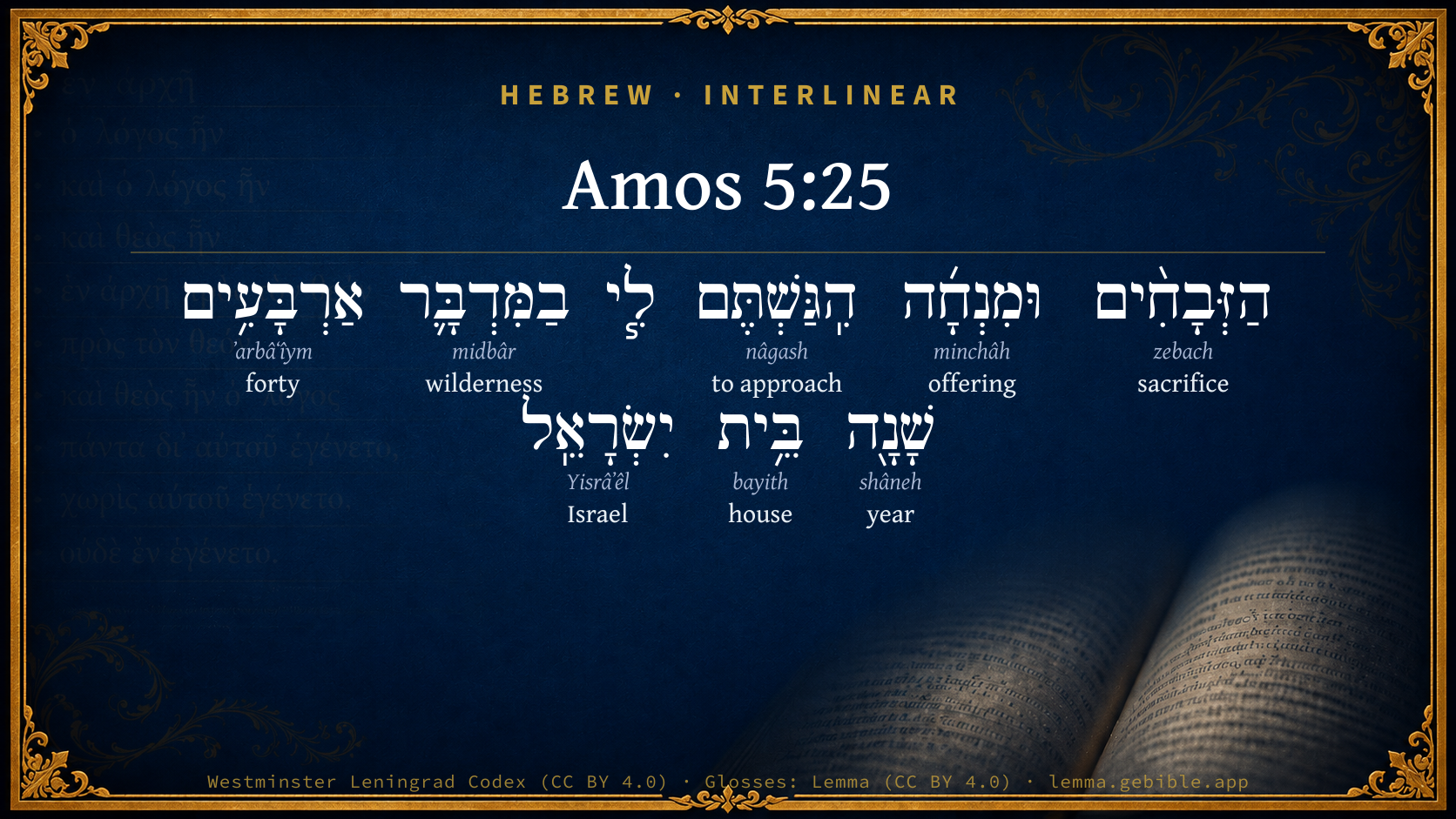
  1. הַזְּבָחִ֨ים zebach H2077 “sacrifices” Particle, Interrogative + Noun, Common, Masculine, Plural, Absolute
  2. וּמִנְחָ֜ה minchâh H4503 “and · offering” Conjunction + Noun, Common, Feminine, Singular, Absolute
  3. בַמִּדְבָּ֛ר midbâr H4057 “in/at the · wilderness” Preposition, Determined + Noun, Common, Masculine, Singular, Absolute
  4. אַרְבָּעִ֥ים ʼarbâʻîym H705 “forty” Adjective, Cardinal number, Both, Plural, Absolute
  5. שָׁנָ֖ה shâneh H8141 “year” Noun, Common, Feminine, Singular, Absolute
  6. בֵּ֥ית bayith H1004 “house of” Noun, Common, Masculine, Singular, Construct
  7. יִשְׂרָאֵֽל Yisrâʼêl H3478 “Israel” Noun, Proper

About this verse

These counts appear in no published source. They are computed here, from the morphology-tagged text and Lemma’s own curated glosses. What Lemma adds →

9
words
8
distinct lemmas
Prophets
section

Grammatical profile

  • 1 verb
  • 6 nouns
  • 1 adjective
  • 1 preposition

Verb forms

  • הִֽגַּשְׁתֶּם Hiphil · Perfect

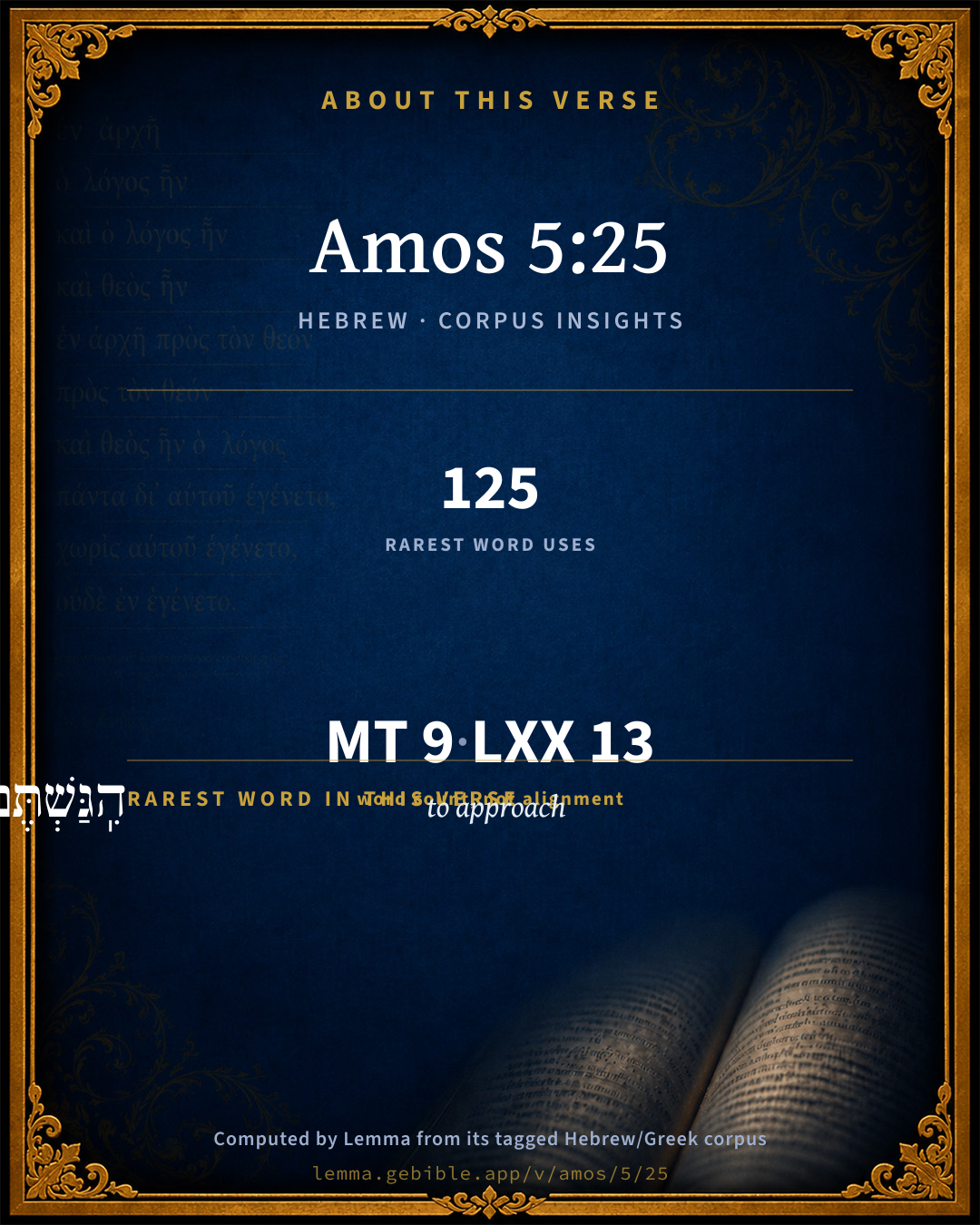
Hebrew & Septuagint length

In English translation the verse runs 16 words from the Hebrew and 17 from the Septuagint (LXX English) — closely comparable.

A rough comparison of the two English renderings, which tokenize alike — not a word-level alignment.

Word counts can differ between the Hebrew and the Greek without any difference in meaning — e.g. the Hebrew direct-object marker אֵת has no separate Greek word, and Greek often adds the article ὁ.

In the original languages it is 9 Hebrew tokens and 13 Greek tokens — but the two are counted differently (Hebrew bundles its prefixes and suffixes into one token; the Greek is in lemma form), so that isn’t a like-for-like length.

Cross-references

12

Topical passages linked to Amos 5:25 in the Treasury of Scripture Knowledge — connected by theme and wording, ordered by reader-vote popularity; previews shown in the World English Bible.

  • Acts 7:42–43 But God turned, and gave them up to serve the host of the sky, as it is written in the book of the prophets, 'Did you offer to me slain animals and sacrifices Forty years in the wilderness, O house of Israel?
  • Ezekiel 20:8 But they rebelled against me, and would not listen to me; they did not every man cast away the abominations of their eyes, neither did they forsake the idols of Egypt. Then I said I would pour out my wrath on them, to accomplish my anger against them in the midst of the land of Egypt.
  • Nehemiah 9:18 Yes, when they had made them a molten calf, and said, This is your God who brought you up out of Egypt, and had committed awful blasphemies;
  • Leviticus 17:7 They shall no more sacrifice their sacrifices to the goat idols, after which they play the prostitute. This shall be a statute forever to them throughout their generations.'
  • Joshua 24:14 Now therefore fear Yahweh, and serve him in sincerity and in truth; and put away the gods which your fathers served beyond the River, and in Egypt; and serve you Yahweh.
  • Nehemiah 9:21 Yes, forty years did you sustain them in the wilderness, [and] they lacked nothing; their clothes didn't grow old, and their feet didn't swell.
  • Deuteronomy 32:17–19 They sacrificed to demons, [which were] no God, To gods that they didn't know, To new [gods] that came up of late, Which your fathers didn't dread.
  • Ezekiel 20:16 because they rejected my ordinances, and didn't walk in my statutes, and profaned my Sabbaths: for their heart went after their idols.
  • Ezekiel 20:24 because they had not executed my ordinances, but had rejected my statutes, and had profaned my Sabbaths, and their eyes were after their fathers' idols.
  • Hosea 9:9–10 They have deeply corrupted themselves, As in the days of Gibeah. He will remember their iniquity. He will punish them for their sins.
  • Zechariah 7:5 "Speak to all the people of the land, and to the priests, saying, 'When you fasted and mourned in the fifth and in the seventh month for these seventy years, did you at all fast to me, really to me?
  • Isaiah 43:23–24 You have not brought me of your sheep for burnt offerings; neither have you honored me with your sacrifices. I have not burdened you with offerings, nor wearied you with frankincense.

Cross-references courtesy of OpenBible.info (CC BY 4.0).

Hebrew and Greek witnesses Masoretic Hebrew ↔ Greek Septuagint

The same verse in the two great witnesses to the Old Testament, shown verse-for-verse.

These are two independent witnesses, not word-aligned to each other, and the Septuagint is shown in lemma (dictionary) form.

Hebrew Amos 5:25 Masoretic · Westminster Leningrad Codex

הַזְּבָחִ֨ים וּמִנְחָ֜ה הִֽגַּשְׁתֶּם לִ֧י בַמִּדְבָּ֛ר אַרְבָּעִ֥ים שָׁנָ֖ה בֵּ֥ית יִשְׂרָאֵֽל

"Did you bring to me sacrifices and offerings in the wilderness forty years, house of Israel?

World English Bible · Public Domain

Greek LXX Amos 5:25 Septuagint · lemma form

μή σφάγιον καί θυσία προςφέρω ἐγώ ἐν ὁ ἔρημος τεσσαράκοντα ἔτος οἶκος ἰσραήλ

Have you⌃ offered to me victims and sacrifices, O house of Israel, forty years in the wilderness?

LXX2012 (modern English Septuagint) · Public Domain

On this verse, Ellicott's Commentary for English Readers discusses the Septuagint’s reading. Read the note in Commentary ↓

Hebrew: Westminster Leningrad Codex (CC BY 4.0). Greek: Septuagint (public domain); English from LXX2012 (modern English Septuagint) (Public Domain). How the Septuagint differs from the Hebrew →

Targum (Aramaic paraphrase)

1

The Targum is the ancient Jewish Aramaic paraphrase of the Hebrew Scriptures — an interpretive translation, not the Hebrew text itself. Onkelos (literal) and Pseudo-Jonathan (expansive) render the Torah, and Jonathan the Prophets. Coverage is partial: where no permissively-licensed English translation exists for a verse, only the Aramaic is shown. This is verse-level text, not a word-by-word alignment to the Hebrew.

  1. Targum Jonathan Prophets (Joshua–Malachi)
    הֲנִכְסַת קוּדְשִׁין וְקוּרְבָּנִין קְרַבְתּוּן קֳדָמַי בְּמַדְבְּרָא אַרְבְּעִין שְׁנִין בֵּית יִשְׂרָאֵל:

    (no public-domain English translation for this verse)

    Targum Jonathan — Aramaic: “Mikraot Gedolot” (public domain). English: “Sefaria Community Translation” (CC0 1.0 (public-domain dedication)); “London "Chaldee Paraphrase," 1871” (public domain). Text via Sefaria.

Commentary

Notes on Amos 5:25 from classic Christian and Jewish commentators (each source and its license shown beneath its notes). The classic Christian expositions comment on the surrounding passage and are grouped to its opening verse, so a note may address several verses; the Jewish commentaries on the Tanakh (Rashi and others) are per-verse, so they appear only where the commentator wrote on this verse.

Lemma curates 59 commentaries, every one of them public domain or Creative Commons licensed, each selected and text-cleaned for this edition rather than reprinted as found. About our sources →

Ellicott's Commentary for English Readers

(25, 26) Much uncertainty belongs to the interpretation of these verses and their connection in thought. Some commentators would treat Amo_5:25 as a statement, and not a question, the first word being read as a definite article, and not an interrogative prefix in the Hebrew. But the construction of the following words forbids this supposition, and nearly all exegetes follow the LXX., Vulg., Targ., in taking the sentence as interrogative. Is the expected answer negative or affirmative? Heb. usage points to the former. So Ewald and Keil According to the latter, the words apply to the nation as a whole, or to the great mass of the people, individual exceptions being passed by. The following verse is then taken in an adversative sense, “To me ye have offered no sacrifices, but ye have borne,” &c. The opposition is between the Jehovah-worship, which they suspended, and the idol-worship which they carried on. This is a possible interpretation, as Driver (Heb. Tenses, § 119a, foot-note) admits. But as that writer shows (l.c.), it is more in consonance with grammatical usage to translate in Amo_5:26 by a future, as Ewald does: “So ye shall carry away the tabernacle,” &c., i.e., when driven into exile. To this thought Amo_5:27 forms a natural development: And I will carry you away captive, &c. Moreover, in the light of this interpretation the logical connection of Amo_5:21-27 becomes much simpler: “I, Jehovah, abhor the mechanical round of corrupt and hollow ceremonial cloaking wickedness of conduct. Live righteously. Did I exact punctilious discharge of ceremonial in the desert wanderings? [No.] Therefore I shall submit you once more to the discipline of exile wanderings.” On the meaning of the difficult clause, Chiun your images, the star of your god, which ye made for yourselves, as well as on the rendering of the LXX. and St. Stephen’s quotation of the passage, see Excursus B. Kuenen is scarcely justified in founding an argument on this passage as to the origin of the Sabbath.

EXCURSUS B (Amos 5:26).

Three obscure points render this verse one of the most difficult in the Old Testament.

1. As to tense. The interpretation to which preference has been given in the commentary on the text—the time being regarded as future—has been decided on grounds of grammatical usage only. But certainly the larger number of commentators have rendered the verb as a past tense, “But ye bore the tabernacle,” &c., the time referred to being that of the desert wanderings. This view is upheld by Hitzig, Kuenen, Keil, Henderson, and also by R. S. Poole. It is also supported by the LXX.

2. The word Sikkûth, rendered tabernacle, or tent, in the E.V. and by the LXX., is derived from a root signifying both to interweave and to cover—an etymology which confirms the above rendering. Ewald’s conjecture that it signifies “stake,” inferred from the Aramaic Sekkitho, is to be rejected. The conception of Moloch being carried in a tent may be illustrated from the Egyptian monuments of Rameses XII. Birch (Egypt, S. P. C. K., p. 149), refers to a tablet found in the south-west corner of Karnak: “The picture of the tablet represents Rameses holding a censer, and worshipping the ark of the god [Khons], which, partly covered with curtains, is placed in a boat . . . Figures of priests, a sphinx, and standards are in the boat, while twelve priests carry it on their shoulders.”

3. Both Moloch and Chiun were evidently star-deities. R. S. Poole endeavours to connect Chiun with Semitic deities worshipped in Egypt (see art. “Remphan,” Smith’s Dict. of the Bible). The name Chiun appears as Remphan in the quotation of this passage in Stephen’s speech (Act_7:43). And both Remphan and Chiun were held by Mr. Poole to be the corresponding male and female deities of Asiatic type, Renpu and Ken. But the form Remphan can be clearly shown to have arisen from textual corruption, originating, perhaps, in some false analogy. In the New Testament passage the best MSS. read Rephan, and this reading has been adopted in our Revised Version, and occurs in nearly the same form in the LXX., from which Stephen was freely quoting. In the LXX. the original order of the clauses has suffered transposition, and it is certainly safer to adhere to the Hebrew text (as in Amo_9:11-12).

Rêphan arose from the Hebrew text by the change of a single character. Instances of such interchange are not infrequent in the Old Testament. Yet the form Rephan, though corrupt, is invaluable, as indicating the true reading of the Hebrew word. The word for Chiun was read by the Masoretes as Kiyyûn (according to Ewald, “pedestal” [?]). But the LXX. indicate, and much confirmatory testimony establishes the fact, that the word is to be read Kêvan, and that Kêvan, like the Ammonitish Moloch, represented the star-deity Saturn. Thus Kaivono is the form of the word in the Peshito. This view is supported by Aben Ezra and Kimchi, who cite Kivan as the name for the star Saturn in the Persian and Arabic. This star (see quotations in Henderson’s Commentary) was held to exert malignant influence. Schrader (Cuneiform Inscriptions and the Old Testament, p. 443) compares the name Ka-ai-vanu, the Assyrian name for that planet.

A Bible Commentary for English Readers, edited by Charles John Ellicott (1878–1897) — public domain. Text from a community e-Sword module.

Trapp's Complete Commentary

John Trapp

Amo 5:25 Have ye offered unto me sacrifices and offerings in the wilderness forty years, O house of Israel?

Ver. 25. Have ye offered unto me sacrifices, &c.] i.e. To me only, and not to other gods also? did ye not begin betime to play the idolaters? and do ye not "fill up the measure of your fathers?" Mat 23:32. They sojourned in Egypt, and brought thence a golden calf: Jeroboam sojourned there, and brought home two; which were no sooner up than you were down upon your knees, where still you continue at your mawmet worship. Is it not even so, O house of Israel? And was it not even so in the wilderness, where and when I bore with your "evil manners" (ετροποφορησα) "about the time of forty years," Act 13:18 (for full forty it was not, but thirty-eight only and some few months), and was provoked by you ten times, Num 14:22, when I had but newly brought you out of Egypt, Amo 3:1-2. So that your idolatry is hereditary; and therefore the more ingrained and to be abhorred. God alone is to be worshipped, Exo 20:2-3 1Ki 18:21; truly that there be no halting, and totally that there be no halving. Be the gods of the heathen good fellows, saith one: the true God is a jealous God, and will not share his glory with another. For indeed he is the one, Deu 6:4, and only God, Psa 86:10, besides whom, Psa 18:32, without whom, 1Sa 2:2, and beyond whom, 1Ki 8:6, there is none other, Deu 4:39, nor any like him, 2Sa 7:22, nor any with him, Isa 44:24; he is the only Lord, and besides him there is none other, Joe 2:27.

John Trapp, A Commentary or Exposition upon All the Books of the Old and New Testament (1647–1656) — public domain. Text from a community e-Sword module.

Joseph Benson's Commentary

Amo 5:25. Have ye offered — Or, did you offer, unto me sacrifices and offerings — “Verborum emphasis in MIHI sita est,” says Spencer: The emphasis of the passage lies in ME. “Did ye offer such sacrifices as were acceptable to ME; such an entire and undivided service as I enjoin?” — Newcome. Certainly they did not. They offered sacrifices indeed, but in general did not offer them in a right manner, in a true spirit of piety; in the genuine fear and love of God, and with an upright intention to glorify him. On the contrary, they joined the worship of idols with the worship of God, and thereby polluted it, and rendered it insignificant in God’s sight. Thus Dr. Whitby: “This question is a strong negative, importing, that though they really did offer sacrifices, as he had commanded, yet he did not accept, or look upon them, as offered to him. The expression is like that of the Prophet Zec 7:5, When ye fasted, &c., did ye at all fast to me, even to me? And this is here denied, 1st, Because God will accept of no worship as done unto him, which is not done unto him alone; and when any other is worshipped with him, he looks upon himself as not worshipped at all. So, of those nations which came from Assyria into the cities of Samaria, it is said, 2Ki 17:33, They feared the Lord, and served their own gods; and then it is added, 2Ki 17:34, They feared not the Lord. 2d, Because God will not own any worship as performed to him, while men continue in their disobedience to his laws, and in their hearts depart from him. Thus the Jews, in Zechariah, are said not to fast to him, because they would not hearken to nor obey his words; and he is said to have been angry with them in the wilderness forty years, because they erred from him in their hearts; that is, says the Chaldee, they had their idols in their hearts.”

Joseph Benson's Commentary on the Old and New Testaments (1811–1818) — public domain. Text from a community e-Sword module.

The Preacher's Complete Homiletical Commentary

Joseph S. Exell (gen. ed.)

CRITICAL NOTES.]

Amo_5:25. Have] Lit. Did ye, equivalent to denial, some; others, not entire suspension of sacrifice, but mixed with idolatry. From of old they had been recreant to God. Their present offensive worship was only a continuation of the idolatry in the wilderness. Their sins were the very sins of their forefathers (Eze_20:39).

Amo_5:26. Borne] aloft in pomp, the portable shrine or model tabernacle. The idolatry censured is of Egyptian origin. A literal god of stars cannot be proved [Lange].

Amo_5:27.] Banishment of the people far beyond the borders of their own land. Beyond] the capital of Syria, in which you trust for help instead of me (Act_7:43): combines into one the several passages from prophecy. A most unlikely event then; but Thus saith the Lord indicates its certainty.

HEREDITARY SINS AND GRIEVOUS PUNISHMENT.—Amo_5:25-27

Hereditary sin was the second reason why the day of the Lord would be to them a day of distress. From the earliest period their hearts had been alienated. As heirs to the guilt and imitators of the ways of their fathers, they must be carried into a far country. Continued provocation will bring greater punishment than ever.

I. The same system of idolatry was practised. If we carefully compare the text with Deu_32:17; Jos_24:14, and Eze_20:26, we find that Israel were guilty of idolatry in the wilderness.

1. They misrepresented the true God. They made images for themselves in direct opposition to God’s command. In the very tabernacle of Jehovah they bore the shrines of Moloch and Remphan. Amos declared the men of his day to be addicted to the same sins and identified with the same disgrace. Some men inherit the lusts as well as the lands of their ancestors. The idolatry of the fathers is seen in the worship of the sons. Thus we forfeit the distinction which God gives and entail one of our own. “I will cause you to go into captivity.”

2. They worshipped false gods. “Have ye offered unto me?” Here lies the emphasis. Notwithstanding all their pretensions and sacrifices they offered not to God. “They sacrificed unto devils, not to God; to gods whom they knew not, to new gods, whom your fathers feared not.” We are not safe because we have a Protestant Bible and orthodox creeds, abundant churches, and religious privileges. The same tendency is in our hearts to forget the revealed character and despise the claims of God—to create and honour other gods, and amid constraining reasons for cleaving to God, make images of things in heaven above or in earth beneath. “Their heart was not right with him, neither were they steadfast in his covenant.”

II. The same perverse spirit was cherished. Stephen quotes this charge against the people, as a signal proof of perverseness of heart which had always been shown by the nation. Even in days of wonderful deliverance and multiplied acts of Divine favour they cherished a rebellious heart. Men are found now resisting the Holy Spirit as their fathers from generations before them have done. They partake of the sins of their progenitors.

1. In copying their example;

2. In commending their errors; and

3. In cherishing their spirit. Thus we may identify ourselves with sins which we do not really commit. “Neither be partaker of other men’s sins: keep thyself pure.”

III. The same kind of punishment was inflicted. If we partake of other men’s guilt we are liable to the same punishment. Israel suffered in a similar way to those in ancient days.

1. They fell under severe displeasure. Murmuring and rebellion brought upon a former race the judgments of God. Their carcases fell in the wilderness, a warning to all generations of idolatry and unbelief.

2. They were excluded from the land of promise. One race did not enter Canaan; the other was driven out of it into exile. Instead of warding off the curse, they secured its reversion. The day came when they presumptuously desired and brought darkness, not light; judgment, not deliverance. They were carried “beyond Damascus,” beyond all hope of return (2Ki_17:6). Learn—

1. That God gives a record and warning from the punishment of men’s sins.

2. That he who commits and cherishes a sin, puts himself in the company of those who have been guilty of it from the beginning of the world.

3. That it is a principle with God to punish more severely, if less judgment do not work the end for which they are sent.

4. If men would seriously meditate upon God’s greatness and power, they would not sleep securely under his awful threatenings. Thus “saith the Lord, whose name is the God of Hosts.”

ILLUSTRATIONS TO CHAPTER 5

Amo_5:25-27. The fact that physical, mental, and moral qualities are hereditary, is proved in the persistent characteristics of races and nations. Jewish and negro types, Chinese and Japanese, have had the same characteristics for centuries. So features of morality are stamped upon descendants. By walking in the steps of their fathers, nations and families reap the same harvest. We have hereditary transmission of sins and punishment.

The Preacher's Complete Homiletical Commentary (gen. ed. Joseph S. Exell; Funk & Wagnalls, c. 1892) — public domain (pre-1929). A full-Bible homiletical/sermon-outline anthology covering 65 of 66 books (2 John is absent from the source module). Text from a community e-Sword module.

Keil & Delitzsch

C. F. Keil & F. Delitzsch

Their heartless worship would not arrest the flood of divine judgments, since Israel had from time immemorial been addicted to idolatry. Amo 5:25. "Have ye offered me sacrifices and gifts in the desert forty years, O house of Israel? Amo 5:26. But have ye borne the booth of your king and the pedestal of your images, the star of your gods, which ye made for yourselves? Amo 5:27. Then I will carry you beyond Damascus, saith Jehovah; God of hosts is His name." The connection between these verses and what precedes is explained by Hengstenberg thus: "All this (the acts of worship enumerated in Amo 5:21-23) can no more be called a true worship, than the open idolatry in the wilderness. Therefore (Amo 5:17) as in that instance the outwardly idolatrous people did not tread the holy land, so now will the inwardly idolatrous people be driven out of the holy land" (Dissertations on the Pentateuch, vol. i. p. 157 transl.). But if this were the train of thought, the prophet would not have omitted all reference to the punishment of the idolatrous people in the wilderness. And as there is no such allusion here, it is more natural to take Amo 5:25 and Amo 5:26, as Calvin does, and regard the reference to the idolatry of the people, which was practised even in the wilderness, as assigning a further reason for their exposure to punishment.

(Note: "In this place," says Calvin, "the prophet proves more clearly, that he is not merely reproving hypocrisy among the Israelites, or the fact that they only obtruded their external pomps upon the notice of God, without any true piety of heart, but he also condemns their departure from the precepts of the law. And he shows that this was not a new disease among the Israelitish people, since their fathers had mixed up such leaven as this with the worship of God from the very beginning, and had thereby corrupted that worship. He therefore shows that the Israelites had always been addicted to superstitions, and could not be kept in any way whatever to the true and innate worship of God.")

The question, "Have ye offered me sacrifices?" is equivalent to a denial, and the words apply to the nation as a whole, or the great mass of the people, individual exceptions being passed by. The forty years are used as a round number, to denote the time during which the people were sentenced to die in the wilderness after the rebellion at Kadesh, just as in Num 14:33-34, and Jos 5:6, where this time, which actually amounted to only thirty-eight years, is given, as it is here, as forty years. And "the prophet could speak all the more naturally of forty years, since the germ of apostasy already existed in the great mass of the people, even when they still continued outwardly to maintain their fidelity to the God of Israel" (Hengstenberg). During that time even the circumcision of the children born in the thirty-eight years was suspended (see at Jos 5:5-7), and the sacrificial worship prescribed by the law fell more and more into disuse, so that the generation that was sentenced to die out offered no more sacrifices. Zebhâchı̄m (slain-offerings) and minchâh (meat-offerings), i.e., bleeding and bloodless sacrifices, are mentioned here as the two principal kinds, to denote sacrifices of all kinds. We cannot infer from this that the daily sacrificial worship was entirely suspended: in Num 17:11, indeed, the altar-fire is actually mentioned, and the daily sacrifice assumed to be still in existence; at the same time, the event there referred to belonged to the time immediately succeeding the passing of the sentence upon the people. Amos mentions the omission of the sacrifices, however, not as an evidence that the blessings which the Lord had conferred upon the people were not to be attributed to the sacrifices they had offered to Him, As Ephraem Syrus supposes, nor to support the assertion that God does not need or wish for their worship, for which Hitzig appeals to Jer 7:22; but as a proof that from time immemorial Israel has acted faithlessly towards its God, in adducing which he comprehends all the different generations of the people in the unity of the house of Israel, because the existing generation resembled the contemporaries of Moses in character and conduct.

Amo 5:26-27

Amo 5:26 is attached in an adversative sense: "To me (Jehovah) ye have offered no sacrifices, but ye have borne," etc. The opposition between the Jehovah-worship which they suspended, and the idol-worship which they carried on, is so clearly expressed in the verbs הגּשׁתּם and נשׂאתם, which correspond to one another, that the idea is precluded at once as altogether untenable, that "Amo 5:26 refers to either the present or future in the form of an inference drawn from the preceding verse: therefore do ye (or shall ye) carry the hut of your king," etc. Moreover, the idea of the idols being carried into captivity, which would be the meaning of נשׂא in that case, is utterly foreign to the prophetical range of thought. It is not those who go into captivity who carry their gods away with them; but the gods of a vanquished nation are carried away by the conquerors (Isa 46:1). To give a correct interpretation to this difficult verse, which has been explained in various ways from the very earliest times, it is necessary, above all things, to bear in mind the parallelism of the clauses. Whereas in the first half of the verse the two objects are connected together by the copula ו (ואת), the omission of both את and the copula ו before כּוכב indicates most obviously that כּוכב אלהיכם does not introduce a third object in addition to the two preceding ones, but rather that the intention is to define those objects more precisely; from which it follows still further, that סכּוּת מלכּכם and כּיּוּן צלמיכם do not denote two different kinds of idolatry, but simply two different forms of the very same idolatry. The two ἁπ. λεγ. sikkūth and kiyyūn are undoubtedly appellatives, notwithstanding the fact that the ancient versions have taken kiyyūn as the proper name of a deity. This is required by the parallelism of the members; for צלמיכם stands in the same relation to כיון as מלככם to סכות. The plural צלמיכם, however, cannot be in apposition to the singular כיון (kiyyūn, your images), but must be a genitive governed by it: "the kiyyūn of your images." And in the same way מלככם is the genitive after סכות: "the sikkūth of your king." Sikkūth has been taken in an appellative sense by all the ancient translators. The lxx and Symm. render it τὴν σκηνήν; the Peshito, Jerome, and the Ar. tentorium. The Chaldee has retained sikkūth. The rendering adopted by Aquila, συσκιασμός, is etymologically the more exact; for sikkūth, from סכך, to shade, signifies a shade or shelter, hence a covering, a booth, and is not to be explained either from sâkhath, to be silent, from which Hitzig deduces the meaning "block," or from the Syriac and Chaldee word סכתא, a nail or stake, as Rosenmller and Ewald suppose. כּיּוּן, from כּוּן, is related to כּן, basis (Exo 30:18), and מכונה, and signifies a pedestal or framework. The correctness of the Masoretic pointing of the word is attested by the kiyyūn of the Chaldee, and also by צלמיכם, inasmuch as the reading כּיון, which is given in the lxx and Syr., requires the singular צלמכם, which is also given in the Syriac. צלמים are images of gods, as in Num 33:52; Kg2 11:18. The words כּוכב אל which follow are indeed also governed by נשׂאתם; but, as the omission of ואת clearly shows, the connection is only a loose one, so that it is rather to be regarded as in apposition to the preceding objects in the sense of "namely, the star of your god;" and there is no necessity to alter the pointing, as Hitzig proposes, and read כּוכב, "a star was your god," although this rendering expresses the sense quite correctly. כּוכב אלהיכם is equivalent to the star, which is your god, which ye worship as your god (for this use of the construct state, see Ges. 116, 5). By the star we have to picture to ourselves not a star formed by human hand as a representation of the god, nor an image of a god with the figure of a star upon its head, like those found upon the Ninevite sculptures (see Layard). For if this had been what Amos meant, he would have repeated the particle ואת before כּוכב. The thought is therefore the following: the king whose booth, and the images whose stand they carried, were a star which they had made their god, i.e., a star-deity (אשׁר refers to אלהיכם, not to כּוכב). This star-god, which they worshipped as their king, they had embodied in tselâmı̄m. The booth and the stand were the things used for protecting and carrying the images of the star-god.

Sikkūth was no doubt a portable shrine, in which the image of the deity was kept. Such shrines (ναΐ́σκοι) were used by the Egyptians, according to Herodotus (ii. 63) and Diodorus Sic. (i. 97): they were "small chapels, generally gilded and ornamented with flowers and in other ways, intended to hold a small idol when processions were made, and to be carried or driven about with it" (Drumann, On the Rosetta Inscription, p. 211). The stand on which the chapel was placed during these processions was called παστοφόριον (Drumann, p. 212); the bearers were called ἱεραφόροι or παστοφόροι (D. p. 226). This Egyptian custom explains the prophet's words: "the hut of your king, and the stand of your images," as Hengstenberg has shown in his Dissertations on the Pentateuch, vol. i. p. 161), and points to Egypt as the source of the idolatry condemned by Amos. This is also favoured by the fact, that the golden calf which the Israelites worshipped at Sinai was an imitation of the idolatry of Egypt; also by the testimony of the prophet Ezekiel (Eze 20:7.), to the effect that the Israelites did not desist even in the wilderness from the abominations of their eyes, namely the idols of Egypt; and lastly, by the circumstance that the idea of there being any allusion in the words to the worship of Moloch or Saturn is altogether irreconcilable with the Hebrew text, and cannot be historically sustained,

(Note: This explanation of the words is simply founded upon the rendering of the lxx: καὶ ἀνελάβετε τὴν σκηνὴν τοῦ Μολόχ καὶ τὸ ἄστρον τοῦ Θεοῦ ὑμῶν Ῥαιφάν, τοὺς τύπους οὓς ἐποιήσατε ἑαυτοῖς. These translators, therefore, have not only rendered מלכּכם erroneously as Μολόχ, but have arbitrarily twisted the other words of the Hebrew text. For the Hebrew reading מלככם is proved to be the original one, not only by the τοῦ βασιλέως ὑμῶν of Symm. and Theod., but also by the Μαλχόμ of Aquila and the malkūm of the Peshito; and all the other ancient translators enter a protest against the displacing of the other words. The name Ῥαιφάν (Ῥηφαν), or Ῥεμφάν (Act 7:43), however, owes its origin simply to the false reading of the unpointed כיון as ריפן, inasmuch as in the old Hebrew writings not only is כ similar to ר, but ו is also similar to פ; and in Sa2 22:12, where חשׁרת־מים is rendered σκοτός (i.e., חשׁכת) ὑδάτων, we have an example of the interchange of כ and ר. There was no god Rephan or Rempha; for the name never occurs apart from the lxx. The statement made in the Arabico-Coptic list of planets, edited by Ath. Kircher, that Suhhel (the Arabic name of Saturn) is the same as Ῥηφάν, and the remark found in a Coptic MS on the Acts of the Apostles, "Rephan deus temporis," prove nothing more than that Coptic Christians supposed the Rephan or Remphan, whose name occurred in their version of the Bible which was founded upon the lxx, to be the star Saturn as the god of time; but they by no means prove that the ancient Egyptians called Saturn Rephan, or were acquainted with any deity of that name, since the occurrence of the Greek names Υλια and Σελινη for sun and moon are a sufficient proof of the very recent origin of the list referred to. It is true that the Peshito has also rendered כּיּוּן by ke'wām (כּיון), by which the Syrians understood Saturn, as we may see from a passage of Ephraem Syrus, quoted by Gesenius in his Comm. on Isaiah (ii. p. 344), where this father, in his Sermones adv. haer. s. 8, when ridiculing the star-worshippers, refers to the Kevan, who devoured his own children. But no further evidence can be adduced in support of the correctness of this explanation of כּיון. The corresponding use of the Arabic Kaivan for Saturn, to which appeal has also been made, does not occur in any of the earlier Arabic writings, but has simply passed into the Arabic from the Persian; so that the name and its interpretation originated with the Syrian church, passing thence to the Persians, and eventually reaching the Arabs through them. Consequently the interpretation of Kevan by Saturn has no higher worth than that of an exegetical conjecture, which is not elevated into a truth by the fact that כיון is mentioned in the Cod. Nazar. i. p. 54, ed. Norb., in connection with Nebo, Bel, and Nerig (= Nergal). With the exception of these passages, and the gloss of a recent Arabian grammarian cited by Bochart, viz., "Keivan signifies Suhhel," not a single historical trace can be found of Kevan having been an ancient oriental name of Saturn; so that the latest supporter of this hypothesis, namely Movers (Phnizier, i. p. 290), has endeavoured to prop up the arguments already mentioned in his own peculiar and uncritical manner, by recalling the Phoenician and Babylonian names, San-Choniâth, Kyn-el-Adan, and others. Not even the Graeco-Syrian fathers make any reference to this interpretation. Theodoret cannot say anything more about Μολόχ καὶ Ῥεφάν, than that they were εἰδώλων ὀνόματα; and Theod. Mops. has this observation on Ῥεμφάν: φασὶ δὲ τὸν ἑωσφόρον οὕτω κατὰ τὴν Ἑβραίων γλῶτταν. It is still very doubtful, therefore, whether the Alexandrian and Syrian translators of Amos really supposed Ῥαιφάν and כּיון to signify Saturn; and this interpretation, whether it originated with the translators named, or was first started by later commentators upon these versions, arose in all probability simply from a combination of the Greek legend concerning Saturn, who swallowed his own children, and the Moloch who was worshipped with the sacrifice of children, and therefore might also be said to devour children; that is to say, it was merely an inference drawn from the rendering of מלככם as Μολόχ. But we are precluded from thinking of Moloch-worship, or regarding מלככם, "your king," as referring to Moloch, by the simple circumstance that כּוכב אלהיכם unquestionably points to the Sabaean (sidereal) character of the worship condemned by Amos, whereas nothing is known of the sidereal nature of Moloch; and even if the sun is to be regarded as the physical basis of their deity, as Mnter, Creuzer, and others conjecture, it is impossible to discover the slightest trace in the Old Testament of any such basis as this.

The Alexandrian translation of this passage, which we have thus shown to rest upon a misinterpretation of the Hebrew text, has acquired a greater importance than it would otherwise possess, from the fact that the proto-martyr Stephen, in his address (Act 7:42-43), has quoted the words of the prophet according to that version, simply because the departure of the Greek translation from the original text was of no consequence, so far as his object was concerned, viz., to prove to the Jews that they had always resisted the Holy Ghost, inasmuch as the Alex. rendering also contains the thought, that their fathers worshipped the στρατιᾶ τοῦ οὐρανοῦ.)

whereas star-worship, or at any rate the worship of the sun, was widely spread in Egypt from the very earliest times. According to the more recent investigations into the mythology of the ancient Egyptians which have been made by Lepsius (Transactions of the Academy of Science at Berlin, 1851, p. 157ff.), "the worship of the sun was the oldest kernel and most general principle of the religious belief of Egypt;" and this "was regarded even down to the very latest times as the outward culminating point of the whole system of religion" (Lepsius, p. 193). The first group of deities of Upper and Lower Egypt consists of none but sun-gods (p. 188).

(Note: It is true, that in the first divine sphere Ra occupies the second place according to the Memphitic doctrine, namely, after Phtha (Hephaestos), and according to the Theban doctrine, Amen (Ἄμων). Mentu and Atmu stand at the head (Leps. p. 186); but the two deities, Mentu, i.e., the rising sun, and Atmu, i.e., the setting sun, are simply a splitting up of Ra; and both Hephaestos and Amon (Amon-Ra) were placed at the head of the gods at a later period (Leps. pp. 187, 189).)

Ra, i.e., Helios, is the prototype of the kings, the highest potency and prototype of nearly all the gods, the king of the gods, and he is identified with Osiris (p. 194). But from the time of Menes, Osiris has been worshipped in This and Abydos; whilst in Memphis the bull Apis was regarded as the living copy of Osiris (p. 191). According to Herodotus (ii. 42), Osiris and Isis were the only gods worshipped by the ancient Egyptians; and, according to Diodorus Sic. (i. 11), the Egyptians were said to have had originally only two gods, Helios and Selene, and to have worshipped the former in Osiris, the latter in Isis. The Pan of Mendes appears to have also been a peculiar form of Osiris (cf. Diod. Sic. i. 25, and Leps. p. 175). Herodotus (ii. 145) speaks of this as of primeval antiquity, and reckons it among the eight so-called first gods; and Diodorus Sic. (i. 18) describes it as διαφερόντως ὑπὸ τῶν Αἰγυπτίων τιμώμενον. It was no doubt to these Egyptian sun-gods that the star-god which the Israelites carried about with them in the wilderness belonged. This is all that can at present be determined concerning it. There is not sufficient evidence to support Hengstenberg's opinion, that the Egyptian Pan as the sun-god was the king worshipped by them. It is also impossible to establish the identity of the king mentioned by Amos with the שׂעירים in Lev 17:7, since these שׂעירים, even if they are connected with the goat-worship of Mendes, are not exhausted by this goat-deity.

The prophet therefore affirms that, during the forty years' journey through the wilderness, Israel did not offer sacrifices to its true King Jehovah, but carried about with it a star made into a god as the king of heaven. If, then, as has already been observed, we understand this assertion as referring to the great mass of the people, like the similar passage in Isa 43:23, it agrees with the intimations in the Pentateuch as to the attitude of Israel. For, beside the several grosser outbreaks of rebellion against the Lord, which are the only ones recorded at all circumstantially there, and which show clearly enough that it was not devoted to its God with all its heart, we also find traces of open idolatry. Among these are the command in Leviticus 17, that every one who slaughtered a sacrificial animal was to bring it to the tabernacle, when taken in connection with the reason assigned, namely, that they were not to offer their sacrifices any more to the Se‛ı̄rı̄m, after which they went a whoring (Amo 5:7), and the warning in Deu 4:19, against worshipping the sun, moon, and stars, even all the host of heaven, from which we may infer that Moses had a reason for this, founded upon existing circumstances. After this further proof of the apostasy of Israel from its God, the judgment already indicated in Amo 5:24 is still further defined in Amo 5:27 as the banishment of the people far beyond the borders of the land given to it by the Lord, where higlâh evidently points back to yiggal in Amo 5:24. מהלאה ל, lit., "from afar with regard to," i.e., so that when looked at from Damascus, the place showed itself afar off, i.e., according to one mode of viewing it, "far beyond Damascus."

Keil & Delitzsch — Biblical Commentary on the Old Testament (1861–1891) — public domain (CC PDM 1.0). Text via the HelloAO Bible API. (Old Testament only.)

Tyndale Open Study Notes

Tyndale Open Resources

5:25-26 Although the people of Israel claimed that God had to bless them because of the Sinai covenant, Amos demonstrated that they had been fundamentally pagan from the very earliest days of the covenant.

5:25 Israel’s relationship with God was based on true devotion that yielded obedience (1 Sam 15:22-23). Sacrifices representing repentance and faith could repair a breach made by sin, but they were not a substitute for a life lived in accordance with God’s word. • Forty years in the wilderness was the duration of Israel’s wandering after the rebellion at Kadesh-barnea (see Num 14:32-35).

Tyndale Open Study Notes — © Tyndale Open Resources, licensed CC BY-SA 4.0. Text via the HelloAO Bible API.

Jamieson, Fausset & Brown

Robert Jamieson, A. R. Fausset & David Brown

Have ye offered? &c.--Yes: ye have. "But (all the time with strange inconsistency) ye have borne (aloft in solemn pomp) the tabernacle (that is, the portable shrine, or model tabernacle: small enough not to be detected by Moses; compare Act 19:24) of your Molech" (that idol is "your" god; I am not, though ye go through the form of presenting offerings to Me). The question, "Have ye," is not a denial (for they did offer in the wilderness to Jehovah sacrifices of the cattle which they took with them in their nomad life there, Exo 24:4; Num. 7:1-89; Num 9:1, &c.), but a strong affirmation (compare Sa1 2:27-28; Jer 31:20; Eze 20:4). The sin of Israel in Amos' time is the very sin of their forefathers, mocking God with worship, while at the same time worshipping idols (compare Eze 20:39). It was clandestine in Moses' time, else he would have put it down; he was aware generally of their unfaithfulness, though not knowing the particulars (Deu 31:21, Deu 31:27).

Molech . . . Chiun--"Molech" means "king" answering to Mars [BENGEL]; the Sun [JABLONSKI]; Saturn, the same as "Chiun" [MAURER]. The Septuagint translates "Chiun" into Remphan, as Stephen quotes it (Act 7:42-43). The same god often had different names. Molech is the Ammonite name; Chiun, the Arabic and Persian name, written also Chevan. In an Arabic lexicon Chiun means "austere"; so astrologers represented Saturn as a planet baleful in his influence. Hence the Phœnicians offered human sacrifices to him, children especially; so idolatrous Israel also. Rimmon was the Syrian name (Kg2 5:18); pronounced as Remvan, or "Remphan," just as Chiun was also Chevan. Molech had the form of a king; Chevan, or Chiun, of a star [GROTIUS]. Remphan was the Egyptian name for Saturn: hence the Septuagint translator of Amos gave the Egyptian name for the Hebrew, being an Egyptian. [HODIUS II, De Bibliorum Textibus Originalibus. 4.115]. The same as the Nile, of which the Egyptians made the star Saturn the representative [HARENBERG]. BENGEL considers Remphan or Rephan akin to Teraphim and Remphis, the name of a king of Egypt. The Hebrews became infected with Sabeanism, the oldest form of idolatry, the worship of the Saba or starry hosts, in their stay in the Arabian desert, where Job notices its prevalence (Job 31:26); in opposition, in Amo 5:27, Jehovah declares Himself "the God of hosts."

the star of your god--R. ISAAC CARO says all the astrologers represented Saturn as the star of Israel. Probably there was a figure of a star on the head of the image of the idol, to represent the planet Saturn; hence "images" correspond to "star" in the parallel clause. A star in hieroglyphics represents God (Num 24:17). "Images" are either a Hebraism for "image," or refer to the many images made to represent Chiun.

Jamieson, Fausset & Brown — Commentary Critical and Explanatory on the Whole Bible (1871) — public domain (CC PDM 1.0). Text via the HelloAO Bible API.

Adam Clarke's Commentary

Verse 25. Have ye offered unto me sacrifices] Some have been led to think that "during the forty years which the Israelites spent in the wilderness, between Egypt and the promised land, they did not offer any sacrifices, as in their circumstances it was impossible; they offered none because they had none." But such people must have forgotten that when the covenant was made at Sinai, there were burnt-offerings and peace-offerings of oxen sacrificed to the Lord, Ex 24:5; and at the setting up of the tabernacle the twelve princes of the twelve tribes offered each a young bullock, a ram, and a lamb, for a burnt-offering; a kid for a sin-offering; two oxen, five rams, five he-goats, and five lambs, for a peace-offering, Nu 7:12, c. which amounted to an immense number of victims offered in the course of the twelve days during which this feast of the dedication lasted. At the consecration of priests, bullocks and rams to a considerable number were offered, see Le 8:1, c. but they were not offered so regularly, nor in such abundance, as they were after the settlement in the promised land. Learned men, therefore, have considered this verse as speaking thus: Did ye offer to me, during forty years in the wilderness, sacrifices in such a way as was pleasing to me? Ye did not; for your hearts were divided, and ye were generally in a spirit of insurrection or murmuring.

Adam Clarke's Commentary on the Bible (1810–1826) — public domain. Text from a community e-Sword/MySword module.

John Calvin's Commentaries

The Prophet shows in this place, that he not only reproved hypocrisy in the Israelites in obtruding on God only external display of ceremonies without any true religion in the heart; but that he also condemned them for having departed from the rule of the law. He also shows that this was not a new disease among the people of Israel; for immediately at the beginning their fathers mixed such a leaven as vitiated the worship of God. He therefore proves that the Israelites had ever been given to superstitions, and could not by any means be retained in the true and pure worship of God.

Have ye then caused sacrifices, victims, or an oblation to come before me in the desert for forty years? He addresses them as though they had perverted God’s worship in the desert, and yet they were born many ages after; what does he mean? Even this, — the Prophet includes the whole body of the people from their first beginning, as though he said, “It is right to inclose you in the same bundle with your fathers; for you are the same with your fathers in your ways and dispositions.” We hence see that the Israelites were regarded guilty, not only because they vitiated God’s worship in one age by their superstitions, but also from the beginning. And he asks whether they offered victims to him: it is certain that such was their intention; for they at no time dared to deny God, by whom they had been not long before delivered; and we know that though they made for themselves many things condemned by the law, they ever adhered to this principle, “The God, who hath redeemed us, is to be worshipped by us:” yea, they always proudly boasted of their father Abraham. They had never then willingly alienated themselves from God, who had chosen Abraham their father and themselves to be his people: and indeed the Prophet shortly before had said, ‘Take away from me,’ etc.; and then, ‘when ye offer to me sacrifices and a gift of flour, I will not count them acceptable.’ There seems to be an inconsistency in this — that God should deny that victims been offered to him — and yet say that they were offered to him by the people of Israel, when, as we have stated, they had presumptuously built a profane and spurious altar. The solution is easy, and it is even this, — that the people had ever offered sacrifices to God, if we regard what they pretended to do: for good intention, as it is commonly called, so blinds the superstitious, that with great presumption they trifle with God. Hence with respect to them we may say that they sacrificed to God; but as to God, he denies that what was not purely offered was offered to him. We now then see why God says now that sacrifices were not offered to him in the wilderness: he says so, because the people blended with his worship the leaven of idolatry: and God abhorred this depravation. This is the meaning.

But another objection may be again proposed. This defection did not prevail long, and the whole people did not give their consent to idolatry; and still more, we know what the impostor Balaam said, that Jacob had no idol; and speaking in the twentieth chapter of Numbers, by the prophetic spirit, he testifies that the only true God reigned in Jacob, and that there were among them no false gods. How then does the Prophet say now that idolatry prevailed among them? The answer is ready: The greater part went astray: hence the whole people are justly condemned; and though this sin was reproved, yet they relapsed continually, as it is well known, into superstitions; and still more, they worshipped strange gods to please strumpets. Since it was so, it is no wonder that they are accused here by the Prophet of not having offered victims to God, inasmuch as they were contaminated with impure superstitions: it could not then be, that they brought anything to God. At the same time God’s worship, required by his law, was of such importance, that he declared that he was worshipped by Jacob, as also Christ says,

“We know what we worship,” (John 4:22;)

and yet not one in a hundred among the Jews cherished the hope of eternal life in his heart. They were all Epicureans or profane; nay, the Sadducees prevailed openly among them: the whole of religion was fallen, or was at least so decayed, that there was no holiness and no integrity among them; and yet Christ says, “We know what we worship;” and this was true with regard to the law.

Now then we see that the Prophets speak in various ways of Israel: when they regard the people, they say, that they were perfidious, that they were apostates, who had immediately from the beginning departed from the true and legitimate worship of God: but when they commend the grace of God, they say, that the true worship of God shone among them, that though the whole multitude had become perverted, yet the Lord approved of what he had commanded. So it is with Baptism; it is a sacred and immutable testimony of the grace of God, though it were administered by the devil, though all who may partake of it were ungodly and polluted as to their own persons. Baptism ever retains its own character, and is never contaminated by the vices of men. The same must be said of sacrifices.

I shall now return to the words of the Prophet: Have you offered to me victims for forty years in the desert? He enhances their sin by the circumstance of their condition; for they were there shut up in a narrow and hard confinement, and yet they turned aside after their superstitions. And it was certainly a monstrous thing: God fed them daily with manna; they were therefore under the necessity, however unwilling, of looking up to heaven every day; for God constrained their unwillingness with no common favor. They knew, too, that water flowed for them miraculously from a rock. Seeing then that God constrained them thus to look up to him, how was it that they yet became vain through their own deceptions? It was, as I have said, a prodigious blindness. Hence the Prophet speaks of the forty years and of the desert, that the atrocity of their sin might more fully appear; for the Lord could not, by so many bonds, keep the people from such a madness.

John Calvin's Commentaries (1540-1563) — public domain. Text from the Calvin Translation Society English edition (1840s-50s) via the Christian Classics Ethereal Library (ccel.org). Calvin's coverage is partial (roughly two-thirds of the Bible); uncommented books and verses are honest gaps, never fabricated. The 19th-century editor's footnotes and remarks are omitted so the notes are faithfully Calvin's own voice.

The Cambridge Bible for Schools and Colleges

gen. ed. J. J. S. Perowne

25. Did ye bring unto me sacrifices &c.] The question evidently requires a negative answer; and the emphatic words in the sentence are not, as has been sometimes supposed, unto me (which hold in the Hebrew quite a subordinate position), but sacrifices and offerings (which follow immediately after the interrogative particle). The prophet shews that sacrifice is no indispensable element of religious service, from the fact that during the 40 years in the wilderness—which, nevertheless, was a period when, above all others, Jehovah manifested His love and favour towards Israel (Amo_2:9-10)—it was not offered.

bring] of a sacrifice, as Exo_32:6; Lev_8:14; 1Sa_13:9.

sacrifices and offerings] Rather, and meal-offerings: see on Amo_5:22. The same combination, Isa_19:21; Psa_40:6.

The Cambridge Bible for Schools and Colleges (gen. ed. J. J. S. Perowne; Cambridge University Press, 1878–1918) — public domain. Text from a community e-Sword module.

John Gill's Exposition

Have ye offered unto me sacrifices and offerings,.... No; they were not offered to God, but to devils, to the golden calf, and to the host of heaven: so their fathers did

in the wilderness forty years; where sacrifices were omitted during that time, a round number for a broken one, it being about thirty eight years; and these their children were imitators of them, and offered sacrifice to idols too, and therefore deserved punishment as they: even ye,

O house of Israel? the ten tribes, who are here particularly charged and threatened; See Gill on Act 7:42.

John Gill's Exposition of the Whole Bible (1746–1763) — public domain (CC PDM 1.0). Text via the HelloAO Bible API.

Albert Barnes' Notes on the Bible

Have ye offered - (better, “Did ye offer”) unto Me sacrifices and offerings? Israel justified himself to himself by his half-service. This had been his way from the first. “Their heart was not whole with God, neither abode they in His covenant” Psa 78:37. He thought to be accepted by God, because he did a certain homage to Him. He acknowledged God in his own way. God sets before him another instance of this half-service and what it issued in; the service of that generation which He brought out of Egypt, and which left their bones in the wilderness. The idolatry of the ten tribes was the revival of the idolatry of the wilderness. The ten tribes owned as the forefathers of their worship those first idolaters . They identified themselves with sin which they did not commit. By approving it and copying it, they made that sin their own. As the Church of God in all times is one and the same, and Hosea says of God’s vision to Jacob, “there He spake with us” , so that great opposite camp, the city of the devil, has a continuous existence through all time. These idolaters were “filling up the measure of” their forefathers, and in the end of those forefathers, who perished in the wilderness where they sinned, they might behold their own. As God rejected the divided service of their forefathers, so He would their’s.

God does not say that they did not offer sacrifice at all, but that they did not offer unto “Him.” The “unto Me” is emphatic. If God is not served wholly and alone, He is not served at all. : “He regardeth not the offering, but the will of the offerer.” Some sacrifices were offered during the 38 years and a half, after God had rejected that generation, and left them to die in the wilderness. For the rebellion of Korah and his company was a claim to exercise the priesthood, as Aaron was exercising it Num 16:5, Num 16:9-10. When atonement was to be made, the “live coals” were already on the altar Num 16:46. These, however, were not the free-will offerings of the people, but the ordinance of God, performed by the priests. The people, in that they went after their idols, had no share in nor benefit from what was offered in their name. So Moses says, “they sacrificed to devils, not to God” Deu 32:17; and Ezekiel, “Their heart went after their idols” Eze 20:16.

Those were the gods of their affections, whom they chose. God had taken them for His people, and had become their God, on the condition that they should not associate other gods with Him Exo 20:2-5. Had they loved God who made them, they would have loved none beside Him. Since they chose other gods, these were the objects of their love. God was, at most, an object of their fear. As He said by Hosea, “their bread is for themselves, it shall not enter into the house of the Lord” Hos 9:4, so here He asks, and by asking denies it, “Did ye offer unto Me?” Idolatry and heresy feign a god of their own. They do not own God as He has revealed Himself; and since they own not God as He is, the god whom they worship, is not the true God, but some creature of their own imaginings, such as they conceive God to be. Anti-Trinitarianism denies to God His essential Being, Father, Son, and Holy Spirit. Other heresies refuse to own His awful holiness and justice; others, the depth of His love and condescension. Plainly, their god is not the one true God. So these idolaters, while they associated with God gods of cruelty and lust, and looked to them for things which God in His holiness and love refused them, did not own God, as the One Holy Creator, the Sole Disposer of all things.

Albert Barnes' Notes on the Bible (1834–1885) — public domain. Text from a community e-Sword/MySword module.

Haydock's Catholic Bible Commentary

Did you offer, &c. Except the sacrifices that were offered at the first, in the dedication of the tabernacle, the Israelites offered no sacrifices in the desert. (Challoner) --- They ceased after the beginning of the second year. (St. Augustine, q. 47 in Exodus, Leviticus vii., &c.) (Worthington) --- God did not require sacrifices when the people came out of Egypt, Jeremias vii. 22., and Deuteronomy xii. 8. They were not performed so regularly in the desert, (Calmet) and the people still bore a secret affection for idols, (ver. 26.) which rendered all their victims useless. (Haydock)

George Leo Haydock (1774–1849), Haydock's Catholic Family Bible and Commentary, 1859 edition — public domain. Excludes Psalms (Douay-Rheims chapter numbering differs from Protestant) and Deuterocanonical books (Catholic canon only).

Matthew Poole's English Annotations

Their fathers and they, though at so great distance of time, are one people, and so the prophet considers them in this place.

Have ye offered? did you not frequently omit to offer, and yet were not reproved or plagued for the omission, when your frequent removes, and many other difficulties, made it unpracticable? so little is sacrifice with your God! and yet, when you did offer, was it to me only? or did you not sacrifice to idols and false gods, and provoked me? Will-worship and idolatry have been hereditary diseases in your generations; and it is well known, too, that these idolaters fell in the wilderness, and are made admonitions to you.

Sacrifices of beasts slain, as the word properly speaks.

Offerings: minchah, in general, is any gift or present made, but particularly here it is a gift or present of fine flour, oil, and frankincense unto God with the sacrifice.

In the wilderness forty years: it was a broken number of years in exact account, that is, thirty-eight years and eleven months; but, as is common in such cases, the full and round number is taken and so the account runs here, and in Act 7:42, forty years.

O house of Israel; you of the ten tribes.

Matthew Poole's English Annotations on the Holy Bible (1683–1685) — public domain. Text from a community e-Sword/MySword module.

The Pulpit Commentary

Ye have always been idolaters, corrupters of pure worship. Your service in the wilderness, when you were little exposed to external influence, was no more true and faithful than that which you offer now; that was as unacceptable as this. Have ye offered unto me? Did ye offer unto me? The answer expected is "No;" i.e. you did not so really, because your worship was mixed with falsehood, and was not offered simply and genuinely to me. It is certain, too, that during the sojourn in the wilderness sacrificial worship fell greatly into desuetude, as we know that the rite of circumcision was suspended, (Jos_5:5-7) the Passover was not duly celebrated, and Joshua urged the people to put away the strange gods from among them. (Jos_24:23) Moses, too, doubtless with a view to existing practices, warns them against worshipping the heavenly bodies, (Deu_4:19) and offering sacrifice unto devils (seirim), "after whom they had gone a-whoring". (Lev_17:7) The prophets, too, allude to the idolatry practised in the desert. (see Eze_20:7-26; Hos_9:10) But to argue (as some neologians do) from this passage of Amos that the Israelites during those forty years knew nothing of Jehovah, or that Amos himself denies that they offered him any worship, is absurd, seeing that the prophet presupposes the fact, and blames them for corrupting the Divine service and mingling the prescribed and enacted ritual with idolatrous accretions. Sacrifices; slain, bloody sacrifices. Offerings; bloodless sacrifices, meal offerings.

Vers. 25-27.

Trusting in idols that cannot save.

In these words, God"s case against Israel just announced is strengthened. Their services now were hollow and insincere; their sacrifices formal acts in which the heart had no part. This, in itself, was ground of punishment even to destruction. But it is only a portion of the iniquity chargeable against them. In the wilderness the course had been already entered on. Appointed ordinances had been neglected. Idolatrous ordinances had been introduced. As now they were going on, so they had long ago begun. There was a diuturnity in their wrong doing which made the fall of destroying judgments a foregone conclusion. We see here

I ISRAEL"S PRESENT JUDGED IN THE LIGHT OF ITS PAST. What Israel in Amos"s time was and should receive was affected by what Israel had been and done in the desert of sin. This is according to principles universally received.

1. Every nation is held responsible for its own entire past. The England of today not only owns responsibility for, but is striving nobly to make compensation for, errors of the England of thrice hundred years ago. The prophet-killing Israel of our Lord"s time are declared responsible for all the martyr blood shed from that of Abel down. (Mat_23:35) The logic of this is unassailable. The national identity remains unbroken. The national policy remains unchanged. The national life maintains its continuity. And so among its heirlooms is the inherited responsibility for the sins of other days.

2. A nation is further responsible for its past, in that the present takes its tone from it. A certain proportion of almost every evil is hereditary. From the past generations we inherit evil qualities and learn evil ways. The father"s vices reappear in the child. The present is the child of the past, begotten in its likeness, and liable as such for the evil it has taken up and perpetuates.

3. The life of a nation, like that of an individual, can be judged of only as a whole. If a nation from its birth to its death be one thing, so is a nation"s life. Now, the glory of God"s dealing is its perfect equity, arising out of its exhaustive induction of facts. He leaves nothing out of account, no smallest word, no slightest desire, no most trifling act. His verdict in each case is based on the entire life of the party in court. The method is fair. No other method would be fair. Each part is modified by its relation to all the others, and cannot be fairly judged unless in connection with them.

II THAT PAST PERSISTENTLY UNFAITHFUL. The interrogative form of ver. 25 is equivalent to a strong negation.

1. They had neglected sacrifice in the wilderness. "Have ye offered me sacrifices and gifts in the desert forty years?" Typifying the atonement of Christ, through which men draw near to God, sacrifice was the fundamental exercise of Old Testament worship. This was not abandoned by the priests, (Num_16:46) but it was, like circumcision, (Jos_5:5) neglected by the people, and superseded by sacrifices to. (Deu_32:17; Eze_20:16) In this neglect or perversion were included the voluntary gifts (offerings) as well as the prescribed sacrifices. Thus early adopted, and long persisted in, was Israel"s rebellions way. Emphasizing the pronoun, God says in effect of the whole run of Jewish national history, "Ye either offered no sacrifice at all, or none to me.

2. They were at palm to make, and carry, idolatrous appliances with them. "But ye have berne the tabernacle of your Moloch." Divinely appointed sacrifice they found too burdensome to be followed. Of Divine worship in each of its ordinances they said, "What a weariness is it!" But they thought it no trouble to make and carry about portable shrines and pedestals for use in the worship of heathen idols. A man will do for his idol what he will not do for God. Be it idol lust, or habit, or opinion, he loves it more, and is more like it, and so finds its service more congenial. The God of the legalist is not the God of Scripture, but a God of his own devising, and so he serves him laboriously in works of self-righteousness, whilst stubbornly declining the far easier call of the true God to simple faith in Jesus Christ. It was in following his affinities thus that Israel was ever found joined to his idols, and alien to the God of heaven.

3. This idolatry they had derived from Egypt. "It was no doubt to these Egyptian sun gods that the star god which the Israelites carried about with them belonged" (Keil). They were not seduced into idolatry merely by the nations among whom they passed. They did not wait for that. They tired of Jehovah"s service, and sought out false gods for themselves. They were bent on having idols, come whence they would. Failing others, they adopted, in their blind and besotted perverseness, those of Egypt itself Their return to Jehovah for deliverance was desertion, and the lesson learned under idolatrous Egypt"s savage oppression was to adopt the idol worship that produced it. This is eloquent of the godlessness of the corrupt heart. Nothing can disgust it with idols, nothing can attach it to God. It hates him always, and embraces, or seeks, or makes occasions of abandoning his worship.

4. Israels worship of idols involved the serving of them. "The booth of your king." Every man"s god is his king. Worship is the highest act of service. When it is rendered, the other and lower acts necessarily follow; when it is abandoned, they logically and actually cease. A new idol in the heart means a new sovereign over the life.

III THE DIVINE PUNISHMENT TO BE ADJUSTED TO THE SIN. This it always is, but in the present case the correspondence is specially obvious.

1. They should go into captivity. God often punishes sins against himself by human instrumentality, generally that of the wicked (2Sa_24:13; Psa_109:6) The severity of such punishment is guaranteed by the native cruelty of the human heart. As the conqueror and owner of the vanquished and enslaved, the wicked puts on his worst character, and his treatment becomes punishment corresponding to the worst sin of idolatry.

2. Their captivity should be among idolaters. The rod of God"s anger in this case was to be the Assyrian. (Isa_10:5) In captivity with him, Israel would find out what kind of masters idolatry makes of its votaries. This would disenchant them, if anything could. The test of the god we worship is the practical one of the character of his service. When our idol lusts become our masters, we know them as they really are. The drunkard has attained to a knowledge of the drink appetite that would be a wholesome revelation to those who are just beginning to indulge.

3. They should die as slaves in the land out of which their progenitor had at first been called. "I will carry you beyond Damascus." Stephen (Act_7:42, Act_7:43) quotes this "beyond Babylon." In either case the neighbourhood of Ur of the Chaldees would be referred to. This, which had been the cradle of the nation, would be its grave. There, where their godly ancestor had been a prince, the idolatrous nation would be slaves; (Jos_24:14, Jos_24:3) his faith, and the promises to it, having been lost together.

IV GOD"S THREATS EMPHASIZED BY HIS NAME. This says what he is, and so indicates how he will act.

1. He is Jehovah, the Self-existent One. "He cannot but be, and he is, the Source of all being; the unchangeable, infinite, eternal Essence." As Jehovah, he originates all things (ver. 8; Amo_9:6; Jer_33:2) controls all things, (Psa_10:16 Psa_99:1) fills and possesses all things, and "nothing is too hard for him". (Jer_32:27)

2. He is Lord of hosts. "The Lord of the heavenly hosts, for whose worship they forsook God; the Lord of the hosts on earth, whose ministry he employs to punish those who rebel against him. All creatures in heaven and earth are, as he says of the holy angels, "ministers of his that do his pleasure (Pusey). "Jehovah," the great First Cause, "God of hosts," the Controller of all second causes whatever, there is that in the Name of God which guarantees the execution, literal and exhaustive, of all his threats.

Vers. 25, 26.

A divided homage rejected.

The continuity of Israel"s national life is here assumed. Amos addressed the same people that was brought by Moses out of Egypt, that was led by Joshua into Canaan. The same temptations were followed by the same falls; in fact, until after the Captivity, the chosen nation was ever liable to relapse into partial and temporary idolatry. This was especially the case with the northern kingdom, which had not the benefit of the temple services, sacrifices, and priesthood. The peculiarity of the case was the attempt to combine two systems of religion so inconsistent as the worship of Jehovah and the worship of the false deities of the neighbouring nations. Yet this attempt is substantially one which is renewed by some in every generation, even under this spiritual and Christian dispensation. Displeasing as was the conduct of Israel in the view of a holy and "jealous" God, equally offensive is every endeavour to serve two masters, to divide the allegiance and devotion of the heart.

I THE FACT THAT MEN DO ATTEMPT TO DIVIDE THEIR HOMAGE AND WORSHIP. This is no doubt an evidence of human inconsistency and instability; but it is not to be denied that our nature frequently exhibits these qualities. On the one hand, education, the voice of conscience, the aspirations of better moments, the influence of pious friends, tend to retain the heart beneath the sway of true religion. On the other nd, the example of the pleasure seeking and the worldly, the baser impulses of our nature, the suggestions of our spiritual adversary, all draw our hearts towards an inferior good, towards an ignoble choice. Hence many are found neither renouncing God nor rejecting the allurements of a sinful world.

II THE GROUNDS UPON WHICH THE SUPREME REJECTS THE DIVIDED HOMAGE AND WORSHIP WHICH ARE SOMETIMES OFFERED.

1. God"s just claim is to the whole nature and the whole life of hisintelligent creatures. The Father of the spirits of all flesh cannot consent to share his rightful possession with any rival, any pretender, be he who he may.

2. The nature of man is such that he can only give religious reverence andservice that shall be worthy of the name to one Lord. Christ has emphatically pronounced upon the case in his words, "Ye cannot serve God and mammon.

3. The moral degradation and disaster involved in the endeavour arepalpable. There is inconsistency, nay, there is opposition, between the two services. A riven heart is a wretched heart. Hypocrisy is a sandy foundation upon which to build the character and life; upon this no secure and stable edifice can possibly be reared.

III THE URGENCY OF THE ALTERNATIVE CONSEQUENTLY PRESENTED TO EVERY MORAL NATURE. It is the alternative which Joshua urged upon the Israelites: "Choose ye this day whom ye will serve." It is the alternative which Elijah urged upon a later generation: "How long halt ye between two opinions between the two sides? If Jehovah be God, serve him; but if Baal, then serve him. T.

The Pulpit Commentary (1880–1919), ed. H.D.M. Spence-Jones & Joseph S. Exell — public domain. Text from a community e-Sword module.

John Wesley's Explanatory Notes

Have ye - Their fathers and they, tho' at so great a distance of time, are one people, and so the prophet considers them. Unto me - Was it to me, or to your idols, that you offered, even in the wilderness?

John Wesley, Explanatory Notes Upon the Whole Bible (1754–1765) — public domain. Text via the GEBible commentary corpus.

unfoldingWord translationNotes

Door43 World Missions Community

Did you bring me sacrifices ... Israel?

Possible meanings are 1) God uses this question to rebuke them because they did not offer sacrifices. AT: "You did not bring me sacrifices ... Israel." or 2) God uses this question to remind them that the sacrifices were not the most important part about their relationship. AT: "You did not have to bring me sacrifices ... Israel." (See: Rhetorical Question)

Did you bring

God speaks as though the Israelites he is speaking to were part of the group that wandered in the wilderness. AT: "Did your ancestors bring" (See: Metonymy)

house of Israel

The word "house" is a metonym for the family that lives in the house. In this case it refers to Israel's descendants. See how you translated it in Amos 5:1. AT: "you people of Israel" or "you Israelite people group" (See: Metonymy)

You have lifted up the images of Sikkuth ... and Kaiwan

Here "lifted up the images" represents worshiping them. AT: "You have worshiped the images of Sikkuth ... and Kaiwan" (See: Metonymy)

Sikkuth ... Kaiwan

These are the names of two false gods. The people had made images to represent them. (See: How to Translate Names)

Kaiwan

Some versions write this as "Kiyyun."

translationWords

sacrifice

desert

house

Israel

king

unfoldingWord translationNotes — © Distant Shores Media and the Door43 World Missions Community, licensed CC BY-SA 4.0. Source: git.door43.org/Door43/en_tn.

Rashi

Rabbi Shlomo Yitzchaki (Rashi)

Did... sacrifices and meal offerings—Is My desire for sacrifices and meal offerings? Is it not so that in the desert I did not speak with your forefathers to offer up sacrifices to Me? I said: (Lev. 1: 2) “Should a man sacrifice,” when he wishes to sacrifice. And Scripture states: (Num. 9:2) “And the children of Israel shall make the Passover sacrifice in its time.” This tells us that Israel made only that Passover sacrifice. [based on Sifre to Num. 9:2]

Rashi on the Tanakh — English translations: “The Judaica Press complete Tanach with Rashi, translated by A. J. Rosenberg” (CC BY 4.0); “Pentateuch with Rashi's commentary by M. Rosenbaum and A.M. Silbermann, 1929-1934” (public domain); “The Metsudah Tanach series, Lakewood, N.J” (CC BY 4.0); and “The Book of Joshua, Metsudah Publications, 1997” (CC BY 4.0). Text via Sefaria.

Lesson kit

Teaching starters — assembled from the data on this page, not authored interpretation. Every prompt links to the verse data it draws on. Edit before teaching.

Amos, in the Prophets, opens this verse with 9 words (8 distinct Hebrew lemmas). Its most distinctive word is nâgash (“to approach”). A historical commentator’s framing appears above. Read the whole chapter for the surrounding context.

Discussion questions

  1. The word nâgash carries the sense “to approach.” How does it shape the verse?
  2. Acts 7:42–43 shares this passage’s theme. How do the two illuminate each other?
  3. These translations render this verse differently. What is at stake in choosing one wording over another?
  4. The verb «הִֽגַּשְׁתֶּם» is Hiphil Perfect. How does its form color the action?
  5. Reading how Ellicott's Commentary for English Readers and Trapp's Complete Commentary read this verse, where do the two commentators agree and where do they part?

Things to notice

Reading settings

Reading text

Shown beneath each verse's original-language words.

Old Testament
Old Testament edition

Read the OT as the Masoretic Hebrew (MT) or the Greek Septuagint (LXX).

English shown for the Greek Septuagint (in the Hebrew ↔ Greek comparison).

Comparing translations? Open the Compare panel on any verse page to stack up to four side by side.