
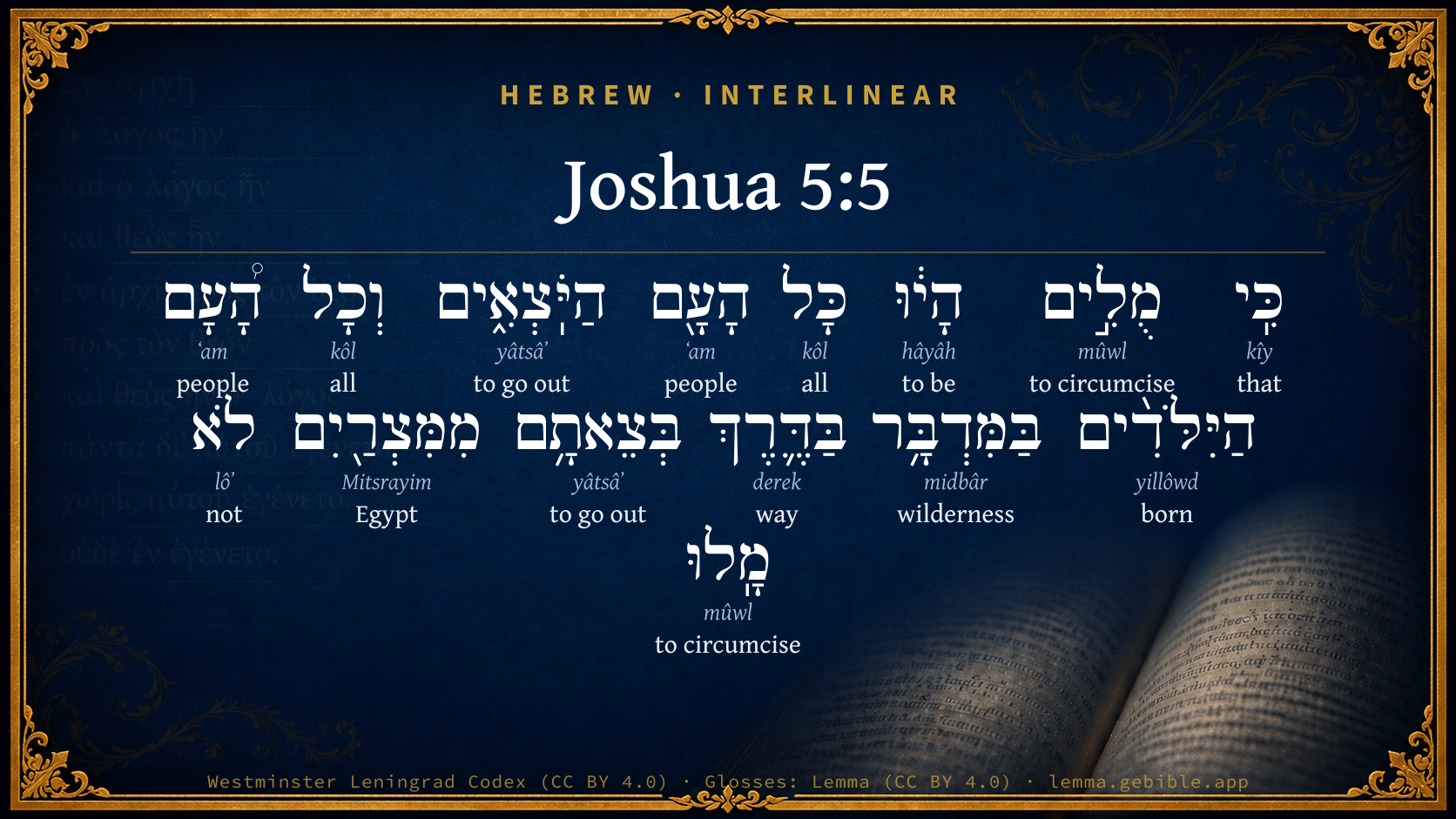
Joshua 5:5

Hebrew (Westminster Leningrad Codex) Joshua 5:5 appears in the Hebrew Old Testament. The text above is from the Westminster Leningrad Codex. Each word links to its Strong’s number, a concise gloss, and parsing drawn from the Open Scriptures Hebrew Bible morphology. Click any word for its full Brown-Driver-Briggs (BDB) entry.
Download image
Cite this verse

Joshua 5:5 (World English Bible). Public Domain. Lemma interlinear Bible study tool, https://lemma.gebible.app/v/joshua/5/5.

Show BibTeX & RIS
BibTeX
RIS
English Translation
For all the people who came out were circumcised; but all the people who were born in the wilderness by the way as they came forth out of Egypt, they had not circumcised.
World English Bible · Public Domain
Download a study sheet

One document with this verse’s original text, its word-by-word gloss line, the meaning frame, cross-references with their text, attributed commentary, and full source and license credits — printable, and it pastes into notes with its structure intact.

This verse Autodidact and up

Study sheet (.html) Plain text (.txt)

A passage Seminary Student

Up to 50 verses in one chapter. A passage sheet keeps up to 6 commentary sources and 12 cross-references per verse, in the order this page ranks them, and says so on the sheet whenever that leaves anything out. Ask for a single verse and you get the Autodidact verse sheet above.

Everything on this page stays free to read, with no account — the sheet is a download of what is already on screen, not access to it.

Want to remove ads? Support Godless Engineer
Compare translations 3

The same verse in 3 English versions, stacked beneath the original-language interlinear above. Click any original word for its lexicon entry.

Each is an independent rendering of the whole verse — the interlinear is not word-aligned to these translations.

Highlighted words mark where these versions differ — a whole-verse word diff, not a word-by-word alignment.

  • World English Bible Public Domain
    For all the people who came out were circumcised; but all the people who were born in the wilderness by the way as they came forth out of Egypt, they had not circumcised.
  • King James Version Public Domain
    Now all the people that came out were circumcised: but all the people that were born in the wilderness by the way as they came forth out of Egypt, them they had not circumcised.
  • unfoldingWord Literal Text CC BY-SA 4.0
    For all of the people having come out were circumcised, but all the people born in the wilderness on the way in their coming out from Egypt they did not circumcise.

unfoldingWord Literal Text — © unfoldingWord, licensed CC BY-SA 4.0. Word-aligned USFM3 via Door43 (git.door43.org/unfoldingWord/en_ult).

Versions to compare (up to 4)

3 of 4 selected

Show all 18 translations

Every available English version of this verse, each an independent rendering of the whole verse.

  • World English Bible Public Domain
    For all the people who came out were circumcised; but all the people who were born in the wilderness by the way as they came forth out of Egypt, they had not circumcised.
  • Berean Standard Bible Public Domain
    Though all who had come out were circumcised, none of those born in the wilderness on the journey from Egypt had been circumcised.
  • Majority Standard Bible Public Domain
    Though all who had come out were circumcised, none of those born in the wilderness on the journey from Egypt had been circumcised.
  • King James Version Public Domain
    Now all the people that came out were circumcised: but all the people that were born in the wilderness by the way as they came forth out of Egypt, them they had not circumcised.
  • American Standard Version (1901) Public Domain
    For all the people that came out were circumcised; but all the people that were born in the wilderness by the way as they came forth out of Egypt, they had not circumcised.
  • Revised Version (1885) Public Domain
    For all the people that came out were circumcised: but all the people that were born in the wilderness by the way as they came forth out of Egypt, they had not circumcised.
  • Geneva Bible (1599) Public Domain
    For all the people that came out were circumcised: but all the people that were borne in the wildernes by the way after they came out of Egypt, were not circumcised.
  • Douay-Rheims (1899) Public Domain
    Now these were all circumcised. But the people that were born in the desert,
  • Young's Literal Translation Public Domain
    for all the people who are coming out were circumcised, and all the people who `are' born in the wilderness, in the way, in their coming out from Egypt, they have not circumcised;
  • Literal Standard Version CC BY-SA 4.0
    for all the people who are coming out were circumcised, and all the people who [are] born in the wilderness, in the way, in their coming out from Egypt, they have not circumcised;
  • Unlocked Literal Bible CC BY-SA 4.0
    Though all the males who came out of Egypt were circumcised, still, none of the boys born in the wilderness on the way out of Egypt had been circumcised.
  • unfoldingWord Literal Text CC BY-SA 4.0
    For all of the people having come out were circumcised, but all the people born in the wilderness on the way in their coming out from Egypt they did not circumcise.
  • Darby Bible Public Domain
    For all the people that came out were circumcised; but all the people that were born in the wilderness on the way, after they came out of Egypt, [them] had they not circumcised.
  • World Messianic Bible Public Domain
    For all the people who came out were circumcised; but all the people who were born in the wilderness along the way as they came out of Egypt had not been circumcised.
  • Webster's Bible Public Domain
    Now all the people that came out were circumcised; but all the people that were born in the wilderness by the way as they came forth from Egypt, them they had not circumcised.
  • Free Bible Version CC BY-SA 4.0
    They had all been circumcised when they left Egypt, but those born on the journey since then had not.
  • Bible in Basic English Public Domain
    All the people who came out had undergone circumcision; but all the people whose birth had taken place in the waste land on their journey from Egypt had not.
  • JPS Tanakh (1917) Public Domain
    For all the people that came out were circumcised; but all the people that were born in the wilderness by the way as they came forth out of Egypt, had not been circumcised.

Literal Standard Version (2020), Covenant Press — licensed CC BY-SA 4.0. Text via the HelloAO Bible API (eBible.org). Unlocked Literal Bible (unfoldingWord) — licensed CC BY-SA 4.0. Text via the HelloAO Bible API (eBible.org). unfoldingWord Literal Text — © unfoldingWord, licensed CC BY-SA 4.0. Word-aligned USFM3 via Door43 (git.door43.org/unfoldingWord/en_ult). Free Bible Version, Dr. Jonathan Gallagher — licensed CC BY-SA 4.0. Text via the HelloAO Bible API (eBible.org).

Word by word

More ways to search: Search by grammar → Find every occurrence → Compare this word →

Practice this passage: Drill this verse → Learn its vocabulary →

הַיִּלֹּדִ֨ים
yillôwd
H3209
“the · born”
Particle, Definite Article + Adjective, Adjective, Masculine, Plural, Absolute
Part of Speech
Particle + Adjective
Type
Adjective
Gender
Masculine
Number
Plural
State
Absolute
Full BDB Definition

Origin: passive from H3205

TWOT: 867d

born
  1. כִּֽי kîy H3588 “that” Conjunction
  2. מֻלִ֣ים mûwl H4135 “circumcised” Verb, Qal, Participle Passive, Masculine, Plural, Absolute
  3. הָי֔וּ hâyâh H1961 “to be” Verb, Qal, Perfect, 3rd Person, Common, Plural
  4. כָּל kôl H3605 “all of” Noun, Common, Masculine, Singular, Construct
  5. הָעָ֖ם ʻam H5971 “the · people” Particle, Definite Article + Noun, Common, Masculine, Singular, Absolute
  6. הַיֹּֽצְאִ֑ים yâtsâʼ H3318 “the · going out” Particle, Definite Article + Verb, Qal, Participle Active, Masculine, Plural, Absolute
  7. וְכָל kôl H3605 “and · all of” Conjunction + Noun, Common, Masculine, Singular, Construct
  8. הָ֠עָם ʻam H5971 “the · people” Particle, Definite Article + Noun, Common, Masculine, Singular, Absolute
  9. בַּמִּדְבָּ֥ר midbâr H4057 “in/at the · wilderness” Preposition, Determined + Noun, Common, Masculine, Singular, Absolute
  10. בַּדֶּ֛רֶךְ derek H1870 “in/at the · way” Preposition, Determined + Noun, Common, Both, Singular, Absolute
  11. בְּצֵאתָ֥ם yâtsâʼ H3318 “in/at · to go out · them” Preposition + Verb, Qal, Infinitive Construct + Suffix, Personal, 3rd Person, Masculine, Plural
  12. מִמִּצְרַ֖יִם Mitsrayim H4714 “from · Egypt” Preposition + Noun, Proper
  13. לֹא lôʼ H3808 “not” Particle, Negative
  14. מָֽלוּ mûwl H4135 “to circumcise” Verb, Qal, Perfect, 3rd Person, Common, Plural

About this verse

These counts appear in no published source. They are computed here, from the morphology-tagged text and Lemma’s own curated glosses. What Lemma adds →

15
words
11
distinct lemmas
Historical
section

Notable vocabulary

The rarest word here is הַיִּלֹּדִ֨ים born H3209 — appearing just 4 times in the whole Hebrew Bible.

Shared distinctive vocabulary

הַיִּלֹּדִ֨ים born H3209 occurs in 4 verses of the Hebrew Bible. Also found in:

Grammatical profile

  • 5 verbs
  • 7 nouns
  • 1 adjective
  • 1 conjunction
  • 1 particle

Verb forms

  • מֻלִ֣ים Qal · Participle Passive
  • הָי֔וּ Qal · Perfect
  • הַיֹּֽצְאִ֑ים Qal · Participle Active
  • בְּצֵאתָ֥ם Qal · Infinitive Construct
  • מָֽלוּ Qal · Perfect

Repetition

Words recur within this verse — often emphatic in Hebrew:

  • מֻלִ֣ים to circumcise H4135 ×2
  • כָּל all H3605 ×2
  • הָעָ֖ם people H5971 ×2
  • הַיֹּֽצְאִ֑ים to go out H3318 ×2

Hebrew & Septuagint length

In English translation the verse runs 33 words from the Hebrew and 16 from the Septuagint (LXX English) — the Septuagint runs noticeably shorter here. See the side-by-side →

A rough comparison of the two English renderings, which tokenize alike — not a word-level alignment.

Word counts can differ between the Hebrew and the Greek without any difference in meaning — e.g. the Hebrew direct-object marker אֵת has no separate Greek word, and Greek often adds the article ὁ.

Cross-references

7

Topical passages linked to Joshua 5:5 in the Treasury of Scripture Knowledge — connected by theme and wording, ordered by reader-vote popularity; previews shown in the World English Bible.

  • Deuteronomy 12:8–9 You shall not do after all the things that we do here this day, every man whatever is right in his own eyes;
  • Hosea 6:6–7 For I desire mercy, and not sacrifice; And the knowledge of God more than burnt offerings.
  • Matthew 12:7 But if you had known what this means, 'I desire mercy, and not sacrifice,' you would not have condemned the guiltless.
  • Romans 2:26 If therefore the uncircumcised keep the ordinances of the law, won't his uncircumcision be accounted as circumcision?
  • 1 Corinthians 7:19 Circumcision is nothing, and uncircumcision is nothing, but the keeping of the commandments of God.
  • Galatians 5:6 For in Christ Jesus neither circumcision amounts to anything, nor uncircumcision, but faith working through love.
  • Galatians 6:15 For in Christ Jesus neither is circumcision anything, nor uncircumcision, but a new creation.

Cross-references courtesy of OpenBible.info (CC BY 4.0).

Hebrew and Greek witnesses Masoretic Hebrew ↔ Greek Septuagint

The same verse in the two great witnesses to the Old Testament, shown verse-for-verse.

Here the Septuagint runs noticeably shorter than the Hebrew — LXX2012 (modern English Septuagint) 16 words vs World English Bible 33. A rough length comparison of the two English translations, not a word-level alignment — read both below.

These are two independent witnesses, not word-aligned to each other, and the Septuagint is shown in lemma (dictionary) form.

Hebrew Joshua 5:5 Masoretic · Westminster Leningrad Codex

כִּֽי מֻלִ֣ים הָי֔וּ כָּל הָעָ֖ם הַיֹּֽצְאִ֑ים וְכָל הָ֠עָם הַיִּלֹּדִ֨ים בַּמִּדְבָּ֥ר בַּדֶּ֛רֶךְ בְּצֵאתָ֥ם מִמִּצְרַ֖יִם לֹא מָֽלוּ

For all the people who came out were circumcised; but all the people who were born in the wilderness by the way as they came forth out of Egypt, they had not circumcised.

World English Bible · Public Domain

Greek LXX Joshua 5:5 Septuagint · lemma form

πᾶς οὗτος περιτέμνω ἰησοῦς

all these Joshua circumcised; for forty and two years Israel wondered in the wilderness of Mabdaris—

LXX2012 (modern English Septuagint) · Public Domain

Hebrew: Westminster Leningrad Codex (CC BY 4.0). Greek: Septuagint (public domain); English from LXX2012 (modern English Septuagint) (Public Domain). How the Septuagint differs from the Hebrew →

Targum (Aramaic paraphrase)

1

The Targum is the ancient Jewish Aramaic paraphrase of the Hebrew Scriptures — an interpretive translation, not the Hebrew text itself. Onkelos (literal) and Pseudo-Jonathan (expansive) render the Torah, and Jonathan the Prophets. Coverage is partial: where no permissively-licensed English translation exists for a verse, only the Aramaic is shown. This is verse-level text, not a word-by-word alignment to the Hebrew.

  1. Targum Jonathan Prophets (Joshua–Malachi)
    אֲרֵי גְזִירִין הֲווֹ כָּל עַמָא דִי נְפַקוּ וְכָל עַמָא דְאִתְיְלִידוּ בְּמַדְבְּרָא בְּאָרְחָא בְּמִפַּקְהוֹן מִמִצְרַיִם לָא גְזָרוּ:

    (no public-domain English translation for this verse)

    Targum Jonathan — Aramaic: “Mikraot Gedolot” (public domain). English: “Sefaria Community Translation” (CC0 1.0 (public-domain dedication)); “London "Chaldee Paraphrase," 1871” (public domain). Text via Sefaria.

Commentary

Notes on Joshua 5:5 from classic Christian and Jewish commentators (each source and its license shown beneath its notes). The classic Christian expositions comment on the surrounding passage and are grouped to its opening verse, so a note may address several verses; the Jewish commentaries on the Tanakh (Rashi and others) are per-verse, so they appear only where the commentator wrote on this verse.

Lemma curates 59 commentaries, every one of them public domain or Creative Commons licensed, each selected and text-cleaned for this edition rather than reprinted as found. About our sources →

Trapp's Complete Commentary

John Trapp

Jos 5:5 Now all the people that came out were circumcised: but all the people [that were] born in the wilderness by the way as they came forth out of Egypt, [them] they had not circumcised.

Ver. 5. Now all the people that came out were circumcised,] i.e., As many as feared the Lord and believed Moses: for a great sort of them, by their long abode in Egypt, were much infected with idolatry and profaneness. {Eze 20:7; Eze 23:3; Eze 23:9}

John Trapp, A Commentary or Exposition upon All the Books of the Old and New Testament (1647–1656) — public domain. Text from a community e-Sword module.

Joseph Benson's Commentary

Jos 5:5. The people born in the wilderness — they had not circumcised — What occasioned this omission is not said, nor is it easy to determine whether it arose from negligence, or from God’s dispensing, for a time, with his ordinance, on account of the unsettledness of their state, and their frequent removes while they were in the wilderness, it being necessary for children, after they were circumcised, and thereby made sore, to rest some time. This latter reason has generally been acquiesced in by commentators. But some have not judged it satisfactory, because sometimes the Israelites continued a year in a place, (Num 9:22,) if not much longer; and in their removes, their little children, though sore, might have been kept so warm, and carried so easy, as to receive no damage; and might certainly have been much better accommodated than the mothers in travail, or in lying-in. They have therefore thought that God’s not expressly and particularly enjoining them (for it does not appear that he did so enjoin them) to circumcise their children while they were in the wilderness, was a continued token of his displeasure against them for their unbelief and murmuring, and a token that they should never have the benefit of that promise of Canaan, whereof circumcision was the seal, Gen 17:8. But whatsoever the reason was, it seems this great ordinance was intermitted in Israel for almost forty years together; a plain indication that it was not of absolute necessity to men’s eternal salvation, nor to be of perpetual obligation, but should, in the fulness of time, be abolished, as now it was for a long time suspended.

Joseph Benson's Commentary on the Old and New Testaments (1811–1818) — public domain. Text from a community e-Sword module.

Geneva Bible (1599)

Geneva Bible translators

For they looked daily to remove at the Lord’s commandment, which thing they that were new circumcised, could not do without great danger.

Geneva Bible (1599) marginal notes — public domain. Text via Bolls.life.

John Gill's Exposition

Now all the people that came out were circumcised,.... All that came out of Egypt, and males, were circumcised, whether under or above twenty years of age; for though it is possible all were circumcised before they came out of Egypt, which favours the opinion of Dr. Lightfoot, that they might be circumcised during the three nights' darkness of the Egyptians, when they could take no advantage of it, as Levi and Simeon did of the Shechemites; and which seems more probable than that it should be on the night they came out of Egypt, when many must have been unfit for travelling, and seems preferable to that of their being circumcised at Mount Sinai, which was a year after their coming out of Egypt:

but all the people that were born in the wilderness by the way, as they came forth out of Egypt, them they had not circumcised; the reasons of which neglect; See Gill on Jos 5:2. The phrase, "by the way", seems to point at the true reason of it, at least to countenance the reason there given, which was on account of their journey; that is, their stay at any place being uncertain and precarious; so the Jews say (z), because of the affliction or trouble of journeying, the Israelites did not circumcise their children. This is to be understood of all males only born in the wilderness, they only being the subjects of circumcision.

(z) Pirke Eliezer, ut supra. (c. 29.)

John Gill's Exposition of the Whole Bible (1746–1763) — public domain (CC PDM 1.0). Text via the HelloAO Bible API.

Haydock's Catholic Bible Commentary

Desert. After the departure from Sinai, where the Passover was celebrated, and where, of course, the people must have been circumcised. (Calmet)

George Leo Haydock (1774–1849), Haydock's Catholic Family Bible and Commentary, 1859 edition — public domain. Excludes Psalms (Douay-Rheims chapter numbering differs from Protestant) and Deuterocanonical books (Catholic canon only).

Matthew Poole's English Annotations

They; either their parents, or the rulers of Israel, whose omission hereof was not through neglect; for then God, who had ordered the neglecter of circumcision to be cut off, Gen 17:14, would not have left so gross a fault unpunished; but by Divine permission and indulgence; partly because they were now in a journey, in which case the passover also might be neglected, Num 9:10,13, and in that journey the passover was but once observed; and partly because there was not so great a necessity of this note of circumcision to distinguish them from other nations, whilst they dwelt alone and unmixed in the wilderness, as there was afterwards.

Matthew Poole's English Annotations on the Holy Bible (1683–1685) — public domain. Text from a community e-Sword/MySword module.

Whedon's Commentary on the Bible

Daniel D. Whedon

5. All the people that came out were circumcised — That is, had been circumcised in infancy. Lev_12:3.

The people… born in the wilderness… they had not circumcised — Various reasons have been assigned for the neglect in the wilderness of this rite, which was so scrupulously performed in Egypt. The fact that they were in an unsettled condition is not a sufficient reason, for they dwelt for months together in one place. The most satisfactory account of the matter is that, while under the sentence of the divine displeasure for forty years, the nation was temporarily rejected by its divine Head, and prohibited from impressing upon their sons the sign of the covenant. See note introductory to Jos_5:2.

Daniel D. Whedon (gen. ed.), Commentary on the Old and New Testaments (1874–1909) — public domain. Text from a community e-Sword module.

The Pulpit Commentary

Now all the people that came out were circumcised. The Hebrew of this passage (which runs literally thus circumcised had they been, all the people who were going forth") is sufficient to refute the idea that there was a great circumcision of the people under Moses, on account of the neglect of the rile in Egypt. For, before the exodus, Moses was not in a position to perform any general act of this kind, as the history plainly shows, while after it such a rite could not have taken place, since the Hebrew Wyh denotes a state of things which was completed at the time spoken of, and therefore must here be rendered (as above) by the pluperfect. Them they had not circumcised. Here again the Hebrew is used of the perfected action, and is therefore rightly rendered by our version, giving the idea that the Israelites who were born in the wilderness had not been circumcised up to the point which our history has now reached. See also ver. 7, where the same construction is found.

The Pulpit Commentary (1880–1919), ed. H.D.M. Spence-Jones & Joseph S. Exell — public domain. Text from a community e-Sword module.

John Wesley's Explanatory Notes

Them - Either their parents, or the rulers of Israel, by Divine permission and indulgence; because they were now on a journey, in which case the passover also might be neglected, Num. ix, 10, 13. Rather, it was a continued token of God's displeasure against them, for their unbelief and murmuring: a token that they should never have the benefit of that promise, whereof circumcision was the seal.

John Wesley, Explanatory Notes Upon the Whole Bible (1754–1765) — public domain. Text via the GEBible commentary corpus.

Rashi

Rabbi Shlomo Yitzchaki (Rashi)

Were not circumcised. As I have previously explained, the north wind had not blown. It was these who were now to be circumcised.

Rashi on the Tanakh — English translations: “The Judaica Press complete Tanach with Rashi, translated by A. J. Rosenberg” (CC BY 4.0); “Pentateuch with Rashi's commentary by M. Rosenbaum and A.M. Silbermann, 1929-1934” (public domain); “The Metsudah Tanach series, Lakewood, N.J” (CC BY 4.0); and “The Book of Joshua, Metsudah Publications, 1997” (CC BY 4.0). Text via Sefaria.

Lesson kit

Teaching starters — assembled from the data on this page, not authored interpretation. Every prompt links to the verse data it draws on. Edit before teaching.

Joshua, in the Historical, opens this verse with 15 words (11 distinct Hebrew lemmas). Its most distinctive word is yillôwd (“born”). The Greek Septuagint runs shorter here. A historical commentator’s framing appears above. Read the whole chapter for the surrounding context.

Discussion questions

  1. What does “born” (yillôwd) contribute to the verse as a whole?
  2. Exodus 1:22 shares the word «born» with this verse. How do the two illuminate each other?
  3. “to circumcise” occurs 2× in this one verse. What is the effect of the repetition?
  4. Compared with the Hebrew, the Septuagint runs shorter here. What questions does that raise?
  5. These translations render this verse differently; the difference is in the English rendering, not the original. What questions does that raise?
  6. The verb «מֻלִ֣ים» is Qal Participle Passive. How does its form color the action?
  7. Reading how Trapp's Complete Commentary and Joseph Benson's Commentary read this verse, where do the two commentators agree and where do they part?

Things to notice

  • These translations choose different wording for 10 words in this verse.
  • “to circumcise” occurs 2× in this single verse.
  • 11 distinct Hebrew lemmas span 15 words in this verse.

Reading settings

Reading text

Shown beneath each verse's original-language words.

Old Testament
Old Testament edition

Read the OT as the Masoretic Hebrew (MT) or the Greek Septuagint (LXX).

English shown for the Greek Septuagint (in the Hebrew ↔ Greek comparison).

Comparing translations? Open the Compare panel on any verse page to stack up to four side by side.