
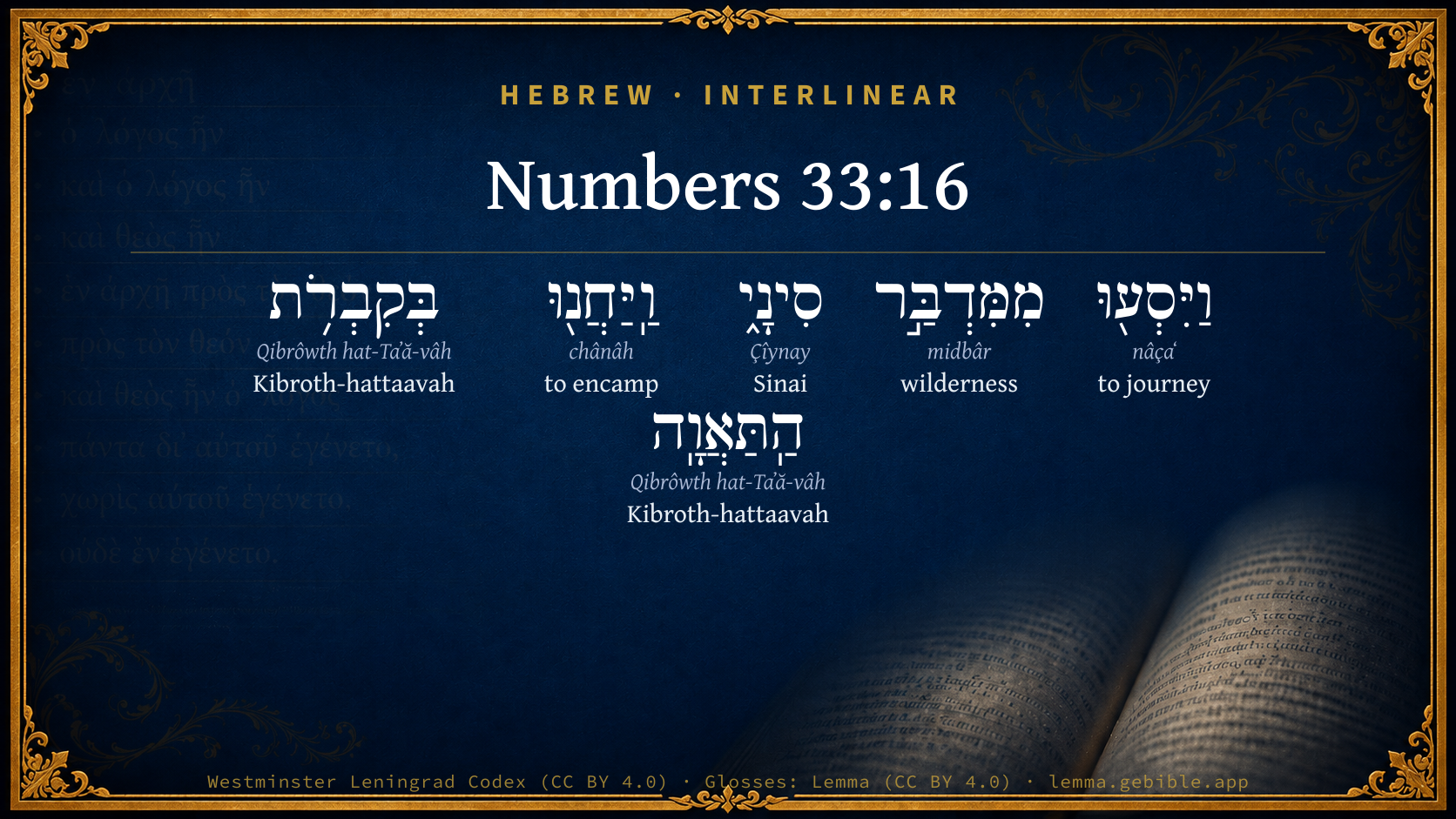
Numbers 33:16

Hebrew (Westminster Leningrad Codex) Numbers 33:16 appears in the Hebrew Old Testament. The text above is from the Westminster Leningrad Codex. Each word links to its Strong’s number, a concise gloss, and parsing drawn from the Open Scriptures Hebrew Bible morphology. Click any word for its full Brown-Driver-Briggs (BDB) entry.
Download image
Cite this verse

Numbers 33:16 (World English Bible). Public Domain. Lemma interlinear Bible study tool, https://lemma.gebible.app/v/numbers/33/16.

Show BibTeX & RIS
BibTeX
RIS
English Translation
They traveled from the wilderness of Sinai, and encamped in Kibroth-hattaavah.
World English Bible · Public Domain
Download a study sheet

One document with this verse’s original text, its word-by-word gloss line, the meaning frame, cross-references with their text, attributed commentary, and full source and license credits — printable, and it pastes into notes with its structure intact.

This verse Autodidact and up

Study sheet (.html) Plain text (.txt)

A passage Seminary Student

Up to 50 verses in one chapter. A passage sheet keeps up to 6 commentary sources and 12 cross-references per verse, in the order this page ranks them, and says so on the sheet whenever that leaves anything out. Ask for a single verse and you get the Autodidact verse sheet above.

Everything on this page stays free to read, with no account — the sheet is a download of what is already on screen, not access to it.

Want to remove ads? Support Godless Engineer
Compare translations 3

The same verse in 3 English versions, stacked beneath the original-language interlinear above. Click any original word for its lexicon entry.

Each is an independent rendering of the whole verse — the interlinear is not word-aligned to these translations.

Highlighted words mark where these versions differ — a whole-verse word diff, not a word-by-word alignment.

  • World English Bible Public Domain
    They traveled from the wilderness of Sinai, and encamped in Kibroth-hattaavah.
  • King James Version Public Domain
    And they removed from the desert of Sinai, and pitched at Kibrothhattaavah.
  • unfoldingWord Literal Text CC BY-SA 4.0
    And they set out from the wilderness of Sinai and camped at Kibroth Hattaavah.

unfoldingWord Literal Text — © unfoldingWord, licensed CC BY-SA 4.0. Word-aligned USFM3 via Door43 (git.door43.org/unfoldingWord/en_ult).

Versions to compare (up to 4)

3 of 4 selected

Show all 18 translations

Every available English version of this verse, each an independent rendering of the whole verse.

  • World English Bible Public Domain
    They traveled from the wilderness of Sinai, and encamped in Kibroth-hattaavah.
  • Berean Standard Bible Public Domain
    They set out from the Wilderness of Sinai and camped at Kibroth-hattaavah.
  • Majority Standard Bible Public Domain
    They set out from the Wilderness of Sinai and camped at Kibroth-hattaavah.
  • King James Version Public Domain
    And they removed from the desert of Sinai, and pitched at Kibrothhattaavah.
  • American Standard Version (1901) Public Domain
    And they journeyed from the wilderness of Sinai, and encamped in Kibroth-hattaavah.
  • Revised Version (1885) Public Domain
    And they journeyed from the wilderness of Sinai, and pitched in Kibroth-hattaavah.
  • Geneva Bible (1599) Public Domain
    And they remoued from the desert of Sinai, and pitched in Kibroth Hattaauah.
  • Douay-Rheims (1899) Public Domain
    But departing also from the desert of Sinai, they came to the graves of lust.
  • Young's Literal Translation Public Domain
    and they journey from the wilderness of Sinai, and encamp in Kibroth-Hattaavah.
  • Literal Standard Version CC BY-SA 4.0
    And they journey from the wilderness of Sinai and encamp in Kibroth-Hattaavah.
  • Unlocked Literal Bible CC BY-SA 4.0
    They set out from the wilderness of Sinai and camped at Kibroth Hattaavah.
  • unfoldingWord Literal Text CC BY-SA 4.0
    And they set out from the wilderness of Sinai and camped at Kibroth Hattaavah.
  • Darby Bible Public Domain
    And they removed from the wilderness of Sinai, and encamped at Kibroth-hattaavah.
  • World Messianic Bible Public Domain
    They traveled from the wilderness of Sinai, and encamped in Kibroth Hattaavah.
  • Webster's Bible Public Domain
    And they removed from the desert of Sinai, and encamped at Kibroth-hattaavah.
  • Free Bible Version CC BY-SA 4.0
    They moved on from the Sinai Desert and set up camp at Kibroth-hattaavah.
  • Bible in Basic English Public Domain
    And they went on from the waste land of Sinai and put up their tents in Kibroth-hattaavah.
  • JPS Tanakh (1917) Public Domain
    And they journeyed from the wilderness of Sinai, and pitched in Kibroth-hattaavah.

Literal Standard Version (2020), Covenant Press — licensed CC BY-SA 4.0. Text via the HelloAO Bible API (eBible.org). Unlocked Literal Bible (unfoldingWord) — licensed CC BY-SA 4.0. Text via the HelloAO Bible API (eBible.org). unfoldingWord Literal Text — © unfoldingWord, licensed CC BY-SA 4.0. Word-aligned USFM3 via Door43 (git.door43.org/unfoldingWord/en_ult). Free Bible Version, Dr. Jonathan Gallagher — licensed CC BY-SA 4.0. Text via the HelloAO Bible API (eBible.org).

Word by word

More ways to search: Search by grammar → Find every occurrence → Compare this word →

Practice this passage: Drill this verse → Learn its vocabulary →

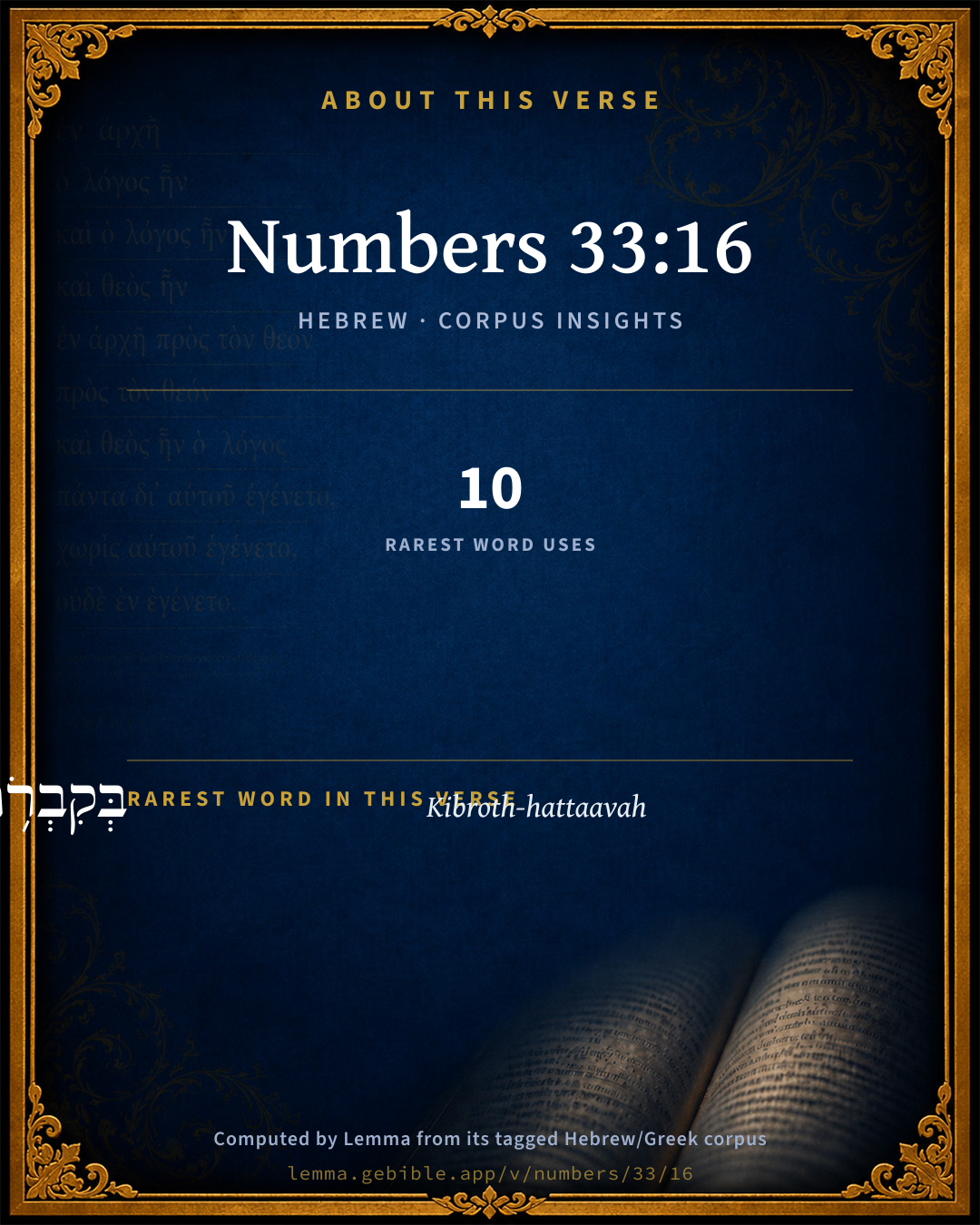
About this verse

These counts appear in no published source. They are computed here, from the morphology-tagged text and Lemma’s own curated glosses. What Lemma adds →

6
words
5
distinct lemmas
Pentateuch
section

Notable vocabulary

The rarest word here is בְּקִבְרֹ֥ת Kibroth-hattaavah H6914 — appearing just 10 times in the whole Hebrew Bible.

Shared distinctive vocabulary

בְּקִבְרֹ֥ת Kibroth-hattaavah H6914 occurs in 5 verses of the Hebrew Bible. Also found in:

Grammatical profile

  • 2 verbs
  • 4 nouns

Verb forms

  • וַיִּסְע֖וּ Qal · Sequential Imperfect
  • וַֽיַּחֲנ֖וּ Qal · Sequential Imperfect

Repetition

A word recurs within this verse — often emphatic in Hebrew:

  • בְּקִבְרֹ֥ת Kibroth-hattaavah H6914 ×2

Hebrew & Septuagint length

In English translation the verse runs 11 words from the Hebrew and 15 from the Septuagint (LXX English) — closely comparable.

A rough comparison of the two English renderings, which tokenize alike — not a word-level alignment.

Word counts can differ between the Hebrew and the Greek without any difference in meaning — e.g. the Hebrew direct-object marker אֵת has no separate Greek word, and Greek often adds the article ὁ.

Cross-references

5

Topical passages linked to Numbers 33:16 in the Treasury of Scripture Knowledge — connected by theme and wording, ordered by reader-vote popularity; previews shown in the World English Bible.

  • Numbers 11:34 The name of that place was called Kibrothhattaavah, because there they buried the people who lusted.
  • Numbers 10:11–13 It happened in the second year, in the second month, on the twentieth day of the month, that the cloud was taken up from over the tent of the testimony.
  • Numbers 10:33 They set forward from the Mount of Yahweh three days' journey; and the ark of the covenant of Yahweh went before them three days' journey, to seek out a resting-place for them.
  • Numbers 11:4 The mixed multitude that was among them lusted exceedingly: and the children of Israel also wept again, and said, Who shall give us flesh to eat?
  • Deuteronomy 1:6 Yahweh our God spoke to us in Horeb, saying, You have lived long enough in this mountain:

Cross-references courtesy of OpenBible.info (CC BY 4.0).

Hebrew and Greek witnesses Masoretic Hebrew ↔ Greek Septuagint

The same verse in the two great witnesses to the Old Testament, shown verse-for-verse.

These are two independent witnesses, not word-aligned to each other, and the Septuagint is shown in lemma (dictionary) form.

Hebrew Numbers 33:16 Masoretic · Westminster Leningrad Codex

וַיִּסְע֖וּ מִמִּדְבַּ֣ר סִינָ֑י וַֽיַּחֲנ֖וּ בְּקִבְרֹ֥ת הַֽתַּאֲוָֽה

They traveled from the wilderness of Sinai, and encamped in Kibroth-hattaavah.

World English Bible · Public Domain

Greek LXX Numbers 33:16 Septuagint · lemma form

καί ἀποαἴρω ἐκ ὁ ἔρημος σινα καί παρα ἐνβάλλω ἐν μνῆμα ὁ ἐπιθυμία

And they departed from the wilderness of Sina, and encamped at the Graves of Lust.

LXX2012 (modern English Septuagint) · Public Domain

Hebrew: Westminster Leningrad Codex (CC BY 4.0). Greek: Septuagint (public domain); English from LXX2012 (modern English Septuagint) (Public Domain). How the Septuagint differs from the Hebrew →

Targum (Aramaic paraphrase)

2

The Targum is the ancient Jewish Aramaic paraphrase of the Hebrew Scriptures — an interpretive translation, not the Hebrew text itself. Onkelos (literal) and Pseudo-Jonathan (expansive) render the Torah, and Jonathan the Prophets. Coverage is partial: where no permissively-licensed English translation exists for a verse, only the Aramaic is shown. This is verse-level text, not a word-by-word alignment to the Hebrew.

  1. Targum Onkelos Torah (Genesis–Deuteronomy)
    וּנְטָלוּ מִמַדְבְּרָא דְסִינָי וּשְׁרוֹ בְּקִבְרֵי דִמְשַׁאֲלֵי

    (no public-domain English translation for this verse)

    Targum Onkelos — Aramaic: “Onkelos Genesis” (public domain); “Onkelos Exodus” (public domain); “Onkelos Leviticus” (public domain); “Onkelos Numbers” (public domain); “Onkelos Deuteronomy” (public domain). English: “Sefaria Community Translation” (CC0 1.0 (public-domain dedication)); “J.W. Etheridge. The Targums of Onkelos and Jonathan Ben Uzziel on the Pentateuch. London: Longmans, Green, 1862” (public domain). Text via Sefaria.

  2. Targum Pseudo-Jonathan Torah (Genesis–Deuteronomy)
    וּנְטָלוּ מִמַדְבְּרָא דְסִינָי וּשְׁרוֹ בְּקִבְרֵי דִמְשַׁאֲלֵי בִּישְרָא

    thence to the Graves of those who desired flesh;

    Targum Pseudo-Jonathan — Aramaic: “Targum Jonathan on Genesis” (public domain); “Targum Jonathan on Exodus” (public domain); “Targum Jonathan on Leviticus” (public domain); “Targum Jonathan on Numbers” (public domain); “Targum Jonathan on Deuteronomy” (public domain). English: “The Targum of Jonathan ben Uzziel, trans. J. W. Etheridge, London, 1862” (public domain). Text via Sefaria.

Commentary

Notes on Numbers 33:16 from classic Christian and Jewish commentators (each source and its license shown beneath its notes). The classic Christian expositions comment on the surrounding passage and are grouped to its opening verse, so a note may address several verses; the Jewish commentaries on the Tanakh (Rashi and others) are per-verse, so they appear only where the commentator wrote on this verse.

Lemma curates 59 commentaries, every one of them public domain or Creative Commons licensed, each selected and text-cleaned for this edition rather than reprinted as found. About our sources →

Jamieson, Fausset & Brown

Robert Jamieson, A. R. Fausset & David Brown

FROM SINAI TO KADESH AND PLAINS OF MOAB. (Num. 33:16-56)

Kibroth-Hattaavah ("the graves of lust," see on Num 11:34) --The route, on breaking up the encampment at Sinai, led down Wady Sheikh; then crossing Jebel-et-Tih, which intersected the peninsula, they descended into Wady Zalaka, pitching successively at two brief, though memorable, stations (Deu 9:22); then they encamped at Hazeroth ("unwalled villages"), supposed to be at Ain-Hadera (see on Num 11:35). Kadesh, or Kadesh-barnea, is supposed to be the great valley of the Ghor, and the city Kadesh to have been situated on the border of this valley [BURCKHARDT; ROBINSON]. But as there are no less than eighteen stations inserted between Hazeroth and Kadesh, and only eleven days were spent in performing that journey (Deu 1:2), it is evident that the intermediate stations here recorded belong to another and totally different visit to Kadesh. The first was when they left Sinai in the second month (Num 1:11; Num 13:20), and were in Kadesh in August (Deu 1:45), and "abode many days" in it. Then, murmuring at the report of the spies, they were commanded to return into the desert "by the way of the Red Sea." The arrival at Kadesh, mentioned in this catalogue, corresponds to the second sojourn at that place, being the first month, or April (Num 20:1). Between the two visits there intervened a period of thirty-eight years, during which they wandered hither and thither through all the region of El-Tih ("wanderings"), often returning to the same spots as the pastoral necessities of their flocks required; and there is the strongest reason for believing that the stations named between Hazeroth (Num 33:8) and Kadesh (Num 33:36) belong to the long interval of wandering. No certainty has yet been attained in ascertaining the locale of many of these stations. There must have been more than are recorded; for it is probable that those only are noted where they remained some time, where the tabernacle was pitched, and where Moses and the elders encamped, the people being scattered for pasture in various directions. From Ezion-geber, for instance, which stood at the head of the gulf of Akaba, to Kadesh, could not be much less than the whole length of the great valley of the Ghor, a distance of not less than a hundred miles, whatever might be the exact situation of Kadesh; and, of course, there must have been several intervening stations, though none are mentioned. The incidents and stages of the rest of the journey to the plains of Moab are sufficiently explicit from the preceding chapters.

Jamieson, Fausset & Brown — Commentary Critical and Explanatory on the Whole Bible (1871) — public domain (CC PDM 1.0). Text via the HelloAO Bible API.

Tyndale Open Study Notes

Tyndale Open Resources

33:16-36 The journey between Sinai and Kadesh. Our ability to locate the named sites depends on the identification of Mount Sinai.

33:16-17 Kibroth-hattaavah . . . Hazeroth: See 11:34–12:16.

Tyndale Open Study Notes — © Tyndale Open Resources, licensed CC BY-SA 4.0. Text via the HelloAO Bible API.

Adam Clarke's Commentary

STAT. XII.

Verse 16. KIBROTH-HATTAAVAH.] No city, village, &c., but a place in the open desert, which had its name from the plague that fell upon the Israelites, through their murmuring against God, and their inordinate desire of flesh. See Clarke on Nu 6:1 &c. But it appears that the Israelites had travelled three days' journey in order to reach this place, Nu 10:33, and commentators suppose there must have been other stations which are not laid down here, probably because the places were not remarkable.

Adam Clarke's Commentary on the Bible (1810–1826) — public domain. Text from a community e-Sword/MySword module.

John Gill's Exposition

And they departed from Rithmah, and pitched at Rimmonparez. Six miles from Rithmah, and then from Rimmon to Libnah, which was six miles also; and from thence to Rissah, which was six miles more; and from Rissah to, Kehelathah, which was the same number of miles; and from thence to Shapher, which was six miles also; and then they came to Haradah, which was four miles from thence; the next remove was to Makheloth, which was four miles and a half from the last place; then they went to Tahath, which was four miles more; and from thence to Tarah, which also was four miles; the next place they came to was Mithcah, four miles from Tarah; and then to Hashmonah, which was eight miles more.

And they departed from Rithmah, and pitched at Rimmonparez. Six miles from Rithmah, and then from Rimmon to Libnah, which was six miles also; and from thence to Rissah, which was six miles more; and from Rissah to, Kehelathah, which was the same number of miles; and from thence to Shapher, which was six miles also; and then they came to Haradah, which was four miles from thence; the next remove was to Makheloth, which was four miles and a half from the last place; then they went to Tahath, which was four miles more; and from thence to Tarah, which also was four miles; the next place they came to was Mithcah, four miles from Tarah; and then to Hashmonah, which was eight miles more.

Numbers 33:30

num 33:30

num 33:30

num 33:30And they departed from Hashmonah, and encamped at Moseroth. Thirty two miles from Hashmonah. In Deu 10:6 it is called Mosera; and according to the account there, they came hither from the following place, Benejaakan; probably they went first thither from Hashmonah, and then from Mosera or Moserot, and so to Benejaakan again, going backwards and forwards, so Jarchi; the distance of the two places was twenty four miles; for the further reconciliation this; see Gill on Deu 10:6 and the Samaritan version there.

John Gill's Exposition of the Whole Bible (1746–1763) — public domain (CC PDM 1.0). Text via the HelloAO Bible API.

Haydock's Catholic Bible Commentary

Lust. After three days’ journey, passing by the station of burning, chap. x. 33., and xi. 3.

George Leo Haydock (1774–1849), Haydock's Catholic Family Bible and Commentary, 1859 edition — public domain. Excludes Psalms (Douay-Rheims chapter numbering differs from Protestant) and Deuterocanonical books (Catholic canon only).

Whedon's Commentary on the Bible

Daniel D. Whedon

16. Kibroth-hattaavah — Also called Taberah. Num_11:3; Num_11:34, notes. A glance at Kiepert’s or any good map will show that from Sinai to Canaan there was a choice between two main routes, namely, that on the west of the high plateau called the Tih region, and that on the east going up the ‘Arabah or desert valley west of Mount Seir. There are good reasons for supposing that Moses took the eastern route, and that Kibroth-hattaavah is to be sought for in this direction.

Daniel D. Whedon (gen. ed.), Commentary on the Old and New Testaments (1874–1909) — public domain. Text from a community e-Sword module.

Scofield Reference Notes

C. I. Scofield

Kibroth-hattaavah

i.e. the graves of lust.

The Scofield Reference Bible (1917 edition), notes by C. I. Scofield — public domain. Text from a community e-Sword module.

Lesson kit

Teaching starters — assembled from the data on this page, not authored interpretation. Every prompt links to the verse data it draws on. Edit before teaching.

Numbers, in the Pentateuch, opens this verse with 6 words (5 distinct Hebrew lemmas). Its most distinctive word is Qibrôwth hat-Taʼă-vâh (“Kibroth-hattaavah”). A historical commentator’s framing appears above. Read the whole chapter for the surrounding context.

Discussion questions

  1. The word Qibrôwth hat-Taʼă-vâh carries the sense “Kibroth-hattaavah.” How does it shape the verse?
  2. How does Numbers 11:34, which shares the word «Kibroth-hattaavah», read alongside this verse?
  3. What does the repetition of “Kibroth-hattaavah” (2× in this one verse) do in this verse?
  4. These translations render this verse differently; the difference is in the English rendering, not the original. What questions does that raise?
  5. «וַיִּסְע֖וּ» is a Qal Sequential Imperfect verb. How does that grammatical form shape the action described?
  6. Compare how Jamieson, Fausset & Brown and Tyndale Open Study Notes read this verse. Where do they agree or differ?

Things to notice

  • These translations choose different wording for 13 words in this verse.
  • “Kibroth-hattaavah” occurs 2× in this single verse.
  • 5 distinct Hebrew lemmas span 6 words in this verse.

Reading settings

Reading text

Shown beneath each verse's original-language words.

Old Testament
Old Testament edition

Read the OT as the Masoretic Hebrew (MT) or the Greek Septuagint (LXX).

English shown for the Greek Septuagint (in the Hebrew ↔ Greek comparison).

Comparing translations? Open the Compare panel on any verse page to stack up to four side by side.