
Psalms 107:4

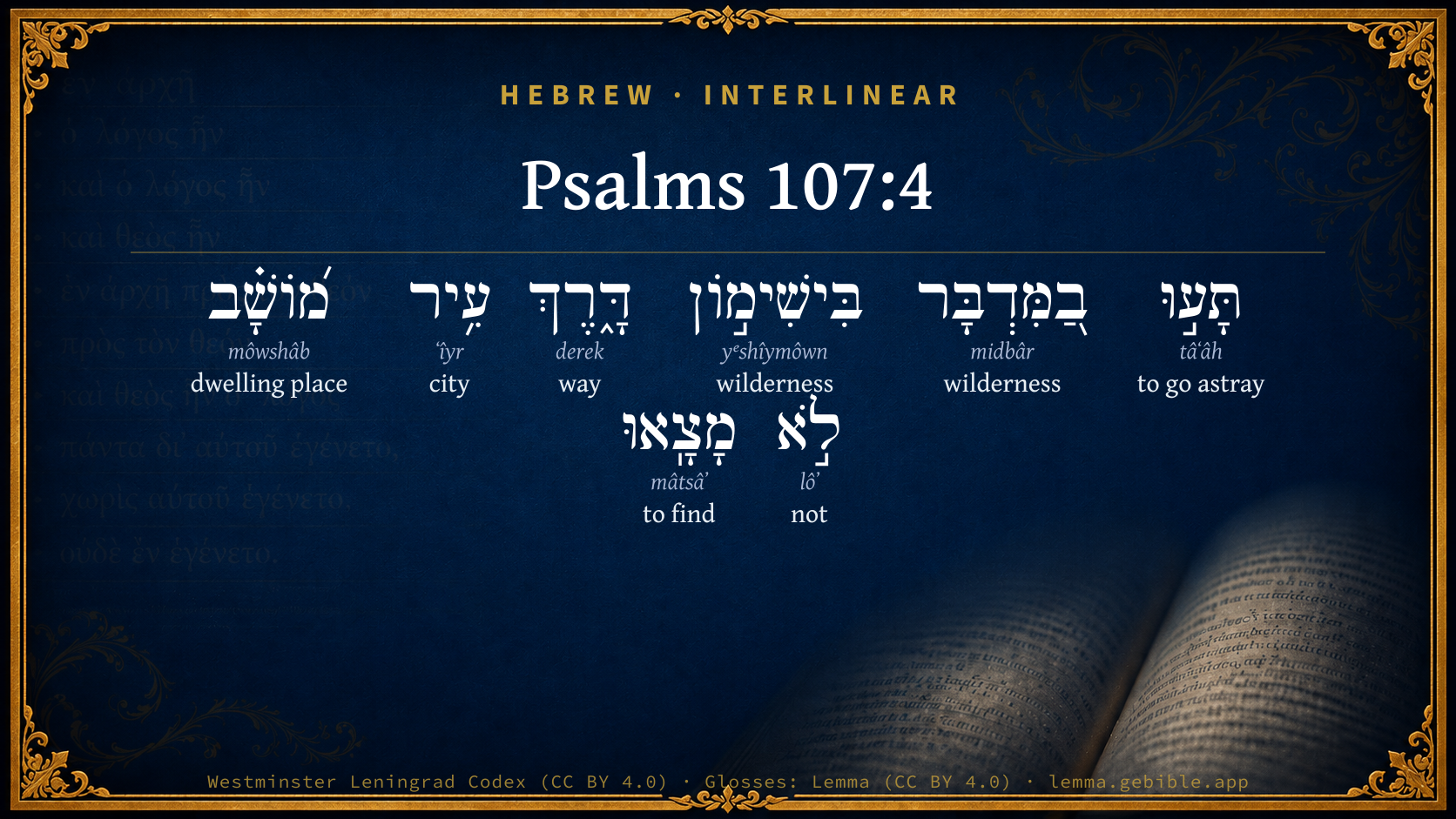
Hebrew (Westminster Leningrad Codex) Psalms 107:4 appears in the Hebrew Old Testament. The text above is from the Westminster Leningrad Codex. Each word links to its Strong’s number, a concise gloss, and parsing drawn from the Open Scriptures Hebrew Bible morphology. Click any word for its full Brown-Driver-Briggs (BDB) entry.
Download image
Cite this verse

Psalms 107:4 (World English Bible). Public Domain. Lemma interlinear Bible study tool, https://lemma.gebible.app/v/psalms/107/4.

Show BibTeX & RIS
BibTeX
RIS
English Translation
They wandered in the wilderness in a desert way. They found no city to live in.
World English Bible · Public Domain
Download a study sheet

One document with this verse’s original text, its word-by-word gloss line, the meaning frame, cross-references with their text, attributed commentary, and full source and license credits — printable, and it pastes into notes with its structure intact.

This verse Autodidact and up

Study sheet (.html) Plain text (.txt)

A passage Seminary Student

Up to 50 verses in one chapter. A passage sheet keeps up to 6 commentary sources and 12 cross-references per verse, in the order this page ranks them, and says so on the sheet whenever that leaves anything out. Ask for a single verse and you get the Autodidact verse sheet above.

Everything on this page stays free to read, with no account — the sheet is a download of what is already on screen, not access to it.

Want to remove ads? Support Godless Engineer
Compare translations 3

The same verse in 3 English versions, stacked beneath the original-language interlinear above. Click any original word for its lexicon entry.

Each is an independent rendering of the whole verse — the interlinear is not word-aligned to these translations.

Highlighted words mark where these versions differ — a whole-verse word diff, not a word-by-word alignment.

  • World English Bible Public Domain
    They wandered in the wilderness in a desert way. They found no city to live in.
  • King James Version Public Domain
    They wandered in the wilderness in a solitary way; they found no city to dwell in.
  • unfoldingWord Literal Text CC BY-SA 4.0
    They wandered in the desert with wilderness for a road; a city for a home they did not find.

unfoldingWord Literal Text — © unfoldingWord, licensed CC BY-SA 4.0. Word-aligned USFM3 via Door43 (git.door43.org/unfoldingWord/en_ult).

Versions to compare (up to 4)

3 of 4 selected

Show all 18 translations

Every available English version of this verse, each an independent rendering of the whole verse.

  • World English Bible Public Domain
    They wandered in the wilderness in a desert way. They found no city to live in.
  • Berean Standard Bible Public Domain
    Some wandered in desert wastelands, finding no path to a city in which to dwell.
  • Majority Standard Bible Public Domain
    Some wandered in desert wastelands, finding no path to a city in which to dwell.
  • King James Version Public Domain
    They wandered in the wilderness in a solitary way; they found no city to dwell in.
  • American Standard Version (1901) Public Domain
    They wandered in the wilderness in a desert way; They found no city of habitation.
  • Revised Version (1885) Public Domain
    They wandered in the wilderness in a desert way; they found no city of habitation.
  • Geneva Bible (1599) Public Domain
    When they wandered in the desert and wildernesse out of the waie, and founde no citie to dwell in,
  • Douay-Rheims (1899) Public Domain
    They wandered in a wilderness, in a place without water: they found not the way of a city for their habitation.
  • Young's Literal Translation Public Domain
    They wandered in a wilderness, in a desert by the way, A city of habitation they have not found.
  • Literal Standard Version CC BY-SA 4.0
    They wandered in a wilderness, in a desert by the way, || They have not found a city of habitation.
  • Unlocked Literal Bible CC BY-SA 4.0
    They wandered in the wilderness on a desert road and found no city in which to live.
  • unfoldingWord Literal Text CC BY-SA 4.0
    They wandered in the desert with wilderness for a road; a city for a home they did not find.
  • Darby Bible Public Domain
    They wandered in the wilderness in a desert way, they found no city of habitation;
  • World Messianic Bible Public Domain
    They wandered in the wilderness in a desert way. They found no city to live in.
  • Webster's Bible Public Domain
    They wandered in the wilderness in a solitary way; they found no city to dwell in.
  • Free Bible Version CC BY-SA 4.0
    They wandered in the desert wilderness, unable to find a way to a city where they could live.
  • Bible in Basic English Public Domain
    They were wandering in the waste places; they saw no way to a resting-place.
  • JPS Tanakh (1917) Public Domain
    They wandered in the wilderness in a desert way; they found no city of habitation.

Literal Standard Version (2020), Covenant Press — licensed CC BY-SA 4.0. Text via the HelloAO Bible API (eBible.org). Unlocked Literal Bible (unfoldingWord) — licensed CC BY-SA 4.0. Text via the HelloAO Bible API (eBible.org). unfoldingWord Literal Text — © unfoldingWord, licensed CC BY-SA 4.0. Word-aligned USFM3 via Door43 (git.door43.org/unfoldingWord/en_ult). Free Bible Version, Dr. Jonathan Gallagher — licensed CC BY-SA 4.0. Text via the HelloAO Bible API (eBible.org).

Word by word

More ways to search: Search by grammar → Find every occurrence → Compare this word →

Practice this passage: Drill this verse → Learn its vocabulary →

About this verse

These counts appear in no published source. They are computed here, from the morphology-tagged text and Lemma’s own curated glosses. What Lemma adds →

8
words
8
distinct lemmas
Wisdom
section

Notable vocabulary

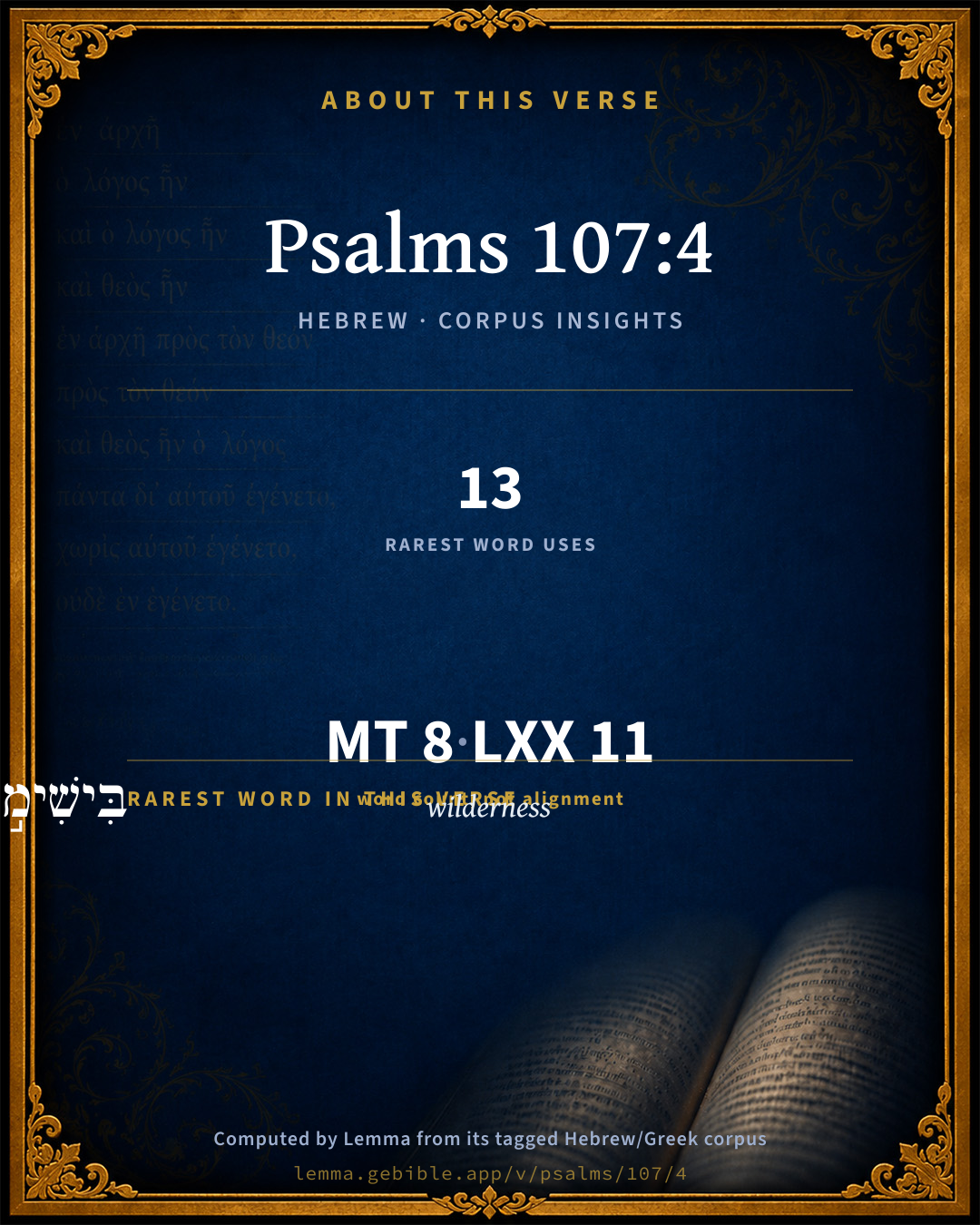
The rarest word here is בִּישִׁימ֣וֹן wilderness H3452 — appearing just 13 times in the whole Hebrew Bible.

Shared distinctive vocabulary

בִּישִׁימ֣וֹן wilderness H3452 occurs in 13 verses of the Hebrew Bible. Also found in:

Grammatical profile

  • 2 verbs
  • 5 nouns
  • 1 particle

Verb forms

  • תָּע֣וּ Qal · Perfect
  • מָצָֽאוּ Qal · Perfect

Hebrew & Septuagint length

In English translation the verse runs 16 words from the Hebrew and 18 from the Septuagint (LXX English) — closely comparable.

A rough comparison of the two English renderings, which tokenize alike — not a word-level alignment.

Word counts can differ between the Hebrew and the Greek without any difference in meaning — e.g. the Hebrew direct-object marker אֵת has no separate Greek word, and Greek often adds the article ὁ.

In the original languages it is 8 Hebrew tokens and 11 Greek tokens — but the two are counted differently (Hebrew bundles its prefixes and suffixes into one token; the Greek is in lemma form), so that isn’t a like-for-like length.

Cross-references

11

Topical passages linked to Psalms 107:4 in the Treasury of Scripture Knowledge — connected by theme and wording, ordered by reader-vote popularity; previews shown in the World English Bible.

  • Deuteronomy 32:10 He found him in a desert land, In the waste howling wilderness; He compassed him about, he cared for him, He kept him as the apple of his eye.
  • Ezekiel 34:6 My sheep wandered through all the mountains, and on every high hill: yes, my sheep were scattered on all the surface of the earth; and there was none who searched or sought.
  • Ezekiel 34:12 As a shepherd seeks out his flock in the day that he is among his sheep that are scattered abroad, so will I seek out my sheep; and I will deliver them out of all places where they have been scattered in the cloudy and dark day.
  • Numbers 14:33 Your children shall be wanderers in the wilderness forty years, and shall bear your prostitution, until your dead bodies be consumed in the wilderness.
  • Genesis 21:14–16 Abraham rose up early in the morning, and took bread and a bottle of water, and gave it to Hagar, putting it on her shoulder, and gave her the child, and sent her away. She departed, and wandered in the wilderness of Beersheba.
  • Job 12:24 He takes away understanding from the chiefs of the people of the earth, And causes them to wander in a wilderness where there is no way.
  • Psalms 107:40 He pours contempt on princes, And causes them to wander in a trackless waste.
  • Hebrews 11:38 (of whom the world was not worthy), wandering in deserts, mountains, caves, and the holes of the earth.
  • Numbers 32:13 Yahweh's anger was kindled against Israel, and he made them wander back and forth in the wilderness forty years, until all the generation, who had done evil in the sight of Yahweh, was consumed.
  • Deuteronomy 8:15 who led you through the great and terrible wilderness, [in which were] fiery serpents and scorpions, and thirsty ground where was no water; who brought you forth water out of the rock of flint;
  • Revelation 12:6 The woman fled into the wilderness, where she has a place prepared by God, that there they may nourish her one thousand two hundred sixty days.

Cross-references courtesy of OpenBible.info (CC BY 4.0).

Hebrew and Greek witnesses Masoretic Hebrew ↔ Greek Septuagint

The same verse in the two great witnesses to the Old Testament, shown verse-for-verse.

You’re reading Greek Psalm 106 (Hebrew Psalm 107). The Septuagint counts the superscription, so verse numbers can differ from the Hebrew — chapter-level alignment, not verse-by-verse. Numbering follows Rahlfs.

These are two independent witnesses, not word-aligned to each other, and the Septuagint is shown in lemma (dictionary) form.

Hebrew Psalms 107:4 Masoretic · Westminster Leningrad Codex

תָּע֣וּ בַ֭מִּדְבָּר בִּישִׁימ֣וֹן דָּ֑רֶךְ עִ֥יר מ֝וֹשָׁ֗ב לֹ֣א מָצָֽאוּ

They wandered in the wilderness in a desert way. They found no city to live in.

World English Bible · Public Domain

Greek LXX Greek Psalm 106:4 Septuagint · lemma form

πλανάω ἐν ὁ ἔρημος ἐν ἄνυδρος ὁδός πόλις κατοικητήριον οὐ εὑρίσκω

They wandered in the wilderness in a dry land; they found no way to a city of habitation.

LXX2012 (modern English Septuagint) · Public Domain

On this verse, The Cambridge Bible for Schools and Colleges discusses the Septuagint’s reading. Read the note in Commentary ↓

Hebrew: Westminster Leningrad Codex (CC BY 4.0). Greek: Septuagint (public domain); English from LXX2012 (modern English Septuagint) (Public Domain). How the Septuagint differs from the Hebrew →

Commentary

Notes on Psalms 107:4 from classic Christian and Jewish commentators (each source and its license shown beneath its notes). The classic Christian expositions comment on the surrounding passage and are grouped to its opening verse, so a note may address several verses; the Jewish commentaries on the Tanakh (Rashi and others) are per-verse, so they appear only where the commentator wrote on this verse.

Lemma curates 59 commentaries, every one of them public domain or Creative Commons licensed, each selected and text-cleaned for this edition rather than reprinted as found. About our sources →

The Cambridge Bible for Schools and Colleges

gen. ed. J. J. S. Perowne

4. They wandered &c.] The subject of the verb is to be supplied, according to a common Hebrew idiom, from the verb itself. We might paraphrase the words ‘There were travellers who had lost their way in the desert.’ The absence of any expressed subject has led some commentators to connect Psa_107:2-3 with Psa_107:4. But this ruins the symmetry of the Psalm. If Psa_107:1-3 are regarded as a general introduction, each stanza will begin with a description of the plight of the sufferers whose deliverance is subsequently described.

in a solitary way] R.V. in a desert way. But the phrase is a questionable one; and it is preferable to follow the LXX[61] and Syr. in reading, They wandered in the wilderness, in the desert; the way to a city of habitation they found not.

[61] ὁδὸν πόλεως κατοικητηρίου οὐχ εὖρον, אc.a. ART Vg.: the singular reading of א ὁδὸν πόλιν printed in Swete’s edition (B is here wanting) may however be held to support the Mass. text, if ὁδόν is transferred to the previous line.

no city to dwell in] Lit. no city of habitation, a phrase peculiar to this Psalms , vv7, 36; no inhabited city where they might obtain food and shelter.

4–9. First example of Jehovah’s lovingkindness to men: the deliverance of travellers who had lost their way in the desert and were on the point of perishing, doubtless a common experience. Cp. Job_6:18-20.

The Cambridge Bible for Schools and Colleges (gen. ed. J. J. S. Perowne; Cambridge University Press, 1878–1918) — public domain. Text from a community e-Sword module.

Trapp's Complete Commentary

John Trapp

Psa 107:4 They wandered in the wilderness in a solitary way; they found no city to dwell in.

Ver. 4. They wandered in the wilderness, &c.] This is a sad case, Mendicum patria amissa laribusque vagari.

Pλαγχθοσυνης ουκ εστι κακωτερον αλλο βροτοισι.

And yet this is the case of all God’s redeemed ones while they are here, Heb 11:38 1Pe 2:12.

Per varios casus per tot discrlmina rerum

Tendimus in patriam veram vitamque perennem.

John Trapp, A Commentary or Exposition upon All the Books of the Old and New Testament (1647–1656) — public domain. Text from a community e-Sword module.

The Biblical Illustrator

Joseph S. Exell

Psa_107:4

They wandered in the wilderness.

The sinner homeless

The old legend of the Wandering Jew tells us how he who had struck and insulted Jesus as He left the Judgment Hall was condemned to wander homeless through many lands, a stranger, unwelcomed and uncared for, who found no city to dwell in. The legend is not without its teaching. Those who wilfully sin against Jesus and the Truth wander through the wilderness of the world out of the right way. They are in a barren and dry land where no water is--no water of life, no water of grace, no water of penitent tears. They are homeless, they find no city to dwell in. Like the Prodigal, they have left their Fathers House, their true home; they have wandered from the true Food, and they are hungry; they have deserted the true Fountain, and they are athirst--Hungry and, thirsty, their soul fainted in them. They have shut themselves out of Gods House, and it is no longer home to them. (H. J. Wilmot Buxton, M.A.)

The Biblical Illustrator, edited by Joseph S. Exell (c. 1880s–1900s) — public domain. Text from a community e-Sword module.

Joseph Benson's Commentary

Psa 107:4-7. They wandered in the wilderness — Where there was no trodden path, no company, but a solitary way. They found no city to dwell in — Or rather, no inhabited city, or town, no lodging; no conveniences, no accommodations where they might have refreshment. Hungry and thirsty, their soul fainted, &c. — Spent with the fatigues of their journey, and ready to drop down for want of support. This may refer, 1st, To the wanderings of the Israelites in the wilderness for forty years, when God led them about, (Deu 32:10,) instructed them, and kept them as the apple of his eye. It may refer, 2d, To poor travellers in general, those particularly whose way lay through the wilds of Arabia, where, we may suppose, they were often at a loss; and yet many in that distress were wonderfully relieved, so that few perished. It is applicable, 3d, To our condition in this world; we are here as in a wilderness, have here no continuing city, but dwell in tents as strangers and pilgrims; but we are under the conduct of his wise and good providence, to which if we commit ourselves, we shall be led, in the right way, to the city that hath foundations. They cried unto the Lord in their trouble — Earnestly implored his help in their distress and misery; and he delivered them — In answer to their prayers, he mercifully extricated them out of their difficulties, and freed them from all their anxieties. And he led them forth — Out of the wilderness, where they had lost their way; that they might go to a city of habitation — To a place inhabited, where they might find relief for their necessities. “Fervent and importunate prayer to the God of our salvation will procure, from above, knowledge to dispel our ignorance, and grace to help our infirmities; the former will discover to us our road, the latter will enable us to walk in it, and both together will carry us, in due time, to the city of our eternal habitation.” — Horne.

Joseph Benson's Commentary on the Old and New Testaments (1811–1818) — public domain. Text from a community e-Sword module.

Keil & Delitzsch

C. F. Keil & F. Delitzsch

It has actually come to pass, the first strophe tells us, that they wandered in a strange land through deserts and wastes, and seemed likely to have to succumb to death from hunger. According to Psa 107:40 and Isa 43:19, it appears that Psa 107:4 ought to be read לא־דרך (Olshausen, Baur, and Thenius); but the line is thereby lengthened inelegantly. The two words, joined by Munach, stand in the construct state, like פּרא אדם, Gen 16:12 : a waste of a way = ἔρημος ὁδός, Act 8:26 (Ewald, Hitzig), which is better suited to the poetical style than that דּרך, as in משׁנה־כּסףp, and the like, should be an accusative of nearer definition (Hengstenberg). In connection with עיר מושׁב the poet, who is fond of this combination (Psa 107:7, Psa 107:36, cf. בּית־מושׁב, Lev 25:29), means any city whatever which might afford the homeless ones a habitable, hospitable reception. With the perfects, which describe what has been experienced, alternates in Psa 107:5 the imperfect, which shifts to the way in which anything comes about: their soul in them enveloped itself (vid., Psa 61:3), i.e., was nigh upon extinction. With the fut. consec. then follows in Psa 107:6 the fact which gave the turn to the change in their misfortune. Their cry for help, as the imperfect יצּילם implies, was accompanied by their deliverance, the fact of which is expressed by the following fut. consec. ויּדריכם. Those who have experienced such things are to confess to the Lord, with thanksgiving, His loving-kindness and His wonderful works to the children of men. It is not to be rendered: His wonders (supply אשׁר עשׂה) towards the children of men (Luther, Olshausen, and others). The two ל coincide: their thankful confession of the divine loving-kindness and wondrous acts is not to be addressed alone to Jahve Himself, but also to men, in order that out of what they have experienced a wholesome fruit may spring forth for the multitude. נפשׁ שׁוקקה (part. Polel, the ē of which is retained as a pre-tonic vowel in pause, cf. Psa 68:26 and on Job 20:27, Ew. 188, b) is, as in Isa 29:9, the thirsting soul (from שׁוּק, Arab. sâq, to urge forward, of the impulse and drawing of the emotions, in Hebrew to desire ardently). The preterites are here an expression of that which has been experienced, and therefore of that which has become a fact of experience. In superabundant measure does God uphold the languishing soul that is in imminent danger of languishing away.

Keil & Delitzsch — Biblical Commentary on the Old Testament (1861–1891) — public domain (CC PDM 1.0). Text via the HelloAO Bible API. (Old Testament only.)

J. A. Alexander on Psalms

Joseph Addison Alexander

4. (Psa 107:4) They wandered in the wilderness, in a desert way; a city of habitation found they not. Here begins the first metaphorical account of the Captivity and Restoration, in which the exiles are described as wanderers in a desert way, i. e. as some suppose a pathless desert, which sense, however, can scarcely be extracted from the Hebrew words. Others understand the phrase to mean a way, i.e. a course, a region to be traversed, which is desert; but this supposes way to be the subject and desert the qualifying term, as they would be in English, but in Hebrew the precise sense is a desert of way, or a way-desert, which some interpreters explain to mean a desert in reference to its ways or paths, thus arriving, by a different course, at the meaning first suggested, namely that of a pathless wilderness. City of habitation may mean a habitable or inhabited city in general, or a city for them to inhabit in particular. The latter is more probable, because the word translated habitation is not an abstract but a local noun, meaning the place where men sit or dwell, according to the primary and secondary meaning of the verbal root. See above, on Psa 1:1. It may here be either governed by city, as above, or in apposition with it, a city, a dwelling-place, i.e. a city in which they might dwell. There is obvious allusion to Jerusalem, as well as to the great Arabian wilderness, although the contrast of the city and the desert suggests the idea of suffering and relief, by a natural as well as a historical association. See Eze 29:5, and compare Job 12:24,

Joseph Addison Alexander, The Psalms Translated and Explained (1850) — public domain. Text from a community e-Sword module.

Tyndale Open Study Notes

Tyndale Open Resources

107:4-9 Those who were lost in the wilderness thank God for his rescue. The wilderness might be a metaphor for leaving the path of wisdom (1:1; Prov 4:10-15).

Tyndale Open Study Notes — © Tyndale Open Resources, licensed CC BY-SA 4.0. Text via the HelloAO Bible API.

Adam Clarke's Commentary

Verse 4. They wandered in the wilderness] Here begins the FINEST comparison: the Israelites in captivity are compared to a traveller in a dreary, uninhabited, and barren desert, spent with hunger and thirst, as well as by the fatigues of the journey, Ps 107:5.

Adam Clarke's Commentary on the Bible (1810–1826) — public domain. Text from a community e-Sword/MySword module.

Ellicott's Commentary for English Readers

(4) They.—It seems more natural to understand the subject of the verb wandered from the preceding clauses, than to supply a general subject, they; but this is by no means a certain interpretation. It depends on the view we take of the poem. (See Introduction.)

A solitary way.—Better, in a desert track. (Comp. Act_8:26.) There is a grammatical difficulty, but this does not affect the general intention of the verse. Whether it represents an historical fact, or merely draws an imaginary picture, the reference to the dangers of Eastern travel is equally clear and distinct.

City to dwell in.—Literally, city of habitation, as rendered in Psa_107:7.

“Boundless and bare

The lone and level sands stretch far away.”—SHELLEY.

(4-9) The wanderers.

A Bible Commentary for English Readers, edited by Charles John Ellicott (1878–1897) — public domain. Text from a community e-Sword module.

John Gill's Exposition

Hungry and thirsty,.... As travellers in deserts sometimes are; their provisions being spent they bring with them, and none to be had on the road; there being no inns to stop at, nor any sort of food to eat, nor springs of water to drink of. In such a condition are souls, when, like the prodigal, they come to themselves, and are thoroughly convinced of their state and condition by nature; they find themselves starving and famishing, and no provision to be had from themselves or the creature: they hunger after Christ, the bread of life, and thirst after his grace, the water of life, and the blessings of it; they hunger and thirst after his righteousness, and justification by it; after the pardon of their sins through his blood, and after salvation by him, and an interest in it; after more knowledge of him, and communion with him.

Their soul fainted in them; for want of food and drink; as men do, in a spiritual sense, for want of Christ, the blessings of his grace, particularly salvation; for want of views of interest in it, of the joys and comforts of it; see Psa 119:81. Some refer all this to the apostles and apostolic men, wandering in the Gentile world, hungry, thirsty, and without any certain dwelling place; see Co1 4:11.

John Gill's Exposition of the Whole Bible (1746–1763) — public domain (CC PDM 1.0). Text via the HelloAO Bible API.

Albert Barnes' Notes on the Bible

They wandered in the wilderness - On their return from Babylon; or, when God was conducting them again to their own land. The word “wilderness” in the Scriptures means a desolate, barren, uninhabited region, usually destitute of trees, of springs, and of water-courses. It does not denote, as it does with us, a region of extensive “forests.” Compare the notes at Mat 4:1.

In a solitary way - Rather, in a “waste” way; a land that was desolate and uncultivated.

They found no city to dwell in - In their journeyings. This was true of the region between Babylon and Palestine; a wide, barren, desolate waste.

Albert Barnes' Notes on the Bible (1834–1885) — public domain. Text from a community e-Sword/MySword module.

Matthew Poole's English Annotations

They wandered in the wilderness; mistaking their way, which they might easily do in the vast and sandy deserts of Arabia.

No city to dwell in; or rather, no city or town inhabited, where they might refresh themselves, as travellers used to do; for they did not go into the wilderness to seek for a city or habitation there, but only intended to pass through it, as appears by the context, and by the nature of the thing.

Matthew Poole's English Annotations on the Holy Bible (1683–1685) — public domain. Text from a community e-Sword/MySword module.

The Treasury of David

Charles H. Spurgeon

Ver. 4. They wandered in the wilderness. They wandered, for the track was lost, no vestige of a road remained; worse still, they wandered in a wilderness, where all around was burning sand. They were lost in the worst possible place, even as the sinner is who is lost in sin; they wandered up and down in vain searches and researches as a sinner does when he is awakened and sees his lost estate; but it ended in nothing, for they still continued in the wilderness, though they had hoped to escape from it.

In a solitary way. No dwelling of man was near, and no other company of travellers passed within hail. Solitude is a great intensifier of misery. The loneliness of a desert has a most depressing influence upon the man who is lost in the boundless waste. The traveller's way in the wilderness is a waste way, and when he leaves even that poor, barren trail, to get utterly beyond the path of man, he is in a wretched plight indeed. A soul without sympathy is on the borders of hell: a solitary way is the way of despair.

They found no city to dwell in. How could they? There was none. Israel in the wilderness abode under canvas, and enjoyed none of the comforts of settled life; wanderers in the Sahara find no town or village. Men when under distress of soul find nothing to rest upon, no comfort and no peace; their efforts after salvation are many, weary, and disappointing, and the dread solitude of their hearts fills them with dire distress.

Ver. 4. They wandered, etc. In these words it is not easy to ascertain the persons immediately intended. But this is a circumstance not to be lamented. It is even an advantage; it constrains us to a more spiritual and evangelical interpretation of the subject. And thus the whole representation is fully and easily embodied. For the people of God are "redeemed" redeemed from the curse of the law, the powers of darkness, and the bondage of corruption. They are "gathered" gathered by his grace out of all the diversities of the human race; "out of all nations and kindreds and peoples and tongues." Whatever this world is to others, they find it to be "a wilderness"; when they are often tried, but their trials urge them to prayer, and prayer brings them relief. And being divinely conducted, they at length reach their destination: and this is the conclusion of the whole, and it applies to each of them: And he led them forth by the right way, that they might go to a city of habitation. William Jay.

Ver. 4. Wandered. Their passage through the wilderness was not a journeying, such as when men pass on in a road to some inhabited place; but a wandering up and down away from all path and road, and so in an endless maze of desolation. Henry Hammond.

Ver. 4. Wandered in the wilderness, etc. He has lost his way. When he was in the world, he had no difficulties; the path was so broad that he could not mistake it. But when the work of divine grace begins in a sinner's heart, he loses his way. He cannot find his way into the world; God has driven him out of it, as he drove Lot out of Sodom. He cannot find his way to heaven; because he at present lacks those clear testimonies, those bright manifestations whereby alone he can see his path. This is his experience then, that he has lost his way; having turned his back upon the world; and yet unable to realise those enjoyments in his soul that would make heaven his home. He has so lost his way, that whether he turns to the right hand or the left, he has no plain land marks to show him the path in which his soul longs to go.

We need not stray from the text to find where the wanderer is. "They wandered in the wilderness." The wilderness is a type and figure of what this life is to the Lord's people. There is nothing that grows in it fit for their food or nourishment. In it the fiery flying serpentssin and Satanare perpetually biting and stinging them: and there is nothing in it that can give them any sweet and solid rest. The barren sands of carnality below, and the burning sun of temptation above, alike deny them food and shelter.

But there is a word added which throws a further light upon the character of the wilderness. "They wandered in the wilderness, in a solitary way; "a way not tracked; a path in which each has to walk alone; a road where no company cheers him, and without landmarks to direct his course. This is a mark peculiar to the child of Godthat the path by which he travels is, in his own feelings, a solitary way. This much increases his exercises, that they appear peculiar to himself. His perplexities are such as he cannot believe any living soul is exercised with; the fiery darts which are cast into his mind by the Wicked One are such as he thinks no child of God has ever experienced; the darkness of his soul, the unbelief and infidelity of his heart, and the workings of his powerful corruptions, are such as he supposes none ever knew but himself. It is this walking "in a solitary way", that makes the path of trial and temptation so painful to God's family. J.C. Philpot (1802-1869), in a Sermon entitled "The Houseless Wanderer."

Ver. 4. In a solitary way. The greater part of the desert being totally destitute of water is seldom visited by any human being; unless where the trading caravans trace out their toilsome and dangerous route across it. In some parts of this extensive waste the ground is covered with low, stunted shrubs, which serve as landmarks for the caravans, and furnish the camels with a scanty forage. In other parts, the disconsolate wanderer, wherever he turns, sees nothing around him but a vast interminable expanse of sand and sky; a gloomy and barren void, where the eye finds no particular object to rest upon, and the mind is filled with painful apprehensions of perishing with thirst. Surrounded by this dreary solitude, the traveller sees the dead bodies of birds, that the violence of the wind has brought from happier regions; and, as he ruminates on the fearful length of his remaining passage, listens with horror to the driving blast, the only sound that interrupts the awful repose of the desert. ("Proceedings of the African Association.") Mungo Park, 1771-1806

Ver. 4. In a solitary way. See the reason why people in trouble love solitariness. They are full of sorrow; and sorrow, if it have taken deep root, is naturally reserved, and flies all conversation. Grief is a thing that is very silent and private. Those people that are very talkative and clamorous in their sorrows, are never very sorrowful. Some are apt to wonder why melancholy people delight to be so much alone, and I will tell you the reason of it.

1. Because the disordered humours of their bodies alter their temper, their humours, and their inclinations, that they are no more the same that they used to be; their very distemper is averse to what is joyous and diverting; and they that wonder at them, may as wisely wonder why they will be diseased, which they would not be, if they knew how to help it; but the disease of melancholy is so obstinate, and so unknown to all but those who have it, that nothing but the power of God can totally overthrow it, and I know no other cure for it.

2. Another reason why they choose to be alone, is, because people do not generally mind what they say, nor believe them, but deride them, which they do not use so cruelly to do with those that are in other distempers; and no man is to be blamed for avoiding society, when it does not afford the common credit to his words, that is due to the rest of men. But,

3. Another, and the principal reason why people in trouble and sadness choose to be alone, is, because they generally apprehend themselves singled out to be the marks of God's peculiar displeasure, and they are often by their sharp afflictions a terror to themselves, and a wonder to others. It even breaks their hearts to see how low they are fallen, how oppressed, that were once as easy, as pleasant, as full of hope as others are, Job 6:21; "Ye see my casting down, and are afraid." Ps 71:7; "I am as a wonder unto many." And it is usually unpleasant to others to be with them. Ps 88:18; "Lover and friend hast thou put far from me, and mine acquaintance into darkness." And though it was not so with the friends of Job; to see a man whom they had once known happy, to be so miserable, one whom they had seen so very prosperous, to be so very poor, in such sorry, forlorn circumstances, did greatly affect them; he, poor man, was changed, they knew him not, Job 2:12-13: "And when they lifted up their eyes afar off, and knew him not, they lifted up their voice and wept; and they rent every one his mantle, and sprinkled dust upon their heads toward heaven. So they sat down with him upon the ground seven days and seven nights, and none spake a word unto him: for they saw that his grief was very great." As the prophet represents one under spiritual and great afflictions, that "he sitteth alone, and keepeth silence", La 3:28. Timothy Rogers (1660-1729) in "Trouble of Mind, and the Disease of Melancholy."

Ver. 4. They found no city to dwell in; nor even to call at or lodge in, for miles together; which is the case of travellers in some parts, particularly in the desert of Arabia. Spiritual travellers find no settlement, rest, peace, joy, and comfort, but in Christ; nor any indeed in this world, and the things of it; here they have no continuing city, Heb 13:14. John Gill.

Ver. 4. Wandering Jews. Illustrate the roaming of a mind in search of truth, peace, love, purity, etc.

Ver. 4-10. The words contain a brief history of man's fall and misery and of his restoration by Jesus Christ; which are described under these particulars.

1. The lost state of men by nature.

2. They are brought to a right sense of it, and cry to the Lord Jesus for deliverance.

3. He hears them and delivers them out of all their distresses.

4. The tribute of thanks due to him for this great deliverance.

W. Romaine.

Psalms 107:5*

Charles H. Spurgeon's The Treasury of David (1869–1885) — public domain. Psalms only. Text from a community e-Sword/MySword module.

The Pulpit Commentary

Vers. 4-9. The form is historical, but the intention is to describe a recurrent event. Men from time to time wander lose their way either literally, or in the wilderness of life, grow faint and weary, and are ready to perish. But if they cry to God, God gives them aid, succors them, saves them. Then let them praise and thank him.

They wandered in the wilderness in a solitary way; they found no city to dwell in. It is, perhaps, best to divide this verse as was done by the LXX, who attached "way," to the latter clause. So Cheyne, who translates, "They wandered in the wilderness, yea, in the desert; they found no road to a city of habitation." So also Rosenm

Vers. 4-32. Four portraits of one soul.

I INQUIRE AS TO THE SOUL.

1. The psalm tells of ransomed exiles, of redeemed Israelites, and recounts the sad but varied experiences through which they had passed. Some had been wanderers, some captives, some stricken with mortal sickness, some all but lost at sea.

2. But in all ages of the Church this psalm has been taken as telling not merely of the literal facts which it records, but as setting forth in vivid and varied way the history of every soul as yet unsaved. It is, then, of the soul not yet saved that this fourfold portraiture is given.

II LOOK AT THE PORTRAITS.

1. That of the wanderer. Out of the right way, in the wilderness, and going astray there; very miserable since he can find no home or rest; famine stares him in the face, and his soul faints within him. Is not this a true description of such as are unsaved? Every detail answers to his experience and condition. "All we like sheep have gone astray." Wanderers from God, and weary because of it, such is the unsaved soul.

2. That of the captive. He is shut up in some dark dungeon, fettered hand and foot, doomed to die; he has brought it all on himself by his rebellion; the weight of his trouble has utterly east him down; he lies prostrate on the ground, without help or hope. Here, again, the real resemblance between this portrait and the unsaved soul can be readily seen. Many such can bear testimony that they have been through it all. Christ speaks of such as captives, held fast behind prison doors and bound. (Luk_4:18) Then:

3. That of the man stricken with mortal disease. Fools are they, and not simply unhappy, for these also have brought their misery on themselves; they are sinners as well as foolish. But now, so stricken with sickness are they, that they turn from all food, and are at the point of death. Sin is such a disease, and they are fools who bring it on themselves; and the effects of it are just what is said, and there is but a step betwixt them and death.

4. The storm-driven mariner ready to perish. Again we have a portrait of the soul, so driven and tossed by the tempests, trials, and storms of life, that he has almost made shipwreck. We may be going on in our ordinary pursuits when these dreadful tempests rise; and then, at our wit"s end, not knowing what to do, our soul is melted because of trouble. Oat of Christ, we are ever exposed to such storms; for his word alone can still the tempest, and bring us to the haven where we would be.

III OBSERVE THE POINTS OF DIFFERENCE AND RESEMBLANCE.

1. Of difference. The first tells of the unrest and failure of the soul to find satisfaction apart from God. The second, of the awful power, oppression, and cruelty of sin. "O wretched man that I am! who," etc.? (Rom_7:24) The third, of the paralysis of all spiritual energies, and the drawing ever nearer death of all the faculties of the soul, which sin causes. The fourth, of the liability to sudden and overwhelming destruction of the soul unpiloted by Christ.

2. Of resemblance. All such souls have to suffer. That suffering reaches extremity ere succor comes. Nor does it come then until prayed for; but then it does come and according to the need of each. The Lord alone sends it. The effect of it is ever to wake up praise; to make the soul long that others may praise, and to grieve that they do not. S.C.

The Pulpit Commentary (1880–1919), ed. H.D.M. Spence-Jones & Joseph S. Exell — public domain. Text from a community e-Sword module.

John Wesley's Explanatory Notes

No city - Or rather, no town inhabited, where they might refresh themselves.

John Wesley, Explanatory Notes Upon the Whole Bible (1754–1765) — public domain. Text via the GEBible commentary corpus.

unfoldingWord translationNotes

Door43 World Missions Community

They wandered

"Some people wandered"

on a desert road

"on a road that was in the desert"

in which to live

"that they could live in"

Then they called out to Yahweh in their trouble

It is implied that they are praying to Yahweh so that he will help them. AT: "Then they prayed to Yahweh to help them in their trouble" (See: Assumed Knowledge and Implicit Information)

their distress

"their difficulties" or "their afflictions"

translationWords

desert

life

trouble

unfoldingWord translationNotes — © Distant Shores Media and the Door43 World Missions Community, licensed CC BY-SA 4.0. Source: git.door43.org/Door43/en_tn.

Rashi

Rabbi Shlomo Yitzchaki (Rashi)

They strayed in the desert, on a road of desolation, etc. Those who travel in the deserts must also give thanks because sometimes they stray and suffer from hunger and thirst.

Rashi on the Tanakh — English translations: “The Judaica Press complete Tanach with Rashi, translated by A. J. Rosenberg” (CC BY 4.0); “Pentateuch with Rashi's commentary by M. Rosenbaum and A.M. Silbermann, 1929-1934” (public domain); “The Metsudah Tanach series, Lakewood, N.J” (CC BY 4.0); and “The Book of Joshua, Metsudah Publications, 1997” (CC BY 4.0). Text via Sefaria.

Lesson kit

Teaching starters — assembled from the data on this page, not authored interpretation. Every prompt links to the verse data it draws on. Edit before teaching.

Psalms, in the Wisdom, opens this verse with 8 words (8 distinct Hebrew lemmas). Its most distinctive word is yᵉshîymôwn (“wilderness”). A historical commentator’s framing appears above. Read the whole chapter for the surrounding context.

Discussion questions

  1. What does “wilderness” (yᵉshîymôwn) contribute to the verse as a whole?
  2. Numbers 21:20 shares the word «wilderness» with this verse. How do the two illuminate each other?
  3. The translations on this page render this verse differently — a whole-verse word diff, not a word-by-word alignment. What might account for the different wordings?
  4. The verb «תָּע֣וּ» is Qal Perfect. How does its form color the action?
  5. Reading how The Cambridge Bible for Schools and Colleges and Trapp's Complete Commentary read this verse, where do the two commentators agree and where do they part?

Things to notice

Reading settings

Reading text

Shown beneath each verse's original-language words.

Old Testament
Old Testament edition

Read the OT as the Masoretic Hebrew (MT) or the Greek Septuagint (LXX).

English shown for the Greek Septuagint (in the Hebrew ↔ Greek comparison).

Comparing translations? Open the Compare panel on any verse page to stack up to four side by side.