Numbers 10:12

Hebrew (Westminster Leningrad Codex) Numbers 10:12 appears in the Hebrew Old Testament. The text above is from the Westminster Leningrad Codex. Each word links to its Strong’s number, a concise gloss, and parsing drawn from the Open Scriptures Hebrew Bible morphology. Click any word for its full Brown-Driver-Briggs (BDB) entry.
Download image
Cite this verse

Numbers 10:12 (World English Bible). Public Domain. Lemma interlinear Bible study tool, https://lemma.gebible.app/v/numbers/10/12.

Show BibTeX & RIS
BibTeX
RIS
English Translation
The children of Israel set forward according to their journeys out of the wilderness of Sinai; and the cloud abode in the wilderness of Paran.
World English Bible · Public Domain
Download a study sheet

One document with this verse’s original text, its word-by-word gloss line, the meaning frame, cross-references with their text, attributed commentary, and full source and license credits — printable, and it pastes into notes with its structure intact.

This verse Autodidact and up

Study sheet (.html) Plain text (.txt)

A passage Seminary Student

Up to 50 verses in one chapter. A passage sheet keeps up to 6 commentary sources and 12 cross-references per verse, in the order this page ranks them, and says so on the sheet whenever that leaves anything out. Ask for a single verse and you get the Autodidact verse sheet above.

Everything on this page stays free to read, with no account — the sheet is a download of what is already on screen, not access to it.

Want to remove ads? Support Godless Engineer
Compare translations 3

The same verse in 3 English versions, stacked beneath the original-language interlinear above. Click any original word for its lexicon entry.

Each is an independent rendering of the whole verse — the interlinear is not word-aligned to these translations.

Highlighted words mark where these versions differ — a whole-verse word diff, not a word-by-word alignment.

  • World English Bible Public Domain
    The children of Israel set forward according to their journeys out of the wilderness of Sinai; and the cloud abode in the wilderness of Paran.
  • King James Version Public Domain
    And the children of Israel took their journeys out of the wilderness of Sinai; and the cloud rested in the wilderness of Paran.
  • unfoldingWord Literal Text CC BY-SA 4.0
    And the sons of Israel set out according to their departures from the wilderness of Sinai, and the cloud dwelled in the wilderness of Paran.

unfoldingWord Literal Text — © unfoldingWord, licensed CC BY-SA 4.0. Word-aligned USFM3 via Door43 (git.door43.org/unfoldingWord/en_ult).

Versions to compare (up to 4)

3 of 4 selected

Show all 18 translations

Every available English version of this verse, each an independent rendering of the whole verse.

  • World English Bible Public Domain
    The children of Israel set forward according to their journeys out of the wilderness of Sinai; and the cloud abode in the wilderness of Paran.
  • Berean Standard Bible Public Domain
    and the Israelites set out from the Wilderness of Sinai, traveling from place to place until the cloud settled in the Wilderness of Paran.
  • Majority Standard Bible Public Domain
    and the Israelites set out from the Wilderness of Sinai, traveling from place to place until the cloud settled in the Wilderness of Paran.
  • King James Version Public Domain
    And the children of Israel took their journeys out of the wilderness of Sinai; and the cloud rested in the wilderness of Paran.
  • American Standard Version (1901) Public Domain
    And the children of Israel set forward according to their journeys out of the wilderness of Sinai; and the cloud abode in the wilderness of Paran.
  • Revised Version (1885) Public Domain
    And the children of Israel set forward according to their journeys out of the wilderness of Sinai; and the cloud abode in the wilderness of Paran.
  • Geneva Bible (1599) Public Domain
    And ye children of Israel departed on their iourneys out of the desart of Sinai, and the cloud rested in the wildernesse of Paran.
  • Douay-Rheims (1899) Public Domain
    And the children of Israel marched by their troops from the desert of Sinai, and the cloud rested in the wilderness of Pharan.
  • Young's Literal Translation Public Domain
    and the sons of Israel journey in their journeyings from the wilderness of Sinai, and the cloud doth tabernacle in the wilderness of Paran;
  • Literal Standard Version CC BY-SA 4.0
    and the sons of Israel journey in their journeys from the wilderness of Sinai, and the cloud dwells in the wilderness of Paran;
  • Unlocked Literal Bible CC BY-SA 4.0
    The people of Israel then went on their journey from the wilderness of Sinai. The cloud stopped in the wilderness of Paran.
  • unfoldingWord Literal Text CC BY-SA 4.0
    And the sons of Israel set out according to their departures from the wilderness of Sinai, and the cloud dwelled in the wilderness of Paran.
  • Darby Bible Public Domain
    And the children of Israel set forward according to their journeys out of the wilderness of Sinai; and the cloud stood still in the wilderness of Paran.
  • World Messianic Bible Public Domain
    The children of Israel went forward on their journeys out of the wilderness of Sinai; and the cloud stayed in the wilderness of Paran.
  • Webster's Bible Public Domain
    And the children of Israel took their journeys from the wilderness of Sinai; and the cloud rested in the wilderness of Paran.
  • Free Bible Version CC BY-SA 4.0
    The Israelites left the Desert of Sinai and moved from place to place until the cloud stopped in the Desert of Paran.
  • Bible in Basic English Public Domain
    And the children of Israel went on their journey out of the waste land of Sinai; and the cloud came to rest in the waste land of Paran.
  • JPS Tanakh (1917) Public Domain
    And the children of Israel set forward by their stages out of the wilderness of Sinai; and the cloud abode in the wilderness of Paran. —

Literal Standard Version (2020), Covenant Press — licensed CC BY-SA 4.0. Text via the HelloAO Bible API (eBible.org). Unlocked Literal Bible (unfoldingWord) — licensed CC BY-SA 4.0. Text via the HelloAO Bible API (eBible.org). unfoldingWord Literal Text — © unfoldingWord, licensed CC BY-SA 4.0. Word-aligned USFM3 via Door43 (git.door43.org/unfoldingWord/en_ult). Free Bible Version, Dr. Jonathan Gallagher — licensed CC BY-SA 4.0. Text via the HelloAO Bible API (eBible.org).

Word by word

More ways to search: Search by grammar → Find every occurrence → Compare this word →

Practice this passage: Drill this verse → Learn its vocabulary →

פָּארָֽן
Pâʼrân
H6290
“Paran”
Noun, Proper
Part of Speech
Noun
Type
Proper
Full BDB Definition

Origin: from H6286

TWOT: 1728

Paran = "place of caverns" - wilderness area bounded on the north by Palestine, on the west by the wilderness of Etham, on the south by the desert of Sinai, and on the east by the valley of Arabah; the exodus was through this area and probably all 18 stops were in this area
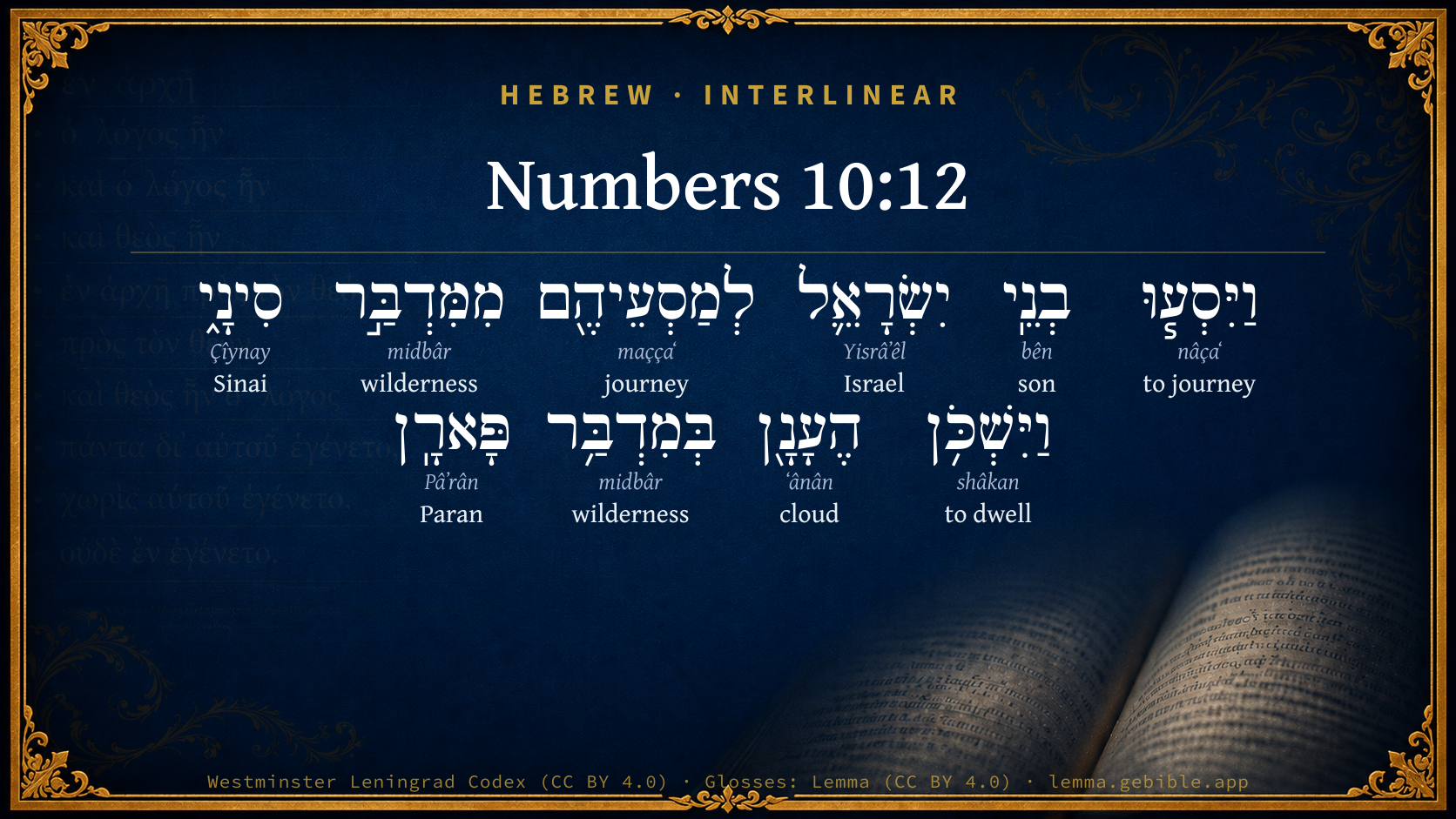
  1. וַיִּסְע֧וּ nâçaʻ H5265 “and · to journey” Conjunction + Verb, Qal, Sequential Imperfect, 3rd Person, Masculine, Plural
  2. בְנֵֽי bên H1121 “sons of” Noun, Common, Masculine, Plural, Construct
  3. יִשְׂרָאֵ֛ל Yisrâʼêl H3478 “Israel” Noun, Proper
  4. לְמַסְעֵיהֶ֖ם maççaʻ H4550 “to/for · journeys · their” Preposition + Noun, Common, Masculine, Plural, Construct + Suffix, Personal, 3rd Person, Masculine, Plural
  5. מִמִּדְבַּ֣ר midbâr H4057 “from · wilderness of” Preposition + Noun, Common, Masculine, Singular, Construct
  6. סִינָ֑י Çîynay H5514 “Sinai” Noun, Proper
  7. וַיִּשְׁכֹּ֥ן shâkan H7931 “and · to dwell” Conjunction + Verb, Qal, Sequential Imperfect, 3rd Person, Masculine, Singular
  8. הֶעָנָ֖ן ʻânân H6051 “the · cloud” Particle, Definite Article + Noun, Common, Masculine, Singular, Absolute
  9. בְּמִדְבַּ֥ר midbâr H4057 “in/at · wilderness of” Preposition + Noun, Common, Masculine, Singular, Construct

About this verse

These counts appear in no published source. They are computed here, from the morphology-tagged text and Lemma’s own curated glosses. What Lemma adds →

10
words
9
distinct lemmas
Pentateuch
section

Notable vocabulary

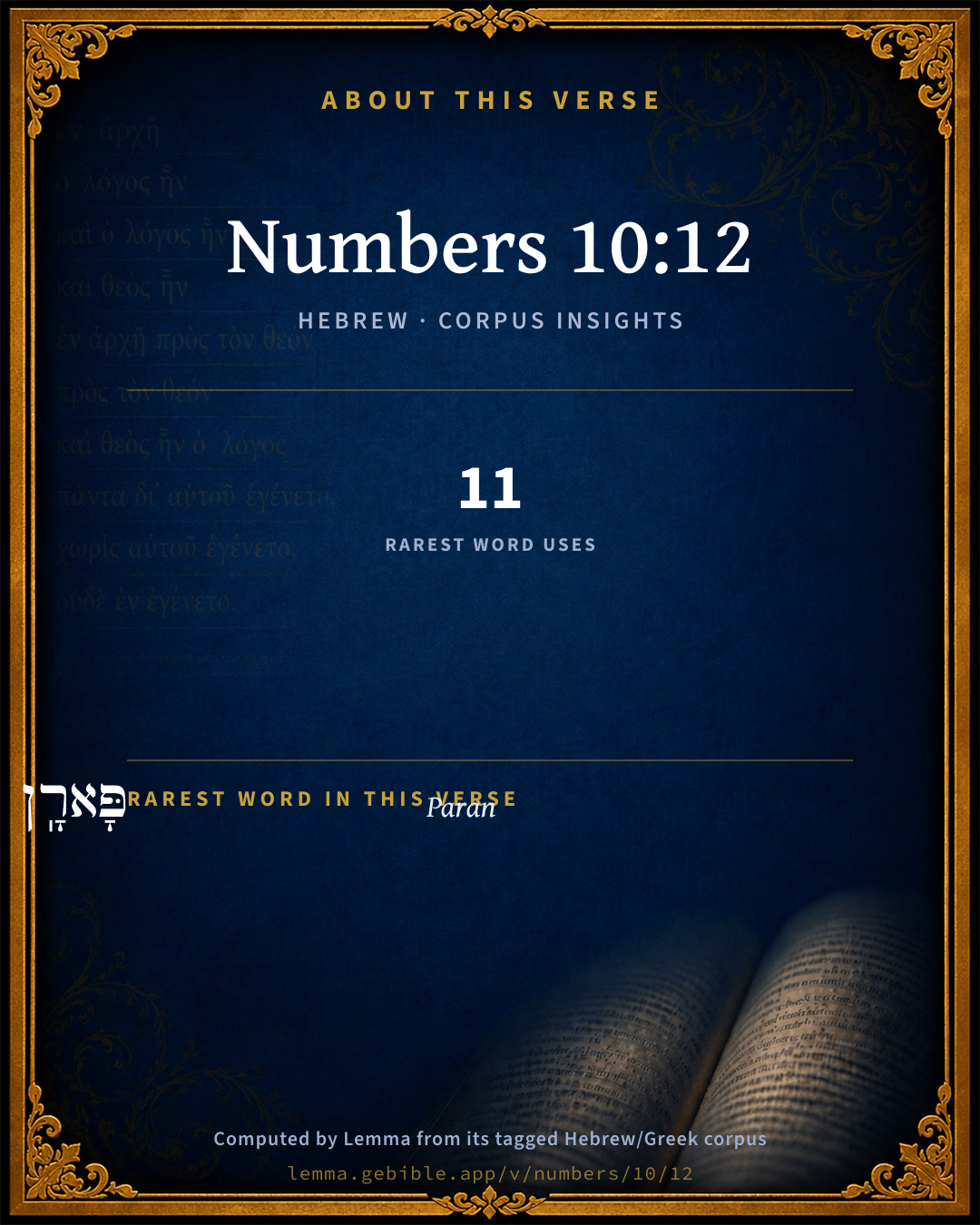
The rarest word here is פָּארָֽן Paran H6290 — appearing just 11 times in the whole Hebrew Bible.

Shared distinctive vocabulary

פָּארָֽן Paran H6290 occurs in 10 verses of the Hebrew Bible. Also found in:

Grammatical profile

  • 2 verbs
  • 8 nouns

Verb forms

  • וַיִּסְע֧וּ Qal · Sequential Imperfect
  • וַיִּשְׁכֹּ֥ן Qal · Sequential Imperfect

Repetition

A word recurs within this verse — often emphatic in Hebrew:

  • מִמִּדְבַּ֣ר wilderness H4057 ×2

Hebrew & Septuagint length

In English translation the verse runs 25 words from the Hebrew and 24 from the Septuagint (LXX English) — closely comparable.

A rough comparison of the two English renderings, which tokenize alike — not a word-level alignment.

Word counts can differ between the Hebrew and the Greek without any difference in meaning — e.g. the Hebrew direct-object marker אֵת has no separate Greek word, and Greek often adds the article ὁ.

Cross-references

16

Topical passages linked to Numbers 10:12 in the Treasury of Scripture Knowledge — connected by theme and wording, ordered by reader-vote popularity; previews shown in the World English Bible.

  • Genesis 21:21 He lived in the wilderness of Paran. His mother took a wife for him out of the land of Egypt.
  • Numbers 12:16 Afterward the people traveled from Hazeroth, and encamped in the wilderness of Paran.
  • Exodus 19:1–2 In the third month after the children of Israel had gone forth out of the land of Egypt, on that same day they came into the wilderness of Sinai.
  • Exodus 40:36–37 When the cloud was taken up from over the tent, the children of Israel went onward, throughout all their journeys;
  • Numbers 1:1 Yahweh spoke to Moses in the wilderness of Sinai, in the Tent of Meeting, on the first day of the second month, in the second year after they had come out of the land of Egypt, saying,
  • Numbers 9:5 They kept the Passover in the first month, on the fourteenth day of the month, at evening, in the wilderness of Sinai. According to all that Yahweh commanded Moses, so the children of Israel did.
  • Numbers 13:3 Moses sent them from the wilderness of Paran according to the commandment of Yahweh: all of them men who were heads of the children of Israel.
  • Numbers 13:26 They went and came to Moses, and to Aaron, and to all the congregation of the children of Israel, to the wilderness of Paran, to Kadesh; and brought back word to them, and to all the congregation, and shown them the fruit of the land.
  • Deuteronomy 1:1 These are the words which Moses spoke to all Israel beyond the Jordan in the wilderness, in the Arabah over against Suph, between Paran, and Tophel, and Laban, and Hazeroth, and Dizahab.
  • Exodus 13:20 They took their journey from Succoth, and encamped in Etham, in the edge of the wilderness.
  • Numbers 9:1 Yahweh spoke to Moses in the wilderness of Sinai, in the first month of the second year after they had come out of the land of Egypt, saying,
  • Numbers 33:15–16 They traveled from Rephidim, and encamped in the wilderness of Sinai.
  • Deuteronomy 1:19 We traveled from Horeb, and went through all that great and terrible wilderness which you saw, by the way to the hill-country of the Amorites, as Yahweh our God commanded us; and we came to Kadesh-barnea.
  • Deuteronomy 33:2 He said, Yahweh came from Sinai, Rose from Seir to them; He shined forth from Mount Paran, He came from the ten thousands of holy ones: At his right hand was a fiery law for them.
  • 1 Samuel 25:1 Samuel died; and all Israel gathered themselves together, and lamented him, and buried him in his house at Ramah. David arose, and went down to the wilderness of Paran.
  • Habakkuk 3:3 God came from Teman, The Holy One from Mount Paran. Selah. His glory covered the heavens, And his praise filled the earth.

Cross-references courtesy of OpenBible.info (CC BY 4.0).

Hebrew and Greek witnesses Masoretic Hebrew ↔ Greek Septuagint

The same verse in the two great witnesses to the Old Testament, shown verse-for-verse.

These are two independent witnesses, not word-aligned to each other, and the Septuagint is shown in lemma (dictionary) form.

Hebrew Numbers 10:12 Masoretic · Westminster Leningrad Codex

וַיִּסְע֧וּ בְנֵֽי יִשְׂרָאֵ֛ל לְמַסְעֵיהֶ֖ם מִמִּדְבַּ֣ר סִינָ֑י וַיִּשְׁכֹּ֥ן הֶעָנָ֖ן בְּמִדְבַּ֥ר פָּארָֽן

The children of Israel set forward according to their journeys out of the wilderness of Sinai; and the cloud abode in the wilderness of Paran.

World English Bible · Public Domain

Greek LXX Numbers 10:12 Septuagint · lemma form

καί ἐκαἴρω ὁ υἱός ἰσραήλ σύν ἀπαρτία αὐτός ἐν ὁ ἔρημος σινα καί ἵστημι ὁ νεφέλη ἐν ὁ ἔρημος ὁ φαραν

And the children of Israel set forward with their baggage in the wilderness of Sina; and the cloud rested in the wilderness of Pharan.

LXX2012 (modern English Septuagint) · Public Domain

On this verse, The Pulpit Commentary discusses the Septuagint’s reading. Read the note in Commentary ↓

Hebrew: Westminster Leningrad Codex (CC BY 4.0). Greek: Septuagint (public domain); English from LXX2012 (modern English Septuagint) (Public Domain). How the Septuagint differs from the Hebrew →

Targum (Aramaic paraphrase)

2

The Targum is the ancient Jewish Aramaic paraphrase of the Hebrew Scriptures — an interpretive translation, not the Hebrew text itself. Onkelos (literal) and Pseudo-Jonathan (expansive) render the Torah, and Jonathan the Prophets. Coverage is partial: where no permissively-licensed English translation exists for a verse, only the Aramaic is shown. This is verse-level text, not a word-by-word alignment to the Hebrew.

  1. Targum Onkelos Torah (Genesis–Deuteronomy)
    וּנְטָלוּ בְנֵי יִשְׂרָאֵל לְמַטְלָנֵיהוֹן מִמַדְבְּרָא דְסִינַי וּשְׁרָא עֲנָנָא בְּמַדְבְּרָא דְפָארָן

    (no public-domain English translation for this verse)

    Targum Onkelos — Aramaic: “Onkelos Genesis” (public domain); “Onkelos Exodus” (public domain); “Onkelos Leviticus” (public domain); “Onkelos Numbers” (public domain); “Onkelos Deuteronomy” (public domain). English: “Sefaria Community Translation” (CC0 1.0 (public-domain dedication)); “J.W. Etheridge. The Targums of Onkelos and Jonathan Ben Uzziel on the Pentateuch. London: Longmans, Green, 1862” (public domain). Text via Sefaria.

  2. Targum Pseudo-Jonathan Torah (Genesis–Deuteronomy)
    וּנְטָלוּ בְּנֵי יִשְרָאֵל לְמַטְלָנֵיהוֹן מִמַדְבְּרָא דְסִינַי וּשְׁרָא עֲנַן יְקָרָא בְּמַדְבְּרָא דְפָּארָן

    and the children of Israel went forward upon their journeys from the wilderness of Sinai, and the Cloud of Glory rested in the wilderness of Pharan.

    Targum Pseudo-Jonathan — Aramaic: “Targum Jonathan on Genesis” (public domain); “Targum Jonathan on Exodus” (public domain); “Targum Jonathan on Leviticus” (public domain); “Targum Jonathan on Numbers” (public domain); “Targum Jonathan on Deuteronomy” (public domain). English: “The Targum of Jonathan ben Uzziel, trans. J. W. Etheridge, London, 1862” (public domain). Text via Sefaria.

Commentary

Notes on Numbers 10:12 from classic Christian and Jewish commentators (each source and its license shown beneath its notes). The classic Christian expositions comment on the surrounding passage and are grouped to its opening verse, so a note may address several verses; the Jewish commentaries on the Tanakh (Rashi and others) are per-verse, so they appear only where the commentator wrote on this verse.

Lemma curates 59 commentaries, every one of them public domain or Creative Commons licensed, each selected and text-cleaned for this edition rather than reprinted as found. About our sources →

Trapp's Complete Commentary

John Trapp

Num 10:12 And the children of Israel took their journeys out of the wilderness of Sinai; and the cloud rested in the wilderness of Paran.

Ver. 12. Out of the wilderness of Sinai.] Where they had dwelt long enough. {Deu 1:6-8} It being a place of bondage, by reason of the law there given. {Gal 4:24-25} The law is a yoke of bondage, as Jerome calls it; and they who look for righteousness from thence, are like oxen, who toil and draw, and when they have done their labour, are fatted for slaughter.

John Trapp, A Commentary or Exposition upon All the Books of the Old and New Testament (1647–1656) — public domain. Text from a community e-Sword module.

Joseph Benson's Commentary

Num 10:12. Paran — From which they travelled to other places, and then returned into it again, Num 12:16.

Joseph Benson's Commentary on the Old and New Testaments (1811–1818) — public domain. Text from a community e-Sword module.

Tyndale Open Study Notes

Tyndale Open Resources

10:12 The Israelites marched to the wilderness of Paran, an arid or semi-arid region in the northeastern part of the Sinai Peninsula, south of the Negev and west of the Dead Sea/Arabah Rift (cp. Gen 21:21).

Tyndale Open Study Notes — © Tyndale Open Resources, licensed CC BY-SA 4.0. Text via the HelloAO Bible API.

Geneva Bible (1599)

Geneva Bible translators

Or, in keeping this order in their journeys.

Geneva Bible (1599) marginal notes — public domain. Text via Bolls.life.

Jamieson, Fausset & Brown

Robert Jamieson, A. R. Fausset & David Brown

wilderness of Paran--It stretched from the base of the Sinaitic group, or from Et-Tyh, over that extensive plateau to the southwestern borders of Palestine.

Jamieson, Fausset & Brown — Commentary Critical and Explanatory on the Whole Bible (1871) — public domain (CC PDM 1.0). Text via the HelloAO Bible API.

Adam Clarke's Commentary

Verse 12. The cloud rested in the wilderness of Paran.] This was three days' journey from the wilderness of Sinai, (see Nu 10:33,) and the people had three stations; the first at Kibroth-hattaavah, the second at Hazeroth, Nu 11:35, and the third in the wilderness of Paran, see Nu 12:16. But it is extremely difficult to determine these journeyings with any degree of exactness; and we are often at a loss to know whether the place in question was in a direct or retrograde position from the place previously mentioned.

Adam Clarke's Commentary on the Bible (1810–1826) — public domain. Text from a community e-Sword/MySword module.

Ellicott's Commentary for English Readers

(12) And the cloud rested in the wilderness of Paran.—The fact is here mentioned by way of anticipation (see Num_10:33). The spot referred to is probably Kibroth-hattaavah, which may have been at the southernmost extremity of the wilderness of Paran. In Deu_1:19 it is called “that great and terrible wilderness.” This wilderness is supposed to have been bounded by the land of Canaan on the north, by the valley of Arabah on the east, and by the desert of Sinai on the south. Its western boundary appears to have been the wilderness of Shur, or rather the river, or brook, of Egypt (Wady-el-Arish), which divides the wilderness into two parts, of which the western part is sometimes known as the wilderness of Shur. The sojourn of the Israelites was confined to the eastern part. (See Kurtz’s History of the Old Covenant, 3 p. 221.)

A Bible Commentary for English Readers, edited by Charles John Ellicott (1878–1897) — public domain. Text from a community e-Sword module.

The Cambridge Bible for Schools and Colleges

gen. ed. J. J. S. Perowne

12. their journeys] their stages; cf. Num_33:1 f., Exo_17:1.

the cloud abode] The verb is that to which mishkân ‘dwelling’ corresponds. The cloud settled down and abode upon the Tabernacle in the wilderness of Paran, as a sign that they were to halt there. See the opening note on ch. 11.

Paran] This wilderness lay to the north of the Sinaitic peninsula. Its eastern border would be roughly a line drawn from the Dead Sea to the Gulf of Akaba. It is closely connected with Edom in Deu_33:2, Hab_3:3. See the writer’s Exodus, p. ciii. It lay between Midian and Egypt (1Ki_11:18); and was Ishmael’s dwelling-place (Gen_21:21 E ). It apparently corresponded to the modern desert of Et-tih.

The Cambridge Bible for Schools and Colleges (gen. ed. J. J. S. Perowne; Cambridge University Press, 1878–1918) — public domain. Text from a community e-Sword module.

John Gill's Exposition

And the children of Israel took their journeys out of the wilderness of Sinai,.... Each of their camps removed from thence, and so everyone took their journey:

and the cloud rested in the wilderness of Paran; which was a signal for the camps to rest and pitch their tents; this was after they had gone three days journey, and were come to Taberah, which, it is probable, was in the wilderness of Paran; otherwise we read of their pitching in the wilderness of Paran, after they had been a month at Kibrothhattaavah, Num 11:34, and seven days at Hazeroth, Num 12:16; so they went from one wilderness to another; of this wilderness; see Gill on Gen 21:21.

John Gill's Exposition of the Whole Bible (1746–1763) — public domain (CC PDM 1.0). Text via the HelloAO Bible API.

Albert Barnes' Notes on the Bible

The wilderness of Paran - See Gen 14:6 note. The wilderness is mentioned here by anticipation. The earliest halting-places, Kibroth-hattaavah and Hazeroth, were not within its limits Num 11:35; Num 12:16.

Albert Barnes' Notes on the Bible (1834–1885) — public domain. Text from a community e-Sword/MySword module.

Matthew Poole's English Annotations

From which they travelled to other places, and then returned into it again, Num 12:16.

Matthew Poole's English Annotations on the Holy Bible (1683–1685) — public domain. Text from a community e-Sword/MySword module.

Whedon's Commentary on the Bible

Daniel D. Whedon

12. The wilderness of Paran — Paran literally signifies a region abounding in caverns. It corresponds in general outline with the desert Et-Tih, a wide stretch of hilly limestone region elsewhere known as “the Desert,” lying north of the Sinaitic triangle, its southern boundary not being a straight line running east and west, but a concave crescent of mountains about one hundred and twenty miles long. The surface of this extensive desert is a chalky formation covered with coarse gravel, mixed with black flint and drifting sand, dipping southward. See Gen_21:21, note; Exo_15:22-27, introductory note. The Paran proper, or definite spot to which the name is applied, (Deu_1:1,) is by Prof. Palmer and other eminent geographers identified with Wady Feiran, closely resembling it in sound.

Daniel D. Whedon (gen. ed.), Commentary on the Old and New Testaments (1874–1909) — public domain. Text from a community e-Sword module.

The Pulpit Commentary

Took their journeys. Literally, "marched according to their journeys" Septuagint, tiaiv autwn , set forward with their baggage. And the cloud rested in the wilderness of Paran. Taken by itself this would seem to apply to the first resting of the cloud and the first halt of the host after breaking up from "the wilderness of Sinai." It appears, however, from Num_12:16 that "the wilderness of Paran" was fully reached after leaving Hazeroth at the end of three days" journey from Sinai, nor would a shorter space of time suffice to carry the host across the mountain barrier of the Jebel et-Tih, which forms the clearly-marked southern limit of the desert plateau of Paran (see next note). Some critics have arbitrarily extended the limits of "the wilderness of Paran" so as to include the sandy waste between Sinai and the Jebel et-Tih, and therefore the very first halting-place of Israel. This, however, is unnecessary as well as arbitrary; for

(1) verses 12, 13 are evidently in the nature of a summary, and the same subject is confessedly taken up again in verse 33, sq. ; and

(2) the departure from Sinai is expressly said to have been for a "three days" journey" (verse 33), which must mean that the march, although actually divided into three stages, was regarded as a single journey, because it brought them to their immediate destination in the wilderness of Paran. Here then is a plain reason for the statement in this verse: the cloud did indeed rest twice between the two wildernesses, but only so as to allow of a night"s repose, not so as to break the continuity of the march. "The wilderness of Paran." Septuagint, en th erhmw tou faran . This geographical expression is nowhere exactly defined in Holy Scripture, and the name itself has disappeared; for in spite of the resemblance in sound (a resemblance here, as in so many cases, wholly delusive), it seems to have no connection whatever with the Wady Feiran, the fertile valley at the base of Serbal, or with the town which once shared the name. All the allusions, however, in the Old Testament to Paran point to a district so clearly marked out, so deeply stamped with its own characteristics, by nature, that no mistake is possible. This district is now called et-Tih, i.e., the wandering, and is still remembered in the traditions of the Arabs as the scene of the wanderings of the people of God. Little known, and never thoroughly explored, its main features are nevertheless unmistakable, and its boundaries sharply defined. Measuring about 150 miles in either direction, its southern frontier (now called the Jebel et-Tih) is divided by the broad sandy waste of er-Ramleh from the Sinaitic mountains and the Sinaitic peninsula properly so called; its northern mountain mass looks across the deep fissure of the Wady Murreh (or desert of Zin), some ten or fifteen miles broad, into er-Rachmah, the mountain of the Amorite, the southern extension of the plateau of Judah; on the east it fails abruptly down to the narrow beach of the Elanite Gulf, and to the Arabah; on the west alone it sinks slowly into the sandy desert of Shur, which separates it from the Mediterranean and from Egypt. Et-Tih is itself divided into nearly equal halves, by the Wady el Arish (or "river of Egypt"), which, rising on the northern slopes of the Jebel et-Tih, and running northwards through the whole plateau, turns off to the west and is lost in the desert of Shur. That the western half of the plateau went also under the name of Paran is evident from the history of Ishmael, (see especially Gen_21:21 Gen_25:18) but it was through the eastern portion alone that the wanderings of the Israelites, so far as we can trace them, lay. This "wilderness of Paran" is indeed "a great and terrible wilderness", (Deu_1:9) lacking for the most part the precipitous grandeur of the granite mountains of Sinai, but lacking also their fertile valleys and numerous streams. A bare limestone or sandstone plateau, crossed by low ranges of hills, seamed with innumerable dry water-courses, and interspersed with large patches of sand and gravel, is what now meets the eye of the traveler in this forsaken land. It is true that a good deal of rain falls at times, and that when it does fall vegetation appears with surprising rapidity and abundance; it is true also that the district has been persistently denuded of trees and shrubs for the sake of fuel. But whatever mitigations may have then existed, it is clear from the Bible itself that the country was then, as now, emphatically frightful. (cf. Deu_1:19 Deu_8:15 Deu_32:10 Jer_2:6) Something may be set, no doubt, to the account of rhetoric, and much may be allowed for variety of seasons. Even in Australia the very same district will appear at one time like the desolation of a thousand years, and in the very next year it will blossom as the rose. But at certain seasons at any rate et-Tih was (as it is) a "howling" wilderness, where the dreadful silence of a lifeless land was only broken by the nightly howling of unclean beasts who tracked the footsteps of the living in order to devour the carcasses of the dead. Perhaps so bad a country has never been attempted by any army in modern days, even by the Russian troops in Central Asia.

Amongst the many Wadys which drain the uncertain rain-fall of the eastern half of et-Tih (and at the same time testify to a greater rain-fall in bygone ages), the most important is the Wady el Terafeh, which, also rising on the northern slopes of Jebel et-Tih, runs northwards and north-westwards, and finally opens into the Arabah. Towards its northern limit et-Tih changes its character for the worse. Here it rises into a precipitous quadrilateral of mountains, about forty miles square, not very lofty, but exceedingly steep and rugged, composed in great measure of dazzling masses of bare chalk or limestone, which glow as in a furnace beneath the summer sun. This mountain mass, now called the Azaimat, or mountain country of the Azazimeh, rising steeply from the rest of the plateau to the southward, is almost completely detached by deep depressions from the surrounding districts; at the north-west corner alone it is united by a short range of mountains with er-Rachmah, and so with the highlands of Southern Palestine. From this corner the Wady Murreh descends broad and deep towards the cast, forking at the eastern extremity towards the Arabah on the southeast, and towards the Dead Sea on the north. east. The interior of this inaccessible country has yet to be really explored, and it is the scanty nature of our present knowledge concerning it which, more than anything else, prevents us from following with any certainty the march of the Israelites as recorded in this book.

The Pulpit Commentary (1880–1919), ed. H.D.M. Spence-Jones & Joseph S. Exell — public domain. Text from a community e-Sword module.

John Wesley's Explanatory Notes

Paran - From which they travelled to other places, and then returned into it again, chap. xii, 16.

John Wesley, Explanatory Notes Upon the Whole Bible (1754–1765) — public domain. Text via the GEBible commentary corpus.

Rashi

Rabbi Shlomo Yitzchaki (Rashi)

למסעיהם means, in accordance with the regulations set forth for the journeys of their divisions — which should be the first to set out and which the last.

במדבר פראן IN THE WILDERNESS OF PARAN — The place “Kibroth-hattavah” (Numbers 12:34) was in the wilderness of Paran and there they encamped after this journey (cf. Numbers 33:16—17 with our verse and with Numbers 11:34—35).

Rashi on the Tanakh — English translations: “The Judaica Press complete Tanach with Rashi, translated by A. J. Rosenberg” (CC BY 4.0); “Pentateuch with Rashi's commentary by M. Rosenbaum and A.M. Silbermann, 1929-1934” (public domain); “The Metsudah Tanach series, Lakewood, N.J” (CC BY 4.0); and “The Book of Joshua, Metsudah Publications, 1997” (CC BY 4.0). Text via Sefaria.

Lesson kit

Teaching starters — assembled from the data on this page, not authored interpretation. Every prompt links to the verse data it draws on. Edit before teaching.

Numbers, in the Pentateuch, opens this verse with 10 words (9 distinct Hebrew lemmas). Its most distinctive word is Pâʼrân (“Paran”). A historical commentator’s framing appears above. Read the whole chapter for the surrounding context.

Discussion questions

  1. What does “Paran” (Pâʼrân) contribute to the verse as a whole?
  2. Genesis 21:21 shares the word «Paran» with this verse. How do the two illuminate each other?
  3. “wilderness” occurs 2× in this one verse. What is the effect of the repetition?
  4. The translations on this page render this verse differently — a whole-verse word diff, not a word-by-word alignment. What might account for the different wordings?
  5. The verb «וַיִּסְע֧וּ» is Qal Sequential Imperfect. How does its form color the action?
  6. Reading how Trapp's Complete Commentary and Joseph Benson's Commentary read this verse, where do the two commentators agree and where do they part?

Things to notice

  • These translations choose different wording for 11 words in this verse.
  • “wilderness” occurs 2× in this single verse.
  • 9 distinct Hebrew lemmas span 10 words in this verse.

Reading settings

Reading text

Shown beneath each verse's original-language words.

Old Testament
Old Testament edition

Read the OT as the Masoretic Hebrew (MT) or the Greek Septuagint (LXX).

English shown for the Greek Septuagint (in the Hebrew ↔ Greek comparison).

Comparing translations? Open the Compare panel on any verse page to stack up to four side by side.