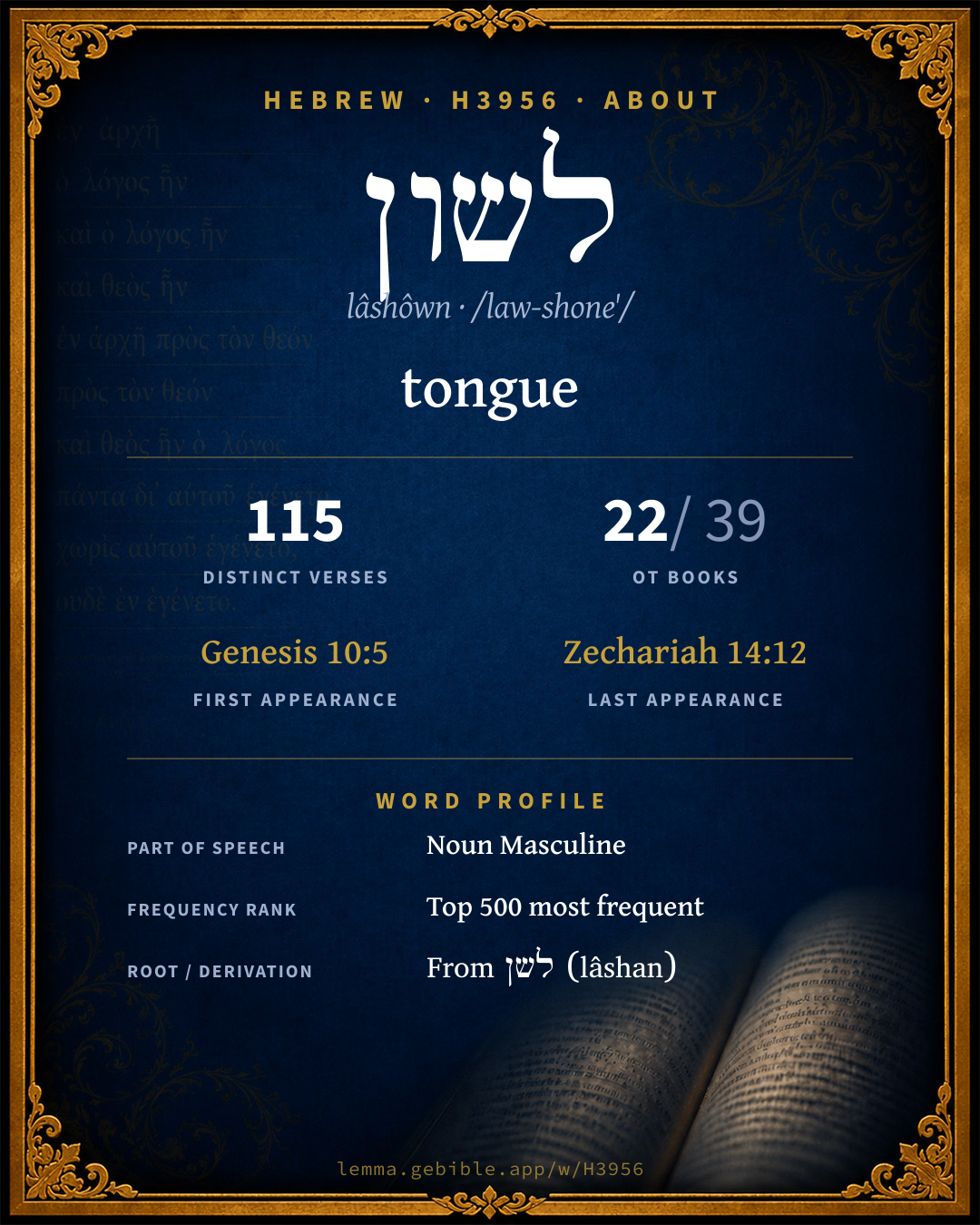
לָשׁוֹן
tongue
‘tongue’ is one of 6 main senses fuller range ↓
Full lexicon entry — Brown-Driver-Briggs (BDB)
From Brown-Driver-Briggs (BDB)
Where this word appears
See every Construct-state word in the Hebrew Bible →
Grammar key — what these labels mean
Part of speech
- Noun
- A naming word — a person, place, thing, or idea.
Noun type
- Common
- A common noun — a general class of person, place, or thing (“king,” “city,” “water”), not a specific name.
State
- Construct
- A noun bound to a following noun in a possessive / “of” relationship (the construct chain).
- Absolute
- The independent form of a noun, not bound to a following word.
Gender
- Both
- Attested as both masculine and feminine.
Number
- Singular
- One.
- Plural
- More than one (in Hebrew, generally three or more).
Grammatical forms
- Noun, Common, Both, Singular, Construct 90 times (77%)
- Noun, Common, Both, Singular, Absolute 22 times (19%)
- Noun, Common, Both, Plural, Construct 3 times (3%)
- Noun, Common, Both, Plural, Absolute 2 times (2%)
Parsed forms decoded from the imported morphology (morphhb / Westminster Leningrad Codex — WLC text public domain, morphhb tagging CC BY 4.0), counted across 117 parsed occurrences — not distinct verses.
Every verse where H3956 appears — 115 distinct verses across 22 books. Click any verse to open its interlinear word-by-word view. Verse text shown in the World English Bible for context — . Each verse’s Hebrew form is shown with its reference; the English is not keyword-highlighted, since the data carries no word-level English alignment. Use “Compare translations” on any verse to read it across multiple English versions. This concordance covers the Hebrew Bible; Septuagint (Greek Old Testament) occurrences are not indexed here.
Genesis 3 verses
- Genesis 10:5 לִ/לְשֹׁנ֑/וֹ prep + n c bs cs + sfx pers 3ms Of these were the isles of the nations divided in their lands, everyone after his language, after their families, in their nations.
- Genesis 10:20 לִ/לְשֹֽׁנֹתָ֑/ם prep + n c bp cs + sfx pers 3mp These are the sons of Ham, after their families, after their languages, in their lands, in their nations.
- Genesis 10:31 לִ/לְשֹׁנֹתָ֑/ם prep + n c bp cs + sfx pers 3mp These are the sons of Shem, after their families, after their languages, in their lands, after their nations.
Exodus 2 verses
- Exodus 4:10 לָשׁ֖וֹן n c bs Moses said to Yahweh, "Oh, Lord, I am not eloquent, neither before now, nor since you have spoken to your servant; for I am slow of speech, and of a slow tongue."
- Exodus 11:7 לְשֹׁנ֔/וֹ n c bs cs + sfx pers 3ms But against any of the children of Israel a dog won't even bark or move its tongue, against man or animal; that you may know that Yahweh makes a distinction between the Egyptians and Israel.
Deuteronomy 1 verse
Joshua 6 verses
- Joshua 7:21 וּ/לְשׁ֨וֹן conj + n c bs cs when I saw among the spoil a goodly Babylonian mantle, and two hundred shekels of silver, and a wedge of gold of fifty shekels weight, then I coveted them, and took them; and, behold, they are hid in the earth in the midst of my tent, and the silver under it.
- Joshua 7:24 לְשׁ֣וֹן n c bs cs Joshua, and all Israel with him, took Achan the son of Zerah, and the silver, and the mantle, and the wedge of gold, and his sons, and his daughters, and his oxen, and his donkeys, and his sheep, and his tent, and all that he had: and they brought them up to the valley of Achor.
- Joshua 10:21 לְשֹׁנֽ/וֹ n c bs cs + sfx pers 3ms that all the people returned to the camp to Joshua at Makkedah in peace: none moved his tongue against any of the children of Israel.
- Joshua 15:2 הַ/לָּשֹׁ֖ן ptcl def.art + n c bs Their south border was from the uttermost part of the Salt Sea, from the bay that looks southward;
- Joshua 15:5 מִ/לְּשׁ֣וֹן prep + n c bs cs The east border was the Salt Sea, even to the end of the Jordan. The border of the north quarter was from the bay of the sea at the end of the Jordan;
- Joshua 18:19 לְשׁ֤וֹן n c bs cs and the border passed along to the side of Beth Hoglah northward; and the goings out of the border were at the north bay of the Salt Sea, at the south end of the Jordan: this was the south border.
Judges 1 verse
2 Samuel 1 verse
Nehemiah 1 verse
Esther 3 verses
- Esther 1:22 כִּ/לְשׁוֹנ֑/וֹ כִּ/לְשׁ֥וֹן prep + n c bs cs + sfx pers 3ms prep + n c bs cs for he sent letters into all the king's provinces, into every province according to the writing of it, and to every people after their language, that every man should bear rule in his own house, and should speak according to the language of his people.
- Esther 3:12 כִּ/לְשׁוֹנ֑/וֹ prep + n c bs cs + sfx pers 3ms Then were the king's scribes called in the first month, on the thirteenth day of it; and there was written according to all that Haman commanded to the king's satraps, and to the governors who were over every province, and to the princes of every people, to every province according to the writing of it, and to every people after their language; in the name of king Ahasuerus was it written, and it was sealed with the king's ring.
- Esther 8:9 כִּ/לְשֹׁנ֑/וֹ וְ/כִ/לְשׁוֹנָֽ/ם prep + n c bs cs + sfx pers 3ms conj + prep + n c bs cs + sfx pers 3mp Then were the king's scribes called at that time, in the third month Sivan, on the three and twentieth [day] of it; and it was written according to all that Mordecai commanded to the Jews, and to the satraps, and the governors and princes of the provinces which are from India to Ethiopia, one hundred twenty-seven provinces, to every province according to the writing of it, and to every people after their language, and to the Jews according to their writing, and according to their language.
Job 9 verses
- Job 5:21 לָ֭שׁוֹן n c bs You shall be hidden from the scourge of the tongue, Neither shall you be afraid of destruction when it comes.
- Job 6:30 בִּ/לְשׁוֹנִ֥/י prep + n c bs cs + sfx pers 1cs Is there injustice on my tongue? Can't my taste discern mischievous things?
- Job 15:5 לְשׁ֣וֹן n c bs cs For your iniquity teaches your mouth, And you choose the language of the crafty.
- Job 20:12 לְשׁוֹנֽ/וֹ n c bs cs + sfx pers 3ms "Though wickedness is sweet in his mouth, Though he hide it under his tongue,
- Job 20:16 לְשׁ֣וֹן n c bs cs He shall suck cobra venom. The viper's tongue shall kill him.
- Job 27:4 וּ֝/לְשׁוֹנִ֗/י conj + n c bs cs + sfx pers 1cs Surely my lips shall not speak unrighteousness, Neither shall my tongue utter deceit.
- Job 29:10 וּ֝/לְשׁוֹנָ֗/ם conj + n c bs cs + sfx pers 3mp The voice of the nobles was hushed, And their tongue stuck to the roof of their mouth.
- Job 33:2 לְשׁוֹנִ֣/י n c bs cs + sfx pers 1cs See now, I have opened my mouth. My tongue has spoken in my mouth.
- Job 41:1 לְשֹׁנֽ/וֹ n c bs cs + sfx pers 3ms "Can you draw out Leviathan with a fishhook? Or press down his tongue with a cord?
Psalms 35 verses
- Psalms 5:9 לְ֝שׁוֹנָ֗/ם n c bs cs + sfx pers 3mp For there is no faithfulness in their mouth. Their heart is destruction. Their throat is an open tomb. They flatter with their tongue.
- Psalms 10:7 לְ֝שׁוֹנ֗/וֹ n c bs cs + sfx pers 3ms His mouth is full of cursing, deceit, and oppression. Under his tongue is mischief and iniquity.
- Psalms 12:3 לָ֝שׁ֗וֹן n c bs May Yahweh cut off all flattering lips, And the tongue that boasts,
- Psalms 12:4 לִ/לְשֹׁנֵ֣/נוּ prep + n c bs cs + sfx pers 1cp Who have said, "With our tongue we will prevail. Our lips are our own. Who is lord over us?"
- Psalms 15:3 לְשֹׁנ֗/וֹ n c bs cs + sfx pers 3ms He who doesn't slander with his tongue, Nor does evil to his friend, Nor casts slurs against his fellow man;
- Psalms 22:15 וּ֭/לְשׁוֹנִ/י conj + n c bs cs + sfx pers 1cs My strength is dried up like a potsherd. My tongue sticks to the roof of my mouth. You have brought me into the dust of death.
- Psalms 31:20 לְשֹׁנֽוֹת n c bp In the shelter of your presence you will hide them from the plotting of man. You will keep them secretly in a dwelling away from the strife of tongues.
- Psalms 34:13 לְשׁוֹנְ/ךָ֣ n c bs cs + sfx pers 2ms Keep your tongue from evil, And your lips from speaking lies.
- Psalms 35:28 וּ֭/לְשׁוֹנִ/י conj + n c bs cs + sfx pers 1cs My tongue shall talk about your righteousness and about your praise all day long.
- Psalms 37:30 וּ֝/לְשׁוֹנ֗/וֹ conj + n c bs cs + sfx pers 3ms The mouth of the righteous talks of wisdom. His tongue speaks justice.
- Psalms 39:1 בִ/לְשׁ֫וֹנִ֥/י prep + n c bs cs + sfx pers 1cs I said, "I will watch my ways, so that I don't sin with my tongue. I will keep my mouth with a bridle while the wicked is before me."
- Psalms 39:3 בִּ/לְשֽׁוֹנִ/י prep + n c bs cs + sfx pers 1cs My heart was hot within me. While I meditated, the fire burned: I spoke with my tongue:
- Psalms 45:1 לְ֝שׁוֹנִ֗/י n c bs cs + sfx pers 1cs My heart overflows with a noble theme. I recite my verses for the king. My tongue is like the pen of a skillful writer.
- Psalms 50:19 וּ֝/לְשׁוֹנְ/ךָ֗ conj + n c bs cs + sfx pers 2ms "You give your mouth to evil. You harnesses your tongue for deceit.
- Psalms 51:14 לְ֝שׁוֹנִ֗/י n c bs cs + sfx pers 1cs Deliver me from bloodguiltiness, O God, the God of my salvation. My tongue shall sing aloud of your righteousness.
- Psalms 52:2 לְשׁוֹנֶ֑/ךָ n c bs cs + sfx pers 2ms Your tongue plots destruction, Like a sharp razor, working deceitfully.
- Psalms 52:4 לְשׁ֣וֹן n c bs cs You love all devouring words, You deceitful tongue.
- Psalms 55:9 לְשׁוֹנָ֑/ם n c bs cs + sfx pers 3mp Confuse them, Lord, and confound their language, For I have seen violence and strife in the city.
- Psalms 57:4 וּ֝/לְשׁוֹנָ֗/ם conj + n c bs cs + sfx pers 3mp My soul is among lions. I lie among those who are set on fire, Even the sons of men, whose teeth are spears and arrows, And their tongue a sharp sword.
- Psalms 64:3 לְשׁוֹנָ֑/ם n c bs cs + sfx pers 3mp Who sharpen their tongue like a sword, And aim their arrows, deadly words,
- Psalms 64:8 לְשׁוֹנָ֑/ם n c bs cs + sfx pers 3mp Their own tongues shall ruin them. All who see them will shake their heads.
- Psalms 66:17 לְשׁוֹנִֽ/י n c bs cs + sfx pers 1cs I cried to him with my mouth. He was extolled with my tongue.
- Psalms 68:23 לְשׁ֥וֹן n c bs cs That you may crush them, dipping your foot in blood, That the tongues of your dogs may have their portion from your enemies."
- Psalms 71:24 לְשׁוֹנִ֗/י n c bs cs + sfx pers 1cs My tongue will also talk about your righteousness all day long, For they are disappointed, and they are confounded, who want to harm me.
- Psalms 73:9 וּ֝/לְשׁוֹנָ֗/ם conj + n c bs cs + sfx pers 3mp They have set their mouth in the heavens. Their tongue walks through the earth.
- Psalms 78:36 וּ֝/בִ/לְשׁוֹנָ֗/ם conj + prep + n c bs cs + sfx pers 3mp But they flattered him with their mouth, And lied to him with their tongue.
- Psalms 109:2 לְשׁ֣וֹן n c bs cs For they have opened the mouth of the wicked and the mouth of deceit against me. They have spoken to me with a lying tongue.
- Psalms 119:172 לְ֭שׁוֹנִ/י n c bs cs + sfx pers 1cs Let my tongue sing of your word, For all your commandments are righteousness.
- Psalms 120:2 מִ/לָּשׁ֥וֹן prep + n c bs cs Deliver my soul, Yahweh, from lying lips, From a deceitful tongue.
- Psalms 120:3 לָשׁ֥וֹן n c bs What will be given to you, and what will be done more to you, You deceitful tongue?
- Psalms 126:2 וּ/לְשׁוֹנֵ֪/נוּ conj + n c bs cs + sfx pers 1cp Then our mouth was filled with laughter, And our tongue with singing. Then they said among the nations, "Yahweh has done great things for them."
- Psalms 137:6 לְשׁוֹנִ֨/י n c bs cs + sfx pers 1cp Let my tongue stick to the roof of my mouth if I don't remember you; If I don't prefer Jerusalem above my chief joy.
- Psalms 139:4 בִּ/לְשׁוֹנִ֑/י prep + n c bs cs + sfx pers 1cs For there is not a word on my tongue, But, behold, Yahweh, you know it altogether.
- Psalms 140:3 לְשׁוֹנָ/ם֮ n c bs cs + sfx pers 3mp They have sharpened their tongues like a serpent. Viper's poison is under their lips. Selah.
- Psalms 140:11 לָשׁוֹן֮ n c bs An evil speaker won't be established in the earth. Evil will hunt the violent man to overthrow him.
Proverbs 19 verses
- Proverbs 6:17 לְשׁ֣וֹן n c bs cs Haughty eyes, a lying tongue, Hands that shed innocent blood;
- Proverbs 6:24 לָשׁ֥וֹן n c bs To keep you from the immoral woman, From the flattery of the wayward wife's tongue.
- Proverbs 10:20 לְשׁ֣וֹן n c bs cs The tongue of the righteous is like choice silver. The heart of the wicked is of little worth.
- Proverbs 10:31 וּ/לְשׁ֥וֹן conj + n c bs cs The mouth of the righteous brings forth wisdom, But the perverse tongue will be cut off.
- Proverbs 12:18 וּ/לְשׁ֖וֹן conj + n c bs cs There is one who speaks rashly like the piercing of a sword, But the tongue of the wise heals.
- Proverbs 12:19 לְשׁ֣וֹן n c bs cs Truth's lips will be established forever, But a lying tongue is only momentary.
- Proverbs 15:2 לְשׁ֣וֹן n c bs cs The tongue of the wise commends knowledge, But the mouth of fools gush out folly.
- Proverbs 15:4 לָ֭שׁוֹן n c bs A gentle tongue is a tree of life, But deceit in it crushes the spirit.
- Proverbs 16:1 לָשֽׁוֹן n c bs The plans of the heart belong to man, But the answer of the tongue is from Yahweh.
- Proverbs 17:4 לְשׁ֥וֹן n c bs cs An evil-doer heeds wicked lips. A liar gives ear to a mischievous tongue.
- Proverbs 17:20 בִּ֝/לְשׁוֹנ֗/וֹ prep + n c bs cs + sfx pers 3ms One who has a perverse heart doesn't find prosperity, And one who has a deceitful tongue falls into trouble.
- Proverbs 18:21 לָשׁ֑וֹן n c bs Death and life are in the power of the tongue; Those who love it will eat its fruit.
- Proverbs 21:6 בִּ/לְשׁ֣וֹן prep + n c bs cs Getting treasures by a lying tongue Is a fleeting vapor for those who seek death.
- Proverbs 21:23 וּ/לְשׁוֹנ֑/וֹ conj + n c bs cs + sfx pers 3ms Whoever guards his mouth and his tongue Keeps his soul from troubles.
- Proverbs 25:15 וְ/לָשׁ֥וֹן conj + n c bs By patience a ruler is persuaded. A soft tongue breaks the bone.
- Proverbs 25:23 לְשׁ֣וֹן n c bs cs The north wind brings forth rain: So a backbiting tongue brings an angry face.
- Proverbs 26:28 לְֽשׁוֹן n c bs cs A lying tongue hates those it hurts; And a flattering mouth works ruin.
- Proverbs 28:23 לָשֽׁוֹן n c bs One who rebukes a man will afterward find more favor Than one who flatters with the tongue.
- Proverbs 31:26 לְשׁוֹנָֽ/הּ n c bs cs + sfx pers 3fs She opens her mouth with wisdom. Faithful instruction is on her tongue.
Ecclesiastes 1 verse
Song of Solomon 1 verse
Isaiah 15 verses
- Isaiah 3:8 לְשׁוֹנָ֤/ם n c bs cs + sfx pers 3mp For Jerusalem is ruined, and Judah is fallen; Because their tongue and their doings are against Yahweh, To provoke the eyes of his glory.
- Isaiah 5:24 לְשׁ֣וֹן n c bs cs Therefore as the tongue of fire devours the stubble, And as the dry grass sinks down in the flame, So their root shall be as rottenness, And their blossom shall go up as dust; Because they have rejected the law of Yahweh of Hosts, And despised the word of the Holy One of Israel.
- Isaiah 11:15 לְשׁ֣וֹן n c bs cs Yahweh will utterly destroy the tongue of the Egyptian sea; and with his scorching wind will he wave his hand over the River, and will strike it into seven streams, and cause men to march over in sandals.
- Isaiah 28:11 וּ/בְ/לָשׁ֖וֹן conj + prep + n c bs No, but by [men of] strange lips and with another language will he speak to this people;
- Isaiah 30:27 וּ/לְשׁוֹנ֖/וֹ conj + n c bs cs + sfx pers 3ms Behold, the name of Yahweh comes from far, burning with his anger, and in thick rising smoke: his lips are full of indignation, and his tongue is as a devouring fire;
- Isaiah 32:4 וּ/לְשׁ֣וֹן conj + n c bs cs The heart of the rash shall understand knowledge, and the tongue of the stammerers shall be ready to speak plainly.
- Isaiah 33:19 לָשׁ֖וֹן n c bs You shall not see the fierce people, a people of a deep speech that you can not comprehend, of a strange language that you can not understand.
- Isaiah 35:6 לְשׁ֣וֹן n c bs cs Then shall the lame man leap as a hart, and the tongue of the mute shall sing; for in the wilderness shall waters break out, and streams in the desert.
- Isaiah 41:17 לְשׁוֹנָ֖/ם n c bs cs + sfx pers 3mp The poor and needy seek water, and there is none, and their tongue fails for thirst; I, Yahweh, will answer them, I, the God of Israel, will not forsake them.
- Isaiah 45:23 לָשֽׁוֹן n c bs By myself have I sworn, the word is gone forth from my mouth [in] righteousness, and shall not return, that to me every knee shall bow, every tongue shall swear.
- Isaiah 50:4 לְשׁ֣וֹן n c bs cs The Lord Yahweh has given me the tongue of those who are taught, that I may know how to sustain with words him who is weary: he wakens morning by morning, he wakens my ear to hear as those who are taught.
- Isaiah 54:17 לָשׁ֛וֹן n c bs No weapon that is formed against you shall prosper; and every tongue that shall rise against you in judgment you shall condemn. This is the heritage of the servants of Yahweh, and their righteousness which is of me, says Yahweh.
- Isaiah 57:4 לָשׁ֑וֹן n c bs Against whom do you sport yourselves? against whom make you a wide mouth, and put out the tongue? Aren't you children of disobedience, a seed of falsehood,
- Isaiah 59:3 לְשׁוֹנְ/כֶ֖ם n c bs cs + sfx pers 2mp For your hands are defiled with blood, and your fingers with iniquity; your lips have spoken lies, your tongue mutters wickedness.
- Isaiah 66:18 וְ/הַ/לְּשֹׁנ֑וֹת conj + ptcl def.art + n c bp For I [know] their works and their thoughts: [the time] comes, that I will gather all nations and languages; and they shall come, and shall see my glory.
Jeremiah 6 verses
- Jeremiah 5:15 לְשֹׁנ֔/וֹ n c bs cs + sfx pers 3ms Behold, I will bring a nation on you from far, house of Israel, says Yahweh: it is a mighty nation, it is an ancient nation, a nation whose language you don't know, neither understand what they say.
- Jeremiah 9:3 לְשׁוֹנָ/ם֙ n c bs cs + sfx pers 3mp They bend their tongue, [as it were] their bow, for falsehood; and they are grown strong in the land, but not for truth: for they proceed from evil to evil, and they don't know me, says Yahweh.
- Jeremiah 9:5 לְשׁוֹנָ֛/ם n c bs cs + sfx pers 3mp They will deceive everyone his neighbor, and will not speak the truth: they have taught their tongue to speak lies; they weary themselves to commit iniquity.
- Jeremiah 9:8 לְשׁוֹנָ֖/ם n c bs cs + sfx pers 3mp Their tongue is a deadly arrow; it speaks deceit: one speaks peaceably to his neighbor with his mouth, but in his heart he lays wait for him.
- Jeremiah 18:18 בַ/לָּשׁ֔וֹן prep det + n c bs Then said they, Come, and let us devise devices against Jeremiah; for the law shall not perish from the priest, nor counsel from the wise, nor the word from the prophet. Come, and let us strike him with the tongue, and let us not give heed to any of his words.
- Jeremiah 23:31 לְשׁוֹנָ֔/ם n c bs cs + sfx pers 3mp Behold, I am against the prophets, says Yahweh, who use their tongues, and say, He says.
Lamentations 1 verse
Ezekiel 4 verses
- Ezekiel 3:5 לָשׁ֖וֹן n c bs For you are not sent to a people of a strange speech and of a hard language, but to the house of Israel;
- Ezekiel 3:6 לָשׁ֔וֹן n c bs not to many peoples of a strange speech and of a hard language, whose words you can not understand. Surely, if I sent you to them, they would listen to you.
- Ezekiel 3:26 וּ/לְשֽׁוֹנְ/ךָ֙ conj + n c bs cs + sfx pers 2ms and I will make your tongue cleave to the roof of your mouth, that you shall be mute, and shall not be to them a reprover; for they are a rebellious house.
- Ezekiel 36:3 לָשׁ֖וֹן n c bs therefore prophesy, and say, Thus says the Lord Yahweh: Because, even because they have made you desolate, and swallowed you up on every side, that you might be a possession to the residue of the nations, and you are taken up in the lips of talkers, and the evil report of the people;
Daniel 1 verse
Hosea 1 verse
Micah 1 verse
Zephaniah 1 verse
Zechariah 2 verses
- Zechariah 8:23 לְשֹׁנ֣וֹת n c bp cs Thus says Yahweh of Hosts: "In those days, ten men will take hold, out of all the languages of the nations, they will take hold of the skirt of him who is a Jew, saying, 'We will go with you, for we have heard that God is with you.'"
- Zechariah 14:12 וּ/לְשׁוֹנ֖/וֹ conj + n c bs cs + sfx pers 3ms This will be the plague with which Yahweh will strike all the peoples who have warred against Jerusalem: their flesh will consume away while they stand on their feet, and their eyes will consume away in their sockets, and their tongue will consume away in their mouth.
About this entry
At a glance — auto-summarized from this page’s data, not written by a person. Every figure links to its source below. This summary describes the numbers; it doesn’t interpret them.
לשון — transliterated lâshôwn — is a Hebrew noun carrying the sense “tongue.” The lexicon spreads it across several senses; see its full sense range. With 115 verses in 22 books, it is a common word in the Hebrew Bible. Its uses concentrate in Psalms (30% of all occurrences). Debuting at Genesis 10:5, it then recurs through the corpus. Each statement above links to its evidence; the full detail follows below.
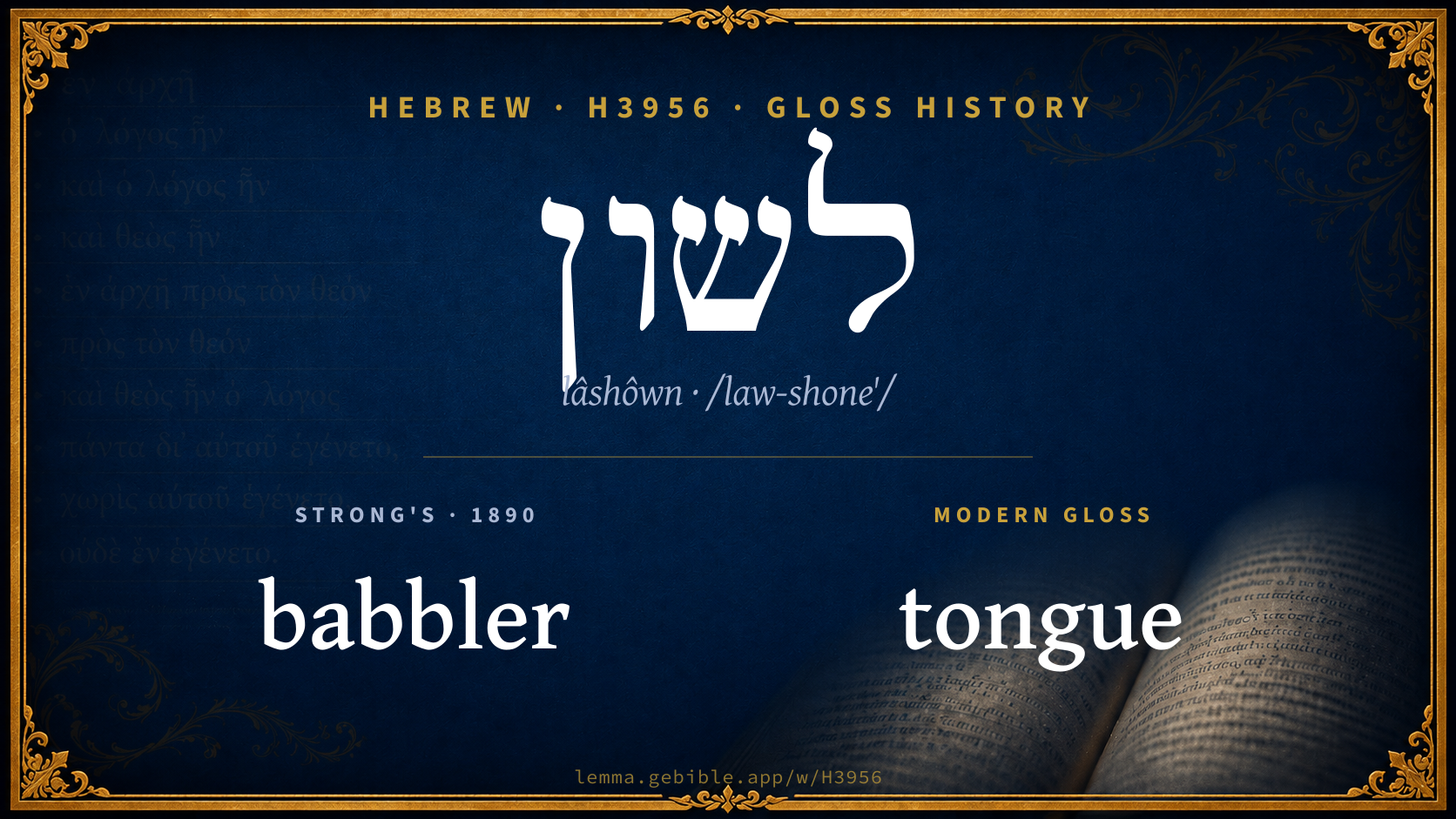
Gloss history
Strong's 1890 vs modern scholarship
About this word
Strong's H3956 catalogs a Hebrew word from the Hebrew Old Testament.
These counts are not copied from any lexicon or concordance. They are computed here, from the morphology-tagged Hebrew Old Testament. What Lemma adds →
- 115
- distinct verses
- The word appears in 115 distinct verses.
- 22 / 39
- OT books
- The word appears in 22 of 39 Old Testament books.
- #372
- by frequency
- Top 500 most frequent Hebrew words (rank 372 of 8,640 Hebrew words by occurrence).
View all 115 occurrences in the concordance →
By section of the Old Testament
By traditional corpus
Conventional, traditional groupings — biblical authorship is debated, so this is a traditional corpus grouping, not an authorship claim. Each share is this word’s portion of its verses in that division of the Hebrew canon. Each figure is a share of the word’s 115 distinct verses.
- Writings (Ketuvim) 71 verses · 62%
- Prophets (Nevi'im) 38 verses · 33%
- Torah (Pentateuch) 6 verses · 5%
How translations render this word
Counts come from each version’s own published word-to-Strong’s tagging or interlinear alignment — an approximate guide to how each version renders this word, not a word-level alignment the data otherwise carries. Because each total is that version’s own tagged count, the per-version totals vary from one another and need not match the appearance or distinct-verse counts above. These counts may also differ from a printed concordance because Lemma counts each distinctly tagged rendering and does not collapse phrase taggings into a single head-word total. This is a fixed set of word-tagged versions (KJV, ASV, BSB, ULT) and does not change with the reading translation you choose elsewhere. Each version’s license is shown beside its name below (and on Sources).
- King James Version: Tongue 76×, Tongues 7×, After their language 3×
- American Standard Version: Tongue 74×, Every people after their language 3×, Language 3×
- Berean Standard Bible: Tongue 58×, Tongues 21×, Language 9×
- unfoldingWord Literal Text: Tongue 66×, Tongue of 25×, Tongues 3×
King James Version Public Domain
Renders H3956 across 116 tagged occurrences — most commonly:
Plus 15 renderings that appear only once — usually multi-word phrases or single function words the recovered tagging swept in, not distinct renderings. Not rendered by a distinct English word in 1 further occurrence.
American Standard Version Public Domain
Renders H3956 across 116 tagged occurrences — most commonly:
Plus 19 renderings that appear only once — usually multi-word phrases or single function words the recovered tagging swept in, not distinct renderings.
Berean Standard Bible Public Domain
Renders H3956 across 112 tagged occurrences — most commonly:
Plus 13 renderings that appear only once — usually multi-word phrases or single function words the recovered tagging swept in, not distinct renderings. Not rendered by a distinct English word in 5 further occurrences.
unfoldingWord Literal Text CC BY-SA 4.0
Renders H3956 across 129 tagged occurrences — most commonly:
Plus 19 renderings that appear only once — usually multi-word phrases or single function words the recovered tagging swept in, not distinct renderings.
9 senses and sub-senses in the full BDB
What do BDB’s symbols mean?
BDB uses these scholarly abbreviations:
| Symbol | Meaning |
|---|---|
| 𝔊 | the Septuagint (the ancient Greek translation, LXX) |
| 𝔙 | the Vulgate (the Latin translation) |
| 𝔖 | the Syriac version (the Peshitta) |
| 𝔗 | the Targum (the Aramaic translation) |
| ψ | the Psalms |
| √ | root (the underlying root or stem) |
| ‖ | parallel passage (a synonymous or contrasted parallel) |
| † | the dagger: every passage where the word occurs is cited |
The 9 senses and sub-senses the full Brown-Driver-Briggs lexicon distinguishes for this word, in lexicon order (not ranked by frequency), with BDB’s own verbatim wording and sub-sense lettering. Shown in Hebrew script with BDB’s own scholarly abbreviations. The condensed entry is in the Lexicon Entry tab. See also the Forms in the corpus table below.
- 1. tongue of men,
- a. used in lapping Ju 7:5; cleaving to the palate (חֵק), in thirst La 4:4, so as to produce dumbness Jb 29:10 (‖ קוֹל נֶחְבָּא), ψ 137:6; Ez 3:26 (‖ נֶאֱלַם); cleaving to jaws (מַלְקוֹחַ) ψ 22:16; ל׳ בַּצָּמָא נָשָׁ֑תָּה Is 41:17 their tongue for thirst is parched; לְ׳ תִּמַּק בְּפִיהֶם Zc 14:12 (of י׳’s judgment); a choice morsel is held תַּחַת ל׳ Jb 20:12 (fig. of mischief), cf. ψ 10:7 (ready to be uttered), 66:17 (‖ פֶּה), Ct 4:11. e.g. Judges 7:5
- b. usually as organ of speech, both good and bad (especially ψ Pr, often ‖ פֶּה, שָׂפָה);—כְּבַד ל׳ Ex 4:10 (J) heavy of tongue; מַעֲנֵה ל׳ Pr 16:1, מִלָּתוֹ עַל־לְשׁוֹנִי 2 S 23:2, cf. Pr. 31:26, ψ 139:4 (בִּל׳), הֲיֵשׁ בִּלְשׁוֹנִי עַוְלָה Jb 6:30; מָוֶת וְחַיִּים בְּיַד ל׳ Pr 18:21, cf. 21:23; 25:15; of (false) proph., הַלֹּקְחִים ל׳ Je 23:31; subj. of vb. of speaking, דִּבֶּר:—דִּבְּרָה לְשׁוֹנִי בְחִכִּי Jb 33:2 ψ 12:4; 37:30; cf. (Je 9:7 infr. and) ל׳..תְּמַהֵר לְדַבֵּר Is 32:4, לְשׁוֹנִי עֵט סֹפֵר מָהִיר ψ 45:2, i.e. as swift as a rapid scribe’s stylus; subj. of הָגָה Is 59:3; Jb 27:4 ψ 35:28; 71:24; subj. of נִשְׁבַּע Is 45:23; ל׳ תִּהֲלַךְ בָּאָרֶץ ψ 73:9; of hostile speech, insolence, etc., Jos 10:21 (JE; obj. of i. חָרַץ q.v., cf. 3 infr.), Je 18:18; Is 3:8; זַעַם ל׳ Ho 7:16 (but text dub., cf. We Now), ל׳ חֶרֶב חַדָּה ψ 57:6, cf. 64:4; שָֽׁנְנוּ ל׳ כְּמוֹ נָחָשׁ 140:4; כָּל־ל׳ תָּקוּם אִתָּךְ Is 54:17; הֶאֱרִיךְ ל׳ 57:4; further, Je 9:2, 4; as instr. of seductive flattery (הֶחֱלִיק), without בְּ, ψ 5:10; Pr 28:23, cf. חֶלְקַת לָ׳ נָכְרִיָּה Pr 6:24; of falsehood ψ 78:36 (cf. infr.); of slander (cf. לוֹשֵׁן) רָגַל עַל־ל׳ ψ 15:3, אִישׁ לָשׁוֹן 140:12, cf. לְ׳ סָ֑תֶר Pr 25:33; חָטָא בְּל׳ ψ 39:2; cf. 64:9 (text dub., v. Hup Che Bae); moral qualities ascribed to:—as arrogant ψ 12:5 (cf. v 4 supr.); as devising injuries, הַוּוֹת תַּחְשֹׁב ל׳ ψ 52:4, cf. לְ׳ הַוֹּת Pr 17:4; ל׳ תַּצְמִיד מִרְמָה ψ 50:19 nectere fraudem; נְצֹר ל׳ מֵרָ֑ע ψ 34:14 (‖ וּשְׂפָתֶיךָ מִדַּבֵּר מִרְמָה); often of lying tongue: לְשׁוֹן שֶׁקֶר Pr 6:17; 12:19; 21:6; 26:28 ψ 109:2; לְ׳ מִרְמָה 52:6; לָ׳ רְמִיָּה Mi 6:12 ψ 120:2, 3; לְ׳ תַּרְמִית Zp 3:13; לְ׳ תַּהְפֻּכוֹת Pr 10:31, and נֶהְפָּךְ בִּל׳ Pr 17:20; ל׳ עֲרוּמִים Jb 15:5; also ל׳ מִרְמָה דִּבֵּ֑ר Je 9:7; on the other hand לְ׳ צַדִּיק Pr 10:20; ל׳ חֲכָמִים 12:18; 15:2; מַרְפֵּה לָ׳ v 4; לְ׳ לִמּוּדִים Is 50:4.—Note phrases שׁוֹט ל׳ Jb 5:21 scourge of (the) tongue, רִיב לְשֹׁנוֹת ψ 31:21; פַּלַּג לְשׁוֹנָם ψ 55:10: also בַּעַל הַלּ׳ Ec 10:11 (of serpent-charmer), and וַתֵּעֲלוּ עַל־שְׂפַת ל׳ Ez 36:3.—On tongue of י׳ (once), v. 4 infr. e.g. Exodus 4:10
- c. organ of singing, subj. of רָנַן ψ 51:16; 126:2; Is 35:6, עָנָה ψ 119:172. e.g. Psalms 51:16
- 2. = language Dt 28:49 Je 5:15 and later, viz.: Ez 3:5, 6 (כִּבְדֵי ל׳, ‖ עִמְקֵי שָׂפָה, but del. 𝔊 Codd. Co SgfrKauAT), Is 28:11 (‖ ל׳ אַחֶרֶת, לַעֲגֵי שָׂפָה, fig. of י׳’s unintelligible dealings); עַם … נִלְעַג ל׳ 33:19 (‖ עִמְקֵי שָׂפָה); 66:18 (‖ גּוֹיִם), Zc 8:23; Gn 10:5, 20, 31 (all P), Ne 13:24; Est 1:22(×2), 3:12, 8:9(×2) Dn 1:4. e.g. Deuteronomy 28:49
- 3. tongue of animals: dog Ex 11:7 (J; obj. of i. חָרַץ q.v.; cf. 1 b), ψ 68:24; adder Jb 20:16 (subj. of תַּהֲרֹג); crocodile 40:25. e.g. Exodus 11:7
- 4. tongue of fire, devouring, כֶּאֱכֹל קַשׁ לְשׁוֹן אֵשׁ Is 5:24; cf. of י׳, וּלְשׁוֹנוֹ כְּאֵשׁ אֹכָ֑לֶת 30:27 (‖ שְׂפָתָיו מָֽלְאוּ זַעַם). e.g. Isaiah 5:24
- 5. = (tongue-shaped) wedge of gold Jos 7:21, 24 (JE). so Assyrian lišânu; v. MeissnerZAW xxiii (1903), 151 f. JohnsAssyrian Deeds 2, 281. e.g. Joshua 7:21
- 6. = (tongue-shaped) bay of sea Is 11:15 Jos 15:2, 5; 18:19 (all P). e.g. Isaiah 11:15
Senses from the full Brown-Driver-Briggs lexicon (Brown, Driver, Briggs; Oxford 1906 — public domain), digitized via Sefaria, supplemented by the OpenScriptures HebrewLexicon (CC BY 4.0). Full attribution on Sources.
Word origin
n.m. Jos 7:21 and (more often) f. Is 28:11 tongue (NH id.; also Assyrian lišânu; Arabic لِسَانٌ; Ethiopic ልሳn; Aramaic לִשָּׁן, לִיּשָּׁן, ܠܶܫܳܢܳܐ (all li-); Zinj. לשן DHMSendsch. 59);—abs. ל׳ Ex 4:10 +; הַלָּשֹׁן Jos 15:2; cstr. לְשׁוֹן Jos 7:21 +; sf. לְשׁוֹנִי 2 S 23:2; לְשֹׁנוֹ Ex 11:7 + 2 times; לְשׁוֹנוֹ Ju 7:5; Est 1:22; לְשׁוֹנְךָ ψ 34:14; לְשׁוֹנְכֶם Is 59:3, etc.; pl. לְשֹׁנוֹת abs. ψ 31:21; Is 66:18; cstr. Zc 8:23; sf. לְשֹׁנֹתָם Gn 10:20, 31;—
— Brown-Driver-Briggs (Oxford 1906, public domain), digitized via Sefaria, supplemented by the OpenScriptures HebrewLexicon (CC BY 4.0). See Sources.
Derived from לשן (lâshan) (H3960) — to slander.
Jastrow Dictionary
A second Hebrew/Aramaic lexicon for comparison, covering Aramaic and post-biblical (Talmudic, Targumic, Midrashic) usage that the biblical-Hebrew BDB does not. Matched by lemma rather than by Strong’s number, so a lemma may carry more than one Jastrow headword (shown separately below), and the entries cover usage well beyond the Bible.
לָשׁוֹן
- c. (b. h.;
- 1. tongue. Ber. 61ᵃ, v. חָתַךְ. Bekh. VI, 8 (40ᵃ), v. מְדַבֵּר. Lev. R. s. 16; a. v. fr.—Pl. לְשׁוֹנוֹת. Lev. R. s. 33, beg.; a. e.—Transf. a) language. Sot. 49ᵇ ל׳ סורסי, Syriac, v. סוּרְסִי; לְ׳ הקודש (abbr. לה"ק) Hebrew; ל׳ יונית Greek; a. v. fr.—b) expression, phraseology, parlance. Ber. 31ᵇ, a. fr. כלְשׁוֹן בני אדם, v. דָּבַר. Y. Ned. VI, beg. 39ᶜ לְ׳ תורה Biblical usage; לְ׳ ב"א common parlance (later Hebrew).—ל׳ נקי or ל׳ נקייה decent expression, euphemism. Gen. R. s. 70; s. 86 (ref. to Gen. XXXIX, 6) ל׳נ׳ it is a euphemism, i.e. ‘the bread which he ate’ means his marital life. Pes. 3ᵃ; a. fr.—Ib. 3ᵇ לְ׳ כבוד respectful, chaste language.—Par. I, 1 מה הל׳ שלשית what does the expression שלשית mean?—Eduy. I, 3; Sabb. 15ᵃ שחייב אדם לומר בל׳ רבו in transmitting a tradition one must use the very words of the teacher, v. הִין; Ber. 47ᵃ.—ל׳ כפול a reiteration of the same word or an amplification. Cant. R. to I, 16, opp. ל׳ פשוט plain expression, v. infra.—ל׳ נופל על ל׳ assonance, alliteration. Gen. R. s. 31 (נָחָשׁ a. נְחשֶׁת); a. e.—ל׳ הרע (abbr. לה"ר) evil talk, calumny, gossip, denunciation. Arakh. 15ᵇ; a. v. fr.—לְ׳ זכר, לְ׳ נקבה, v. זָכָר, נְקֵבָה.—Pl. as ab. Y. Sabb. XIX, 17ᵃ; Y. Yeb. VIII, 8ᵈ bot. (ref. to המול ימול, Gen. XVII, 13) ל׳ ריבויין הן the double expressions intimate amplification (repeated action); ל׳ כפולין וכ׳ (ל׳ כפולות) they are merely double expressions, the Torah speaking in the usual way (according to popular usage, v. supra); Y. Ned. I, beg. 36ᶜ. Y. B. Bath. VIII, end, 16ᶜ בעלי ל׳ linguists; a. fr. e.g. Genesis 39:6
- 2. anything tongue-shaped, strip, strap, wedge. Yoma VI, 8, v. זְהוֹרִית. Erub. 12ᵃ לְ׳ ים a small inlet, creek; a. fr.—Pl. as ab. B. Mets. II, 1 ל׳ של ארגמן purple wool coming in straps; Erub. 96ᵇ, opp. חוטין in threads. Tosef. Kel. B. Mets. VIII, 6 שתי ל׳ two straps of a bed, v. לוּחַ I.—Kel. XVIII, 4 מלבן שנתנו על ל׳ a bottom of a bed made to rest on wedge-shaped corner pieces; a. e.
A Dictionary of the Targumim, the Talmud Babli and Yerushalmi, and the Midrashic Literature (Marcus Jastrow; London, Luzac, 1903) — Public Domain. Digitized via Sefaria. Digitized via Sefaria. Full attribution on Sources.
Forms in the corpus
The 78 distinct written forms H3956 takes in the Hebrew Bible, most frequent first — each parse links to that state’s occurrences in the concordance. Hebrew forms include their vowel points and cantillation, so a single lemma takes many written forms.
The 60 most common forms are shown; 18 rarer forms follow in the full concordance.
Same root — word family
Other BDB entries built from the same root as H3956, grouped by Strong’s listed origin. These share a root / origin per the lexicon — not necessarily a shared meaning. Each links to that word’s own entry.
Derives from
Derived from this word
Compare all same-root words → They share a root, not necessarily a meaning.
Septuagint verse parallels
This word appears in 104 verses that also exist in the Greek Old Testament (Septuagint), out of the 115 Hebrew verses it occurs in. You can read those verses in Greek by switching the Old Testament edition to the Septuagint.
Read these verses in the Septuagint
- Genesis 10:5
- Exodus 4:10
- Deuteronomy 28:49
- Joshua 7:21
- Judges 7:5
- 2 Samuel 23:2
- Esther 1:22
- Job 5:21
- Psalms 5:9
- Proverbs 6:17
- Ecclesiastes 10:11
- Song of Solomon 4:11
This is a verse-level parallel only — the same verses exist in both the Hebrew and Greek Old Testaments. No word-level Hebrew↔Greek correspondence is claimed: the data carries no such alignment, so no Greek word is shown as this Hebrew word’s translation. Coverage is not total — the Septuagint omits the deuterocanon and renumbers the Psalms, so some Hebrew verses have no direct Greek parallel.