
Proverbs 25:15

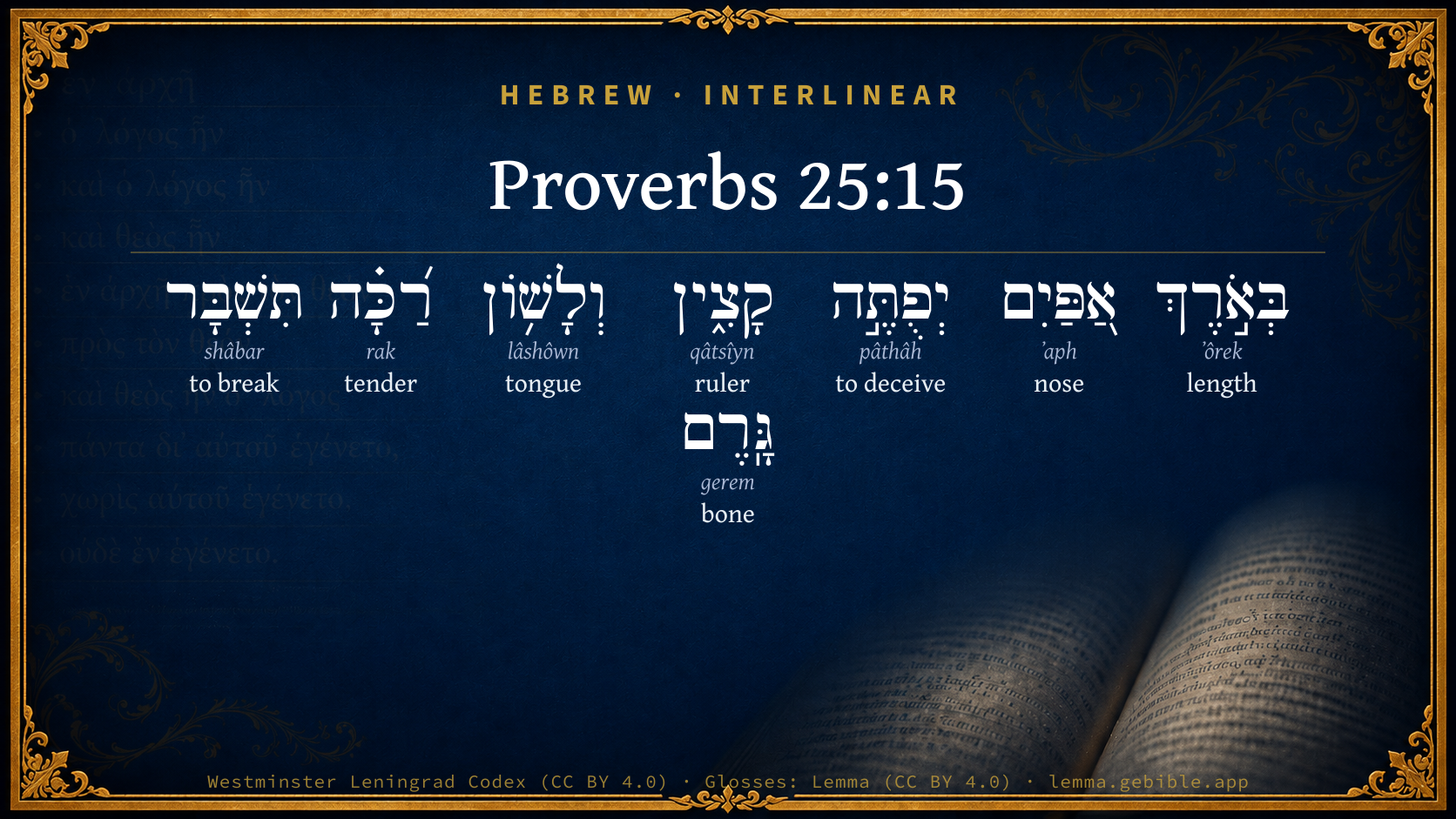
Hebrew (Westminster Leningrad Codex) Proverbs 25:15 appears in the Hebrew Old Testament. The text above is from the Westminster Leningrad Codex. Each word links to its Strong’s number, a concise gloss, and parsing drawn from the Open Scriptures Hebrew Bible morphology. Click any word for its full Brown-Driver-Briggs (BDB) entry.
Download image
Cite this verse

Proverbs 25:15 (World English Bible). Public Domain. Lemma interlinear Bible study tool, https://lemma.gebible.app/v/proverbs/25/15.

Show BibTeX & RIS
BibTeX
RIS
English Translation
By patience a ruler is persuaded. A soft tongue breaks the bone.
World English Bible · Public Domain
Download a study sheet

One document with this verse’s original text, its word-by-word gloss line, the meaning frame, cross-references with their text, attributed commentary, and full source and license credits — printable, and it pastes into notes with its structure intact.

This verse Autodidact and up

Study sheet (.html) Plain text (.txt)

A passage Seminary Student

Up to 50 verses in one chapter. A passage sheet keeps up to 6 commentary sources and 12 cross-references per verse, in the order this page ranks them, and says so on the sheet whenever that leaves anything out. Ask for a single verse and you get the Autodidact verse sheet above.

Everything on this page stays free to read, with no account — the sheet is a download of what is already on screen, not access to it.

Want to remove ads? Support Godless Engineer
Compare translations 3

The same verse in 3 English versions, stacked beneath the original-language interlinear above. Click any original word for its lexicon entry.

Each is an independent rendering of the whole verse — the interlinear is not word-aligned to these translations.

Highlighted words mark where these versions differ — a whole-verse word diff, not a word-by-word alignment.

  • World English Bible Public Domain
    By patience a ruler is persuaded. A soft tongue breaks the bone.
  • King James Version Public Domain
    By long forbearing is a prince persuaded, and a soft tongue breaketh the bone.
  • unfoldingWord Literal Text CC BY-SA 4.0
    By length of nostrils a commander may be persuaded, and a soft tongue can break a bone.

unfoldingWord Literal Text — © unfoldingWord, licensed CC BY-SA 4.0. Word-aligned USFM3 via Door43 (git.door43.org/unfoldingWord/en_ult).

Versions to compare (up to 4)

3 of 4 selected

Show all 18 translations

Every available English version of this verse, each an independent rendering of the whole verse.

  • World English Bible Public Domain
    By patience a ruler is persuaded. A soft tongue breaks the bone.
  • Berean Standard Bible Public Domain
    Through patience a ruler can be persuaded, and a gentle tongue can break a bone.
  • Majority Standard Bible Public Domain
    Through patience a ruler can be persuaded, and a gentle tongue can break a bone.
  • King James Version Public Domain
    By long forbearing is a prince persuaded, and a soft tongue breaketh the bone.
  • American Standard Version (1901) Public Domain
    By long forbearing is a ruler persuaded, And a soft tongue breaketh the bone.
  • Revised Version (1885) Public Domain
    By long forbearing is a ruler persuaded, and a soft tongue breaketh the bone.
  • Geneva Bible (1599) Public Domain
    A Prince is pacified by staying of anger, and a soft tongue breaketh the bones.
  • Douay-Rheims (1899) Public Domain
    By patience a prince shall be appeased, and a soft tongue shall break hardness.
  • Young's Literal Translation Public Domain
    By long-suffering is a ruler persuaded, And a soft tongue breaketh a bone.
  • Literal Standard Version CC BY-SA 4.0
    A ruler is persuaded by long-suffering, || And a soft tongue breaks a bone.
  • Unlocked Literal Bible CC BY-SA 4.0
    With patience a ruler can be persuaded and a soft tongue can break a bone.
  • unfoldingWord Literal Text CC BY-SA 4.0
    By length of nostrils a commander may be persuaded, and a soft tongue can break a bone.
  • Darby Bible Public Domain
    By long forbearing is a ruler persuaded, and a soft tongue breaketh the bone.
  • World Messianic Bible Public Domain
    By patience a ruler is persuaded. A soft tongue breaks the bone.
  • Webster's Bible Public Domain
    By long forbearing is a prince persuaded, and a soft tongue breaketh the bone.
  • Free Bible Version CC BY-SA 4.0
    If you're patient you can persuade your superior, and soft words can break down opposition.
  • Bible in Basic English Public Domain
    A judge is moved by one who for a long time undergoes wrongs without protest, and by a soft tongue even bone is broken.
  • JPS Tanakh (1917) Public Domain
    By long forbearing is a ruler persuaded, and a soft tongue breaketh the bone.

Literal Standard Version (2020), Covenant Press — licensed CC BY-SA 4.0. Text via the HelloAO Bible API (eBible.org). Unlocked Literal Bible (unfoldingWord) — licensed CC BY-SA 4.0. Text via the HelloAO Bible API (eBible.org). unfoldingWord Literal Text — © unfoldingWord, licensed CC BY-SA 4.0. Word-aligned USFM3 via Door43 (git.door43.org/unfoldingWord/en_ult). Free Bible Version, Dr. Jonathan Gallagher — licensed CC BY-SA 4.0. Text via the HelloAO Bible API (eBible.org).

Word by word

More ways to search: Search by grammar → Find every occurrence → Compare this word →

Practice this passage: Drill this verse → Learn its vocabulary →

About this verse

These counts appear in no published source. They are computed here, from the morphology-tagged text and Lemma’s own curated glosses. What Lemma adds →

8
words
8
distinct lemmas
Wisdom
section

Notable vocabulary

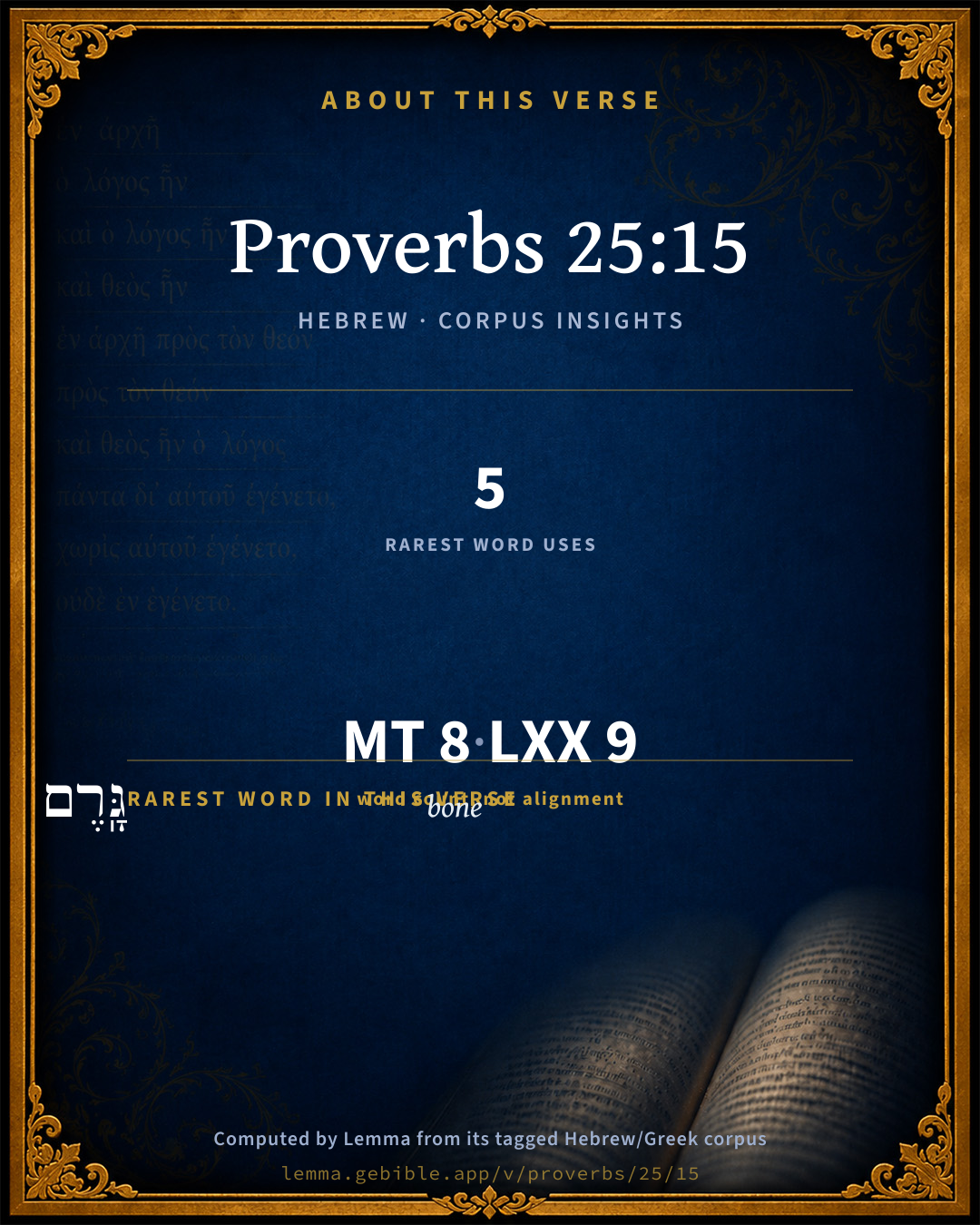
The rarest word here is גָּֽרֶם bone H1634 — appearing just 5 times in the whole Hebrew Bible.

Shared distinctive vocabulary

גָּֽרֶם bone H1634 occurs in 5 verses of the Hebrew Bible. Also found in:

Grammatical profile

  • 2 verbs
  • 5 nouns
  • 1 adjective

Verb forms

  • יְפֻתֶּ֣ה Pual · Imperfect
  • תִּשְׁבָּר Qal · Imperfect

Hebrew & Septuagint length

In English translation the verse runs 12 words from the Hebrew and 13 from the Septuagint (LXX English) — closely comparable.

A rough comparison of the two English renderings, which tokenize alike — not a word-level alignment.

Word counts can differ between the Hebrew and the Greek without any difference in meaning — e.g. the Hebrew direct-object marker אֵת has no separate Greek word, and Greek often adds the article ὁ.

In the original languages it is 8 Hebrew tokens and 9 Greek tokens — but the two are counted differently (Hebrew bundles its prefixes and suffixes into one token; the Greek is in lemma form), so that isn’t a like-for-like length.

Cross-references

6

Topical passages linked to Proverbs 25:15 in the Treasury of Scripture Knowledge — connected by theme and wording, ordered by reader-vote popularity; previews shown in the World English Bible.

  • Proverbs 15:1 A gentle answer turns away wrath, But a harsh word stirs up anger.
  • Ecclesiastes 10:4 If the spirit of the ruler rises up against you, don't leave your place; for gentleness lays great offenses to rest.
  • Proverbs 16:14 The king's wrath is a messenger of death, But a wise man will pacify it.
  • Genesis 32:4–21 He commanded them, saying, "This is what you shall tell my lord, Esau: 'This is what your servant, Jacob, says. I have lived as a foreigner with Laban, and stayed until now.
  • 1 Samuel 25:14 But one of the young men told Abigail, Nabal's wife, saying, Behold, David sent messengers out of the wilderness to Greet our master; and he railed at them.
  • 1 Samuel 25:24–44 She fell at his feet, and said, On me, my lord, on me be the iniquity; and please let your handmaid speak in your ears. Hear the words of your handmaid.

Cross-references courtesy of OpenBible.info (CC BY 4.0).

Hebrew and Greek witnesses Masoretic Hebrew ↔ Greek Septuagint

The same verse in the two great witnesses to the Old Testament, shown verse-for-verse.

These are two independent witnesses, not word-aligned to each other, and the Septuagint is shown in lemma (dictionary) form.

Hebrew Proverbs 25:15 Masoretic · Westminster Leningrad Codex

בְּאֹ֣רֶךְ אַ֭פַּיִם יְפֻתֶּ֣ה קָצִ֑ין וְלָשׁ֥וֹן רַ֝כָּ֗ה תִּשְׁבָּר גָּֽרֶם

By patience a ruler is persuaded. A soft tongue breaks the bone.

World English Bible · Public Domain

Greek LXX Proverbs 25:15 Septuagint · lemma form

ἐν μακροθυμία εὐοδία βασιλεύς γλῶσσα δέ μαλακός συντρίβω ὀστέον

In longsuffering is prosperity to kings, and a soft tongue breaks the bones.

LXX2012 (modern English Septuagint) · Public Domain

On this verse, Haydock's Catholic Bible Commentary discusses the Septuagint’s reading. Read the note in Commentary ↓

Hebrew: Westminster Leningrad Codex (CC BY 4.0). Greek: Septuagint (public domain); English from LXX2012 (modern English Septuagint) (Public Domain). How the Septuagint differs from the Hebrew →

Commentary

Notes on Proverbs 25:15 from classic Christian and Jewish commentators (each source and its license shown beneath its notes). The classic Christian expositions comment on the surrounding passage and are grouped to its opening verse, so a note may address several verses; the Jewish commentaries on the Tanakh (Rashi and others) are per-verse, so they appear only where the commentator wrote on this verse.

Lemma curates 59 commentaries, every one of them public domain or Creative Commons licensed, each selected and text-cleaned for this edition rather than reprinted as found. About our sources →

Trapp's Complete Commentary

John Trapp

Pro 25:15 By long forbearing is a prince persuaded, and a soft tongue breaketh the bone.

Ver. 15. By long forbearing is a prince persuaded.] If he be not over hasty, his wrath may be appeased, and his mind altered. Our Henry III gave commandment for the apprehending of Hubert de Burgo, Earl of Kent, who, having sudden notice thereof at midnight, got him up and fled into a church in Essex. They to whom the business was committed finding him upon his knees before the high altar, with the sacrament in one hand, and a cross in the other, carried him away nevertheless unto the Tower of London. Roger, Bishop of London, taking this to be a great violence and wrong offered unto the holy Church, would never leave the king until he had caused the earl to be carried unto the place whence he was fetched. And this, it is thought, was a means of saving the earl’s life. For though order was taken he should not escape thence, yet it gave the king’s wrath a time to cool, and himself leisure to make his apology, by reason whereof he was afterwards restored to the king’s favour and former places of honour. {a} So true is that of the philosopher, Maximum irae remedium est dilatio, {b} and that of the poet -

“Ut fragilis glacies, interit ira mora.” - Ovid.

There are those who read and sense the words thus: By meekness a prince is appeased - that is, when he seeth that he is not opposed, that his subjects repine not, rebel not against him. An old courtier of Nero’s being asked how he had escaped that lion’s mouth, answered, Iniurias ferendo, et gratias agendo, by taking shrewd turns and being thankful.

A soft tongue breaketh the bones.] Though it be flesh, and no bones, yet it breaketh the bones - that is, stout and stern spirits, that otherwise would not yield. Thus Gideon broke the rage of the Ephraimites, {Jdg 8:1-3} and Abigail David’s, by her humble and dutiful oration. {1Sa 25:23-34} {See Trapp on "Pro 15:1"}

{a} Godwin’s Catal., p. 164.

{b} Sen., De Ira.

John Trapp, A Commentary or Exposition upon All the Books of the Old and New Testament (1647–1656) — public domain. Text from a community e-Sword module.

The Biblical Illustrator

Joseph S. Exell

Pro_25:15

By long forbearing is a prince persuaded, and a soft tongue breaketh the bone.

The power of gentleness

In the government of our words, mildness, or meekness, is specially commendable. The right disposition includes meekness, gentleness, courteousness, kindness. These are the virtues of a soft tongue. The opposites are hardness, roughness, sharpness, bitterness, clamour, brawling. By the term breaking is meant persuading, pacifying, convincing, appeasing, prevailing with. A meek and gentle way of discourse is the most effectual means to overcome the fiercest passions and most obdurate, cruel dispositions. A calm and gentle way in vindicating ourselves is the most effectual means to work confusion in such as would calumniate and reproach us. This truth may be confirmed by two considerations.

1. The nature of these fierce passions and this obduracy or hardness of temper, which are increased by opposition, and consequently must be abated by gentleness and yielding.

2. From the nature of lenity and gentleness, whose property it is to insinuate itself into the hardest things. It is compared with oil. How does this doctrine consist with the imprecations of Scripture? Explain that some of them, though pronounced optatively, are to be understood declaratively, as descriptive of the true state and condition of such parties. Those who used these imprecations were inspired for a particular purpose. They spoke in their zeal for God. It may be right to wish evil to come to persons for the sake of its disciplinary mission. How does this doctrine consist with the severe imprecations of Scripture? Our Saviour called the Pharisees vipers, Herod a fox. The apostle calls some people dogs. To this it may be said, those who have an extraordinary power of discerning may use such hard terms. And those in public stations may thus severely chide and reprehend. How does this doctrine consist with the duties of zeal and reproving, which sometimes must be done with severity? A man may sometimes sin in not being angry. True meekness of wisdom directs a, man how to order his zeal and rebukes. Learn--

1. That if soft words be of such a prevailing efficacy, soft and gentle actions must be so too.

2. The folly and sinfulness of hard speeches, whereby others may be provoked to anger and offence.

3. The lawfulness and fitness of giving men the reverence and honour due to their proper titles.

4. Bitter and provoking words are unmanly, as being against the rules of morality and very un-Christian, as being against the precepts of the gospel. (Bp. John Wilkins.)

The manifestation and mightiness of moral power

There are three kinds of power--material, mental, and moral.

I. The manifestation of moral power. The words indicate a threefold manifestation.

1. Stillness. By long forbearing is a prince persuaded. Forbearance implies calm endurance--a patience like that which the Great Heavenly Exemplar exhibited under insults and persecutions.

2. Speech. A soft tongue breaketh the bone. A soft tongue not a simpering tongue, not a silly tongue, not a sycophantic tongue, but the soft tongue of tender love and forbearing kindness. Such a tongue is might: it breaketh the bone. This somewhat paradoxical expression expresses the amazing power of kind words; they break the bone, the ossified heart of the enemy. Another manifestation of power here is--

3. Service. If thine enemy be hungry, give him bread to eat; and if he be thirsty, give him water to drink, etc. In the smelting of metals, says Arnot, whether on a large or small scale, it is necessary that the burning coals should be above the ore as well as beneath it. The melting fuel and the rude stones to be melted are mingled together and brought into contact, particle by particle, throughout the mass. It is thus that the resistance of the stubborn material is overcome, and the precious separated from the vile. There are but few hearts so obdurate as not to melt under the fires of love that blaze over and under them. These words direct our attention to--

II. The mightiness of moral power.

1. Persuading. By long forbearing is a prince persuaded. Thus David brought down Saul (1Sa_24:8-20; 1Sa_26:3-20).

2. Breaking. A soft tongue breaketh the bone. Loving words can mollify the roughest natures. Gideon, with a kind word, pacified the Ephraimites, and Abigail turned Davids wrath away.

3. Melting. Thou shalt heap coals of fire on his head. The Americans have a tract on this subject, entitled, The Man who Killed his Neighbours. It contains, in the form of a narrative, many useful, practical suggestions on the art of overcoming evil with good. It is with kindness--modest, thoughtful, generous, persevering, unwearied kindness--that the benevolent countryman killed his churlish neighbour: and it is only the old evil man that he kills, leaving the new man to lead a very different life in the same village, after the dross has been purged away. How sublimely elevated is the moral legislation of the Bible! (D. Thomas, D.D.)

The power of Christian kindness

There is a tremendous power in a kind word.

1. Kindness as a means of defence. Have you ever known acerbity and acrimonious dispute settle a quarrel? I have seen men moving amid the annoyances, and vexations, and assaults of life in such calm Christian deliberation that all the buzzing around about their soul amounted to nothing. They conquered them, and, above all, conquered themselves.

2. Kindness as a means of usefulness. In all communities you find sceptical men. How shall you capture them for God? Sharp argument and sareastic retort never yet won a single soul from scepticism to the Christian religion. When such are brought in, it is through the charm of some genial soul, and not by argument at all. Men are not saved through the head; they are saved through the heart. The same thing is true in the reclamation of the openly vicious. Was ever a drunkard saved through the caricature of a drunkard? You can never drive man, woman, or child into the kingdom of God. (T. De Witt Talmage, D.D.)

The Biblical Illustrator, edited by Joseph S. Exell (c. 1880s–1900s) — public domain. Text from a community e-Sword module.

Joseph Benson's Commentary

Pro 25:15. By long forbearing is a prince persuaded — That is, by patient submission and expectation he is pacified, whereas his rage is increased by opposition. And a soft tongue breaketh the bone — A mild and humble answer softens a heart which is as hard as a bone or stone. He alludes to those oils which sink through the flesh to the very bone: see Psa 109:18.

Joseph Benson's Commentary on the Old and New Testaments (1811–1818) — public domain. Text from a community e-Sword module.

The Preacher's Complete Homiletical Commentary

Joseph S. Exell (gen. ed.)

CRITICAL NOTES.—

Pro_25:15. Prince. Rather “Judge”

MAIN HOMILETICS OF Pro_25:15

FORBEARANCE AND PERSUASIVENESS

I. Patience without speech is an overcoming power. The strongest smith will find a piece of cold iron too much for him—if he attempt to bend or break it he will be met with a resistance which he cannot overcome. But he places the apparently unconquerable bar upon the coals, and by degrees it seems to assume altogether another nature, and is ready to be fashioned to any shape or form. He gets this victory by waiting, and he finds it a far more effectual method than attempting to subdue the metal by physical force. Forbearance will sometimes do as much for the stubborn human will as the fire does for the iron. Many men who cannot be threatened into compliance with our wishes, may be overcome by patient kindness. A prince may be here put by Solomon as a type of all men in authority and high position, who by reason of their position are less under the power of others and consequently are less likely to yield to any other force than persuasion. With such men high-handed dealing and efforts to intimidate generally provoke a more stubborn resistance.

II. Patience seconded by gentle speech is doubly powerful. The smith’s work is not done when by waiting he has given time for the iron to become soft and impressible; he must then bring his skill and activity to bear upon it and so mould it to his will. So after long forbearance there must be wise and persuasive speech to finish the work. The long-suffering patience, perhaps under trial and provocation, has softened the hard heart or the stubborn will, and now the gentle words are listened to and have their full weight. But this would not have been the case if patience without speech had not gone first to make way for them.

III. Those who conquer by forbearance in deed and gentleness in word walk in the Divine footsteps. In the dealings of God with the human race, no attribute of His character is more manifest than “the riches of His forbearance and long suffering” (Rom_2:4), and it is by this that He “leads men to repentance.” “Instead of coming down upon man by storm,” says Dr. Bushnell, “in a manner of direct onset to carry his submission by storm, God lays gentle siege to him, waiting for his willing assent and choice.… To redress an injury by gentleness, and tame his adversary’s will by the circuitous approach of forbearance and a siege of true suggestion is not the manner of men, only of God.” It is not, alas! the manner of men in general, but all those who call Him Master try to imitate Him in this as in all other of His perfections that can be imitated by finite and imperfect creatures.

OUTLINES AND SUGGESTIVE COMMENTS

The soft member breaking the hard bone may seem to be a paradox. But it is a fine illustration of the power of gentleness above hardness and irritation. Apply it to those who are set against the truth. Many a stout heart has been won by a forbearing, yet uncompromising, accommodation to prejudice. In reproof Jehovah showed what He could do in “the strong wind and the earthquake.” But His effective rebuke was in the “still small voice;” without upbraiding; sharp, yet tender, (1Ki_19:11-13.) So powerful is the energy of gentleness! Indeed, “among all the graces that adorn the Christian soul, like so many jewels of various colours and lustres, against the day of her espousals to the Lamb of God, there is not one more brilliant than that of patience.”

The Preacher's Complete Homiletical Commentary (gen. ed. Joseph S. Exell; Funk & Wagnalls, c. 1892) — public domain (pre-1929). A full-Bible homiletical/sermon-outline anthology covering 65 of 66 books (2 John is absent from the source module). Text from a community e-Sword module.

Geneva Bible (1599)

Geneva Bible translators

By not ministering occasion to provoke him further.

That is, the heart that is bent to anger, as Prov. 15:1.

Geneva Bible (1599) marginal notes — public domain. Text via Bolls.life.

Matthew Henry's Commentary

Two things are here recommended to us, in dealing with others, as likely means to gain our point: - 1. Patience, to bear a present heat without being put into a heat by it, and to wait for a fit opportunity to offer our reasons and to give persons time to consider them. By this means even a prince may be persuaded to do a thing which he seemed very averse to, much more a common person. That which is justice and reason now will be so another time, and therefore we need not urge them with violence now, but wait for a more convenient season. 2. Mildness, to speak without passion or provocation: A soft tongue breaks the bone; it mollifies the roughest spirits and overcomes those that are most morose, like lightning, which, they say, has sometimes broken the bone, and yet not pierced the flesh. Gideon with a soft tongue pacified the Ephraimites and Abigail turned away David's wrath. Hard words, we say, break no bones, and therefore we should bear them patiently; but, it seems, soft words do, and therefore we should, on all occasions, give them prudently.

Matthew Henry's Commentary on the Whole Bible (1708–1710) — public domain (CC PDM 1.0). Text via the HelloAO Bible API.

Jamieson, Fausset & Brown

Robert Jamieson, A. R. Fausset & David Brown

Gentleness and kindness overcome the most powerful and obstinate.

long forbearing--or, "slowness to anger" (Pro 14:29; Pro 15:18).

Jamieson, Fausset & Brown — Commentary Critical and Explanatory on the Whole Bible (1871) — public domain (CC PDM 1.0). Text via the HelloAO Bible API.

Adam Clarke's Commentary

Verse 15. A soft tongue breaketh the bone.] This is similar to another proverb on the same subject: "A soft answer turneth away wrath." An angry word does nothing but mischief.

Adam Clarke's Commentary on the Bible (1810–1826) — public domain. Text from a community e-Sword/MySword module.

The Cambridge Bible for Schools and Colleges

gen. ed. J. J. S. Perowne

15. We have an illustration of this proverb in the effect of the “long forbearing” of David during his persecution by Saul, and of his “soft tongue” at Engedi (1 Samuel 24), and in the wilderness of Ziph (Ib. Pro_26:7 ff.): “And it came to pass, when David had made an end of speaking these words unto Saul, that Saul said, Is this thy voice, my son David? And Saul lifted up his voice and wept: “Return, my son David; for I will no more do thee harm, because my soul was precious in thine eyes this day.”

The Cambridge Bible for Schools and Colleges (gen. ed. J. J. S. Perowne; Cambridge University Press, 1878–1918) — public domain. Text from a community e-Sword module.

John Gill's Exposition

By long forbearing is a prince persuaded,.... To come into measures, and do that which his council and ministry advise him to, and to which he may seem at first very averse; but by a mild and gentle representation of things, by an humble submission of them to him, and by frequent remonstrances and patient waiting, his mind is softened, bent, and inclined to take their advice, and pursue the measures suggested to him; which, had they been pressed with heat, haughtiness, and haste, would have been rejected;

and a soft tongue breaketh the bone; or "hardness", as the Vulgate Latin version renders it; soft words, or words delivered in soft language, remove hardness and roughness from the minds of men; and work upon, influence, and bend men, whose wills are obstinate and stubborn, and make them pliable and tractable: so David, with a soft tongue, wrought upon Saul, his enemy; and Abigail, by her soft language, turned the mind of David, who was bent upon the destruction of Nabal, Sa1 24:16; see Pro 15:1. Jarchi interprets this soft tongue of prayer and supplication, by which severe things against sinners are removed from them; and so he understands the former clause of the forbearance of God, which gives encouragement to sinners, to persuade him in their favour by repentance and prayer; see Mat 18:26.

John Gill's Exposition of the Whole Bible (1746–1763) — public domain (CC PDM 1.0). Text via the HelloAO Bible API.

Albert Barnes' Notes on the Bible

A soft tongue - Winning and gentle speech does what it seems at first least capable of doing; it overcomes obstacles which are as bones that the strongest jaws would fail to crush.

Albert Barnes' Notes on the Bible (1834–1885) — public domain. Text from a community e-Sword/MySword module.

Haydock's Catholic Bible Commentary

Hardness. Hebrew and Septuagint, "bones." (Haydock)

George Leo Haydock (1774–1849), Haydock's Catholic Family Bible and Commentary, 1859 edition — public domain. Excludes Psalms (Douay-Rheims chapter numbering differs from Protestant) and Deuterocanonical books (Catholic canon only).

Matthew Poole's English Annotations

By long forbearing, by patient submission and expectation,

is a prince persuaded, or pacified, whereas his rage is increased by opposition. Compare Ecc 10:4.

A soft tongue, a mild and humble answer,

breaketh the bone; softeneth a heart which is as hard as bone or stone. He alludes to those oils which sink through the flesh to the very bone. See Psa 109:18.

Matthew Poole's English Annotations on the Holy Bible (1683–1685) — public domain. Text from a community e-Sword/MySword module.

Whedon's Commentary on the Bible

Daniel D. Whedon

15. By long forbearing — By delay of anger or resentment; by patience.

A soft tongue (a gentle or kind word) breaketh the bone — Changes the most obstinate mind and allays the most irritated feeling. Similar to another proverb, “A soft answer turneth away wrath;” or the German proverb, “Patience breaks iron.” Compare Pro_15:1; Pro_16:14; Luke 18:45; Gen_32:4, et seq.; 1Sa_25:24.

Daniel D. Whedon (gen. ed.), Commentary on the Old and New Testaments (1874–1909) — public domain. Text from a community e-Sword module.

The Pulpit Commentary

By long forbearing; i.e. by patience, calmness that does not break out into passion whatever be the provocation, even, it is implied, in the face of a false and malicious accusation. (comp. Pro_14:29) Is a prince persuaded. Katson is rather "an arbiter," or judge, than "a prince," and the proverb says that such an officer is led to take a favourable view of an accused person"s case when he sees him calm and composed, ready to explain the matter without any undue heat or irritation, keeping steadily to the point, and not seduced by calumny or misrepresentation to forget himself and lose his temper. Such a bearing presupposes innocence and weighs favourably with the judge. The LXX makes the gnome apply to monarchs alone, "In long suffering is prosperity unto kings." A soft tongue breaketh the bone. A soft answer, (Pro_15:1) gentle, conciliating words, overcome opposition, and disarm the most determined enemy, and make tender in him that which was hardest and most uncompromising. "Gutta cavat lapidem, non vi, sed saepe cadendo." Similar proverbs are found elsewhere, though probably in a different sense. Thus in modern Greek, "The tongue has no bones, yet it breaks bones;" in Turkish, "The tongue has no bone, yet it crushes;" again, "One drop of honey," says the Turk, "catches more bees than a ton of vinegar."

The Pulpit Commentary (1880–1919), ed. H.D.M. Spence-Jones & Joseph S. Exell — public domain. Text from a community e-Sword module.

John Wesley's Explanatory Notes

Forbearing - By patient submission and expectation. Breaketh - Softens the hardest heart.

John Wesley, Explanatory Notes Upon the Whole Bible (1754–1765) — public domain. Text via the GEBible commentary corpus.

Keil & Delitzsch

C. F. Keil & F. Delitzsch

Three proverbs follow, which have this in common, that they exhort to moderation:

15 By forbearance is a judge won over,

And a gentle tongue breaketh the bone.

קצין (vid., Pro 6:7) does not denote any kind of distinguished person, but a judge or a person occupying a high official position. And פּתּה does not here mean, to talk over or delude; but, like Jer 20:7, to persuade, to win over, to make favourable to one; for ארך אפּים (vid., Pro 14:29) is dispassionate calmness, not breaking out into wrath, which finally makes it manifest that he who has become the object of accusation, suspicion, or of disgrace, is one who nevertheless has right on his side; for indecent, boisterous passion injures even a just cause; while, on the contrary, a quiet, composed, thoughtful behaviour, which is not embarrassed by injustice, either experienced or threatened, in the end secures a decision in our favour. "Patience overcomes" is an old saying. The soft, gentle tongue (cf. רך, Pro 15:1) is the opposite of a passionate, sharp, coarse one, which only the more increases the resistance which it seeks to overcome. "Patience," says a German proverb, "breaks iron;" another says, "Patience is stronger than a diamond." So here: a gentle tongue breaketh the bone (גּרם = עצם, as at Pro 17:22), it softens and breaks to pieces that which is hardest. Sudden anger makes the evil still worse; long-suffering, on the contrary, operates convincingly; cutting, immoderate language, embitters and drives away; gentle words, on the contrary, persuade, if not immediately, yet by this, that they remain as it were unchangeable.

Keil & Delitzsch — Biblical Commentary on the Old Testament (1861–1891) — public domain (CC PDM 1.0). Text via the HelloAO Bible API. (Old Testament only.)

Bridges on Proverbs

Charles Bridges

The wise man had before given a general rule for gentleness. (Pro 15:1 .) Here he takes an extreme case, and shews its power with the prince, whose unrestrained anger may rise to immediate revenge.†1 Yet submission, long-forbearing, has mighty power to persuade. David thus wrought upon Saul’s enraged temper.†2 Often by putting a case before an angry prince at a fitting opportunity, he may be persuaded by "the meekness of wisdom" against his present mind.

But the general principle is most instructive. The soft member breaking the hard bone may seem to be a paradox. But it is a fine illustration of the power of gentleness above hardness and irritation. Apply it to those who are set against the truth. Many a stout heart has been won by a forbearing, yet uncompromising, accommodation to prejudice.†3 In reproof Jehovah shewed what he could do in "the strong wind and the earthquake." But his effective rebuke was in the "still small voice;" without upbraiding; sharp, yet tender. (1Ki 19:11-13 .) So powerful is the energy of gentleness! Indeed ’among all the graces that adorn the Christian soul, like so many jewels of various colors and lusters, against the day of her espousals to the Lamb of God, there is not one more brilliant than that of patience.’†4 Its enduring spirit is a manifest fruit of regeneration (Jas 1:18-19 ); a clear exhibition of the mind of Christ (Mat 11:29 ), and the practical resemblance of his own long-forbearance amidst our continued and most aggravated provocations. For, when we have been indulged with the privilege of the beloved disciple — ’leaning upon Jesus’s breast,’†5 nothing have we felt to be there, but gentleness, tenderness, and love.

Footnotes:

†1 Ecc 8:3; Ecc 10:4 . 1Sa 22:17-18 .

†2 1Sa 24:8-20 ; 1Sa 26:13-25 .

†3 2Ti 2:24-26 . 1Co 9:20-22 .

†4 Bp. Horne’s exquisite Sermon on Patience.

†5 Joh 13:23; Joh 21:20 .

Charles Bridges, An Exposition of the Book of Proverbs (1846) — public domain. Text from a community e-Sword module.

unfoldingWord translationNotes

Door43 World Missions Community

With patience a ruler can be persuaded

These words can be translated in active form. AT: "Someone who is patient can persuade a ruler" or "Someone who is patient can speak to a ruler and change his mind" (See: Active or Passive)

a soft tongue can break a bone

The word "tongue" is a metonym for the words the person speaks using the tongue. The word "bone" is a metaphor for strong opposition. AT: "gentle speech can overcome strong opposition" (See: Metaphor)

translationWords

patient

rule

tongue

unfoldingWord translationNotes — © Distant Shores Media and the Door43 World Missions Community, licensed CC BY-SA 4.0. Source: git.door43.org/Door43/en_tn.

Rashi

Rabbi Shlomo Yitzchaki (Rashi)

The Ruler is won over with slowness to anger As long as the Holy One, blessed be He, holds back His anger and does not requite, the sinners will apply their hearts to win Him over with repentance and prayer.

and a gentle tongue with prayer and supplications.

will break a bone Heb. גרם a bone, the severity of the decree.

Rashi on the Tanakh — English translations: “The Judaica Press complete Tanach with Rashi, translated by A. J. Rosenberg” (CC BY 4.0); “Pentateuch with Rashi's commentary by M. Rosenbaum and A.M. Silbermann, 1929-1934” (public domain); “The Metsudah Tanach series, Lakewood, N.J” (CC BY 4.0); and “The Book of Joshua, Metsudah Publications, 1997” (CC BY 4.0). Text via Sefaria.

Lesson kit

Teaching starters — assembled from the data on this page, not authored interpretation. Every prompt links to the verse data it draws on. Edit before teaching.

Proverbs, in the Wisdom, opens this verse with 8 words (8 distinct Hebrew lemmas). Its most distinctive word is gerem (“bone”). A historical commentator’s framing appears above. Read the whole chapter for the surrounding context.

Discussion questions

  1. How does “bone” (gerem) shape what this verse is saying?
  2. Genesis 49:14 shares the word «bone» with this verse. How do the two illuminate each other?
  3. These translations render this verse differently. What is at stake in choosing one wording over another?
  4. The verb «יְפֻתֶּ֣ה» is Pual Imperfect. How does its form color the action?
  5. Reading how Trapp's Complete Commentary and The Biblical Illustrator read this verse, where do the two commentators agree and where do they part?

Things to notice

Reading settings

Reading text

Shown beneath each verse's original-language words.

Old Testament
Old Testament edition

Read the OT as the Masoretic Hebrew (MT) or the Greek Septuagint (LXX).

English shown for the Greek Septuagint (in the Hebrew ↔ Greek comparison).

Comparing translations? Open the Compare panel on any verse page to stack up to four side by side.