
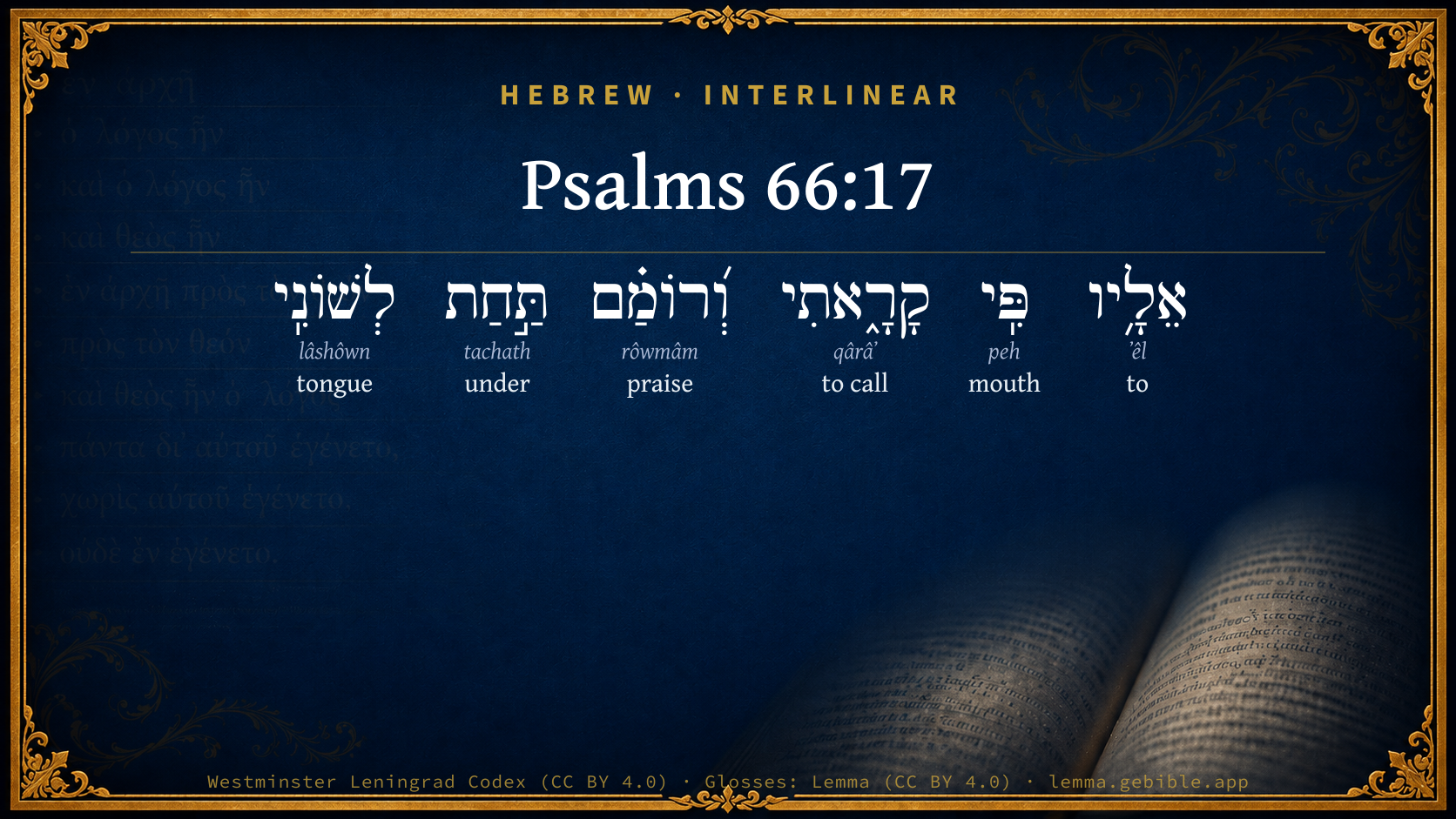
Psalms 66:17

Hebrew (Westminster Leningrad Codex) Psalms 66:17 appears in the Hebrew Old Testament. The text above is from the Westminster Leningrad Codex. Each word links to its Strong’s number, a concise gloss, and parsing drawn from the Open Scriptures Hebrew Bible morphology. Click any word for its full Brown-Driver-Briggs (BDB) entry.
Download image
Cite this verse

Psalms 66:17 (World English Bible). Public Domain. Lemma interlinear Bible study tool, https://lemma.gebible.app/v/psalms/66/17.

Show BibTeX & RIS
BibTeX
RIS
English Translation
I cried to him with my mouth. He was extolled with my tongue.
World English Bible · Public Domain
Highlights
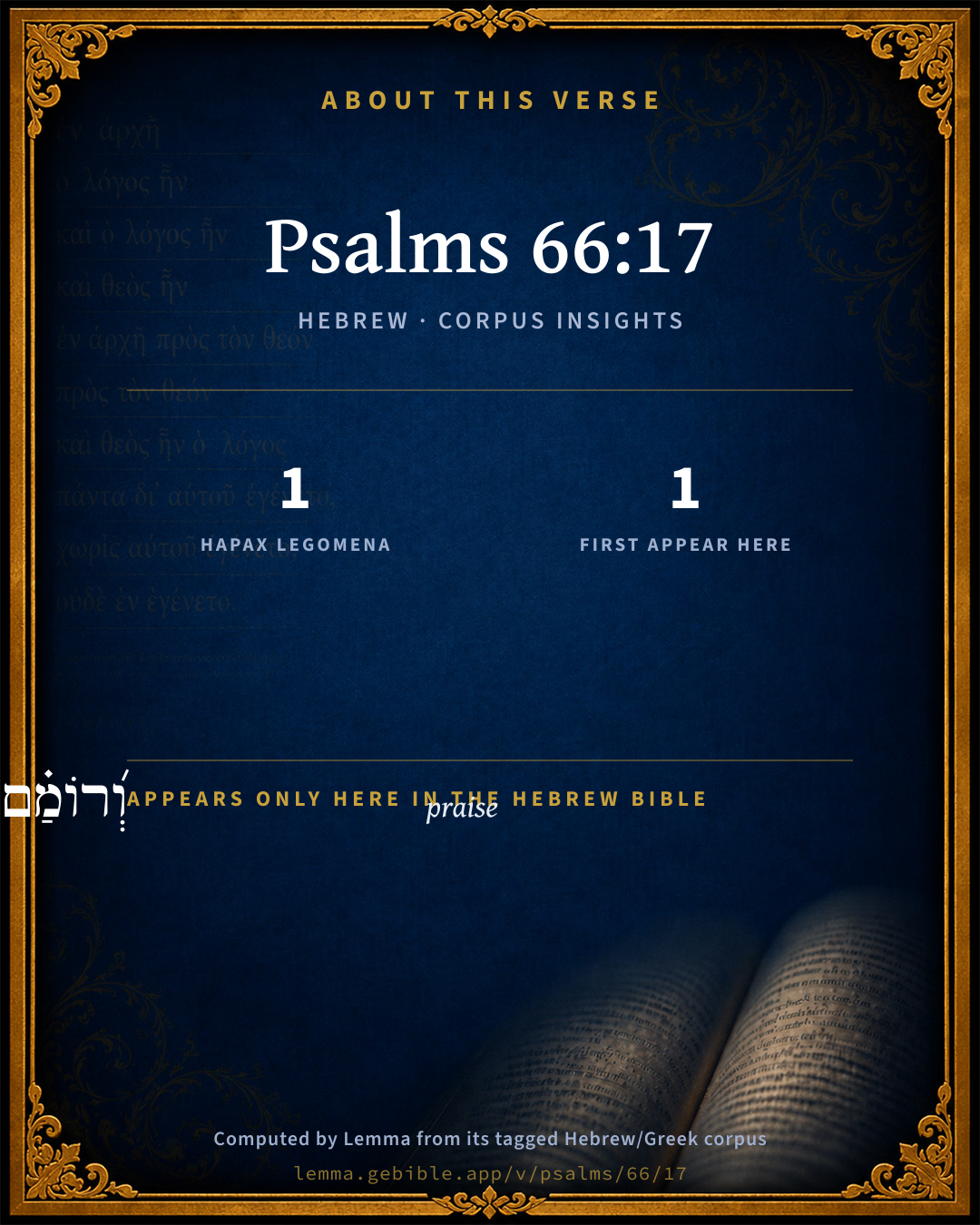
  • 1 hapax legomenon — only here in the Hebrew Bible
  • 1 first appearance in the Hebrew Bible
Full analysis ↓
Download a study sheet

One document with this verse’s original text, its word-by-word gloss line, the meaning frame, cross-references with their text, attributed commentary, and full source and license credits — printable, and it pastes into notes with its structure intact.

This verse Autodidact and up

Study sheet (.html) Plain text (.txt)

A passage Seminary Student

Up to 50 verses in one chapter. A passage sheet keeps up to 6 commentary sources and 12 cross-references per verse, in the order this page ranks them, and says so on the sheet whenever that leaves anything out. Ask for a single verse and you get the Autodidact verse sheet above.

Everything on this page stays free to read, with no account — the sheet is a download of what is already on screen, not access to it.

Want to remove ads? Support Godless Engineer
Compare translations 3

The same verse in 3 English versions, stacked beneath the original-language interlinear above. Click any original word for its lexicon entry.

Each is an independent rendering of the whole verse — the interlinear is not word-aligned to these translations.

Highlighted words mark where these versions differ — a whole-verse word diff, not a word-by-word alignment.

  • World English Bible Public Domain
    I cried to him with my mouth. He was extolled with my tongue.
  • King James Version Public Domain
    I cried unto him with my mouth, and he was extolled with my tongue.
  • unfoldingWord Literal Text CC BY-SA 4.0
    I called to him my mouth, and he was exalted from my tongue.

unfoldingWord Literal Text — © unfoldingWord, licensed CC BY-SA 4.0. Word-aligned USFM3 via Door43 (git.door43.org/unfoldingWord/en_ult).

Versions to compare (up to 4)

3 of 4 selected

Show all 18 translations

Every available English version of this verse, each an independent rendering of the whole verse.

  • World English Bible Public Domain
    I cried to him with my mouth. He was extolled with my tongue.
  • Berean Standard Bible Public Domain
    I cried out to Him with my mouth and praised Him with my tongue.
  • Majority Standard Bible Public Domain
    I cried out to Him with my mouth and praised Him with my tongue.
  • King James Version Public Domain
    I cried unto him with my mouth, and he was extolled with my tongue.
  • American Standard Version (1901) Public Domain
    I cried unto him with my mouth, And he was extolled with my tongue.
  • Revised Version (1885) Public Domain
    I cried unto him with my mouth, and he was extolled with my tongue.
  • Geneva Bible (1599) Public Domain
    I called vnto him with my mouth, and he was exalted with my tongue.
  • Douay-Rheims (1899) Public Domain
    I cried to him with my mouth: and I extolled him with my tongue.
  • Young's Literal Translation Public Domain
    Unto Him `with' my mouth I have called, And exaltation `is' under my tongue.
  • Literal Standard Version CC BY-SA 4.0
    I have called to Him [with] my mouth, || And exaltation [is] under my tongue.
  • Unlocked Literal Bible CC BY-SA 4.0
    I cried to him with my mouth, and he was praised with my tongue.
  • unfoldingWord Literal Text CC BY-SA 4.0
    I called to him my mouth, and he was exalted from my tongue.
  • Darby Bible Public Domain
    I called unto him with my mouth, and he was extolled with my tongue.
  • World Messianic Bible Public Domain
    I cried to him with my mouth. He was extolled with my tongue.
  • Webster's Bible Public Domain
    I cried to him with my mouth, and he was extolled with my tongue.
  • Free Bible Version CC BY-SA 4.0
    I called out to him, and praised him with my voice.
  • Bible in Basic English Public Domain
    My voice went up to him, and I was lifted up from the underworld.
  • JPS Tanakh (1917) Public Domain
    I cried unto Him with my mouth, and He was extolled with my tongue.

Literal Standard Version (2020), Covenant Press — licensed CC BY-SA 4.0. Text via the HelloAO Bible API (eBible.org). Unlocked Literal Bible (unfoldingWord) — licensed CC BY-SA 4.0. Text via the HelloAO Bible API (eBible.org). unfoldingWord Literal Text — © unfoldingWord, licensed CC BY-SA 4.0. Word-aligned USFM3 via Door43 (git.door43.org/unfoldingWord/en_ult). Free Bible Version, Dr. Jonathan Gallagher — licensed CC BY-SA 4.0. Text via the HelloAO Bible API (eBible.org).

Word by word

More ways to search: Search by grammar → Find every occurrence → Compare this word →

Practice this passage: Drill this verse → Learn its vocabulary →

About this verse

These counts appear in no published source. They are computed here, from the morphology-tagged text and Lemma’s own curated glosses. What Lemma adds →

6
words
6
distinct lemmas
Wisdom
section

Notable vocabulary

1 hapax legomenon — a word that appears only here in the entire Hebrew Bible:

  • וְ֝רוֹמַ֗ם praise H7318

First appearance in Scripture

This word makes its first canonical appearance in the Hebrew Bible here:

  • וְ֝רוֹמַ֗ם praise H7318

Grammatical profile

  • 1 verb
  • 3 nouns
  • 2 prepositions

Verb forms

  • קָרָ֑אתִי Qal · Perfect

Hebrew & Septuagint length

In English translation the verse runs 13 words from the Hebrew and 13 from the Septuagint (LXX English) — the same length.

A rough comparison of the two English renderings, which tokenize alike — not a word-level alignment.

Word counts can differ between the Hebrew and the Greek without any difference in meaning — e.g. the Hebrew direct-object marker אֵת has no separate Greek word, and Greek often adds the article ὁ.

Cross-references

7

Topical passages linked to Psalms 66:17 in the Treasury of Scripture Knowledge — connected by theme and wording, ordered by reader-vote popularity; previews shown in the World English Bible.

  • Psalms 34:6 This poor man cried, and Yahweh heard him, And saved him out of all his troubles.
  • Psalms 30:1 I will extol you, Yahweh, for you have raised me up, And have not made my foes to rejoice over me.
  • Psalms 116:1–2 I love Yahweh, because he listens to my voice, And my cries for mercy.
  • Psalms 116:12 What will I give to Yahweh for all his benefits toward me?
  • Psalms 30:8 I cried to you, Yahweh. To Yahweh I made supplication:
  • Psalms 34:3–4 Oh magnify Yahweh with me. Let us exalt his name together.
  • Psalms 145:1 I will exalt you, my God, the King. I will praise your name forever and ever.

Cross-references courtesy of OpenBible.info (CC BY 4.0).

Hebrew and Greek witnesses Masoretic Hebrew ↔ Greek Septuagint

The same verse in the two great witnesses to the Old Testament, shown verse-for-verse.

You’re reading Greek Psalm 65 (Hebrew Psalm 66). The Septuagint counts the superscription, so verse numbers can differ from the Hebrew — chapter-level alignment, not verse-by-verse. Numbering follows Rahlfs.

These are two independent witnesses, not word-aligned to each other, and the Septuagint is shown in lemma (dictionary) form.

Hebrew Psalms 66:17 Masoretic · Westminster Leningrad Codex

אֵלָ֥יו פִּֽי קָרָ֑אתִי וְ֝רוֹמַ֗ם תַּ֣חַת לְשׁוֹנִֽי

I cried to him with my mouth. He was extolled with my tongue.

World English Bible · Public Domain

Greek LXX Greek Psalm 65:17 Septuagint · lemma form

πρός αὐτός ὁ στόμα ἐγώ κράζω καί ὑψόω ὑπό ὁ γλῶσσα ἐγώ

I cried to him with my mouth, and exalted him with my tongue.

LXX2012 (modern English Septuagint) · Public Domain

Hebrew: Westminster Leningrad Codex (CC BY 4.0). Greek: Septuagint (public domain); English from LXX2012 (modern English Septuagint) (Public Domain). How the Septuagint differs from the Hebrew →

Commentary

Notes on Psalms 66:17 from classic Christian and Jewish commentators (each source and its license shown beneath its notes). The classic Christian expositions comment on the surrounding passage and are grouped to its opening verse, so a note may address several verses; the Jewish commentaries on the Tanakh (Rashi and others) are per-verse, so they appear only where the commentator wrote on this verse.

Lemma curates 59 commentaries, every one of them public domain or Creative Commons licensed, each selected and text-cleaned for this edition rather than reprinted as found. About our sources →

Trapp's Complete Commentary

John Trapp

Psa 66:17 I cried unto him with my mouth, and he was extolled with my tongue.

Ver. 17. I cried unto him] I prayed fervently and frequently.

And he was extolled, &c.] My prayers were soon turned into praises, which I silently framed within myself even while I was praying.

John Trapp, A Commentary or Exposition upon All the Books of the Old and New Testament (1647–1656) — public domain. Text from a community e-Sword module.

J. A. Alexander on Psalms

Joseph Addison Alexander

17. (Psa 66:17) To him (with) my mouth I called, and high praise (exaltation) was under my tongue. By a slight change in the pointing, or by supposing an irregularity of punctuation, the last clause may be rendered, he was extolled nder my tongue, i.e. by means of it as an instrument of praise. But as a corresponding plural form occurs below, Psa 149:6, the Hebrew words here meaning lofty praise, or exaltation by means of praise. Under my tongue may be simply equivalent to on or with my tongue, or it may be intended to suggest the additional idea of a store or deposit of such praises still in reserve, to be employed hereafter, which some suppose to be the meaning of the phrase in Psa 10:7.

Joseph Addison Alexander, The Psalms Translated and Explained (1850) — public domain. Text from a community e-Sword module.

Jamieson, Fausset & Brown

Robert Jamieson, A. R. Fausset & David Brown

he was extolled with my tongue--literally, "exaltation (was) under my tongue," as a place of deposit, whence it proceeded; that is, honoring God was habitual.

Jamieson, Fausset & Brown — Commentary Critical and Explanatory on the Whole Bible (1871) — public domain (CC PDM 1.0). Text via the HelloAO Bible API.

Adam Clarke's Commentary

Verse 17. I cried unto him with my mouth] My prayer was fervent; he heard and answered; and my tongue celebrated his mercies; and he as graciously received my thanksgiving, as he compassionately heard my prayer.

Adam Clarke's Commentary on the Bible (1810–1826) — public domain. Text from a community e-Sword/MySword module.

John Calvin's Commentaries

17. I cried unto him with my mouth He proves that he owed his safety to Divine interposition, from the circumstance of his having prayed, and in consequence, having sensibly experienced his kindness. Answers to prayer serve in no small degree to illustrate the goodness of God; and confirm our faith in it. In saying that he cried to God with his mouth and tongue, these are terms denoting, as we have seen in a previous part of the psalm, the vehemency and earnestness with which he prayed. Had he not prayed from the heart, he would have been rejected, but he makes mention of the tongue also, in token of the ardor of his supplications. Some absurdly imagine, that because the expression under the tongue is used, the meaning is with the heart Words are said to come from under the tongue, because they are formed by the flexion of the tongue, as in that passage,

“The poison of asps is under their lips,” (Psalm 140:3)

The term extol intimates, that we cannot honor God more in our worship, than by looking upwards to him for deliverance. The Papists rob him of a chief part of his glory, when they direct their prayers to the dead or to images, and make such little account of calling upon the name of the Lord.

The Psalmist next lays down the rule, which must be attended to, if we would pray properly and acceptably; guarding against that presumptuous exercise which overlooks the necessity of faith and penitence. We see with what audacity hypocrites and ungodly men associate themselves with the Lord’s people, in compliance with the general calls of the word to engage in prayer. To check this solemn mockery, the Psalmist mentions integrity of heart as indispensable. I am aware that the words may be considered as an assertion of his own personal uprightness of conduct, as we find him frequently vindicating this, by an appeal to the visible and practical proofs which God had shown of his favor to him; but his main object is evidently to enforce by the example of his own exercise the common propriety of drawing near to God with a pure heart. We have a parallel scripture in John 9:31, “We know that God heareth not sinners.” In one sense, he hears none but sinners; for we must all conform to the great rule of applying to him for the remission of our sins. But while believers make an unreserved confession of guilt before God, by this very thing they cease to be sinners, for God pardons them in answer to their supplications. We are not to forget the words of Paul,

“Let every one that nameth the name of Christ depart from iniquity,” — (2 Timothy 2:19)

Besides, to regard iniquity in the heart does not mean to be conscious of sin — for all the Lord’s people must see their sins and be grieved for them, and this is rather praiseworthy than condemnable; — but to be bent upon the practice of iniquity. He particularly refers to the heart, intimating that not only were his hands clean, in the sense of his being innocent before men, but that he could appeal to God in proof of his inward integrity. When the heart does not correspond to the outward conduct, and harbours any secret evil intent, the fair exterior appearance may deceive men; but it is an abomination in the sight of God, The Psalmist affirms with emphasis, that his prayers had been answered, and we ought to draw the inference that we shall never be disappointed, if we seek God in sincerity.

John Calvin's Commentaries (1540-1563) — public domain. Text from the Calvin Translation Society English edition (1840s-50s) via the Christian Classics Ethereal Library (ccel.org). Calvin's coverage is partial (roughly two-thirds of the Bible); uncommented books and verses are honest gaps, never fabricated. The 19th-century editor's footnotes and remarks are omitted so the notes are faithfully Calvin's own voice.

Ellicott's Commentary for English Readers

(17) And he . . .—Literally, exaltation (i.e., praise) was under my tongue, apparently a Hebrew idiom akin to our “on the tip of the tongue,” i.e., ready at any moment for utterance.

A Bible Commentary for English Readers, edited by Charles John Ellicott (1878–1897) — public domain. Text from a community e-Sword module.

The Cambridge Bible for Schools and Colleges

gen. ed. J. J. S. Perowne

17. and he was extolled with my tongue] Better as R.V. marg., and high praise (Psa_149:6) was under my tongue. Even while he prayed, he had praises ready, so sure was he of an answer. Cp. Psa_10:7, though (see note) the idea there may be different.

The Cambridge Bible for Schools and Colleges (gen. ed. J. J. S. Perowne; Cambridge University Press, 1878–1918) — public domain. Text from a community e-Sword module.

John Gill's Exposition

I cried unto him with my mouth,.... Crying designs prayer, and supposes distress; and crying with the mouth denotes vocal, ardent, and fervent prayer;

and he was extolled with my tongue: at the same time the psalmist prayed for deliverance out of his distresses, he praised God for the mercies he had received: and did, as the Apostle Paul directs, make known his requests with thanksgiving, Phi 4:6; or "he was exalted under my tongue" (g); that is, in his heart, as some interpret it; his heart and his mouth went together; and out of the abundance of his heart his tongue spoke of the goodness, kindness, and mercy of God to him. The Targum is,

"and his promise was under my tongue;''

and so he was very different from a wicked man, who keeps iniquity under his tongue, as a sweet morsel, Job 20:12.

(g) "sublingua mea", Montanus, Tigurine version, Vatablus, Musculus, Cocceius, Gejerus, Michaelis.

John Gill's Exposition of the Whole Bible (1746–1763) — public domain (CC PDM 1.0). Text via the HelloAO Bible API.

Albert Barnes' Notes on the Bible

I cried unto him with my mouth - That is, in my trouble; when distress came upon me. This, according to the explanation of the design of the psalm given above, is one individual speaking on behalf of the nation, or uttering the sentiment of the people. At the same time, however, all this is language appropriate to an individual when recording his own experience.

And he was extolled with my tongue - I praised him; I acknowledged his supremacy. I recognized my dependence on him, and looked to him as that God who had all things under his control, and who could grant me the deliverance which I desired.

Albert Barnes' Notes on the Bible (1834–1885) — public domain. Text from a community e-Sword/MySword module.

Matthew Poole's English Annotations

With my mouth; with a loud voice and great fervency: or it is a pleonasm, as Psa 44:1, We have heard with our ears. Extolled, i.e. praised by me, to wit, for answering my prayers.

Matthew Poole's English Annotations on the Holy Bible (1683–1685) — public domain. Text from a community e-Sword/MySword module.

The Treasury of David

Charles H. Spurgeon

Ver. 17. I cried unto him with my mouth, and he was extolled with my tongue. It is well when prayer and praise go together, like the horses in Pharaoh's chariot. Some cry who do not sing, and some sing who do not cry: both together are best. Since the Lord's answers so frequently follow close at the heels of our petitions, and even overtake them, it becomes us to let our grateful praises keep pace with our humble prayers. Observe that the psalmist did both cry and speak; the Lord has cast the dumb devil out of his children, and those of them who are least fluent with their tongues are often the most eloquent with their hearts.

Ver. 17. This verse may be rendered thus: --I cried unto him with my mouth, and his exaltation was under my tongue; that is, I was considering and meditating how I might lift up and exalt the name of God, and make his praise glorious. Holy thoughts are said to be under the tongue when we are in a preparation to bring them forth. Joseph Caryl.

Ver. 17. He was extolled with my tongue. It is a proof that prayer has proceeded from unworthy motives, when the blessings which succeed it are not acknowledged with as much fervency as when they were originally implored. The ten lepers all cried for mercy, and all obtained it, but only one returned to render thanks. John Morison.

Ver. 17. He was extolled with my tongue: literally an extolling (of Him was) under my tongue, implying fulness of praise (Ps 10:7). A store of praise being conceived as under the tongue, whence a portion might be taken on all occasions. The sense is, scarcely had I cried unto him when, by delivering me, he gave me abundant reason to extol him. (Ps 34:6.) A. R. Faussett.

Ver. 17. With my tongue. Let the praise of God be in thy tongue, under thy tongue, and upon thy tongue, that it may shine before all men, and that they may see that thy heart is good. The fish lucerna has a shining tongue, (A reviewer condemns us for quoting false natural history, but no intelligent reader will be misled thereby. --Editor.) from which it takes its name; and in the depths of the sea the light of its tongue reveals it: if thy heart has a tongue, shining with the praises of God, it will sufficiently show itself of what sort it is. Hence the old saying, "Speak, that I may see thee." Thomas Le Blanc.

Ver. 17.

I. The two principal parts of devotion. Prayer and praise.

II. Their degree. In prayer, crying. In praise, extolling.

III. Their order.

1. Prayer.

2. Then praise. What is won by prayer is worn in praise.

Psalms 66:18*

Charles H. Spurgeon's The Treasury of David (1869–1885) — public domain. Psalms only. Text from a community e-Sword/MySword module.

Whedon's Commentary on the Bible

Daniel D. Whedon

17-19. He rehearses the steps of his experience.

I cried—Earnestly prayed.

Extolled with my tongue—Made open, verbal confession, and offered praise.

If I regard iniquity—To be free from “iniquity,” the psalmist had to be sincere in purpose and in act, his motives being known to and judged by God, who looketh at the heart.

God hath heard me—The answer came. The thing asked was given. A simple narrative and testimony.

Daniel D. Whedon (gen. ed.), Commentary on the Old and New Testaments (1874–1909) — public domain. Text from a community e-Sword module.

The Pulpit Commentary

I cried unto him with my mouth, and he was extolled with my tongue; rather, and praise was under my tongue; i.e. I was so confident of being heard that a song of praise was already in my mouth, on the point of bursting forth.

The Pulpit Commentary (1880–1919), ed. H.D.M. Spence-Jones & Joseph S. Exell — public domain. Text from a community e-Sword module.

Rashi

Rabbi Shlomo Yitzchaki (Rashi)

My mouth called out to Him When we were in exile, we called out to Him, and we recited His exaltation with our tongue.

and He was exalted Heb. ורומם, like ונתרומם, and He was exalted. I found: With my mouth, I called out to Him. ורומם is a noun. His exaltation is ready under my tongue to be let out of my mouth, as (Job 20:12): “though he hide it under his tongue.”

Rashi on the Tanakh — English translations: “The Judaica Press complete Tanach with Rashi, translated by A. J. Rosenberg” (CC BY 4.0); “Pentateuch with Rashi's commentary by M. Rosenbaum and A.M. Silbermann, 1929-1934” (public domain); “The Metsudah Tanach series, Lakewood, N.J” (CC BY 4.0); and “The Book of Joshua, Metsudah Publications, 1997” (CC BY 4.0). Text via Sefaria.

Lesson kit

Teaching starters — assembled from the data on this page, not authored interpretation. Every prompt links to the verse data it draws on. Edit before teaching.

Psalms, in the Wisdom, opens this verse with 6 words (6 distinct Hebrew lemmas). Its most distinctive word is rôwmâm (“praise”). A historical commentator’s framing appears above. Read the whole chapter for the surrounding context.

Discussion questions

  1. The word rôwmâm carries the sense “praise.” How does it shape the verse?
  2. This verse holds 1 word here found nowhere else in the Hebrew Bible. What might the rare word draw attention to?
  3. The word “praise” first appears here in Scripture. What is being introduced at this debut?
  4. Psalms 34:6 shares this passage’s theme. How do the two illuminate each other?
  5. These translations render this verse differently; the difference is in the English rendering, not the original. What questions does that raise?
  6. The verb «קָרָ֑אתִי» is Qal Perfect. How does its form color the action?
  7. Reading how Trapp's Complete Commentary and J. A. Alexander on Psalms read this verse, where do the two commentators agree and where do they part?

Things to notice

  • 1 word in this verse appears nowhere else in the Hebrew Bible.
  • 1 word makes its first canonical appearance in Scripture here.
  • These translations choose different wording for 4 words in this verse.
  • 6 distinct Hebrew lemmas span 6 words in this verse.

Reading settings

Reading text

Shown beneath each verse's original-language words.

Old Testament
Old Testament edition

Read the OT as the Masoretic Hebrew (MT) or the Greek Septuagint (LXX).

English shown for the Greek Septuagint (in the Hebrew ↔ Greek comparison).

Comparing translations? Open the Compare panel on any verse page to stack up to four side by side.