
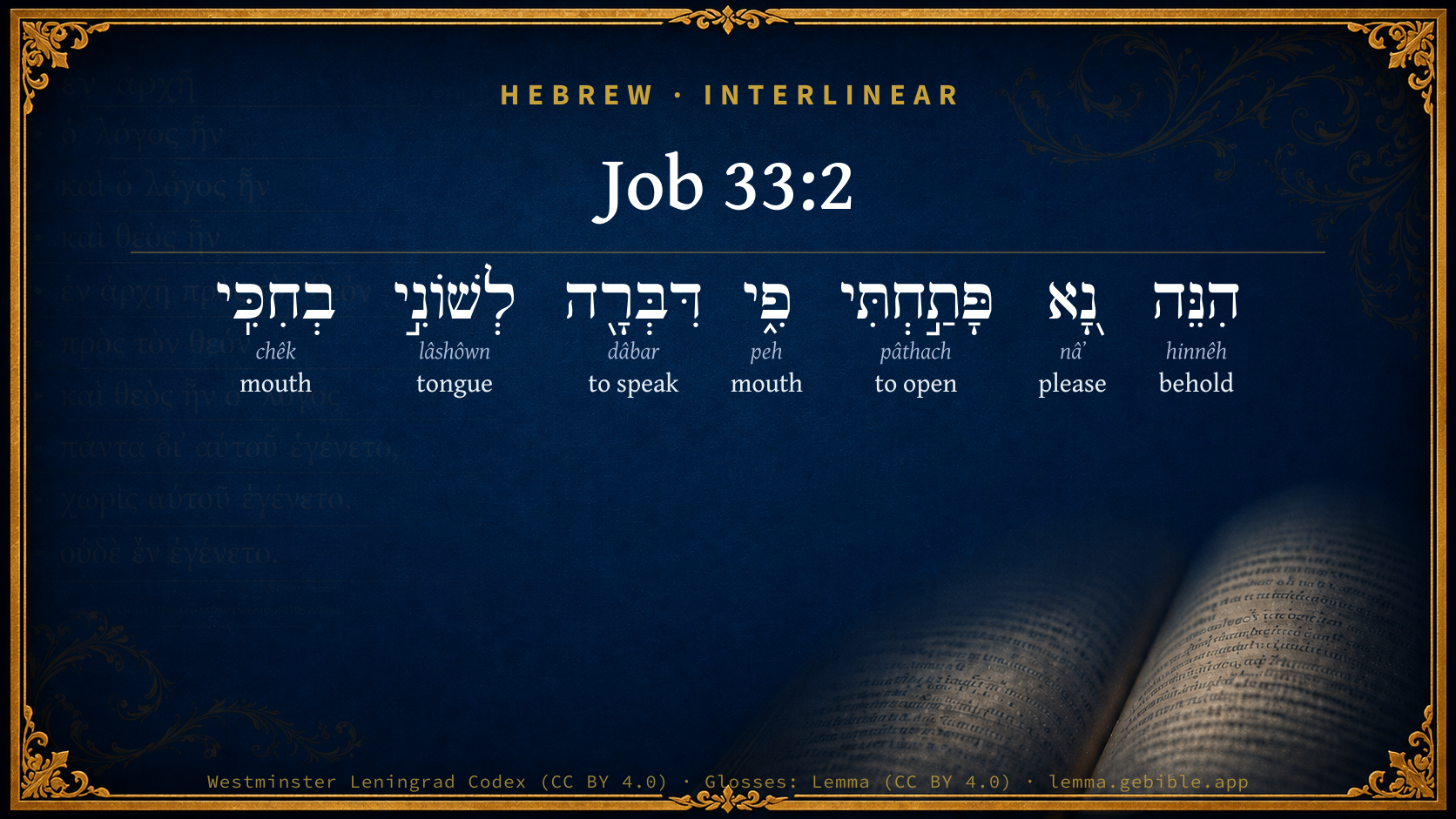
Job 33:2

Hebrew (Westminster Leningrad Codex) Job 33:2 appears in the Hebrew Old Testament. The text above is from the Westminster Leningrad Codex. Each word links to its Strong’s number, a concise gloss, and parsing drawn from the Open Scriptures Hebrew Bible morphology. Click any word for its full Brown-Driver-Briggs (BDB) entry.
Download image
Cite this verse

Job 33:2 (World English Bible). Public Domain. Lemma interlinear Bible study tool, https://lemma.gebible.app/v/job/33/2.

Show BibTeX & RIS
BibTeX
RIS
English Translation
See now, I have opened my mouth. My tongue has spoken in my mouth.
World English Bible · Public Domain
Download a study sheet

One document with this verse’s original text, its word-by-word gloss line, the meaning frame, cross-references with their text, attributed commentary, and full source and license credits — printable, and it pastes into notes with its structure intact.

This verse Autodidact and up

Study sheet (.html) Plain text (.txt)

A passage Seminary Student

Up to 50 verses in one chapter. A passage sheet keeps up to 6 commentary sources and 12 cross-references per verse, in the order this page ranks them, and says so on the sheet whenever that leaves anything out. Ask for a single verse and you get the Autodidact verse sheet above.

Everything on this page stays free to read, with no account — the sheet is a download of what is already on screen, not access to it.

Want to remove ads? Support Godless Engineer
Compare translations 3

The same verse in 3 English versions, stacked beneath the original-language interlinear above. Click any original word for its lexicon entry.

Each is an independent rendering of the whole verse — the interlinear is not word-aligned to these translations.

Highlighted words mark where these versions differ — a whole-verse word diff, not a word-by-word alignment.

  • World English Bible Public Domain
    See now, I have opened my mouth. My tongue has spoken in my mouth.
  • King James Version Public Domain
    Behold, now I have opened my mouth, my tongue hath spoken in my mouth.
  • unfoldingWord Literal Text CC BY-SA 4.0
    Behold, I have now opened my mouth; my tongue has spoken on my palate.

unfoldingWord Literal Text — © unfoldingWord, licensed CC BY-SA 4.0. Word-aligned USFM3 via Door43 (git.door43.org/unfoldingWord/en_ult).

Versions to compare (up to 4)

3 of 4 selected

Show all 18 translations

Every available English version of this verse, each an independent rendering of the whole verse.

  • World English Bible Public Domain
    See now, I have opened my mouth. My tongue has spoken in my mouth.
  • Berean Standard Bible Public Domain
    Behold, I will open my mouth; my address is on the tip of my tongue.
  • Majority Standard Bible Public Domain
    Behold, I will open my mouth; my address is on the tip of my tongue.
  • King James Version Public Domain
    Behold, now I have opened my mouth, my tongue hath spoken in my mouth.
  • American Standard Version (1901) Public Domain
    Behold now, I have opened my mouth; My tongue hath spoken in my mouth.
  • Revised Version (1885) Public Domain
    Behold now, I have opened my mouth, my tongue hath spoken in my mouth.
  • Geneva Bible (1599) Public Domain
    Beholde now, I haue opened my mouth: my tongue hath spoken in my mouth.
  • Douay-Rheims (1899) Public Domain
    Behold now I have opened my mouth, let my tongue speak within my jaws.
  • Young's Literal Translation Public Domain
    Lo, I pray thee, I have opened my mouth, My tongue hath spoken in the palate.
  • Literal Standard Version CC BY-SA 4.0
    Now behold, I have opened my mouth, || My tongue has spoken in the palate.
  • Unlocked Literal Bible CC BY-SA 4.0
    See now, I have opened my mouth; my tongue has spoken in my mouth.
  • unfoldingWord Literal Text CC BY-SA 4.0
    Behold, I have now opened my mouth; my tongue has spoken on my palate.
  • Darby Bible Public Domain
    Behold now, I have opened my mouth, my tongue speaketh in my palate,
  • World Messianic Bible Public Domain
    See now, I have opened my mouth. My tongue has spoken in my mouth.
  • Webster's Bible Public Domain
    Behold, now I have opened my mouth, my tongue hath spoken in my mouth.
  • Free Bible Version CC BY-SA 4.0
    Look, I'm about to speak; my mouth is ready to talk.
  • Bible in Basic English Public Domain
    See, now my mouth is open, my tongue gives out words.
  • JPS Tanakh (1917) Public Domain
    Behold now, I have opened my mouth, my tongue hath spoken in my mouth.

Literal Standard Version (2020), Covenant Press — licensed CC BY-SA 4.0. Text via the HelloAO Bible API (eBible.org). Unlocked Literal Bible (unfoldingWord) — licensed CC BY-SA 4.0. Text via the HelloAO Bible API (eBible.org). unfoldingWord Literal Text — © unfoldingWord, licensed CC BY-SA 4.0. Word-aligned USFM3 via Door43 (git.door43.org/unfoldingWord/en_ult). Free Bible Version, Dr. Jonathan Gallagher — licensed CC BY-SA 4.0. Text via the HelloAO Bible API (eBible.org).

Word by word

More ways to search: Search by grammar → Find every occurrence → Compare this word →

Practice this passage: Drill this verse → Learn its vocabulary →

About this verse

These counts appear in no published source. They are computed here, from the morphology-tagged text and Lemma’s own curated glosses. What Lemma adds →

7
words
7
distinct lemmas
Wisdom
section

Notable vocabulary

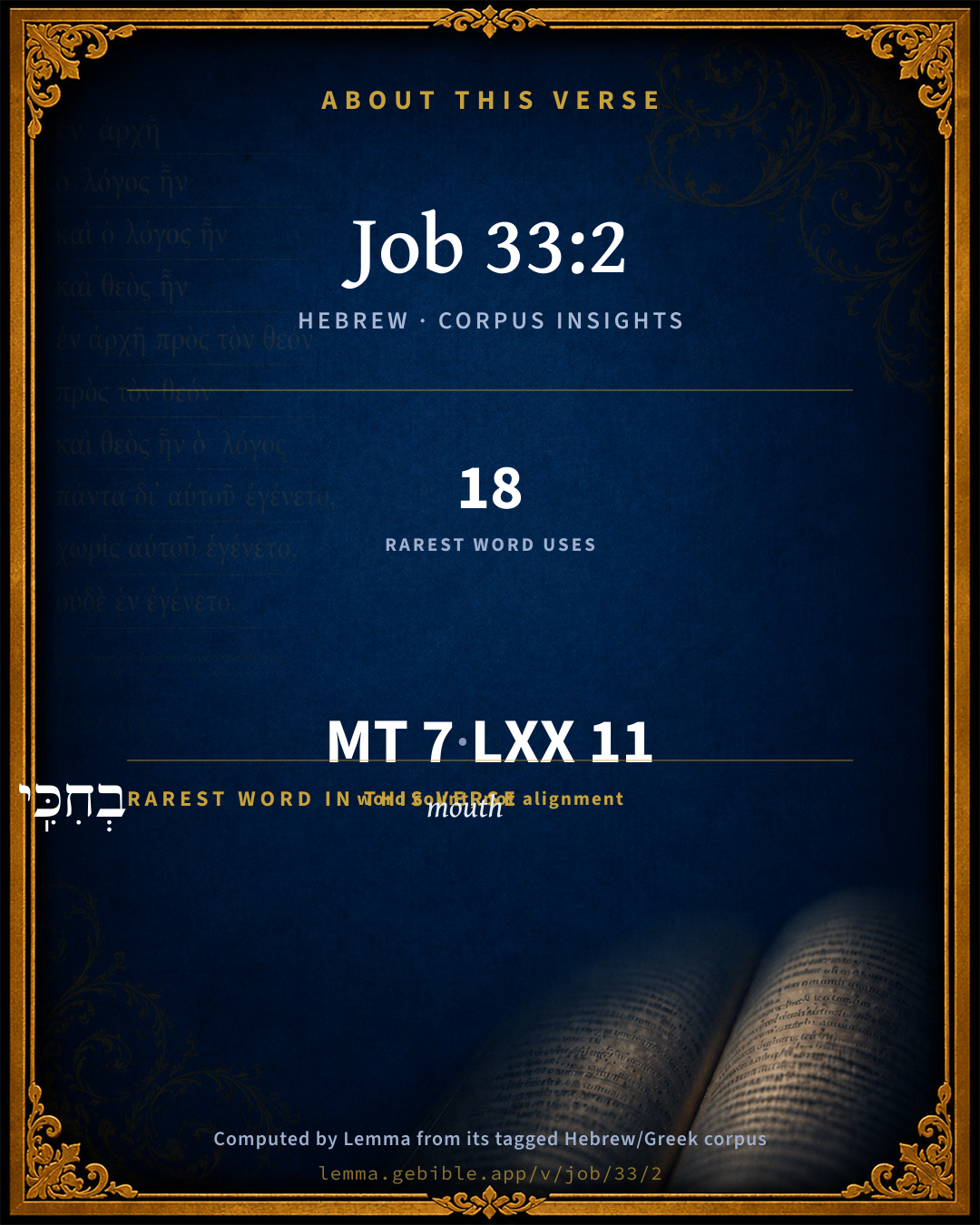
The rarest word here is בְחִכִּֽי mouth H2441 — appearing just 18 times in the whole Hebrew Bible.

Shared distinctive vocabulary

בְחִכִּֽי mouth H2441 occurs in 18 verses of the Hebrew Bible. Also found in:

Grammatical profile

  • 2 verbs
  • 3 nouns
  • 2 particles

Verb forms

  • פָּתַ֣חְתִּי Qal · Perfect
  • דִּבְּרָ֖ה Piel · Perfect

Hebrew & Septuagint length

In English translation the verse runs 14 words from the Hebrew and 12 from the Septuagint (LXX English) — closely comparable.

A rough comparison of the two English renderings, which tokenize alike — not a word-level alignment.

Word counts can differ between the Hebrew and the Greek without any difference in meaning — e.g. the Hebrew direct-object marker אֵת has no separate Greek word, and Greek often adds the article ὁ.

In the original languages it is 7 Hebrew tokens and 11 Greek tokens — but the two are counted differently (Hebrew bundles its prefixes and suffixes into one token; the Greek is in lemma form), so that isn’t a like-for-like length.

Cross-references

4

Topical passages linked to Job 33:2 in the Treasury of Scripture Knowledge — connected by theme and wording, ordered by reader-vote popularity; previews shown in the World English Bible.

  • Job 3:1 After this Job opened his mouth, and cursed the day of his birth.
  • Job 31:30 (Yes, I have not allowed my mouth to sin By asking his life with a curse);
  • Psalms 78:2 I will open my mouth in a parable. I will utter dark sayings of old,
  • Matthew 5:2 He opened his mouth and taught them, saying,

Cross-references courtesy of OpenBible.info (CC BY 4.0).

Hebrew and Greek witnesses Masoretic Hebrew ↔ Greek Septuagint

The same verse in the two great witnesses to the Old Testament, shown verse-for-verse.

These are two independent witnesses, not word-aligned to each other, and the Septuagint is shown in lemma (dictionary) form.

Hebrew Job 33:2 Masoretic · Westminster Leningrad Codex

הִנֵּה נָ֭א פָּתַ֣חְתִּי פִ֑י דִּבְּרָ֖ה לְשׁוֹנִ֣י בְחִכִּֽי

See now, I have opened my mouth. My tongue has spoken in my mouth.

World English Bible · Public Domain

Greek LXX Job 33:2 Septuagint · lemma form

ἰδού γάρ ἀναοἴγω ὁ στόμα ἐγώ καί λαλέω ὁ γλῶσσα ἐγώ

For behold, I have opened my mouth, and my tongue has spoken.

LXX2012 (modern English Septuagint) · Public Domain

Hebrew: Westminster Leningrad Codex (CC BY 4.0). Greek: Septuagint (public domain); English from LXX2012 (modern English Septuagint) (Public Domain). How the Septuagint differs from the Hebrew →

Commentary

Notes on Job 33:2 from classic Christian and Jewish commentators (each source and its license shown beneath its notes). The classic Christian expositions comment on the surrounding passage and are grouped to its opening verse, so a note may address several verses; the Jewish commentaries on the Tanakh (Rashi and others) are per-verse, so they appear only where the commentator wrote on this verse.

Lemma curates 59 commentaries, every one of them public domain or Creative Commons licensed, each selected and text-cleaned for this edition rather than reprinted as found. About our sources →

Trapp's Complete Commentary

John Trapp

Job 33:2 Behold, now I have opened my mouth, my tongue hath spoken in my mouth.

Ver. 2. Behold, now I have opened my mouth] I have taken upon me to be a speaker, an arbitrator in this controversy, which is usually a thankless office; for he who interposeth in business of this nature, if he had two friends before, is likely enough to lose one of them. I must of necessity blame both parties, however I come off with them. Thy three friends have had their share in the former chapter, and now comes thine, which shall be sound, though sharp, of matters weighty and important, as Psa 78:2 Habebis sermonem serium, et de re gravi; for so much the Hebrews intend by this expression of opening the mouth. In the Revelation, wherever we read that heaven opened, some great matter followed; so when such open their mouths as have the law of God in their hearts, Psa 37:31 Pro 31:26. Fools indeed have their mouths ever open, blustering out whatsoever lies uppermost, rashly and without consideration, Kεχηνοτες, a Luciano et Aristophane dicuntur. But a wise man weigheth his words before he uttereth them; and speaketh not but for some good purpose.

My tongue hath spoken in my mouth] Heb. In my palate, or under my palate, which are two chief of those mine instruments of speech, none of which can well be wanting. Let God be glorified for and with that peculiar faculty; and let our praises proceed, not from the palate only, or roof of the mouth, but from the root of the heart. The voice which is made in the mouth is nothing so sweet as that which cometh from the bottom of the breast. One interpreter saith, that by these words, My tongue hath spoken in my mouth, Elihu meaneth, that he would not speak clamorously, but, as it were, whisperingly, to his ear, in secret.

John Trapp, A Commentary or Exposition upon All the Books of the Old and New Testament (1647–1656) — public domain. Text from a community e-Sword module.

Joseph Benson's Commentary

Job 33:2-3. Behold, now I have opened my mouth — Now I have begun to speak, and intend, with thy good leave, to proceed in my discourse with thee. My words shall be of the uprightness of my heart — I will not speak passionately or partially, as one resolved to defend what I have once said, whether true or false, but what I verily believe to be true and important, and from a sincere desire to profit thee. My lips shall utter knowledge clearly — What I speak will be plain, not hard to be understood.

Joseph Benson's Commentary on the Old and New Testaments (1811–1818) — public domain. Text from a community e-Sword module.

The Cambridge Bible for Schools and Colleges

gen. ed. J. J. S. Perowne

2. The somewhat formal and circumstantial way in which he intimates that he is going to speak indicates his feeling of the importance of what he is going to say, and bespeaks Job’s attention.

The Cambridge Bible for Schools and Colleges (gen. ed. J. J. S. Perowne; Cambridge University Press, 1878–1918) — public domain. Text from a community e-Sword module.

John Gill's Exposition

Behold, now I have opened my mouth,.... Begun to speak in order to give vent to the fulness of matter within him, which made him, like bottles of new wine, ready to burst; and since he had opened his lips, that he might speak and be refreshed, he desires Job to listen to him, and offers same things to his consideration to induce him to it:

my tongue hath spoken in my mouth: but does not every man's tongue speak in his mouth when he speaks? is there anything singular and peculiar in this, that can excite attention? it may be rendered, "in my palate" (d); which, as it is an instrument of speech, so of tasting and trying food, see Job 6:30; and Elihu's sense is, that he had thoroughly considered what he should say, he had well weighed what he should speak, and should not deliver anything raw, crude, and undigested; he had palated his words, in order to discern whether there was anything in them perverse or not.

(d) "in palato meo", Pagninus, Montanus, Tigurine version, Beza, Schultens; so Mr. Broughton.

John Gill's Exposition of the Whole Bible (1746–1763) — public domain (CC PDM 1.0). Text via the HelloAO Bible API.

Albert Barnes' Notes on the Bible

My tongue hath spoken in my mouth - Margin, “palate.” The meaning is, that since he had ventured to speak, and had actually commenced, he would utter only that which was worthy to be heard. This is properly the commencement of his argument, for all that he had before said was merely an introduction. The word palate - “in my palate” (בחכי bechêkiy) is used here because of the importance of that organ in the act of speaking. Perhaps also, there may be reference to the fact that the Hebrews made much more use of the lower organs of enunciation - the palate, and the throat, than we do, and much less use of the teeth and lips. Hence, their language was strongly guttural.

Albert Barnes' Notes on the Bible (1834–1885) — public domain. Text from a community e-Sword/MySword module.

Matthew Poole's English Annotations

Now I have begun to speak, and intend with thy good leave to proceed in my discourse with thee.

In my mouth, Heb. in or with my palate; for both tongue and palate are instruments of speech; and, that a man should speak plainly and distinctly, (which he designed to do,) it is necessary that his tongue should ofttimes touch the palate or roof of the month.

Matthew Poole's English Annotations on the Holy Bible (1683–1685) — public domain. Text from a community e-Sword/MySword module.

Whedon's Commentary on the Bible

Daniel D. Whedon

Fourth section — First of all the interlocutors to address Job by name, Elihu invites him to consider that he himself, like Job, is a creature of God; and as Job has so often challenged Deity to justify his ways, and at the same time made professions of fear lest he be overwhelmed by the majesty of God, he may now think himself safe in listening to the speaker as the human deputy of God: and of Job cannot answer the forthcoming discourses of instruction and reproof, he may conclude how foolish his challenge and arraignment of God have been, Job_33:1-7.

2. In my mouth — Or palate. He has carefully proved the words he is about to utter, by tasting them. The Hebrew word palate stood for a discerning faculty, in a sense similar to that of our own word taste. (See Job_6:30.) “These circumstantial statements solemnly inaugurate what follows” — Delitzsch. “The moment when Elihu begins to speak is an event. The natal hour of a truth is weightier than that of a world-renowned hero.” — Hengstenberg.

2. That Job has declared God to be arbitrary and cruel toward men, in making him to be his [Job’s] “jailer and most crafty watcher.” (See note on Job_13:27, which Elihu cites quite literally.) In so doing Job denies the divine rectitude in the sufferings of men in general. For answer see page 209.

Daniel D. Whedon (gen. ed.), Commentary on the Old and New Testaments (1874–1909) — public domain. Text from a community e-Sword module.

The Pulpit Commentary

Behold, now I have opened my mouth. (On the solemnity of the phrase, "opened my mouth," see the comment upon Job_3:1) My tongue hath spoken in my mouth; literally, in my palate. (comp. Job_6:30) Each word has been, as it were, tasted; that is, seriously considered and examined beforehand. My remarks will not be crude, extempore remarks; so may they be the better worth attending to.

The Pulpit Commentary (1880–1919), ed. H.D.M. Spence-Jones & Joseph S. Exell — public domain. Text from a community e-Sword module.

Lesson kit

Teaching starters — assembled from the data on this page, not authored interpretation. Every prompt links to the verse data it draws on. Edit before teaching.

Job, in the Wisdom, opens this verse with 7 words (7 distinct Hebrew lemmas). Its most distinctive word is chêk (“mouth”). A historical commentator’s framing appears above. Read the whole chapter for the surrounding context.

Discussion questions

  1. How does “mouth” (chêk) shape what this verse is saying?
  2. How does Job 6:30, which shares the word «mouth», read alongside this verse?
  3. These translations render this verse differently; the difference is in the English rendering, not the original. What questions does that raise?
  4. «פָּתַ֣חְתִּי» is a Qal Perfect verb. How does that grammatical form shape the action described?
  5. Compare how Trapp's Complete Commentary and Joseph Benson's Commentary read this verse. Where do they agree or differ?

Things to notice

Reading settings

Reading text

Shown beneath each verse's original-language words.

Old Testament
Old Testament edition

Read the OT as the Masoretic Hebrew (MT) or the Greek Septuagint (LXX).

English shown for the Greek Septuagint (in the Hebrew ↔ Greek comparison).

Comparing translations? Open the Compare panel on any verse page to stack up to four side by side.