
Psalms 78:36

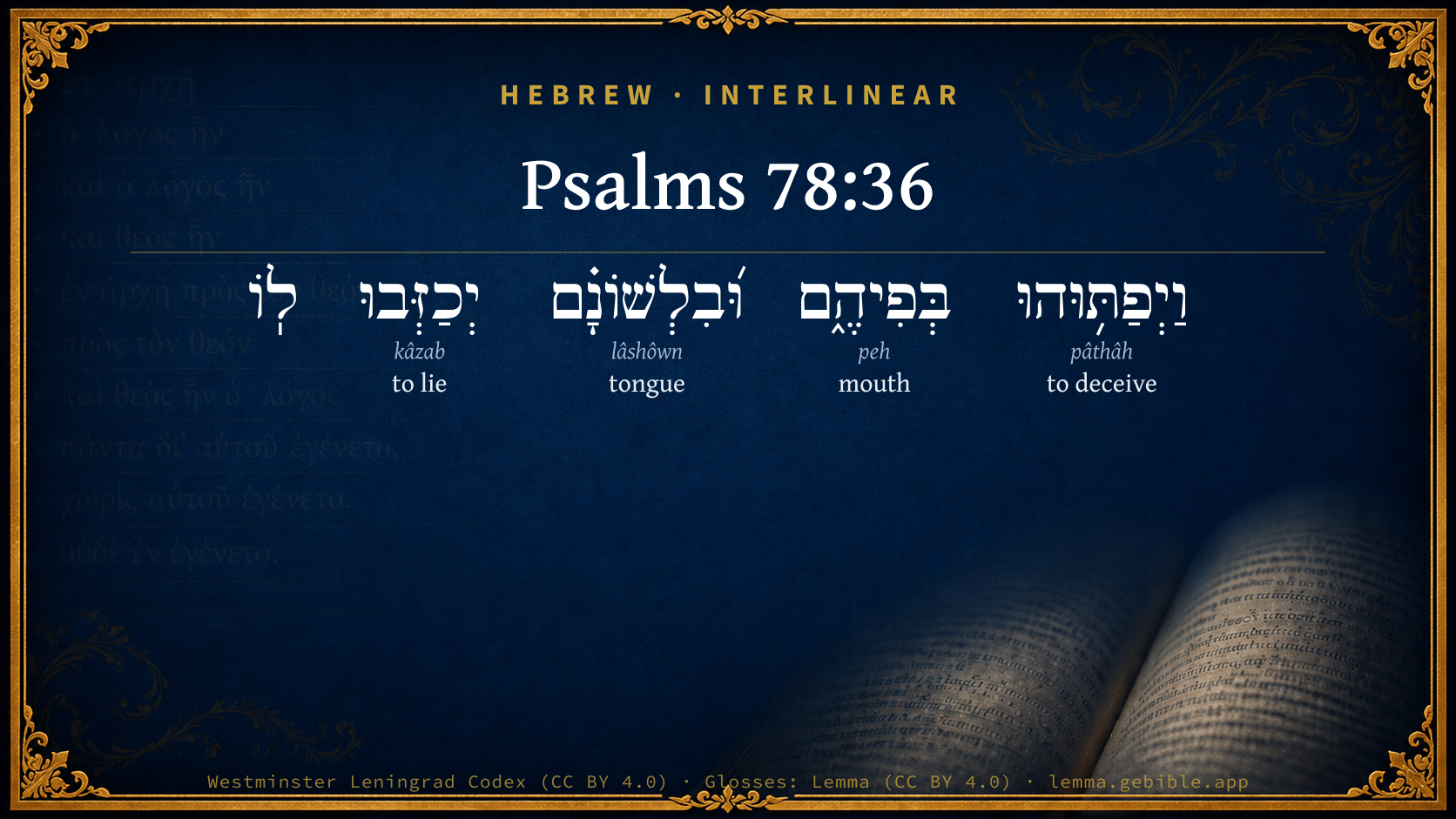
Hebrew (Westminster Leningrad Codex) Psalms 78:36 appears in the Hebrew Old Testament. The text above is from the Westminster Leningrad Codex. Each word links to its Strong’s number, a concise gloss, and parsing drawn from the Open Scriptures Hebrew Bible morphology. Click any word for its full Brown-Driver-Briggs (BDB) entry.
Download image
Cite this verse

Psalms 78:36 (World English Bible). Public Domain. Lemma interlinear Bible study tool, https://lemma.gebible.app/v/psalms/78/36.

Show BibTeX & RIS
BibTeX
RIS
English Translation
But they flattered him with their mouth, And lied to him with their tongue.
World English Bible · Public Domain
Download a study sheet

One document with this verse’s original text, its word-by-word gloss line, the meaning frame, cross-references with their text, attributed commentary, and full source and license credits — printable, and it pastes into notes with its structure intact.

This verse Autodidact and up

Study sheet (.html) Plain text (.txt)

A passage Seminary Student

Up to 50 verses in one chapter. A passage sheet keeps up to 6 commentary sources and 12 cross-references per verse, in the order this page ranks them, and says so on the sheet whenever that leaves anything out. Ask for a single verse and you get the Autodidact verse sheet above.

Everything on this page stays free to read, with no account — the sheet is a download of what is already on screen, not access to it.

Want to remove ads? Support Godless Engineer
Compare translations 3

The same verse in 3 English versions, stacked beneath the original-language interlinear above. Click any original word for its lexicon entry.

Each is an independent rendering of the whole verse — the interlinear is not word-aligned to these translations.

Highlighted words mark where these versions differ — a whole-verse word diff, not a word-by-word alignment.

  • World English Bible Public Domain
    But they flattered him with their mouth, And lied to him with their tongue.
  • King James Version Public Domain
    Nevertheless they did flatter him with their mouth, and they lied unto him with their tongues.
  • unfoldingWord Literal Text CC BY-SA 4.0
    And they would deceive him with their mouth and lie to him with their tongues.

unfoldingWord Literal Text — © unfoldingWord, licensed CC BY-SA 4.0. Word-aligned USFM3 via Door43 (git.door43.org/unfoldingWord/en_ult).

Versions to compare (up to 4)

3 of 4 selected

Show all 18 translations

Every available English version of this verse, each an independent rendering of the whole verse.

  • World English Bible Public Domain
    But they flattered him with their mouth, And lied to him with their tongue.
  • Berean Standard Bible Public Domain
    But they deceived Him with their mouths, and lied to Him with their tongues.
  • Majority Standard Bible Public Domain
    But they deceived Him with their mouths, and lied to Him with their tongues.
  • King James Version Public Domain
    Nevertheless they did flatter him with their mouth, and they lied unto him with their tongues.
  • American Standard Version (1901) Public Domain
    But they flattered him with their mouth, And lied unto him with their tongue.
  • Revised Version (1885) Public Domain
    But they flattered him with their mouth, and lied unto him with their tongue.
  • Geneva Bible (1599) Public Domain
    But they flattered him with their mouth, and dissembled with him with their tongue.
  • Douay-Rheims (1899) Public Domain
    And they loved him with their mouth: and with their tongue they lied unto him:
  • Young's Literal Translation Public Domain
    And -- they deceive Him with their mouth, And with their tongue do lie to Him,
  • Literal Standard Version CC BY-SA 4.0
    And they deceive Him with their mouth, || And lie to Him with their tongue,
  • Unlocked Literal Bible CC BY-SA 4.0
    But they would flatter him with their mouth and lie to him with their words.
  • unfoldingWord Literal Text CC BY-SA 4.0
    And they would deceive him with their mouth and lie to him with their tongues.
  • Darby Bible Public Domain
    But they flattered him with their mouth, and lied unto him with their tongue;
  • World Messianic Bible Public Domain
    But they flattered him with their mouth, and lied to him with their tongue.
  • Webster's Bible Public Domain
    Nevertheless they flattered him with their mouth, and they lied to him with their tongues.
  • Free Bible Version CC BY-SA 4.0
    They flattered him by what they told him, but they were only lying.
  • Bible in Basic English Public Domain
    But their lips were false to him, and their tongues were untrue to him;
  • JPS Tanakh (1917) Public Domain
    But they beguiled Him with their mouth, and lied unto Him with their tongue.

Literal Standard Version (2020), Covenant Press — licensed CC BY-SA 4.0. Text via the HelloAO Bible API (eBible.org). Unlocked Literal Bible (unfoldingWord) — licensed CC BY-SA 4.0. Text via the HelloAO Bible API (eBible.org). unfoldingWord Literal Text — © unfoldingWord, licensed CC BY-SA 4.0. Word-aligned USFM3 via Door43 (git.door43.org/unfoldingWord/en_ult). Free Bible Version, Dr. Jonathan Gallagher — licensed CC BY-SA 4.0. Text via the HelloAO Bible API (eBible.org).

Word by word

More ways to search: Search by grammar → Find every occurrence → Compare this word →

Practice this passage: Drill this verse → Learn its vocabulary →

יְכַזְּבוּ
kâzab
H3576
“to lie”
Verb, Piel, Imperfect, 3rd Person, Masculine, Plural
Part of Speech
Verb
Stem
Piel
Form
Imperfect
Person
3rd Person
Gender
Masculine
Number
Plural
Full BDB Definition

Origin: a primitive root

TWOT: 970

to lie, tell a lie, be a liar, be found a liar, be in vain, fail - (Qal) liar (participle) - (Niphal) to be proven to be lying - (Piel) - to lie, tell a lie, tell a lie with, deceive - to disappoint, fail - (Hiphil) to make a liar, prove to be a liar
  1. וַיְפַתּ֥וּהוּ pâthâh H6601 “and · to deceive · him” Conjunction + Verb, Piel, Sequential Imperfect, 3rd Person, Masculine, Plural + Suffix, Personal, 3rd Person, Masculine, Singular
  2. בְּפִיהֶ֑ם peh H6310 “in/at · mouth · their” Preposition + Noun, Common, Masculine, Singular, Construct + Suffix, Personal, 3rd Person, Masculine, Plural
  3. וּ֝בִלְשׁוֹנָ֗ם lâshôwn H3956 “and · in/at · tongue · their” Conjunction + Preposition + Noun, Common, Both, Singular, Construct + Suffix, Personal, 3rd Person, Masculine, Plural

About this verse

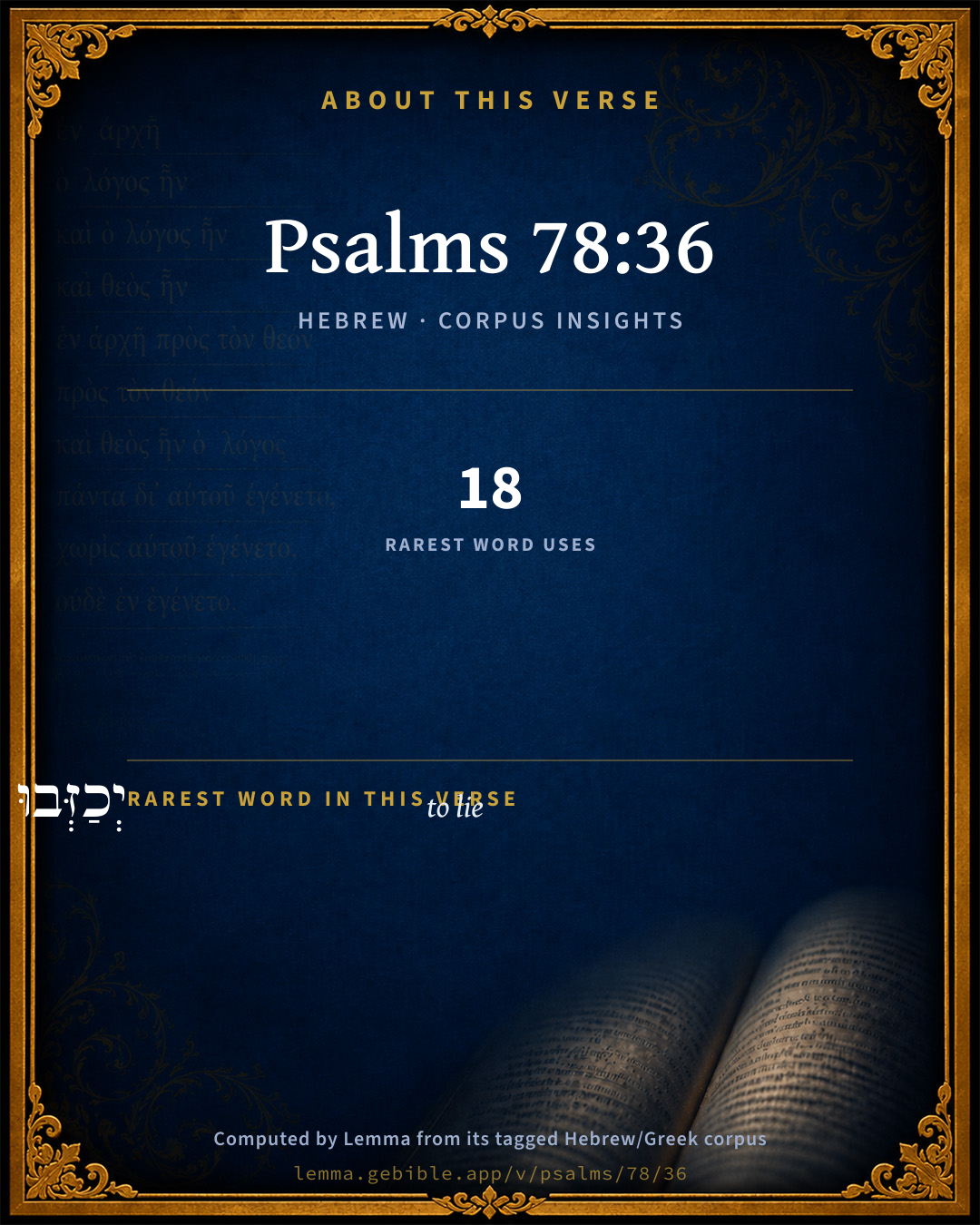
These counts appear in no published source. They are computed here, from the morphology-tagged text and Lemma’s own curated glosses. What Lemma adds →

5
words
4
distinct lemmas
Wisdom
section

Notable vocabulary

The rarest word here is יְכַזְּבוּ to lie H3576 — appearing just 18 times in the whole Hebrew Bible.

Shared distinctive vocabulary

יְכַזְּבוּ to lie H3576 occurs in 18 verses of the Hebrew Bible. Also found in:

Grammatical profile

  • 2 verbs
  • 2 nouns
  • 1 preposition

Verb forms

  • וַיְפַתּ֥וּהוּ Piel · Sequential Imperfect
  • יְכַזְּבוּ Piel · Imperfect

Hebrew & Septuagint length

In English translation the verse runs 14 words from the Hebrew and 15 from the Septuagint (LXX English) — closely comparable.

A rough comparison of the two English renderings, which tokenize alike — not a word-level alignment.

Word counts can differ between the Hebrew and the Greek without any difference in meaning — e.g. the Hebrew direct-object marker אֵת has no separate Greek word, and Greek often adds the article ὁ.

Cross-references

7

Topical passages linked to Psalms 78:36 in the Treasury of Scripture Knowledge — connected by theme and wording, ordered by reader-vote popularity; previews shown in the World English Bible.

  • Ezekiel 33:31 They come to you as the people comes, and they sit before you as my people, and they hear your words, but don't do them; for with their mouth they show much love, but their heart goes after their gain.
  • Isaiah 29:13 The Lord said, Because this people draw near [to me], and with their mouth and with their lips to honor me, but have removed their heart far from me, and their fear of me is a commandment of men which has been taught [them];
  • Deuteronomy 5:28–29 Yahweh heard the voice of your words, when you spoke to me; and Yahweh said to me, I have heard the voice of the words of this people, which they have spoken to you: they have well said all that they have spoken.
  • Psalms 18:44 As soon as they hear of me they shall obey me. The foreigners shall submit themselves to me.
  • Psalms 106:12–13 Then they believed his words. They sang his praise.
  • Isaiah 57:11 Of whom have you been afraid and in fear, that you lie, and have not remembered me, nor laid it to your heart? Haven't I held my peace even of long time, and you don't fear me?
  • Hosea 11:12 Ephraim surrounds me with falsehood, And the house of Israel with deceit; And Judah still us unruly with God, And is unfaithful to the Holy One.

Cross-references courtesy of OpenBible.info (CC BY 4.0).

Hebrew and Greek witnesses Masoretic Hebrew ↔ Greek Septuagint

The same verse in the two great witnesses to the Old Testament, shown verse-for-verse.

You’re reading Greek Psalm 77 (Hebrew Psalm 78). The Septuagint counts the superscription, so verse numbers can differ from the Hebrew — chapter-level alignment, not verse-by-verse. Numbering follows Rahlfs.

These are two independent witnesses, not word-aligned to each other, and the Septuagint is shown in lemma (dictionary) form.

Hebrew Psalms 78:36 Masoretic · Westminster Leningrad Codex

וַיְפַתּ֥וּהוּ בְּפִיהֶ֑ם וּ֝בִלְשׁוֹנָ֗ם יְכַזְּבוּ לֽוֹ

But they flattered him with their mouth, And lied to him with their tongue.

World English Bible · Public Domain

Greek LXX Greek Psalm 77:36 Septuagint · lemma form

καί ἀπατάω αὐτός ἐν ὁ στόμα αὐτός καί ὁ γλῶσσα αὐτός ψεύδομαι αὐτός

Yet they loved him only with their mouth, and lied to him with their tongue.

LXX2012 (modern English Septuagint) · Public Domain

On this verse, Albert Barnes' Notes on the Bible discusses the Septuagint’s reading. Read the note in Commentary ↓

Hebrew: Westminster Leningrad Codex (CC BY 4.0). Greek: Septuagint (public domain); English from LXX2012 (modern English Septuagint) (Public Domain). How the Septuagint differs from the Hebrew →

Commentary

Notes on Psalms 78:36 from classic Christian and Jewish commentators (each source and its license shown beneath its notes). The classic Christian expositions comment on the surrounding passage and are grouped to its opening verse, so a note may address several verses; the Jewish commentaries on the Tanakh (Rashi and others) are per-verse, so they appear only where the commentator wrote on this verse.

Lemma curates 59 commentaries, every one of them public domain or Creative Commons licensed, each selected and text-cleaned for this edition rather than reprinted as found. About our sources →

Trapp's Complete Commentary

John Trapp

Psa 78:36 Nevertheless they did flatter him with their mouth, and they lied unto him with their tongues.

Ver 36. Nevertheless they did flatter him with their mouth] They looked pitifully, as the fox caught in a gin doth, but it is only to get out; they spake God fair, as the devil in the Gospel did our Saviour, but it was only to be rid of him. They worshipped him, as the Indians do the devil, that he may do them no hurt. The Latin word Colo, to worship, is by some derived of the Greek word κολακευειν, to flatter, and the English word flatter, from the Greek λατρευειν, to worship. Sure it is that many men’s devotion is mere dissimulation.

And they lied unto him] sc. While they called him Rock, Redeemer, and all was but from the teeth outward; which how much God abhorreth as a ludibrious devotion, see Jer 3:4-5. And here it is said to be the middle of the psalter; for hitherto the Hebrews reckon one thousand two hundred sixty and three verses; and as many they note to be yet left in the second part.

John Trapp, A Commentary or Exposition upon All the Books of the Old and New Testament (1647–1656) — public domain. Text from a community e-Sword module.

The Biblical Illustrator

Joseph S. Exell

Psa_78:36

Nevertheless they did flatter Him with their mouth.

Flattering God

I. Here is a world-wide enormity.

1. It is rampant in heathendom. Men flatter their gods.

2. It is prevalent in Christendom. Looking at the moral character of England, for example, who can doubt that the vast majorities of all Churches flatter God by the use of the hymns they sing and the prayers they repeat?

II. Here is a monstrous absurdity. Poor man is so vain that he likes flattery, and is deceived by it. But to use it to Omniscience is the height of pre-posity. He knows what is in man. He abhors the sacrifice where not the heart is found.

III. Here is a moral abomination. What an insult to Omniscience! (Homilist.)

The Biblical Illustrator, edited by Joseph S. Exell (c. 1880s–1900s) — public domain. Text from a community e-Sword module.

The Treasury of David

Charles H. Spurgeon

Ver. 36. Nevertheless they did flatter him with their mouth. Bad were they at their best. False on their knees, liars in their prayers. Mouth worship must be very detestable to God when dissociated from the heart: other kings love flattery, but the King of kings abhors it. Since the sharpest afflictions only extort from carnal men a feigned submission to God, there is proof positive that the heart is desperately set on mischief, and that sin is ingrained in our very nature. If you beat a tiger with many stripes you cannot turn him into a sheep. The devil cannot be whipped out of human nature, though another devil, namely, hypocrisy may be whipped into it. Piety produced by the damps of sorrow and the heats of terror is of mushroom growth; it is rapid in its springing up--"they enquired early after God" --but it is a mere unsubstantial fungus of unabiding excitement.

And they lied unto him with their tongues. Their godly speech was cant, their praise mere wind, their prayer a fraud. Their skin deep repentance was a film too thin to conceal the deadly wound of sin. This teaches us to place small reliance upon professions of repentance made by dying men, or upon such even when the basis is evidently slavish fear, and nothing more. Any thief will whine out repentance if he thinks the judge will thereby be moved to let him go scot free.

Ver. 36. Flattery of God.

I. A common sin.

II. A hateful sin.

III. A dangerous sin. B. D.

Ver. 36-38. There is no disputing the fact which gives accuracy to the text, that God was moved by a repentance which had not in it even the elements of godly sorrow for sin; which could not even, by a casual observer, much less by him who searches the heart, have been mistaken for that penitence which supposes an inward and radical change, and, nevertheless, even such a repentance as this sufficed to procure a recompense at the hands of God. Though the sackcloth was on the body and not on the soul; though it was the punishment of the sin and not the sin itself which led to this outward humiliation, God did not turn away from the forced supplication, but vouchsafed the deliverance which was sought at his hands. Yes, God, who never expresses greater abhorrence of any character than that of the hypocrite; God, who rejects nothing more indignantly than outward homage when it is not the index of inward prostration--God may be said to have removed the humiliation of the people as though he could not read their hearts, or as though, having read them, and noted their unsubdued rebellion, he still thought the apparent contrition deserving of some recompense...

If God would not leave the show and semblance of contrition without a recompense, will he be unmindful of real penitence? If many a time turned he his anger away from those who did but flatter him with their mouths, and lied unto him with their tongues, has he nothing in store for those who are humble in spirit, and who come to him with the sacrifice of a broken heart? Oh! the turning away of temporal wrath because idols were outwardly abandoned, this is a mighty pledge that eternal wrath will be averted if we are inwardly stricken, and flee for refuge to the Saviour. God must have eternal good in store for his friends, if even his enemies are recompensed with temporal good. Yes, as I mark the Philistines and the Ammonites oppressing the idolatrous Israelites, and then see the oppressors driven back in return even for heartless service, Oh! I learn that true penitence for sin and true faith in the sacrifice of Jesus Christ will cause all enemies to be scattered; I return from the contemplation of the backsliding people, emancipated notwithstanding the known hollowness of their vows, I return assured that a kingdom which neither Philistine nor Ammonite can invade, shall be the portion of all who seek deliverance through Christ. Henry Melvill.

Ver. 36-38. See Psalms on "Ps 78:36" for further information.

Ver. 36-38. See Psalms on "Ps 78:36" for further information.

Charles H. Spurgeon's The Treasury of David (1869–1885) — public domain. Psalms only. Text from a community e-Sword/MySword module.

Joseph Benson's Commentary

Psa 78:36-37. Nevertheless, they did flatter him with their mouth — As if they thought, by mere fair speeches, to prevail on Him who searches the heart, and requires truth in the inward parts, to revoke the sentence gone out against them, or remove the judgment under which they suffered. And they lied unto him with their tongue — They made glorious but false professions and protestations of their sincere resolutions of future obedience. For their heart was not right with him — All their confessions and petitions were but hypocritical and forced, and did not proceed from hearts truly upright and grieved for their former offences, and firmly resolved to turn unto the Lord. Neither were they steadfast in his covenant — They discovered their hypocrisy, by their apostacy from God, as soon as their danger was past.

Joseph Benson's Commentary on the Old and New Testaments (1811–1818) — public domain. Text from a community e-Sword module.

J. A. Alexander on Psalms

Joseph Addison Alexander

36. (Psa 78:36) And (yet) they deceived him with their mouth, and with their tongue they lie to him. Even these apparent reformations only led to hypocritical professions. The verb in the first clause does not describe the effect but the intention. It may therefore be translated flattered, although this is not the strict sense of the Hebrew word.

Joseph Addison Alexander, The Psalms Translated and Explained (1850) — public domain. Text from a community e-Sword module.

Adam Clarke's Commentary

Verse 36. Nevertheless they did flatter him with their mouth] What idea could such people have of God, whom they supposed they could thus deceive? They promised well, they called him their God, and their fathers' God; and told him how good, and kind, and merciful he had been to them. Thus, their mouth flattered him. And they said that, whatever the Lord their God commanded them to do, they would perform.

And they lied unto him.] I think the Vulgate gives the true sense of the Hebrew: Dilexerunt eum in ore suo; et lingua sua mentiti sunt ei, - "They loved him with their mouth; and they lied unto him with their tongue." "That is," says the old Psalter, "thai sayde thai lufed God, bot thai lighed, als thair dedes schewes; for thai do noght als thai hight; for when God ceses to make men rad; than cese thai to do wele."

Adam Clarke's Commentary on the Bible (1810–1826) — public domain. Text from a community e-Sword/MySword module.

John Calvin's Commentaries

36. And they flattered him with their mouth, and lied to him with their tongue. Here they are charged with perfidiousness, because they neither confessed their guilt with sincerity of heart, nor truly ascribed to God the glory of their deliverance. We are not to suppose that they made no acknowledgement at all; but it is intimated that the confession of the mouth, as it did not proceed from the heart, was constrained and not voluntary. This is well worthy of being noticed; for from it we learn, not only the duty incumbent upon us of guarding against that gross hypocrisy which consists in uttering with the tongue, before men, one thing, while we think a different thing in our hearts, but also that we ought to beware of a species of hypocrisy which is more hidden, and which consists in this, that the sinner, being constrained by fear, flatters God in a slavish manner, while yet, if he could, he would shun the judgment of God. The greater part of men are mortally smitten with this disease; for although the divine majesty extorts from them some kind of awe, yet it would be gratifying to them were the light of divine truth completely extinguished. It is, therefore, not enough to yield an assent to the divine word, unless that assent is accompanied with true and pure affection, so that our hearts may not be double or divided. The Psalmist points out the cause and source of this dissimulation to be, that they were not steadfast and faithful By this he intimates, that whatever does not proceed from unfeigned purity of heart is accounted lying and deceit in the sight of God. Since this uprightness is every where required in the law, he accuses the people with being covenant-breakers, because they had not kept the covenant of God with that fidelity which became them. As I have observed elsewhere, there is always to be presupposed a mutual relation and correspondence between the covenant of God and our faith, in order that the unfeigned consent of the latter may answer to the faithfulness of the former.

John Calvin's Commentaries (1540-1563) — public domain. Text from the Calvin Translation Society English edition (1840s-50s) via the Christian Classics Ethereal Library (ccel.org). Calvin's coverage is partial (roughly two-thirds of the Bible); uncommented books and verses are honest gaps, never fabricated. The 19th-century editor's footnotes and remarks are omitted so the notes are faithfully Calvin's own voice.

The Cambridge Bible for Schools and Colleges

gen. ed. J. J. S. Perowne

36. But they flattered him with their mouth,

And lied unto him with their tongue (R.V.).

As though God were a man who could be deceived by hypocrisy. Cp. Isa_29:13.

According to the Massoratic reckoning, this is the middle of the 2527 verses of the Psalter, but it must be remembered that the titles of the Psalms are frequently reckoned as verses in the Hebrew text (Introd. p. xvi).

The Cambridge Bible for Schools and Colleges (gen. ed. J. J. S. Perowne; Cambridge University Press, 1878–1918) — public domain. Text from a community e-Sword module.

John Gill's Exposition

For their heart was not right with him,.... Neither prepared and ready to any good work, but reprobate thereunto; nor steady, fixed, and established, as a good man's heart is, trusting in the Lord; but wavering, fickle, and inconstant; nor true, faithful, and upright; but turning aside like a deceitful bow, as is afterwards said, Psa 78:57,

neither were they steadfast in his covenant; which was made with them at Sinai, though they promised to be obedient, and to do all the Lord said unto them; but this covenant they broke, though he were an husband to them; see Exo 24:7.

John Gill's Exposition of the Whole Bible (1746–1763) — public domain (CC PDM 1.0). Text via the HelloAO Bible API.

Albert Barnes' Notes on the Bible

Nevertheless they did flatter him with their mouth - The word rendered “flatter” means properly “to open;” and hence, “to be open; to be ingenious or frank;” and then, to be easily persuaded, to be deluded, to be beguiled; and hence, also, in an active form, to persuade, to entice, to seduce, to beguile, to delude. The meaning here is, that they attempted to deceive by their professions, or that their professions were false and hollow. Those professions were the mere result of affliction. They were based on no principle; there was no true love or confidence at the foundation. Such professions or promises are often made in affliction. Under the pressure of heavy judgments, the loss of property, the loss of friends, or the failure of health, people become serious, and resolve to give attention to religion. It is rarely that such purposes are founded in sincerity, and that the conversions apparently resulting from them are true conversions. The Septuagint and the Latin Vulgate render the phrase here, “They loved with their mouth.”

And they lied unto him with their tongues - They made promises which they did not keep.

Albert Barnes' Notes on the Bible (1834–1885) — public domain. Text from a community e-Sword/MySword module.

Matthew Poole's English Annotations

They made glorious but false professions and protestations of their sincere resolutions of future obedience, if God would spare them.

Matthew Poole's English Annotations on the Holy Bible (1683–1685) — public domain. Text from a community e-Sword/MySword module.

The Pulpit Commentary

Nevertheless they did flatter him with their mouth. The Revised Version is simpler and better, But they flattered him with their mouth. All that they said or did when alarmed by some judgment of God"s was a mere pretence an attempt to "flatter" and cozen God, and so win his favour. And they lied unto him with their tongues. They offered him a lip service, which was a "lie," a mere semblance of real religion.

The worship that God hates.

I IT IS ALL TOO COMMON. This psalm is all taken up with the record of such worship. And it did not begin with the people told of here. What was Cain"s worship but so much flattery and lying unto God? And all through the prophetic history, the like worship is perpetually denounced. The one class of people whose presence and contact even the wonted gentleness of our Lord could not abide were such as these hypocrites. We know with what scathing words he was wont to address them. And the apostles of our Lord, after his ascension, were continually meeting with it and condemning it. And it is rife and rampant still. How terrible the contrast, so widely seen, between what men profess and what they really are and do! But

II HOW IS IT TO BE ACCOUNTED FOR?

1. Sometimes the visible anger of God will lead to it. It is the too common product of a religion begotten of terror and abject fear. (see ver. 34; and cf. Isa_25:9) Such times will make men profess anything that they think will get them relief.

2. Sometimes it is from the contagion of common custom. Everybody makes a profession of religion; in many circles it is held to be bad form not to do something of the kind. But it makes no sort of difference to the real character or the ordinary conduct. It leaves the heart untouched, and too often worse than that.

3. There is a secret, undefined trust that there is some good in it, after all. People do not flatter their fellow men, nor tell lies to them when they are perfectly sure that no advantage will result; still less if they are sure that harm will follow. But they think they will be advantaged by it, perhaps greatly. And so in regard to God. Men think that their attention to religious observances, and the loud profession they make, must count for something to their advantage when the great reckoning-day comes. And hence the flattering and lying told of here go on.

4. And such people encourage one another. Religious teachers, judging only by what they see and they cannot do much more assume that all is right, and hope for the best, and so insensibly soothe those who really need to be aroused from their condition as with the trump of doom. Even under a generally faithful ministry a man who will not give up his sin can manage to suck a poisonous satisfaction from these flatteries and lies, whereby he has probably first of all deceived himself, and hopes to deceive God, as he has his ministers and his Church generally. But

III WHAT COMES OF IT?

1. If there be amendment of conduct, it is very short-lived (vers. 34-40).

2. A heart made harder than before.

3. Repeated Divine chastisements, so that their life is a wretched one.

4. Final and utter rejection (vers. 59, 60).

IV WHAT DOES ALL THIS SAY TO US?

1. Examine yourselves. Do you give time to regular secret prayer? Are you really consecrated to God? If so, then:

2. Trust Christ to keep you hour by hour and day by day. S.C.

The Pulpit Commentary (1880–1919), ed. H.D.M. Spence-Jones & Joseph S. Exell — public domain. Text from a community e-Sword module.

John Wesley's Explanatory Notes

Lied - They made but false protestations of their sincere resolutions of future obedience.

John Wesley, Explanatory Notes Upon the Whole Bible (1754–1765) — public domain. Text via the GEBible commentary corpus.

Lesson kit

Teaching starters — assembled from the data on this page, not authored interpretation. Every prompt links to the verse data it draws on. Edit before teaching.

Psalms, in the Wisdom, opens this verse with 5 words (4 distinct Hebrew lemmas). Its most distinctive word is kâzab (“to lie”). A historical commentator’s framing appears above. Read the whole chapter for the surrounding context.

Discussion questions

  1. How does “to lie” (kâzab) shape what this verse is saying?
  2. Numbers 23:19 shares the word «to lie» with this verse. How do the two illuminate each other?
  3. These translations render this verse differently. What is at stake in choosing one wording over another?
  4. The verb «וַיְפַתּ֥וּהוּ» is Piel Sequential Imperfect. How does its form color the action?
  5. Reading how Trapp's Complete Commentary and The Biblical Illustrator read this verse, where do the two commentators agree and where do they part?

Things to notice

Reading settings

Reading text

Shown beneath each verse's original-language words.

Old Testament
Old Testament edition

Read the OT as the Masoretic Hebrew (MT) or the Greek Septuagint (LXX).

English shown for the Greek Septuagint (in the Hebrew ↔ Greek comparison).

Comparing translations? Open the Compare panel on any verse page to stack up to four side by side.